ANKYLOSING SPONDYLITIS
Dr.PONNILAVAN
Introduction
• Ankylosing spondylitis is an inflammatory arthritis belonging to the
group of seronegative spondyloarthropathy.
• Two patients of ankylosing spondylitis were first described by
Strumpell (1884) in his textbook. Pierre-Marie (1888), gave detailed
description of ankylosing spondylitis.
• Therefore, it is also known by the eponym of “Marie-Strumpell”
disease
• Etiology unknown; association with HLA-B27.
Ankylosing spondylitis,
Reiter’s disease &
psoriatic arthritis
characteristically test negative for rheumatoid
factor; they have been grouped together as the
‘seronegative spondarthopathies’
Male/female ratio 3 : 1; aged 20 to 40
Most common in Northern European whites
90% HLA-B27 positive
Insidious onset of back pain (spondylitis) in a patient younger than 40
- Improves with exercise, no better with rest, night pain
Seronegative spondarthropathies
are closely asso. with the presence
of HLAB27 on chromosome 6;
Frequently used as a confirmatory
test in patients suspected of
having ankylosing spondylitis or
Reiter’s disease, but it should not
be regarded as a specific test
because it is positive in about 8%
of normal western Europeans.
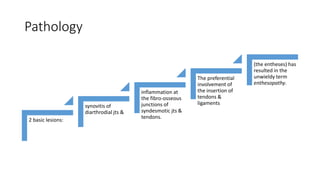
Pathology
2 basic lesions:
synovitis of
diarthrodial jts &
inflammation at
the fibro-osseous
junctions of
syndesmotic jts &
tendons.
The preferential
involvement of
the insertion of
tendons &
ligaments
(the entheses) has
resulted in the
unwieldy term
enthesopathy.
Synovitis of SI & vertebral facet joints causes destruction of articular
cartilage and peri-articular bone.
Costovertebral joints also frequently involved, leading to diminished
respiratory excursion.
When peripheral joints are affected the same changes occur.
• Inflammation of the fibro-osseous junctions affects the
- Ivdp,
- SI ligaments,
- symphysis pubis,
- manubrium sterni &
- the bony insertions of large tendons.
Pathological changes proceed in three stages:
(1) an inflammatory reaction with cell infiltration,
granulation tissue formation and erosion of adjacent bone;
(2) replacement of the granulation tissue by fibrous tissue; &
(3) ossification of the fibrous tissue, leading to ankylosis of
the joint.
Ossification across the surface of the disc gives rise to small
bony bridges or syndesmophytes linking adjacent vertebral
bodies.
If many vertebrae are involved the spine may become
absolutely rigid.
• Axial skeleton:
• Bilateral sacroiliitis—earliest symptom
• Associated morning stiffness
• Progressive spinal flexion deformities over life
• Ascending ankyloses from thoracic to entire
• “Chin-on-chest” deformity
• Hip involvement at young age—poor prognosis
• Enthesitis: inflammation of tendon insertion
Examination:
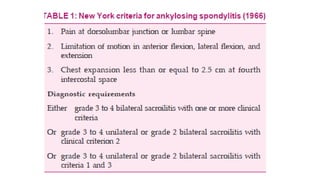
Chest expansion loss:
• Circumference at fourth rib space
• Max inspiration versus max expiration
• Normally over 5 cm
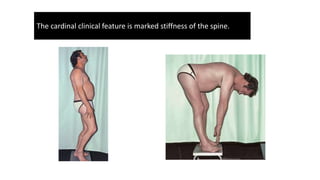
The cardinal clinical feature is marked stiffness of the spine.
■ Associated with higher risk for heterotopic ossification
- Hip hyperextension due to fixed pelvic deformity can lead to a higher
anterior dislocation rate.
Diagnostic criteria:
• More than 3 months of low back pain in someone
younger than age 45
• Definite x-ray or MRI sacroiliitis
The HLA-B27 test yields positive results in 90% to 95% of patients with
ankylosing spondylitis
• Ankylosing spondylitis is associated with HLA-B27, but the HLA-
B27test is not useful as a screening tool.
• Limitation of chest wall expansion is more specific.
• Radiographic changes
• Squaring of the vertebrae
• Vertical syndesmophytes
• “Bamboo spine”
• Autofusion of sacroiliac joints
• “Whiskering” of the enthesis
Extraskeletal issues:
• Uveitis—red, painful eye in 40%
• Colitis—5% to 10%; aortic insufficiency
• Pulmonary function tests: pulmonary restriction,
• chest excursion
• Pseudoarthrosis with potential for complete fracture and cord
damage from minor injury at the dorsal and lumbar spine junction.
This is also known as Anderson Lesion
Imaging
• X-rays
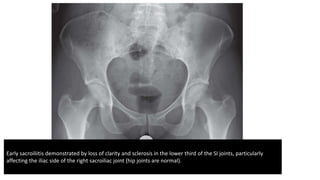
• The cardinal sign – and often the earliest – is erosion and fuzziness of
the sacroiliac joints.
• Later there may be peri-articular sclerosis, especially on the
iliac side of the joint and finally bony ankylosis.
Early sacroiliitis demonstrated by loss of clarity and sclerosis in the lower third of the SI joints, particularly
affecting the iliac side of the right sacroiliac joint (hip joints are normal).
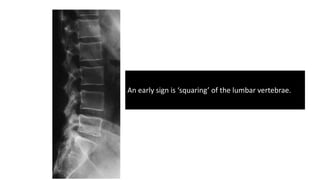
The earliest
vertebral change
is flattening of
the normal
anterior concavity
of the vertebral
body (‘squaring’).
An early sign is ‘squaring’ of the lumbar vertebrae.
• Later, ossification of the ligaments around the intervertebral discs
produces delicate bridges (syndesmophytes) between adjacent
vertebrae.
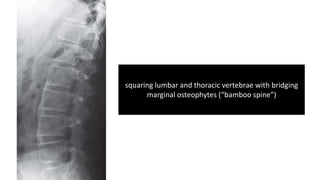
• Bridging at several levels gives the appearance of a ‘bamboo spine’.
squaring lumbar and thoracic vertebrae with bridging
marginal osteophytes (“bamboo spine”)
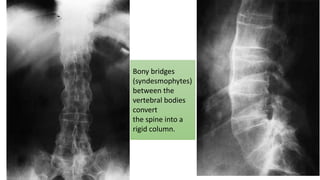
Bony bridges
(syndesmophytes)
between the
vertebral bodies
convert
the spine into a
rigid column.
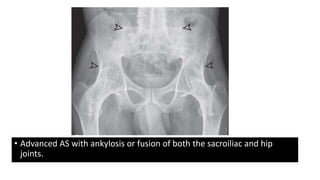
• Advanced AS with ankylosis or fusion of both the sacroiliac and hip
joints.
Radiological changes in sacroiliac joints
• one of the definite criteria for diagnosis of ankylosing spondylitis.
• Changes in sacroiliac joints develop slowly and can be graded from 0 to 4
(Calin 1993, Dhaon 1994)as below
• 0 Unequivocally normal
• 1 Possibly normal
• 2 Definite marginal sclerosis
• 3 Definite erosion and sclerosis
• 4 Complete obliteration and ankylosis
• PA view is better compared to AP view & oblique views for assessing
radiological changes at SI joints.
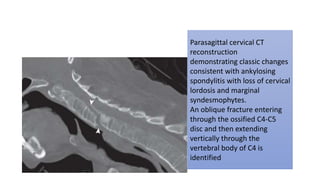
Parasagittal cervical CT
reconstruction
demonstrating classic changes
consistent with ankylosing
spondylitis with loss of cervical
lordosis and marginal
syndesmophytes.
An oblique fracture entering
through the ossified C4-C5
disc and then extending
vertically through the
vertebral body of C4 is
identified
Special investigations
• The ESR and CRP are usually elevated during active phases of the
disease.
• HLA-B27 is present in 95 per cent of cases.
• Serological tests for rheumatoid factor are usually negative
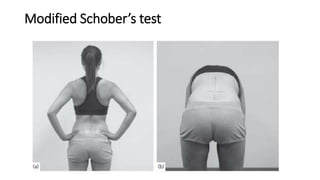
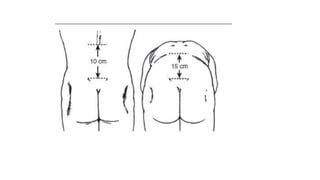
Modified Schober’s test
Treatment
• consists of:
• (1) general measures to maintain satisfactory posture and preserve
movement;
• (2) anti-inflammatory drugs to counteract pain and stiffness;
• (3) the use of TNF inhibitors for severe disease; and
• (4) operations to correct deformity or restore mobility
General measures
• Patients are encouraged to remain active and follow their normal
pursuits as far as possible.
• They should be taught how to maintain satisfactory posture and
urged to perform spinal extension exercises every day.
• Swimming, dancing and gymnastics are ideal forms of recreation.
• Rest and immobilization are contraindicated because they tend to
increase the general feeling of stiffness.
Non-steroidal anti-inflammatory drugs
• It is doubtful whether these drugs prevent or retard the progress to
ankylosis, but they do control pain and counteract soft-tissue stiffness,
thus making it possible to benefit from exercise and activity.
They may have to be continued for many years.
TNF inhibitors
• With the introduction of the TNF inhibitors it has become possible to
treat the underlying inflammatory processes active in AS.
• This can result in significant improvement in disease activity including
remission.
• These therapies are generally reserved for individuals who have failed
to be controlled with non-steroidal anti-inflammatory drugs.
SURGERY
• Significantly damaged hips can be treated by joint replacement, though this
seldom provides more than moderate mobility.
• Moreover, the incidence of infection is higher than usual and patients may
need prolonged rehabilitation.
• Deformity of the spine may be severe enough to warrant lumbar or cervical
osteotomy.
• These are difficult and potentially hazardous procedures; fortunately, with
improved activity and exercise programmes, they are seldom needed. If
spinal deformity is combined with hip stiffness, hip replacements
(permitting full extension) often suffice.
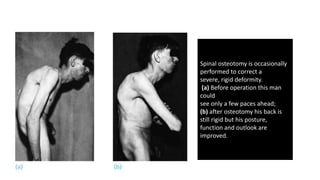
Spinal osteotomy is occasionally
performed to correct a
severe, rigid deformity.
(a) Before operation this man
could
see only a few paces ahead;
(b) after osteotomy his back is
still rigid but his posture,
function and outlook are
improved.
SUMMARY
• Diagnosis is easy in patients with spinal rigidity & typical deformities,
but it is often missed in those with early disease or unusual forms of
presentation.
• In over 10 per cent of cases the disease starts with an asymmetrical
inflammatory arthritis – usually of the hip, knee or ankle – and it may
be several years before back pain appears.
• Atypical onset is more common in women, who may show less
obvious changes in the sacroiliac joints.
• A history of AS in a close relative is strongly suggestive.
THANK U
• Miller
• Apley
• kulkarni

Ankylosing spondylitis

  • 1.
  • 2.
    Introduction • Ankylosing spondylitisis an inflammatory arthritis belonging to the group of seronegative spondyloarthropathy. • Two patients of ankylosing spondylitis were first described by Strumpell (1884) in his textbook. Pierre-Marie (1888), gave detailed description of ankylosing spondylitis. • Therefore, it is also known by the eponym of “Marie-Strumpell” disease
  • 3.
    • Etiology unknown;association with HLA-B27. Ankylosing spondylitis, Reiter’s disease & psoriatic arthritis characteristically test negative for rheumatoid factor; they have been grouped together as the ‘seronegative spondarthopathies’
  • 4.
    Male/female ratio 3: 1; aged 20 to 40 Most common in Northern European whites 90% HLA-B27 positive Insidious onset of back pain (spondylitis) in a patient younger than 40 - Improves with exercise, no better with rest, night pain
  • 5.
    Seronegative spondarthropathies are closelyasso. with the presence of HLAB27 on chromosome 6; Frequently used as a confirmatory test in patients suspected of having ankylosing spondylitis or Reiter’s disease, but it should not be regarded as a specific test because it is positive in about 8% of normal western Europeans.
  • 6.
    Pathology 2 basic lesions: synovitisof diarthrodial jts & inflammation at the fibro-osseous junctions of syndesmotic jts & tendons. The preferential involvement of the insertion of tendons & ligaments (the entheses) has resulted in the unwieldy term enthesopathy.
  • 7.
    Synovitis of SI& vertebral facet joints causes destruction of articular cartilage and peri-articular bone. Costovertebral joints also frequently involved, leading to diminished respiratory excursion. When peripheral joints are affected the same changes occur.
  • 8.
    • Inflammation ofthe fibro-osseous junctions affects the - Ivdp, - SI ligaments, - symphysis pubis, - manubrium sterni & - the bony insertions of large tendons.
  • 9.
    Pathological changes proceedin three stages: (1) an inflammatory reaction with cell infiltration, granulation tissue formation and erosion of adjacent bone; (2) replacement of the granulation tissue by fibrous tissue; & (3) ossification of the fibrous tissue, leading to ankylosis of the joint.
  • 10.
    Ossification across thesurface of the disc gives rise to small bony bridges or syndesmophytes linking adjacent vertebral bodies. If many vertebrae are involved the spine may become absolutely rigid.
  • 11.
    • Axial skeleton: •Bilateral sacroiliitis—earliest symptom • Associated morning stiffness • Progressive spinal flexion deformities over life • Ascending ankyloses from thoracic to entire • “Chin-on-chest” deformity • Hip involvement at young age—poor prognosis • Enthesitis: inflammation of tendon insertion
  • 12.
    Examination: Chest expansion loss: •Circumference at fourth rib space • Max inspiration versus max expiration • Normally over 5 cm
  • 13.
    The cardinal clinicalfeature is marked stiffness of the spine.
  • 14.
    ■ Associated withhigher risk for heterotopic ossification - Hip hyperextension due to fixed pelvic deformity can lead to a higher anterior dislocation rate.
  • 15.
    Diagnostic criteria: • Morethan 3 months of low back pain in someone younger than age 45 • Definite x-ray or MRI sacroiliitis The HLA-B27 test yields positive results in 90% to 95% of patients with ankylosing spondylitis
  • 16.
    • Ankylosing spondylitisis associated with HLA-B27, but the HLA- B27test is not useful as a screening tool. • Limitation of chest wall expansion is more specific.
  • 17.
    • Radiographic changes •Squaring of the vertebrae • Vertical syndesmophytes • “Bamboo spine” • Autofusion of sacroiliac joints • “Whiskering” of the enthesis
  • 18.
    Extraskeletal issues: • Uveitis—red,painful eye in 40% • Colitis—5% to 10%; aortic insufficiency • Pulmonary function tests: pulmonary restriction, • chest excursion
  • 19.
    • Pseudoarthrosis withpotential for complete fracture and cord damage from minor injury at the dorsal and lumbar spine junction. This is also known as Anderson Lesion
  • 20.
    Imaging • X-rays • Thecardinal sign – and often the earliest – is erosion and fuzziness of the sacroiliac joints. • Later there may be peri-articular sclerosis, especially on the iliac side of the joint and finally bony ankylosis.
  • 21.
    Early sacroiliitis demonstratedby loss of clarity and sclerosis in the lower third of the SI joints, particularly affecting the iliac side of the right sacroiliac joint (hip joints are normal).
  • 22.
    The earliest vertebral change isflattening of the normal anterior concavity of the vertebral body (‘squaring’).
  • 23.
    An early signis ‘squaring’ of the lumbar vertebrae.
  • 24.
    • Later, ossificationof the ligaments around the intervertebral discs produces delicate bridges (syndesmophytes) between adjacent vertebrae. • Bridging at several levels gives the appearance of a ‘bamboo spine’.
  • 25.
    squaring lumbar andthoracic vertebrae with bridging marginal osteophytes (“bamboo spine”)
  • 26.
    Bony bridges (syndesmophytes) between the vertebralbodies convert the spine into a rigid column.
  • 27.
    • Advanced ASwith ankylosis or fusion of both the sacroiliac and hip joints.
  • 28.
    Radiological changes insacroiliac joints • one of the definite criteria for diagnosis of ankylosing spondylitis. • Changes in sacroiliac joints develop slowly and can be graded from 0 to 4 (Calin 1993, Dhaon 1994)as below • 0 Unequivocally normal • 1 Possibly normal • 2 Definite marginal sclerosis • 3 Definite erosion and sclerosis • 4 Complete obliteration and ankylosis • PA view is better compared to AP view & oblique views for assessing radiological changes at SI joints.
  • 30.
    Parasagittal cervical CT reconstruction demonstratingclassic changes consistent with ankylosing spondylitis with loss of cervical lordosis and marginal syndesmophytes. An oblique fracture entering through the ossified C4-C5 disc and then extending vertically through the vertebral body of C4 is identified
  • 31.
    Special investigations • TheESR and CRP are usually elevated during active phases of the disease. • HLA-B27 is present in 95 per cent of cases. • Serological tests for rheumatoid factor are usually negative
  • 32.
  • 34.
    Treatment • consists of: •(1) general measures to maintain satisfactory posture and preserve movement; • (2) anti-inflammatory drugs to counteract pain and stiffness; • (3) the use of TNF inhibitors for severe disease; and • (4) operations to correct deformity or restore mobility
  • 35.
    General measures • Patientsare encouraged to remain active and follow their normal pursuits as far as possible. • They should be taught how to maintain satisfactory posture and urged to perform spinal extension exercises every day. • Swimming, dancing and gymnastics are ideal forms of recreation. • Rest and immobilization are contraindicated because they tend to increase the general feeling of stiffness.
  • 36.
    Non-steroidal anti-inflammatory drugs •It is doubtful whether these drugs prevent or retard the progress to ankylosis, but they do control pain and counteract soft-tissue stiffness, thus making it possible to benefit from exercise and activity. They may have to be continued for many years.
  • 37.
    TNF inhibitors • Withthe introduction of the TNF inhibitors it has become possible to treat the underlying inflammatory processes active in AS. • This can result in significant improvement in disease activity including remission. • These therapies are generally reserved for individuals who have failed to be controlled with non-steroidal anti-inflammatory drugs.
  • 38.
    SURGERY • Significantly damagedhips can be treated by joint replacement, though this seldom provides more than moderate mobility. • Moreover, the incidence of infection is higher than usual and patients may need prolonged rehabilitation. • Deformity of the spine may be severe enough to warrant lumbar or cervical osteotomy. • These are difficult and potentially hazardous procedures; fortunately, with improved activity and exercise programmes, they are seldom needed. If spinal deformity is combined with hip stiffness, hip replacements (permitting full extension) often suffice.
  • 39.
    Spinal osteotomy isoccasionally performed to correct a severe, rigid deformity. (a) Before operation this man could see only a few paces ahead; (b) after osteotomy his back is still rigid but his posture, function and outlook are improved.
  • 40.
    SUMMARY • Diagnosis iseasy in patients with spinal rigidity & typical deformities, but it is often missed in those with early disease or unusual forms of presentation. • In over 10 per cent of cases the disease starts with an asymmetrical inflammatory arthritis – usually of the hip, knee or ankle – and it may be several years before back pain appears. • Atypical onset is more common in women, who may show less obvious changes in the sacroiliac joints. • A history of AS in a close relative is strongly suggestive.
  • 41.
    THANK U • Miller •Apley • kulkarni

Editor's Notes

  • #14 A-This patient manages to stand upright by keeping his knees slightly flexed (b) It looks as if he can bend down to touch his toes, but his back is rigid and all the movement takes place at his hips.
  • #33 The modified Schober’s test can be used to evaluate the contribution of the lumbar spine to total flexion. Draw a horizontal line between the posterior superior iliac spines, which lie beneath the skin dimples, & a vertical line in the midline which extends 10 cm above and 5 cm below this level. When the patient bends forwards, the midline marking should increase in length by 5–7 cm
  • #34 Modified Schober’s test The modified Schober’s test can be used to evaluate the contribution of the lumbar spine to total flexion. Draw a horizontal line between the posterior superior iliac spines, which lie beneath the skin dimples, and a vertical line in the midline which extends 10 cm above and 5 cm below this level. When the patient bends forwards, the midline marking should increase in length by 5–7 cm