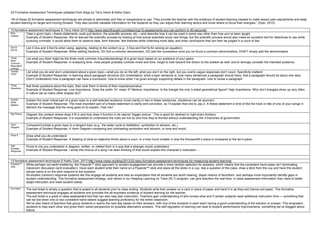
22 Formative Assessment Techniques (adapted from blogs by Terry Heick & Kathy Dyer)
“All of these 22 formative assessment techniques are simple to administer and free or inexpensive to use. They provide the teacher with the evidence of student learning needed to make lesson plan adjustments and keep
student learning on target and moving forward. They also provide valuable information for the students so they can adjust their learning tactics and know where to focus their energies.” (Dyer, 2013)
10 formative assessment techniques © Terry Heick 2013 http://www.teachthought.com/teaching/10-assessments-you-can-perform-in-90-seconds/
New
Clothes
Take a given topic—thesis statements, push-pull factors, the scientific process, etc.—and describe how it can be used in some way other than how you’ve been taught.
Example of Student Response: We’ve learned the scientific process by looking at how actual scientists study new things, but the scientific process would also make an excellent tool for detectives to use while
pursuing criminals. It would allow them to observe data, form theories, test theories while collecting more data, and draw conclusions that can then be judged in a court of law.
Dos &
Don’ts
List 3 Dos and 3 Don’ts when using, applying, relating to the content (e.g., 3 Dos and Don’ts for solving an equation).
Example of Student Response: When adding fractions, DO find a common denominator, DO add the numerators once you’ve found a common denominators, DON’T simply add the denominators
Three
Most
Common
Misunderst
andings
List what you think might be the three most common misunderstandings of a given topic based on an audience of your peers.
Example of Student Response: In analyzing tone, most people probably confuse mood and tone, forget to look beyond the diction to the subtext as well, and to strongly consider the intended audience.
Yes/No
Chart
List what you do and don’t understand about a given topic—what you do on the left, what you don’t on the right, but you overly-vague responses don’t count. Specificity matters!
Example of Student Response: In learning about paragraph structure (Do Understand): what a topic sentence is, how many sentences a paragraph should have, that a paragraph should be about one idea;
(Don’t Understand) how a paragraph can have a conclusion, how to know when I’ve given enough supporting details in the paragraph, how to revise a paragraph
Three
Questions
Ask three questions about the topic, then rank them in terms of their importance/value.
Example of Student Response: Low Importance: Does the prefix “tri” mean 3? Medium Importance: Is the triangle the only 3-sided geometrical figure? High Importance: Why don’t triangles show up very often
in nature (as so many other shapes do)?
Explain
What
Matters
Explain the most critical part of a given topic to a self-selected audience (must clarify) in two or fewer sentences. (Audience can be anyone!)
Example of Student Response: The most important part of a thesis statement is clarity and conviction, so I’ll explain that one to Jay-Z: A thesis statement is kind of like the hook or title of one of your songs–it
delivers the message that the song goes on to explain. Feel me?
Big Picture Diagram the context–where does it fit in and how does it function in its natural “bigger picture.” This is good for abstract or right-brain thinkers.
Example of Student Response: It is impossible to understand the rules we live by and how they’re formed without understanding the 3 branches of government.
Venn
Diagram
Compare/Contrast a given topic to a tangent topic (e.g., the water cycle to distillation, symbolism to allusion, etc.)
Example of Student Response: A Venn Diagram comparing and contrasting symbolism and allusion, or tone and mood.
Draw It Draw what you do understand.
Example of Student Response: A drawing of what an adjective thinks about a noun, or a how much smaller in size the thousandth’s place is compared to the ten’s place.
Self-
Directed
Response
Prove to me you understand in diagram, written, or related form in a way that a stranger would understand.
Example of Student Response: I wrote this chorus of a song I’ve been thinking of that would explain this character’s motivation….
12 formative assessment techniques © Kathy Dyer, 2013 http://www.nwea.org/blog/2013/22-easy-formative-assessment-techniques-for-measuring-student-learning/
Popsicle™
stick.
While perhaps not earth-shattering, the Popsicle™ stick approach to student engagement can provide a more random selection for answers, which means that the consistent hand-raiser isn’t dominating
classroom discussion (and evaluation). Have each student write their name on a Popsicle™ stick and place all the sticks in a cup. Ask a question of the class, draw a stick from the cup and have the student
whose name is on the stick respond to the question.
All-student (random) response systems like this engage all students and sets an expectation that all students are worth hearing, dispel notions of favoritism, and perhaps more importantly identify gaps in
student understanding. This formative assessment strategy, and others in our Keeping Learning on Track (KLT) program, can give teachers the real-time, in class assessment information they need to better
adapt instruction and meet student needs.
Exit ticket The exit ticket is simply a question that is posed to all students prior to class ending. Students write their answer on a card or piece of paper and hand it in as they exit (hence exit pass). This formative
assessment technique engages all students and provides the all-important evidence of student learning for the teacher.
The exit ticket is a great in class assessment tool that can also help plan instruction. Teachers gain understanding of who knows what and if certain subjects need additional instruction time — something that
can be lost when one or two consistent hand-raisers suggest learning proficiency for the entire classroom.
We’ve also heard of teachers that group students in teams the next day based on their answers, with one of the students in each team having a good understanding of the solution or answer. This empowers
students to help each other and gives them varied perspective on possible alternative answers. This self-regulation of learning can lead to student performance improvements, something we’ve blogged about
before.
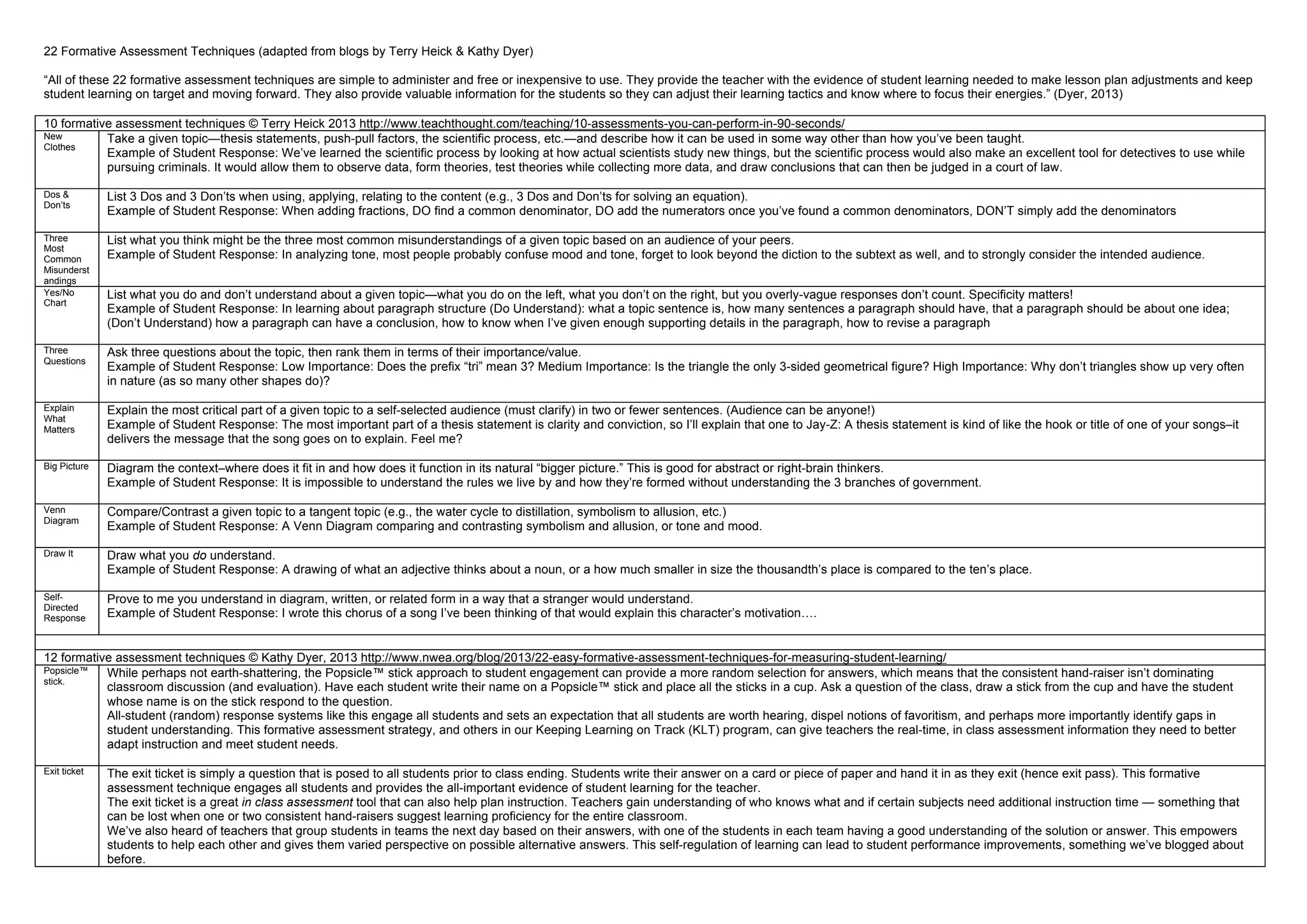
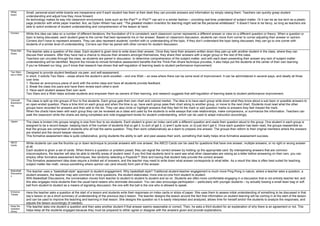
White
board
Small, personal-sized white boards are inexpensive and if each student has them at their desk they can provide answers and information by simply raising them. Teachers can quickly grasp student
understanding and adjust how they move forward.
As technology makes its way into classroom environment, tools such as the iPad™ or iPod™ can act in a similar fashion – providing real-time understand of subject matter. Or it can be as low tech as a plastic
page protector with white paper inserted. But, as Dylan Wiliam has said, “The greatest modern invention for learning might well be the personal whiteboard.” It doesn’t have to be fancy, so long as teachers are
able to solicit evidence of student understanding and comprehension of the lesson at hand.
Corners While this idea can take on a number of different iterations, the foundation of it is consistent; each classroom corner represents a different answer or view on a different question or theory. When a question or
topic is being discussed, each student goes to the corner that best represents his or her answer. Based on classroom discussion, students can move from corner to corner adjusting their answer or opinion.
Corners don’t have to represent answers. They can also represent students’ comfort with or understanding of the topic. If they don’t understand the topic being discussed, they can go to one corner with
students of a similar level of understanding. Corners can then be paired with other corners for student discussion.
Think-Pair-
Share
The teacher asks a question of the class. Each student is given time to write down their answer. Once they have their answers written down they pair-up with another student in the class, where they can
discuss their answers. After they have had a chance to discuss their answers amongst themselves, they share their answers with a larger group or the rest of the class.
Teachers can circulate through the class, as students are paired in discussion, to determine comprehension of the subject matter, and with each team presenting their answer any lack of subject matter
understanding will be identified. Beyond the minute-to-minute formative assessment benefits that the Think-Pair-Share technique provides, it also helps put the students at the center of their own learning.
If you’ve followed our blog, you’ll know that research has shown that self-regulation of learning leads to student performance improvement.
Two Stars
and a Wish
Designed to provide student feedback via peer- and self-assessment.
In short, it solicits Two Stars – areas where the student’s work excelled – and one Wish – an area where there can be some level of improvement. It can be administered in several ways, and ideally all three
over time:
1. Review an anonymous piece of work with the entire class and have all students provide feedback
2. Break the class into pairs and have them review each other’s work
3. Have each student assess their own work
Two Stars and a Wish helps activate students and empower them as owners of their learning, and research suggests that self-regulation of learning leads to student performance improvement.
Carousel
Brainstorm
ing
The class is split up into groups of four to five students. Each group gets their own chart and colored marker. The idea is to have each group write down what they know about a sub topic or possible answers to
an open-ended question. Place a time limit on each group and when the time is up, have each group pass their chart along to another group, or move to the next chart. Students must read what the other
groups have recorded for answers and then add to the list. They can also circle or highlight answers that they feel hit the mark or add question marks to answers they feel missed the mark.
When the charts have been with each group they can be reviewed as a class and used by the students to write essays that note relationships, make comparisons, or summarize the information. Teachers can
walk the classroom while the charts are being completed and note engagement levels for student understanding, which can be used to adapt instruction accordingly.
Jigsaw The class is broken into groups ranging in size from four to six students. Each student is given an index card with a different question and reads their question aloud to the group. One student in each group is
assigned to be a record keeper, keeping track of the number of students that a) get it, b) sort of get it, c) aren’t quite sure, or d) just don’t get it. Once each question has been read, the groups reassemble so
that the groups are comprised of students who all had the same question. They then work collaboratively as a team to prepare one answer. The groups then reform to their original members where the answers
are shared and the record keeper rescores.
This formative assessment idea is quite collaborative, giving students the ability to self- and peer-assess their work, something that really helps drive formative assessment success.
ABCD
Cards
While students can use the thumbs up or down technique to provide answers with one answer, the ABCD Cards can be used for questions that have one answer, multiple answers, or no right or wrong answer
at all.
Each student is given a set of cards. When there’s a question or problem posed, they can signal the correct answer by holding up the appropriate card. By interspersing answers that are common
misconceptions, the teacher will also be able to identify areas of student need. If you find that students tend to want see what other classmates are raising as a letter before answering on their own, you can
employ other formative assessment techniques, like randomly selecting a Popsicle™ Stick and having that student help provide the correct answer.
This formative assessment idea does require a limited set of answers, and the teacher may need to write down what answer corresponds to what letter. As a result this idea is often best suited for teaching
subject matter like math, versus something where opinion can (and should) form part of the answer.
Basketball
Discussion
s
The teacher uses a “basketball-style” approach to student engagement. Why basketball style? Traditional student-teacher engagement is much more Ping-Pong in nature, where a teacher asks a question, a
student answers, the teacher may add comment or more questions, the student elaborates; more one-on-one from student to student.
With Basketball Discussions, the conversation moves from teacher to student to student to student and so on. Students are often more comfortable engaging in a discussion that is not entirely teacher led, and
this also engages more students than the usual hand-raisers who dominate discussion. You can also encourage participation – particularly with younger students – by actually tossing a small bean bag or soft
ball from student to student as a means of signaling discussion; the one with the ball is the one who is allowed to speak.
Entrance
Tickets
Here the teacher asks a question at the start of a lesson and students write their responses on index cards or strips of paper. She uses them to assess initial understanding of something to be discussed in that
day’s lesson or as a short summary of understanding of the previous day’s lesson. The teacher designs the lesson around the fact that information on student learning will be coming in at the start of the lesson
and can be used to improve the teaching and learning in that lesson. She designs the question so it is easily interpreted and analyzed, allows time for herself and/or the students to analyze the responses, and
adjusts the lesson accordingly (if needed).
Keep the
Question
Going
Yhe teacher asks one student a question and then asks another student if that answer seems reasonable or correct. Then, he asks a third student for an explanation of why there is an agreement or not. This
helps keep all the students engaged because they must be prepared to either agree or disagree with the answers given and provide explanations.

22 formative assessment techniques

  • 1.
    22 Formative AssessmentTechniques (adapted from blogs by Terry Heick & Kathy Dyer) “All of these 22 formative assessment techniques are simple to administer and free or inexpensive to use. They provide the teacher with the evidence of student learning needed to make lesson plan adjustments and keep student learning on target and moving forward. They also provide valuable information for the students so they can adjust their learning tactics and know where to focus their energies.” (Dyer, 2013) 10 formative assessment techniques © Terry Heick 2013 http://www.teachthought.com/teaching/10-assessments-you-can-perform-in-90-seconds/ New Clothes Take a given topic—thesis statements, push-pull factors, the scientific process, etc.—and describe how it can be used in some way other than how you’ve been taught. Example of Student Response: We’ve learned the scientific process by looking at how actual scientists study new things, but the scientific process would also make an excellent tool for detectives to use while pursuing criminals. It would allow them to observe data, form theories, test theories while collecting more data, and draw conclusions that can then be judged in a court of law. Dos & Don’ts List 3 Dos and 3 Don’ts when using, applying, relating to the content (e.g., 3 Dos and Don’ts for solving an equation). Example of Student Response: When adding fractions, DO find a common denominator, DO add the numerators once you’ve found a common denominators, DON’T simply add the denominators Three Most Common Misunderst andings List what you think might be the three most common misunderstandings of a given topic based on an audience of your peers. Example of Student Response: In analyzing tone, most people probably confuse mood and tone, forget to look beyond the diction to the subtext as well, and to strongly consider the intended audience. Yes/No Chart List what you do and don’t understand about a given topic—what you do on the left, what you don’t on the right, but you overly-vague responses don’t count. Specificity matters! Example of Student Response: In learning about paragraph structure (Do Understand): what a topic sentence is, how many sentences a paragraph should have, that a paragraph should be about one idea; (Don’t Understand) how a paragraph can have a conclusion, how to know when I’ve given enough supporting details in the paragraph, how to revise a paragraph Three Questions Ask three questions about the topic, then rank them in terms of their importance/value. Example of Student Response: Low Importance: Does the prefix “tri” mean 3? Medium Importance: Is the triangle the only 3-sided geometrical figure? High Importance: Why don’t triangles show up very often in nature (as so many other shapes do)? Explain What Matters Explain the most critical part of a given topic to a self-selected audience (must clarify) in two or fewer sentences. (Audience can be anyone!) Example of Student Response: The most important part of a thesis statement is clarity and conviction, so I’ll explain that one to Jay-Z: A thesis statement is kind of like the hook or title of one of your songs–it delivers the message that the song goes on to explain. Feel me? Big Picture Diagram the context–where does it fit in and how does it function in its natural “bigger picture.” This is good for abstract or right-brain thinkers. Example of Student Response: It is impossible to understand the rules we live by and how they’re formed without understanding the 3 branches of government. Venn Diagram Compare/Contrast a given topic to a tangent topic (e.g., the water cycle to distillation, symbolism to allusion, etc.) Example of Student Response: A Venn Diagram comparing and contrasting symbolism and allusion, or tone and mood. Draw It Draw what you do understand. Example of Student Response: A drawing of what an adjective thinks about a noun, or a how much smaller in size the thousandth’s place is compared to the ten’s place. Self- Directed Response Prove to me you understand in diagram, written, or related form in a way that a stranger would understand. Example of Student Response: I wrote this chorus of a song I’ve been thinking of that would explain this character’s motivation…. 12 formative assessment techniques © Kathy Dyer, 2013 http://www.nwea.org/blog/2013/22-easy-formative-assessment-techniques-for-measuring-student-learning/ Popsicle™ stick. While perhaps not earth-shattering, the Popsicle™ stick approach to student engagement can provide a more random selection for answers, which means that the consistent hand-raiser isn’t dominating classroom discussion (and evaluation). Have each student write their name on a Popsicle™ stick and place all the sticks in a cup. Ask a question of the class, draw a stick from the cup and have the student whose name is on the stick respond to the question. All-student (random) response systems like this engage all students and sets an expectation that all students are worth hearing, dispel notions of favoritism, and perhaps more importantly identify gaps in student understanding. This formative assessment strategy, and others in our Keeping Learning on Track (KLT) program, can give teachers the real-time, in class assessment information they need to better adapt instruction and meet student needs. Exit ticket The exit ticket is simply a question that is posed to all students prior to class ending. Students write their answer on a card or piece of paper and hand it in as they exit (hence exit pass). This formative assessment technique engages all students and provides the all-important evidence of student learning for the teacher. The exit ticket is a great in class assessment tool that can also help plan instruction. Teachers gain understanding of who knows what and if certain subjects need additional instruction time — something that can be lost when one or two consistent hand-raisers suggest learning proficiency for the entire classroom. We’ve also heard of teachers that group students in teams the next day based on their answers, with one of the students in each team having a good understanding of the solution or answer. This empowers students to help each other and gives them varied perspective on possible alternative answers. This self-regulation of learning can lead to student performance improvements, something we’ve blogged about before.
  • 2.
    White board Small, personal-sized whiteboards are inexpensive and if each student has them at their desk they can provide answers and information by simply raising them. Teachers can quickly grasp student understanding and adjust how they move forward. As technology makes its way into classroom environment, tools such as the iPad™ or iPod™ can act in a similar fashion – providing real-time understand of subject matter. Or it can be as low tech as a plastic page protector with white paper inserted. But, as Dylan Wiliam has said, “The greatest modern invention for learning might well be the personal whiteboard.” It doesn’t have to be fancy, so long as teachers are able to solicit evidence of student understanding and comprehension of the lesson at hand. Corners While this idea can take on a number of different iterations, the foundation of it is consistent; each classroom corner represents a different answer or view on a different question or theory. When a question or topic is being discussed, each student goes to the corner that best represents his or her answer. Based on classroom discussion, students can move from corner to corner adjusting their answer or opinion. Corners don’t have to represent answers. They can also represent students’ comfort with or understanding of the topic. If they don’t understand the topic being discussed, they can go to one corner with students of a similar level of understanding. Corners can then be paired with other corners for student discussion. Think-Pair- Share The teacher asks a question of the class. Each student is given time to write down their answer. Once they have their answers written down they pair-up with another student in the class, where they can discuss their answers. After they have had a chance to discuss their answers amongst themselves, they share their answers with a larger group or the rest of the class. Teachers can circulate through the class, as students are paired in discussion, to determine comprehension of the subject matter, and with each team presenting their answer any lack of subject matter understanding will be identified. Beyond the minute-to-minute formative assessment benefits that the Think-Pair-Share technique provides, it also helps put the students at the center of their own learning. If you’ve followed our blog, you’ll know that research has shown that self-regulation of learning leads to student performance improvement. Two Stars and a Wish Designed to provide student feedback via peer- and self-assessment. In short, it solicits Two Stars – areas where the student’s work excelled – and one Wish – an area where there can be some level of improvement. It can be administered in several ways, and ideally all three over time: 1. Review an anonymous piece of work with the entire class and have all students provide feedback 2. Break the class into pairs and have them review each other’s work 3. Have each student assess their own work Two Stars and a Wish helps activate students and empower them as owners of their learning, and research suggests that self-regulation of learning leads to student performance improvement. Carousel Brainstorm ing The class is split up into groups of four to five students. Each group gets their own chart and colored marker. The idea is to have each group write down what they know about a sub topic or possible answers to an open-ended question. Place a time limit on each group and when the time is up, have each group pass their chart along to another group, or move to the next chart. Students must read what the other groups have recorded for answers and then add to the list. They can also circle or highlight answers that they feel hit the mark or add question marks to answers they feel missed the mark. When the charts have been with each group they can be reviewed as a class and used by the students to write essays that note relationships, make comparisons, or summarize the information. Teachers can walk the classroom while the charts are being completed and note engagement levels for student understanding, which can be used to adapt instruction accordingly. Jigsaw The class is broken into groups ranging in size from four to six students. Each student is given an index card with a different question and reads their question aloud to the group. One student in each group is assigned to be a record keeper, keeping track of the number of students that a) get it, b) sort of get it, c) aren’t quite sure, or d) just don’t get it. Once each question has been read, the groups reassemble so that the groups are comprised of students who all had the same question. They then work collaboratively as a team to prepare one answer. The groups then reform to their original members where the answers are shared and the record keeper rescores. This formative assessment idea is quite collaborative, giving students the ability to self- and peer-assess their work, something that really helps drive formative assessment success. ABCD Cards While students can use the thumbs up or down technique to provide answers with one answer, the ABCD Cards can be used for questions that have one answer, multiple answers, or no right or wrong answer at all. Each student is given a set of cards. When there’s a question or problem posed, they can signal the correct answer by holding up the appropriate card. By interspersing answers that are common misconceptions, the teacher will also be able to identify areas of student need. If you find that students tend to want see what other classmates are raising as a letter before answering on their own, you can employ other formative assessment techniques, like randomly selecting a Popsicle™ Stick and having that student help provide the correct answer. This formative assessment idea does require a limited set of answers, and the teacher may need to write down what answer corresponds to what letter. As a result this idea is often best suited for teaching subject matter like math, versus something where opinion can (and should) form part of the answer. Basketball Discussion s The teacher uses a “basketball-style” approach to student engagement. Why basketball style? Traditional student-teacher engagement is much more Ping-Pong in nature, where a teacher asks a question, a student answers, the teacher may add comment or more questions, the student elaborates; more one-on-one from student to student. With Basketball Discussions, the conversation moves from teacher to student to student to student and so on. Students are often more comfortable engaging in a discussion that is not entirely teacher led, and this also engages more students than the usual hand-raisers who dominate discussion. You can also encourage participation – particularly with younger students – by actually tossing a small bean bag or soft ball from student to student as a means of signaling discussion; the one with the ball is the one who is allowed to speak. Entrance Tickets Here the teacher asks a question at the start of a lesson and students write their responses on index cards or strips of paper. She uses them to assess initial understanding of something to be discussed in that day’s lesson or as a short summary of understanding of the previous day’s lesson. The teacher designs the lesson around the fact that information on student learning will be coming in at the start of the lesson and can be used to improve the teaching and learning in that lesson. She designs the question so it is easily interpreted and analyzed, allows time for herself and/or the students to analyze the responses, and adjusts the lesson accordingly (if needed). Keep the Question Going Yhe teacher asks one student a question and then asks another student if that answer seems reasonable or correct. Then, he asks a third student for an explanation of why there is an agreement or not. This helps keep all the students engaged because they must be prepared to either agree or disagree with the answers given and provide explanations.