The Role of Economic Evaluation and
Cost-Effectiveness in Program Science
Aslam H. Anis, PhD, FCAHS
CAHR Ancillary Program Science Session
Thursday, April 20, 2015
2:30 pm – 3:00 pm
Metro Toronto Convention Centre, Toronto, Ontario
Economic Evaluation: Rationale
• Scarcity of resources
– Not enough people, time, facilities or dollars
to satisfy all wants or implement all beneficial
health activities.
• Maximize Benefits
– Must use health resources efficiently to
maximize benefits from health activities
2
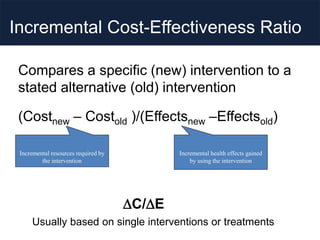
Incremental Cost-Effectiveness Ratio
Compares a specific (new) intervention to a
stated alternative (old) intervention
(Costnew – Costold )/(Effectsnew –Effectsold)
Incremental resources required by
the intervention
Incremental health effects gained
by using the intervention
C/E
Usually based on single interventions or treatments
What if health activity is multifaceted?
• Involves the application of acquired scientific
knowledge to improve
– program design and delivery
– system level logistics including complex systems
– implementation of guidelines and best practices
• Requires estimation of both program level and
system level costs and externalities
• Allocative and distributional efficiency i.e.
equity
4
In the context of HIV
• Involves approaches to maximize return on
investments in HIV prevention efforts (World
Bank):
– Where do new HIV infections come from?
• Identifying at risk populations, targeted testing
– What interventions do we have?
• beyond treatment to improve adherence and
effectiveness
– How do we implement, monitor and evaluate
these interventions?
5
Alternative Expressions
• Project Appraisal
• Program Evaluation
• Health Technology Assessment
• Systematic review and Implementation
• Program Science
Making Informed Decisions
6
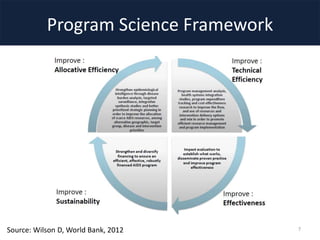
Program Science Framework
7Source: Wilson D, World Bank, 2012
8
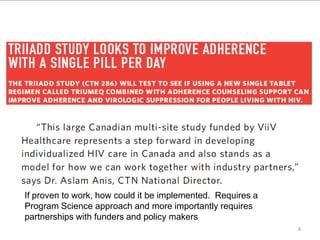
If proven to work, how could it be implemented. Requires a
Program Science approach and more importantly requires
partnerships with funders and policy makers
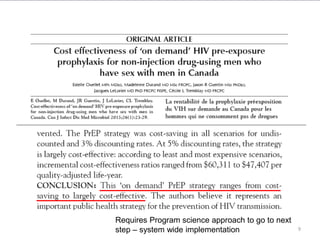
9
Requires Program science approach to go to next
step – system wide implementation
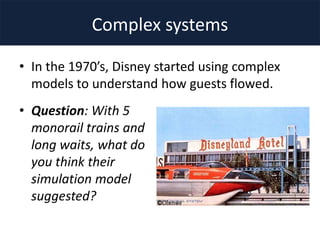
Complex systems
• In the 1970’s, Disney started using complex
models to understand how guests flowed.
• Question: With 5
monorail trains and
long waits, what do
you think their
simulation model
suggested?
Complex systems
• Answer: Remove 1
train to decrease
waits and improve
travel time.
And it worked.
Complexity in healthcare
• Our healthcare systems are complex:
– Many patients
– Multiple resources
– Different “paths”
– Numerous variables
• We can learn from Disney, from other
industries, and from other healthcare systems
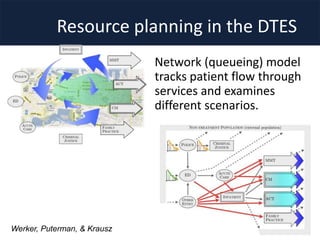
Resource planning in the DTES
Network (queueing) model
tracks patient flow through
services and examines
different scenarios.
Werker, Puterman, & Krausz
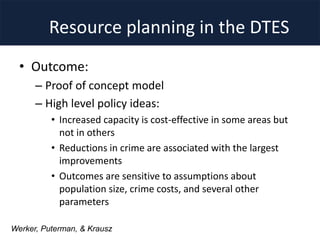
Resource planning in the DTES
Werker, Puterman, & Krausz
• Outcome:
– Proof of concept model
– High level policy ideas:
• Increased capacity is cost-effective in some areas but
not in others
• Reductions in crime are associated with the largest
improvements
• Outcomes are sensitive to assumptions about
population size, crime costs, and several other
parameters
PBMA: Program Budgeting Marginal Analysis
• Budgeting in government often a zero sum game
• PBMA is an adaptation of decision analytic
techniques to consider both disinvestment or
contraction from low benefit services and
reinvestment or expansion into higher benefit ones
• Marginal analysis that can evaluate incremental
changes in outcomes e.g. costs, benefits, other when
resources within a program are increased, decreased
or deployed in different ways
15
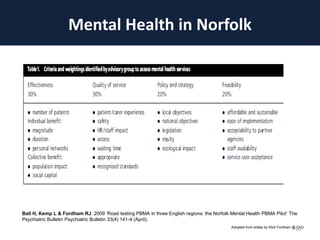
Mental Health in Norfolk
Ball H, Kemp L & Fordham RJ. 2009 ‘Road testing PBMA in three English regions: the Norfolk Mental Health PBMA Pilot’ The
Psychiatric Bulletin Psychiatric Bulletin 33(4) 141-4 (April).
Adopted from slides by Rick Fordham @ EAU
16
MCDA: Multi-Criteria Decision Analysis
• MCDA
– Based on economics, operations research, or other
quantitative decision making approaches
– Seeks to improve/optimize more than one measure,
e.g.,
• Cost ↓
• Quality ↑
• Room/bed/resource utilization ↓
• Patient satisfaction ↑
• Practical approach that reflects relative priorities
• The process can be open, inclusive and
deliberative by engaging key stakeholders
17
Alternative Expressions
• Project Appraisal
• Program Evaluation
• Health Technology Assessment
• Systematic review and Implementation
• Program Science
• PBMA
• MCDA
Making Informed Decisions
18
Concluding remarks
• Have covered a lot of ground
– System comparisons in terms of outcomes
– Performance of health system
– Access issues
• Systems Change
• Health Care Quality
• Program Science is an approach that calls on all of the
above tools
• Lots of opportunity to collaborate amongst disciplines
• Unlike typical Economist – purveyors of the dismal
science, I feel optimistic about Program Science!

The Role of Economic Evaluation and Cost-Effectiveness in Program Science

  • 1.
    The Role ofEconomic Evaluation and Cost-Effectiveness in Program Science Aslam H. Anis, PhD, FCAHS CAHR Ancillary Program Science Session Thursday, April 20, 2015 2:30 pm – 3:00 pm Metro Toronto Convention Centre, Toronto, Ontario
  • 2.
    Economic Evaluation: Rationale •Scarcity of resources – Not enough people, time, facilities or dollars to satisfy all wants or implement all beneficial health activities. • Maximize Benefits – Must use health resources efficiently to maximize benefits from health activities 2
  • 3.
    Incremental Cost-Effectiveness Ratio Comparesa specific (new) intervention to a stated alternative (old) intervention (Costnew – Costold )/(Effectsnew –Effectsold) Incremental resources required by the intervention Incremental health effects gained by using the intervention C/E Usually based on single interventions or treatments
  • 4.
    What if healthactivity is multifaceted? • Involves the application of acquired scientific knowledge to improve – program design and delivery – system level logistics including complex systems – implementation of guidelines and best practices • Requires estimation of both program level and system level costs and externalities • Allocative and distributional efficiency i.e. equity 4
  • 5.
    In the contextof HIV • Involves approaches to maximize return on investments in HIV prevention efforts (World Bank): – Where do new HIV infections come from? • Identifying at risk populations, targeted testing – What interventions do we have? • beyond treatment to improve adherence and effectiveness – How do we implement, monitor and evaluate these interventions? 5
  • 6.
    Alternative Expressions • ProjectAppraisal • Program Evaluation • Health Technology Assessment • Systematic review and Implementation • Program Science Making Informed Decisions 6
  • 7.
    Program Science Framework 7Source:Wilson D, World Bank, 2012
  • 8.
    8 If proven towork, how could it be implemented. Requires a Program Science approach and more importantly requires partnerships with funders and policy makers
  • 9.
    9 Requires Program scienceapproach to go to next step – system wide implementation
  • 10.
    Complex systems • Inthe 1970’s, Disney started using complex models to understand how guests flowed. • Question: With 5 monorail trains and long waits, what do you think their simulation model suggested?
  • 11.
    Complex systems • Answer:Remove 1 train to decrease waits and improve travel time. And it worked.
  • 12.
    Complexity in healthcare •Our healthcare systems are complex: – Many patients – Multiple resources – Different “paths” – Numerous variables • We can learn from Disney, from other industries, and from other healthcare systems
  • 13.
    Resource planning inthe DTES Network (queueing) model tracks patient flow through services and examines different scenarios. Werker, Puterman, & Krausz
  • 14.
    Resource planning inthe DTES Werker, Puterman, & Krausz • Outcome: – Proof of concept model – High level policy ideas: • Increased capacity is cost-effective in some areas but not in others • Reductions in crime are associated with the largest improvements • Outcomes are sensitive to assumptions about population size, crime costs, and several other parameters
  • 15.
    PBMA: Program BudgetingMarginal Analysis • Budgeting in government often a zero sum game • PBMA is an adaptation of decision analytic techniques to consider both disinvestment or contraction from low benefit services and reinvestment or expansion into higher benefit ones • Marginal analysis that can evaluate incremental changes in outcomes e.g. costs, benefits, other when resources within a program are increased, decreased or deployed in different ways 15
  • 16.
    Mental Health inNorfolk Ball H, Kemp L & Fordham RJ. 2009 ‘Road testing PBMA in three English regions: the Norfolk Mental Health PBMA Pilot’ The Psychiatric Bulletin Psychiatric Bulletin 33(4) 141-4 (April). Adopted from slides by Rick Fordham @ EAU 16
  • 17.
    MCDA: Multi-Criteria DecisionAnalysis • MCDA – Based on economics, operations research, or other quantitative decision making approaches – Seeks to improve/optimize more than one measure, e.g., • Cost ↓ • Quality ↑ • Room/bed/resource utilization ↓ • Patient satisfaction ↑ • Practical approach that reflects relative priorities • The process can be open, inclusive and deliberative by engaging key stakeholders 17
  • 18.
    Alternative Expressions • ProjectAppraisal • Program Evaluation • Health Technology Assessment • Systematic review and Implementation • Program Science • PBMA • MCDA Making Informed Decisions 18
  • 19.
    Concluding remarks • Havecovered a lot of ground – System comparisons in terms of outcomes – Performance of health system – Access issues • Systems Change • Health Care Quality • Program Science is an approach that calls on all of the above tools • Lots of opportunity to collaborate amongst disciplines • Unlike typical Economist – purveyors of the dismal science, I feel optimistic about Program Science!