Using the policy diffusion framework to
investigate domestic ownership of PBF in Mali:
methodological and practical challenges
METHODS FOR IMPLEMENTATION SCIENCE
IN GLOBAL HEALTH
April, 20th. 2017
McGill University
Workshop co-organised by REALISME Chair and McGill of Global Health Programs
Lara Gautier
Context
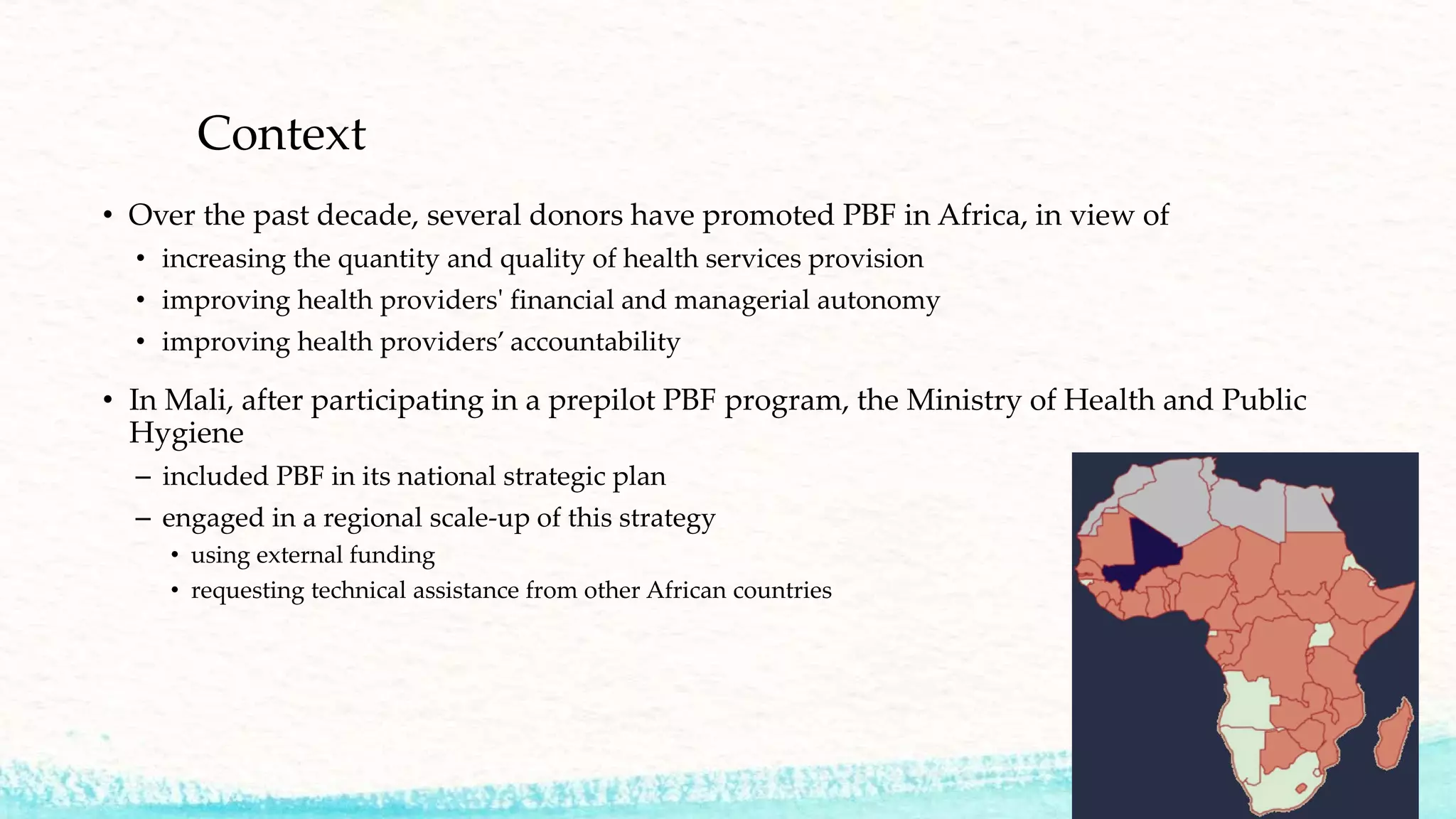
• Over the past decade, several donors have promoted PBF in Africa, in view of
• increasing the quantity and quality of health services provision
• improving health providers' financial and managerial autonomy
• improving health providers’ accountability
• In Mali, after participating in a prepilot PBF program, the Ministry of Health and Public
Hygiene
– included PBF in its national strategic plan
– engaged in a regional scale-up of this strategy
• using external funding
• requesting technical assistance from other African countries
Objectives of the study
• Document the ways in which PBF was gradually diffused across Mali's national
elites (experts and policymakers at both the central and decentralised levels),
thereby improving their ownership of the policy
• We investigate this diffusion through an analysis of three typical diffusion
mechanisms:
– Policy emulation
– Policy learning
– Policy cooperation
• To which we add one recently-incorporated mechanism (Gilardi, 2017)
– Policy framing
Main challenge: multiple locations of PBF implementation:
e.g. which jurisdiction/level learns from who?
Method
• Multiple datasources are sought
1. national experts' and policymakers' documentation on PBF in Mali (N=51) by
running a semantic content analysis (using Semato©)
– This notably enabled to identify the major ideas, beliefs, and values associated with PBF
2. qualitative data: meeting observation notes (N=5) and qualitative interviews (N=26)
with national PBF experts and policymakers, as well as international technical
assistants and funders of PBF in Mali
• Datasets are triangulated in order to bring out consistent findings on
how PBF is framed in the national discourse, and what shaped the
mechanisms of emulation, learning, and cooperation
Main challenge: finding strategies to move beyond central
actors’ (apparently) consensual discourse about PBF
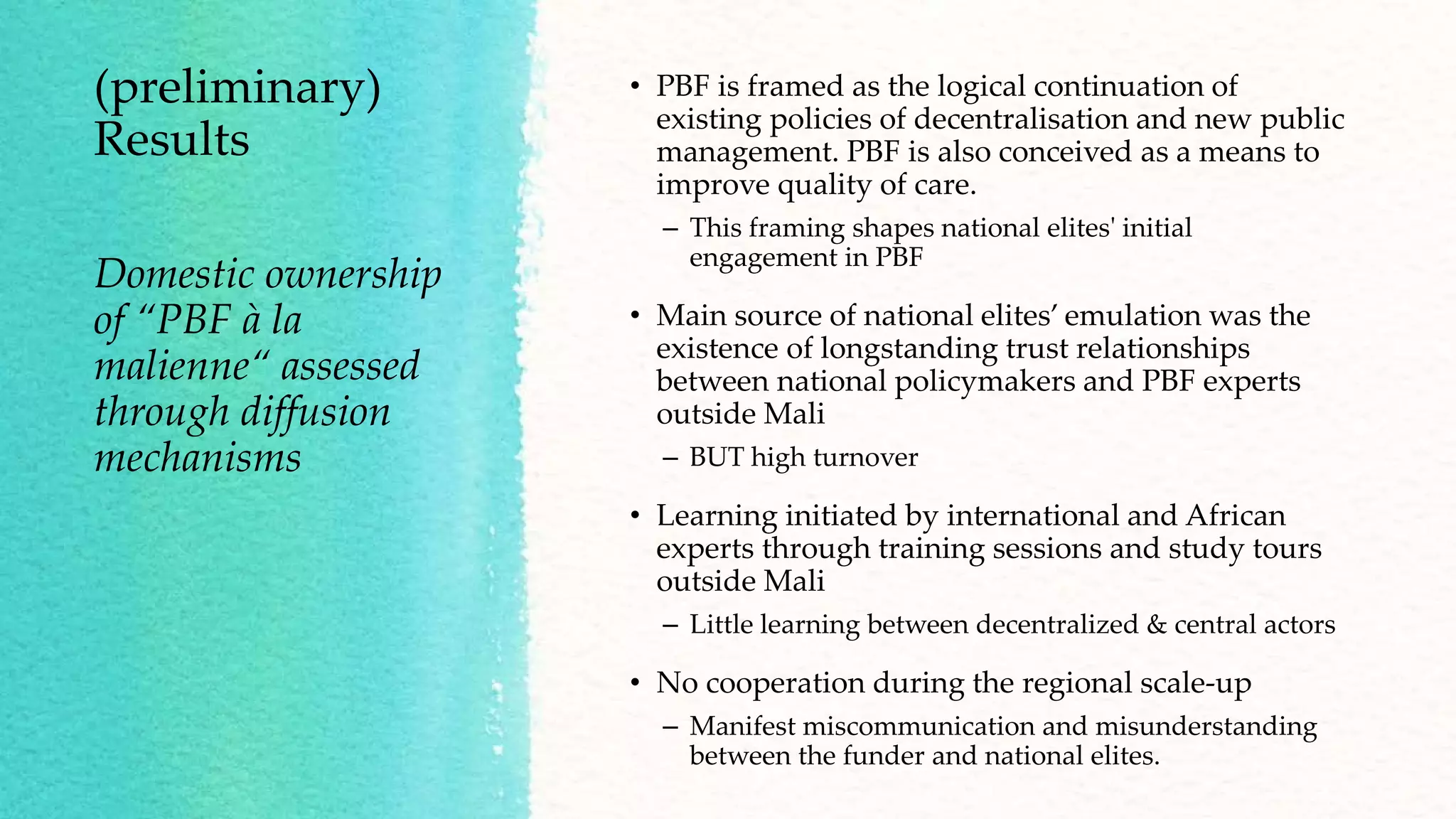
(preliminary)
Results
• PBF is framed as the logical continuation of
existing policies of decentralisation and new public
management. PBF is also conceived as a means to
improve quality of care.
– This framing shapes national elites' initial
engagement in PBF
• Main source of national elites’ emulation was the
existence of longstanding trust relationships
between national policymakers and PBF experts
outside Mali
– BUT high turnover
• Learning initiated by international and African
experts through training sessions and study tours
outside Mali
– Little learning between decentralized & central actors
• No cooperation during the regional scale-up
– Manifest miscommunication and misunderstanding
between the funder and national elites.
Domestic ownership
of “PBF à la
malienne“ assessed
through diffusion
mechanisms
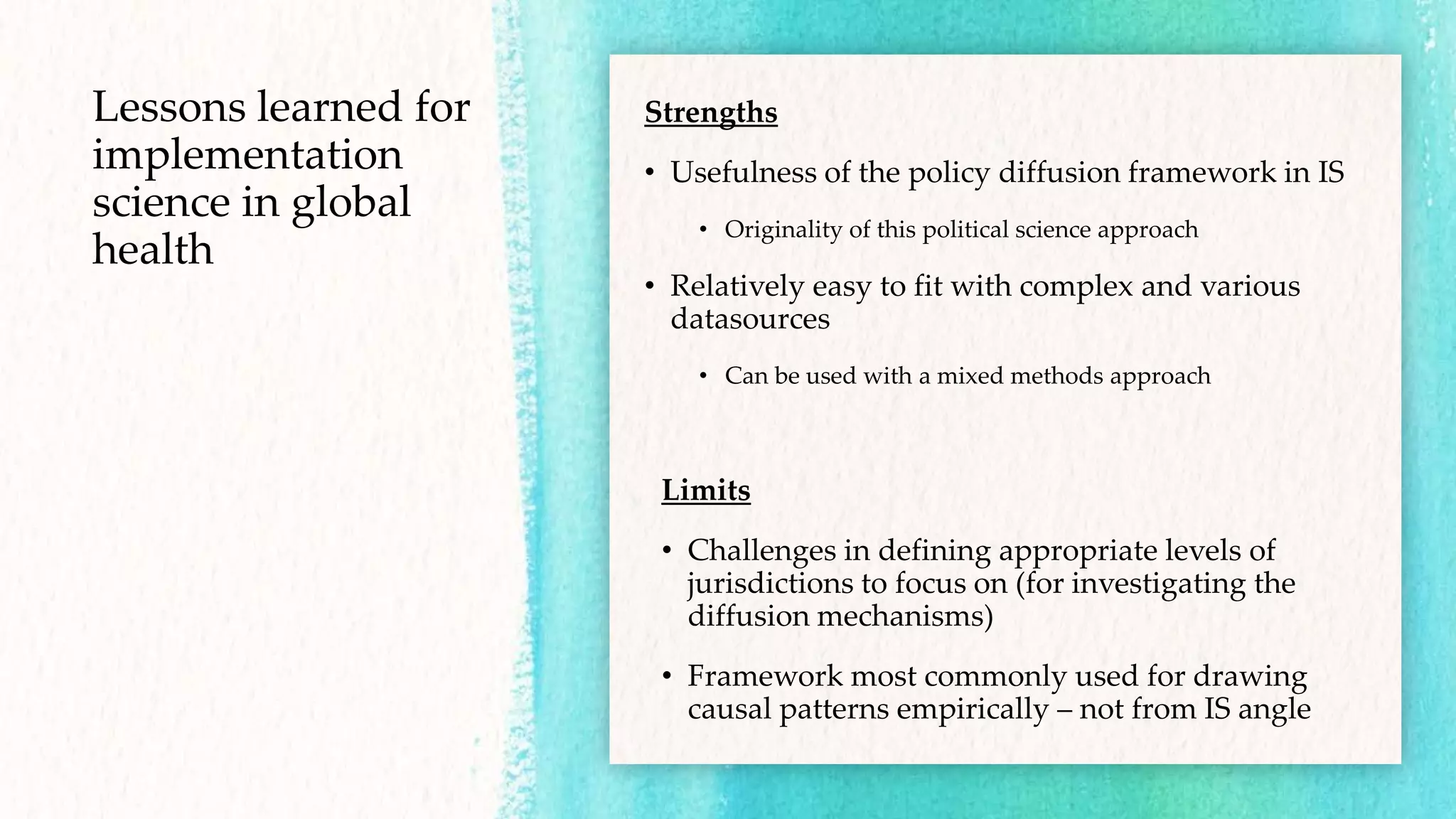
Lessons learned for
implementation
science in global
health
Strengths
• Usefulness of the policy diffusion framework in IS
• Originality of this political science approach
• Relatively easy to fit with complex and various
datasources
• Can be used with a mixed methods approach
Limits
• Challenges in defining appropriate levels of
jurisdictions to focus on (for investigating the
diffusion mechanisms)
• Framework most commonly used for drawing
causal patterns empirically – not from IS angle
Going further
• Berry, F. S., and Berry, W.D. (2007). Innovation and Diffusion Models in Policy
Research. In Theories of the Policy Process, ed. Paul A. Sabatier. Second edition.
Boulder, CO: Westview Press, 223-260.
• Dalglish, S. L., George, A., Shearer, J. C., & Bennett, S. (2015). Epistemic
communities in global health and the development of child survival policy: a case
study of iCCM. Health policy and planning, 30(suppl 2), ii12-ii25.
• Gilardi F. (2012). Transnational diffusion: Norms, ideas, and policies. Handbook of
international relations, 2; 453-477.
• Gilardi F., Shipan C.R., and Wueest B. (2017). The Diffusion of Policy Frames:
Evidence from a Structural Topic Model. Forthcoming, URL available from:
http://www.fabriziogilardi.org/resources/papers/diffusion-policy-frames.pdf
Let’s discuss together!
Meet the experts
Thank you for your attention

Using the policy diffusion framework to investigate domestic actors’ ownership of performance-based financing in Mali

  • 1.
    Using the policydiffusion framework to investigate domestic ownership of PBF in Mali: methodological and practical challenges METHODS FOR IMPLEMENTATION SCIENCE IN GLOBAL HEALTH April, 20th. 2017 McGill University Workshop co-organised by REALISME Chair and McGill of Global Health Programs Lara Gautier
  • 2.
    Context • Over thepast decade, several donors have promoted PBF in Africa, in view of • increasing the quantity and quality of health services provision • improving health providers' financial and managerial autonomy • improving health providers’ accountability • In Mali, after participating in a prepilot PBF program, the Ministry of Health and Public Hygiene – included PBF in its national strategic plan – engaged in a regional scale-up of this strategy • using external funding • requesting technical assistance from other African countries
  • 3.
    Objectives of thestudy • Document the ways in which PBF was gradually diffused across Mali's national elites (experts and policymakers at both the central and decentralised levels), thereby improving their ownership of the policy • We investigate this diffusion through an analysis of three typical diffusion mechanisms: – Policy emulation – Policy learning – Policy cooperation • To which we add one recently-incorporated mechanism (Gilardi, 2017) – Policy framing Main challenge: multiple locations of PBF implementation: e.g. which jurisdiction/level learns from who?
  • 4.
    Method • Multiple datasourcesare sought 1. national experts' and policymakers' documentation on PBF in Mali (N=51) by running a semantic content analysis (using Semato©) – This notably enabled to identify the major ideas, beliefs, and values associated with PBF 2. qualitative data: meeting observation notes (N=5) and qualitative interviews (N=26) with national PBF experts and policymakers, as well as international technical assistants and funders of PBF in Mali • Datasets are triangulated in order to bring out consistent findings on how PBF is framed in the national discourse, and what shaped the mechanisms of emulation, learning, and cooperation Main challenge: finding strategies to move beyond central actors’ (apparently) consensual discourse about PBF
  • 5.
    (preliminary) Results • PBF isframed as the logical continuation of existing policies of decentralisation and new public management. PBF is also conceived as a means to improve quality of care. – This framing shapes national elites' initial engagement in PBF • Main source of national elites’ emulation was the existence of longstanding trust relationships between national policymakers and PBF experts outside Mali – BUT high turnover • Learning initiated by international and African experts through training sessions and study tours outside Mali – Little learning between decentralized & central actors • No cooperation during the regional scale-up – Manifest miscommunication and misunderstanding between the funder and national elites. Domestic ownership of “PBF à la malienne“ assessed through diffusion mechanisms
  • 6.
    Lessons learned for implementation sciencein global health Strengths • Usefulness of the policy diffusion framework in IS • Originality of this political science approach • Relatively easy to fit with complex and various datasources • Can be used with a mixed methods approach Limits • Challenges in defining appropriate levels of jurisdictions to focus on (for investigating the diffusion mechanisms) • Framework most commonly used for drawing causal patterns empirically – not from IS angle
  • 7.
    Going further • Berry,F. S., and Berry, W.D. (2007). Innovation and Diffusion Models in Policy Research. In Theories of the Policy Process, ed. Paul A. Sabatier. Second edition. Boulder, CO: Westview Press, 223-260. • Dalglish, S. L., George, A., Shearer, J. C., & Bennett, S. (2015). Epistemic communities in global health and the development of child survival policy: a case study of iCCM. Health policy and planning, 30(suppl 2), ii12-ii25. • Gilardi F. (2012). Transnational diffusion: Norms, ideas, and policies. Handbook of international relations, 2; 453-477. • Gilardi F., Shipan C.R., and Wueest B. (2017). The Diffusion of Policy Frames: Evidence from a Structural Topic Model. Forthcoming, URL available from: http://www.fabriziogilardi.org/resources/papers/diffusion-policy-frames.pdf
  • 8.
    Let’s discuss together! Meetthe experts Thank you for your attention