
Accountable Care and Evidence-based decision-
                   making

                  Eugene Rich MD

           Director, Center on Health Care
                     Effectiveness
Inside the DC Beltway

  65 miles surrounded by reality
  Beltway view of the current US Health Care
   System
CBO on promoting evidence based care to
address rising health care costs
 “…little rigorous evidence is available about which
  treatments work best for which patients”
   – Solution: CER/PCOR

 And”…financial incentives … tend to encourage
  the adoption of more expensive treatments and
  procedures, even if evidence of their relative
  effectiveness is limited”
   – Solution: provider payment reform


                             Orszag and Ellis, NEJM, Nov 2007
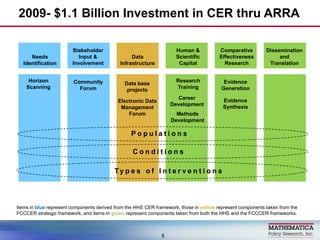
2009- $1.1 Billion Investment in CER thru ARRA

                        Stakeholder                                  Human &            Comparative         Dissemination
     Needs                 Input &                Data               Scientific         Effectiveness            and
  Identification        Involvement          Infrastructure           Capital             Research           Translation


      Horizon           Community                                    Research             Evidence
                                              Data base
     Scanning             Forum                                      Training            Generation
                                               projects
                                                                    Career               Evidence
                                            Electronic Data
                                                                  Development            Synthesis
                                             Management
                                                Forum                Methods
                                                                   Development

                                                 Populations

                                                  Conditions

                                          Ty p e s o f I n t e r v e n t i o n s


Items in blue represent components derived from the HHS CER framework, those in yellow represent components taken from the
FCCCER strategic framework, and items in green represent components taken from both the HHS and the FCCCER frameworks.


 5
                                                              5
Support for CER/PCOR after ARRA

Patient Centered Outcomes Research Trust
  Fund
   grows to $600 M per year by 2014
     – $50 M in 2011; $150 M in 2012
     – Funding thru mandatory appropriation, and tax on
       private health insurance

 20% to HHS and AHRQ for PCOR data
    infrastructure, methods development and research
    translation
   80% controlled by PCORI
    – “not an agency … of the federal government”
    – 21 member Board of Governors
    – Establish and support agenda for “patient centered outcomes
      research”
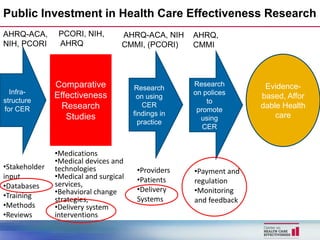
Public Investment in Health Care Effectiveness Research
AHRQ-ACA,       PCORI, NIH,        AHRQ-ACA, NIH     AHRQ,
NIH, PCORI      AHRQ               CMMI, (PCORI)     CMMI


               Comparative             Research
                                                     Research        Evidence-
  Infra-                                             on polices
               Effectiveness            on using                    based, Affor
structure                                                to
                 Research                 CER                       dable Health
for CER                                               promote
                  Studies              findings in                      care
                                                       using
                                         practice
                                                        CER


               •Medications
               •Medical devices and
•Stakeholder   technologies             •Providers   •Payment and
input          •Medical and surgical    •Patients
               services,                             regulation
•Databases                              •Delivery
               •Behavioral change                    •Monitoring
•Training      strategies,              Systems      and feedback
•Methods       •Delivery system
•Reviews       interventions
Patient Centered Outcomes Research Definition
“Patient-Centered Outcomes Research (PCOR) helps
  people and their caregivers communicate and make
  informed health care decisions, allowing their voice to
  be heard in assessing the value of health care
  options.”
1.   “Given my personal characteristics, conditions and preferences, what
     should I expect will happen to me?”

2.   “What are my options and what are the benefits and harms of those
     options?”

3.   “What can I do to improve the outcomes that are most important to
     me?”

4.   “How can clinicians and the health care system they work in help me
     make the best decisions about my health and healthcare?”

       www.PCORI.org
                                     8
PCORI Funding Opportunities
   Assessment of Prevention, Diagnosis, and Treatment Options – projects
    that address critical decisions that patients, their caregivers and
    clinicians face with too little information (CER)

   Improving Healthcare Systems – projects that address critical decisions
    that face health care systems, the patients and caregivers who rely on
    them, and the clinicians who work within them

   Communication and Dissemination Research – projects that address
    critical elements in the communication and dissemination process
    among patients, their caregivers and clinicians

   Addressing Disparities – projects that will inform the choice of
    strategies to eliminate disparities

   Accelerating Patient-Centered Outcomes Research and Methodological
    Research – COMING FALL 2013


                                       9
Patient Centered Research Questions

 A 47-year-old woman with rheumatoid arthritis has learned that her
  primary care doctor recently joined a large medical group
  …becoming part of the system’s patient-centered medical home.
   – What should this woman know about the potential benefits or possible risks of
     this new way of primary care practice compared to her current or other care
     approaches?

 A world-class athlete has been advised by her sports medicine
  physicians that she needs arthroplasty in each knee. She is
  referred to a group of orthopedic surgeons …that are part of an
  accountable care organization.
   – How will this organizational model impact her care,
   – and what information about the ACO should she know to determine whether
     they will be likely to honor her strong preference for treatment that will return her
     to maximal function as quickly as possible?


                                           10
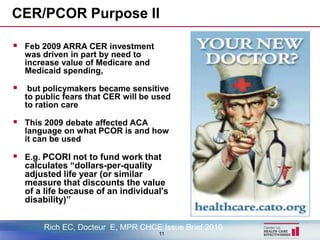
CER/PCOR Purpose II

   Feb 2009 ARRA CER investment
    was driven in part by need to
    increase value of Medicare and
    Medicaid spending,

    but policymakers became sensitive
    to public fears that CER will be used
    to ration care

   This 2009 debate affected ACA
    language on what PCOR is and how
    it can be used

   E.g. PCORI not to fund work that
    calculates “dollars-per-quality
    adjusted life year (or similar
    measure that discounts the value
    of a life because of an individual's
    disability)”


        Rich EC, Docteur E, MPR CHCE Issue Brief 2010
                                      11
Using CER: What’s Allowed by ACA

  Dissemination:
    – AHRQ charged with disseminating findings
      published by PCORI and other CER/PCOR

  Clinical decision support:
    – PCORI/AHRQ expected to promote use of findings
      via automated clinical support tools

  Use of PCORI findings in coverage and
   reimbursement decisions by public programs
    – findings can’t be sole input to Medicare coverage
      decisions but ACA does not prohibit use


 Rich EC, Docteur E, MPR CHCE Issue Brief 2010
                             12
CMMI: Learning How to Improve Care Delivery

  CMS- Center for Medicare and Medicaid Innovation
    (CMMI)
   $10B mandatory appropriation over 10 years
   Goal: better care and better health, at reduced costs through
     improvement…

   identifying, testing and spreading new models of care and
     payment
      – Patient Care Models- eg interventions to reduce
        healthcare-acquired conditions
      – Seamless Coordinated Care- eg identifying and deploying
        the best advanced primary care and health home models
      – Community and Population Health Models- eg test new
        care models that impact underlying drivers of heath
        (smoking, obesity)
PCOR- Research Development Challenges


 New understanding of the consumers of CER study
  products

 CER/PCOR focus on answering questions relevant to
  typical clinician and patient decision makers


     Rich EC, Bonham A, Kirch D, Academic Medicine 2011
                                  14
Incorporating the clinical decision-maker perspective


     Soliciting the insights of patients and clinicians
     Incorporating the diversity of
       –   communities,
       –   cultures,
       –   patient perspectives,
       –   practice settings

     Recruiting representative research participants
      and settings into research networks


       Rich EC, Bonham A, Kirch D, Academic Medicine 2011
                                    15
CBO on promoting evidence based care to
address rising health care costs
 “…little rigorous evidence is available about which
  treatments work best for which patients”
   – Solution: CER/PCOR)

 And”…financial incentives … tend to encourage
  the adoption of more expensive treatments and
  procedures, even if evidence of their relative
  effectiveness is limited”
   – Solution: provider payment reform


                             Orszag and Ellis, NEJM, Nov 2007
Fee for Service Payment

 Longstanding approach to physician reimbursement
 Risks well recognized
   – Code of Hammurabi, Heraclitus, Ben Franklin, GB Shaw

 Physician as “seller of services”
   – Buyer does not have physician’s specialized knowledge
   – Buyer further disadvantaged by pain, anxiety, cognitive
     impairment

 Principle-agent theory
   – Physician contracts to act as patient’s agent
   – Patients interests are advanced when the physician
     (clinician) recommends services with evidence of benefit


                               17
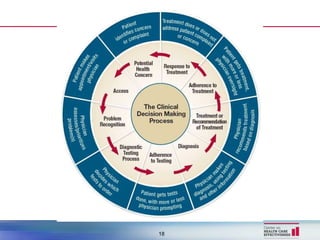
18
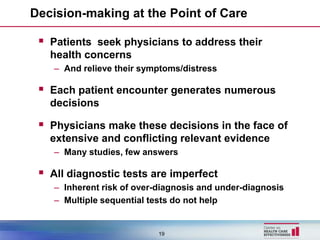
Decision-making at the Point of Care

  Patients seek physicians to address their
   health concerns
    – And relieve their symptoms/distress

  Each patient encounter generates numerous
   decisions

  Physicians make these decisions in the face of
   extensive and conflicting relevant evidence
    – Many studies, few answers

  All diagnostic tests are imperfect
    – Inherent risk of over-diagnosis and under-diagnosis
    – Multiple sequential tests do not help


                            19
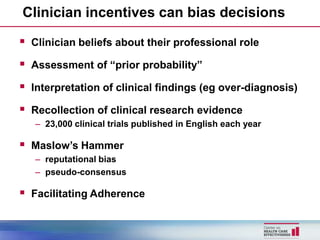
Clinician incentives can bias decisions

 Clinician beliefs about their professional role
 Assessment of “prior probability”
 Interpretation of clinical findings (eg over-diagnosis)
 Recollection of clinical research evidence
   – 23,000 clinical trials published in English each year

 Maslow’s Hammer
   – reputational bias
   – pseudo-consensus

 Facilitating Adherence
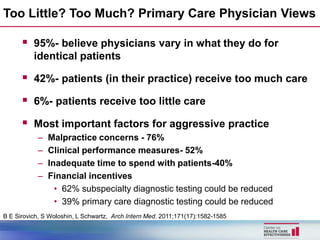
Too Little? Too Much? Primary Care Physician Views

       95%- believe physicians vary in what they do for
          identical patients

       42%- patients (in their practice) receive too much care
       6%- patients receive too little care
       Most important factors for aggressive practice
           –   Malpractice concerns - 76%
           –   Clinical performance measures- 52%
           –   Inadequate time to spend with patients-40%
           –   Financial incentives
                 • 62% subspecialty diagnostic testing could be reduced
                 • 39% primary care diagnostic testing could be reduced
B E Sirovich, S Woloshin, L Schwartz, Arch Intern Med. 2011;171(17):1582-1585
FFS and Point of Care Decision-making

  FFS offers straightforward method to
   encourage delivery of services at the point of
   care
    – Patients have greater trust under FFS payment

  FFS may not provide consistent incentives to
   promote evidence- based practice
    – Poor calibration of fees- eg high margins for services
      of limited effectiveness

  Potential impact of FFS imbalance on point of
   care decisions
    – Over or under-testing
    – Over or under diagnosis
    – Over or under treatment

                             22
Imaging for Low Back Pain*

 High margin for imaging studies for back pain creates
  incentives for physician/clinician to …
   – Promote increased patient awareness of medical services for the
     problem
   – Increase patient access for evaluation
   – Perceive higher likelihood of conditions that require testing
   – Provide services to help patients adhere to testing
     recommendation

 If imaging study is an efficient means of diagnosis
  candidates for a high margin treatment – then additional
  incentives for physician/clinician to …
   – Diagnose the condition that warrants the high margin treatment
   – Provide services to help patients adhere to testing
     recommendation                  * Overused service identified by “Choosing Wisely” program


                                            23
Antibiotic prescribing in Sinus infection

  No direct FFS incentive of ABX RX (in US)
  FFS incentive to recommend an approach that
   satisfies patient expectations
    – ABX plausibly effective in addressing the likely
      diagnosis
    – Patients prior belief regarding ABX efficacy
    – Patient desire to avoid missed work/school
    – Patient preferences and shared decision-making

  Current FFS provides inadequate incentive to
   educate patients regarding risks and benefits

  Patient satisfaction may not be enhanced by
   efforts to discourage antibiotic prescribing

                            24
Treatment “under-management” for GERD

   GERD Rx “should be titrated to the lowest
    effective dose needed to achieve therapeutic
    goals”

   Evidence-based care requires:
     – physician must contact asymptomatic patients on
       chronic therapy for GERD,
     – reduce medication dose as appropriate,
     – Follow-up on symptom response and further adjust
       medication

   Not easily rewarded via FFS
   May be viewed as unwelcome distraction by
    asymptomatic patients

                           25
Payment reform options: potential impact
on evidence-based care

  Revised FFS
  FFS + P4Q
  Episode-based payment
  Global payment (capitation)


                       26
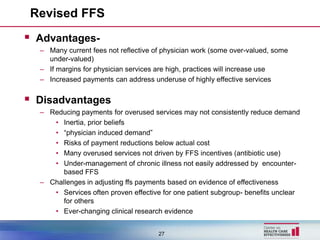
Revised FFS
 Advantages-
  – Many current fees not reflective of physician work (some over-valued, some
    under-valued)
  – If margins for physician services are high, practices will increase use
  – Increased payments can address underuse of highly effective services


 Disadvantages
  – Reducing payments for overused services may not consistently reduce demand
     • Inertia, prior beliefs
     • “physician induced demand”
     • Risks of payment reductions below actual cost
     • Many overused services not driven by FFS incentives (antibiotic use)
     • Under-management of chronic illness not easily addressed by encounter-
        based FFS
  – Challenges in adjusting ffs payments based on evidence of effectiveness
     • Services often proven effective for one patient subgroup- benefits unclear
        for others
     • Ever-changing clinical research evidence


                                      27
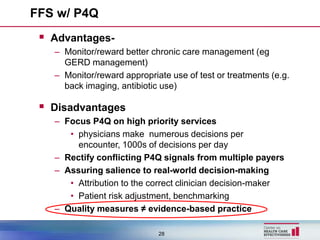
FFS w/ P4Q
  Advantages-
   – Monitor/reward better chronic care management (eg
     GERD management)
   – Monitor/reward appropriate use of test or treatments (e.g.
     back imaging, antibiotic use)

  Disadvantages
   – Focus P4Q on high priority services
      • physicians make numerous decisions per
        encounter, 1000s of decisions per day
   – Rectify conflicting P4Q signals from multiple payers
   – Assuring salience to real-world decision-making
      • Attribution to the correct clinician decision-maker
      • Patient risk adjustment, benchmarking
   – Quality measures ≠ evidence-based practice

                             28
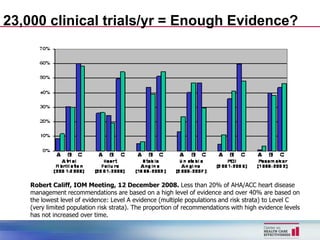
23,000 clinical trials/yr = Enough Evidence?


    Robert Califf, IOM Meeting, 12 December 2008. Less than 20% of AHA/ACC heart disease
    management recommendations are based on a high level of evidence and over 40% are based on
    the lowest level of evidence: Level A evidence (multiple populations and risk strata) to Level C
    (very limited population risk strata). The proportion of recommendations with high evidence levels
    has not increased over time.
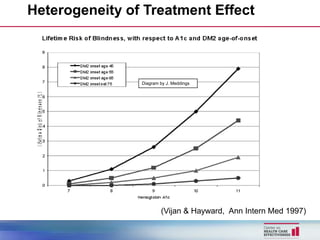
Heterogeneity of Treatment Effect


                Diagram by J. Meddings


                        (Vijan & Hayward, Ann Intern Med 1997)
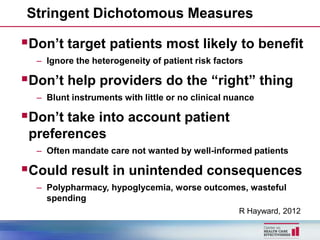
Stringent Dichotomous Measures

Don’t target patients most likely to benefit
  – Ignore the heterogeneity of patient risk factors

Don’t help providers do the “right” thing
  – Blunt instruments with little or no clinical nuance

Don’t take into account patient
 preferences
  – Often mandate care not wanted by well-informed patients

Could result in unintended consequences
  – Polypharmacy, hypoglycemia, worse outcomes, wasteful
    spending
                                                   R Hayward, 2012
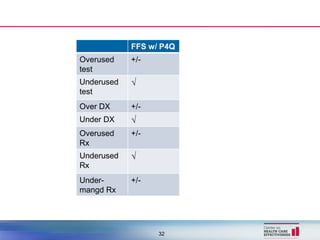
FFS w/ P4Q
Overused    +/-
test
Underused   √
test
Over DX     +/-
Under DX    √
Overused    +/-
Rx
Underused   √
Rx
Under-      +/-
mangd Rx


                  32
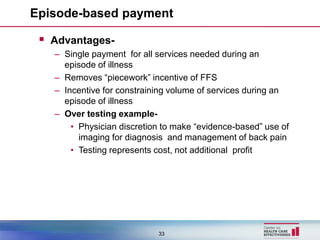
Episode-based payment

  Advantages-
   – Single payment for all services needed during an
     episode of illness
   – Removes “piecework” incentive of FFS
   – Incentive for constraining volume of services during an
     episode of illness
   – Over testing example-
       • Physician discretion to make “evidence-based” use of
         imaging for diagnosis and management of back pain
       • Testing represents cost, not additional profit


                            33
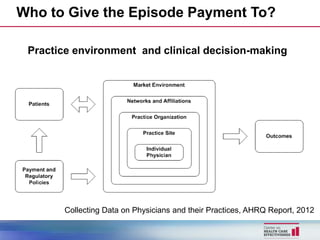
Who to Give the Episode Payment To?

 Practice environment and clinical decision-making


       Collecting Data on Physicians and their Practices, AHRQ Report, 2012
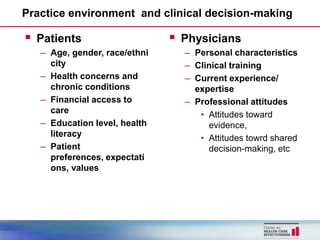
Practice environment and clinical decision-making

 Patients                      Physicians
   – Age, gender, race/ethni     – Personal characteristics
     city                        – Clinical training
   – Health concerns and         – Current experience/
     chronic conditions            expertise
   – Financial access to         – Professional attitudes
     care                           • Attitudes toward
   – Education level, health          evidence,
     literacy                       • Attitudes towrd shared
   – Patient                          decision-making, etc
     preferences, expectati
     ons, values
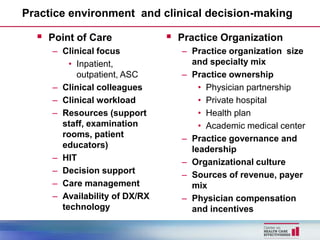
Practice environment and clinical decision-making

     Point of Care                Practice Organization
      – Clinical focus              – Practice organization size
          • Inpatient,                and specialty mix
            outpatient, ASC         – Practice ownership
      – Clinical colleagues             • Physician partnership
      – Clinical workload               • Private hospital
      – Resources (support              • Health plan
        staff, examination              • Academic medical center
        rooms, patient              – Practice governance and
        educators)                    leadership
      – HIT                         – Organizational culture
      – Decision support            – Sources of revenue, payer
      – Care management               mix
      – Availability of DX/RX       – Physician compensation
        technology                    and incentives
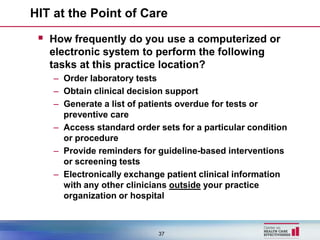
HIT at the Point of Care

  How frequently do you use a computerized or
   electronic system to perform the following
   tasks at this practice location?
    – Order laboratory tests
    – Obtain clinical decision support
    – Generate a list of patients overdue for tests or
      preventive care
    – Access standard order sets for a particular condition
      or procedure
    – Provide reminders for guideline-based interventions
      or screening tests
    – Electronically exchange patient clinical information
      with any other clinicians outside your practice
      organization or hospital


                            37
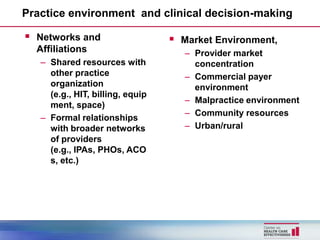
Practice environment and clinical decision-making

   Networks and                      Market Environment,
    Affiliations                       – Provider market
    – Shared resources with              concentration
      other practice                   – Commercial payer
      organization                       environment
      (e.g., HIT, billing, equip
                                       – Malpractice environment
      ment, space)
                                       – Community resources
    – Formal relationships
      with broader networks            – Urban/rural
      of providers
      (e.g., IPAs, PHOs, ACO
      s, etc.)
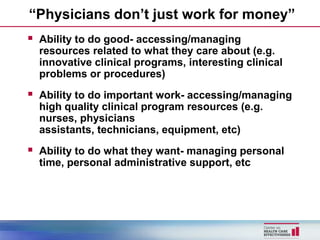
“Physicians don’t just work for money”
 Ability to do good- accessing/managing
  resources related to what they care about (e.g.
  innovative clinical programs, interesting clinical
  problems or procedures)
 Ability to do important work- accessing/managing
  high quality clinical program resources (e.g.
  nurses, physicians
  assistants, technicians, equipment, etc)
 Ability to do what they want- managing personal
  time, personal administrative support, etc
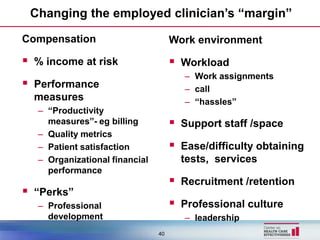
Changing the employed clinician’s “margin”

Compensation                        Work environment

 % income at risk                   Workload
                                       – Work assignments
 Performance                          – call
  measures                             – “hassles”
  – “Productivity
    measures”- eg billing            Support staff /space
  – Quality metrics
  – Patient satisfaction             Ease/difficulty obtaining
  – Organizational financial          tests, services
    performance
                                     Recruitment /retention
 “Perks”
  – Professional                     Professional culture
    development                        – leadership
                               40
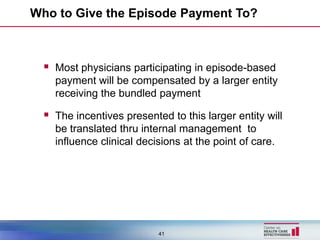
Who to Give the Episode Payment To?


   Most physicians participating in episode-based
    payment will be compensated by a larger entity
    receiving the bundled payment

   The incentives presented to this larger entity will
    be translated thru internal management to
    influence clinical decisions at the point of care.


                           41
Physician Compensation Strategies and
      Intensity of Care

          Highly capitated practice environments had
             lower intensity of care for episodes of care

          Productivity payments had the highest
             spending

          True for practice owners
          and for employed physicians


Landon, et al. The Relationship between Physician Compensation Strategies and the Intensity of
Care Delivered to Medicare Beneficiaries. HSR July 2011
Episode-based payment
  Disadvantages
    – Episode-based payments may discourage evidence-
      based testing and treatment during an episode of
      illness
        • PFTs in asthma
        • Drug management in GERD
    – Episode-based payments tied to diagnosis of
      illnesses
        • Potential incentive for over-testing to find episodes
        • Potential incentive for over-diagnosis from test results
    – Episode-based payments often tied to high cost
      services (like surgical procedures)
        • Potential incentives for over-Rx

  P4Q can help
    – Same limitations as FFS
                              43
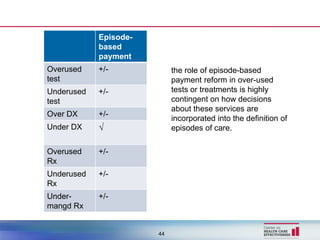
Episode-
            based
            payment
Overused    +/-             the role of episode-based
test                        payment reform in over-used
Underused   +/-             tests or treatments is highly
test                        contingent on how decisions
                            about these services are
Over DX     +/-
                            incorporated into the definition of
Under DX    √               episodes of care.

Overused    +/-
Rx
Underused   +/-
Rx
Under-      +/-
mangd Rx


                       44
Global payment (Capitation)


  Advantages-
   – Single payment for all services needed by a patient
     during a year
   – Removes “piecework” incentive of FFS
   – Incentive for constraining volume of low- value services
     for patients
   – Incentives for providing services that are effective in
     averting unnecessary spending on preventable illnesses
     or illness complications

  Who to Give the Money to?
   – Accountable care organizations


                            45
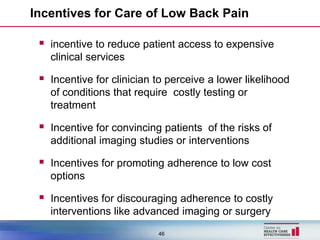
Incentives for Care of Low Back Pain

  incentive to reduce patient access to expensive
   clinical services

  Incentive for clinician to perceive a lower likelihood
   of conditions that require costly testing or
   treatment

  Incentive for convincing patients of the risks of
   additional imaging studies or interventions

  Incentives for promoting adherence to low cost
   options

  Incentives for discouraging adherence to costly
   interventions like advanced imaging or surgery
                           46
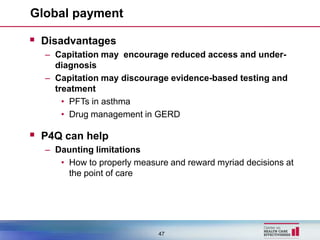
Global payment

 Disadvantages
  – Capitation may encourage reduced access and under-
    diagnosis
  – Capitation may discourage evidence-based testing and
    treatment
      • PFTs in asthma
      • Drug management in GERD

 P4Q can help
  – Daunting limitations
     • How to properly measure and reward myriad decisions at
       the point of care


                            47
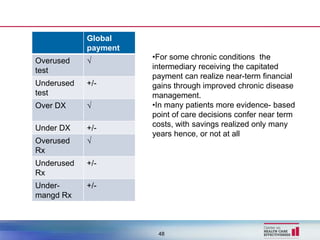
Global
            payment
Overused    √         •For some chronic conditions the
test                  intermediary receiving the capitated
                      payment can realize near-term financial
Underused   +/-       gains through improved chronic disease
test                  management.
Over DX     √         •In many patients more evidence- based
                      point of care decisions confer near term
Under DX    +/-       costs, with savings realized only many
                      years hence, or not at all
Overused    √
Rx
Underused   +/-
Rx
Under-      +/-
mangd Rx


                       48
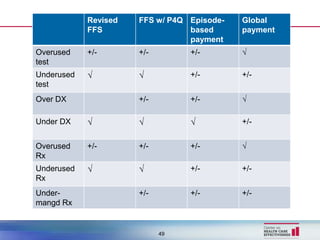
Revised   FFS w/ P4Q Episode-   Global
            FFS                  based      payment
                                 payment
Overused    +/-       +/-        +/-        √
test
Underused   √         √          +/-        +/-
test
Over DX               +/-        +/-        √

Under DX    √         √          √          +/-


Overused    +/-       +/-        +/-        √
Rx
Underused   √         √          +/-        +/-
Rx
Under-                +/-        +/-        +/-
mangd Rx


                            49
Policy Goals for Payment Reform

 Promote evidence-based decision-making at the
  point of care
  – Patients seek clinicians they can trust to recommend “what
    is best”
  – Professional societies and policy makers want clinicians to
    recommend evidence-based services
  – Incentives that do not consistently reward evidence-based
    care will prove unacceptable to both patients and clinicians

 Other purposes for broader payment reform
  –   Correcting clinician specialty imbalances
  –   Addressing care fragmentation
  –   Enhancing the role of primary care clinicians
  –   Promoting new modes for addressing patient concerns


                              50
Incentive Reform to Promote Evidence-based Care


      There are many mechanisms for paying
       physicians; some are good and some are bad.

      The three worst are…
      fee for service, capitation, and salary.
        – James Robinson
Incentive Reform to Promote Evidence-based Care


      Recalibrate productivity measures to
       recognize physician costs (margin) at the point
       of care

      Monitor patterns of care relative to highly
       effective services
        –   Overused and underused tests
        –   Over- and under-diagnosis
        –   Overused and underused treatments
        –   Under management of chronic conditions

      Choosing Wisely Program
        – One place to start


                                52
For under-used, highly effective, tests or treatments
  Address clinical issues
    – Knowledge, diagnostic skills
    – Conflicting interpretations/ professional standards
    – Easy access to knowledge resources and decision support

  Incentive reform
    – Re-evaluate for mis-calibrated physician costs
    – If productivity measures look appropriate consider
        • Compensation plan
           – Increased FFS payment (to jumpstart increased use for highly
             effective services)
           – P4Q incentives to increase awareness of appropriate use
       • Work environment
           – Workload, Support staff , Ease of ordering/obtaining
           – Professional culture
           – ??Reminders (recent surveys show reminder burden)

                                     53
For over-used in-effective, tests or treatments
  Address clinical issues
  Incentive reform
    – Re-evaluate for mis-calibrated physician costs
    – If productivity measures look appropriate consider
        • Compensation plan
            – Eliminate production incentive for this service
            – P4Q incentives to increase awareness of appropriate use
            – Production incentives/targets based on expected utilization
        • Work environment
            – Ease of ordering/obtaining
            – Referral process
            – Workload, Support staff
            – Professional culture


                                    54
Policy Goals for Payment Reform

 Promote evidence-based decision-making at the
  point of care
  – Patients seek clinicians they can trust to recommend “what
    is best”
  – Professional societies and policy makers want clinicians to
    recommend evidence-based services
  – Incentives that do not consistently reward evidence-based
    care will prove unacceptable to both patients and clinicians

 Other purposes for broader payment reform
  –   Correcting clinician specialty imbalances
  –   Addressing care fragmentation
  –   Enhancing the role of primary care clinicians
  –   Promoting new modes for addressing patient concerns


                              55
Promoting evidence based care to
  address rising health care costs
  – “…little rigorous evidence is available about which
    treatments work best for which patients”

 Solution: CER/PCOR

  – And”…financial incentives … tend to encourage the
    adoption of more expensive treatments and
    procedures, even if evidence of their relative effectiveness
    is limited”

 Solution: Provider payment reform


                              Orszag and Ellis, NEJM, Nov 2007

Accountable care and evidence based decision making

  • 1.
    Accountable Care andEvidence-based decision- making Eugene Rich MD Director, Center on Health Care Effectiveness
  • 2.
    Inside the DCBeltway  65 miles surrounded by reality  Beltway view of the current US Health Care System
  • 4.
    CBO on promotingevidence based care to address rising health care costs  “…little rigorous evidence is available about which treatments work best for which patients” – Solution: CER/PCOR  And”…financial incentives … tend to encourage the adoption of more expensive treatments and procedures, even if evidence of their relative effectiveness is limited” – Solution: provider payment reform Orszag and Ellis, NEJM, Nov 2007
  • 5.
    2009- $1.1 BillionInvestment in CER thru ARRA Stakeholder Human & Comparative Dissemination Needs Input & Data Scientific Effectiveness and Identification Involvement Infrastructure Capital Research Translation Horizon Community Research Evidence Data base Scanning Forum Training Generation projects Career Evidence Electronic Data Development Synthesis Management Forum Methods Development Populations Conditions Ty p e s o f I n t e r v e n t i o n s Items in blue represent components derived from the HHS CER framework, those in yellow represent components taken from the FCCCER strategic framework, and items in green represent components taken from both the HHS and the FCCCER frameworks. 5 5
  • 6.
    Support for CER/PCORafter ARRA Patient Centered Outcomes Research Trust Fund  grows to $600 M per year by 2014 – $50 M in 2011; $150 M in 2012 – Funding thru mandatory appropriation, and tax on private health insurance  20% to HHS and AHRQ for PCOR data infrastructure, methods development and research translation  80% controlled by PCORI – “not an agency … of the federal government” – 21 member Board of Governors – Establish and support agenda for “patient centered outcomes research”
  • 7.
    Public Investment inHealth Care Effectiveness Research AHRQ-ACA, PCORI, NIH, AHRQ-ACA, NIH AHRQ, NIH, PCORI AHRQ CMMI, (PCORI) CMMI Comparative Research Research Evidence- Infra- on polices Effectiveness on using based, Affor structure to Research CER dable Health for CER promote Studies findings in care using practice CER •Medications •Medical devices and •Stakeholder technologies •Providers •Payment and input •Medical and surgical •Patients services, regulation •Databases •Delivery •Behavioral change •Monitoring •Training strategies, Systems and feedback •Methods •Delivery system •Reviews interventions
  • 8.
    Patient Centered OutcomesResearch Definition “Patient-Centered Outcomes Research (PCOR) helps people and their caregivers communicate and make informed health care decisions, allowing their voice to be heard in assessing the value of health care options.” 1. “Given my personal characteristics, conditions and preferences, what should I expect will happen to me?” 2. “What are my options and what are the benefits and harms of those options?” 3. “What can I do to improve the outcomes that are most important to me?” 4. “How can clinicians and the health care system they work in help me make the best decisions about my health and healthcare?” www.PCORI.org 8
  • 9.
    PCORI Funding Opportunities  Assessment of Prevention, Diagnosis, and Treatment Options – projects that address critical decisions that patients, their caregivers and clinicians face with too little information (CER)  Improving Healthcare Systems – projects that address critical decisions that face health care systems, the patients and caregivers who rely on them, and the clinicians who work within them  Communication and Dissemination Research – projects that address critical elements in the communication and dissemination process among patients, their caregivers and clinicians  Addressing Disparities – projects that will inform the choice of strategies to eliminate disparities  Accelerating Patient-Centered Outcomes Research and Methodological Research – COMING FALL 2013 9
  • 10.
    Patient Centered ResearchQuestions  A 47-year-old woman with rheumatoid arthritis has learned that her primary care doctor recently joined a large medical group …becoming part of the system’s patient-centered medical home. – What should this woman know about the potential benefits or possible risks of this new way of primary care practice compared to her current or other care approaches?  A world-class athlete has been advised by her sports medicine physicians that she needs arthroplasty in each knee. She is referred to a group of orthopedic surgeons …that are part of an accountable care organization. – How will this organizational model impact her care, – and what information about the ACO should she know to determine whether they will be likely to honor her strong preference for treatment that will return her to maximal function as quickly as possible? 10
  • 11.
    CER/PCOR Purpose II  Feb 2009 ARRA CER investment was driven in part by need to increase value of Medicare and Medicaid spending,  but policymakers became sensitive to public fears that CER will be used to ration care  This 2009 debate affected ACA language on what PCOR is and how it can be used  E.g. PCORI not to fund work that calculates “dollars-per-quality adjusted life year (or similar measure that discounts the value of a life because of an individual's disability)” Rich EC, Docteur E, MPR CHCE Issue Brief 2010 11
  • 12.
    Using CER: What’sAllowed by ACA  Dissemination: – AHRQ charged with disseminating findings published by PCORI and other CER/PCOR  Clinical decision support: – PCORI/AHRQ expected to promote use of findings via automated clinical support tools  Use of PCORI findings in coverage and reimbursement decisions by public programs – findings can’t be sole input to Medicare coverage decisions but ACA does not prohibit use Rich EC, Docteur E, MPR CHCE Issue Brief 2010 12
  • 13.
    CMMI: Learning Howto Improve Care Delivery CMS- Center for Medicare and Medicaid Innovation (CMMI)  $10B mandatory appropriation over 10 years  Goal: better care and better health, at reduced costs through improvement…  identifying, testing and spreading new models of care and payment – Patient Care Models- eg interventions to reduce healthcare-acquired conditions – Seamless Coordinated Care- eg identifying and deploying the best advanced primary care and health home models – Community and Population Health Models- eg test new care models that impact underlying drivers of heath (smoking, obesity)
  • 14.
    PCOR- Research DevelopmentChallenges  New understanding of the consumers of CER study products  CER/PCOR focus on answering questions relevant to typical clinician and patient decision makers Rich EC, Bonham A, Kirch D, Academic Medicine 2011 14
  • 15.
    Incorporating the clinicaldecision-maker perspective  Soliciting the insights of patients and clinicians  Incorporating the diversity of – communities, – cultures, – patient perspectives, – practice settings  Recruiting representative research participants and settings into research networks Rich EC, Bonham A, Kirch D, Academic Medicine 2011 15
  • 16.
    CBO on promotingevidence based care to address rising health care costs  “…little rigorous evidence is available about which treatments work best for which patients” – Solution: CER/PCOR)  And”…financial incentives … tend to encourage the adoption of more expensive treatments and procedures, even if evidence of their relative effectiveness is limited” – Solution: provider payment reform Orszag and Ellis, NEJM, Nov 2007
  • 17.
    Fee for ServicePayment  Longstanding approach to physician reimbursement  Risks well recognized – Code of Hammurabi, Heraclitus, Ben Franklin, GB Shaw  Physician as “seller of services” – Buyer does not have physician’s specialized knowledge – Buyer further disadvantaged by pain, anxiety, cognitive impairment  Principle-agent theory – Physician contracts to act as patient’s agent – Patients interests are advanced when the physician (clinician) recommends services with evidence of benefit 17
  • 18.
  • 19.
    Decision-making at thePoint of Care  Patients seek physicians to address their health concerns – And relieve their symptoms/distress  Each patient encounter generates numerous decisions  Physicians make these decisions in the face of extensive and conflicting relevant evidence – Many studies, few answers  All diagnostic tests are imperfect – Inherent risk of over-diagnosis and under-diagnosis – Multiple sequential tests do not help 19
  • 20.
    Clinician incentives canbias decisions  Clinician beliefs about their professional role  Assessment of “prior probability”  Interpretation of clinical findings (eg over-diagnosis)  Recollection of clinical research evidence – 23,000 clinical trials published in English each year  Maslow’s Hammer – reputational bias – pseudo-consensus  Facilitating Adherence
  • 21.
    Too Little? TooMuch? Primary Care Physician Views  95%- believe physicians vary in what they do for identical patients  42%- patients (in their practice) receive too much care  6%- patients receive too little care  Most important factors for aggressive practice – Malpractice concerns - 76% – Clinical performance measures- 52% – Inadequate time to spend with patients-40% – Financial incentives • 62% subspecialty diagnostic testing could be reduced • 39% primary care diagnostic testing could be reduced B E Sirovich, S Woloshin, L Schwartz, Arch Intern Med. 2011;171(17):1582-1585
  • 22.
    FFS and Pointof Care Decision-making  FFS offers straightforward method to encourage delivery of services at the point of care – Patients have greater trust under FFS payment  FFS may not provide consistent incentives to promote evidence- based practice – Poor calibration of fees- eg high margins for services of limited effectiveness  Potential impact of FFS imbalance on point of care decisions – Over or under-testing – Over or under diagnosis – Over or under treatment 22
  • 23.
    Imaging for LowBack Pain*  High margin for imaging studies for back pain creates incentives for physician/clinician to … – Promote increased patient awareness of medical services for the problem – Increase patient access for evaluation – Perceive higher likelihood of conditions that require testing – Provide services to help patients adhere to testing recommendation  If imaging study is an efficient means of diagnosis candidates for a high margin treatment – then additional incentives for physician/clinician to … – Diagnose the condition that warrants the high margin treatment – Provide services to help patients adhere to testing recommendation * Overused service identified by “Choosing Wisely” program 23
  • 24.
    Antibiotic prescribing inSinus infection  No direct FFS incentive of ABX RX (in US)  FFS incentive to recommend an approach that satisfies patient expectations – ABX plausibly effective in addressing the likely diagnosis – Patients prior belief regarding ABX efficacy – Patient desire to avoid missed work/school – Patient preferences and shared decision-making  Current FFS provides inadequate incentive to educate patients regarding risks and benefits  Patient satisfaction may not be enhanced by efforts to discourage antibiotic prescribing 24
  • 25.
    Treatment “under-management” forGERD  GERD Rx “should be titrated to the lowest effective dose needed to achieve therapeutic goals”  Evidence-based care requires: – physician must contact asymptomatic patients on chronic therapy for GERD, – reduce medication dose as appropriate, – Follow-up on symptom response and further adjust medication  Not easily rewarded via FFS  May be viewed as unwelcome distraction by asymptomatic patients 25
  • 26.
    Payment reform options:potential impact on evidence-based care  Revised FFS  FFS + P4Q  Episode-based payment  Global payment (capitation) 26
  • 27.
    Revised FFS  Advantages- – Many current fees not reflective of physician work (some over-valued, some under-valued) – If margins for physician services are high, practices will increase use – Increased payments can address underuse of highly effective services  Disadvantages – Reducing payments for overused services may not consistently reduce demand • Inertia, prior beliefs • “physician induced demand” • Risks of payment reductions below actual cost • Many overused services not driven by FFS incentives (antibiotic use) • Under-management of chronic illness not easily addressed by encounter- based FFS – Challenges in adjusting ffs payments based on evidence of effectiveness • Services often proven effective for one patient subgroup- benefits unclear for others • Ever-changing clinical research evidence 27
  • 28.
    FFS w/ P4Q  Advantages- – Monitor/reward better chronic care management (eg GERD management) – Monitor/reward appropriate use of test or treatments (e.g. back imaging, antibiotic use)  Disadvantages – Focus P4Q on high priority services • physicians make numerous decisions per encounter, 1000s of decisions per day – Rectify conflicting P4Q signals from multiple payers – Assuring salience to real-world decision-making • Attribution to the correct clinician decision-maker • Patient risk adjustment, benchmarking – Quality measures ≠ evidence-based practice 28
  • 29.
    23,000 clinical trials/yr= Enough Evidence? Robert Califf, IOM Meeting, 12 December 2008. Less than 20% of AHA/ACC heart disease management recommendations are based on a high level of evidence and over 40% are based on the lowest level of evidence: Level A evidence (multiple populations and risk strata) to Level C (very limited population risk strata). The proportion of recommendations with high evidence levels has not increased over time.
  • 30.
    Heterogeneity of TreatmentEffect Diagram by J. Meddings (Vijan & Hayward, Ann Intern Med 1997)
  • 31.
    Stringent Dichotomous Measures Don’ttarget patients most likely to benefit – Ignore the heterogeneity of patient risk factors Don’t help providers do the “right” thing – Blunt instruments with little or no clinical nuance Don’t take into account patient preferences – Often mandate care not wanted by well-informed patients Could result in unintended consequences – Polypharmacy, hypoglycemia, worse outcomes, wasteful spending R Hayward, 2012
  • 32.
    FFS w/ P4Q Overused +/- test Underused √ test Over DX +/- Under DX √ Overused +/- Rx Underused √ Rx Under- +/- mangd Rx 32
  • 33.
    Episode-based payment Advantages- – Single payment for all services needed during an episode of illness – Removes “piecework” incentive of FFS – Incentive for constraining volume of services during an episode of illness – Over testing example- • Physician discretion to make “evidence-based” use of imaging for diagnosis and management of back pain • Testing represents cost, not additional profit 33
  • 34.
    Who to Givethe Episode Payment To? Practice environment and clinical decision-making Collecting Data on Physicians and their Practices, AHRQ Report, 2012
  • 35.
    Practice environment andclinical decision-making  Patients  Physicians – Age, gender, race/ethni – Personal characteristics city – Clinical training – Health concerns and – Current experience/ chronic conditions expertise – Financial access to – Professional attitudes care • Attitudes toward – Education level, health evidence, literacy • Attitudes towrd shared – Patient decision-making, etc preferences, expectati ons, values
  • 36.
    Practice environment andclinical decision-making  Point of Care  Practice Organization – Clinical focus – Practice organization size • Inpatient, and specialty mix outpatient, ASC – Practice ownership – Clinical colleagues • Physician partnership – Clinical workload • Private hospital – Resources (support • Health plan staff, examination • Academic medical center rooms, patient – Practice governance and educators) leadership – HIT – Organizational culture – Decision support – Sources of revenue, payer – Care management mix – Availability of DX/RX – Physician compensation technology and incentives
  • 37.
    HIT at thePoint of Care  How frequently do you use a computerized or electronic system to perform the following tasks at this practice location? – Order laboratory tests – Obtain clinical decision support – Generate a list of patients overdue for tests or preventive care – Access standard order sets for a particular condition or procedure – Provide reminders for guideline-based interventions or screening tests – Electronically exchange patient clinical information with any other clinicians outside your practice organization or hospital 37
  • 38.
    Practice environment andclinical decision-making  Networks and  Market Environment, Affiliations – Provider market – Shared resources with concentration other practice – Commercial payer organization environment (e.g., HIT, billing, equip – Malpractice environment ment, space) – Community resources – Formal relationships with broader networks – Urban/rural of providers (e.g., IPAs, PHOs, ACO s, etc.)
  • 39.
    “Physicians don’t justwork for money”  Ability to do good- accessing/managing resources related to what they care about (e.g. innovative clinical programs, interesting clinical problems or procedures)  Ability to do important work- accessing/managing high quality clinical program resources (e.g. nurses, physicians assistants, technicians, equipment, etc)  Ability to do what they want- managing personal time, personal administrative support, etc
  • 40.
    Changing the employedclinician’s “margin” Compensation Work environment  % income at risk  Workload – Work assignments  Performance – call measures – “hassles” – “Productivity measures”- eg billing  Support staff /space – Quality metrics – Patient satisfaction  Ease/difficulty obtaining – Organizational financial tests, services performance  Recruitment /retention  “Perks” – Professional  Professional culture development – leadership 40
  • 41.
    Who to Givethe Episode Payment To?  Most physicians participating in episode-based payment will be compensated by a larger entity receiving the bundled payment  The incentives presented to this larger entity will be translated thru internal management to influence clinical decisions at the point of care. 41
  • 42.
    Physician Compensation Strategiesand Intensity of Care  Highly capitated practice environments had lower intensity of care for episodes of care  Productivity payments had the highest spending  True for practice owners  and for employed physicians Landon, et al. The Relationship between Physician Compensation Strategies and the Intensity of Care Delivered to Medicare Beneficiaries. HSR July 2011
  • 43.
    Episode-based payment Disadvantages – Episode-based payments may discourage evidence- based testing and treatment during an episode of illness • PFTs in asthma • Drug management in GERD – Episode-based payments tied to diagnosis of illnesses • Potential incentive for over-testing to find episodes • Potential incentive for over-diagnosis from test results – Episode-based payments often tied to high cost services (like surgical procedures) • Potential incentives for over-Rx  P4Q can help – Same limitations as FFS 43
  • 44.
    Episode- based payment Overused +/- the role of episode-based test payment reform in over-used Underused +/- tests or treatments is highly test contingent on how decisions about these services are Over DX +/- incorporated into the definition of Under DX √ episodes of care. Overused +/- Rx Underused +/- Rx Under- +/- mangd Rx 44
  • 45.
    Global payment (Capitation)  Advantages- – Single payment for all services needed by a patient during a year – Removes “piecework” incentive of FFS – Incentive for constraining volume of low- value services for patients – Incentives for providing services that are effective in averting unnecessary spending on preventable illnesses or illness complications  Who to Give the Money to? – Accountable care organizations 45
  • 46.
    Incentives for Careof Low Back Pain  incentive to reduce patient access to expensive clinical services  Incentive for clinician to perceive a lower likelihood of conditions that require costly testing or treatment  Incentive for convincing patients of the risks of additional imaging studies or interventions  Incentives for promoting adherence to low cost options  Incentives for discouraging adherence to costly interventions like advanced imaging or surgery 46
  • 47.
    Global payment  Disadvantages – Capitation may encourage reduced access and under- diagnosis – Capitation may discourage evidence-based testing and treatment • PFTs in asthma • Drug management in GERD  P4Q can help – Daunting limitations • How to properly measure and reward myriad decisions at the point of care 47
  • 48.
    Global payment Overused √ •For some chronic conditions the test intermediary receiving the capitated payment can realize near-term financial Underused +/- gains through improved chronic disease test management. Over DX √ •In many patients more evidence- based point of care decisions confer near term Under DX +/- costs, with savings realized only many years hence, or not at all Overused √ Rx Underused +/- Rx Under- +/- mangd Rx 48
  • 49.
    Revised FFS w/ P4Q Episode- Global FFS based payment payment Overused +/- +/- +/- √ test Underused √ √ +/- +/- test Over DX +/- +/- √ Under DX √ √ √ +/- Overused +/- +/- +/- √ Rx Underused √ √ +/- +/- Rx Under- +/- +/- +/- mangd Rx 49
  • 50.
    Policy Goals forPayment Reform  Promote evidence-based decision-making at the point of care – Patients seek clinicians they can trust to recommend “what is best” – Professional societies and policy makers want clinicians to recommend evidence-based services – Incentives that do not consistently reward evidence-based care will prove unacceptable to both patients and clinicians  Other purposes for broader payment reform – Correcting clinician specialty imbalances – Addressing care fragmentation – Enhancing the role of primary care clinicians – Promoting new modes for addressing patient concerns 50
  • 51.
    Incentive Reform toPromote Evidence-based Care  There are many mechanisms for paying physicians; some are good and some are bad.  The three worst are…  fee for service, capitation, and salary. – James Robinson
  • 52.
    Incentive Reform toPromote Evidence-based Care  Recalibrate productivity measures to recognize physician costs (margin) at the point of care  Monitor patterns of care relative to highly effective services – Overused and underused tests – Over- and under-diagnosis – Overused and underused treatments – Under management of chronic conditions  Choosing Wisely Program – One place to start 52
  • 53.
    For under-used, highlyeffective, tests or treatments  Address clinical issues – Knowledge, diagnostic skills – Conflicting interpretations/ professional standards – Easy access to knowledge resources and decision support  Incentive reform – Re-evaluate for mis-calibrated physician costs – If productivity measures look appropriate consider • Compensation plan – Increased FFS payment (to jumpstart increased use for highly effective services) – P4Q incentives to increase awareness of appropriate use • Work environment – Workload, Support staff , Ease of ordering/obtaining – Professional culture – ??Reminders (recent surveys show reminder burden) 53
  • 54.
    For over-used in-effective,tests or treatments  Address clinical issues  Incentive reform – Re-evaluate for mis-calibrated physician costs – If productivity measures look appropriate consider • Compensation plan – Eliminate production incentive for this service – P4Q incentives to increase awareness of appropriate use – Production incentives/targets based on expected utilization • Work environment – Ease of ordering/obtaining – Referral process – Workload, Support staff – Professional culture 54
  • 55.
    Policy Goals forPayment Reform  Promote evidence-based decision-making at the point of care – Patients seek clinicians they can trust to recommend “what is best” – Professional societies and policy makers want clinicians to recommend evidence-based services – Incentives that do not consistently reward evidence-based care will prove unacceptable to both patients and clinicians  Other purposes for broader payment reform – Correcting clinician specialty imbalances – Addressing care fragmentation – Enhancing the role of primary care clinicians – Promoting new modes for addressing patient concerns 55
  • 56.
    Promoting evidence basedcare to address rising health care costs – “…little rigorous evidence is available about which treatments work best for which patients”  Solution: CER/PCOR – And”…financial incentives … tend to encourage the adoption of more expensive treatments and procedures, even if evidence of their relative effectiveness is limited”  Solution: Provider payment reform Orszag and Ellis, NEJM, Nov 2007