A Role for Mathematical Models
in Program Science
Sharmistha Mishra
April 30, 2015
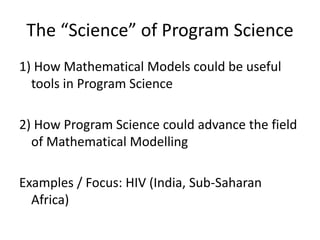
The “Science” of Program Science
1) How Mathematical Models could be useful
tools in Program Science
2) How Program Science could advance the field
of Mathematical Modelling
Examples / Focus: HIV (India, Sub-Saharan
Africa)
Program Science
• “collaboration and integration between programs
and science to improve the ways programs are
designed, implemented and evaluated to
accelerate and increase health impact”
Blanchard and Aral. STI. 2011
population
The “Science” of Program Science
Key program/community questions or observations
Clear Research Questions and Hypotheses
Program planning , implementation, management
Best (Feasible) Tools
Becker et al. In preparation. 2013
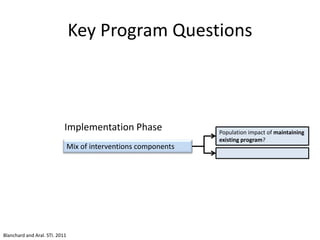
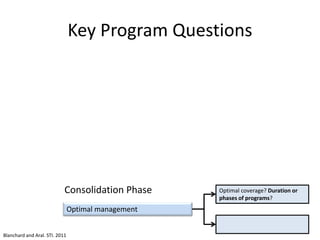
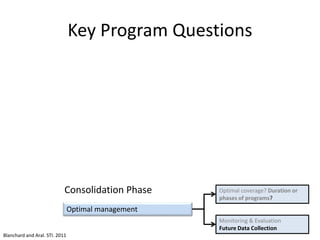
Key Program Questions
Epidemic appraisal
Key population = relative size,
distribution, contribution to
transmission dynamics?
Population impact already
achieved?
Strategic Planning Phase
Mix of interventions components
Population impact of maintaining
existing program?
Prioritization? Efficiency?
Implementation Phase
Optimal management
Duration or phases of programs?
Monitoring & Evaluation
Future Data Collection
Consolidation Phase
Blanchard and Aral. STI. 2011; Becker et al. submitted. 2015
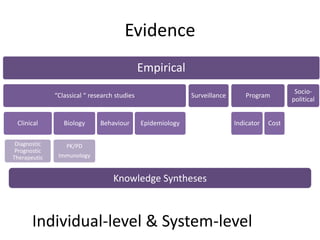
Evidence
Empirical
“Classical “ research studies
Clinical
Diagnostic
Prognostic
Therapeutic
Biology
PK/PD
Immunology
Behaviour Epidemiology
Surveillance Program
Indicator Cost
Socio-
political
Knowledge Syntheses
Individual-level & System-level
Evidence
Empirical
“Classical “ research studies
Clinical
Diagnostic
Prognostic
Therapeutic
Biology
PK/PD
Immunology
Behaviour Epidemiology
Surveillance Program
Indicator Cost
Socio-
political
Knowledge Syntheses
Population-level =“More is different”
Becker et al. submitted. 2015
Evidence
Empirical
“Classical “ research studies
Clinical
Diagnostic
Prognostic
Therapeutic
Biology
PK/PD
Immunology
Behaviour Epidemiology
Surveillance Program
Indicator Cost
Socio-
political
Knowledge Syntheses
Mathematical Models (Transmission Dynamics)
Individual & system-level
characteristics  population-level
Model =
simplified
version of
reality
Pickles et al. Lancet Glob Health. 2013
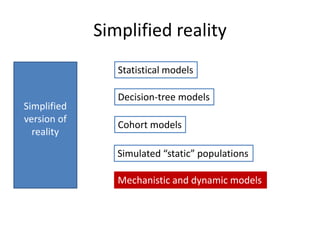
Simplified reality
Simplified
version of
reality
Statistical models
Decision-tree models
Cohort models
Simulated “static” populations
Mechanistic and dynamic models
Transmission dynamics models
• Mechanistic
• Natural history of infection
• Differences and changes in the epidemiological (behavioural or
biological) characteristics of individuals
• Differences and changes at a system-level (health, structural,
environmental) or features that are “shared” by individuals
• The mechanism of transmission
• Dynamic = feedback loop
• Incidence  Prevalence  Incidence  Prevalence
• Every “case is a risk factor”
• Onward or indirect transmission (upstream or downstream
infections); herd effects
Examples
Key Program Questions
Epidemic appraisal
Key population = relative size,
distribution, contribution to
transmission dynamics?
Strategic Planning Phase
Epidemic appraisal
• The overall HIV prevalence in my district is
3.3% but 1% of women are sex workers and
their HIV prevalence is 38%
• Am I dealing with a generalized HIV epidemic
(overall HIV prevalence >1%)?
– don’t need to prioritize prevention for sex
workers?
How big can a concentrated HIV
epidemic get?
• Concentrated epidemic
– key population (sex workers)
• Simulated 10,000 HIV
concentrated epidemics using
data from West/Central Africa
to reproduce range of
“plausible” overall HIV
prevalence trends* b/w 1995-
2012
•  170,000 snap-shots of
different concentrated
epidemics
* Range in HIV prevalence over time from UNAIDS Boily et al. 2015
Key Program Questions
Epidemic appraisal
Key population = relative size,
distribution, contribution to
transmission dynamics?
Population impact already
achieved?
Strategic Planning Phase
Blanchard and Aral. STI. 2011
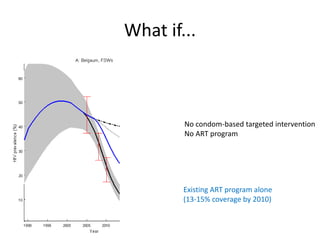
FSW HIV prevalence
(Belgaum, south India)
Existing condom-based targeted intervention
Existing ART program
Mishra et al. AIDS. 2013.
What if...
No condom-based targeted intervention
No ART program
What if...
No condom-based targeted intervention
No ART program
No condom-based targeted intervention
Poor ART program
(3-5% ART coverage)
What if...
Existing ART program alone
(13-15% coverage by 2010)
No condom-based targeted intervention
No ART program
Existing condom-based targeted intervention has had
a larger impact than existing ART program to date
No condom-based targeted intervention
No ART program
Existing ART program alone
Existing condom-based targeted
Intervention alone
% HIV infections averted up to Jan
2014
% HIV infections averted (total pop.)
Belgaum Mysore Shimoga
Existing ART alone 5-11%
(2006-2014)
6-18%
(2007-2014)
5-9%
(2008-2014)
Existing condom-
based TI alone
27-47%
(2004-2014)
29-55%
(2004-2014)
31-48%
(2004-2014)
Existing ART +
condom-based TI
30-50% 32-58% 33-55%
Incremental impact of the existing ART program to date: 2-3% infections averted
Mishra et al. AIDS. 2013.
Key Program Questions
Mix of interventions components
Population impact of maintaining
existing program?
Implementation Phase
Blanchard and Aral. STI. 2011
Life-years saved over next 10 years due
to infections prevented vs.  mortality
District (by epidemic size)
Belgaum Mysore Shimoga
Life-years saved per
person-year on ART
14-26 8-21 3-5
% of life-years saved
due to infections
averted
13.6%
(5.3-34.9%)
11.9%
(4.4-23.4%)
9.7%
(2.3-19.1%)
Epidemic size
80-85% of life-years saved due to
mortality benefit of ART @ individual-level
Preventive potential of ART largest
early in India’s HIV epidemics
0%
10%
20%
30%
40%
50%
60%
70%
80%
90%
100%
1990 1995 2000 2005 2010
%
Year
% due to increased life-expectancy
% due to HIV prevention
% of life-years saved over 10 years
Key Program Questions
Mix of interventions components
Population impact of maintaining
existing program?
Prioritization? Efficiency?
Implementation Phase
Blanchard and Aral. STI. 2011
0 0.5 1 1.5 2 2.5
0
0.2
0.4
0.6
0.8
1
1.2
1.4
1.6
500, FSWs
all HIV+, FSWs
access FSWs
access FSWs, all HIV+ FSWs
access
all HIV+
DALYsaverted(thousands,3%discount
Additional Cost, millions $US, 3% discount
Cumulative impact over 10 years
vs. maintain existing access & eligibility
ICER<3*GDP
Strategy on efficieny frontier
Dominated strategy
ICER>3*GDP
Most efficient next step?
Efficient next
steps
(expansion path)
$US per DALY
averted
(% discount)
≤500, FSWs 223 (190-345)
All HIV+ FSWs 271 (217-398)
↑access FSWs 539 (498-691)
↑access FSWs,
all HIV+ FSWs
660 (510-818)
↑access, all HIV+ 6,249
(5,851-7,192)
Best fit from dynamical model & average across efficacy, costs, and utilities
Added health impact
Added cost
Eaton et al. 2014.
Key Program Questions
Optimal management
Optimal coverage? Duration or
phases of programs?
Consolidation Phase
Blanchard and Aral. STI. 2011
HIV pre-exposure prophylaxis (PreP)
for FSWs in Mysore, India
• Impact plateaus
after 5-10 years
• Impact of 5 years of
PrEP achieves:
– 80% impact of 10
years of PrEP
– 66% impact of 20
years of PrEP
0
20
40
60
80
1 year 5 years 10 years 20 years
#ofHIVinfections
averted
PreP for 20 years
Low-risk group
Clients
FSWs
0
20
40
60
80
1 year 5 years 10 years 20 years
#ofHIVinfections
averted 5 years of PreP
Key Program Questions
Optimal management
Optimal coverage? Duration or
phases of programs?
Monitoring & Evaluation
Future Data Collection
Consolidation Phase
Blanchard and Aral. STI. 2011
0 0.5 1 1.5 2 2.5
0
0.2
0.4
0.6
0.8
1
1.2
1.4
1.6
500, FSWs
all HIV+, FSWs
access FSWs
access FSWs, all HIV+ FSWs
access
all HIV+
DALYsaverted(thousands,3%discount
Additional Cost, millions $US, 3% discount
Cumulative impact over 10 years
vs. maintain existing access & eligibility
ICER<3*GDP
Strategy on efficieny frontier
Dominated strategy
ICER>3*GDP
Most efficient next step?
Efficient next
steps
(expansion path)
$US per DALY
averted
(% discount)
≤500, FSWs 223 (190-345)
All HIV+ FSWs 271 (217-398)
↑access FSWs 539 (498-691)
↑access FSWs,
all HIV+ FSWs
660 (510-818)
↑access, all HIV+ 6,249
(5,851-7,192)
Best fit from dynamical model & average across efficacy, costs, and utilities
Added health impact
Added cost
62% @
1 GDP
41% @
1 GDP
Eaton et al. 2014.
Value of information
• What data should we collect to help us choose
the most cost-effective strategy (willingness to
pay = 1 GDP)?  re-analyze
For parameters <$20,000 USD
0
20
40
60
80
100
120
Partialexpectedvalueofperfectinformation(thousands
US$)
Intervention , utilities, or cost parameter
Decision: ≤500 vs. all HIV+ (prioritized to FSWs)
ART efficacy (adherence)
Reduction in HIV-attributable
mortality
ART discontinuation
and re-initiation rates
Relative
value of
additional
information
Mishra et al. In preparation. 2015.
A role for Program Science in
Mathematical Modelling?
PS generates data
1) Model validation
2) Model re-calibration
3) Model modification
...models = “moving target”...
Ask first,
Choose later
4) PS first asks the question, then chooses the
tools  will require that we design and build
new (novel) mathematical models
Harness data at different scales
5) PS generate and draw from data gathered at
very different scales (cellular, host,
population)  will require that we build the
next generation of mathematical models that
make best use of different data
-including qualitative data
6) Knowledge syntheses could (should) play a
larger role in mathematical modelling projects
Strengthen how we conduct and
report uncertainty
7) Models designed to meet the needs of decision-makers
(program implementers)
 “absence of data”  ignore the mechanism
 models to “impute” data
test the importance of the “missing” data or “structural”
assumptions
8) To inform decisions, we should provide uncertainty bounds
 pushing transmission dynamics modelling to utilize
applications from other fields (Bayesian statistics, Health
Economics)
Summary
• Mathematical Models could be useful tools in
Program Science
– examine the influence of individual biology,
behaviour, and the environment  dynamics of
disease spread in the population
• Program Science could advance the field of
Mathematical Modelling

A Role for Mathematical Models in Program Science

  • 1.
    A Role forMathematical Models in Program Science Sharmistha Mishra April 30, 2015
  • 2.
    The “Science” ofProgram Science 1) How Mathematical Models could be useful tools in Program Science 2) How Program Science could advance the field of Mathematical Modelling Examples / Focus: HIV (India, Sub-Saharan Africa)
  • 3.
    Program Science • “collaborationand integration between programs and science to improve the ways programs are designed, implemented and evaluated to accelerate and increase health impact” Blanchard and Aral. STI. 2011 population
  • 4.
    The “Science” ofProgram Science Key program/community questions or observations Clear Research Questions and Hypotheses Program planning , implementation, management Best (Feasible) Tools Becker et al. In preparation. 2013
  • 5.
    Key Program Questions Epidemicappraisal Key population = relative size, distribution, contribution to transmission dynamics? Population impact already achieved? Strategic Planning Phase Mix of interventions components Population impact of maintaining existing program? Prioritization? Efficiency? Implementation Phase Optimal management Duration or phases of programs? Monitoring & Evaluation Future Data Collection Consolidation Phase Blanchard and Aral. STI. 2011; Becker et al. submitted. 2015
  • 6.
    Evidence Empirical “Classical “ researchstudies Clinical Diagnostic Prognostic Therapeutic Biology PK/PD Immunology Behaviour Epidemiology Surveillance Program Indicator Cost Socio- political Knowledge Syntheses Individual-level & System-level
  • 7.
    Evidence Empirical “Classical “ researchstudies Clinical Diagnostic Prognostic Therapeutic Biology PK/PD Immunology Behaviour Epidemiology Surveillance Program Indicator Cost Socio- political Knowledge Syntheses Population-level =“More is different” Becker et al. submitted. 2015
  • 8.
    Evidence Empirical “Classical “ researchstudies Clinical Diagnostic Prognostic Therapeutic Biology PK/PD Immunology Behaviour Epidemiology Surveillance Program Indicator Cost Socio- political Knowledge Syntheses Mathematical Models (Transmission Dynamics)
  • 9.
    Individual & system-level characteristics population-level Model = simplified version of reality Pickles et al. Lancet Glob Health. 2013
  • 10.
    Simplified reality Simplified version of reality Statisticalmodels Decision-tree models Cohort models Simulated “static” populations Mechanistic and dynamic models
  • 11.
    Transmission dynamics models •Mechanistic • Natural history of infection • Differences and changes in the epidemiological (behavioural or biological) characteristics of individuals • Differences and changes at a system-level (health, structural, environmental) or features that are “shared” by individuals • The mechanism of transmission • Dynamic = feedback loop • Incidence  Prevalence  Incidence  Prevalence • Every “case is a risk factor” • Onward or indirect transmission (upstream or downstream infections); herd effects
  • 12.
  • 13.
    Key Program Questions Epidemicappraisal Key population = relative size, distribution, contribution to transmission dynamics? Strategic Planning Phase
  • 14.
    Epidemic appraisal • Theoverall HIV prevalence in my district is 3.3% but 1% of women are sex workers and their HIV prevalence is 38% • Am I dealing with a generalized HIV epidemic (overall HIV prevalence >1%)? – don’t need to prioritize prevention for sex workers?
  • 15.
    How big cana concentrated HIV epidemic get? • Concentrated epidemic – key population (sex workers) • Simulated 10,000 HIV concentrated epidemics using data from West/Central Africa to reproduce range of “plausible” overall HIV prevalence trends* b/w 1995- 2012 •  170,000 snap-shots of different concentrated epidemics * Range in HIV prevalence over time from UNAIDS Boily et al. 2015
  • 16.
    Key Program Questions Epidemicappraisal Key population = relative size, distribution, contribution to transmission dynamics? Population impact already achieved? Strategic Planning Phase Blanchard and Aral. STI. 2011
  • 17.
    FSW HIV prevalence (Belgaum,south India) Existing condom-based targeted intervention Existing ART program Mishra et al. AIDS. 2013.
  • 18.
    What if... No condom-basedtargeted intervention No ART program
  • 19.
    What if... No condom-basedtargeted intervention No ART program No condom-based targeted intervention Poor ART program (3-5% ART coverage)
  • 20.
    What if... Existing ARTprogram alone (13-15% coverage by 2010) No condom-based targeted intervention No ART program
  • 21.
    Existing condom-based targetedintervention has had a larger impact than existing ART program to date No condom-based targeted intervention No ART program Existing ART program alone Existing condom-based targeted Intervention alone
  • 22.
    % HIV infectionsaverted up to Jan 2014 % HIV infections averted (total pop.) Belgaum Mysore Shimoga Existing ART alone 5-11% (2006-2014) 6-18% (2007-2014) 5-9% (2008-2014) Existing condom- based TI alone 27-47% (2004-2014) 29-55% (2004-2014) 31-48% (2004-2014) Existing ART + condom-based TI 30-50% 32-58% 33-55% Incremental impact of the existing ART program to date: 2-3% infections averted Mishra et al. AIDS. 2013.
  • 23.
    Key Program Questions Mixof interventions components Population impact of maintaining existing program? Implementation Phase Blanchard and Aral. STI. 2011
  • 24.
    Life-years saved overnext 10 years due to infections prevented vs.  mortality District (by epidemic size) Belgaum Mysore Shimoga Life-years saved per person-year on ART 14-26 8-21 3-5 % of life-years saved due to infections averted 13.6% (5.3-34.9%) 11.9% (4.4-23.4%) 9.7% (2.3-19.1%) Epidemic size 80-85% of life-years saved due to mortality benefit of ART @ individual-level
  • 25.
    Preventive potential ofART largest early in India’s HIV epidemics 0% 10% 20% 30% 40% 50% 60% 70% 80% 90% 100% 1990 1995 2000 2005 2010 % Year % due to increased life-expectancy % due to HIV prevention % of life-years saved over 10 years
  • 26.
    Key Program Questions Mixof interventions components Population impact of maintaining existing program? Prioritization? Efficiency? Implementation Phase Blanchard and Aral. STI. 2011
  • 27.
    0 0.5 11.5 2 2.5 0 0.2 0.4 0.6 0.8 1 1.2 1.4 1.6 500, FSWs all HIV+, FSWs access FSWs access FSWs, all HIV+ FSWs access all HIV+ DALYsaverted(thousands,3%discount Additional Cost, millions $US, 3% discount Cumulative impact over 10 years vs. maintain existing access & eligibility ICER<3*GDP Strategy on efficieny frontier Dominated strategy ICER>3*GDP Most efficient next step? Efficient next steps (expansion path) $US per DALY averted (% discount) ≤500, FSWs 223 (190-345) All HIV+ FSWs 271 (217-398) ↑access FSWs 539 (498-691) ↑access FSWs, all HIV+ FSWs 660 (510-818) ↑access, all HIV+ 6,249 (5,851-7,192) Best fit from dynamical model & average across efficacy, costs, and utilities Added health impact Added cost Eaton et al. 2014.
  • 28.
    Key Program Questions Optimalmanagement Optimal coverage? Duration or phases of programs? Consolidation Phase Blanchard and Aral. STI. 2011
  • 29.
    HIV pre-exposure prophylaxis(PreP) for FSWs in Mysore, India • Impact plateaus after 5-10 years • Impact of 5 years of PrEP achieves: – 80% impact of 10 years of PrEP – 66% impact of 20 years of PrEP 0 20 40 60 80 1 year 5 years 10 years 20 years #ofHIVinfections averted PreP for 20 years Low-risk group Clients FSWs 0 20 40 60 80 1 year 5 years 10 years 20 years #ofHIVinfections averted 5 years of PreP
  • 30.
    Key Program Questions Optimalmanagement Optimal coverage? Duration or phases of programs? Monitoring & Evaluation Future Data Collection Consolidation Phase Blanchard and Aral. STI. 2011
  • 31.
    0 0.5 11.5 2 2.5 0 0.2 0.4 0.6 0.8 1 1.2 1.4 1.6 500, FSWs all HIV+, FSWs access FSWs access FSWs, all HIV+ FSWs access all HIV+ DALYsaverted(thousands,3%discount Additional Cost, millions $US, 3% discount Cumulative impact over 10 years vs. maintain existing access & eligibility ICER<3*GDP Strategy on efficieny frontier Dominated strategy ICER>3*GDP Most efficient next step? Efficient next steps (expansion path) $US per DALY averted (% discount) ≤500, FSWs 223 (190-345) All HIV+ FSWs 271 (217-398) ↑access FSWs 539 (498-691) ↑access FSWs, all HIV+ FSWs 660 (510-818) ↑access, all HIV+ 6,249 (5,851-7,192) Best fit from dynamical model & average across efficacy, costs, and utilities Added health impact Added cost 62% @ 1 GDP 41% @ 1 GDP Eaton et al. 2014.
  • 32.
    Value of information •What data should we collect to help us choose the most cost-effective strategy (willingness to pay = 1 GDP)?  re-analyze For parameters <$20,000 USD 0 20 40 60 80 100 120 Partialexpectedvalueofperfectinformation(thousands US$) Intervention , utilities, or cost parameter Decision: ≤500 vs. all HIV+ (prioritized to FSWs) ART efficacy (adherence) Reduction in HIV-attributable mortality ART discontinuation and re-initiation rates Relative value of additional information Mishra et al. In preparation. 2015.
  • 33.
    A role forProgram Science in Mathematical Modelling?
  • 34.
    PS generates data 1)Model validation 2) Model re-calibration 3) Model modification ...models = “moving target”...
  • 35.
    Ask first, Choose later 4)PS first asks the question, then chooses the tools  will require that we design and build new (novel) mathematical models
  • 36.
    Harness data atdifferent scales 5) PS generate and draw from data gathered at very different scales (cellular, host, population)  will require that we build the next generation of mathematical models that make best use of different data -including qualitative data 6) Knowledge syntheses could (should) play a larger role in mathematical modelling projects
  • 37.
    Strengthen how weconduct and report uncertainty 7) Models designed to meet the needs of decision-makers (program implementers)  “absence of data”  ignore the mechanism  models to “impute” data test the importance of the “missing” data or “structural” assumptions 8) To inform decisions, we should provide uncertainty bounds  pushing transmission dynamics modelling to utilize applications from other fields (Bayesian statistics, Health Economics)
  • 38.
    Summary • Mathematical Modelscould be useful tools in Program Science – examine the influence of individual biology, behaviour, and the environment  dynamics of disease spread in the population • Program Science could advance the field of Mathematical Modelling

Editor's Notes

  • #2 Thank you. In the next 15 minutes, I’m going to try and show how mathematical models could play an important and diverse role in the “Science” component of Program Science.
  • #3 Showing examples of how models could be useful tools in Program Science And conversely, how Program Science could advance the field of Mathematical Modelling And I’ll draw on examples from HIV modeling work for Program Science in india and SSA
  • #28 Probabilistic sensitivity analyses: % = fraction of simulations where the first strategy was more cost-effective than the subsequent strategy (at 1 GDP = willingness to pay threshold)
  • #32 Probabilistic sensitivity analyses: % = fraction of simulations where the first strategy was more cost-effective than the subsequent strategy (at 1 GDP = willingness to pay threshold)