DEPARTMENT OF ELECTRONICS AND COMMUNICATION
ENGINEERING
KINGSTON ENGINEERING COLLEGE, VELLORE.
Paper presentation on
ANIMATION+ELECTRONICS
=ANIMATRONICS
By:
P.S.Prasanna-prasananirmala@gmail.com.
3rd year,
ECE Department,
Kingston Engineering College, Vellore.
ANIMATRONICS
P. S. Prasanna, 3rd year,
Department of Electronics and Communication Engineering.
Kingston Engineering College, Vellore.
ABSTRACT:
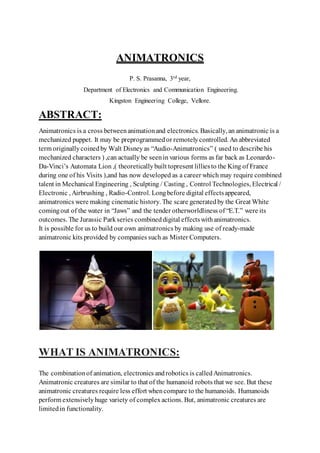
Animatronics is a cross betweenanimationand electronics. Basically, an animatronic is a
mechanized puppet. It may be preprogrammedor remotelycontrolled. An abbreviated
term originallycoinedby Walt Disneyas “Audio-Animatronics” ( used to describe his
mechanized characters ) ,can actually be seenin various forms as far back as Leonardo-
Da-Vinci’s Automata Lion ,( theoreticallybuilt topresent lilliesto the King of France
during one of his Visits ),and has now developed as a career which may require combined
talent in Mechanical Engineering , Sculpting / Casting , Control Technologies, Electrical /
Electronic , Airbrushing , Radio-Control. Longbefore digital effectsappeared,
animatronics were making cinematic history. The scare generatedby the Great White
comingout of the water in “Jaws” and the tender otherworldliness of “E.T.” were its
outcomes. The Jurassic Parkseries combineddigital effectswithanimatronics.
It is possible for us to build our own animatronics by making use of ready-made
animatronic kits provided by companies such as Mister Computers.
WHAT IS ANIMATRONICS:
The combinationof animation, electronics androbotics is calledAnimatronics.
Animatronic creatures are similar to that of the humanoid robots that we see. But these
animatronic creatures require less effort whencompare to the humanoids. Humanoids
perform extensivelyhuge variety of complexactions. But, animatronic creatures are
limitedin functionality.
One may pose a questionthat what is the need of animatronics when we have computer
graphics. The difference betweenCG and Animatronics is that the animatronic creatures
provide the physical appearance of the creatures infilm making. In the case of CG, the
performer has to imagine the gestures and movement of such giant aliencreatures. This
enhances the performance of the actors.
The first use of Audio-Animatronics was for Walt Disney's Enchanted Tiki Room
inDisneyland, which opened in June, 1963. The Tiki birds were operated
using digital controls;that is, something that is either on or off. Tones were
recorded onto tape, which on playback would cause a metal reed to vibrate.
CURRENTRESEARCHIN THE FIELD:
Hanson Robotics is one of the premier leaders of this industry. Their researchinto
animatronics have lead to robots that can read faical expression, suchas Zeno, and robots
that can display and be controlledby an actor’s facial expressions, Einsteinand Jules
(Hanson Robotics, 2009). The Hanson Robotics robots were all astounding in the realism
they were able to portraywith pliable skin and the number of actuators theyhad
underneath that skin. However, due to the complexityof these robots, theyserve best as
models for inspirationthananything that useful informationcouldbe gained from for this
project. Though, it is interestingto note that face-trackingand face-detectionis being
used on the more advanced animatronic robots inthe industry.
Nexi, a robot designedby the MIT Media Lab, was designedto express human emotions
while, unlike the Hanson Robotics robots, her face consists solelyof moveable rigid
components (Chandler, 2008). This robot is very similar to the end goal of the robot for
this project. However, each eyebrow is individually controlled, as is each set of eyelids.
This would over-complicatethe robot inthis project. It is somethingthat is further
addressedin the mechanical system section. Interestingly, though, Nexi has a rigidmouth
that opens and closes, she has no horizontal control of her mouthto accentuate the
movement of her lips to pronounce words.
REQUIREMENTS:
To designand build an animatronic head, thenprogram it using data recordedfrom face-
tracking software. The robot must meet the followingrequirements:
 The head must have the shape of a human’s head
 The robot must have a human voice
 While the head will not have full functionalityof a human head and face for
simplicity, the features selectedto be includedmust have the full range of an
average human
 All movements must be recordedusingface tracking software, where feasible
 The final animatronic head must have the capability to perform for aminimum of
two minutes.
FUTUREOFANIMATRONICS:
It can be speculatedthat animatronics will not be a large player in the future of cinematic
special effects andtheme parks. Because of the growing ease and versatilityof
computer graphics, animatronics are being used less and less to render life-like fantasy
creatures in movies. It is much less expensive to create a digital version of imaginary
monsters, thento build them in a life-like size. The other mainuse for animatronics,
themeparks, has also seenadecline inthe needfor mechanized puppets. Newer theme
parks are built around attractions suchas roller-coasters andthe importance of visual
stimulationsuchas animatronic figures has beendownplayed in favor of the thrill of an
adrenaline rush. Furthermore, the initial wow-factor which applied to animatronics when
the Enchanted Tiki Room has worn off because of an audience usedto seeingmany the
technological marvels ontelevisionand through the Internet. Nevertheless, animatronics
(and their father, the puppet) have played a large role in the theatre for a long time and
that is unlikely to change unless theatre as a whole becomes lessimportant withthe easy
accessibilityof movies and television
MAKING OF ANIMATRONIC SPINOSAURUS
USED INJURASSICPARK:
CREATURE CREATION:
Building the various components usedin the animatronic device usually takes the longest
time. Most of the creatures that are developed at Stan WinstonStudio require parts that
you're not going to find at your local hardware store. Whenis the last time you saw a left
forearm for aSpinosaurus sittingon the shelf at Home Depot?This means that SWS has
to build almost everything themselves. They do take advantage of any existingproducts
when possible, usually by repurposingparts of a commondevice to fill some of their
unknown needs.
Working on the head of Tyrannosaurus rex
Basically, there are four main categories that the work splits into, with development
happening simultaneouslyacross the categories.
MECHANICAL :
SWS engineers designand build the mechanical systems, which includes everything
from basicgears to sophisticated hydraulics. An interestingfact about the animatronic
Spinosaurus is that nearly all of the mechanical systems usedinit are hydraulic.
ELECTRONIC :
Another group develops the electronic control systems neededto operate the animatronic
device. Typically startingfrom scratchand creatingtheir own custom circuit boards, these
engineers are essentiallybuildinggiant remote-controlledtoys. Almost all of the
movement of the Spinosaurus will be manipulated by specializedremote-control systems
known as telemetrydevices. We discuss the specific telemetrydevices usedin the next
section.
All hydraulic systems are installed and checked.
STRUCTURAL:
All of the electronic andmechanical components needsomethingto attachto and control,
and the skin must have a frame to maintain its shape. This is done by building a plastic
and steel frame. To increase the realism, and because it is the natural way to designit, the
frame of the Spinosaurus, as well as most other creatures made by SWS, resemblesthe
actual skeletonof the beast. This skeletal frame is largelycomprisedof graphite, a
synthetic material known for its strengthand lightness.
SURFACE :
The "skin" of the Spinosaurus is made from foam rubber, which is a very light, spongy
rubber that is made by mixing air with liquid latex rubber and then curing(hardening) it.
While there are other compounds, suchas silicone and urethane, that are stronger and last
longer, foam rubber is used because it is much easier to work with. The solutionis poured
into each moldand allowedto cure. As mentionedearlier, parts of the frame are
embedded with the foam rubber at certainpoints. To further strengthenthe skin, a piece
of fabric is cut to size and embedded in the foam rubber after it is poured into the mold.
Once cured, eachpiece of skin is pulled from its mold.
PUTTING IT TOGETHER:
When all the components are done, it's time to build the Spinosaurus. The frame is put
together and then the mechanical systems are put in place. As each component is added, it
is checkedto ensure that it moves properlyand doesn't interferewithother components.
Most of the electronic components are thenconnectedto the mechanical systems they
will control. The controls have been testedwith the mechanical systems prior to final
assembly, but the systems are checkedagain.
The "skeleton" of the Spinosaurus
Parts of the skin that have embedded pieces of the frame inthem are put in place when
the frame is assembled. The other skinpieces are fastenedinplace on the frame once the
mechanical and electroniccomponents are installed. Assemblingthe skin is a very
laborious process. As each piece is added, the team has to checkto make sure there are no
problems, suchas:
 Unwanted folds
 Buckling
 Stretching
 Too tight
Whenever one of these problems occurs, the skinmust be adapted or attacheddifferently.
Also, there are places where you do want the skin to foldor hang loose or travel ina
certainway, and it must be adjusted to achieve that effect. One of the tricks that SWS
uses to make the Spinosaurus and other dinosaurs seem more realisticis to attachbungee
cords betweenareas of skin and the frame. During movement, these bungee cords
simulate tendons under the skin, bunching and stretching.
The skin is mostly"painted" before it is attachedto the frame. Stan WinstonStudio does
not use actual paint, though. Instead, a specially formulatedmixture that is akin to rubber
cement is used. Tints are added to the mixture to get the correct color. Rosengrant says
that they use this mixture in place of traditional paint because it bonds more stronglywith
the foam rubber and stretcheswithit as the animatronic moves.
Once the animatronic device is complete, the team has to test it and work out any
problems.
PROGRAMMING:
Finally, if it is an animated character the electronic wizardmove in to connect the control
systeminto valve assemblyin the preparationfor programming. Programmingis the final
step, and for some animations it is the most rewarding. Programmingcan be done either
at the manufacturingfacilityor at the final installationsite. In programming, all the
individual moves are coordinatedinto complexanimatedactions and nuances that bring
the character to “life.”
MAKING IT MOVE:
The people that control the animatronic figure are called puppeteers, because that is all
that an animatronic device is -- a sophisticatedpuppet. These puppeteers are skilledactors
in their own right and will spend some time with the animatronic figure learning its range
of movements. Rosengrant calls this "finding the performance."The puppeteers are
determiningwhat movements make the animatronic figure lookangry, surprised, hungry
or any other emotions or moods that are calledfor inthe script.
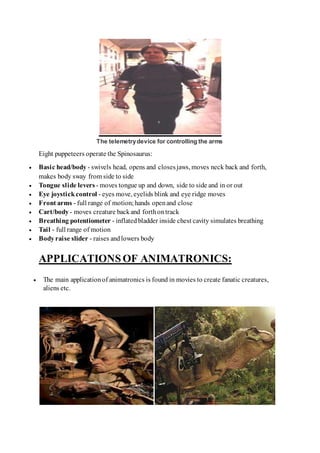
The telemetrydevice for controlling the arms
Eight puppeteers operate the Spinosaurus:
 Basic head/body - swivels head, opens and closesjaws, moves neck back and forth,
makes body sway from side to side
 Tongue slide levers - moves tongue up and down, side to side and in or out
 Eye joystickcontrol - eyes move, eyelids blink and eye ridge moves
 Front arms - full range of motion;hands openand close
 Cart/body - moves creature backand forthontrack
 Breathing potentiometer - inflatedbladder inside chest cavity simulates breathing
 Tail - full range of motion
 Bodyraise slider - raises andlowers body
APPLICATIONSOF ANIMATRONICS:
 The main applicationof animatronics is found in movies to create fanatic creatures,
aliens etc.
 Theme parks also implement animatronics for the real-time amusement of visitors.
CONCLUSION:
Creating a good animatronic figure that is able to perform constantlywithout fail requires
Many special skills and lots of technical know how. Before assumingthe task of creating
an animatronic figure, you should have a stronghold on how these things are constructed
and be willing to spend a prettypenny on equipment and materials. Animtronics has now
developed as a career which may require combinedtalent in Mechanical Engineering,
Sculpting / Casting ,Control Technologies , Electrical / Electronic, Airbrushing , Radio-
Control etc. But the realistic creatures that it can create are amazing and is rewarding to
its creator.
REFERENCES:
https://en.wikipedia.org/wiki/Animatronics
entertainment.howstuffworks.com/animatronic.htm
freddy-fazbears-pizza.wikia.com/wiki/Animatronics
www.academia.edu/7947922/Topic_ANIMATRONICS_Content

animatronics pdf

  • 1.
    DEPARTMENT OF ELECTRONICSAND COMMUNICATION ENGINEERING KINGSTON ENGINEERING COLLEGE, VELLORE. Paper presentation on ANIMATION+ELECTRONICS =ANIMATRONICS By: P.S.Prasanna-prasananirmala@gmail.com. 3rd year, ECE Department, Kingston Engineering College, Vellore.
  • 2.
    ANIMATRONICS P. S. Prasanna,3rd year, Department of Electronics and Communication Engineering. Kingston Engineering College, Vellore. ABSTRACT: Animatronics is a cross betweenanimationand electronics. Basically, an animatronic is a mechanized puppet. It may be preprogrammedor remotelycontrolled. An abbreviated term originallycoinedby Walt Disneyas “Audio-Animatronics” ( used to describe his mechanized characters ) ,can actually be seenin various forms as far back as Leonardo- Da-Vinci’s Automata Lion ,( theoreticallybuilt topresent lilliesto the King of France during one of his Visits ),and has now developed as a career which may require combined talent in Mechanical Engineering , Sculpting / Casting , Control Technologies, Electrical / Electronic , Airbrushing , Radio-Control. Longbefore digital effectsappeared, animatronics were making cinematic history. The scare generatedby the Great White comingout of the water in “Jaws” and the tender otherworldliness of “E.T.” were its outcomes. The Jurassic Parkseries combineddigital effectswithanimatronics. It is possible for us to build our own animatronics by making use of ready-made animatronic kits provided by companies such as Mister Computers. WHAT IS ANIMATRONICS: The combinationof animation, electronics androbotics is calledAnimatronics. Animatronic creatures are similar to that of the humanoid robots that we see. But these animatronic creatures require less effort whencompare to the humanoids. Humanoids perform extensivelyhuge variety of complexactions. But, animatronic creatures are limitedin functionality.
  • 3.
    One may posea questionthat what is the need of animatronics when we have computer graphics. The difference betweenCG and Animatronics is that the animatronic creatures provide the physical appearance of the creatures infilm making. In the case of CG, the performer has to imagine the gestures and movement of such giant aliencreatures. This enhances the performance of the actors. The first use of Audio-Animatronics was for Walt Disney's Enchanted Tiki Room inDisneyland, which opened in June, 1963. The Tiki birds were operated using digital controls;that is, something that is either on or off. Tones were recorded onto tape, which on playback would cause a metal reed to vibrate. CURRENTRESEARCHIN THE FIELD: Hanson Robotics is one of the premier leaders of this industry. Their researchinto animatronics have lead to robots that can read faical expression, suchas Zeno, and robots that can display and be controlledby an actor’s facial expressions, Einsteinand Jules (Hanson Robotics, 2009). The Hanson Robotics robots were all astounding in the realism they were able to portraywith pliable skin and the number of actuators theyhad underneath that skin. However, due to the complexityof these robots, theyserve best as
  • 4.
    models for inspirationthananythingthat useful informationcouldbe gained from for this project. Though, it is interestingto note that face-trackingand face-detectionis being used on the more advanced animatronic robots inthe industry. Nexi, a robot designedby the MIT Media Lab, was designedto express human emotions while, unlike the Hanson Robotics robots, her face consists solelyof moveable rigid components (Chandler, 2008). This robot is very similar to the end goal of the robot for this project. However, each eyebrow is individually controlled, as is each set of eyelids. This would over-complicatethe robot inthis project. It is somethingthat is further addressedin the mechanical system section. Interestingly, though, Nexi has a rigidmouth that opens and closes, she has no horizontal control of her mouthto accentuate the movement of her lips to pronounce words. REQUIREMENTS: To designand build an animatronic head, thenprogram it using data recordedfrom face- tracking software. The robot must meet the followingrequirements:  The head must have the shape of a human’s head  The robot must have a human voice  While the head will not have full functionalityof a human head and face for simplicity, the features selectedto be includedmust have the full range of an average human  All movements must be recordedusingface tracking software, where feasible  The final animatronic head must have the capability to perform for aminimum of two minutes. FUTUREOFANIMATRONICS: It can be speculatedthat animatronics will not be a large player in the future of cinematic special effects andtheme parks. Because of the growing ease and versatilityof computer graphics, animatronics are being used less and less to render life-like fantasy creatures in movies. It is much less expensive to create a digital version of imaginary monsters, thento build them in a life-like size. The other mainuse for animatronics, themeparks, has also seenadecline inthe needfor mechanized puppets. Newer theme parks are built around attractions suchas roller-coasters andthe importance of visual stimulationsuchas animatronic figures has beendownplayed in favor of the thrill of an adrenaline rush. Furthermore, the initial wow-factor which applied to animatronics when the Enchanted Tiki Room has worn off because of an audience usedto seeingmany the technological marvels ontelevisionand through the Internet. Nevertheless, animatronics (and their father, the puppet) have played a large role in the theatre for a long time and
  • 5.
    that is unlikelyto change unless theatre as a whole becomes lessimportant withthe easy accessibilityof movies and television MAKING OF ANIMATRONIC SPINOSAURUS USED INJURASSICPARK: CREATURE CREATION: Building the various components usedin the animatronic device usually takes the longest time. Most of the creatures that are developed at Stan WinstonStudio require parts that you're not going to find at your local hardware store. Whenis the last time you saw a left forearm for aSpinosaurus sittingon the shelf at Home Depot?This means that SWS has to build almost everything themselves. They do take advantage of any existingproducts when possible, usually by repurposingparts of a commondevice to fill some of their unknown needs. Working on the head of Tyrannosaurus rex Basically, there are four main categories that the work splits into, with development happening simultaneouslyacross the categories. MECHANICAL : SWS engineers designand build the mechanical systems, which includes everything from basicgears to sophisticated hydraulics. An interestingfact about the animatronic Spinosaurus is that nearly all of the mechanical systems usedinit are hydraulic.
  • 6.
    ELECTRONIC : Another groupdevelops the electronic control systems neededto operate the animatronic device. Typically startingfrom scratchand creatingtheir own custom circuit boards, these engineers are essentiallybuildinggiant remote-controlledtoys. Almost all of the movement of the Spinosaurus will be manipulated by specializedremote-control systems known as telemetrydevices. We discuss the specific telemetrydevices usedin the next section. All hydraulic systems are installed and checked. STRUCTURAL: All of the electronic andmechanical components needsomethingto attachto and control, and the skin must have a frame to maintain its shape. This is done by building a plastic and steel frame. To increase the realism, and because it is the natural way to designit, the frame of the Spinosaurus, as well as most other creatures made by SWS, resemblesthe actual skeletonof the beast. This skeletal frame is largelycomprisedof graphite, a synthetic material known for its strengthand lightness. SURFACE : The "skin" of the Spinosaurus is made from foam rubber, which is a very light, spongy rubber that is made by mixing air with liquid latex rubber and then curing(hardening) it. While there are other compounds, suchas silicone and urethane, that are stronger and last longer, foam rubber is used because it is much easier to work with. The solutionis poured into each moldand allowedto cure. As mentionedearlier, parts of the frame are embedded with the foam rubber at certainpoints. To further strengthenthe skin, a piece of fabric is cut to size and embedded in the foam rubber after it is poured into the mold. Once cured, eachpiece of skin is pulled from its mold.
  • 7.
    PUTTING IT TOGETHER: Whenall the components are done, it's time to build the Spinosaurus. The frame is put together and then the mechanical systems are put in place. As each component is added, it is checkedto ensure that it moves properlyand doesn't interferewithother components. Most of the electronic components are thenconnectedto the mechanical systems they will control. The controls have been testedwith the mechanical systems prior to final assembly, but the systems are checkedagain. The "skeleton" of the Spinosaurus Parts of the skin that have embedded pieces of the frame inthem are put in place when the frame is assembled. The other skinpieces are fastenedinplace on the frame once the mechanical and electroniccomponents are installed. Assemblingthe skin is a very laborious process. As each piece is added, the team has to checkto make sure there are no problems, suchas:  Unwanted folds  Buckling  Stretching  Too tight Whenever one of these problems occurs, the skinmust be adapted or attacheddifferently. Also, there are places where you do want the skin to foldor hang loose or travel ina certainway, and it must be adjusted to achieve that effect. One of the tricks that SWS uses to make the Spinosaurus and other dinosaurs seem more realisticis to attachbungee cords betweenareas of skin and the frame. During movement, these bungee cords simulate tendons under the skin, bunching and stretching.
  • 8.
    The skin ismostly"painted" before it is attachedto the frame. Stan WinstonStudio does not use actual paint, though. Instead, a specially formulatedmixture that is akin to rubber cement is used. Tints are added to the mixture to get the correct color. Rosengrant says that they use this mixture in place of traditional paint because it bonds more stronglywith the foam rubber and stretcheswithit as the animatronic moves. Once the animatronic device is complete, the team has to test it and work out any problems. PROGRAMMING: Finally, if it is an animated character the electronic wizardmove in to connect the control systeminto valve assemblyin the preparationfor programming. Programmingis the final step, and for some animations it is the most rewarding. Programmingcan be done either at the manufacturingfacilityor at the final installationsite. In programming, all the individual moves are coordinatedinto complexanimatedactions and nuances that bring the character to “life.” MAKING IT MOVE: The people that control the animatronic figure are called puppeteers, because that is all that an animatronic device is -- a sophisticatedpuppet. These puppeteers are skilledactors in their own right and will spend some time with the animatronic figure learning its range of movements. Rosengrant calls this "finding the performance."The puppeteers are determiningwhat movements make the animatronic figure lookangry, surprised, hungry or any other emotions or moods that are calledfor inthe script.
  • 9.
    The telemetrydevice forcontrolling the arms Eight puppeteers operate the Spinosaurus:  Basic head/body - swivels head, opens and closesjaws, moves neck back and forth, makes body sway from side to side  Tongue slide levers - moves tongue up and down, side to side and in or out  Eye joystickcontrol - eyes move, eyelids blink and eye ridge moves  Front arms - full range of motion;hands openand close  Cart/body - moves creature backand forthontrack  Breathing potentiometer - inflatedbladder inside chest cavity simulates breathing  Tail - full range of motion  Bodyraise slider - raises andlowers body APPLICATIONSOF ANIMATRONICS:  The main applicationof animatronics is found in movies to create fanatic creatures, aliens etc.
  • 10.
     Theme parksalso implement animatronics for the real-time amusement of visitors. CONCLUSION: Creating a good animatronic figure that is able to perform constantlywithout fail requires Many special skills and lots of technical know how. Before assumingthe task of creating an animatronic figure, you should have a stronghold on how these things are constructed and be willing to spend a prettypenny on equipment and materials. Animtronics has now developed as a career which may require combinedtalent in Mechanical Engineering, Sculpting / Casting ,Control Technologies , Electrical / Electronic, Airbrushing , Radio- Control etc. But the realistic creatures that it can create are amazing and is rewarding to its creator. REFERENCES: https://en.wikipedia.org/wiki/Animatronics entertainment.howstuffworks.com/animatronic.htm freddy-fazbears-pizza.wikia.com/wiki/Animatronics www.academia.edu/7947922/Topic_ANIMATRONICS_Content