Timeline
1800 - 1899
By Sam Jackson

1832
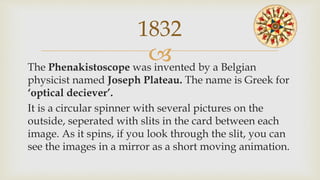
The Phenakistoscope was invented by a Belgian
physicist named Joseph Plateau. The name is Greek for
‘optical deciever’.
It is a circular spinner with several pictures on the
outside, seperated with slits in the card between each
image. As it spins, if you look through the slit, you can
see the images in a mirror as a short moving animation.
1832

1834
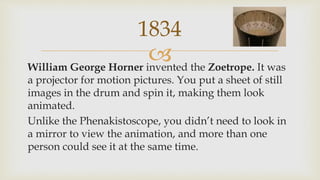
William George Horner invented the Zoetrope. It was
a projector for motion pictures. You put a sheet of still
images in the drum and spin it, making them look
animated.
Unlike the Phenakistoscope, you didn’t need to look in
a mirror to view the animation, and more than one
person could see it at the same time.
1834

1838
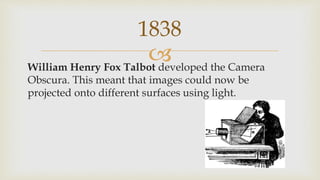
William Henry Fox Talbot developed the Camera
Obscura. This meant that images could now be
projected onto different surfaces using light.
1838

1861
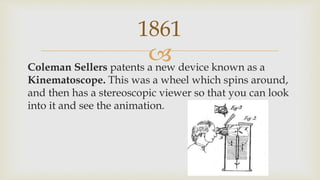
Coleman Sellers patents a new device known as a
Kinematoscope. This was a wheel which spins around,
and then has a stereoscopic viewer so that you can look
into it and see the animation.
1861

1880
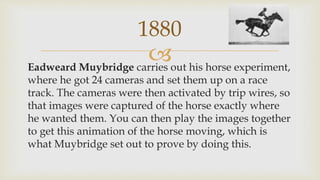
Eadweard Muybridge carries out his horse experiment,
where he got 24 cameras and set them up on a race
track. The cameras were then activated by trip wires, so
that images were captured of the horse exactly where
he wanted them. You can then play the images together
to get this animation of the horse moving, which is
what Muybridge set out to prove by doing this.
1880

1882
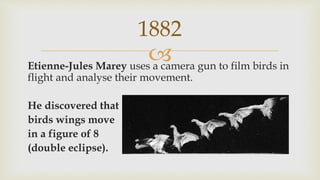
Etienne-Jules Marey uses a camera gun to film birds in
flight and analyse their movement.
He discovered that
birds wings move
in a figure of 8
(double eclipse).
1882

1882
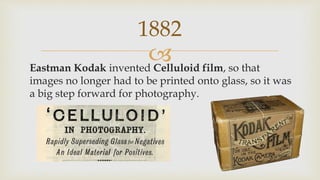
Eastman Kodak invented Celluloid film, so that
images no longer had to be printed onto glass, so it was
a big step forward for photography.

1895
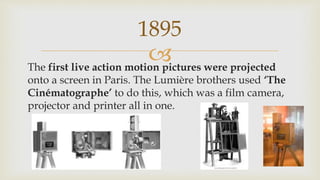
The first live action motion pictures were projected
onto a screen in Paris. The Lumière brothers used ‘The
Cinématographe’ to do this, which was a film camera,
projector and printer all in one.
1895

1899
First stop frame animation was made by Arthur-
Melbourne Cooper for the Bryant and May matchstick
company in London. The advertisement, shown at the
Empire Theatre in December 1899 asks for people to
donate money so that British Soldiers could be sent
matches in South Africa.
Animated matches wrote a message on a
Blackboard.
1899
Animation changed a lot in the 19th Century,
especially in the latter parts…
By Sam Jackson

Animation in the 1800's

  • 1.
  • 2.
  • 3.
    The Phenakistoscope wasinvented by a Belgian physicist named Joseph Plateau. The name is Greek for ‘optical deciever’. It is a circular spinner with several pictures on the outside, seperated with slits in the card between each image. As it spins, if you look through the slit, you can see the images in a mirror as a short moving animation. 1832
  • 4.
  • 5.
    William George Hornerinvented the Zoetrope. It was a projector for motion pictures. You put a sheet of still images in the drum and spin it, making them look animated. Unlike the Phenakistoscope, you didn’t need to look in a mirror to view the animation, and more than one person could see it at the same time. 1834
  • 6.
  • 7.
    William Henry FoxTalbot developed the Camera Obscura. This meant that images could now be projected onto different surfaces using light. 1838
  • 8.
  • 9.
    Coleman Sellers patentsa new device known as a Kinematoscope. This was a wheel which spins around, and then has a stereoscopic viewer so that you can look into it and see the animation. 1861
  • 10.
  • 11.
    Eadweard Muybridge carriesout his horse experiment, where he got 24 cameras and set them up on a race track. The cameras were then activated by trip wires, so that images were captured of the horse exactly where he wanted them. You can then play the images together to get this animation of the horse moving, which is what Muybridge set out to prove by doing this. 1880
  • 12.
  • 13.
    Etienne-Jules Marey usesa camera gun to film birds in flight and analyse their movement. He discovered that birds wings move in a figure of 8 (double eclipse). 1882
  • 14.
     1882 Eastman Kodak inventedCelluloid film, so that images no longer had to be printed onto glass, so it was a big step forward for photography.
  • 15.
  • 16.
    The first liveaction motion pictures were projected onto a screen in Paris. The Lumière brothers used ‘The Cinématographe’ to do this, which was a film camera, projector and printer all in one. 1895
  • 17.
  • 18.
    First stop frameanimation was made by Arthur- Melbourne Cooper for the Bryant and May matchstick company in London. The advertisement, shown at the Empire Theatre in December 1899 asks for people to donate money so that British Soldiers could be sent matches in South Africa. Animated matches wrote a message on a Blackboard. 1899
  • 19.
    Animation changed alot in the 19th Century, especially in the latter parts… By Sam Jackson