Filmmaking History
The Beginnings
Namra M. Guilmo
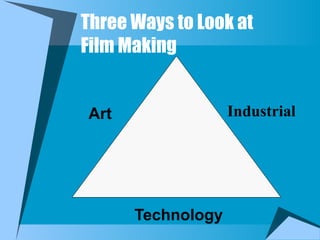
Three Ways to Look at
Film Making
Technology
Art Industrial
Filmmaking
A process of making a film of
moving images that they turn
into film. It is a very expensive
and complicated form of art,
involving many task ex. Script
writing, casting and editing
film sequences before they can
be shown to an audience. A full
length features films often
takes a many weeks or months
to produce.
Filmmaking
When did
it all started?
Photography
Had to have photography
before motion pictures
Important Dates
1816 - Nicephore
Niepce made first
photographic images.
1839 - Louis Daguerre
created clear, sharp
images on silver
copperplate.
 Required 15 minutes
exposure time.
1841 - Only 3 minutes
needed for exposure.
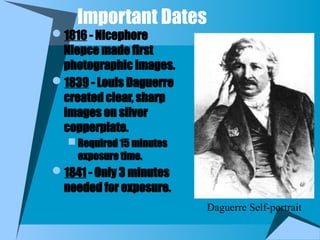
Daguerre Self-portrait
Filmmaking
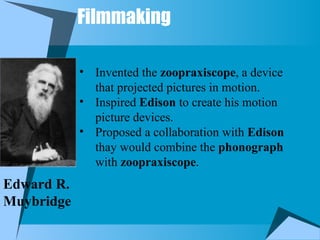
Edward R.
Muybridge
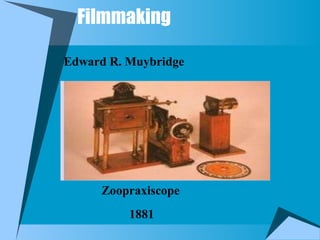
• Invented the zoopraxiscope, a device
that projected pictures in motion.
• Inspired Edison to create his motion
picture devices.
• Proposed a collaboration with Edison
thay would combine the phonograph
with zoopraxiscope.
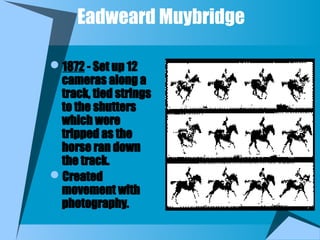
Eadweard Muybridge
1872 - Set up 12
cameras along a
track, tied strings
to the shutters
which were
tripped as the
horse ran down
the track.
Created
movement with
photography.
Filmmaking
Edward R. Muybridge
Zoopraxiscope
1881
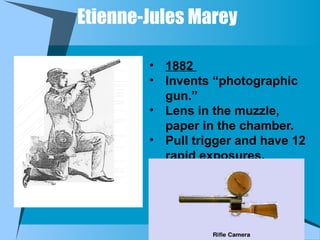
Etienne-Jules Marey
• 1882
• Invents “photographic
gun.”
• Lens in the muzzle,
paper in the chamber.
• Pull trigger and have 12
rapid exposures.
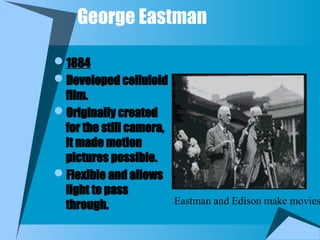
George Eastman
1884
Developed celluloid
film.
Originally created
for the still camera,
it made motion
pictures possible.
Flexible and allows
light to pass
through. Eastman and Edison make movies
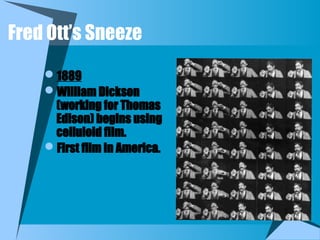
1889
William Dickson
(working for Thomas
Edison) begins using
celluloid film.
First film in America.
Fred Ott’s Sneeze
Motion Picture
Photography Solved!
Filmmakers now had to
find a way to show their
images.
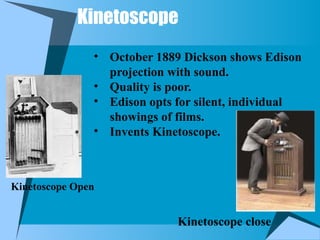
Kinetoscope
Kinetoscope Open
• October 1889 Dickson shows Edison
projection with sound.
• Quality is poor.
• Edison opts for silent, individual
showings of films.
• Invents Kinetoscope.
Kinetoscope close
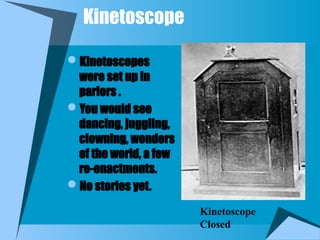
Kinetoscope
Kinetoscopes
were set up in
parlors .
You would see
dancing, juggling,
clowning, wonders
of the world, a few
re-enactments.
No stories yet.
Kinetoscope
Closed
Thomas Edison
• Despite Edison’s shortsightedness in mass
projection he did leave his mark on motion
pictures.
• He contributed sprocket holes on film.
• Black Maria.
• First movie studio.
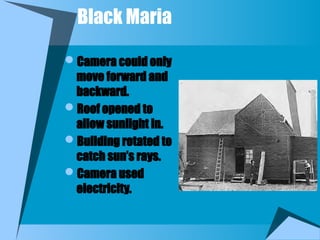
Black Maria
Camera could only
move forward and
backward.
Roof opened to
allow sunlight in.
Building rotated to
catch sun’s rays.
Camera used
electricity.
These are a few of the
contributions from
America. The history now
goes back to Europe.
Projection
Projection was a difficult
problem to solve. Its roots go
back as far as 1646.
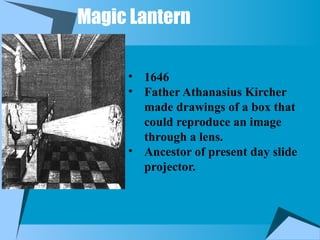
Magic Lantern
• 1646
• Father Athanasius Kircher
made drawings of a box that
could reproduce an image
through a lens.
• Ancestor of present day slide
projector.
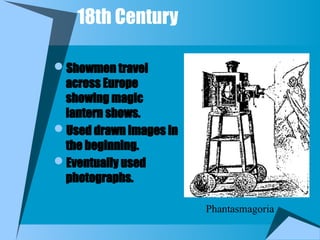
18th Century
Showmen travel
across Europe
showing magic
lantern shows.
Used drawn images in
the beginning.
Eventually used
photographs.
Phantasmagoria
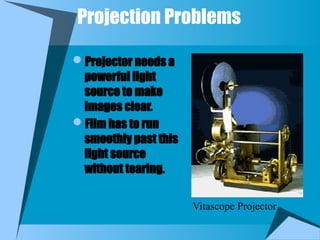
Projection Problems
Projector needs a
powerful light
source to make
images clear.
Film has to run
smoothly past this
light source
without tearing.
Vitascope Projector
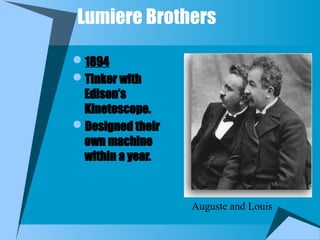
Lumiere Brothers
1894
Tinker with
Edison’s
Kinetoscope.
Designed their
own machine
within a year.
Auguste and Louis
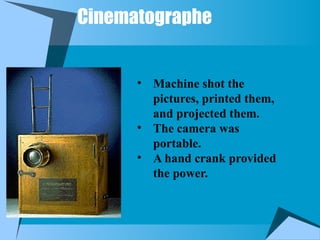
Cinematographe
• Machine shot the
pictures, printed them,
and projected them.
• The camera was
portable.
• A hand crank provided
the power.
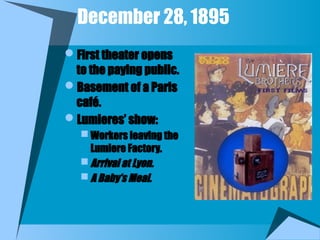
December 28, 1895
First theater opens
to the paying public.
Basement of a Paris
café.
Lumieres’ show:
 Workers leaving the
Lumiere Factory.
 Arrival at Lyon.
 A Baby’s Meal.
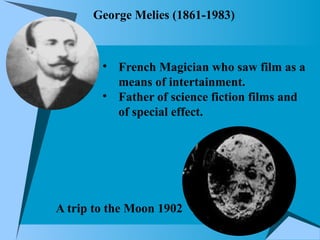
George Melies (1861-1983)
• French Magician who saw film as a
means of intertainment.
• Father of science fiction films and
of special effect.
A trip to the Moon 1902
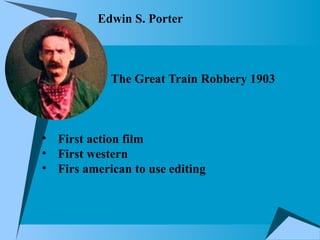
Edwin S. Porter
The Great Train Robbery 1903
• First action film
• First western
• Firs american to use editing
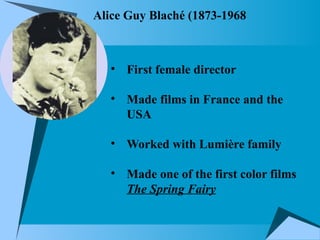
Alice Guy Blaché (1873-1968
• First female director
• Made films in France and the
USA
• Worked with Lumière family
• Made one of the first color films
The Spring Fairy
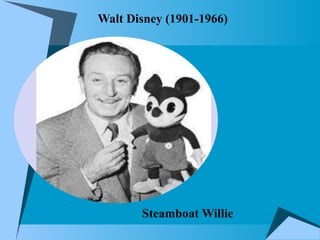
Walt Disney (1901-1966)
Steamboat Willie
The End of the Studio System
• Televisions were first mass-produce in
1947.
• The film industry saw Televisions as a
threat to them.
• Attendance to movie theathers decreased.
THANK
YOU

Fimmaking report in visual art subject report