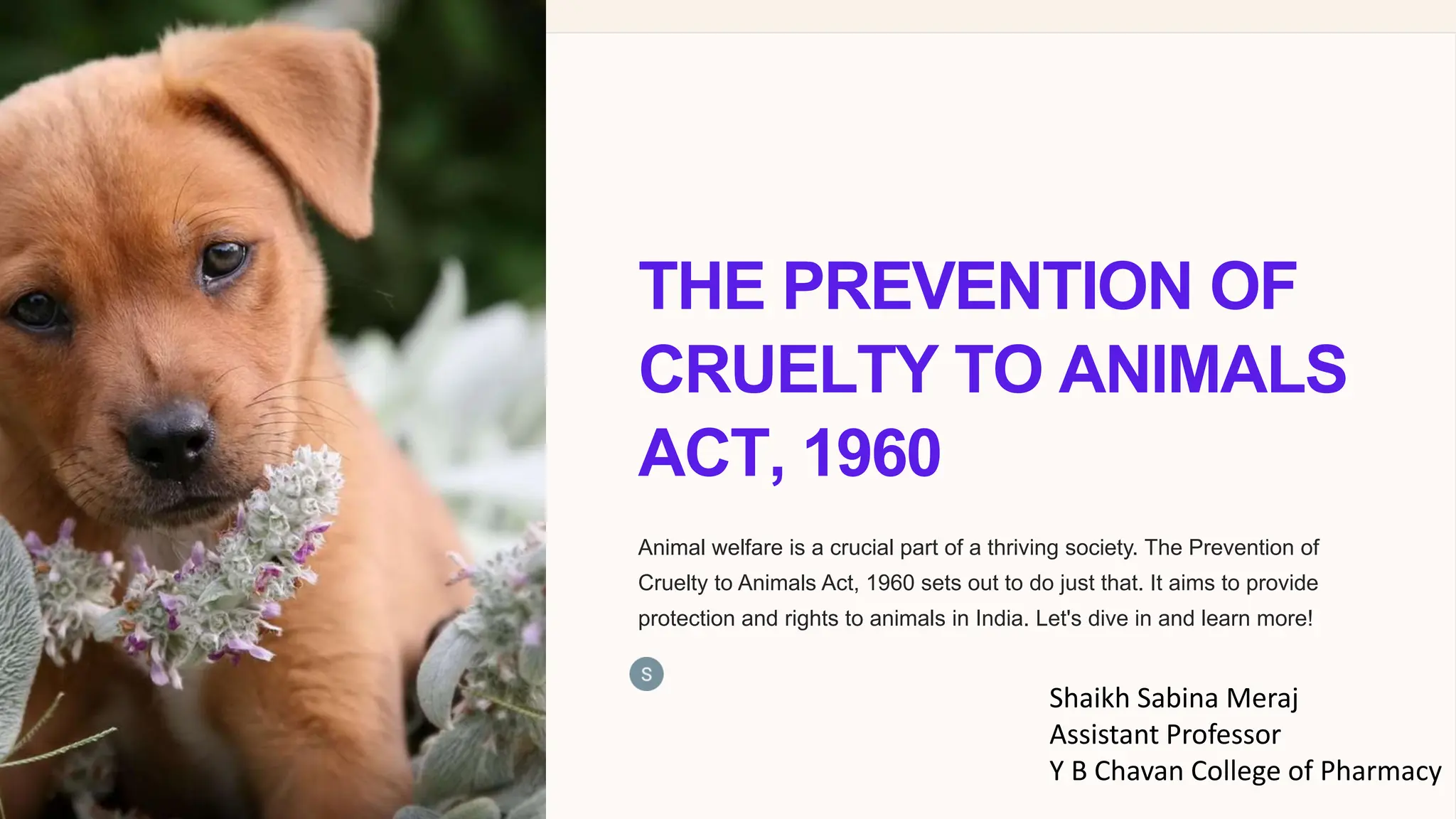
THE PREVENTION OF
CRUELTY TO ANIMALS
ACT, 1960
Animal welfare is a crucial part of a thriving society. The Prevention of
Cruelty to Animals Act, 1960 sets out to do just that. It aims to provide
protection and rights to animals in India. Let's dive in and learn more!
Shaikh Sabina Meraj
Assistant Professor
Y B Chavan College of Pharmacy
Objectives of the Act
Prevent Cruelty
The act aims to prevent cruelty
to all animals, including stray
animals, farm animals, and
animals used for
experimentation.
Promote Animal Welfare
Animal welfare is central to the
act, promoting proper care,
nutrition, and environment for
all animals.
Encourage Compassion
The act aims to instill
compassion and respect for
animals in all people,
especially children.
Definations
An Animal
An animal is any living being that feels pain,
pleasure, happiness, or sadness.
Phooka
Phooka means dragging, hauling or lifting
any animal by any part of its body.
Cruelty
Cruelty means any act that causes
unnecessary pain or suffering to animals.
This includes physical, mental or emotional
abuse.
Acting Against Cruelty
If you witness cruelty to animals, you must
take action by reporting it to the authorities.
It's your responsibility to protect their welfare.
ANIMAL WELFARE BOARD
OF INDIA
This Board is established by Central Government
(a) to promote animal welfare generally and
(b) to protect animals from unnecessary pain or suffering in partie The
Board consists of the various members. The Central Govern members to
be its Chairman and another member to be Its vi Government may
appoint secretary of the Board.
Role of the Animal Welfare Board
1 Central Board
The Animal Welfare Board of India is a
central board that monitors and
advises the government on all matters
related to animal welfare.
2
Functions
The board plays a crucial role in
promoting animal welfare through
education, awareness, and
implementation of policies across
India.
3 Local Chapters
The board has local chapters that work
alongside organizations to implement
animal welfare programs in
communities and protect the welfare of
all animals.
Functions:
• Protect animals by enforcing the law and preventing cruelty
• Create rules to minimize animal suffering during transportation, performances, and captivity
• Advise the government on improving vehicle designs to reduce burden on working animals
• Provide shelters, water troughs, and veterinary assistance to improve animal welfare
• Support the formation of rescue homes and shelters for old animals and birds
Function
• Work with associations to protect animals from pain and suffering
• Advise the government on improving medical care and attention for animals in hospitals
• Teach people how to treat animals with kindness and respect through lectures, books, and posters
• Provide expert guidance to the government on other matters related to animal welfare
Regulating Animal Experimentation
Committee for
Experimentation on
Animals
The committee is responsible
for regulating the use of
animals in experiments and
ensuring appropriate care and
treatment.
Composition of the
Committee
The committee is made up of
scientists, animal welfare
experts, and members of the
public who are committed to
safeguarding animal welfare
while allowing for scientific
research.
Rules for
Experimentation
The committee has established
strict rules for animal
experimentation to ensure that
animals are only used when
necessary and that the
experiments cause them the
least amount of harm possible.
The members of the committee are as
follows
i) Two members each of the
(a) Indian council of Medical Research.
(b) Indian Council of Agricultural Research and
(c) Council of Scientific and Industrial Research.
nominated by the Central Government
ii) Two members from universities giving medical and veterinary degrees nominated by the Central
Government.
iii) One member of the Lok Sabha and one of the Rajya Sabha to be elected by the Houses respectively.
iv) Five non-oficial members from the persons actively engaged in the promotion of animal welfare
nominated by the Central Government.
The committee shall also make such
rules so as to secure the following
objects:
1. Be kind to our furry friends! Institution leaders and outside researchers must be responsible for
avoiding any cruelty to animals during experiments.
2. Give 'em a little love. Whenever possible, use anaesthetics and perform experiments with care
and humanity.
3. When things go wrong, do the right thing. If an animal becomes too injured to recover without
serious pain, it should be gently put down while still unconscious.
4. Books, models, and films can be just as good! Whenever possible, avoid experiments on animals
if other teaching tools are sufficient.
5. Size doesn't matter! Use smaller laboratory animals like rats, frogs, or rabbits whenever possible.
6. Practice makes perfect, but not on our animal friends. Avoid performing experiments on animals
just for practice.
7. Take good care of our animal participants. Properly look after them before and after experiments.
8. Keep good records. Make sure to maintain proper records of animal experimentation.
Prohibition of Animal
Experimentation
1 Alternatives
The act outlines that animals
should only be used for
experimentation if there is no
alternative available.
Researchers are encouraged to
use alternative methods of
research and scientific
investigation.
2 Harm Reduction
If animals are used, the
experiments should be
conducted in such a way that it
causes the least amount of
harm possible and is as
painless as it can be.
3 Penalties
Violations of the act can result in hefty fines or imprisonment. Offenders
may be fined up to $50 or sentenced to three months in prison, or both.
Offences and penalties
1. Treating animals cruelly is punishable with fine not less than 10 rupees which may extend to ,
50rupees on first conviction.
In the case of subsequent conviction if the offence is committed within three years of previous offence, it
is punishable with fine not less than 25 rupees which may extend to 100 rupees or imprisonment upto
three months or with both.
2. Performing the operation like Phooka or doom dev or any other operations to improve lactation
which are injurious to health of the animal is punishable with fine upto rupees 1000/-or with
imprisonment upto two years or with both. The animal subjected to such operation is liable to
forfeiture to the Government.
3. Contravention of any order made by the committee or a breach of any condition imposed by the
committee is punishable with the fine upto 200/-.

V sem pharmaceutical jurisprudence, THE-PREVENTION-OF-CRUELTY-TO-ANIMALS-ACT-1960

  • 1.
    THE PREVENTION OF CRUELTYTO ANIMALS ACT, 1960 Animal welfare is a crucial part of a thriving society. The Prevention of Cruelty to Animals Act, 1960 sets out to do just that. It aims to provide protection and rights to animals in India. Let's dive in and learn more! Shaikh Sabina Meraj Assistant Professor Y B Chavan College of Pharmacy
  • 2.
    Objectives of theAct Prevent Cruelty The act aims to prevent cruelty to all animals, including stray animals, farm animals, and animals used for experimentation. Promote Animal Welfare Animal welfare is central to the act, promoting proper care, nutrition, and environment for all animals. Encourage Compassion The act aims to instill compassion and respect for animals in all people, especially children.
  • 3.
    Definations An Animal An animalis any living being that feels pain, pleasure, happiness, or sadness. Phooka Phooka means dragging, hauling or lifting any animal by any part of its body. Cruelty Cruelty means any act that causes unnecessary pain or suffering to animals. This includes physical, mental or emotional abuse. Acting Against Cruelty If you witness cruelty to animals, you must take action by reporting it to the authorities. It's your responsibility to protect their welfare.
  • 4.
    ANIMAL WELFARE BOARD OFINDIA This Board is established by Central Government (a) to promote animal welfare generally and (b) to protect animals from unnecessary pain or suffering in partie The Board consists of the various members. The Central Govern members to be its Chairman and another member to be Its vi Government may appoint secretary of the Board.
  • 5.
    Role of theAnimal Welfare Board 1 Central Board The Animal Welfare Board of India is a central board that monitors and advises the government on all matters related to animal welfare. 2 Functions The board plays a crucial role in promoting animal welfare through education, awareness, and implementation of policies across India. 3 Local Chapters The board has local chapters that work alongside organizations to implement animal welfare programs in communities and protect the welfare of all animals.
  • 6.
    Functions: • Protect animalsby enforcing the law and preventing cruelty • Create rules to minimize animal suffering during transportation, performances, and captivity • Advise the government on improving vehicle designs to reduce burden on working animals • Provide shelters, water troughs, and veterinary assistance to improve animal welfare • Support the formation of rescue homes and shelters for old animals and birds
  • 7.
    Function • Work withassociations to protect animals from pain and suffering • Advise the government on improving medical care and attention for animals in hospitals • Teach people how to treat animals with kindness and respect through lectures, books, and posters • Provide expert guidance to the government on other matters related to animal welfare
  • 8.
    Regulating Animal Experimentation Committeefor Experimentation on Animals The committee is responsible for regulating the use of animals in experiments and ensuring appropriate care and treatment. Composition of the Committee The committee is made up of scientists, animal welfare experts, and members of the public who are committed to safeguarding animal welfare while allowing for scientific research. Rules for Experimentation The committee has established strict rules for animal experimentation to ensure that animals are only used when necessary and that the experiments cause them the least amount of harm possible.
  • 9.
    The members ofthe committee are as follows i) Two members each of the (a) Indian council of Medical Research. (b) Indian Council of Agricultural Research and (c) Council of Scientific and Industrial Research. nominated by the Central Government ii) Two members from universities giving medical and veterinary degrees nominated by the Central Government. iii) One member of the Lok Sabha and one of the Rajya Sabha to be elected by the Houses respectively. iv) Five non-oficial members from the persons actively engaged in the promotion of animal welfare nominated by the Central Government.
  • 10.
    The committee shallalso make such rules so as to secure the following objects: 1. Be kind to our furry friends! Institution leaders and outside researchers must be responsible for avoiding any cruelty to animals during experiments. 2. Give 'em a little love. Whenever possible, use anaesthetics and perform experiments with care and humanity. 3. When things go wrong, do the right thing. If an animal becomes too injured to recover without serious pain, it should be gently put down while still unconscious. 4. Books, models, and films can be just as good! Whenever possible, avoid experiments on animals if other teaching tools are sufficient. 5. Size doesn't matter! Use smaller laboratory animals like rats, frogs, or rabbits whenever possible. 6. Practice makes perfect, but not on our animal friends. Avoid performing experiments on animals just for practice. 7. Take good care of our animal participants. Properly look after them before and after experiments. 8. Keep good records. Make sure to maintain proper records of animal experimentation.
  • 11.
    Prohibition of Animal Experimentation 1Alternatives The act outlines that animals should only be used for experimentation if there is no alternative available. Researchers are encouraged to use alternative methods of research and scientific investigation. 2 Harm Reduction If animals are used, the experiments should be conducted in such a way that it causes the least amount of harm possible and is as painless as it can be. 3 Penalties Violations of the act can result in hefty fines or imprisonment. Offenders may be fined up to $50 or sentenced to three months in prison, or both.
  • 12.
    Offences and penalties 1.Treating animals cruelly is punishable with fine not less than 10 rupees which may extend to , 50rupees on first conviction. In the case of subsequent conviction if the offence is committed within three years of previous offence, it is punishable with fine not less than 25 rupees which may extend to 100 rupees or imprisonment upto three months or with both. 2. Performing the operation like Phooka or doom dev or any other operations to improve lactation which are injurious to health of the animal is punishable with fine upto rupees 1000/-or with imprisonment upto two years or with both. The animal subjected to such operation is liable to forfeiture to the Government. 3. Contravention of any order made by the committee or a breach of any condition imposed by the committee is punishable with the fine upto 200/-.