   Name 3 examples of angles in the real
    world.
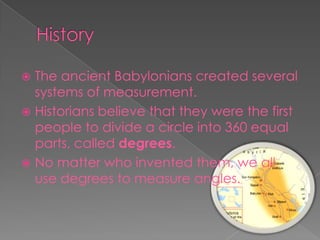
 The ancient Babylonians created several
  systems of measurement.
 Historians believe that they were the first
  people to divide a circle into 360 equal
  parts, called degrees.
 No matter who invented them, we all
  use degrees to measure angles.
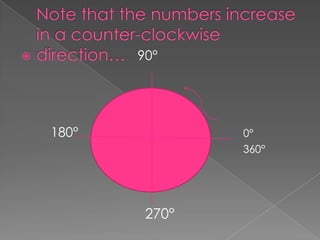
          90°


    180°           0°
                   360°


            270°
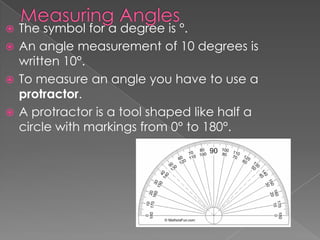
 The symbol for a degree is °.
 An angle measurement of 10 degrees is
  written 10°.
 To measure an angle you have to use a
  protractor.
 A protractor is a tool shaped like half a
  circle with markings from 0° to 180°.
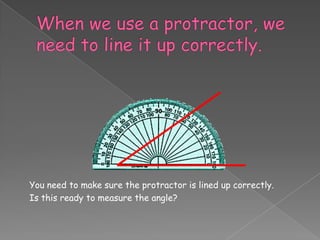
You need to make sure the protractor is lined up correctly.
Is this ready to measure the angle?
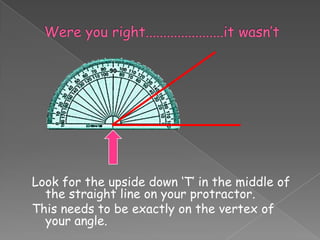
Look for the upside down ‘T’ in the middle of
  the straight line on your protractor.
This needs to be exactly on the vertex of
  your angle.
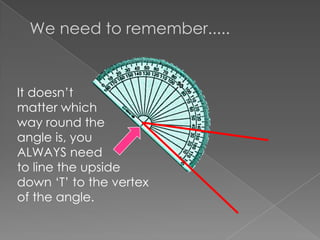
We need to remember.....


It doesn’t
matter which
way round the
angle is, you
ALWAYS need
to line the upside
down ‘T’ to the vertex
of the angle.
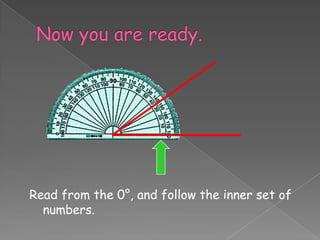
Read from the 0°, and follow the inner set of
  numbers.
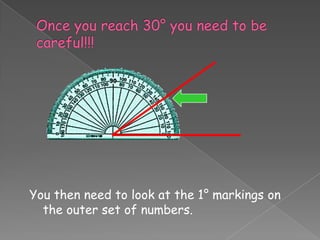
You then need to look at the 1° markings on
  the outer set of numbers.
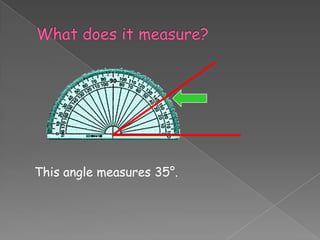
This angle measures 35°.
 Turn to page 15 in your textbook.
 Measure angle a.
 What did you get?
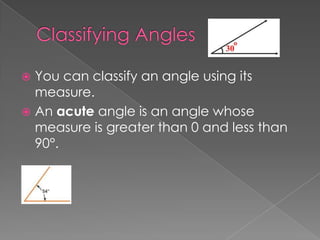
 You can classify an angle using its
  measure.
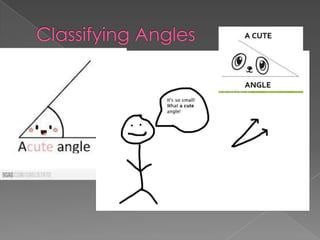
 An acute angle is an angle whose
  measure is greater than 0 and less than
  90°.
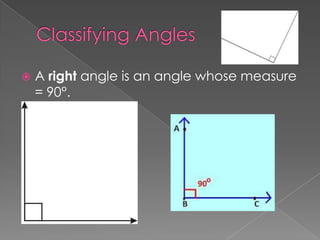
   A right angle is an angle whose measure
    = 90°.
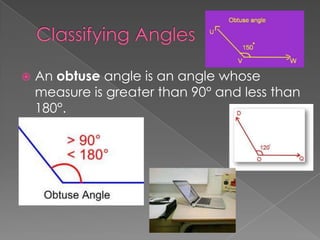
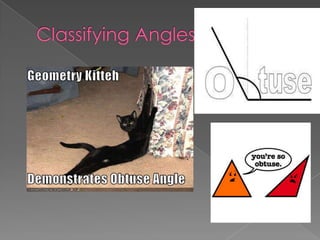
   An obtuse angle is an angle whose
    measure is greater than 90° and less than
    180°.
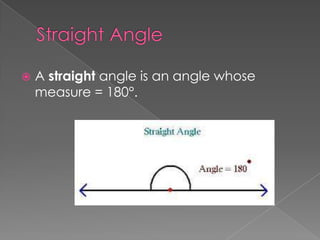
   A straight angle is an angle whose
    measure = 180°.
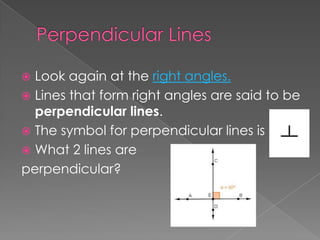
 Look again at the right angles.
 Lines that form right angles are said to be
  perpendicular lines.
 The symbol for perpendicular lines is
 What 2 lines are
perpendicular?
 Complete pages 18-19 All
 You have 15 minutes.
 Homework: Workbook 5… You need a
  protractor!!

1.4 Measuring and Classifying Angles

  • 2.
    Name 3 examples of angles in the real world.
  • 3.
     The ancientBabylonians created several systems of measurement.  Historians believe that they were the first people to divide a circle into 360 equal parts, called degrees.  No matter who invented them, we all use degrees to measure angles.
  • 4.
    90° 180° 0° 360° 270°
  • 5.
     The symbolfor a degree is °.  An angle measurement of 10 degrees is written 10°.  To measure an angle you have to use a protractor.  A protractor is a tool shaped like half a circle with markings from 0° to 180°.
  • 6.
    You need tomake sure the protractor is lined up correctly. Is this ready to measure the angle?
  • 7.
    Look for theupside down ‘T’ in the middle of the straight line on your protractor. This needs to be exactly on the vertex of your angle.
  • 8.
    We need toremember..... It doesn’t matter which way round the angle is, you ALWAYS need to line the upside down ‘T’ to the vertex of the angle.
  • 9.
    Read from the0°, and follow the inner set of numbers.
  • 10.
    You then needto look at the 1° markings on the outer set of numbers.
  • 11.
  • 12.
     Turn topage 15 in your textbook.  Measure angle a.  What did you get?
  • 13.
     You canclassify an angle using its measure.  An acute angle is an angle whose measure is greater than 0 and less than 90°.
  • 15.
    A right angle is an angle whose measure = 90°.
  • 17.
    An obtuse angle is an angle whose measure is greater than 90° and less than 180°.
  • 19.
    A straight angle is an angle whose measure = 180°.
  • 20.
     Look againat the right angles.  Lines that form right angles are said to be perpendicular lines.  The symbol for perpendicular lines is  What 2 lines are perpendicular?
  • 21.
     Complete pages18-19 All  You have 15 minutes.  Homework: Workbook 5… You need a protractor!!