BASIC GEOMETRY
Std 5
An introduction to point, lines, plane and angles.
POINT
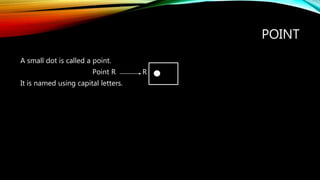
A small dot is called a point.
Point R R
It is named using capital letters.
LINE SEGMENT
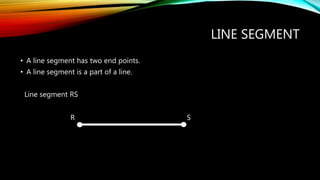
• A line segment has two end points.
• A line segment is a part of a line.
Line segment RS
R S
RAY
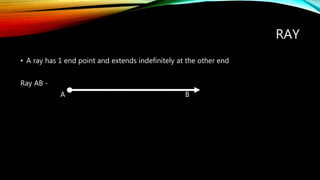
• A ray has 1 end point and extends indefinitely at the other end
Ray AB -
A B
LINE
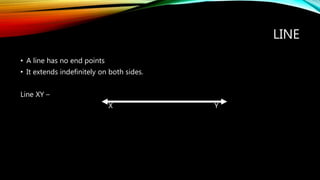
• A line has no end points
• It extends indefinitely on both sides.
Line XY –
X Y
COLLINEAR AND NON COLLINEAR POINTS
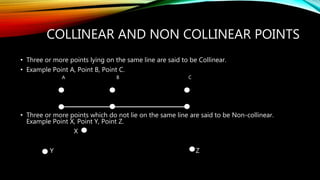
• Three or more points lying on the same line are said to be Collinear.
• Example Point A, Point B, Point C.
A B C
• Three or more points which do not lie on the same line are said to be Non-collinear.
Example Point X, Point Y, Point Z.
X
Y Z
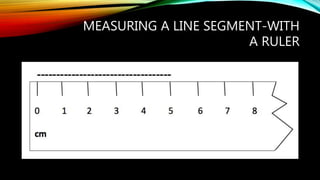
MEASURING A LINE SEGMENT-WITH
A RULER
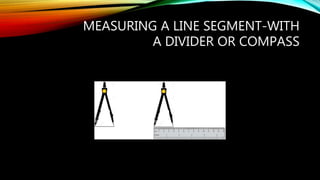
MEASURING A LINE SEGMENT-WITH
A DIVIDER OR COMPASS
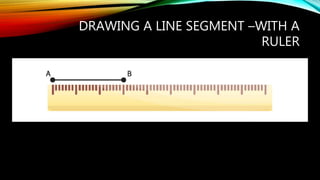
DRAWING A LINE SEGMENT –WITH A
RULER
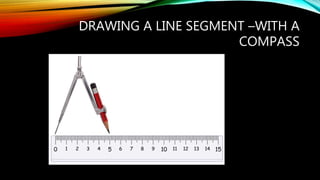
DRAWING A LINE SEGMENT –WITH A
COMPASS
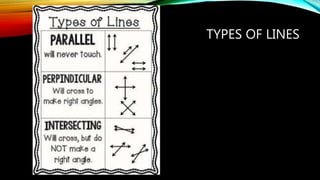
TYPES OF LINES
ANGLE
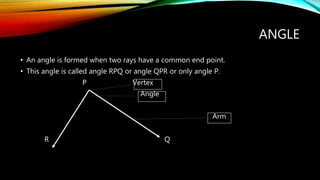
• An angle is formed when two rays have a common end point.
• This angle is called angle RPQ or angle QPR or only angle P.
P Vertex
Angle
Arm
R Q
TYPES OF ANGLES
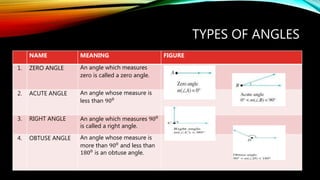
NAME MEANING FIGURE
1. ZERO ANGLE An angle which measures
zero is called a zero angle.
2. ACUTE ANGLE An angle whose measure is
less than 900
3. RIGHT ANGLE An angle which measures 900
is called a right angle.
4. OBTUSE ANGLE An angle whose measure is
more than 900 and less than
1800
is an obtuse angle.
TYPES OF ANGLES
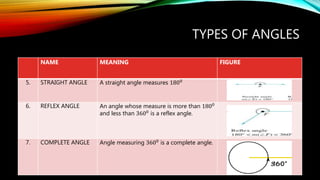
NAME MEANING FIGURE
5. STRAIGHT ANGLE A straight angle measures 1800
6. REFLEX ANGLE An angle whose measure is more than 1800
and less than 3600 is a reflex angle.
7. COMPLETE ANGLE Angle measuring 3600 is a complete angle.
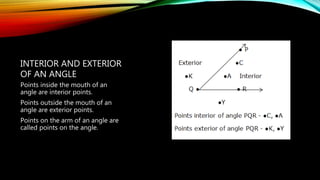
Points inside the mouth of an
angle are interior points.
Points outside the mouth of an
angle are exterior points.
Points on the arm of an angle are
called points on the angle.
INTERIOR AND EXTERIOR
OF AN ANGLE
SIZE OF AN ANGLE
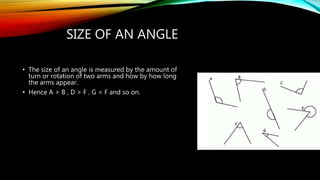
• The size of an angle is measured by the amount of
turn or rotation of two arms and how by how long
the arms appear.
• Hence A > B , D > F , G < F and so on.
MATH FACT
FROM INDIA

BASIC GEOMETRY.pptx

  • 1.
    BASIC GEOMETRY Std 5 Anintroduction to point, lines, plane and angles.
  • 2.
    POINT A small dotis called a point. Point R R It is named using capital letters.
  • 3.
    LINE SEGMENT • Aline segment has two end points. • A line segment is a part of a line. Line segment RS R S
  • 4.
    RAY • A rayhas 1 end point and extends indefinitely at the other end Ray AB - A B
  • 5.
    LINE • A linehas no end points • It extends indefinitely on both sides. Line XY – X Y
  • 6.
    COLLINEAR AND NONCOLLINEAR POINTS • Three or more points lying on the same line are said to be Collinear. • Example Point A, Point B, Point C. A B C • Three or more points which do not lie on the same line are said to be Non-collinear. Example Point X, Point Y, Point Z. X Y Z
  • 7.
    MEASURING A LINESEGMENT-WITH A RULER
  • 8.
    MEASURING A LINESEGMENT-WITH A DIVIDER OR COMPASS
  • 9.
    DRAWING A LINESEGMENT –WITH A RULER
  • 10.
    DRAWING A LINESEGMENT –WITH A COMPASS
  • 11.
  • 12.
    ANGLE • An angleis formed when two rays have a common end point. • This angle is called angle RPQ or angle QPR or only angle P. P Vertex Angle Arm R Q
  • 13.
    TYPES OF ANGLES NAMEMEANING FIGURE 1. ZERO ANGLE An angle which measures zero is called a zero angle. 2. ACUTE ANGLE An angle whose measure is less than 900 3. RIGHT ANGLE An angle which measures 900 is called a right angle. 4. OBTUSE ANGLE An angle whose measure is more than 900 and less than 1800 is an obtuse angle.
  • 14.
    TYPES OF ANGLES NAMEMEANING FIGURE 5. STRAIGHT ANGLE A straight angle measures 1800 6. REFLEX ANGLE An angle whose measure is more than 1800 and less than 3600 is a reflex angle. 7. COMPLETE ANGLE Angle measuring 3600 is a complete angle.
  • 15.
    Points inside themouth of an angle are interior points. Points outside the mouth of an angle are exterior points. Points on the arm of an angle are called points on the angle. INTERIOR AND EXTERIOR OF AN ANGLE
  • 16.
    SIZE OF ANANGLE • The size of an angle is measured by the amount of turn or rotation of two arms and how by how long the arms appear. • Hence A > B , D > F , G < F and so on.
  • 17.