Angle and Properties
For class VII
Prepared by
GOlam Robbani Ahmed
Angles
An angle is formed when two lines meet. The size
of the angle measures the amount of space
between the lines. In the diagram the lines ba and
bc are called the ‘arms’ of the angle, and the point
‘b’ at which they meet is called the ‘vertex’ of the
angle. An angle is denoted by the symbol  .An
angle can be named in one of the three ways:
a
c
b
.
.Amount of space
Angle
1. Three letters
a
b
c
.
.
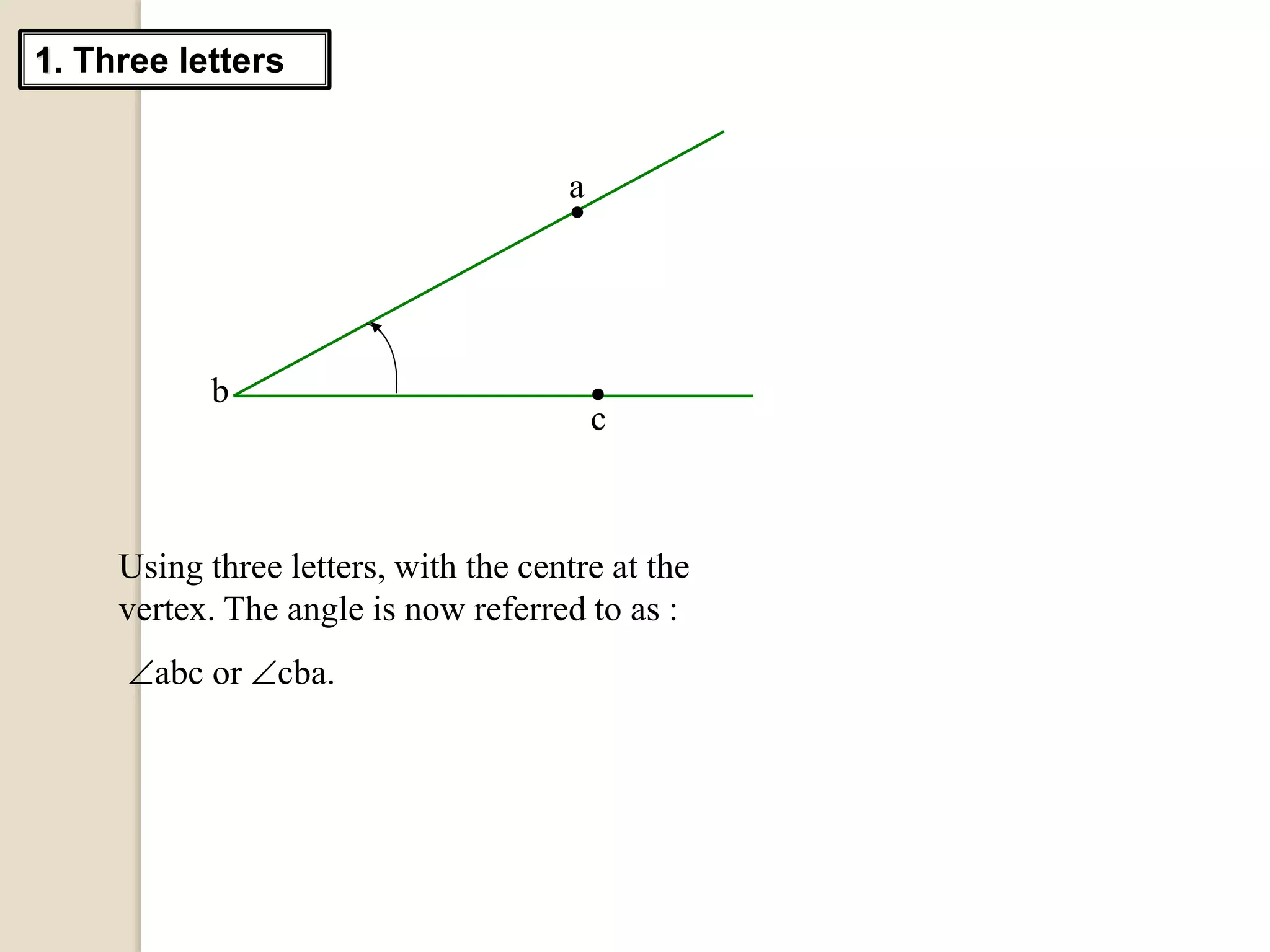
Using three letters, with the centre at the
vertex. The angle is now referred to as :
abc or cba.
2. A number
c
b
.
.1
a
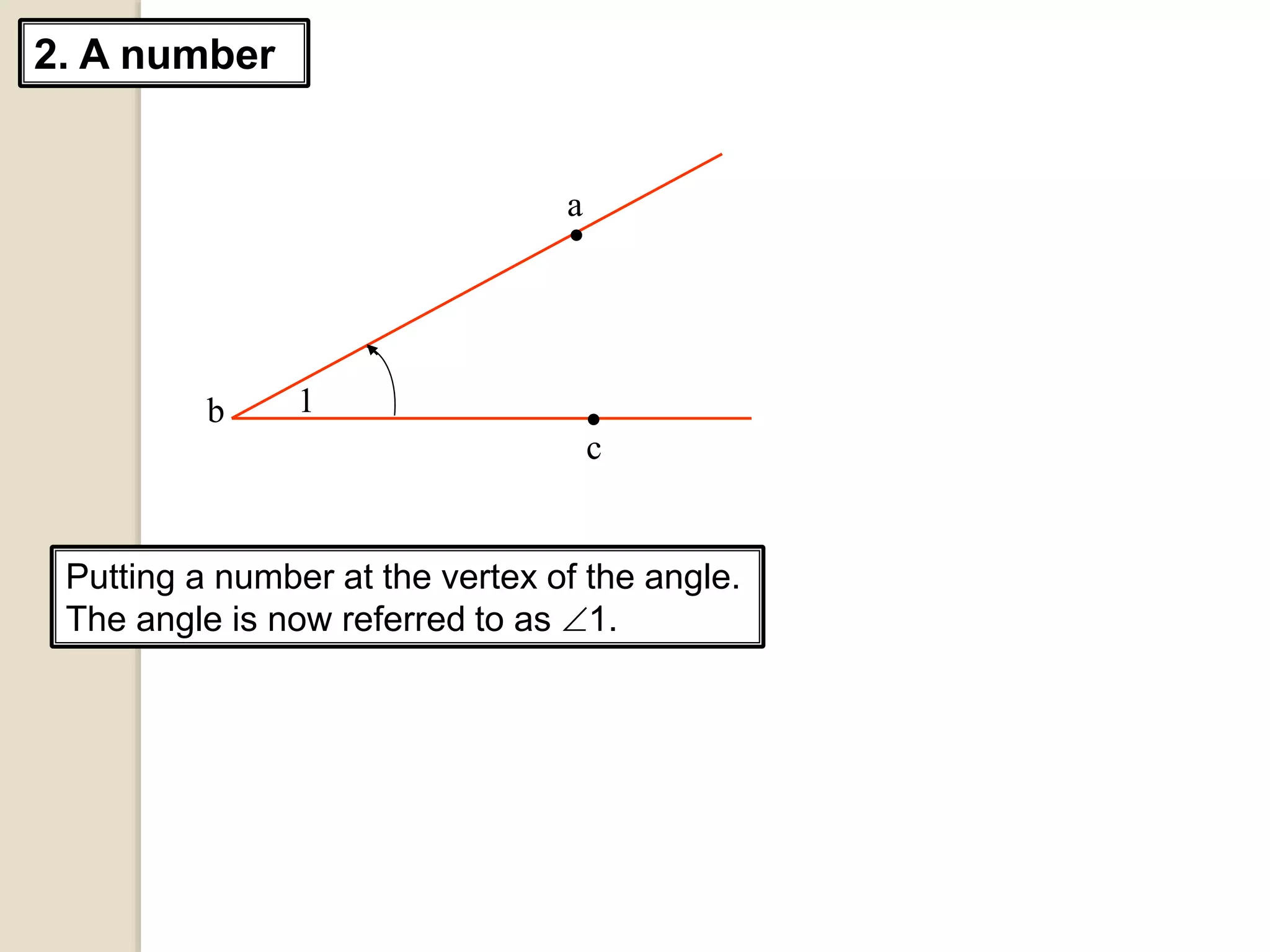
Putting a number at the vertex of the angle.
The angle is now referred to as 1.
3. A capital letter
b
.
.B
a
c
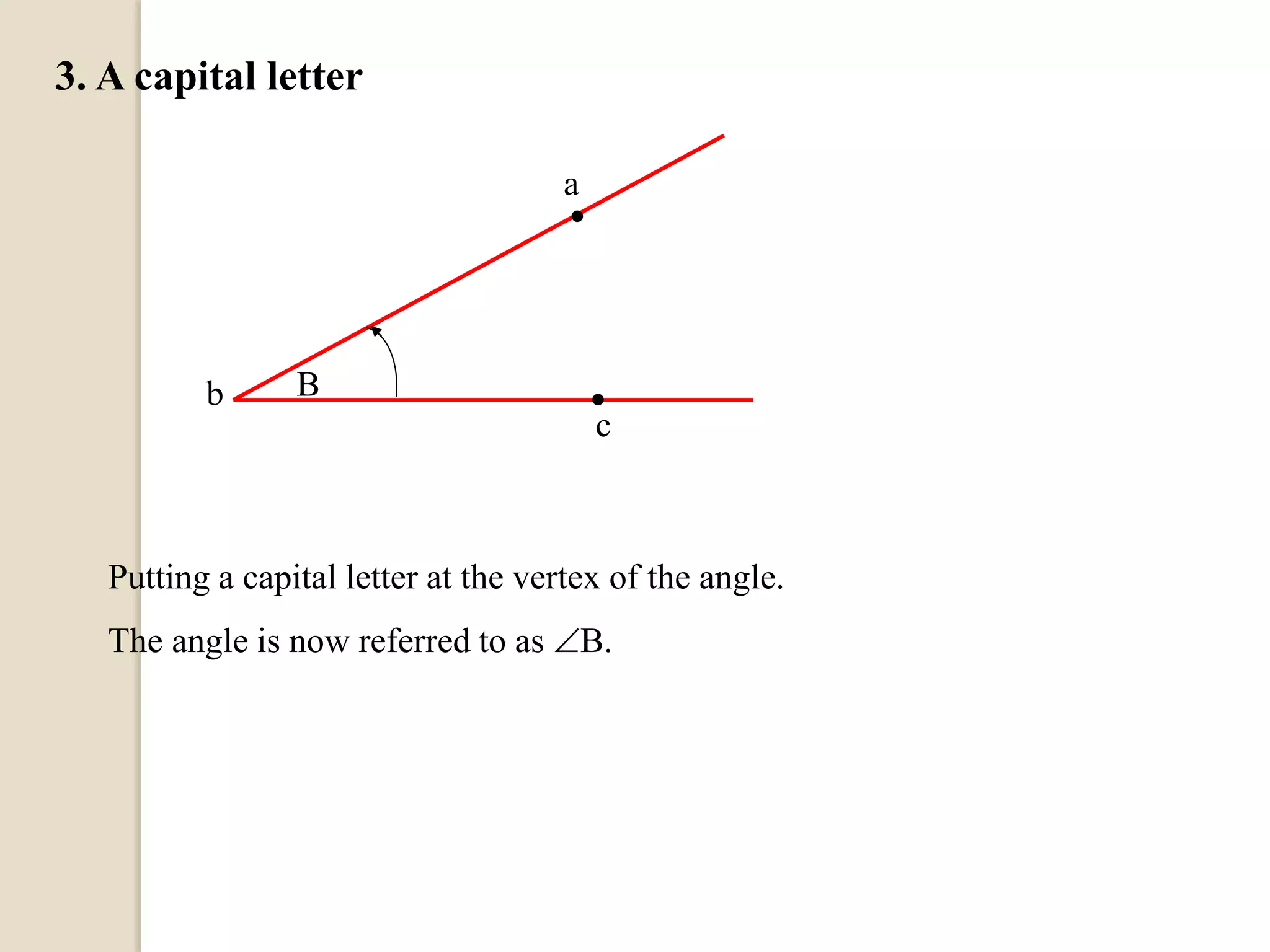
Putting a capital letter at the vertex of the angle.
The angle is now referred to as B.
Right angle
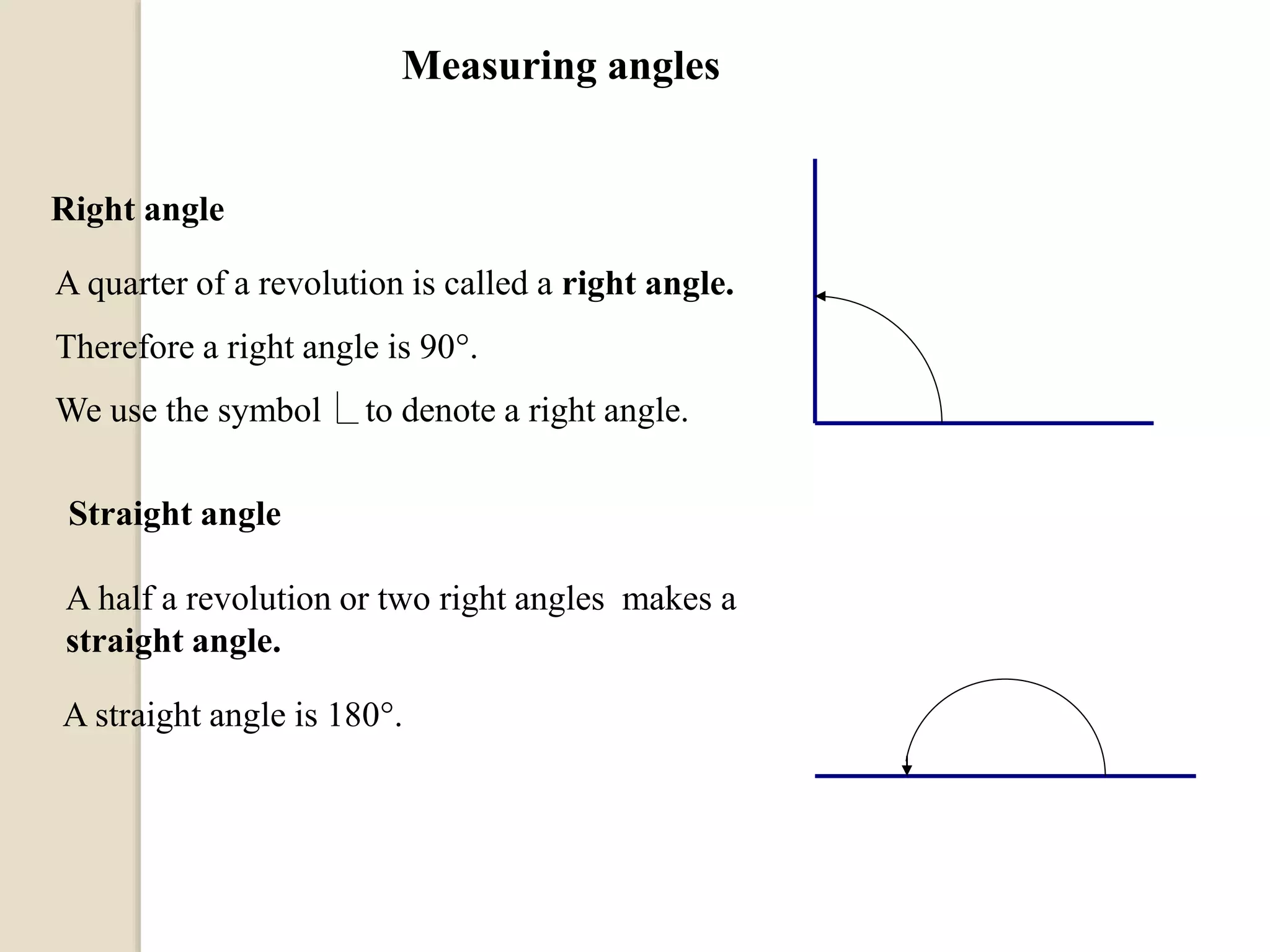
A quarter of a revolution is called a right angle.
Therefore a right angle is 90.
Straight angle
A half a revolution or two right angles makes a
straight angle.
A straight angle is 180.
Measuring angles
We use the symbol to denote a right angle.
Acute, Obtuse and reflex Angles
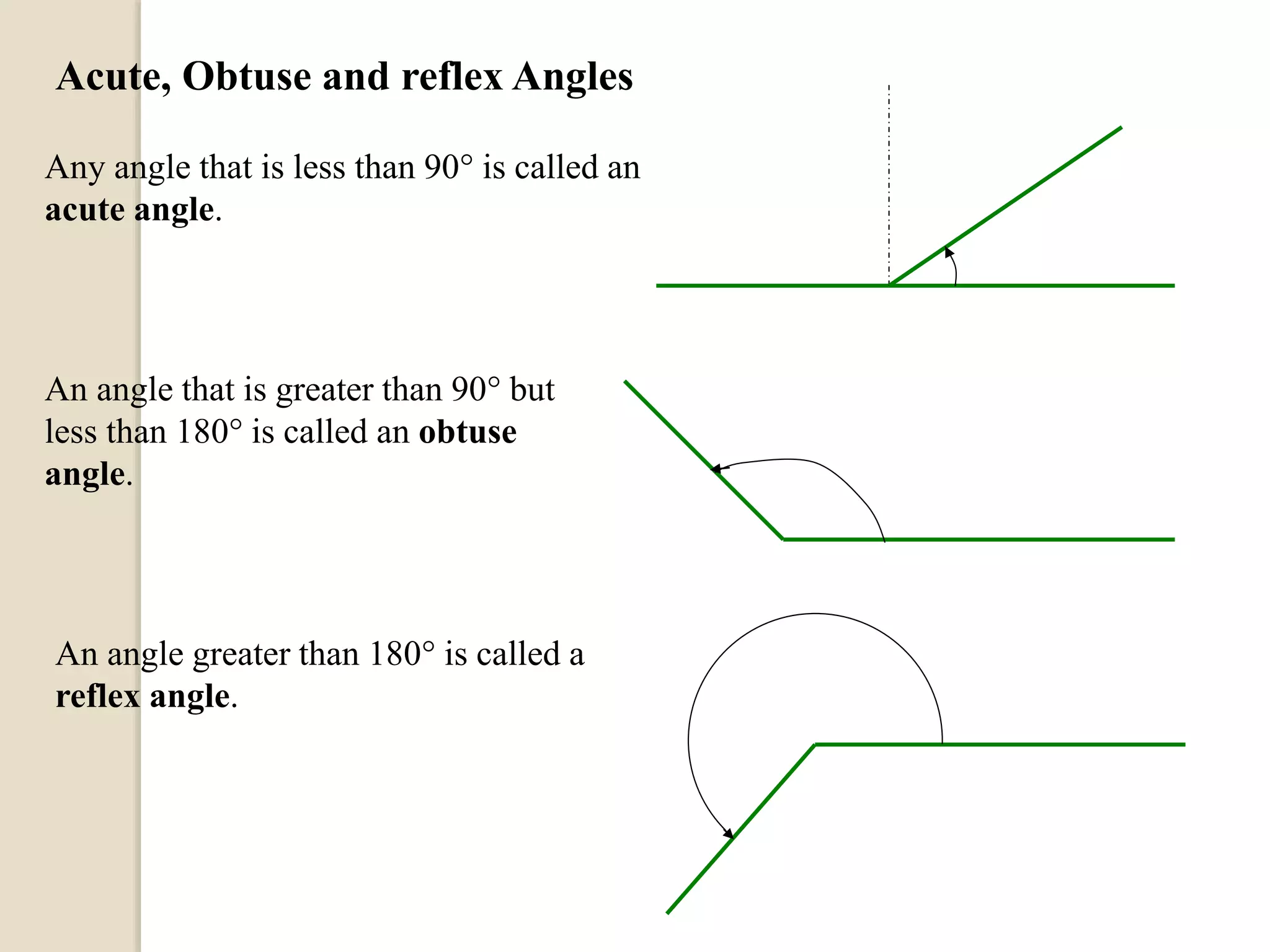
Any angle that is less than 90 is called an
acute angle.
An angle that is greater than 90 but
less than 180 is called an obtuse
angle.
An angle greater than 180 is called a
reflex angle.
Angles on a straight line
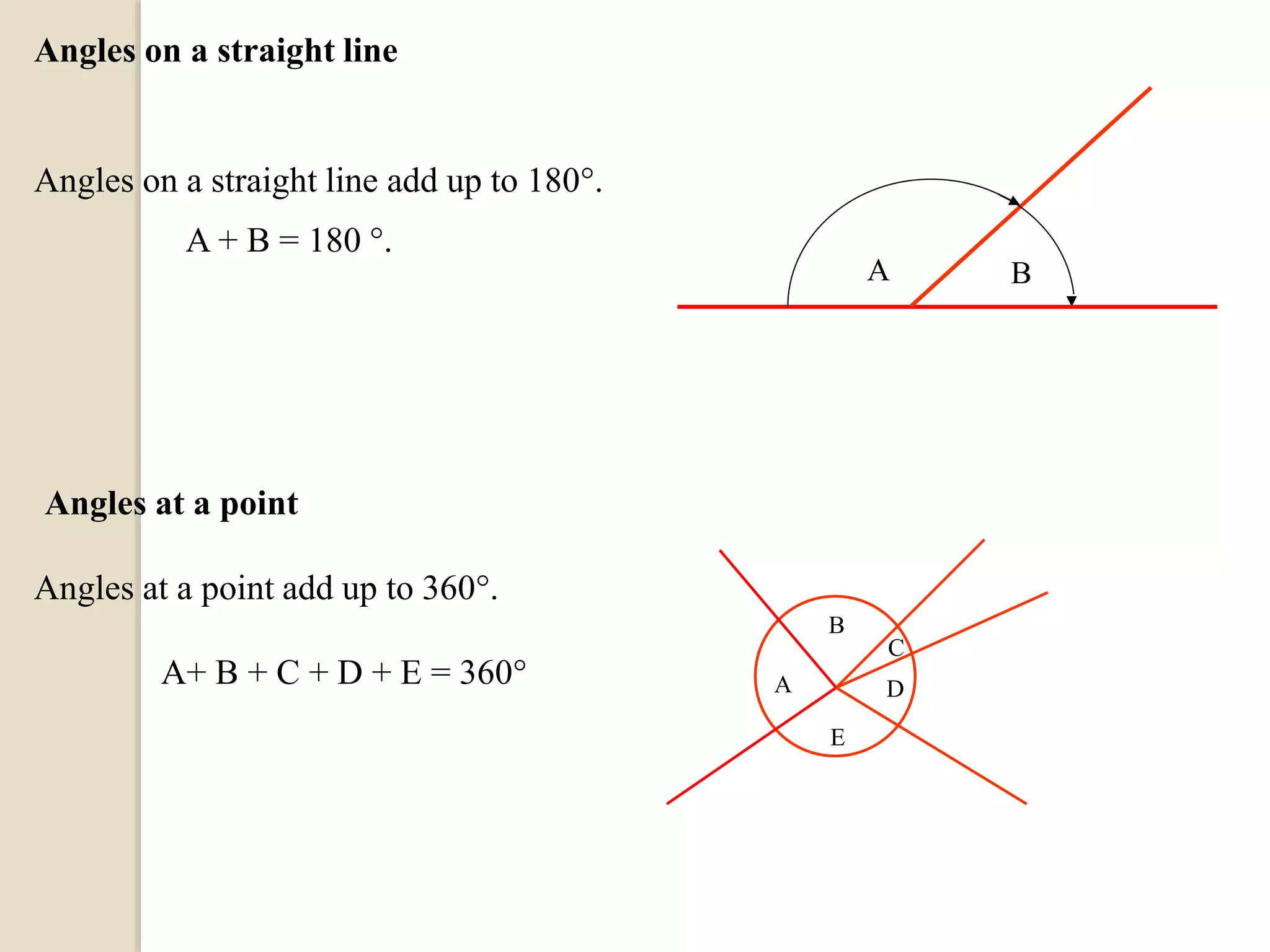
Angles on a straight line add up to 180.
A + B = 180 .
Angles at a point
Angles at a point add up to 360.
A+ B + C + D + E = 360
A B
A
B
D
E
C
Pairs of lines:
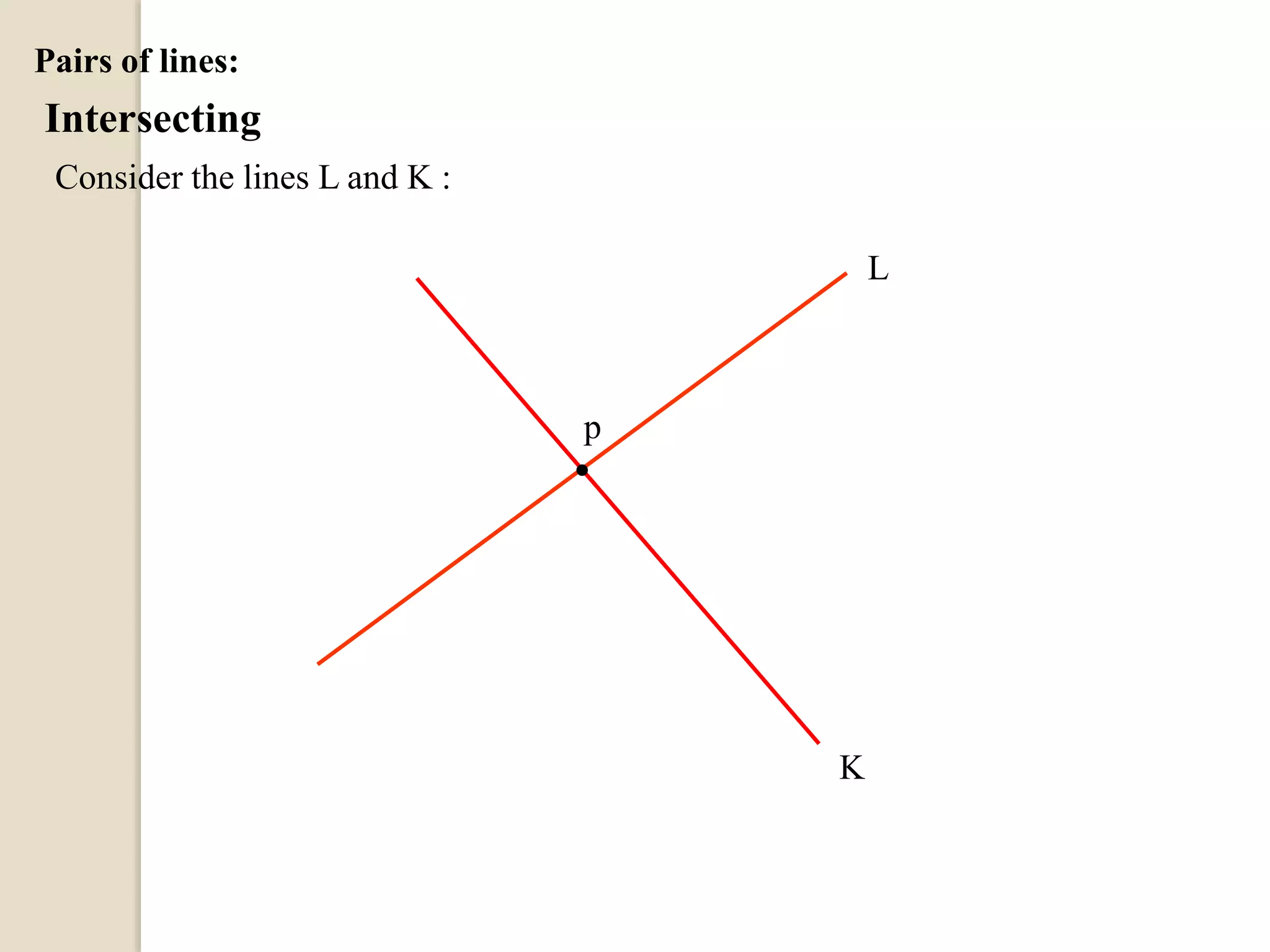
Consider the lines L and K :
.p
L
K
Intersecting
Parallel lines
L
K
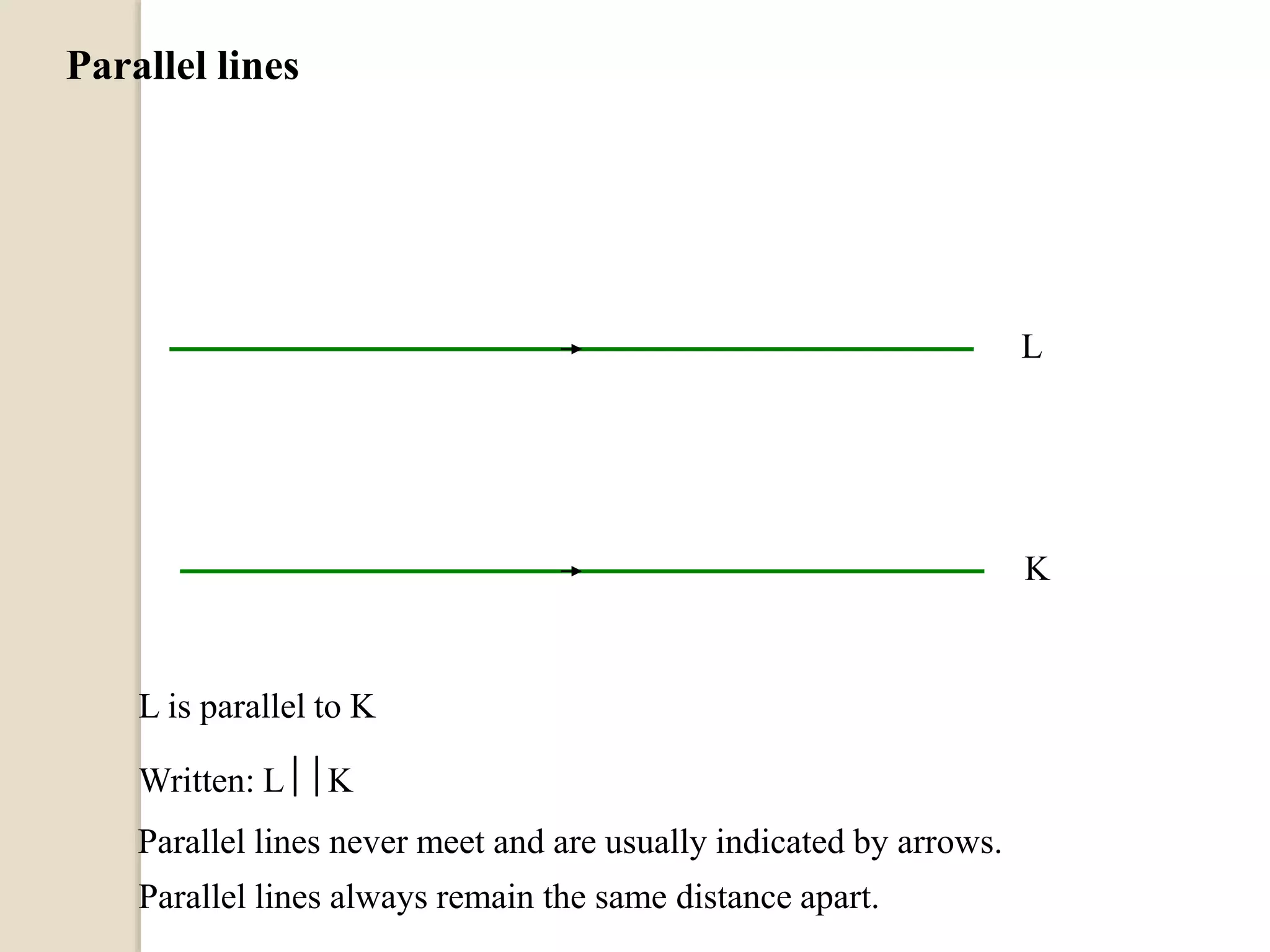
L is parallel to K
Written: LK
Parallel lines never meet and are usually indicated by arrows.
Parallel lines always remain the same distance apart.
Perpendicular
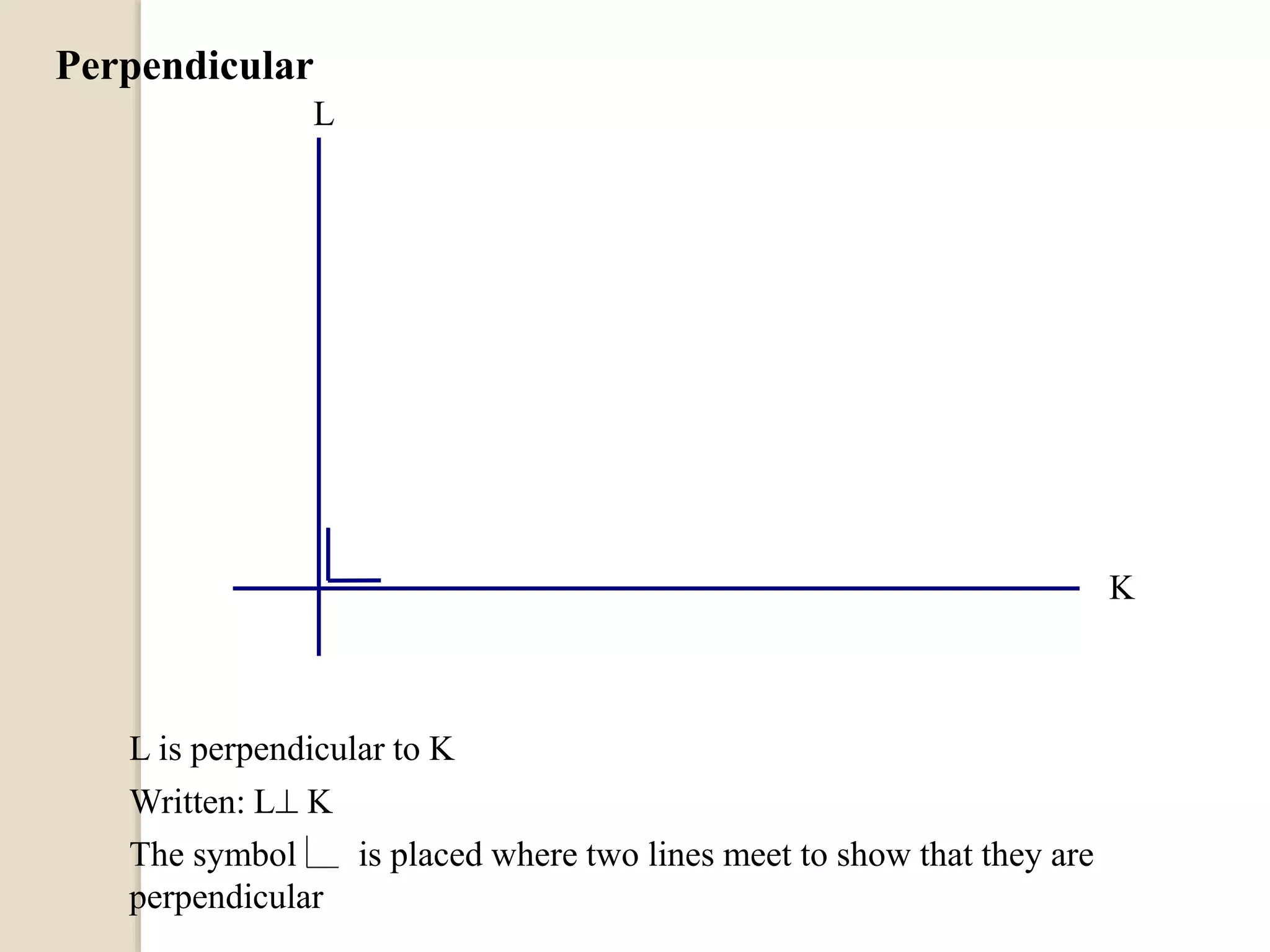
L is perpendicular to K
Written: L K
The symbol is placed where two lines meet to show that they are
perpendicular
L
K
Parallel lines and Angles
1.Vertically opposite angles
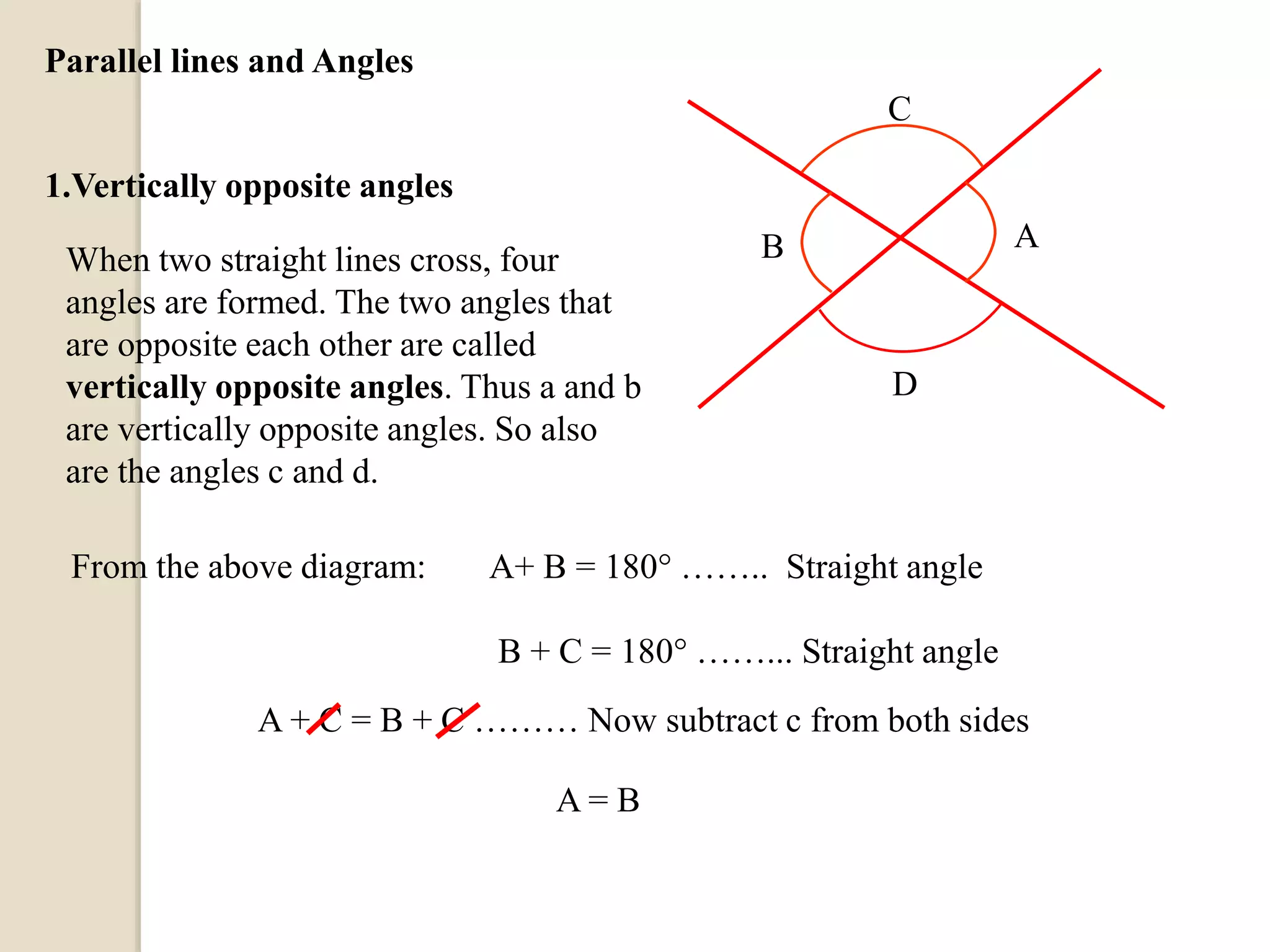
When two straight lines cross, four
angles are formed. The two angles that
are opposite each other are called
vertically opposite angles. Thus a and b
are vertically opposite angles. So also
are the angles c and d.
From the above diagram:
AB
C
D
A+ B = 180 …….. Straight angle
B + C = 180 ……... Straight angle
A + C = B + C ……… Now subtract c from both sides
A = B
2. Corresponding Angles
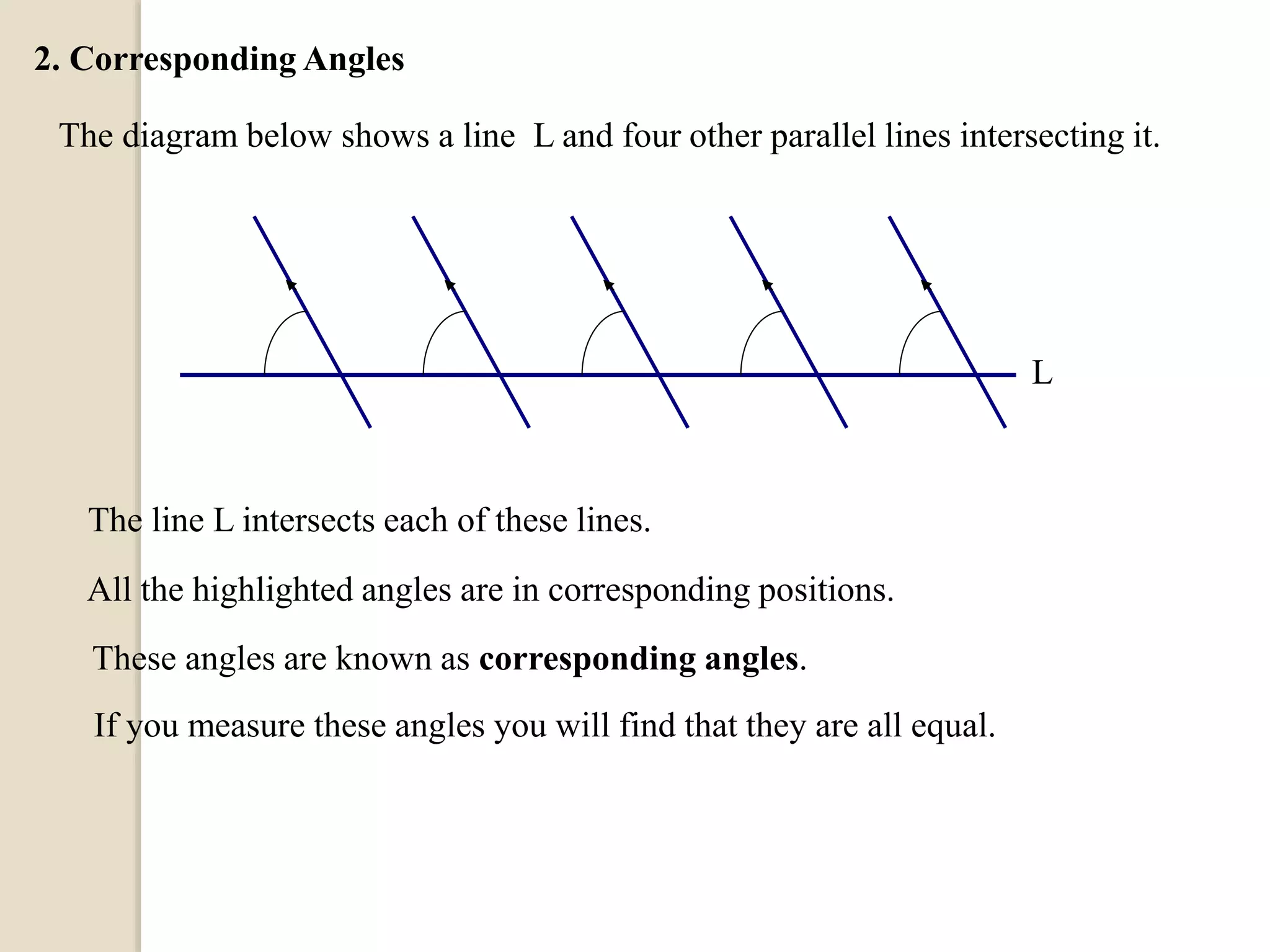
The diagram below shows a line L and four other parallel lines intersecting it.
The line L intersects each of these lines.
L
All the highlighted angles are in corresponding positions.
These angles are known as corresponding angles.
If you measure these angles you will find that they are all equal.
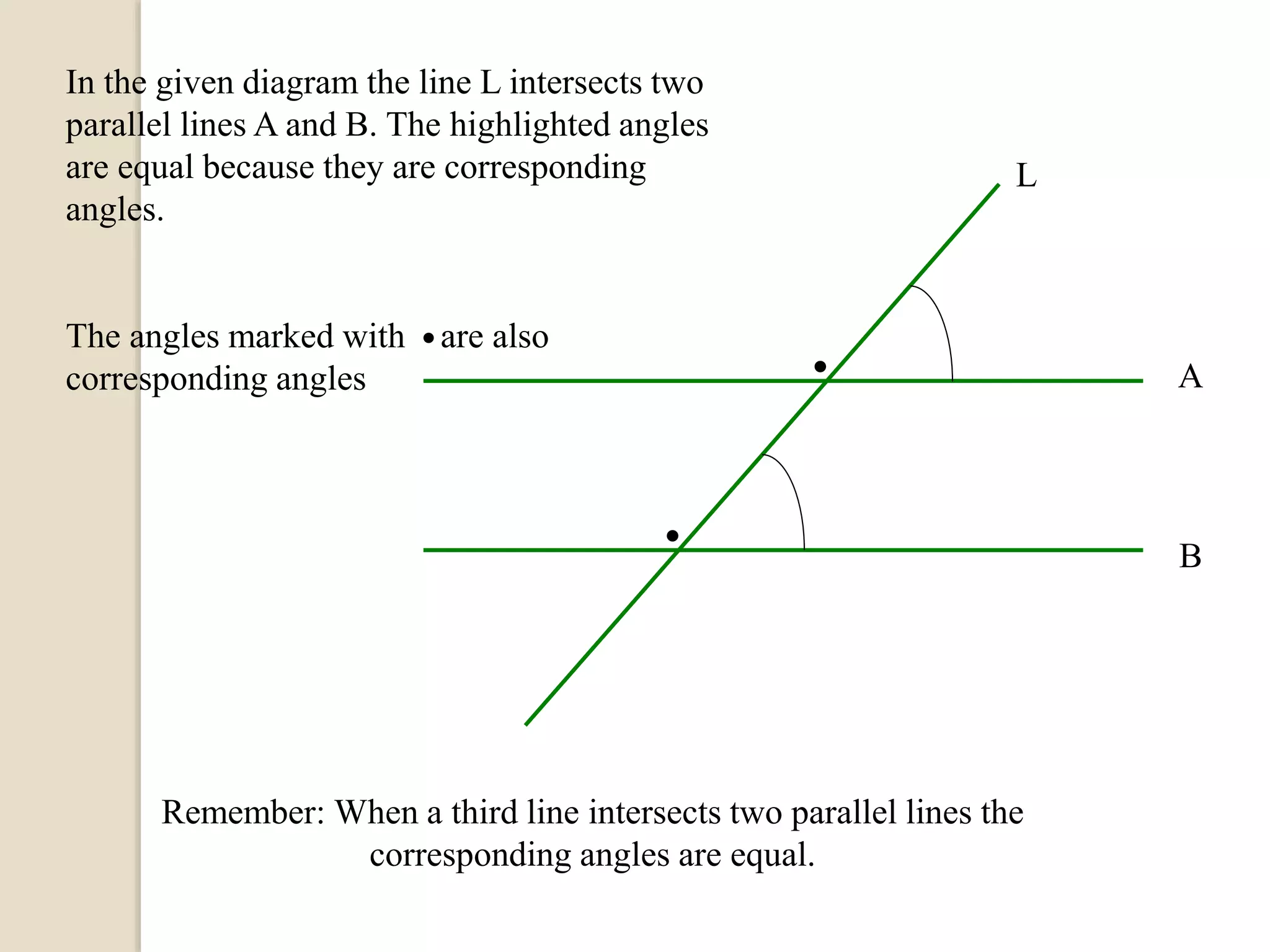
In the given diagram the line L intersects two
parallel lines A and B. The highlighted angles
are equal because they are corresponding
angles.
The angles marked with are also
corresponding angles
. A
B
L
.
.
Remember: When a third line intersects two parallel lines the
corresponding angles are equal.
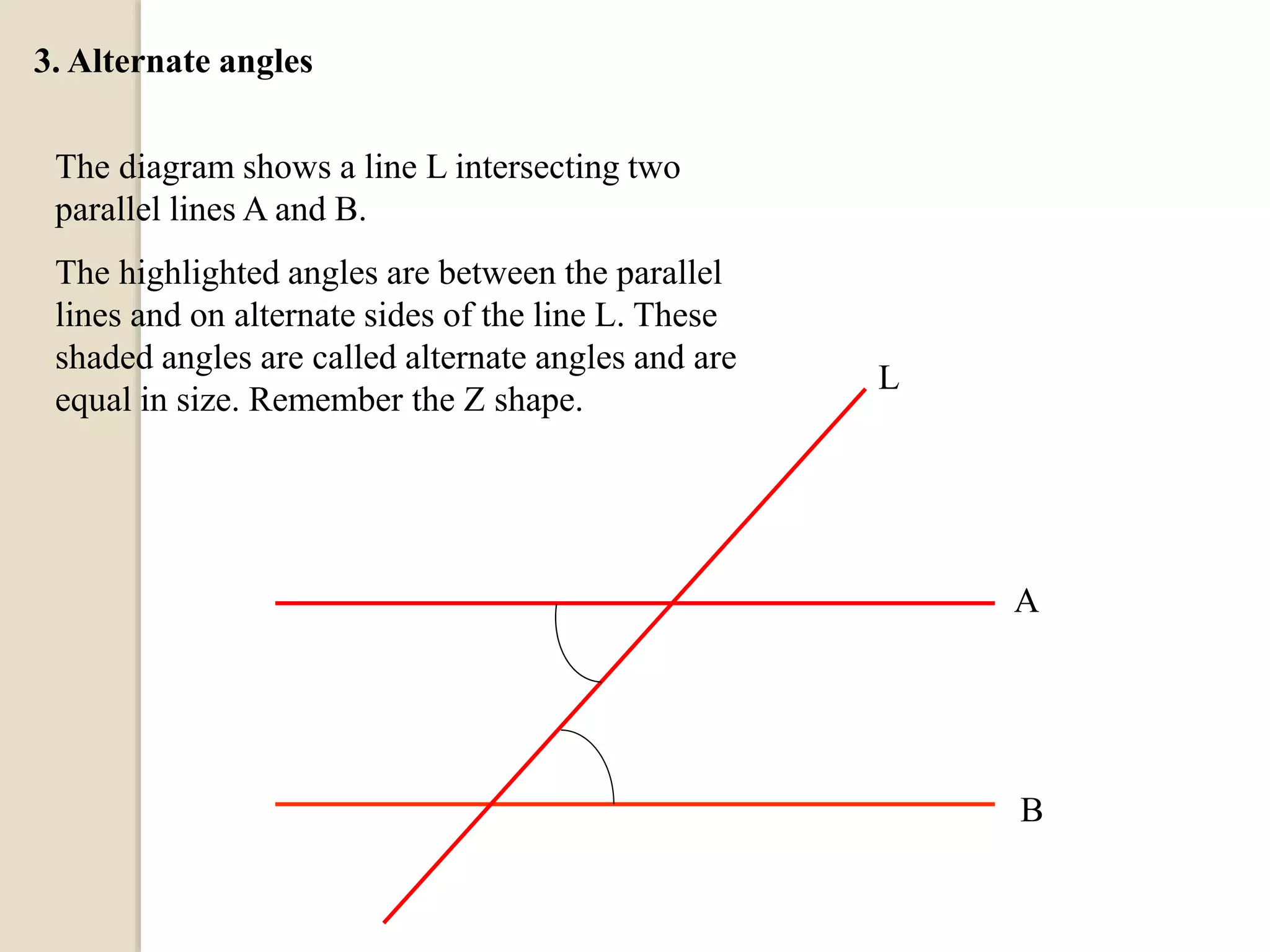
3. Alternate angles
The diagram shows a line L intersecting two
parallel lines A and B.
The highlighted angles are between the parallel
lines and on alternate sides of the line L. These
shaded angles are called alternate angles and are
equal in size. Remember the Z shape.
A
B
L
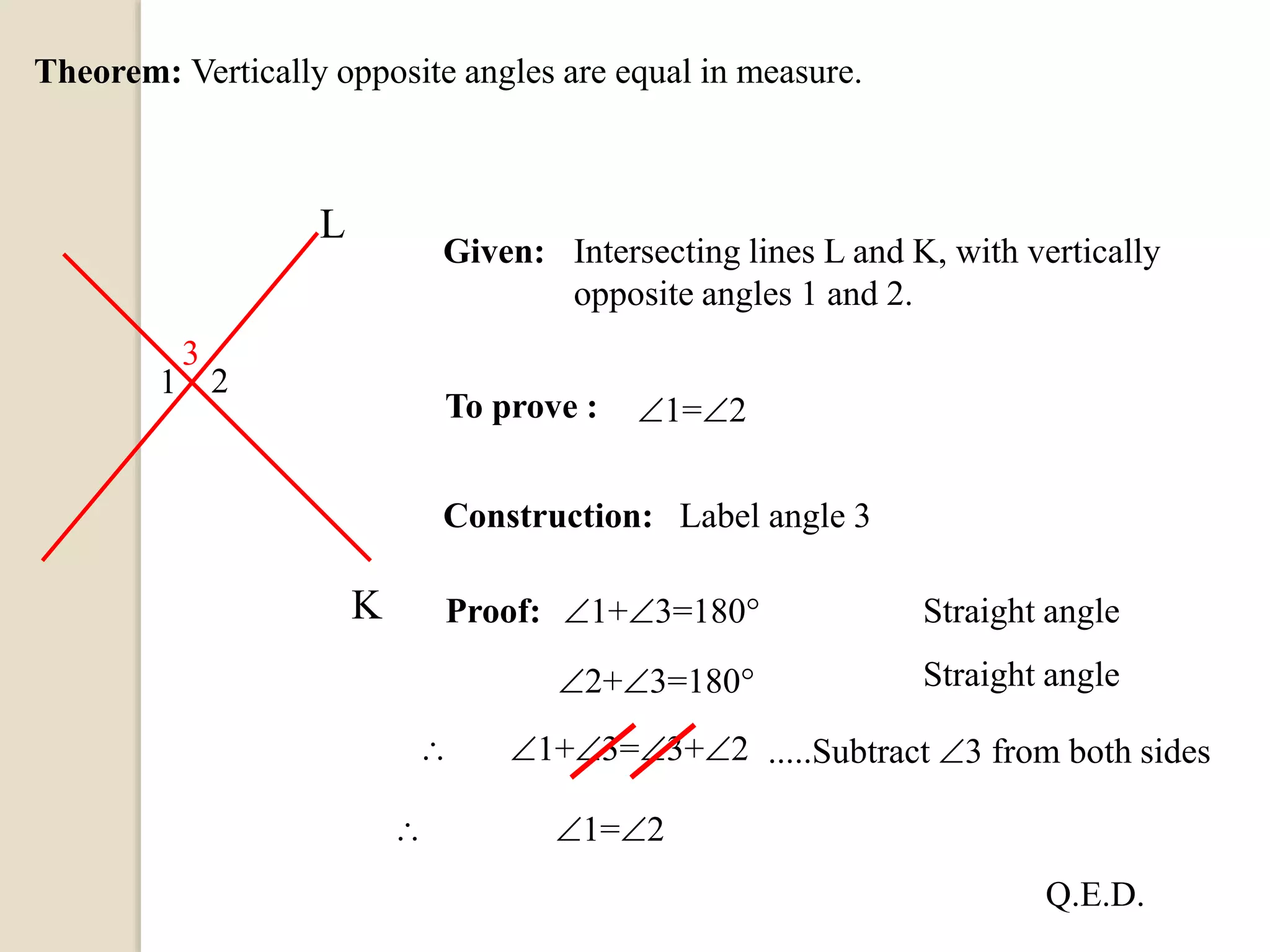
Theorem: Vertically opposite angles are equal in measure.
Given:
To prove :
Construction:
Proof: Straight angle
Straight angle
 1=2
Label angle 3
1=2
Intersecting lines L and K, with vertically
opposite angles 1 and 2.
1+3=180
2+3=180
Q.E.D.
L
K
1 2
 1+3=3+2 .....Subtract 3 from both sides
3
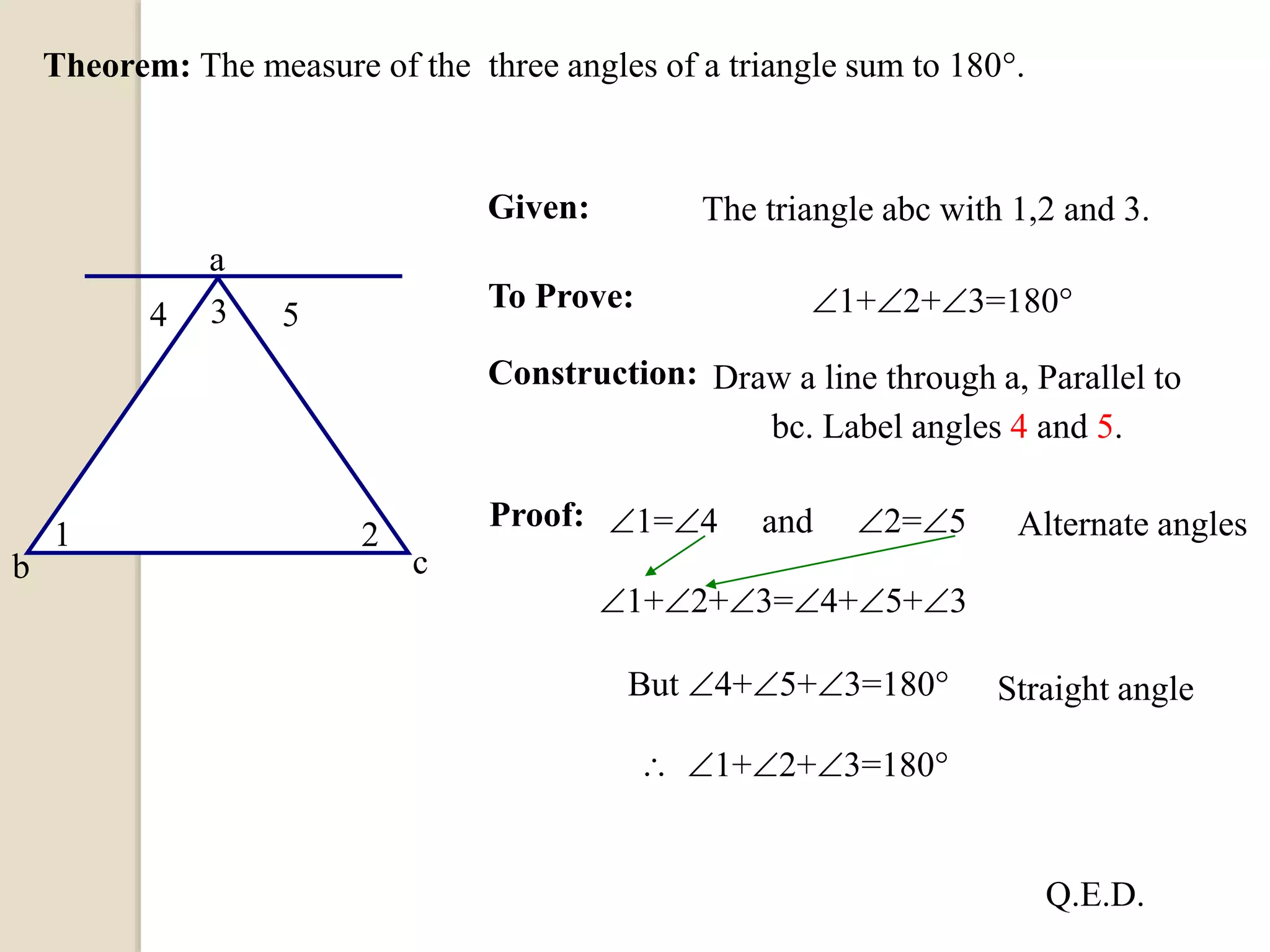
Theorem: The measure of the three angles of a triangle sum to 180.
Given:
To Prove: 1+2+3=180
Construction:
Proof: 1=4 and 2=5 Alternate angles
1+2+3=4+5+3
But 4+5+3=180 Straight angle
 1+2+3=180
The triangle abc with 1,2 and 3.
4 5
a
b c
1 2
3
Q.E.D.
Draw a line through a, Parallel to
bc. Label angles 4 and 5.
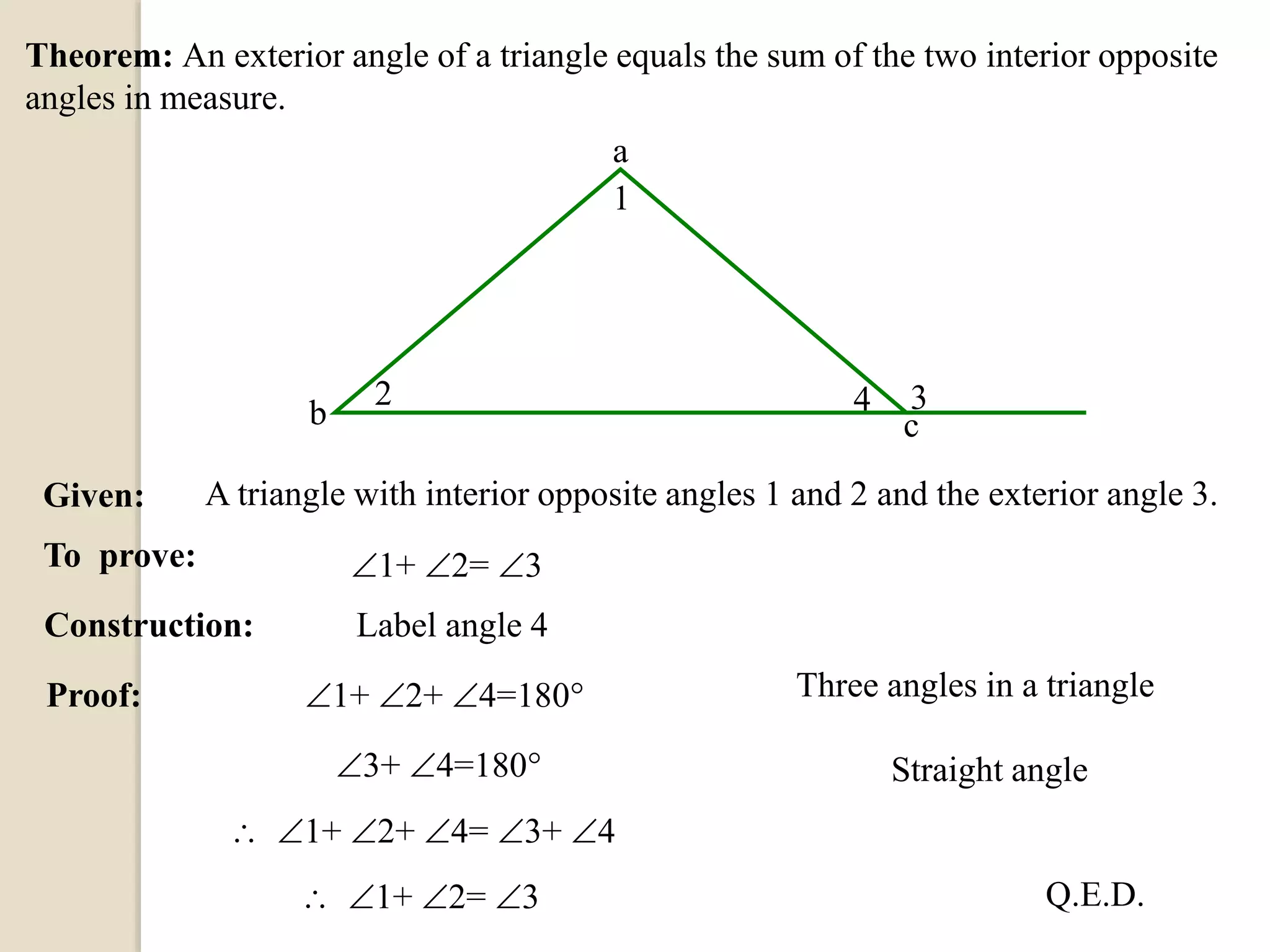
Theorem: An exterior angle of a triangle equals the sum of the two interior opposite
angles in measure.
Given: A triangle with interior opposite angles 1 and 2 and the exterior angle 3.
To prove: 1+ 2= 3
Construction: Label angle 4
Proof: 1+ 2+ 4=180
3+ 4=180
Three angles in a triangle
 1+ 2+ 4= 3+ 4
Straight angle
 1+ 2= 3
a
b c
3
1
2 4
Q.E.D.

Angles and properties for class VII by G R Ahmed

  • 1.
    Angle and Properties Forclass VII Prepared by GOlam Robbani Ahmed
  • 2.
    Angles An angle isformed when two lines meet. The size of the angle measures the amount of space between the lines. In the diagram the lines ba and bc are called the ‘arms’ of the angle, and the point ‘b’ at which they meet is called the ‘vertex’ of the angle. An angle is denoted by the symbol  .An angle can be named in one of the three ways: a c b . .Amount of space Angle
  • 3.
    1. Three letters a b c . . Usingthree letters, with the centre at the vertex. The angle is now referred to as : abc or cba.
  • 4.
    2. A number c b . .1 a Puttinga number at the vertex of the angle. The angle is now referred to as 1.
  • 5.
    3. A capitalletter b . .B a c Putting a capital letter at the vertex of the angle. The angle is now referred to as B.
  • 6.
    Right angle A quarterof a revolution is called a right angle. Therefore a right angle is 90. Straight angle A half a revolution or two right angles makes a straight angle. A straight angle is 180. Measuring angles We use the symbol to denote a right angle.
  • 7.
    Acute, Obtuse andreflex Angles Any angle that is less than 90 is called an acute angle. An angle that is greater than 90 but less than 180 is called an obtuse angle. An angle greater than 180 is called a reflex angle.
  • 8.
    Angles on astraight line Angles on a straight line add up to 180. A + B = 180 . Angles at a point Angles at a point add up to 360. A+ B + C + D + E = 360 A B A B D E C
  • 9.
    Pairs of lines: Considerthe lines L and K : .p L K Intersecting
  • 10.
    Parallel lines L K L isparallel to K Written: LK Parallel lines never meet and are usually indicated by arrows. Parallel lines always remain the same distance apart.
  • 11.
    Perpendicular L is perpendicularto K Written: L K The symbol is placed where two lines meet to show that they are perpendicular L K
  • 12.
    Parallel lines andAngles 1.Vertically opposite angles When two straight lines cross, four angles are formed. The two angles that are opposite each other are called vertically opposite angles. Thus a and b are vertically opposite angles. So also are the angles c and d. From the above diagram: AB C D A+ B = 180 …….. Straight angle B + C = 180 ……... Straight angle A + C = B + C ……… Now subtract c from both sides A = B
  • 13.
    2. Corresponding Angles Thediagram below shows a line L and four other parallel lines intersecting it. The line L intersects each of these lines. L All the highlighted angles are in corresponding positions. These angles are known as corresponding angles. If you measure these angles you will find that they are all equal.
  • 14.
    In the givendiagram the line L intersects two parallel lines A and B. The highlighted angles are equal because they are corresponding angles. The angles marked with are also corresponding angles . A B L . . Remember: When a third line intersects two parallel lines the corresponding angles are equal.
  • 15.
    3. Alternate angles Thediagram shows a line L intersecting two parallel lines A and B. The highlighted angles are between the parallel lines and on alternate sides of the line L. These shaded angles are called alternate angles and are equal in size. Remember the Z shape. A B L
  • 16.
    Theorem: Vertically oppositeangles are equal in measure. Given: To prove : Construction: Proof: Straight angle Straight angle  1=2 Label angle 3 1=2 Intersecting lines L and K, with vertically opposite angles 1 and 2. 1+3=180 2+3=180 Q.E.D. L K 1 2  1+3=3+2 .....Subtract 3 from both sides 3
  • 17.
    Theorem: The measureof the three angles of a triangle sum to 180. Given: To Prove: 1+2+3=180 Construction: Proof: 1=4 and 2=5 Alternate angles 1+2+3=4+5+3 But 4+5+3=180 Straight angle  1+2+3=180 The triangle abc with 1,2 and 3. 4 5 a b c 1 2 3 Q.E.D. Draw a line through a, Parallel to bc. Label angles 4 and 5.
  • 18.
    Theorem: An exteriorangle of a triangle equals the sum of the two interior opposite angles in measure. Given: A triangle with interior opposite angles 1 and 2 and the exterior angle 3. To prove: 1+ 2= 3 Construction: Label angle 4 Proof: 1+ 2+ 4=180 3+ 4=180 Three angles in a triangle  1+ 2+ 4= 3+ 4 Straight angle  1+ 2= 3 a b c 3 1 2 4 Q.E.D.