Angle of view 
In photography, angle of view describes the angular extent of a given scene that is imaged 
by a camera. It is used interchangeably with the more general term field of view. 
It is important to distinguish the angle of view from the angle of coverage, which describes 
the angle range that a lens can image. Typically the image circle produced by a lens is large 
enough to cover the film or sensor completely, possibly including some vignetting toward 
the edge. If the angle of coverage of the lens does not fill the sensor, the image circle will be 
visible, typically with strong vignetting toward the edge, and the effective angle of view will 
be limited to the angle of coverage. 
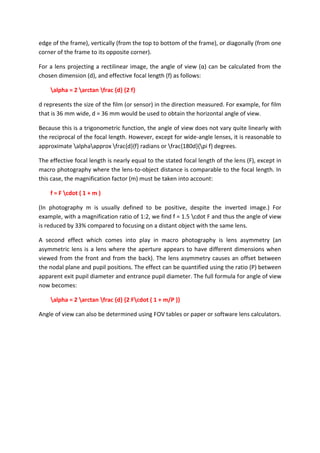
A camera's angle of view can be measured horizontally, vertically, or diagonally. 
Calculating a camera's angle of view 
For lenses projecting rectilinear (non-spatially-distorted) images of distant objects, the 
effective focal length and the image format dimensions completely define the angle of view. 
Calculations for lenses producing non-rectilinear images are much more complex and in the 
end not very useful in most practical applications. (In the case of a lens with distortion, e.g., 
a fisheye lens, a longer lens with distortion can have a wider angle of view than a shorter 
lens with low distortion) Angle of view may be measured horizontally (from the left to right
edge of the frame), vertically (from the top to bottom of the frame), or diagonally (from one 
corner of the frame to its opposite corner). 
For a lens projecting a rectilinear image, the angle of view (α) can be calculated from the 
chosen dimension (d), and effective focal length (f) as follows: 
alpha = 2 arctan frac {d} {2 f} 
d represents the size of the film (or sensor) in the direction measured. For example, for film 
that is 36 mm wide, d = 36 mm would be used to obtain the horizontal angle of view. 
Because this is a trigonometric function, the angle of view does not vary quite linearly with 
the reciprocal of the focal length. However, except for wide-angle lenses, it is reasonable to 
approximate alphaapprox frac{d}{f} radians or frac{180d}{pi f} degrees. 
The effective focal length is nearly equal to the stated focal length of the lens (F), except in 
macro photography where the lens-to-object distance is comparable to the focal length. In 
this case, the magnification factor (m) must be taken into account: 
f = F cdot ( 1 + m ) 
(In photography m is usually defined to be positive, despite the inverted image.) For 
example, with a magnification ratio of 1:2, we find f = 1.5 cdot F and thus the angle of view 
is reduced by 33% compared to focusing on a distant object with the same lens. 
A second effect which comes into play in macro photography is lens asymmetry (an 
asymmetric lens is a lens where the aperture appears to have different dimensions when 
viewed from the front and from the back). The lens asymmetry causes an offset between 
the nodal plane and pupil positions. The effect can be quantified using the ratio (P) between 
apparent exit pupil diameter and entrance pupil diameter. The full formula for angle of view 
now becomes: 
alpha = 2 arctan frac {d} {2 Fcdot ( 1 + m/P )} 
Angle of view can also be determined using FOV tables or paper or software lens calculators.

Angle of view - photography

  • 1.
    Angle of view In photography, angle of view describes the angular extent of a given scene that is imaged by a camera. It is used interchangeably with the more general term field of view. It is important to distinguish the angle of view from the angle of coverage, which describes the angle range that a lens can image. Typically the image circle produced by a lens is large enough to cover the film or sensor completely, possibly including some vignetting toward the edge. If the angle of coverage of the lens does not fill the sensor, the image circle will be visible, typically with strong vignetting toward the edge, and the effective angle of view will be limited to the angle of coverage. A camera's angle of view can be measured horizontally, vertically, or diagonally. Calculating a camera's angle of view For lenses projecting rectilinear (non-spatially-distorted) images of distant objects, the effective focal length and the image format dimensions completely define the angle of view. Calculations for lenses producing non-rectilinear images are much more complex and in the end not very useful in most practical applications. (In the case of a lens with distortion, e.g., a fisheye lens, a longer lens with distortion can have a wider angle of view than a shorter lens with low distortion) Angle of view may be measured horizontally (from the left to right
  • 2.
    edge of theframe), vertically (from the top to bottom of the frame), or diagonally (from one corner of the frame to its opposite corner). For a lens projecting a rectilinear image, the angle of view (α) can be calculated from the chosen dimension (d), and effective focal length (f) as follows: alpha = 2 arctan frac {d} {2 f} d represents the size of the film (or sensor) in the direction measured. For example, for film that is 36 mm wide, d = 36 mm would be used to obtain the horizontal angle of view. Because this is a trigonometric function, the angle of view does not vary quite linearly with the reciprocal of the focal length. However, except for wide-angle lenses, it is reasonable to approximate alphaapprox frac{d}{f} radians or frac{180d}{pi f} degrees. The effective focal length is nearly equal to the stated focal length of the lens (F), except in macro photography where the lens-to-object distance is comparable to the focal length. In this case, the magnification factor (m) must be taken into account: f = F cdot ( 1 + m ) (In photography m is usually defined to be positive, despite the inverted image.) For example, with a magnification ratio of 1:2, we find f = 1.5 cdot F and thus the angle of view is reduced by 33% compared to focusing on a distant object with the same lens. A second effect which comes into play in macro photography is lens asymmetry (an asymmetric lens is a lens where the aperture appears to have different dimensions when viewed from the front and from the back). The lens asymmetry causes an offset between the nodal plane and pupil positions. The effect can be quantified using the ratio (P) between apparent exit pupil diameter and entrance pupil diameter. The full formula for angle of view now becomes: alpha = 2 arctan frac {d} {2 Fcdot ( 1 + m/P )} Angle of view can also be determined using FOV tables or paper or software lens calculators.