Nutrition Basics
Nutritional Requirements:
Components of A Healthy Diet


Essential nutrients




Proteins, Fats, Carbohydrates, Vitamins, Minerals
and Water.

Fuel Potential. Kilocalories (kcalorie).








1 Kcalorie (Kcal)= amount of heat it takes to raise the temperature
of 1 liter of fluid 1 degree of centigrade----or 1 pound of water
another 4 deg F.
1 calorie (cal)= amount of heat to raise one gram of water 1 deg C.
2000 kcalorie or calories per day meets a person needs.
1000 calories = 1 kcalorie.

3 supply energy




Fat = 9 calories per gram
Protein = 4 calories per gram
Carbohydrates = 4 calories per gram

Chapter Twelve

2
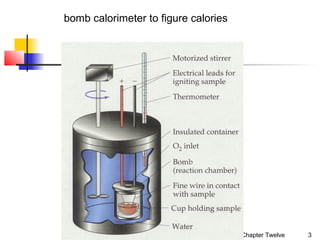
bomb calorimeter to figure calories

Chapter Twelve

3
Proteins



Forms muscle, bone, blood, enzymes,
hormones and cell membrane.



Twenty(or 22) common amino acids
amino acid has COOH at one end, then NH2, and
a side chain gives amino acid name.





Nine essential amino acids(must get from diet)
Eleven nonessential amino acids

Complete proteins provide all essential amino
acids.



Most animal proteins.
Most plant proteins are incomplete.




Combine 2 vegetables to make up missing amino acids.

Recommended amount



0.8 gram per kilogram of body weight
10-35% of total calorie intake


Average is 15-16%
Chapter Twelve

4
Fats or Lipids


Most concentrated source of energy








stored energy and provides insulation and support
for body organs

Saturated Fat
Mono-unsaturated
Poly-unsaturated
Hydrogenation
Trans fatty acids

Chapter Twelve

5
Fats and Health
Cholesterol










High Density Lipo-Protein (HDL’s) – good cholesterol
Low Density Lipo-Protein (LDL’s) – bad cholesterol

60 mg/dL and above=High HDL cholesterol. An HDL of 60
mg/dL and above is considered protective against heart
disease.
LDL less than 100 mg/dL=Optimal

Absorbs Fat-soluble vitamins (A,D,E & K)

Make up 25%-35% of total daily calories






7% from saturated fat
10% from polyunsaturated fat
20% from monounsaturated fat

Recommended Intake

Adults






Men 17 grams per day of linoleic and 1.6 grams of alpha-linoleic
Women 12 grams per day of linoleic and 1.1 grams of alpha-linoleic

Only 3-4 teaspoons (15-20 grams) of vegetable oil per day
AMDRs for total fat 20-35%

Chapter Twelve

6
Carbohydrates(plants)



Supply energy for the body cells
Two groups


Simple Carbs: One or two sugar units




Fruit, sugar, honey, malt, and milk

Complex Carbs: Multiple sugar units


Starches and fiber






Grains – wheat, rye, rice, oats, barley, and millet
Legumes – dry beans, peas, and lentils
Tubers – potatoes and yams

Digestion



Mouth and small intestines
Break down to glucose

Chapter Twelve

7
Recommended Carbohydrate
Intake





Average American – 200-300 grams
130 grams needed to meet the body’s
requirements for essential
carbohydrates
Adults – 45-65% of total daily calories
or 225-325 grams

Chapter Twelve

8
Fiber – A Closer Look


Food and Nutrition Board








Sources




Dietary fiber nondigestible carbohydrate that is
present naturally
Functional fiber nondigestible carbohydrate that has
been isolated or synthesized
Total fiber is the sum of both
All plant substances

Recommended intake




38 grams for adult men
25 grams for adult women
Needs to come from foods not supplements
Chapter Twelve

9
Vitamins




Organic (carbon-containing) substances
required in small amounts to promote specific
chemical reactions (catalyst) within a living
cell.
Thirteen vitamins:





Four Fat Soluble: A, D, E, and K.
Nine Water Soluble: C and 8 B-complex vitamins. Thiamin
(B1), Riboflavin (B2), Niacin (B3), Pyridoxine (B6), Folate, B12, Biotin and Pantothenic acid.

Sources:



Human body does not manufacture most vitamins
Abundant in fruits, vegetables and grains

Chapter Twelve

10
Minerals





Inorganic compounds.
Helps to regulate body functions,aid in
growth,maintenance of body tissues, and a catalyst
for energy release.
17 essential minerals.
 Major minerals - 100 milligrams or more.




calcium, phosphorus, magnesium, sodium, sulfur,
sodium, potassium and chloride.

Trace minerals – minute amounts.


Cobalt, copper, fluoride, iodide, iron, manganese,
molybdenum, selenium,
and zinc

Chapter Twelve

11
Water









body Composed of about 50-60% water
Can live up to 50 days without food , but only
a few days without water
Water and other beverages make-up 80-90%
of your daily water intake
Men – 3.7 total liters of water, with 3.0 liters
(13 cups) coming from beverages
Women – 2.7 total liters of water, with 2.2 (9
cups) coming from beverages

Chapter Twelve

12
Other Substances in Food
Antioxidants –





Reduction in cancers
Vitamin C & E, selenium, carotenoids

Phytochemicals





Soy foods may help lower cholesterol levels
Cruciferous(brocolli/cabbage) vegetables
render some carcinogenic compounds
harmless
Allyl sulfides (garlic and onions) boosts the
cancer-fighting immune cells
Chapter Twelve

13
Dietary Reference Intakes
(DRIs)








Set standards by Food and Nutrition Board of
the National Academy of Sciences developed RDAs and AI (adequate intake)
Include standards for both recommended
and maximum intakes
Established standards for nutrient intake in
order to prevent nutrient deficiencies
Should you take supplements?




DRIs guide you will the nutritional needs with
food, rather than the use of supplements

Daily values – U.S. Food and Drug
Administration use on food labels


Based on 2000 calorie diet
Chapter Twelve

14
Dietary Guidelines for
Americans











Eating a variety of nutrient-dense foods
Control calorie intake to manage healthy
weight
Physically active every day
Plenty of grains, vegetables and fruits
Choose fats wisely
Choose carbohydrates wisely
Prepare foods with little salt and sugar
Moderation of alcohol consumption
Keep foods safe to eat
Chapter Twelve

15
Weight Management







Overweight and obesity are major
public health problem
Americans need to reduce the amount
of calories
Increase physical activity
Make wiser food choices

Chapter Twelve

16
Physical Activity







Aim to accumulate at least 30 minutes
(adults) or 60 minutes (children) of moderate
physical activity
Brisk walk at a pace of 3-4 mile per hour
Manage body weight--- engage in 60 minutes
of moderately to vigorous intense activity
Sustain weight loss engage daily in at least
60-90 minutes of moderate activity
Chapter Twelve

17


Food Groups to Encourage

Fruits and vegetables


4 1/2 cups or the equivalent of 9 servings
each day







Dark green vegetables
Orange vegetables
Legumes

Whole grains
Low-Fat and Fat-free milk and milk
products
Chapter Twelve

18








Fats

Fats and oils provide the essential fatty
acids needed
Total fat: 20-35% of total daily calories
Saturated Fat: Less than 10% of total
calories
Trans fat: as little as possible
Cholesterol: Less than 300 mg per day

Chapter Twelve

19
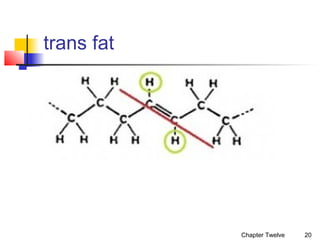
trans fat

Chapter Twelve

20
Carbohydrates





Important energy source
Fiber promotes healthy digestion and
helps reduce the risk of type 2 diabetes
and heart disease
Consumption of foods and beverages
high in added sugar should be avoided

Chapter Twelve

21
Food Safety




Foodborne disease affect 76 million
Americans each year
Be careful around







Poultry
Meats
Eggs
Shellfish
Milk products
Fresh fruits and vegetables
Chapter Twelve

22
Serving Sizes


Grains - 1 slice of bread,1 small muffin (2.5
diameter), 1 cup ready-to-eat cereal flakes



Vegetable – 1 cup raw leafy vegetables, 1/2
cup cooked or raw vegetables, 1/2 cup of
vegetable juice



Fruit – ½ cup fresh, canned, or frozen fruit,
1/2 cup 100% fruit juice,1 small whole fruit,
1/4 cup dried fruit, 3/4 cup fruit juice

Chapter Twelve

23




Serving Sizes
Milk/Dairy -1 cup milk or yogurt,1/2 cup
ricotta cheese,1.5 oz natural cheese,2
oz. Processed cheese.
Meat and Beans – 1 ounce cooked lean
meat,.1/4 cup cooked dry beans or tofu,
1 egg, 1 tablespoon peanut butter, ½
ounce nuts or seeds

Chapter Twelve

24
Personal Plan: Making
Informed Choices About Food




Reading Food Labels
Reading Dietary Supplement Labels
Evaluating Functional Foods

Chapter Twelve

25
Food Allergies and Food
Intolerances


Food allergies





Reaction of the body’s immune system
Affect 2% of the adult population
4-6% of infants
90% of food allergies




Cow’s milk, eggs, peanuts, tree nuts, soy,
wheat, fish, and shellfish

Food intolerances

Chapter Twelve

26
body mass index--BMI




measure for human body shape based
on an individual's mass and height.
Formula: weight (lb) / [height
(in)]2 x 703 or use internet

Chapter Twelve

27
BMI





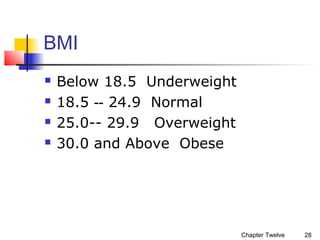
Below 18.5 Underweight
18.5 -- 24.9 Normal
25.0-- 29.9 Overweight
30.0 and Above Obese

Chapter Twelve

28
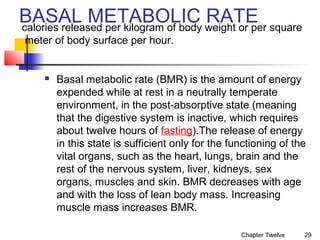
BASAL METABOLIC weight or per square
RATE
calories released per kilogram of body
meter of body surface per hour.



Basal metabolic rate (BMR) is the amount of energy
expended while at rest in a neutrally temperate
environment, in the post-absorptive state (meaning
that the digestive system is inactive, which requires
about twelve hours of fasting).The release of energy
in this state is sufficient only for the functioning of the
vital organs, such as the heart, lungs, brain and the
rest of the nervous system, liver, kidneys, sex
organs, muscles and skin. BMR decreases with age
and with the loss of lean body mass. Increasing
muscle mass increases BMR.
Chapter Twelve

29
BMR formula






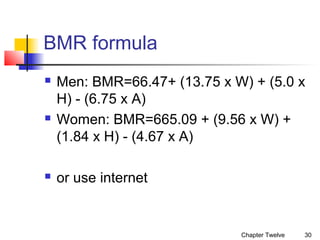
Men: BMR=66.47+ (13.75 x W) + (5.0 x
H) - (6.75 x A)
Women: BMR=665.09 + (9.56 x W) +
(1.84 x H) - (4.67 x A)
or use internet

Chapter Twelve

30

Nutrition1

  • 1.
  • 2.
    Nutritional Requirements: Components ofA Healthy Diet  Essential nutrients   Proteins, Fats, Carbohydrates, Vitamins, Minerals and Water. Fuel Potential. Kilocalories (kcalorie).      1 Kcalorie (Kcal)= amount of heat it takes to raise the temperature of 1 liter of fluid 1 degree of centigrade----or 1 pound of water another 4 deg F. 1 calorie (cal)= amount of heat to raise one gram of water 1 deg C. 2000 kcalorie or calories per day meets a person needs. 1000 calories = 1 kcalorie. 3 supply energy    Fat = 9 calories per gram Protein = 4 calories per gram Carbohydrates = 4 calories per gram Chapter Twelve 2
  • 3.
    bomb calorimeter tofigure calories Chapter Twelve 3
  • 4.
    Proteins  Forms muscle, bone,blood, enzymes, hormones and cell membrane.   Twenty(or 22) common amino acids amino acid has COOH at one end, then NH2, and a side chain gives amino acid name.    Nine essential amino acids(must get from diet) Eleven nonessential amino acids Complete proteins provide all essential amino acids.   Most animal proteins. Most plant proteins are incomplete.   Combine 2 vegetables to make up missing amino acids. Recommended amount   0.8 gram per kilogram of body weight 10-35% of total calorie intake  Average is 15-16% Chapter Twelve 4
  • 5.
    Fats or Lipids  Mostconcentrated source of energy       stored energy and provides insulation and support for body organs Saturated Fat Mono-unsaturated Poly-unsaturated Hydrogenation Trans fatty acids Chapter Twelve 5
  • 6.
    Fats and Health Cholesterol       HighDensity Lipo-Protein (HDL’s) – good cholesterol Low Density Lipo-Protein (LDL’s) – bad cholesterol 60 mg/dL and above=High HDL cholesterol. An HDL of 60 mg/dL and above is considered protective against heart disease. LDL less than 100 mg/dL=Optimal Absorbs Fat-soluble vitamins (A,D,E & K)  Make up 25%-35% of total daily calories     7% from saturated fat 10% from polyunsaturated fat 20% from monounsaturated fat Recommended Intake  Adults     Men 17 grams per day of linoleic and 1.6 grams of alpha-linoleic Women 12 grams per day of linoleic and 1.1 grams of alpha-linoleic Only 3-4 teaspoons (15-20 grams) of vegetable oil per day AMDRs for total fat 20-35% Chapter Twelve 6
  • 7.
    Carbohydrates(plants)   Supply energy forthe body cells Two groups  Simple Carbs: One or two sugar units   Fruit, sugar, honey, malt, and milk Complex Carbs: Multiple sugar units  Starches and fiber     Grains – wheat, rye, rice, oats, barley, and millet Legumes – dry beans, peas, and lentils Tubers – potatoes and yams Digestion   Mouth and small intestines Break down to glucose Chapter Twelve 7
  • 8.
    Recommended Carbohydrate Intake    Average American– 200-300 grams 130 grams needed to meet the body’s requirements for essential carbohydrates Adults – 45-65% of total daily calories or 225-325 grams Chapter Twelve 8
  • 9.
    Fiber – ACloser Look  Food and Nutrition Board     Sources   Dietary fiber nondigestible carbohydrate that is present naturally Functional fiber nondigestible carbohydrate that has been isolated or synthesized Total fiber is the sum of both All plant substances Recommended intake    38 grams for adult men 25 grams for adult women Needs to come from foods not supplements Chapter Twelve 9
  • 10.
    Vitamins   Organic (carbon-containing) substances requiredin small amounts to promote specific chemical reactions (catalyst) within a living cell. Thirteen vitamins:    Four Fat Soluble: A, D, E, and K. Nine Water Soluble: C and 8 B-complex vitamins. Thiamin (B1), Riboflavin (B2), Niacin (B3), Pyridoxine (B6), Folate, B12, Biotin and Pantothenic acid. Sources:   Human body does not manufacture most vitamins Abundant in fruits, vegetables and grains Chapter Twelve 10
  • 11.
    Minerals    Inorganic compounds. Helps toregulate body functions,aid in growth,maintenance of body tissues, and a catalyst for energy release. 17 essential minerals.  Major minerals - 100 milligrams or more.   calcium, phosphorus, magnesium, sodium, sulfur, sodium, potassium and chloride. Trace minerals – minute amounts.  Cobalt, copper, fluoride, iodide, iron, manganese, molybdenum, selenium, and zinc Chapter Twelve 11
  • 12.
    Water      body Composed ofabout 50-60% water Can live up to 50 days without food , but only a few days without water Water and other beverages make-up 80-90% of your daily water intake Men – 3.7 total liters of water, with 3.0 liters (13 cups) coming from beverages Women – 2.7 total liters of water, with 2.2 (9 cups) coming from beverages Chapter Twelve 12
  • 13.
    Other Substances inFood Antioxidants –    Reduction in cancers Vitamin C & E, selenium, carotenoids Phytochemicals    Soy foods may help lower cholesterol levels Cruciferous(brocolli/cabbage) vegetables render some carcinogenic compounds harmless Allyl sulfides (garlic and onions) boosts the cancer-fighting immune cells Chapter Twelve 13
  • 14.
    Dietary Reference Intakes (DRIs)     Setstandards by Food and Nutrition Board of the National Academy of Sciences developed RDAs and AI (adequate intake) Include standards for both recommended and maximum intakes Established standards for nutrient intake in order to prevent nutrient deficiencies Should you take supplements?   DRIs guide you will the nutritional needs with food, rather than the use of supplements Daily values – U.S. Food and Drug Administration use on food labels  Based on 2000 calorie diet Chapter Twelve 14
  • 15.
    Dietary Guidelines for Americans          Eatinga variety of nutrient-dense foods Control calorie intake to manage healthy weight Physically active every day Plenty of grains, vegetables and fruits Choose fats wisely Choose carbohydrates wisely Prepare foods with little salt and sugar Moderation of alcohol consumption Keep foods safe to eat Chapter Twelve 15
  • 16.
    Weight Management     Overweight andobesity are major public health problem Americans need to reduce the amount of calories Increase physical activity Make wiser food choices Chapter Twelve 16
  • 17.
    Physical Activity     Aim toaccumulate at least 30 minutes (adults) or 60 minutes (children) of moderate physical activity Brisk walk at a pace of 3-4 mile per hour Manage body weight--- engage in 60 minutes of moderately to vigorous intense activity Sustain weight loss engage daily in at least 60-90 minutes of moderate activity Chapter Twelve 17
  • 18.
     Food Groups toEncourage Fruits and vegetables  4 1/2 cups or the equivalent of 9 servings each day      Dark green vegetables Orange vegetables Legumes Whole grains Low-Fat and Fat-free milk and milk products Chapter Twelve 18
  • 19.
         Fats Fats and oilsprovide the essential fatty acids needed Total fat: 20-35% of total daily calories Saturated Fat: Less than 10% of total calories Trans fat: as little as possible Cholesterol: Less than 300 mg per day Chapter Twelve 19
  • 20.
  • 21.
    Carbohydrates    Important energy source Fiberpromotes healthy digestion and helps reduce the risk of type 2 diabetes and heart disease Consumption of foods and beverages high in added sugar should be avoided Chapter Twelve 21
  • 22.
    Food Safety   Foodborne diseaseaffect 76 million Americans each year Be careful around       Poultry Meats Eggs Shellfish Milk products Fresh fruits and vegetables Chapter Twelve 22
  • 23.
    Serving Sizes  Grains -1 slice of bread,1 small muffin (2.5 diameter), 1 cup ready-to-eat cereal flakes  Vegetable – 1 cup raw leafy vegetables, 1/2 cup cooked or raw vegetables, 1/2 cup of vegetable juice  Fruit – ½ cup fresh, canned, or frozen fruit, 1/2 cup 100% fruit juice,1 small whole fruit, 1/4 cup dried fruit, 3/4 cup fruit juice Chapter Twelve 23
  • 24.
      Serving Sizes Milk/Dairy -1cup milk or yogurt,1/2 cup ricotta cheese,1.5 oz natural cheese,2 oz. Processed cheese. Meat and Beans – 1 ounce cooked lean meat,.1/4 cup cooked dry beans or tofu, 1 egg, 1 tablespoon peanut butter, ½ ounce nuts or seeds Chapter Twelve 24
  • 25.
    Personal Plan: Making InformedChoices About Food    Reading Food Labels Reading Dietary Supplement Labels Evaluating Functional Foods Chapter Twelve 25
  • 26.
    Food Allergies andFood Intolerances  Food allergies     Reaction of the body’s immune system Affect 2% of the adult population 4-6% of infants 90% of food allergies   Cow’s milk, eggs, peanuts, tree nuts, soy, wheat, fish, and shellfish Food intolerances Chapter Twelve 26
  • 27.
    body mass index--BMI   measurefor human body shape based on an individual's mass and height. Formula: weight (lb) / [height (in)]2 x 703 or use internet Chapter Twelve 27
  • 28.
    BMI     Below 18.5 Underweight 18.5-- 24.9 Normal 25.0-- 29.9 Overweight 30.0 and Above Obese Chapter Twelve 28
  • 29.
    BASAL METABOLIC weightor per square RATE calories released per kilogram of body meter of body surface per hour.  Basal metabolic rate (BMR) is the amount of energy expended while at rest in a neutrally temperate environment, in the post-absorptive state (meaning that the digestive system is inactive, which requires about twelve hours of fasting).The release of energy in this state is sufficient only for the functioning of the vital organs, such as the heart, lungs, brain and the rest of the nervous system, liver, kidneys, sex organs, muscles and skin. BMR decreases with age and with the loss of lean body mass. Increasing muscle mass increases BMR. Chapter Twelve 29
  • 30.
    BMR formula    Men: BMR=66.47+(13.75 x W) + (5.0 x H) - (6.75 x A) Women: BMR=665.09 + (9.56 x W) + (1.84 x H) - (4.67 x A) or use internet Chapter Twelve 30

Editor's Notes

  • #11 Page 192 in 9th edition
  • #14 Antioxidant versus free radicals
  • #16 A= Aim for fitness B=Build a healthy base let the pyramid guide your choices choose a variety of grains eat a variety of fruits and veggies eat fish at least once a week keep food safe C=Choose sensibly choose a diet low in saturated fats and cholesterol choose beverages and foods to moderate your sugar intake choose and prepare foods with less salt if drinking alcohol then do it in moderation.