Anesthesia management for Pituitary tumor Dr. Abhijit Nair, Axon Anesthesia Associates, Consultant Anesthesiologist, Care Hospital, Hyderabad. i
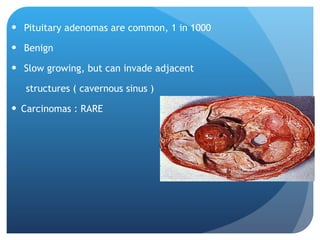
Pituitary adenomas are common, 1 in 1000 Benign Slow growing, but can invade adjacent  structures ( cavernous sinus ) Carcinomas : RARE
Mechanism of tumor generation: Malfunction of growth regulating genes Abnormalities of tumor suppressor genes Alteration in genes controlling programmed cell death
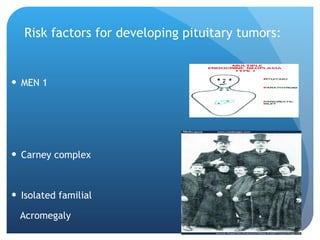
      Risk factors for developing pituitary tumors: MEN 1  Carney complex Isolated familial  Acromegaly
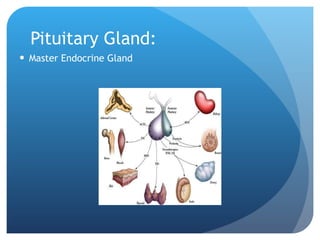
Pituitary Gland: Master Endocrine Gland
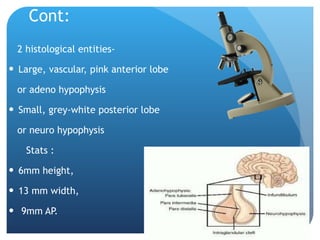
Cont: 2 histological entities- Large, vascular, pink anterior lobe  or adeno hypophysis Small, grey-white posterior lobe or neuro hypophysis Stats : 6mm height, 13 mm width, 9mm AP.
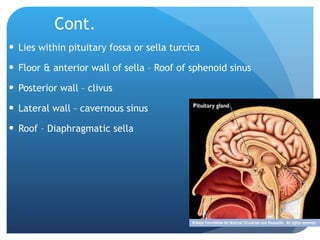
Cont. Lies within pituitary fossa or sella turcica Floor & anterior wall of sella – Roof of sphenoid sinus Posterior wall – clivus Lateral wall – cavernous sinus Roof – Diaphragmatic sella
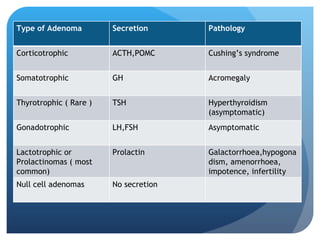
Type of Adenoma Secretion Pathology Corticotrophic ACTH,POMC Cushing’s syndrome Somatotrophic GH Acromegaly Thyrotrophic ( Rare ) TSH Hyperthyroidism (asymptomatic) Gonadotrophic LH,FSH Asymptomatic Lactotrophic or Prolactinomas ( most common) Prolactin Galactorrhoea,hypogonadism, amenorrhoea, impotence, infertility Null cell adenomas No secretion
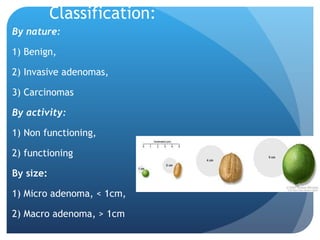
Classification: By nature: 1) Benign, 2) Invasive adenomas, 3) Carcinomas By activity: 1) Non functioning, 2) functioning By size: 1) Micro adenoma, < 1cm, 2) Macro adenoma, > 1cm
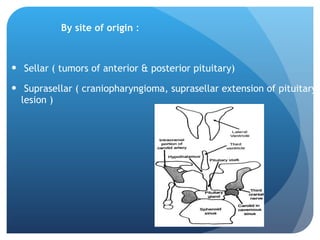
By site of origin  :  Sellar ( tumors of anterior & posterior pituitary) Suprasellar ( craniopharyngioma, suprasellar extension of pituitary lesion )
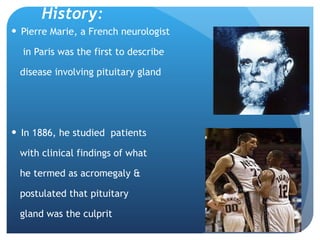
History: Pierre Marie, a French neurologist  in Paris was the first to describe  disease involving pituitary gland In 1886, he studied  patients  with clinical findings of what  he termed as acromegaly & postulated that pituitary  gland was the culprit
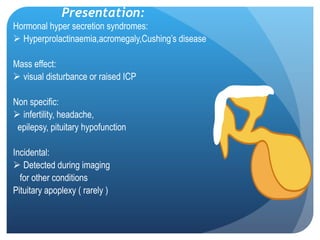
  Presentation: Hormonal hyper secretion syndromes: Hyperprolactinaemia,acromegaly,Cushing’s disease Mass effect: visual disturbance or raised ICP  Non specific: infertility, headache,  epilepsy, pituitary hypofunction Incidental: Detected during imaging  for other conditions Pituitary apoplexy ( rarely )
Goals of pituitary surgery: To remove as much as tumor  as possible to relieve compression & to eliminate hormonally active tissue Avoid additional neurological damage To protect healthy pituitary tissue
Important factors: Experience of Surgeon Size & location of tumor Consistency of tumor Other variables  ( vascularity, presence of  venous sinuses )
Work up: Basal prolactin concentration,  ( 2.8-29.2 ng/ml in women, 2.1-17.7 ng/ml in males) Growth hormone: GH concentration:  short t1/2, misleading if done alone- abnormal if > 10 mU/L ) Failure of GH suppression to < 2mU/L with 75 gm oral glucose, Increased IGF-1 ( a somatomedin )
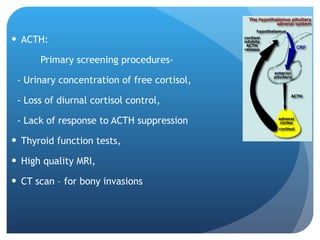
ACTH: Primary screening procedures- - Urinary concentration of free cortisol, - Loss of diurnal cortisol control, - Lack of response to ACTH suppression Thyroid function tests, High quality MRI, CT scan – for bony invasions
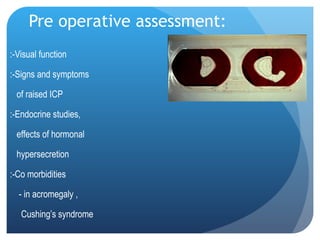
Pre operative assessment: :-Visual function :-Signs and symptoms  of raised ICP :-Endocrine studies,  effects of hormonal  hypersecretion :-Co morbidities  - in acromegaly , Cushing’s syndrome
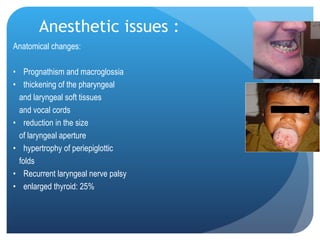
Anesthetic issues : Anatomical changes: Prognathism and macroglossia thickening of the pharyngeal  and laryngeal soft tissues  and vocal cords reduction in the size  of laryngeal aperture hypertrophy of periepiglottic  folds  Recurrent laryngeal nerve palsy  enlarged thyroid: 25%
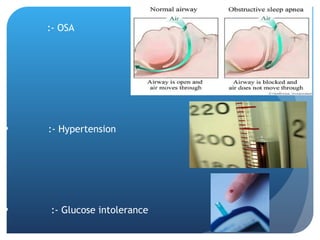
:- OSA :- Hypertension :- Glucose intolerance
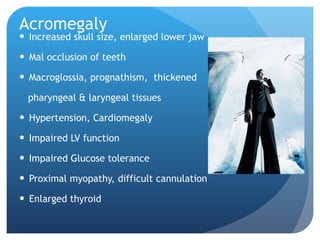
Acromegaly Increased skull size, enlarged lower jaw Mal occlusion of teeth Macroglossia, prognathism,  thickened  pharyngeal & laryngeal tissues Hypertension, Cardiomegaly Impaired LV function Impaired Glucose tolerance Proximal myopathy, difficult cannulation Enlarged thyroid
Cushing’s syndrome Appearance Impaired Glucose tolerance Hypertension, ECG changes,  LVH, ASH Hypernatremia, hypokalemia, alkalosis OSA, GERD Proximal myopathy Cannulation
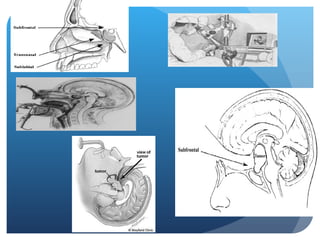
Surgical approach: Trans sphenoidal approach - Sublabial - Endonasal Trans ethmoidal approach Trans cranial - Subfrontal - Pterional
 
Anesthetic management Hemodynamic stability Maintenance of cerebral  oxygenation Facilitate surgical conditions Prevent of intra operative  complications Rapid emergence to facilitate  early neurological assessment
Cont: Airway management: 4 grades described in acromegaly:- Grade 1 – No significant involvement Grade 2 – Nasal & pharyngeal mucosal hypertrophy with normal glottis Grade 3 – Glottic stenosis or VC paresis Grade 4 – Glottic & soft tissue abnormalities South wick JP, Katz J. Unusual airway obstruction in acromegalic patients- indications for Tracheostomy. Anesthesiology 1979; 51: 72-3.
Cont: Throat pack Preparation of nasal mucosa Lumbar drain ( in patients with significant suprasellar extension ) Position
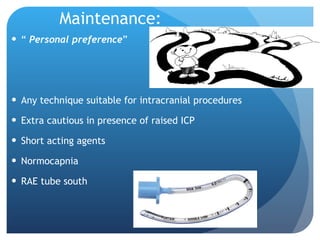
Maintenance: “  Personal preference ” Any technique suitable for intracranial procedures Extra cautious in presence of raised ICP Short acting agents Normocapnia RAE tube south
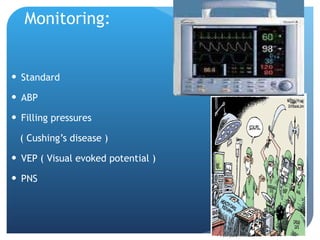
Monitoring: Standard ABP Filling pressures  ( Cushing’s disease ) VEP ( Visual evoked potential ) PNS
Emergence from anesthesia Smooth and rapid Removal of pack, pharyngeal suction  Extubation in a semi seated position
Operative complications: False aneurysm ( Rx: endovascular / clipping ) Damage to pons ( minimised by frequent fluoroscopy ) In transcranial: Frontal lobe ischemia- prolonged traction Seizures ( subfrontal ) Anosmia ( olfactory tract damage )
Post op care: Airway management Analgesia Hormone replacement
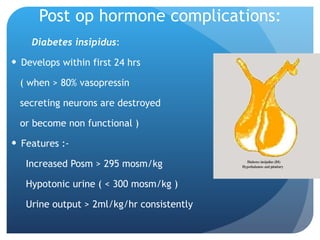
Post op hormone complications: Diabetes insipidus : Develops within first 24 hrs  ( when > 80% vasopressin  secreting neurons are destroyed  or become non functional ) Features :- Increased Posm > 295 mosm/kg Hypotonic urine ( < 300 mosm/kg ) Urine output > 2ml/kg/hr consistently
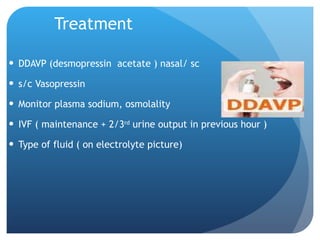
Treatment DDAVP (desmopressin  acetate ) nasal/ sc s/c Vasopressin Monitor plasma sodium, osmolality IVF ( maintenance + 2/3 rd  urine output in previous hour ) Type of fluid ( on electrolyte picture)
Hyponatremia Commonest cause: over enthusiastic  DDAVP  use Rarely- SIADH In SIADH : water retention, Loss of sodium in urine
References: Pituitary disease & Anesthesia. M Smith & N P Hirsch. BJA 85(1) : 3-14(2000) Treatment of  Pituitary tumors : a surgical perspective. Chandler, Barkan. Endocrinal Metab Clin A Am, 37(2008) 51-66 Barash’s Clinical Anesthesia Miller’s Anesthesia Harrison’s Principles of Internal Medicine Google Web & Images

THANK YOU

Anesthesia management for pituitary tumor

  • 1.
    Anesthesia management forPituitary tumor Dr. Abhijit Nair, Axon Anesthesia Associates, Consultant Anesthesiologist, Care Hospital, Hyderabad. i
  • 2.
    Pituitary adenomas arecommon, 1 in 1000 Benign Slow growing, but can invade adjacent structures ( cavernous sinus ) Carcinomas : RARE
  • 3.
    Mechanism of tumorgeneration: Malfunction of growth regulating genes Abnormalities of tumor suppressor genes Alteration in genes controlling programmed cell death
  • 4.
    Risk factors for developing pituitary tumors: MEN 1 Carney complex Isolated familial Acromegaly
  • 5.
    Pituitary Gland: MasterEndocrine Gland
  • 6.
    Cont: 2 histologicalentities- Large, vascular, pink anterior lobe or adeno hypophysis Small, grey-white posterior lobe or neuro hypophysis Stats : 6mm height, 13 mm width, 9mm AP.
  • 7.
    Cont. Lies withinpituitary fossa or sella turcica Floor & anterior wall of sella – Roof of sphenoid sinus Posterior wall – clivus Lateral wall – cavernous sinus Roof – Diaphragmatic sella
  • 8.
    Type of AdenomaSecretion Pathology Corticotrophic ACTH,POMC Cushing’s syndrome Somatotrophic GH Acromegaly Thyrotrophic ( Rare ) TSH Hyperthyroidism (asymptomatic) Gonadotrophic LH,FSH Asymptomatic Lactotrophic or Prolactinomas ( most common) Prolactin Galactorrhoea,hypogonadism, amenorrhoea, impotence, infertility Null cell adenomas No secretion
  • 9.
    Classification: By nature:1) Benign, 2) Invasive adenomas, 3) Carcinomas By activity: 1) Non functioning, 2) functioning By size: 1) Micro adenoma, < 1cm, 2) Macro adenoma, > 1cm
  • 10.
    By site oforigin : Sellar ( tumors of anterior & posterior pituitary) Suprasellar ( craniopharyngioma, suprasellar extension of pituitary lesion )
  • 11.
    History: Pierre Marie,a French neurologist in Paris was the first to describe disease involving pituitary gland In 1886, he studied patients with clinical findings of what he termed as acromegaly & postulated that pituitary gland was the culprit
  • 12.
    Presentation:Hormonal hyper secretion syndromes: Hyperprolactinaemia,acromegaly,Cushing’s disease Mass effect: visual disturbance or raised ICP Non specific: infertility, headache, epilepsy, pituitary hypofunction Incidental: Detected during imaging for other conditions Pituitary apoplexy ( rarely )
  • 13.
    Goals of pituitarysurgery: To remove as much as tumor as possible to relieve compression & to eliminate hormonally active tissue Avoid additional neurological damage To protect healthy pituitary tissue
  • 14.
    Important factors: Experienceof Surgeon Size & location of tumor Consistency of tumor Other variables ( vascularity, presence of venous sinuses )
  • 15.
    Work up: Basalprolactin concentration, ( 2.8-29.2 ng/ml in women, 2.1-17.7 ng/ml in males) Growth hormone: GH concentration: short t1/2, misleading if done alone- abnormal if > 10 mU/L ) Failure of GH suppression to < 2mU/L with 75 gm oral glucose, Increased IGF-1 ( a somatomedin )
  • 16.
    ACTH: Primary screeningprocedures- - Urinary concentration of free cortisol, - Loss of diurnal cortisol control, - Lack of response to ACTH suppression Thyroid function tests, High quality MRI, CT scan – for bony invasions
  • 17.
    Pre operative assessment::-Visual function :-Signs and symptoms of raised ICP :-Endocrine studies, effects of hormonal hypersecretion :-Co morbidities - in acromegaly , Cushing’s syndrome
  • 18.
    Anesthetic issues :Anatomical changes: Prognathism and macroglossia thickening of the pharyngeal and laryngeal soft tissues and vocal cords reduction in the size of laryngeal aperture hypertrophy of periepiglottic folds Recurrent laryngeal nerve palsy enlarged thyroid: 25%
  • 19.
    :- OSA :-Hypertension :- Glucose intolerance
  • 20.
    Acromegaly Increased skullsize, enlarged lower jaw Mal occlusion of teeth Macroglossia, prognathism, thickened pharyngeal & laryngeal tissues Hypertension, Cardiomegaly Impaired LV function Impaired Glucose tolerance Proximal myopathy, difficult cannulation Enlarged thyroid
  • 21.
    Cushing’s syndrome AppearanceImpaired Glucose tolerance Hypertension, ECG changes, LVH, ASH Hypernatremia, hypokalemia, alkalosis OSA, GERD Proximal myopathy Cannulation
  • 22.
    Surgical approach: Transsphenoidal approach - Sublabial - Endonasal Trans ethmoidal approach Trans cranial - Subfrontal - Pterional
  • 23.
  • 24.
    Anesthetic management Hemodynamicstability Maintenance of cerebral oxygenation Facilitate surgical conditions Prevent of intra operative complications Rapid emergence to facilitate early neurological assessment
  • 25.
    Cont: Airway management:4 grades described in acromegaly:- Grade 1 – No significant involvement Grade 2 – Nasal & pharyngeal mucosal hypertrophy with normal glottis Grade 3 – Glottic stenosis or VC paresis Grade 4 – Glottic & soft tissue abnormalities South wick JP, Katz J. Unusual airway obstruction in acromegalic patients- indications for Tracheostomy. Anesthesiology 1979; 51: 72-3.
  • 26.
    Cont: Throat packPreparation of nasal mucosa Lumbar drain ( in patients with significant suprasellar extension ) Position
  • 27.
    Maintenance: “ Personal preference ” Any technique suitable for intracranial procedures Extra cautious in presence of raised ICP Short acting agents Normocapnia RAE tube south
  • 28.
    Monitoring: Standard ABPFilling pressures ( Cushing’s disease ) VEP ( Visual evoked potential ) PNS
  • 29.
    Emergence from anesthesiaSmooth and rapid Removal of pack, pharyngeal suction Extubation in a semi seated position
  • 30.
    Operative complications: Falseaneurysm ( Rx: endovascular / clipping ) Damage to pons ( minimised by frequent fluoroscopy ) In transcranial: Frontal lobe ischemia- prolonged traction Seizures ( subfrontal ) Anosmia ( olfactory tract damage )
  • 31.
    Post op care:Airway management Analgesia Hormone replacement
  • 32.
    Post op hormonecomplications: Diabetes insipidus : Develops within first 24 hrs ( when > 80% vasopressin secreting neurons are destroyed or become non functional ) Features :- Increased Posm > 295 mosm/kg Hypotonic urine ( < 300 mosm/kg ) Urine output > 2ml/kg/hr consistently
  • 33.
    Treatment DDAVP (desmopressin acetate ) nasal/ sc s/c Vasopressin Monitor plasma sodium, osmolality IVF ( maintenance + 2/3 rd urine output in previous hour ) Type of fluid ( on electrolyte picture)
  • 34.
    Hyponatremia Commonest cause:over enthusiastic DDAVP use Rarely- SIADH In SIADH : water retention, Loss of sodium in urine
  • 35.
    References: Pituitary disease& Anesthesia. M Smith & N P Hirsch. BJA 85(1) : 3-14(2000) Treatment of Pituitary tumors : a surgical perspective. Chandler, Barkan. Endocrinal Metab Clin A Am, 37(2008) 51-66 Barash’s Clinical Anesthesia Miller’s Anesthesia Harrison’s Principles of Internal Medicine Google Web & Images
  • 36.