Obstetrics
and
anesthesia
BY: USHAPRIYADHERSINI.S
2017 BATCH ( CRMI)
Definition and History
Anesthesia is defined as the total loss of sensation (touch, pain,
temperature) and may include loss of consciousness in case of general
anesthesia
History:
 Oliver Wendell Holmes- coined the term anesthesia
 John snow- Father of Anesthesia – popularized the concept of
obstetric anesthesia after administering chloroform to Queen
Victoria on her 8th delivery
 August Bier- 1st spinal anesthesia
 Carl koller- 1st local anesthesia – used in ophthalmic surgeries
Types of anesthesia used in obstetrics
 Spinal anesthesia
 Epidural anesthesia
 Continuous spinal anesthesia
 General Anesthesia
Paracervical block
Pudendal nerve block
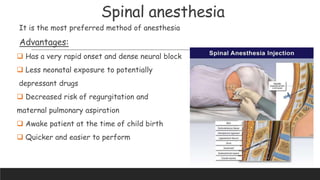
Spinal anesthesia
It is the most preferred method of anesthesia
Advantages:
 Has a very rapid onset and dense neural block
 Less neonatal exposure to potentially
depressant drugs
 Decreased risk of regurgitation and
maternal pulmonary aspiration
 Awake patient at the time of child birth
 Quicker and easier to perform
Technique:
 Hyperbaric 0.5% bupivacaine (10-12 mg) is the most commonly used
agent gravid uterus compressing the subarachnoid space cause faster
spread of drug and progesterone will allow increased sensivity to local
anesthetic drugs
 With patient in sitting position the drug is Injected in subarachnoid space
at L3-L4 level using Quinckes 25G needle
 Block level is T4-T6
 Its duration of action is around 1.5- 2 hours
 Addition of 12.5-25 mcg of fentanyl to Bupivacaine enhances the intensity
of block and also prolongs the duration of anesthesia
 Addition of preservative free morphine 0.1-0.2mg can prolong
postoperative analgesia upto 24hrs but requires special monitoring of vitals
for respiratory depression
 After spinal anesthesia, the patient is placed in supine with left
uterine displacement to avoid compression of inferior vena cava
 Supplemental oxygen id provided
 Blood pressure monitored for hypotension
 Intravenous injection Ephedrine( E6) can be used to maintain the
blood pressure > 100/60mmHg
 Bradycardia may occur due to higher level of spinal block or due to
vagal stimulation due to traction of peritoneum
 Monitoring is important due to risk of amniotic fluid embolism
 Postoperatively cares should continue till the effects of spinal
anesthesia are receded. Monitirng for PDPH is required and should be
managed adequately.
Contraindiactions:
 Coagulation disorders due to pre eclampsia or HELLP syndrome
clot can lead to compression of spinal cord that can cause permanent
paraplegia
 Infection at the site of injection meningitis
 severe hypertension sudden drop in BP after spinal can cause
hypoperfusion of vital organs
 Septicemia
 Cardiac disorders ( Mitral stenosis/ Aortic stenosis)
Raised ICT
Severe thrombocytopenia
Complications:
 Post dural puncture headache
 Hypotension
 Urinary retention
 Respiratory depression due to high level of block
 Neuropathy – temporary or permanent
 Meningitis
 Cauda equina syndrome
Epidural anesthesia
 Epidural is the most common type of anesthesia use during labour(
main goal is analgesia rather than anesthesia)
 Bupivacaine is the drug of choice
Block at T10 level (sensory and sympathetic block) T4 in C-section
 can be used during 1st and 2nd stage of labour
Effect of epidural:
 Shortening of 1st stage of labour
Prolongation of 2nd stage of labour
Sympathetic block Vasodilation decreased placental perfusion
transient fetal bradycardia
Managed by IVF and placing mother in left lateral position
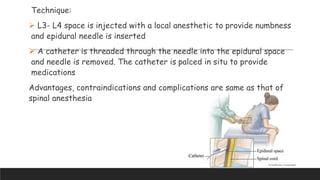
Technique:
 L3- L4 space is injected with a local anesthetic to provide numbness
and epidural needle is inserted
 A catheter is threaded through the needle into the epidural space
and needle is removed. The catheter is palced in situ to provide
medications
Advantages, contraindications and complications are same as that of
spinal anesthesia
Continuous spinal anesthesia
The dura is pierced with an epidural needle and the threads the
epidural catheter within the intrathecal space
Smaller doses of anesthetic agent (bupivacaine) can be given in an
incremental pattern
Advantage in high risk parturients such as cardiac disorders,
morbidly obese patients and those with neuromuscular disease
General anesthesia
Advised only in patients where spinal anesthesia is contraindicated
Disadvantage:
-Mother is unconscious hence cannot participate in child birth
-anesthesia might wear off quickly and result in postop pain
Technique:
- Inj metoclopramide or H2 blockers should be given in patients
with high risk of aspiration
- patient is placed in supin eposition with left uterine
dispalcment
- premedication with glycopyrrolate+ fentanyl+ xylocard
- preoxygenation with 100% O2 for 3-5 mins
Induction with inj Propofol and inj Atracurium
In hypotensive crisis, Inj ketamine 1-1.5mg/kg is substituted for
propofol
ET tube is inserted and secured in place
N2O:O2= 50:50 with isoflurane 1 volume%
 After delivery, N2O is increased to 70% isoflurane is decreased
or discontinued and opioid is administered
Inj oxytocin 10mg is injected into IVF
Once procedure is completed, reversal with Inj Neostigmine and
Glycopyrolate
Patient is extubated
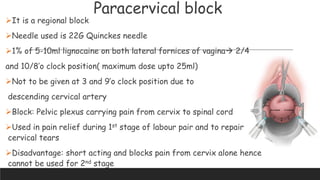
Paracervical block
It is a regional block
Needle used is 22G Quinckes needle
1% of 5-10ml lignocaine on both lateral fornices of vagina 2/4
and 10/8’o clock position( maximum dose upto 25ml)
Not to be given at 3 and 9’o clock position due to
descending cervical artery
Block: Pelvic plexus carrying pain from cervix to spinal cord
Used in pain relief during 1st stage of labour pair and to repair
cervical tears
Disadvantage: short acting and blocks pain from cervix alone hence
cannot be used for 2nd stage
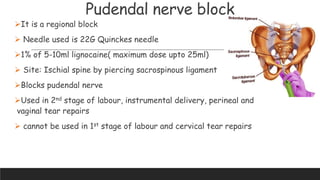
Pudendal nerve block
It is a regional block
 Needle used is 22G Quinckes needle
1% of 5-10ml lignocaine( maximum dose upto 25ml)
 Site: Ischial spine by piercing sacrospinous ligament
Blocks pudendal nerve
Used in 2nd stage of labour, instrumental delivery, perineal and
vaginal tear repairs
 cannot be used in 1st stage of labour and cervical tear repairs
Thank you!!

Obstetrics and anesthesia.ppt

  • 1.
  • 2.
    Definition and History Anesthesiais defined as the total loss of sensation (touch, pain, temperature) and may include loss of consciousness in case of general anesthesia History:  Oliver Wendell Holmes- coined the term anesthesia  John snow- Father of Anesthesia – popularized the concept of obstetric anesthesia after administering chloroform to Queen Victoria on her 8th delivery  August Bier- 1st spinal anesthesia  Carl koller- 1st local anesthesia – used in ophthalmic surgeries
  • 3.
    Types of anesthesiaused in obstetrics  Spinal anesthesia  Epidural anesthesia  Continuous spinal anesthesia  General Anesthesia Paracervical block Pudendal nerve block
  • 4.
    Spinal anesthesia It isthe most preferred method of anesthesia Advantages:  Has a very rapid onset and dense neural block  Less neonatal exposure to potentially depressant drugs  Decreased risk of regurgitation and maternal pulmonary aspiration  Awake patient at the time of child birth  Quicker and easier to perform
  • 5.
    Technique:  Hyperbaric 0.5%bupivacaine (10-12 mg) is the most commonly used agent gravid uterus compressing the subarachnoid space cause faster spread of drug and progesterone will allow increased sensivity to local anesthetic drugs  With patient in sitting position the drug is Injected in subarachnoid space at L3-L4 level using Quinckes 25G needle  Block level is T4-T6  Its duration of action is around 1.5- 2 hours  Addition of 12.5-25 mcg of fentanyl to Bupivacaine enhances the intensity of block and also prolongs the duration of anesthesia  Addition of preservative free morphine 0.1-0.2mg can prolong postoperative analgesia upto 24hrs but requires special monitoring of vitals for respiratory depression
  • 6.
     After spinalanesthesia, the patient is placed in supine with left uterine displacement to avoid compression of inferior vena cava  Supplemental oxygen id provided  Blood pressure monitored for hypotension  Intravenous injection Ephedrine( E6) can be used to maintain the blood pressure > 100/60mmHg  Bradycardia may occur due to higher level of spinal block or due to vagal stimulation due to traction of peritoneum  Monitoring is important due to risk of amniotic fluid embolism  Postoperatively cares should continue till the effects of spinal anesthesia are receded. Monitirng for PDPH is required and should be managed adequately.
  • 7.
    Contraindiactions:  Coagulation disordersdue to pre eclampsia or HELLP syndrome clot can lead to compression of spinal cord that can cause permanent paraplegia  Infection at the site of injection meningitis  severe hypertension sudden drop in BP after spinal can cause hypoperfusion of vital organs  Septicemia  Cardiac disorders ( Mitral stenosis/ Aortic stenosis) Raised ICT Severe thrombocytopenia
  • 8.
    Complications:  Post duralpuncture headache  Hypotension  Urinary retention  Respiratory depression due to high level of block  Neuropathy – temporary or permanent  Meningitis  Cauda equina syndrome
  • 9.
    Epidural anesthesia  Epiduralis the most common type of anesthesia use during labour( main goal is analgesia rather than anesthesia)  Bupivacaine is the drug of choice Block at T10 level (sensory and sympathetic block) T4 in C-section  can be used during 1st and 2nd stage of labour Effect of epidural:  Shortening of 1st stage of labour Prolongation of 2nd stage of labour Sympathetic block Vasodilation decreased placental perfusion transient fetal bradycardia Managed by IVF and placing mother in left lateral position
  • 10.
    Technique:  L3- L4space is injected with a local anesthetic to provide numbness and epidural needle is inserted  A catheter is threaded through the needle into the epidural space and needle is removed. The catheter is palced in situ to provide medications Advantages, contraindications and complications are same as that of spinal anesthesia
  • 11.
    Continuous spinal anesthesia Thedura is pierced with an epidural needle and the threads the epidural catheter within the intrathecal space Smaller doses of anesthetic agent (bupivacaine) can be given in an incremental pattern Advantage in high risk parturients such as cardiac disorders, morbidly obese patients and those with neuromuscular disease
  • 12.
    General anesthesia Advised onlyin patients where spinal anesthesia is contraindicated Disadvantage: -Mother is unconscious hence cannot participate in child birth -anesthesia might wear off quickly and result in postop pain Technique: - Inj metoclopramide or H2 blockers should be given in patients with high risk of aspiration - patient is placed in supin eposition with left uterine dispalcment - premedication with glycopyrrolate+ fentanyl+ xylocard - preoxygenation with 100% O2 for 3-5 mins
  • 13.
    Induction with injPropofol and inj Atracurium In hypotensive crisis, Inj ketamine 1-1.5mg/kg is substituted for propofol ET tube is inserted and secured in place N2O:O2= 50:50 with isoflurane 1 volume%  After delivery, N2O is increased to 70% isoflurane is decreased or discontinued and opioid is administered Inj oxytocin 10mg is injected into IVF Once procedure is completed, reversal with Inj Neostigmine and Glycopyrolate Patient is extubated
  • 14.
    Paracervical block It isa regional block Needle used is 22G Quinckes needle 1% of 5-10ml lignocaine on both lateral fornices of vagina 2/4 and 10/8’o clock position( maximum dose upto 25ml) Not to be given at 3 and 9’o clock position due to descending cervical artery Block: Pelvic plexus carrying pain from cervix to spinal cord Used in pain relief during 1st stage of labour pair and to repair cervical tears Disadvantage: short acting and blocks pain from cervix alone hence cannot be used for 2nd stage
  • 15.
    Pudendal nerve block Itis a regional block  Needle used is 22G Quinckes needle 1% of 5-10ml lignocaine( maximum dose upto 25ml)  Site: Ischial spine by piercing sacrospinous ligament Blocks pudendal nerve Used in 2nd stage of labour, instrumental delivery, perineal and vaginal tear repairs  cannot be used in 1st stage of labour and cervical tear repairs
  • 16.