
Anecdotes from the history of mathematics : Ways of selling mathematics1. Numbers
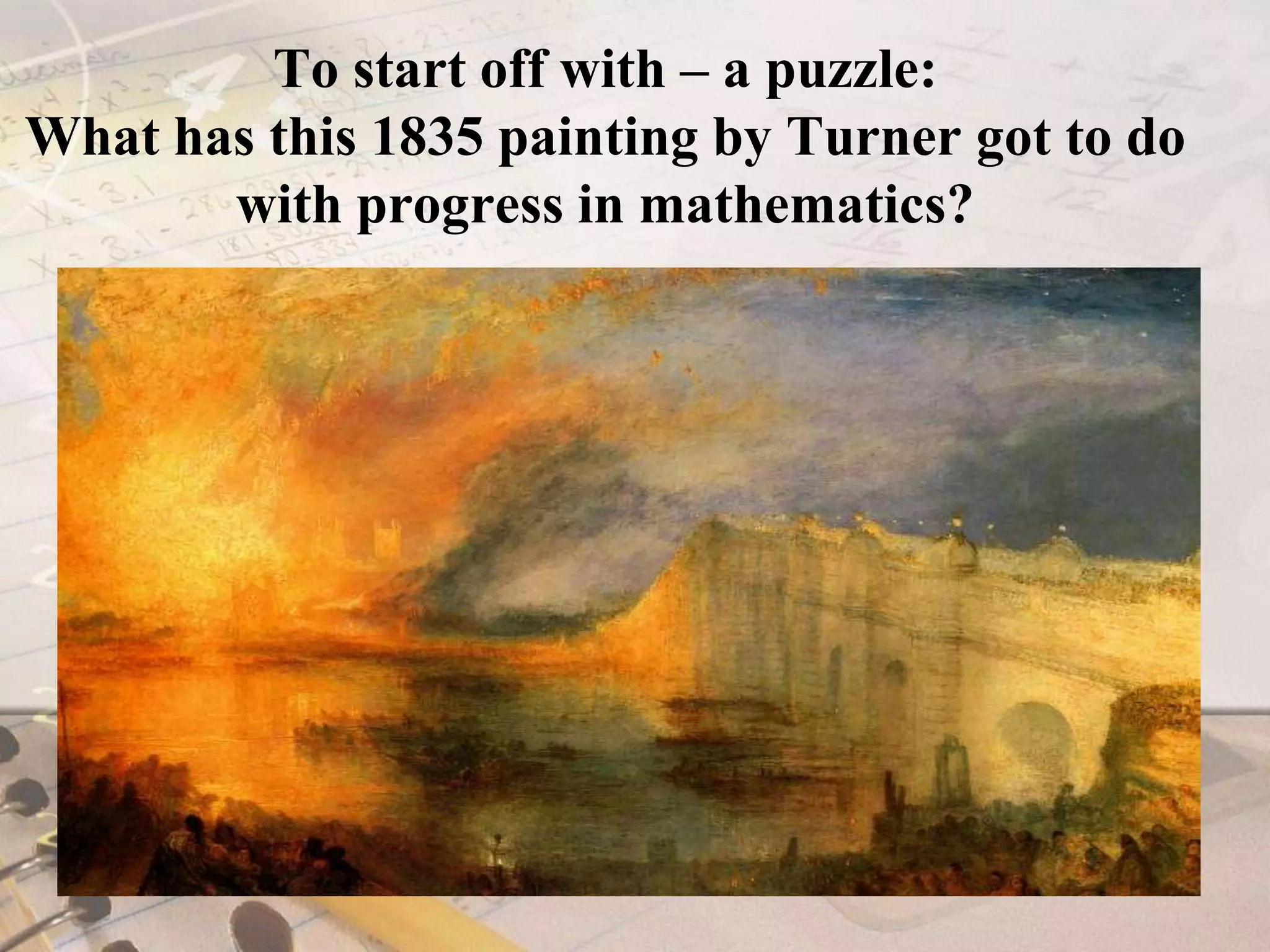
To start off with – a puzzle:What has this 1835 painting by Turner got to do with progress in mathematics?
Number sense              Cardinal number sense                        Number words                                  Counting (influenced by anatomy)                                            Discovery of zero                                                      Development of arithmetic
Number sense – critical for survival of the speciesThe ability to recognize whether a small collection of objects has increased or decreased      Have we lost someone whilst out hunting?      Is our group size sufficient to defend against or attack the opposing tribe?
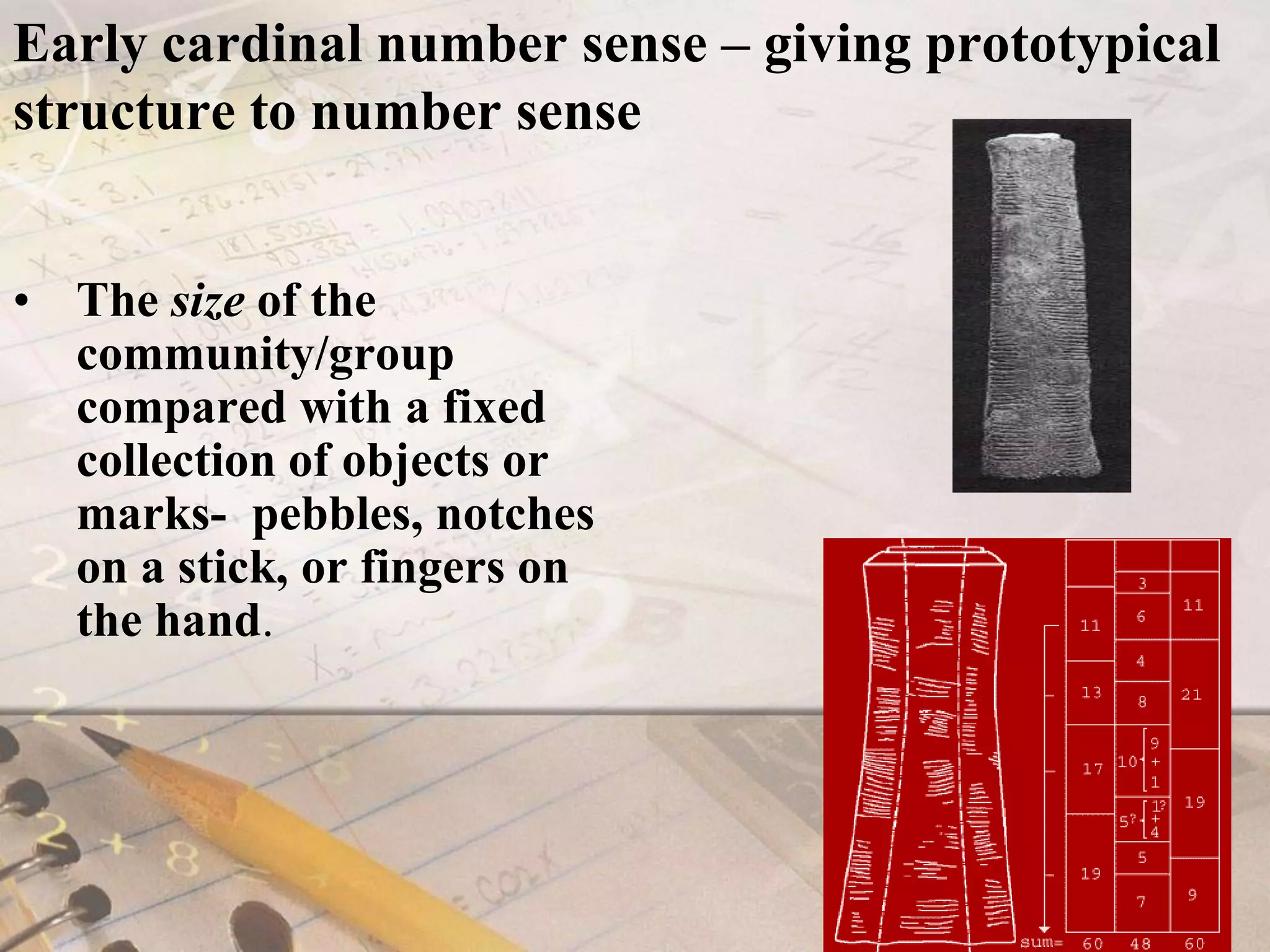
Early cardinal number sense – giving prototypical structure to number senseThe size of the community/group compared with a fixed collection of objects or marks-  pebbles, notches on a stick, or fingers on the hand.
The development of number wordsThe abstraction of number words to abstract symbols came much later. As Bertrand Russell stated "It must have required many ages to discover that a brace of pheasants and a couple of days were both instances of the number 2”.
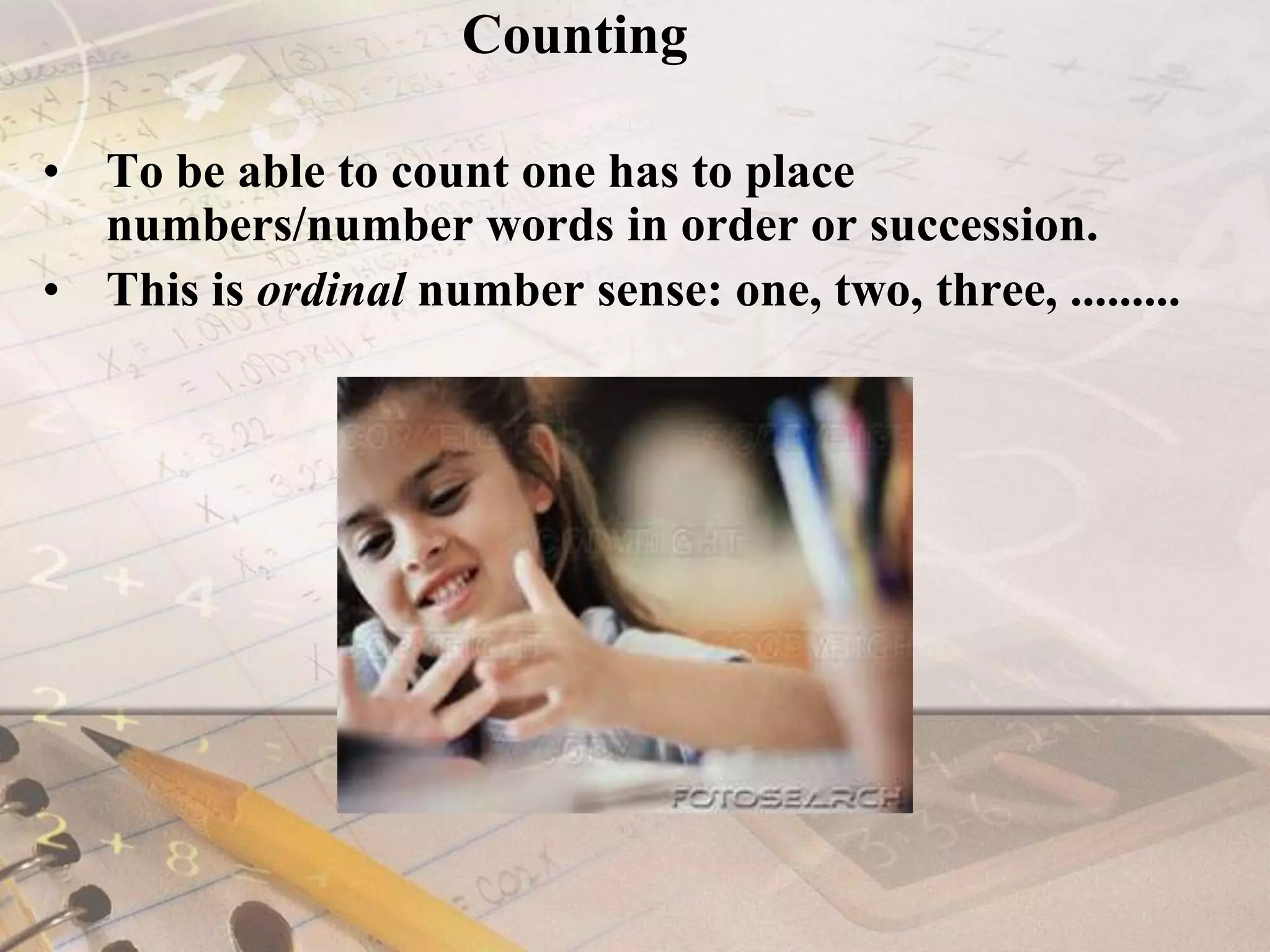
CountingTo be able to count one has to place numbers/number words in order or succession.This is ordinal number sense: one, two, three, .........
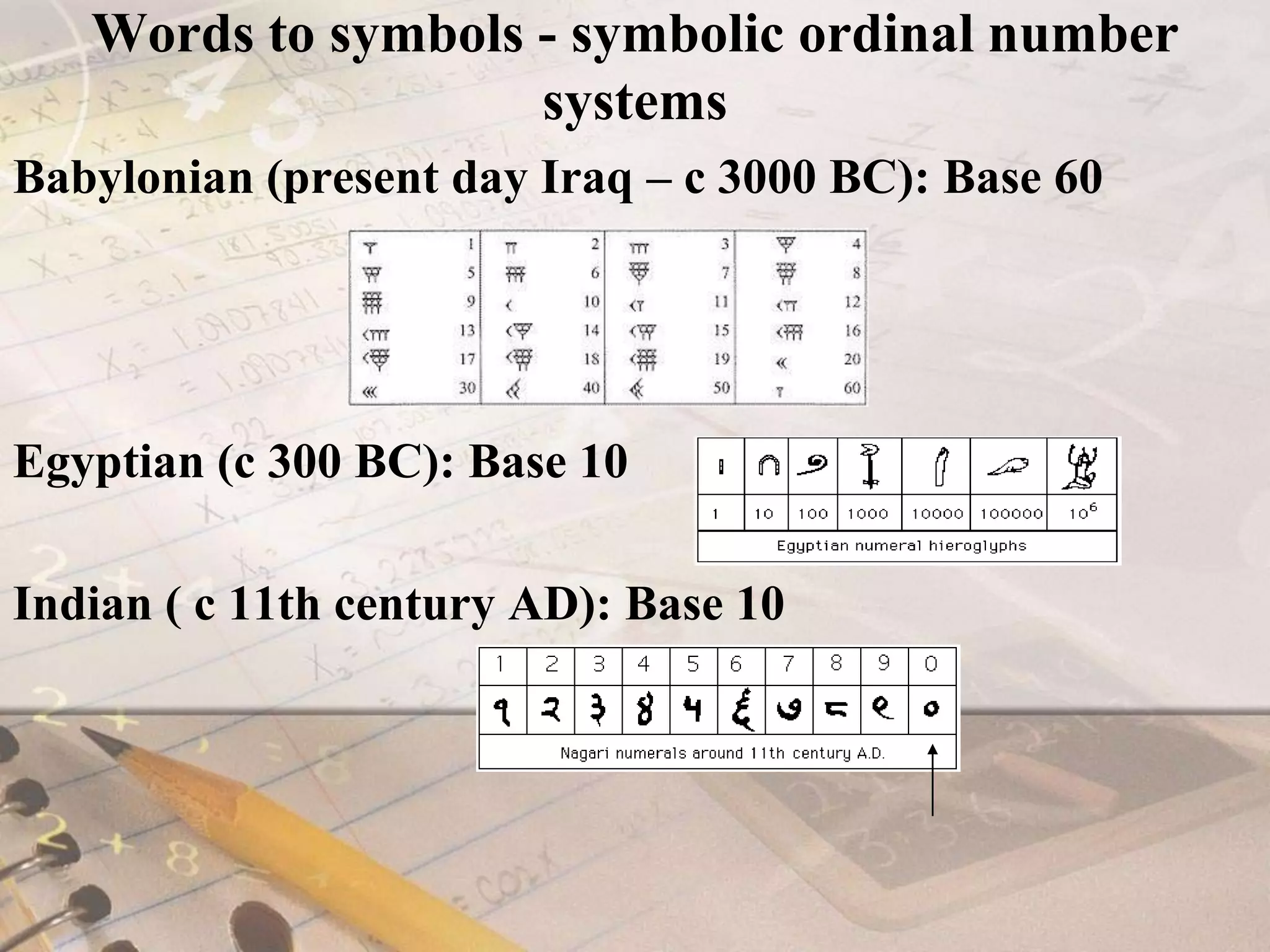
Words to symbols - symbolic ordinal number systemsBabylonian (present day Iraq – c 3000 BC): Base 60Egyptian (c 300 BC): Base 10Indian ( c 11th century AD): Base 10
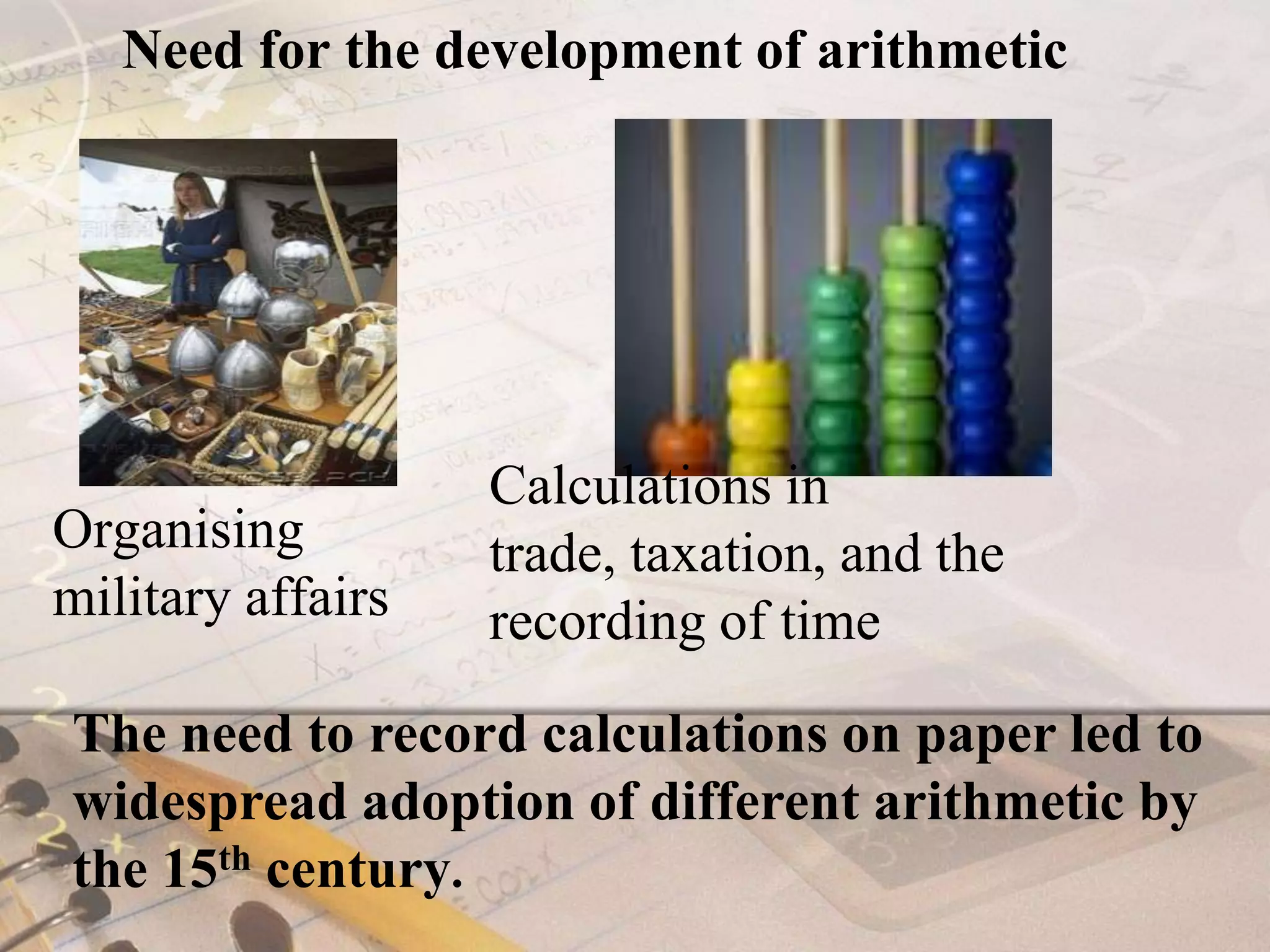
Need for the development of arithmetic Calculations in trade, taxation, and the recording of timeOrganising military affairsThe need to record calculations on paper led to widespread adoption of different arithmetic by the 15th century.
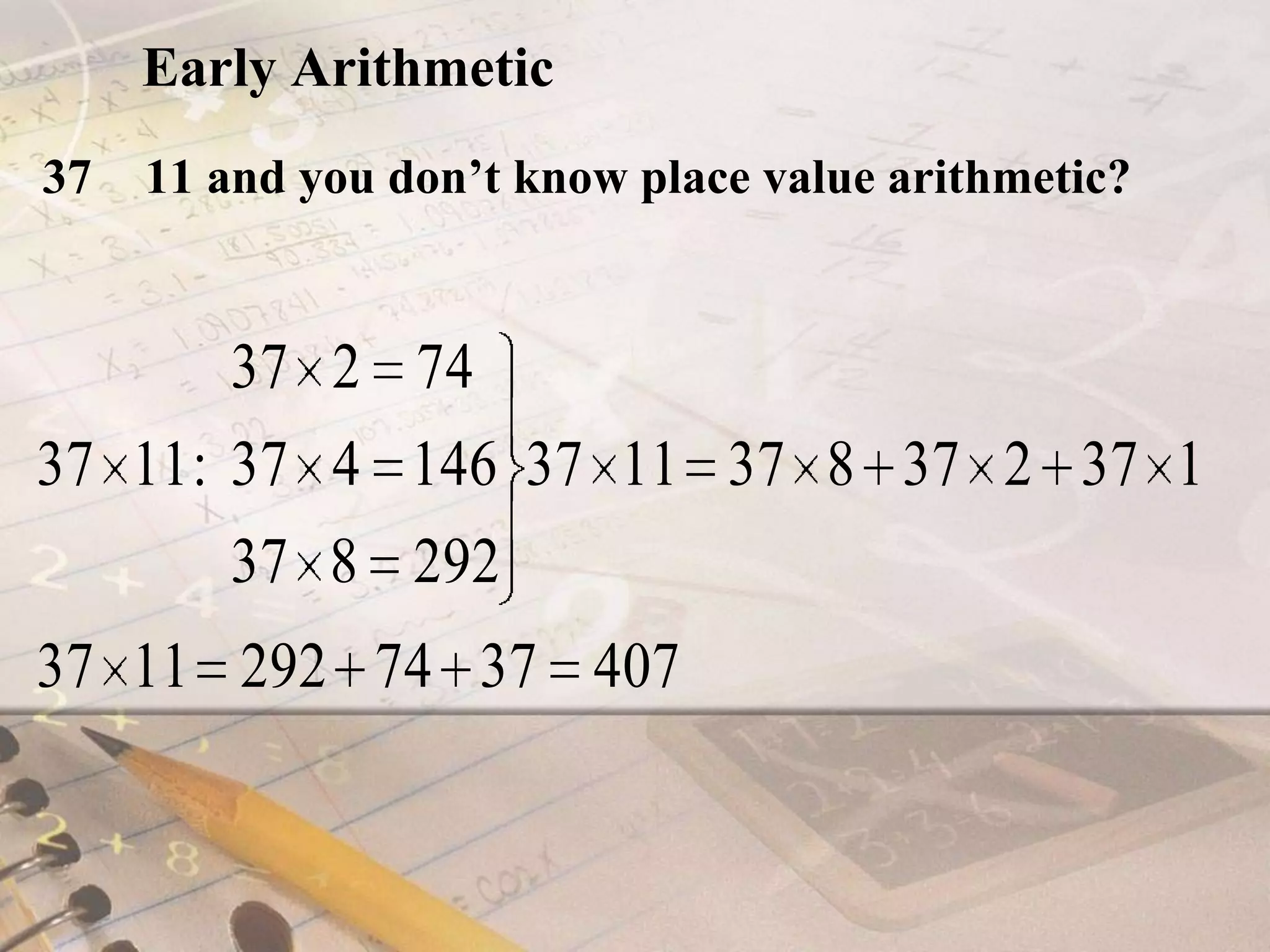
Early Arithmetic37 × 11 and you don’t know place value arithmetic?
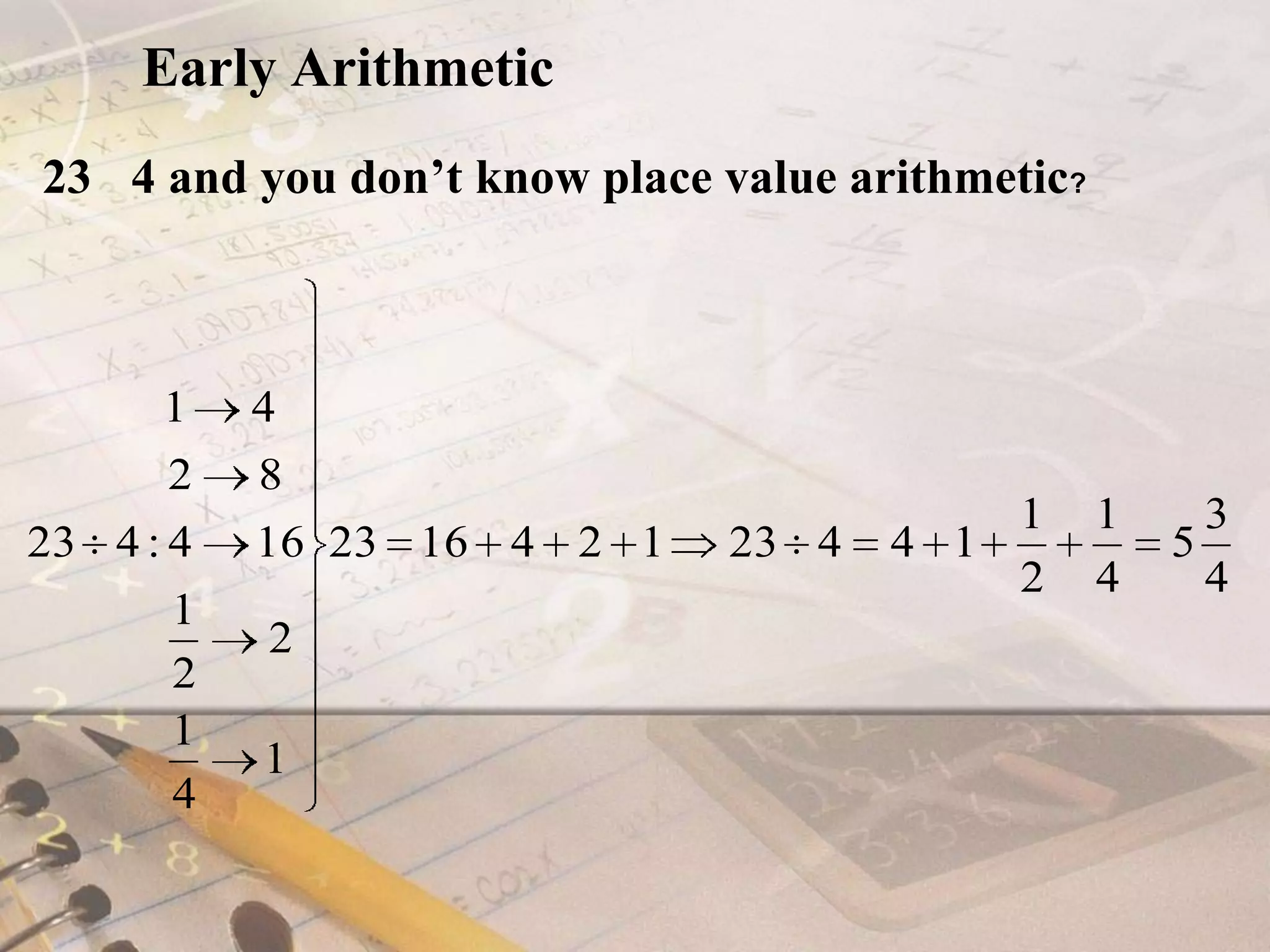
Early Arithmetic23÷ 4 and you don’t know place value arithmetic?
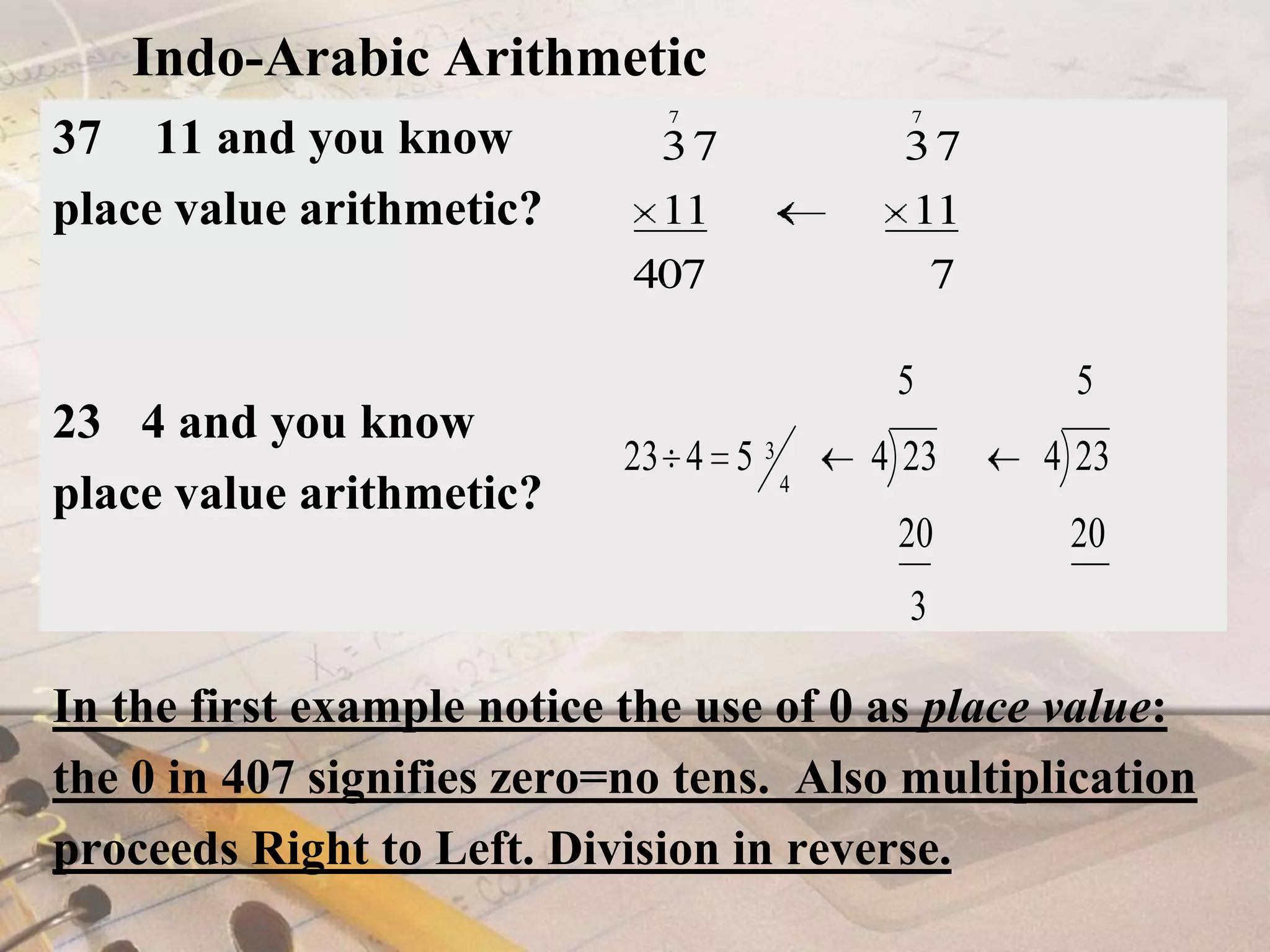
Indo-Arabic Arithmetic37 × 11 and you know place value arithmetic?23÷ 4 and you know place value arithmetic?In the first example notice the use of 0 as place value: the 0 in 407 signifies zero=no tens.  Also multiplication proceeds Right to Left. Division in reverse.
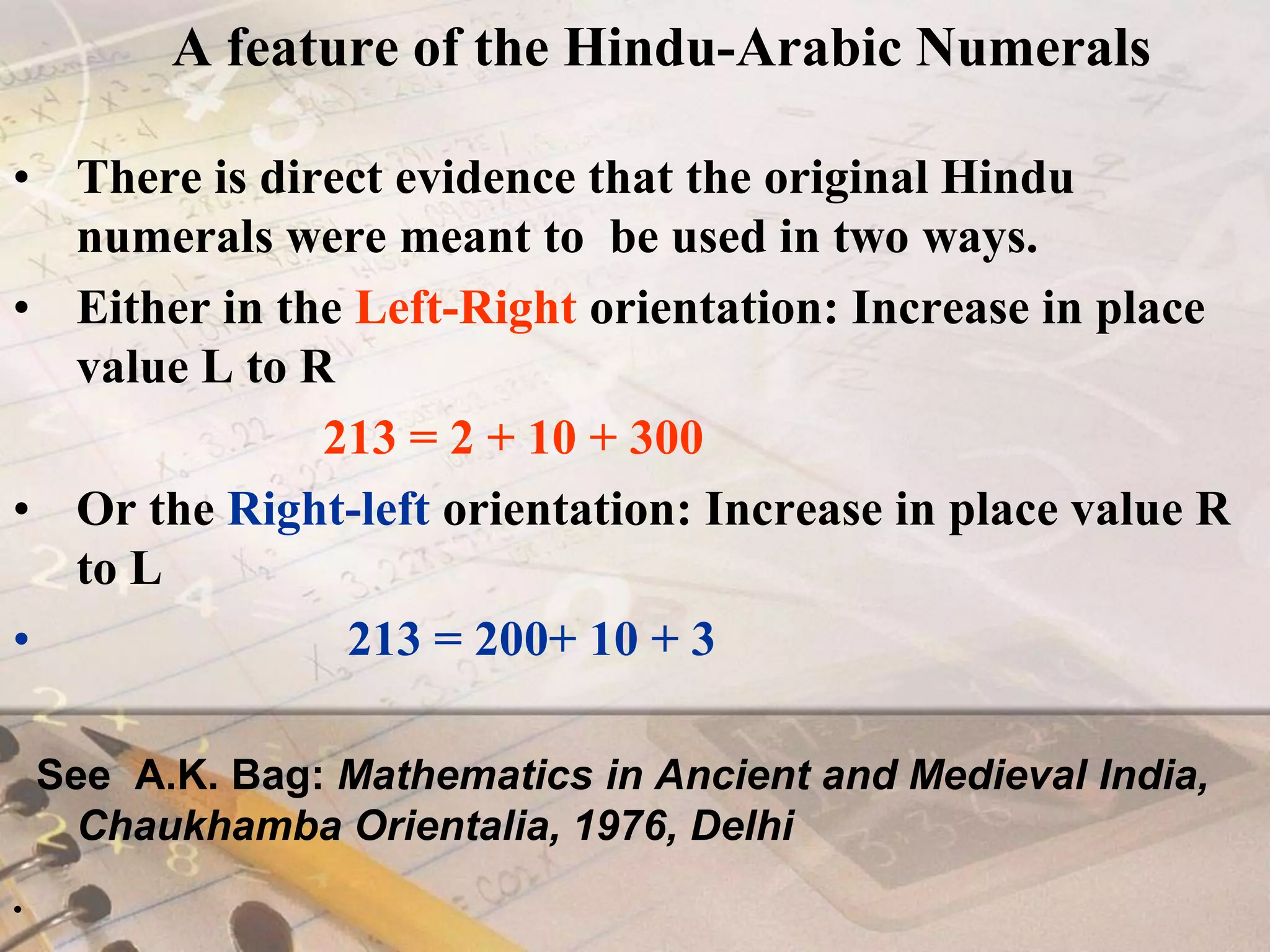
A feature of the Hindu-Arabic NumeralsThere is direct evidence that the original Hindu numerals were meant to  be used in two ways.Either in the Left-Right orientation: Increase in place value L to R           213 = 2 + 10 + 300Or the Right-left orientation: Increase in place value R to L                      213 = 200+ 10 + 3  See  A.K. Bag: Mathematics in Ancient and Medieval India,  Chaukhamba Orientalia, 1976, Delhi
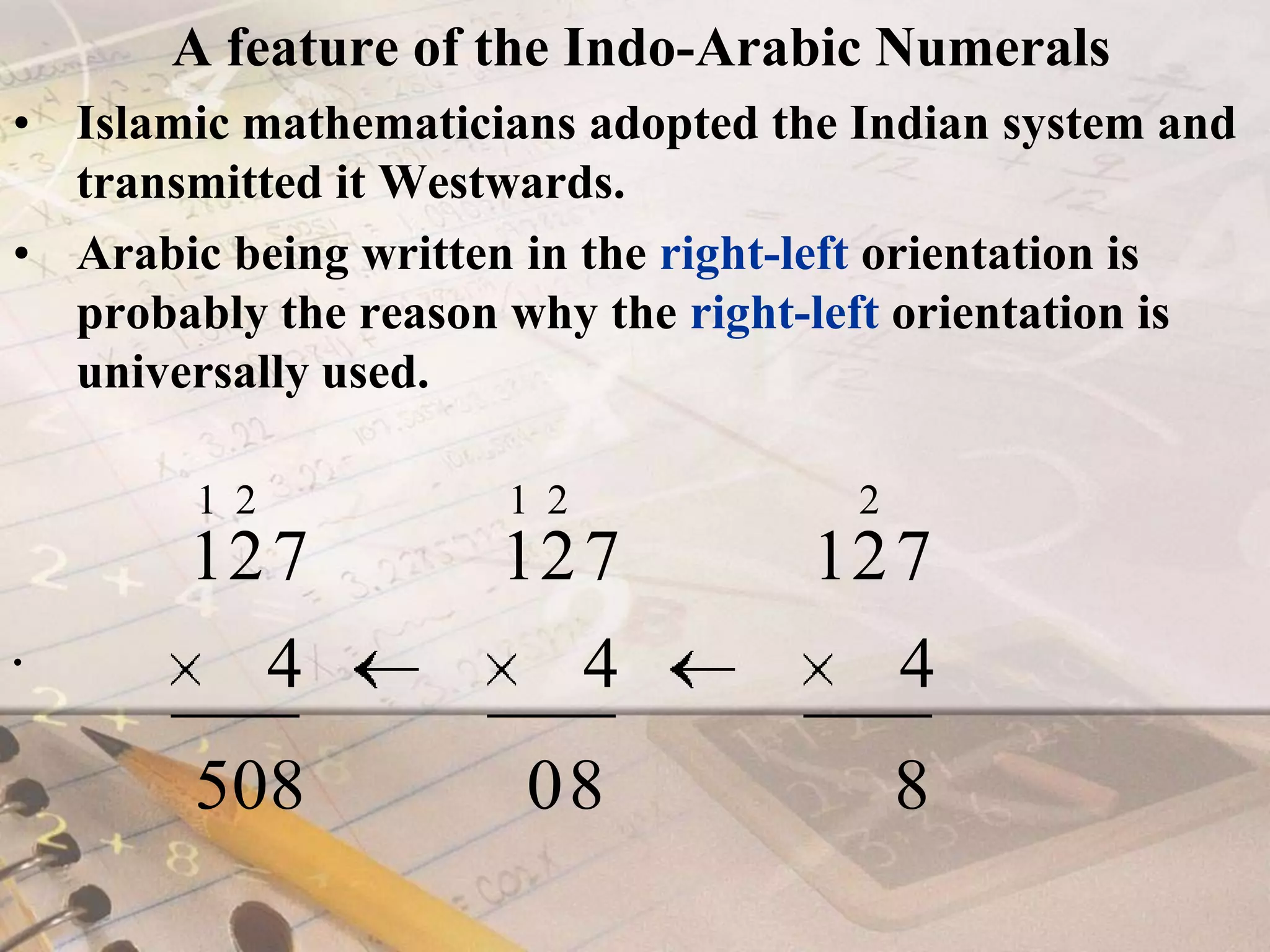
A feature of the Indo-Arabic NumeralsIslamic mathematicians adopted the Indian system and transmitted it Westwards. Arabic being written in the right-left orientation is probably the reason why the right-left orientation is universally used.
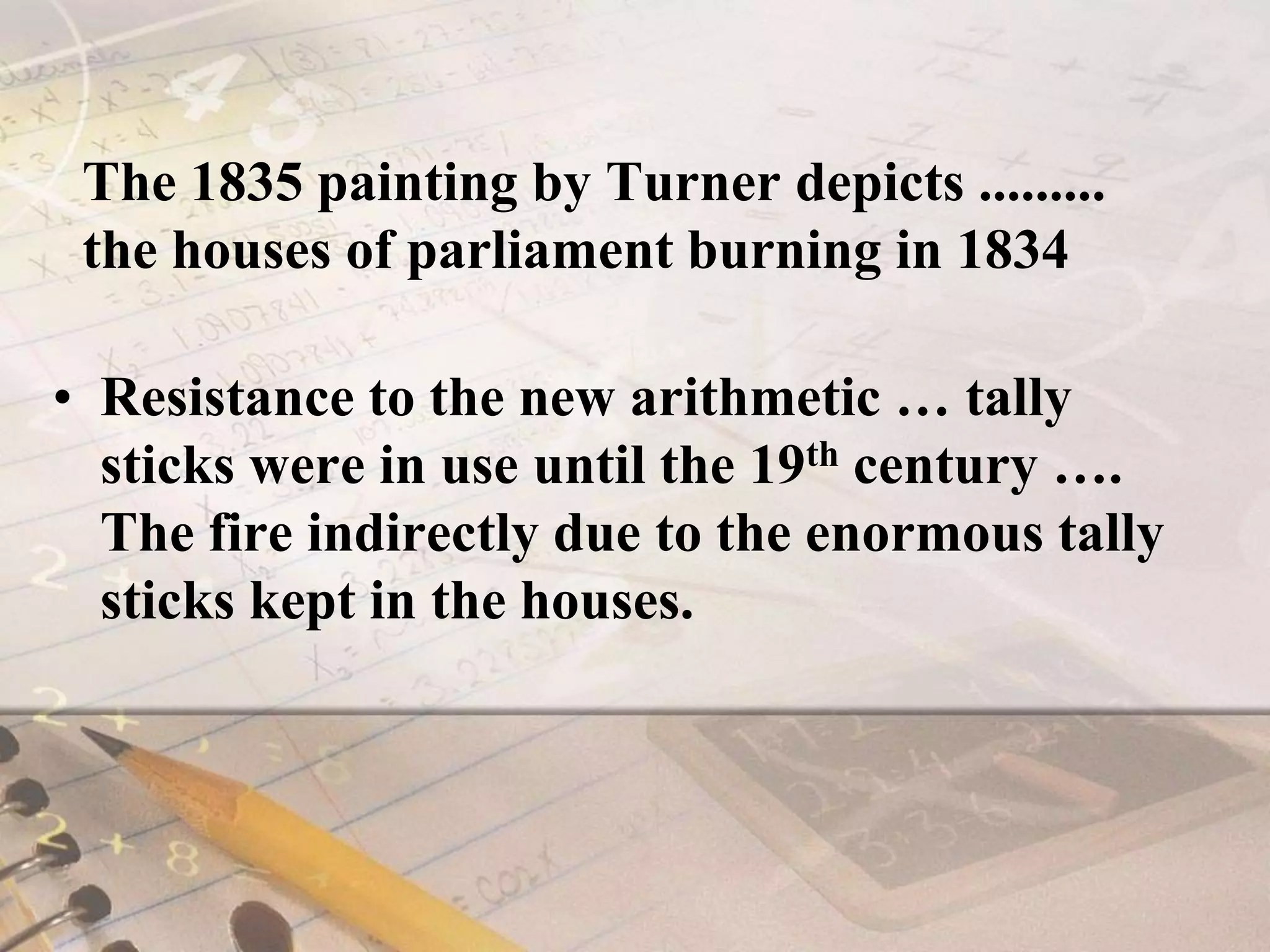
The 1835 painting by Turner depicts .........the houses of parliament burning in 1834Resistance to the new arithmetic … tally sticks were in use until the 19th century …. The fire indirectly due to the enormous tally sticks kept in the houses.
The 1835 painting by TurnerCharles Dickens commented at the time: "... it took until 1826 to get these sticks abolished. ….In 1834 there was a considerable accumulation of them. The sticks were housed in Westminster…… and so the order went out that they should be privately and confidentially burned. It came to pass that they were burned in a stove in the House of Lords. The stove, overgorged with these preposterous sticks, set fire to the panelling; the panelling set fire to the House of Commons; the two houses were reduced to ashes"
Anecdotes from the history of mathematics : Ways of selling mathematics2. Algebra
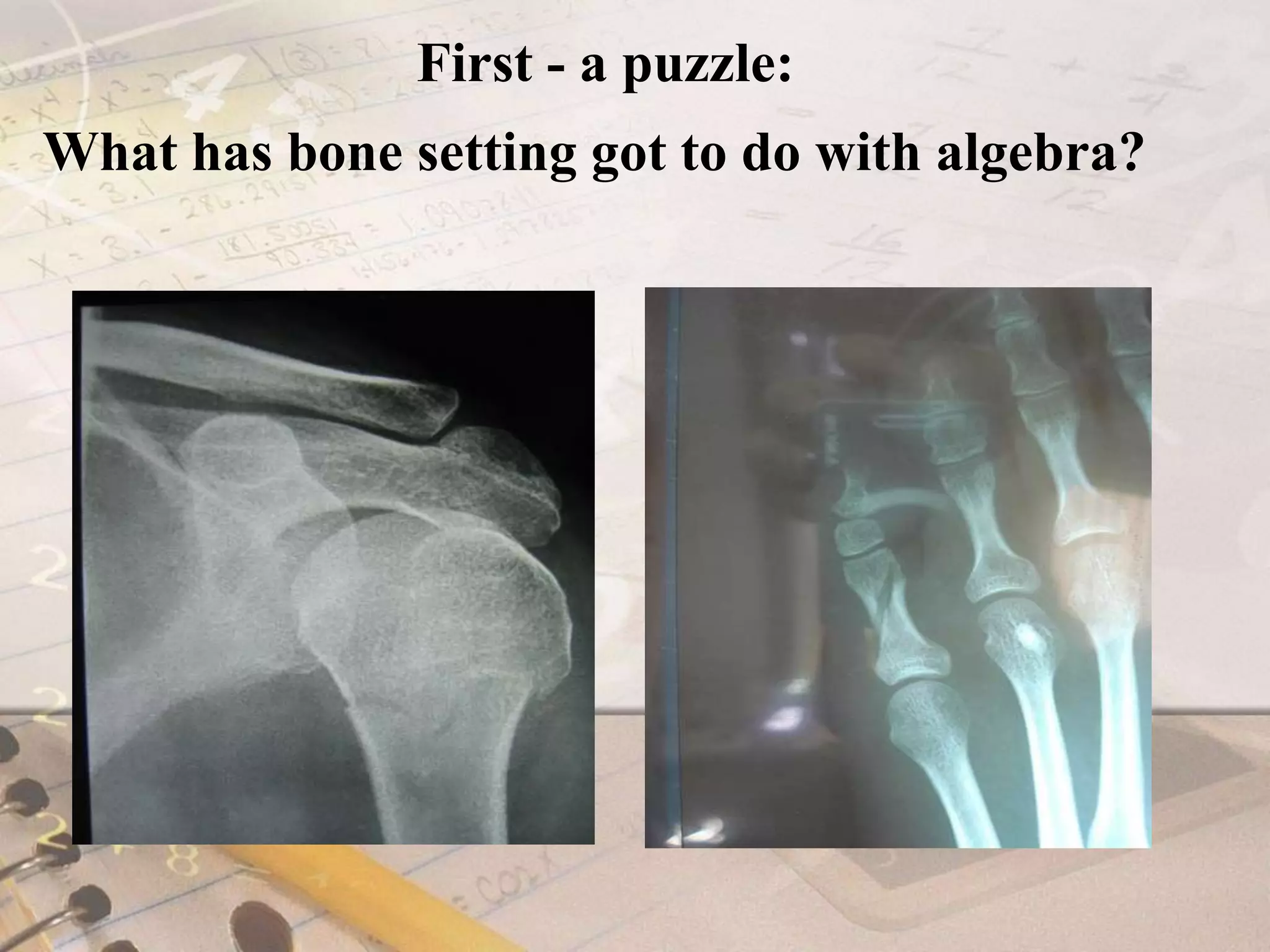
First - a puzzle:What has bone setting got to do with algebra?
Key developments in ancient and medieval algebraExtraction  of square roots     Method for solution of practical problems Method for approximate solutions of these problems
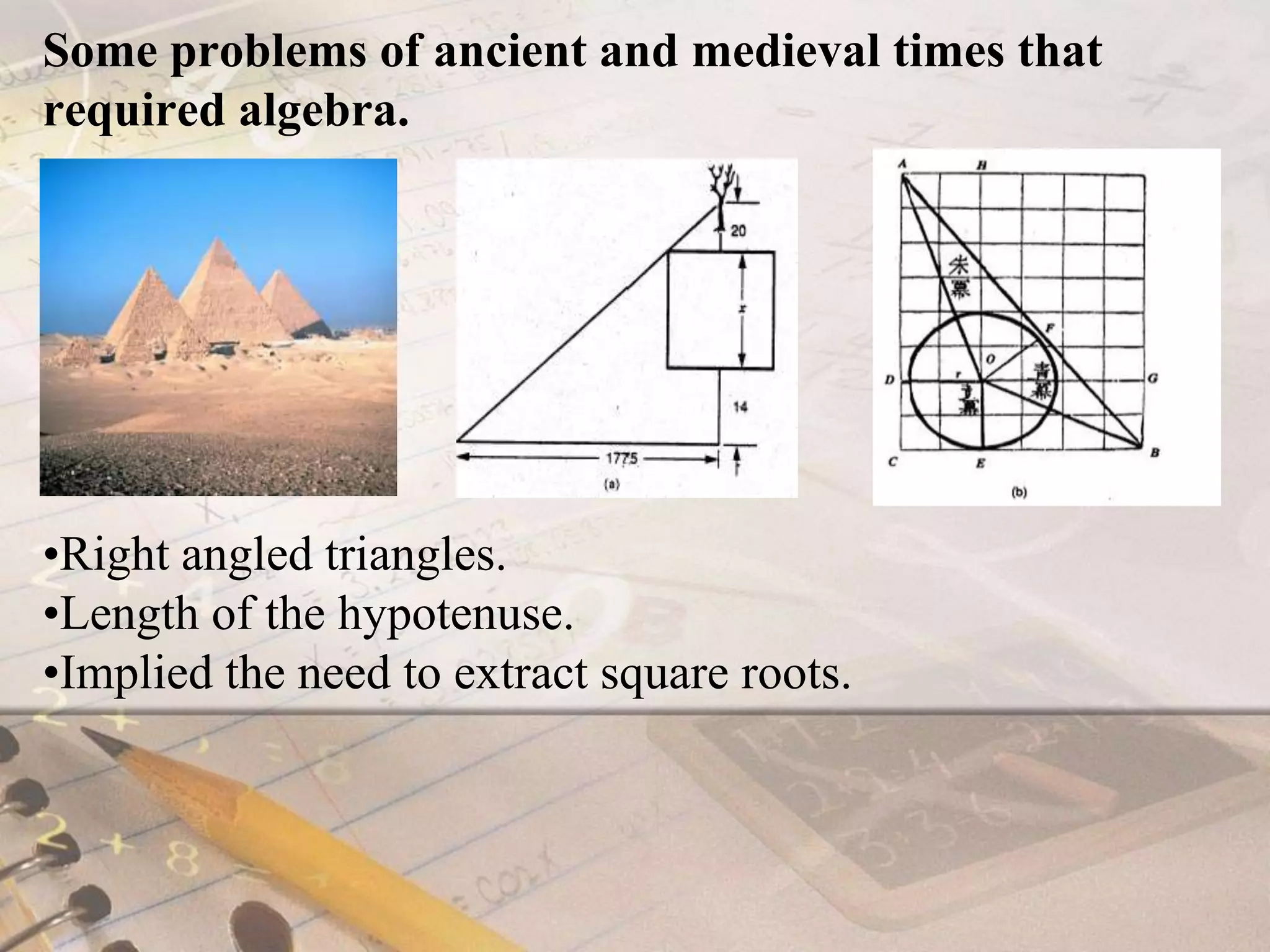
Some problems of ancient and medieval times that required algebra.Right angled triangles. Length of the hypotenuse.Implied the need to extract square roots.
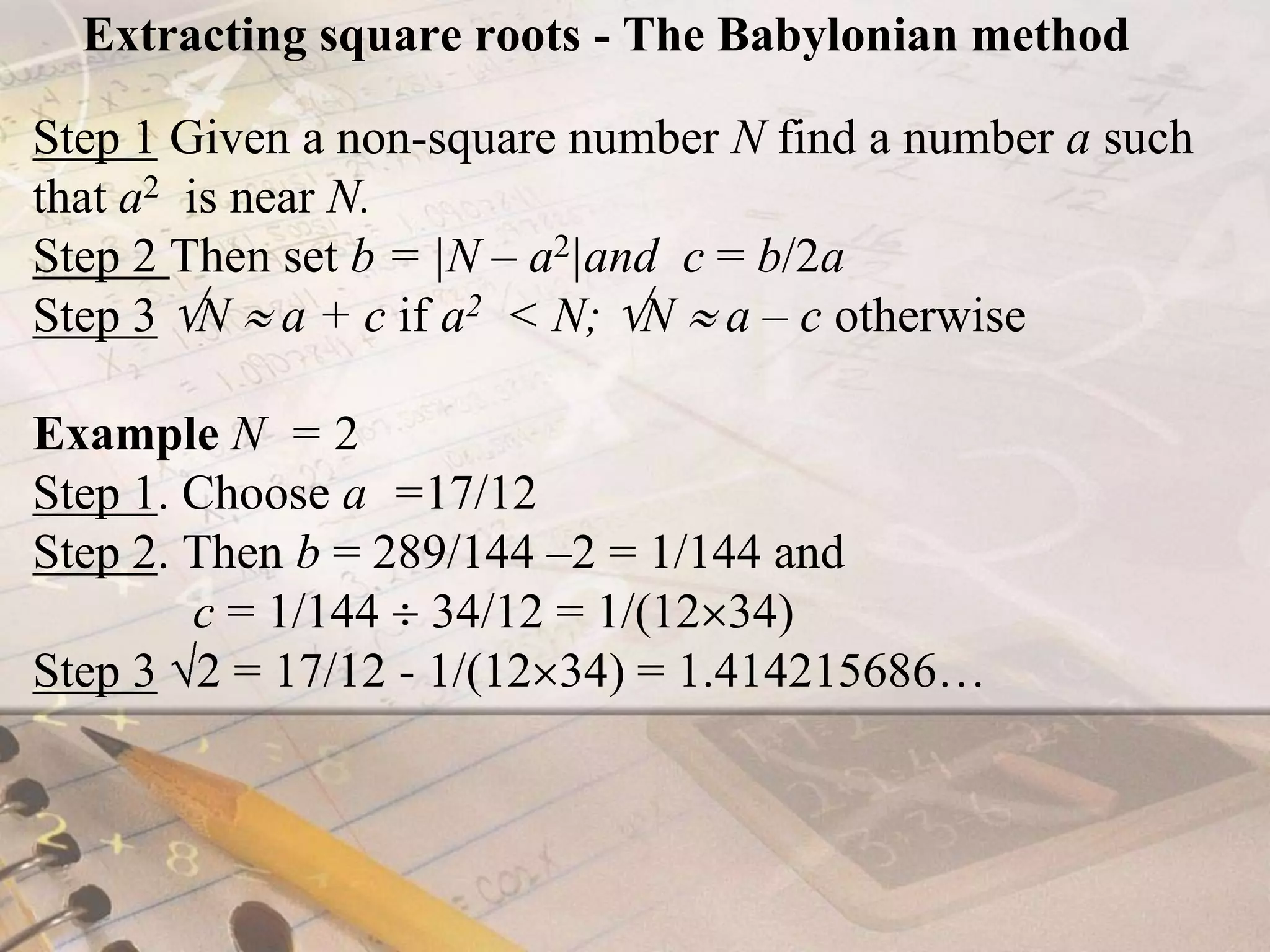
Extracting square roots - The Babylonian methodStep 1 Given a non-square number N find a number a such that a2  is near N.Step 2Then set b = |N – a2|andc = b/2aStep 3N  a + c if a2  < N; N  a – c otherwiseExample N  = 2 Step 1. Choose a  =17/12 Step 2. Then b = 289/144 –2 = 1/144 and              c = 1/144  34/12 = 1/(1234)Step 3 2 = 17/12 - 1/(1234) = 1.414215686…
Solving simple equations – Early generalisationsThe rule of three. To find the cost multiply the fruit by the requisition, and divide the resulting product by the argument.Example 1. If A = 6[the argument] books cost F = 12 units [the fruit], what will R = 10 [requisition] books cost? Rule of 3  Cost = F× R = 12 × 10 = 20 units             A                6
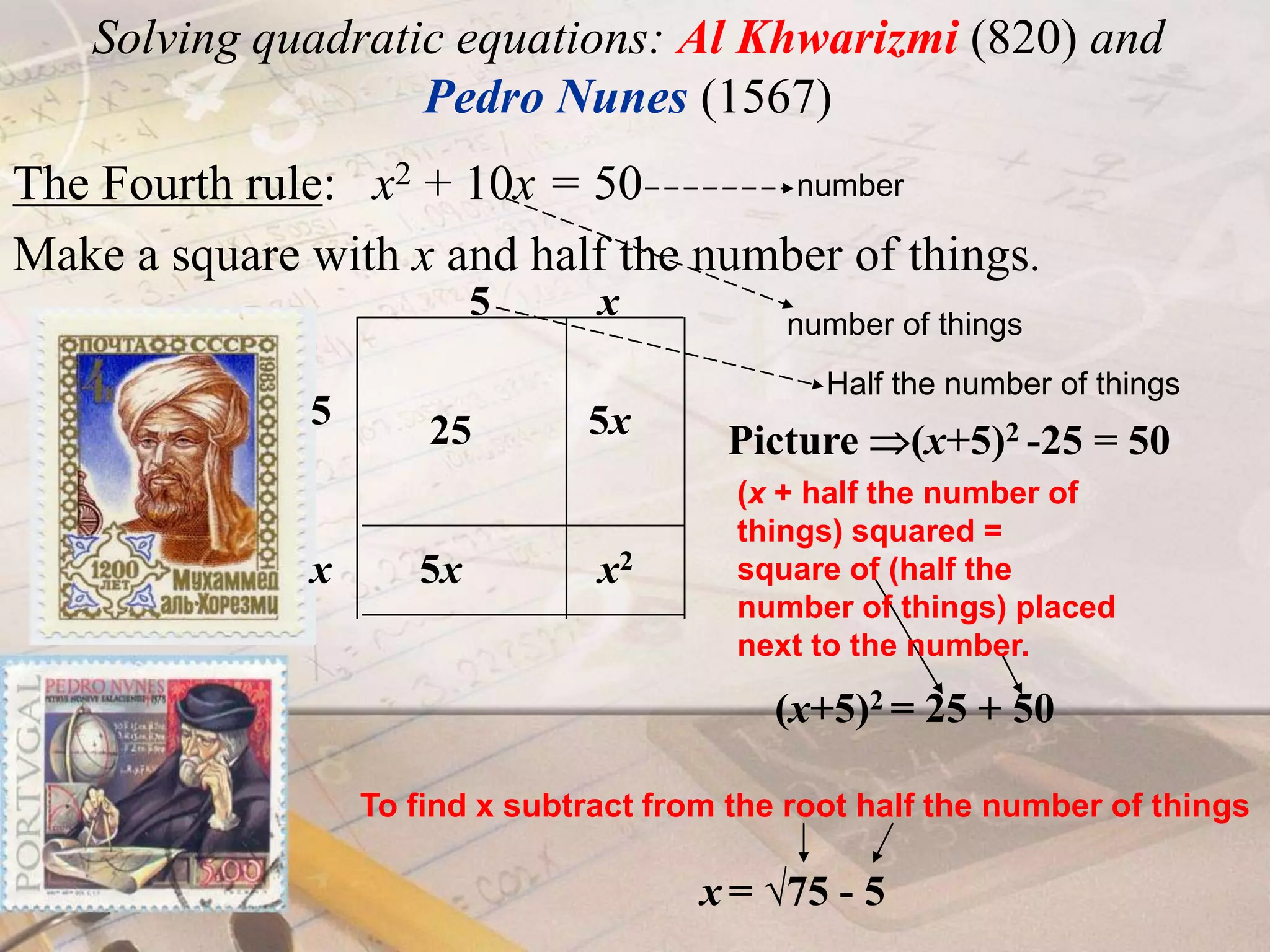
Solving quadratic equations: Al Khwarizmi(820) and Pedro Nunes (1567)The Fourth rule:   x2 +10x = 50  Make a square with x and half the number of things.(x+5)2 = 25 + 50                                                                           x= √75 - 5 number5xnumber of thingsHalf the number of things55x25 Picture (x+5)2 -25 = 50 (x + half the number of things) squared = square of (half the number of things) placed next to the number.5xx2xTo find x subtract from the root half the number of things
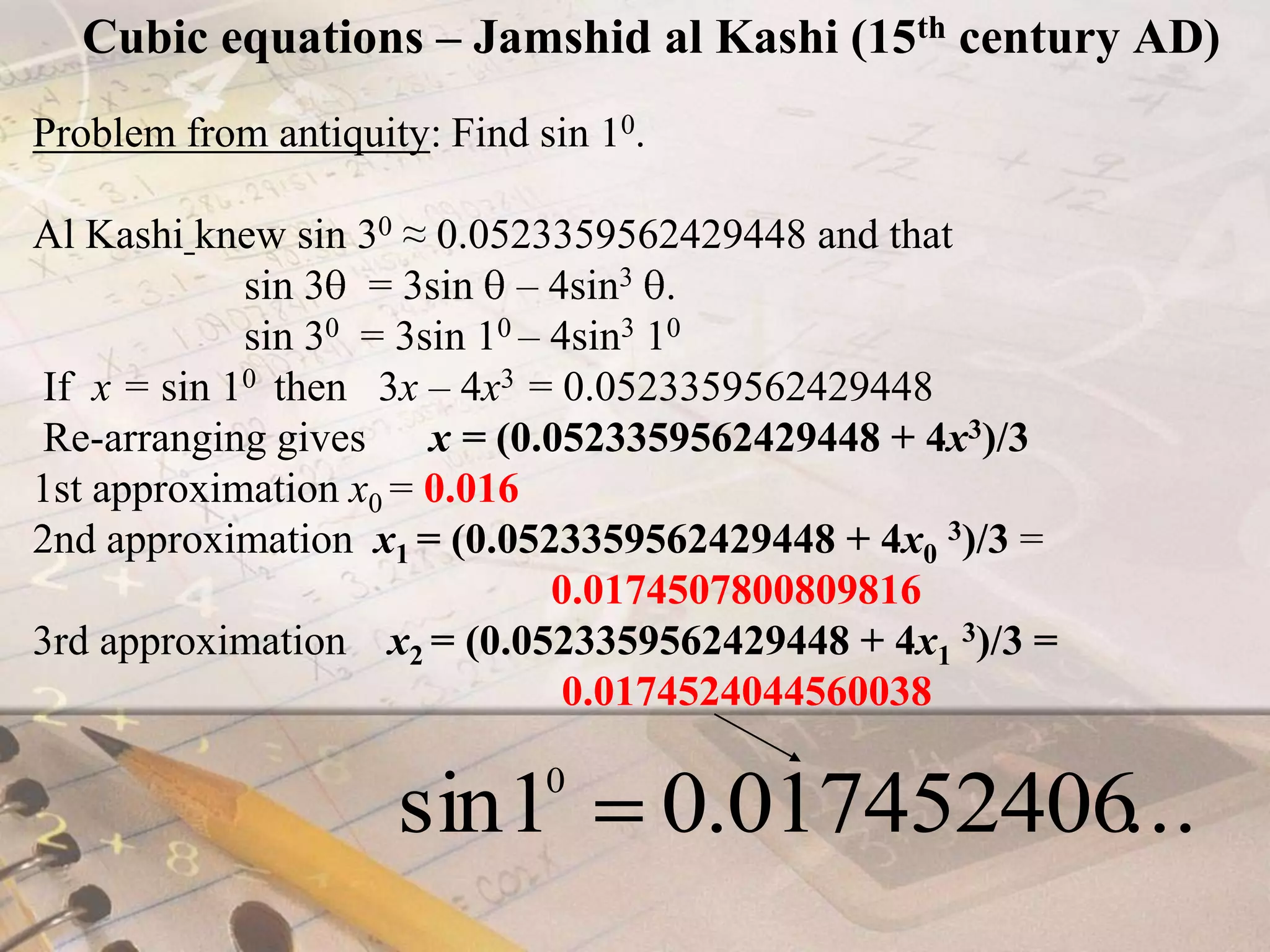
Cubic equations – Jamshid al Kashi (15th century AD)Problem from antiquity: Find sin 10.Al Kashiknew sin 30 ≈ 0.0523359562429448 and that                     sin 3  = 3sin  – 4sin3 .                    sin 30  = 3sin 10 – 4sin3 10  If  x = sin 10  then   3x – 4x3  = 0.0523359562429448 Re-arranging gives      x = (0.0523359562429448 + 4x3)/31st approximation x0 = 0.0162nd approximation  x1 = (0.0523359562429448 + 4x03)/3 =  			                         0.01745078008098163rd approximation    x2 = (0.0523359562429448 + 4x13)/3 =0.0174524044560038
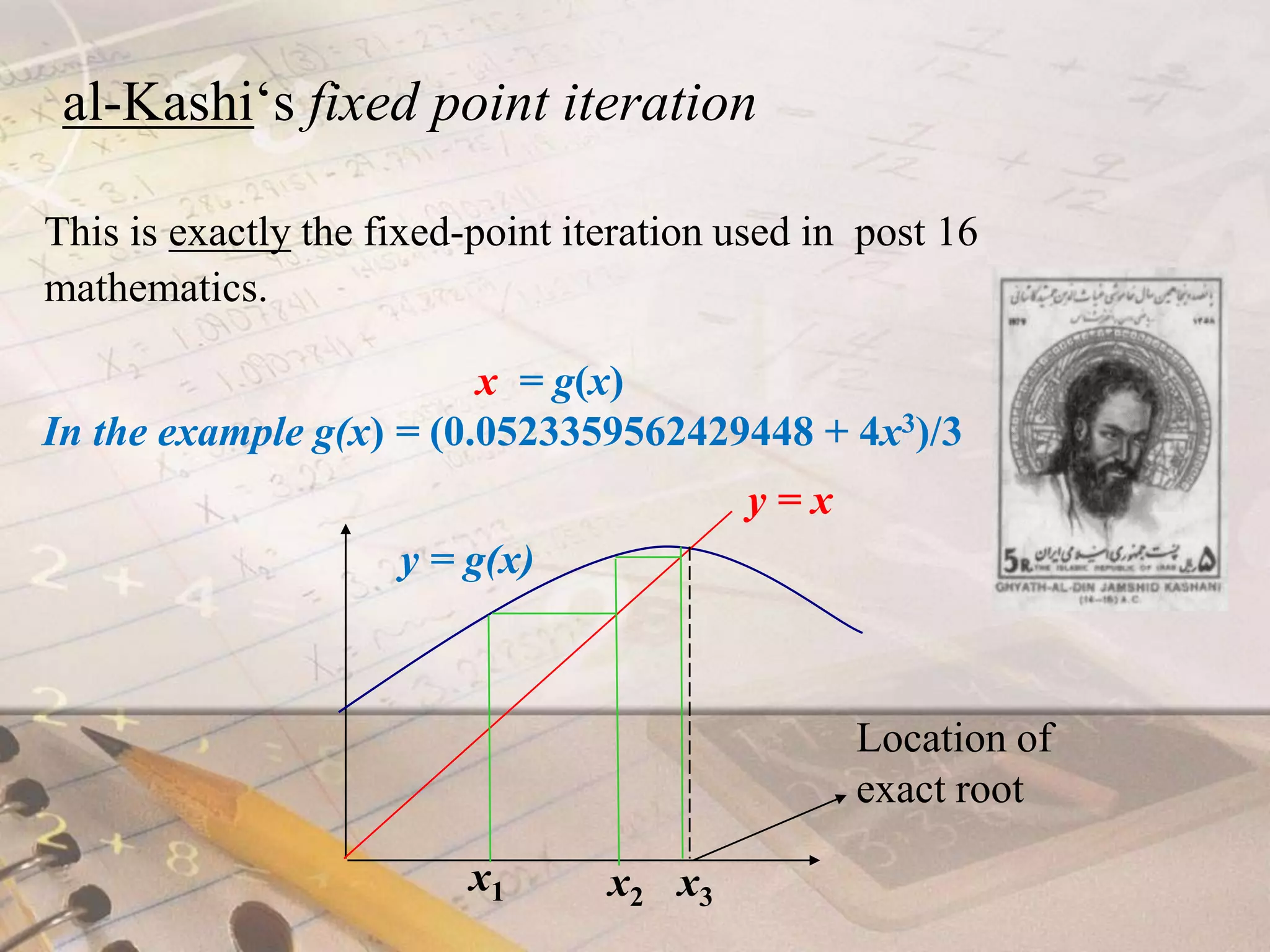
al-Kashi‘s fixed point iterationThis is exactly the fixed-point iteration used in  post 16mathematics.                                          x  = g(x)In the example g(x) = (0.0523359562429448 + 4x3)/3y = xy = g(x)Location of exact rootx1x2x3
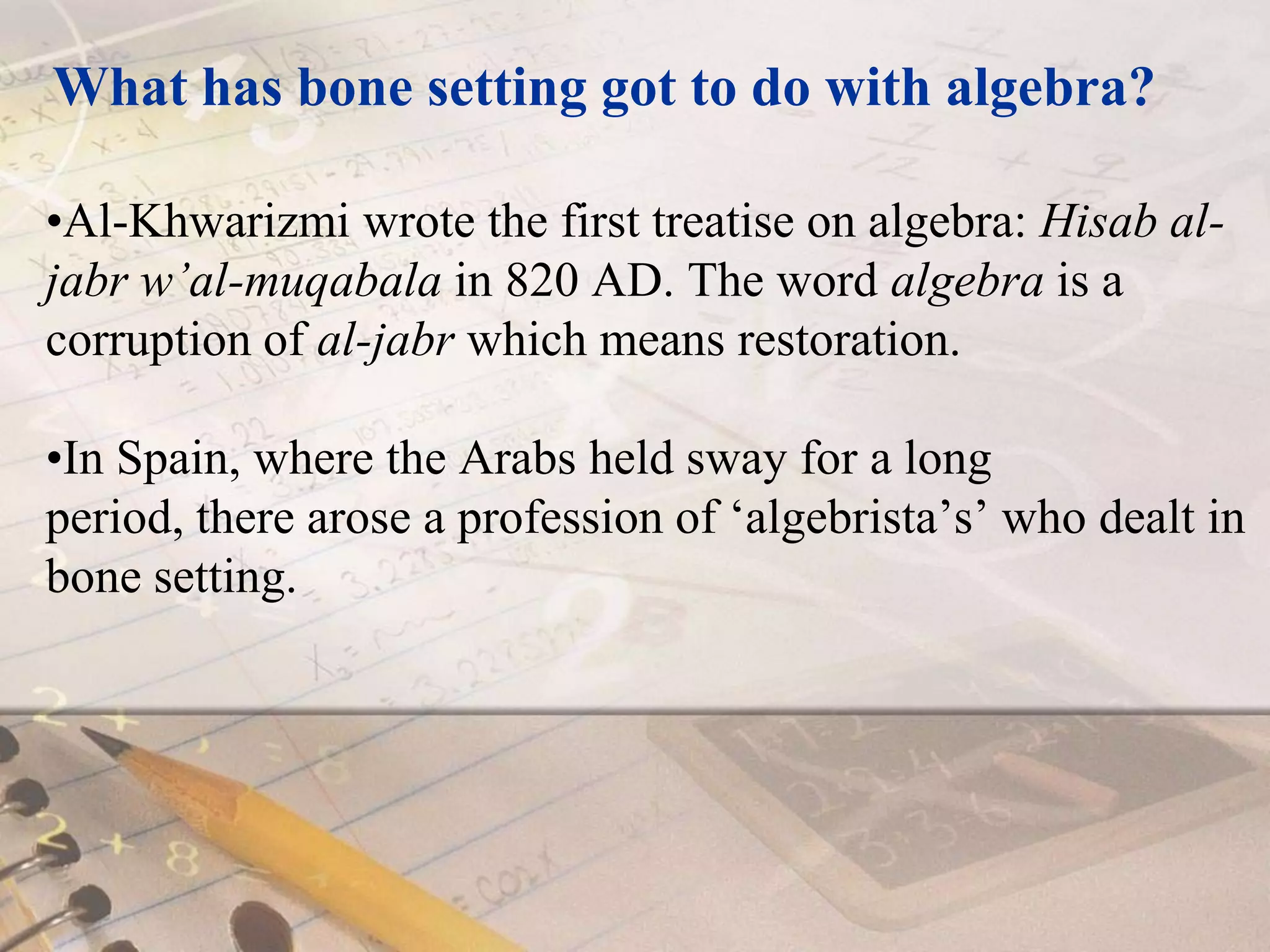
What has bone setting got to do with algebra?Al-Khwarizmi wrote the first treatise on algebra: Hisab al-jabr w’al-muqabala in 820 AD. The word algebra is a corruption of al-jabr which means restoration. In Spain, where the Arabs held sway for a long period, there arose a profession of ‘algebrista’s’ who dealt in bone setting.
What has bone setting got to do with algebra?álgebra. Del lat. tardío algebra, y este abrev. del ár. clás. algabru walmuqabalah, reducción y cotejo. 1. f. Parte de las matemáticas en la cual las operaciones aritméticas son generalizadas empleando números, letras y signos. 2. f. desus. Arte de restituir a su lugar los huesos dislocados  Translation: the art of restoring broken bones to their correct positions
Anecdotes from the history of mathematics : Ways of selling mathematics3. Geometry: the mother of algebra
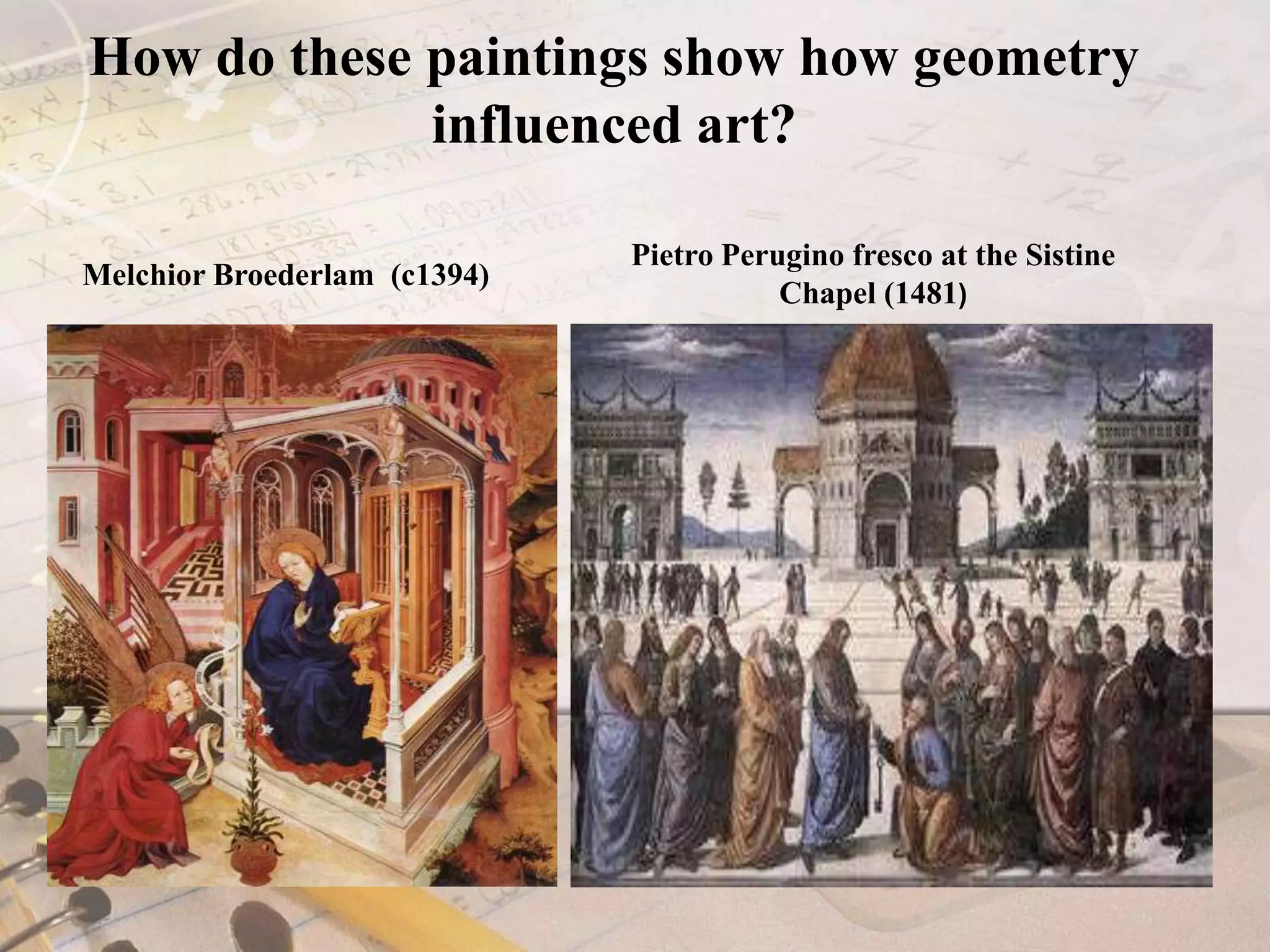
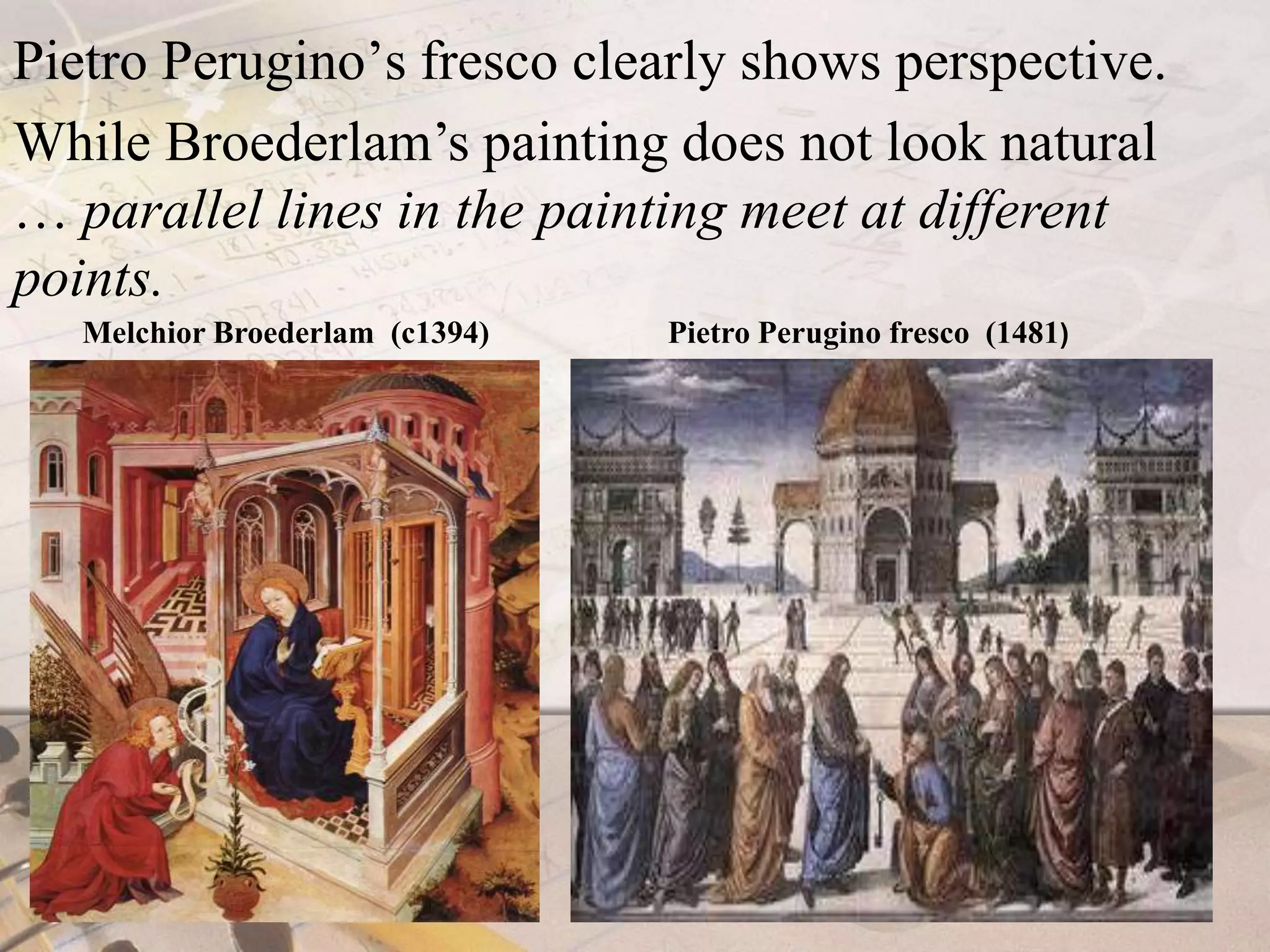
How do these paintings show how geometry influenced art?Pietro Perugino fresco at the Sistine Chapel (1481)Melchior Broederlam(c1394)
Some features in the development of  GeometryPractical knowledge for construction of buildings         Practical knowledge for patterning and art                     Generalisation of geometry                          Axiomatic deductive geometry
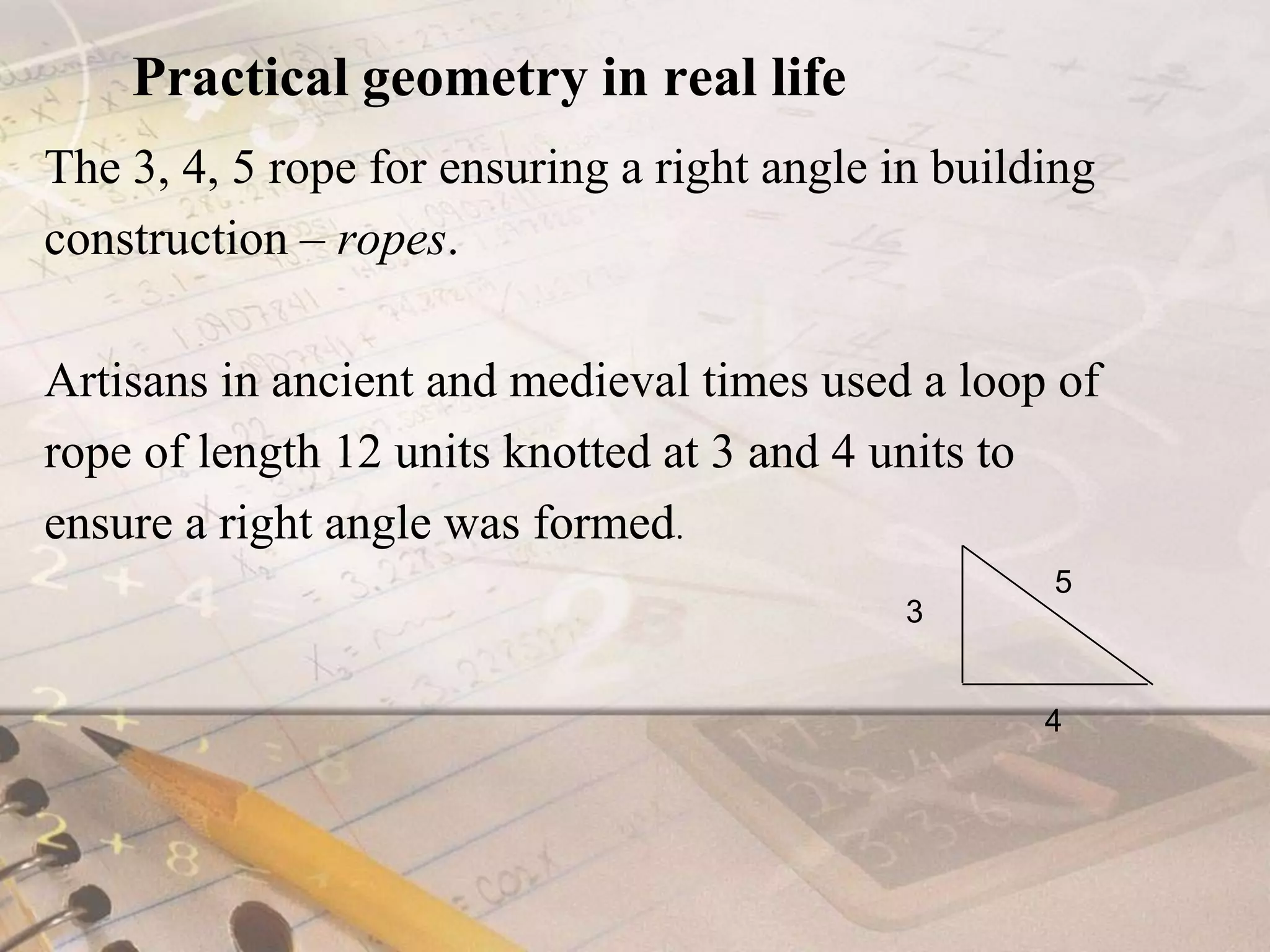
Practical geometry in real lifeThe 3, 4, 5 rope for ensuring a right angle in buildingconstruction – ropes.Artisans in ancient and medieval times used a loop ofrope of length 12 units knotted at 3 and 4 units toensure a right angle was formed.534
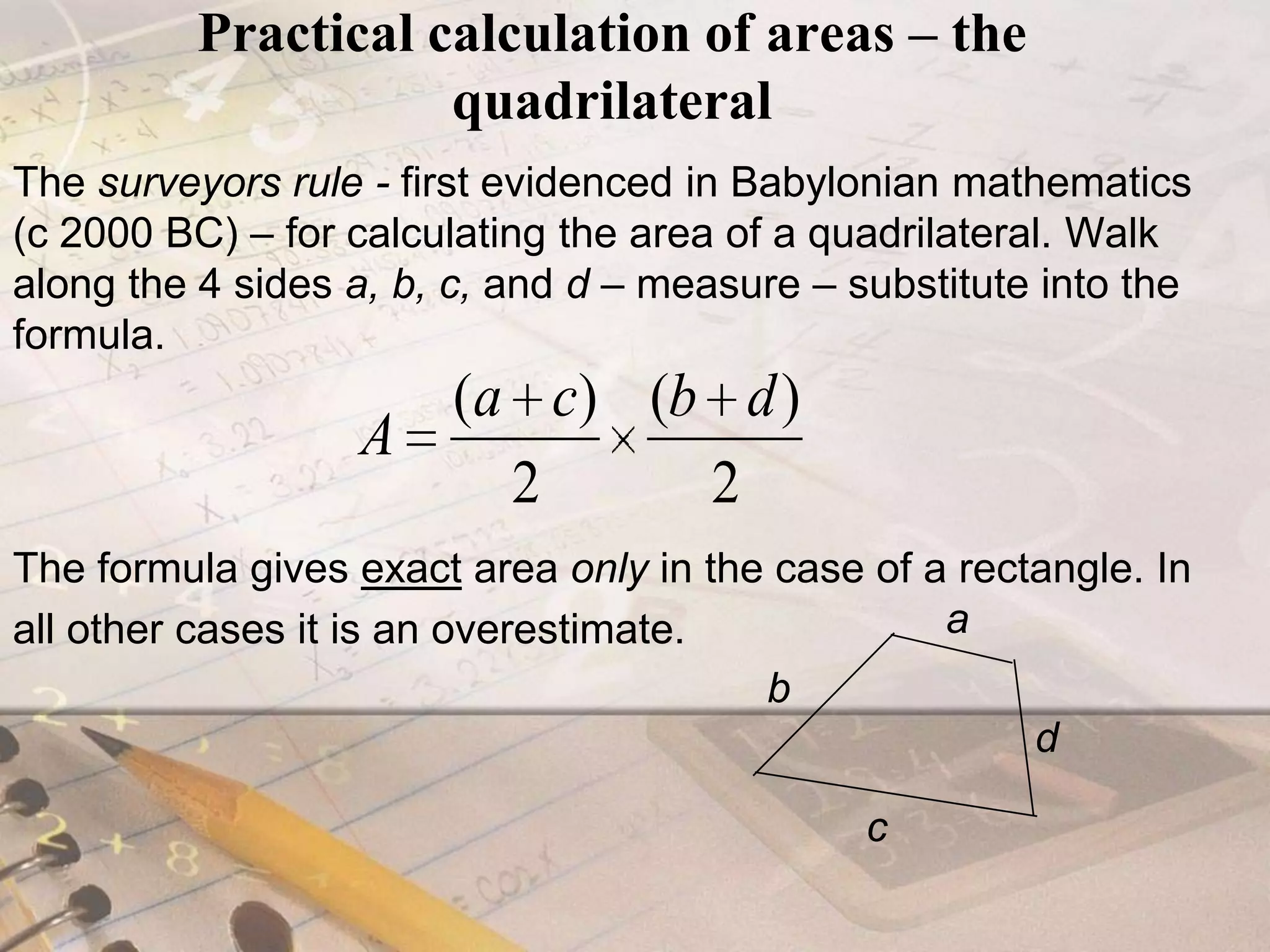
Practical calculation of areas – the quadrilateralThe surveyors rule - first evidenced in Babylonian mathematics (c 2000 BC) – for calculating the area of a quadrilateral. Walk along the 4 sides a, b, c, and d – measure – substitute into the formula. The formula gives exact area only in the case of a rectangle. In all other cases it is an overestimate.abdc
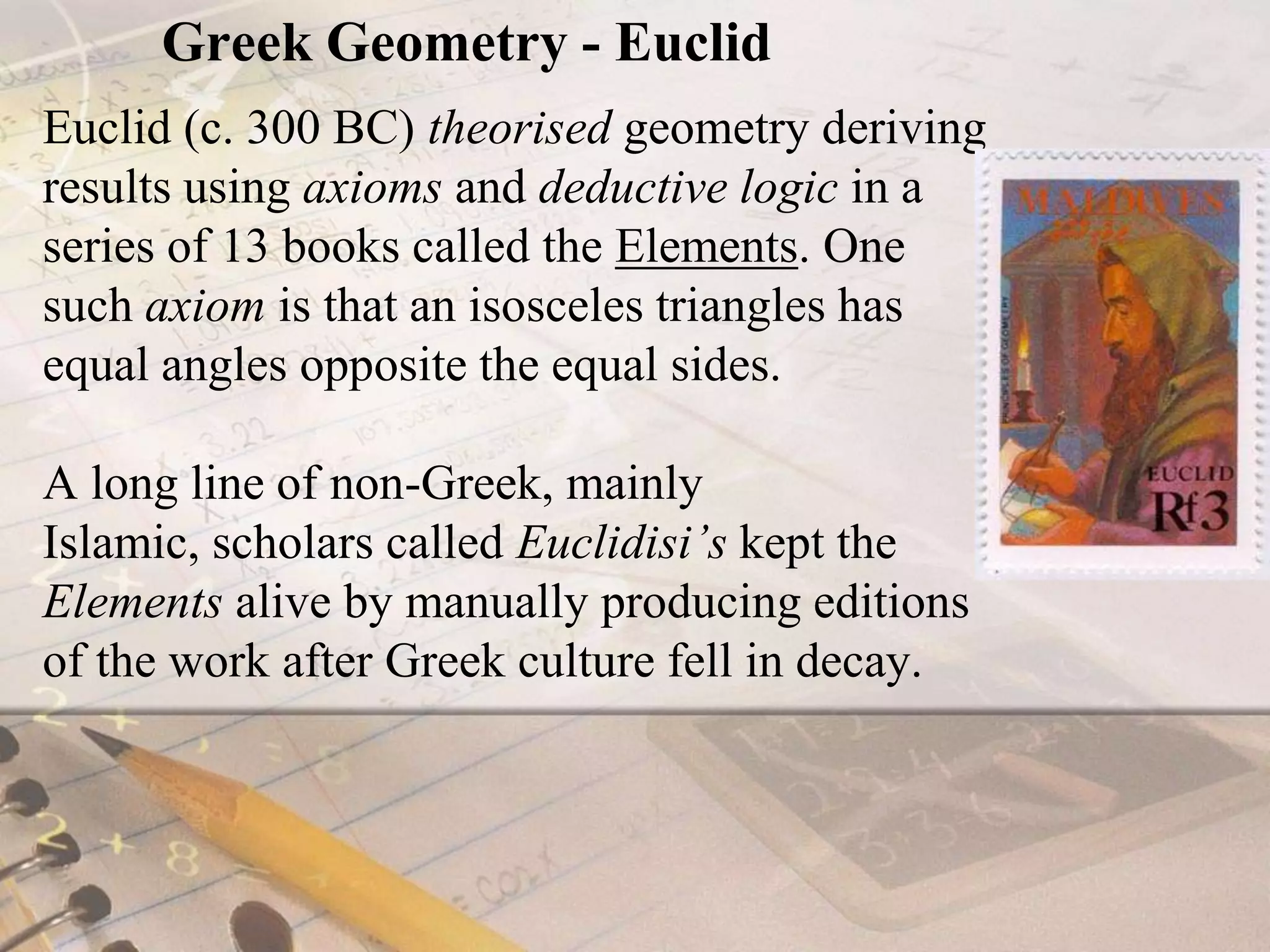
Greek Geometry - EuclidEuclid (c. 300 BC) theorised geometry deriving results using axioms and deductive logic in a series of 13 books called the Elements. One such axiom is that an isosceles triangles has equal angles opposite the equal sides.A long line of non-Greek, mainly Islamic, scholars called Euclidisi’s kept the Elements alive by manually producing editions of the work after Greek culture fell in decay.
The importance of Euclid and Greek geometryGreek geometry was constructed in a culture of democracy where all issues were subject to debate.Greek geometry naturally followed  this tradition  of having to argue the case against  all sceptics. It could be argued that this democratic,  intellectual feature enabled  Euclidean geometry to plant itself in foreign soil and, therefore, survive long after the  decline of Greek culture.
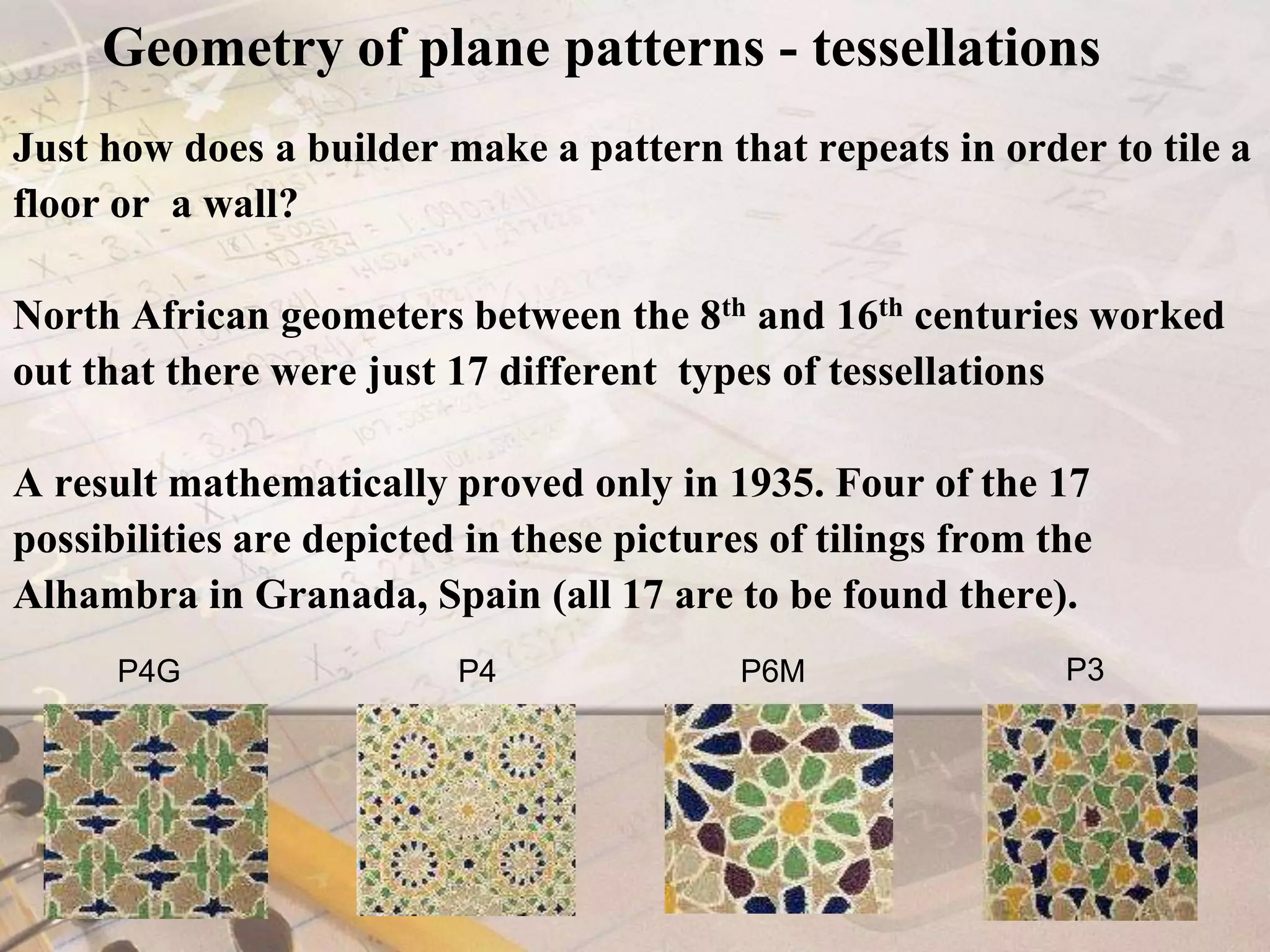
Geometry of plane patterns - tessellationsJust how does a builder make a pattern that repeats in order to tile a floor or  a wall? North African geometers between the 8th and 16th centuries worked out that there were just 17 different  types of tessellations A result mathematically proved only in 1935. Four of the 17 possibilities are depicted in these pictures of tilings from the Alhambra in Granada, Spain (all 17 are to be found there).     P3          P4P6M    P4G
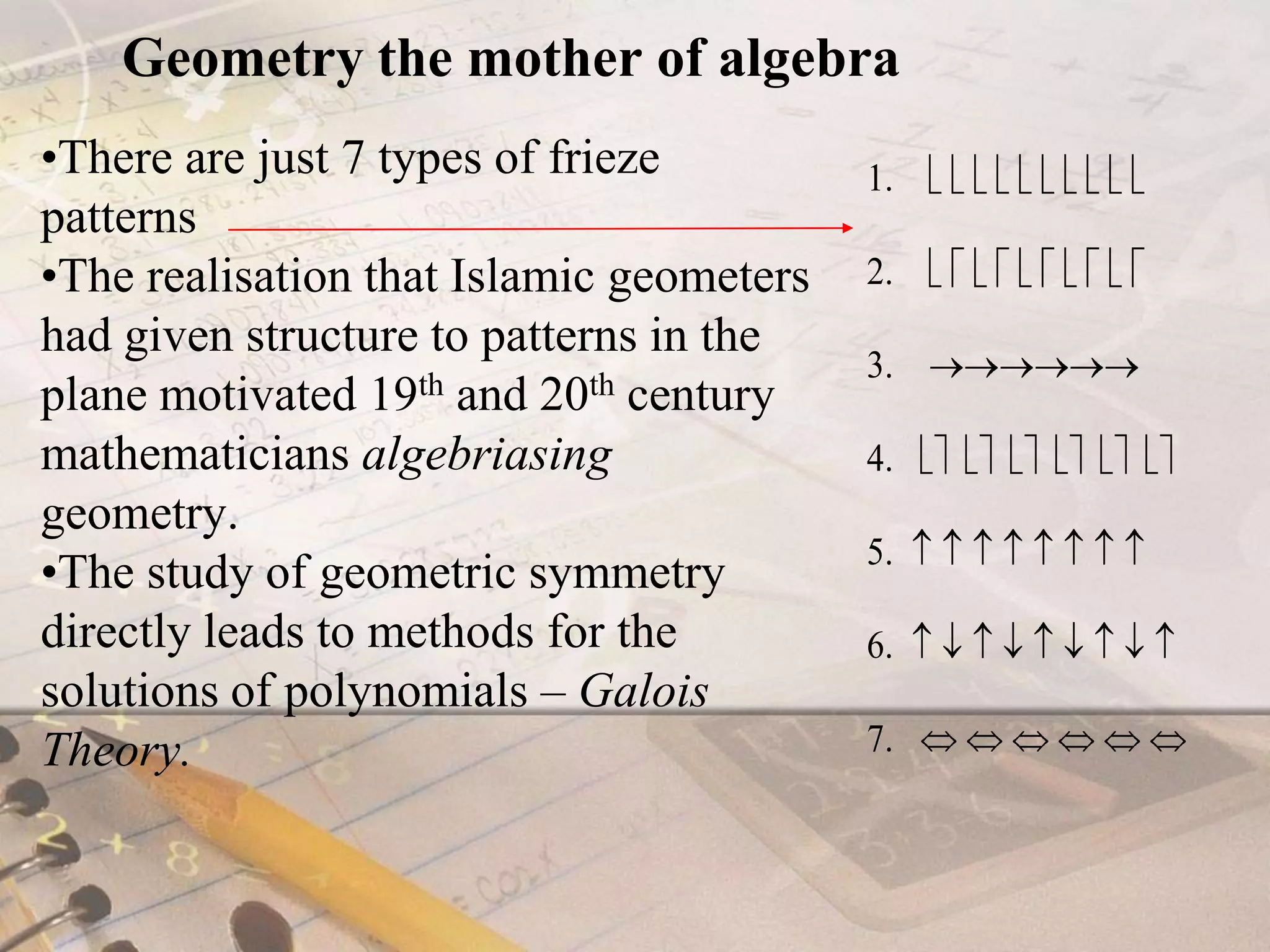
Geometry the mother of algebraThere are just 7 types of frieze patternsThe realisation that Islamic geometers had given structure to patterns in the plane motivated 19th and 20th century mathematicians algebriasing geometry.The study of geometric symmetry directly leads to methods for the solutions of polynomials – Galois Theory.
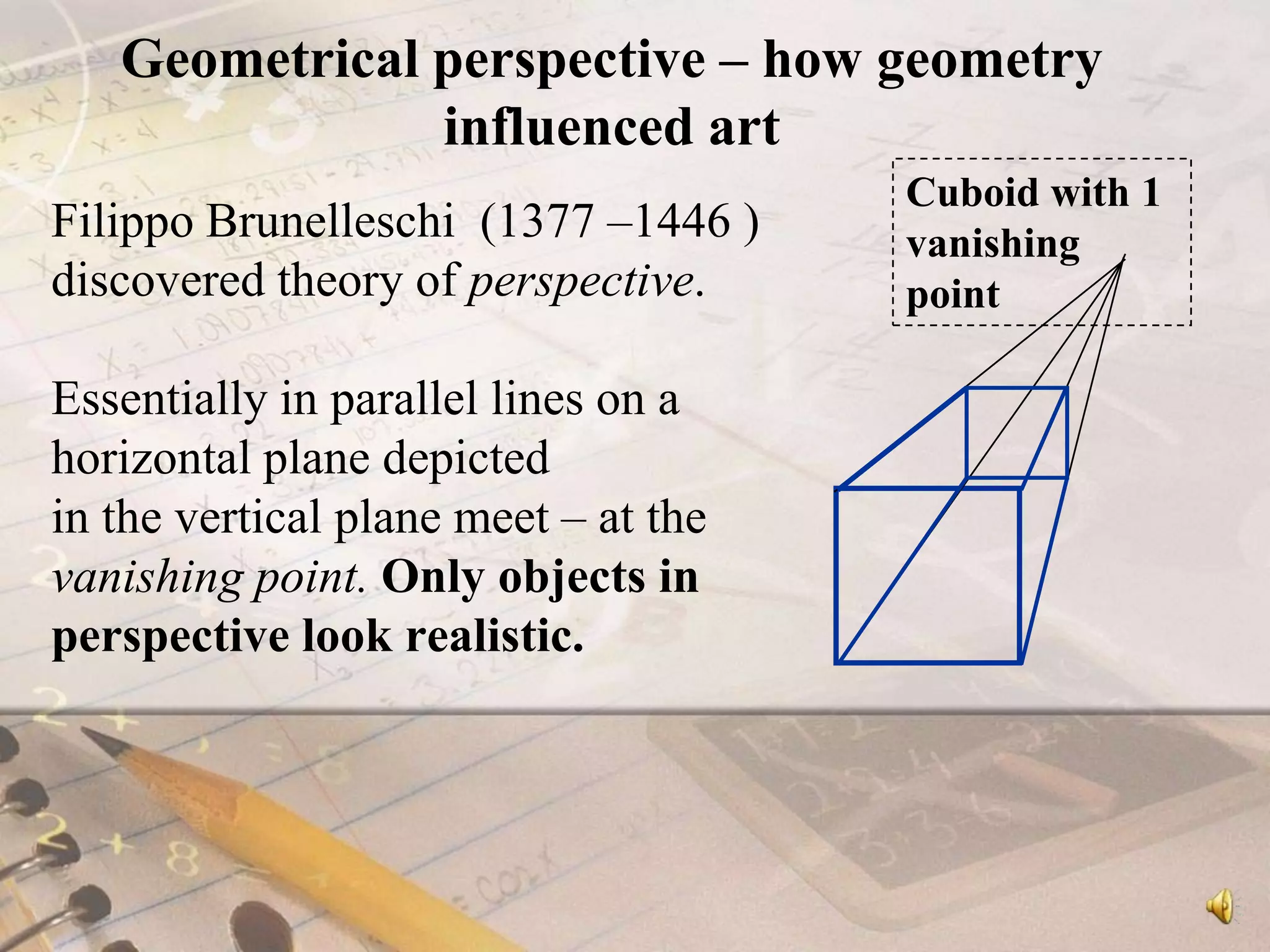
Geometrical perspective – how geometry influenced artFilippo Brunelleschi  (1377 –1446 )discovered theory of perspective. Essentially in parallel lines on a horizontal plane depicted in the vertical plane meet – at the vanishing point. Only objects in perspective look realistic.Cuboid with 1 vanishing point
Pietro Perugino’s fresco clearly shows perspective. While Broederlam’s painting does not look natural … parallel lines in the painting meet at different points.Melchior Broederlam(c1394)Pietro Perugino fresco  (1481)
Anecdotes from the history of mathematics : Ways of selling mathematics4. Who said calculus was hard?
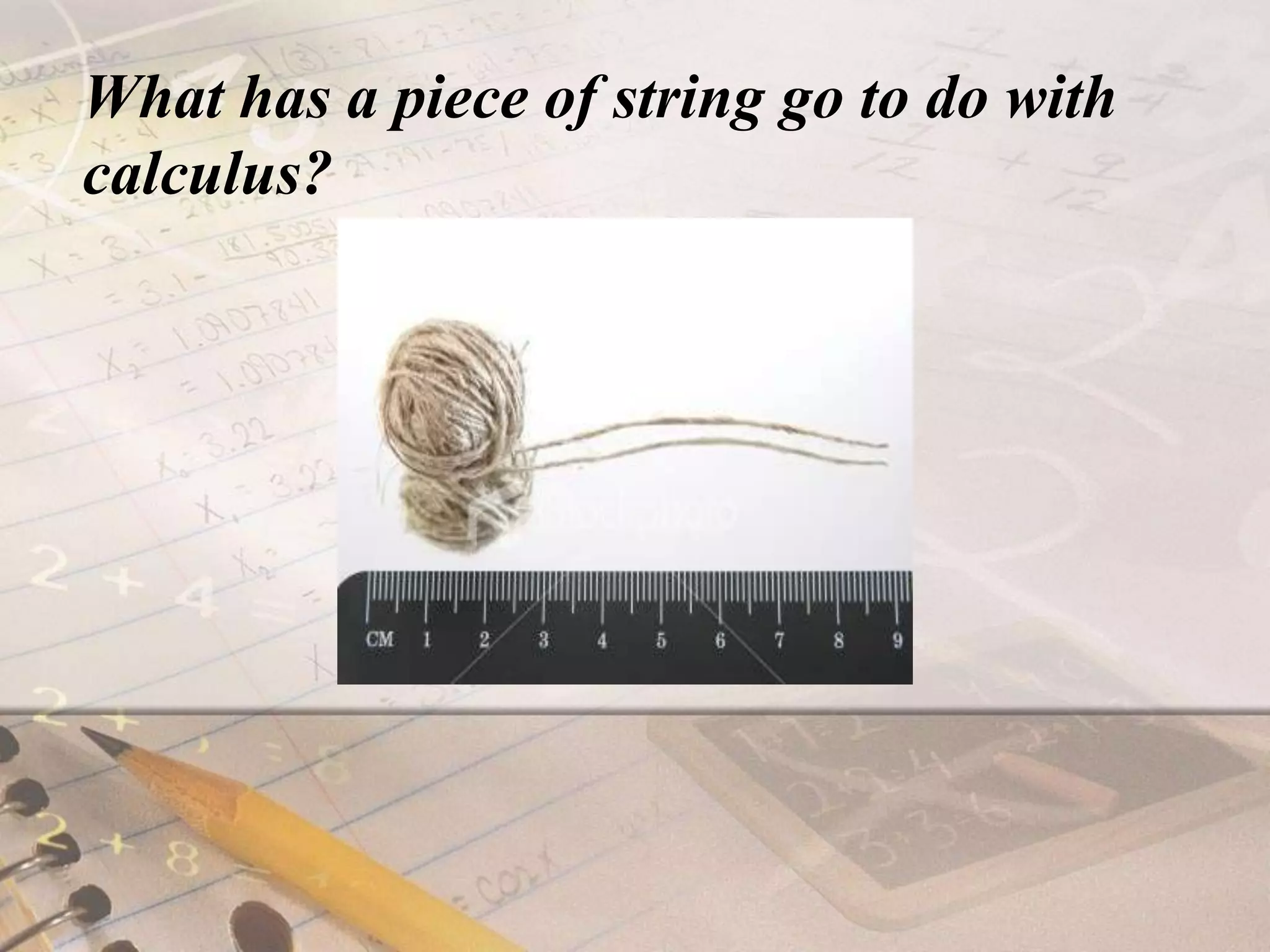
What has a piece of string go to do with calculus?
Some key points in  the history of calculusEarly work on integration; calculation of areas and volumesThe realisation that integration means sum of power series The conquest of infinity: summation of infinite terms Calculation of lengths of curved lines
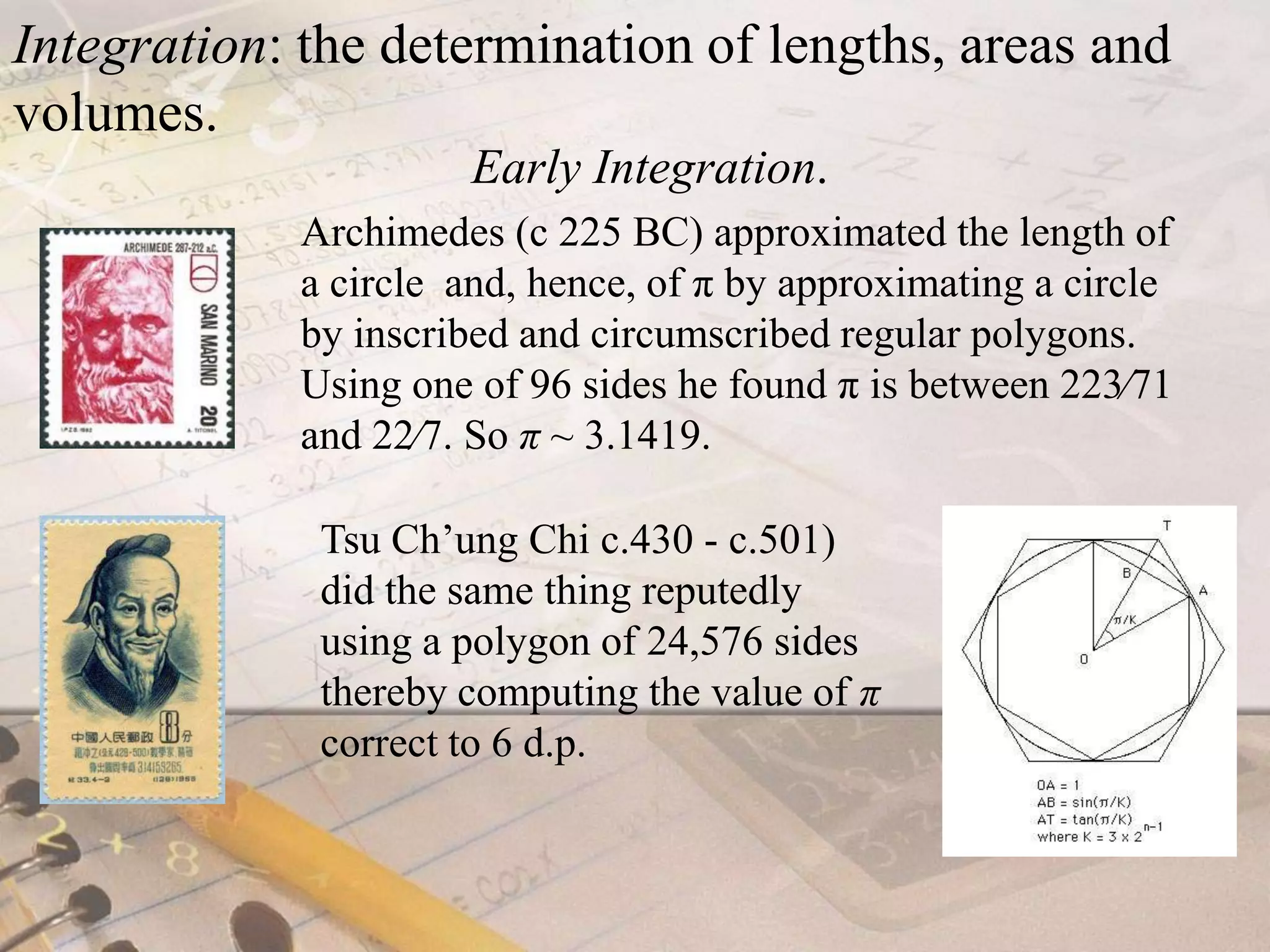
Integration: the determination of lengths, areas and volumes. Early Integration.Archimedes (c 225 BC) approximated the length of a circle  and, hence, of π by approximating a circle by inscribed and circumscribed regular polygons. Using one of 96 sides he found π is between 223⁄71 and 22⁄7. So π ~ 3.1419.Tsu Ch’ung Chi c.430 - c.501) did the same thing reputedly using a polygon of 24,576 sides thereby computing the value of πcorrect to 6 d.p.
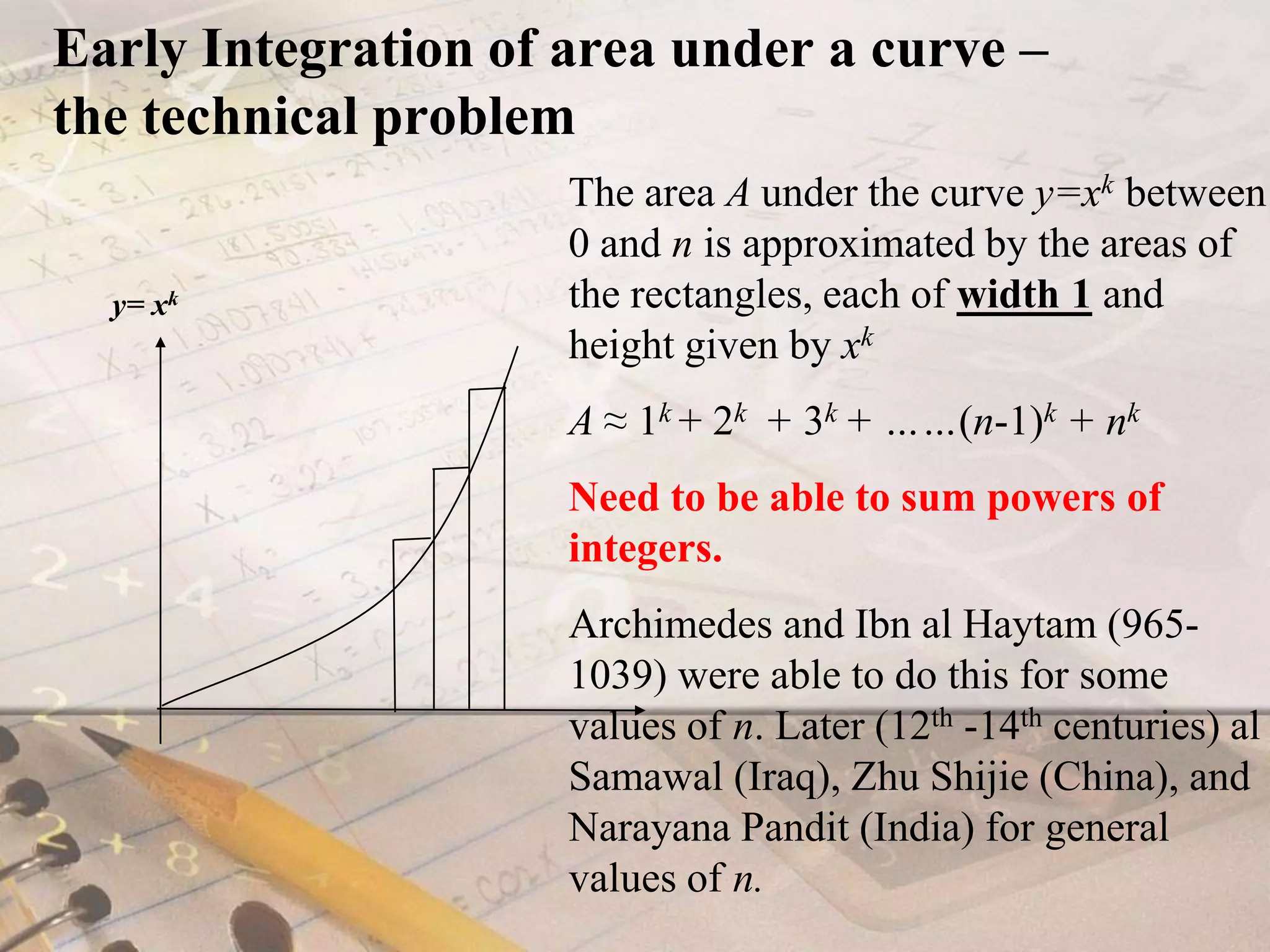
Early Integration of area under a curve – the technical problemThe area A under the curve y=xkbetween 0 and n is approximated by the areas of the rectangles, each of width1 and height given by xkA ≈ 1k+ 2k  + 3k + ……(n-1)k + nkNeed to be able to sum powers of integers.Archimedes and Ibn al Haytam (965-1039) were able to do this for some values of n. Later (12th -14th centuries) al Samawal (Iraq), Zhu Shijie (China), and Narayana Pandit (India) for general values of n.y= xk
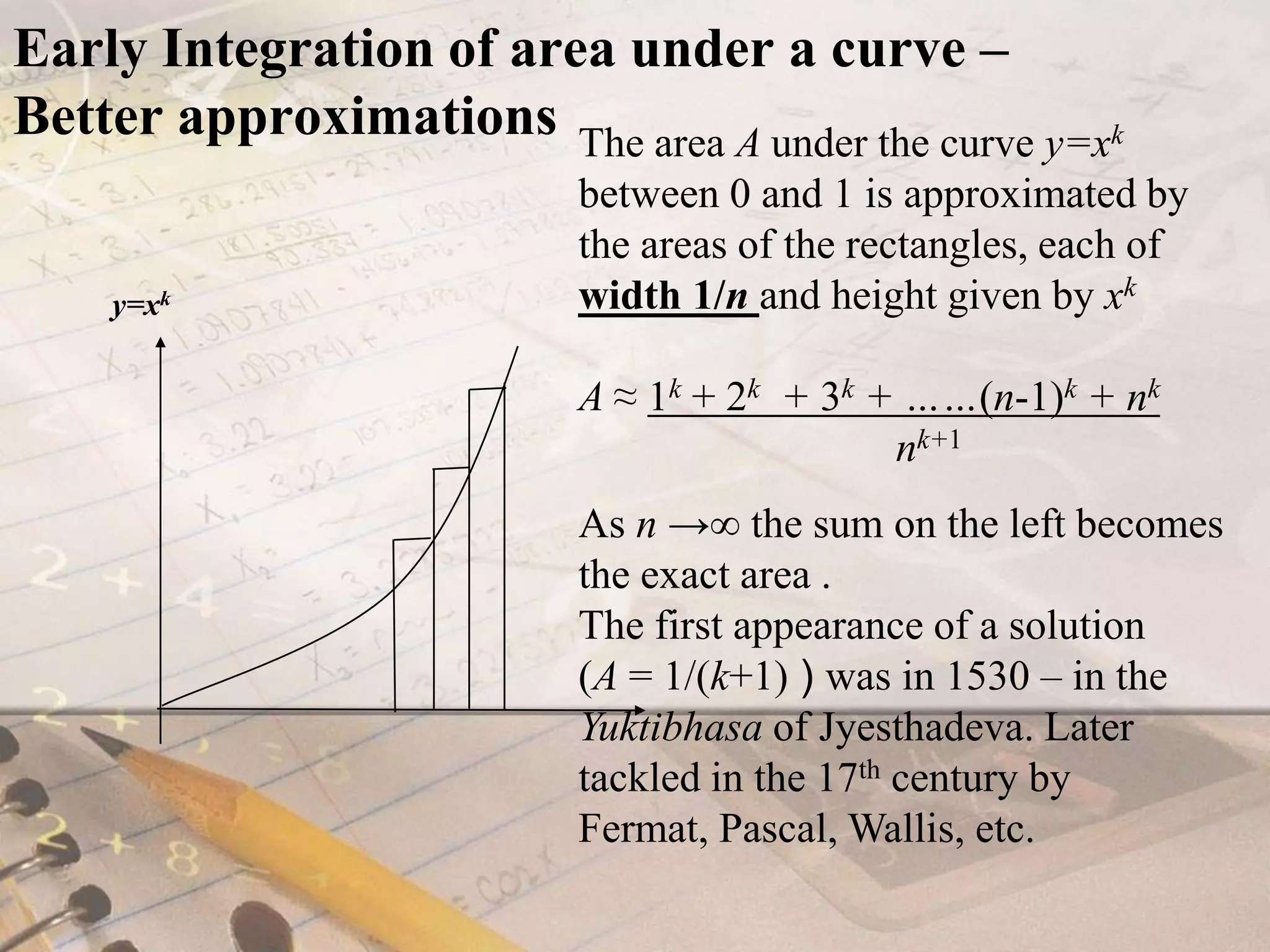
Early Integration of area under a curve – Better approximationsThe area A under the curve y=xkbetween 0 and 1is approximated by the areas of the rectangles, each of width1/nand height given by xkA ≈ 1k + 2k  + 3k + ……(n-1)k + nk                              nk+1As n ->∞ the sum on the left becomes the exact area.The first appearance of a solution (A= 1/(k+1) ) was in 1530 – in the Yuktibhasa of Jyesthadeva. Later tackled in the 17th century by Fermat, Pascal, Wallis, etc.y=xk
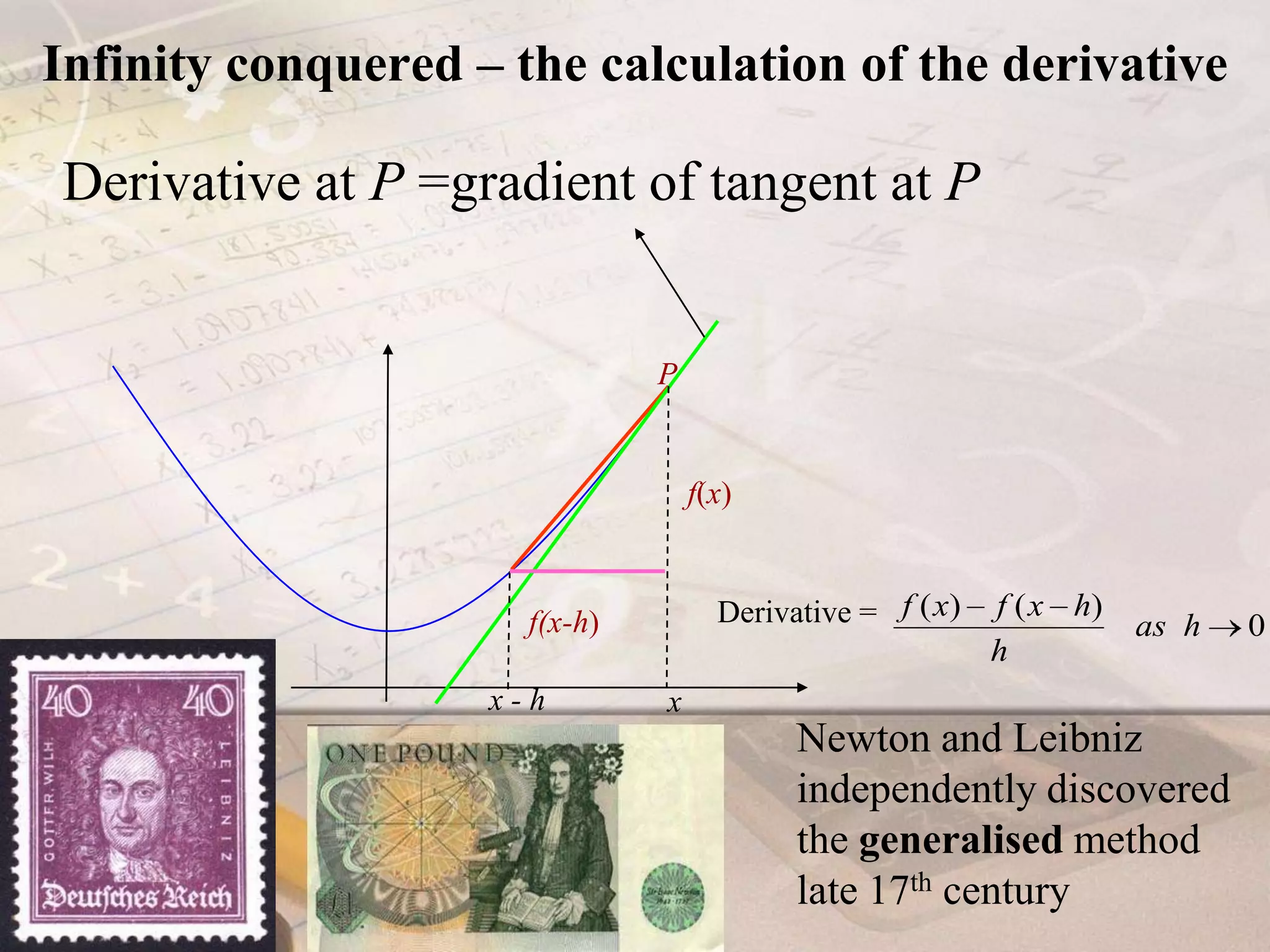
Infinity conquered – the calculation of the derivativeDerivative at P =gradient of tangent at PPf(x)Derivative =f(x-h)x - hxNewton and Leibniz independently discovered the generalised method late 17th century
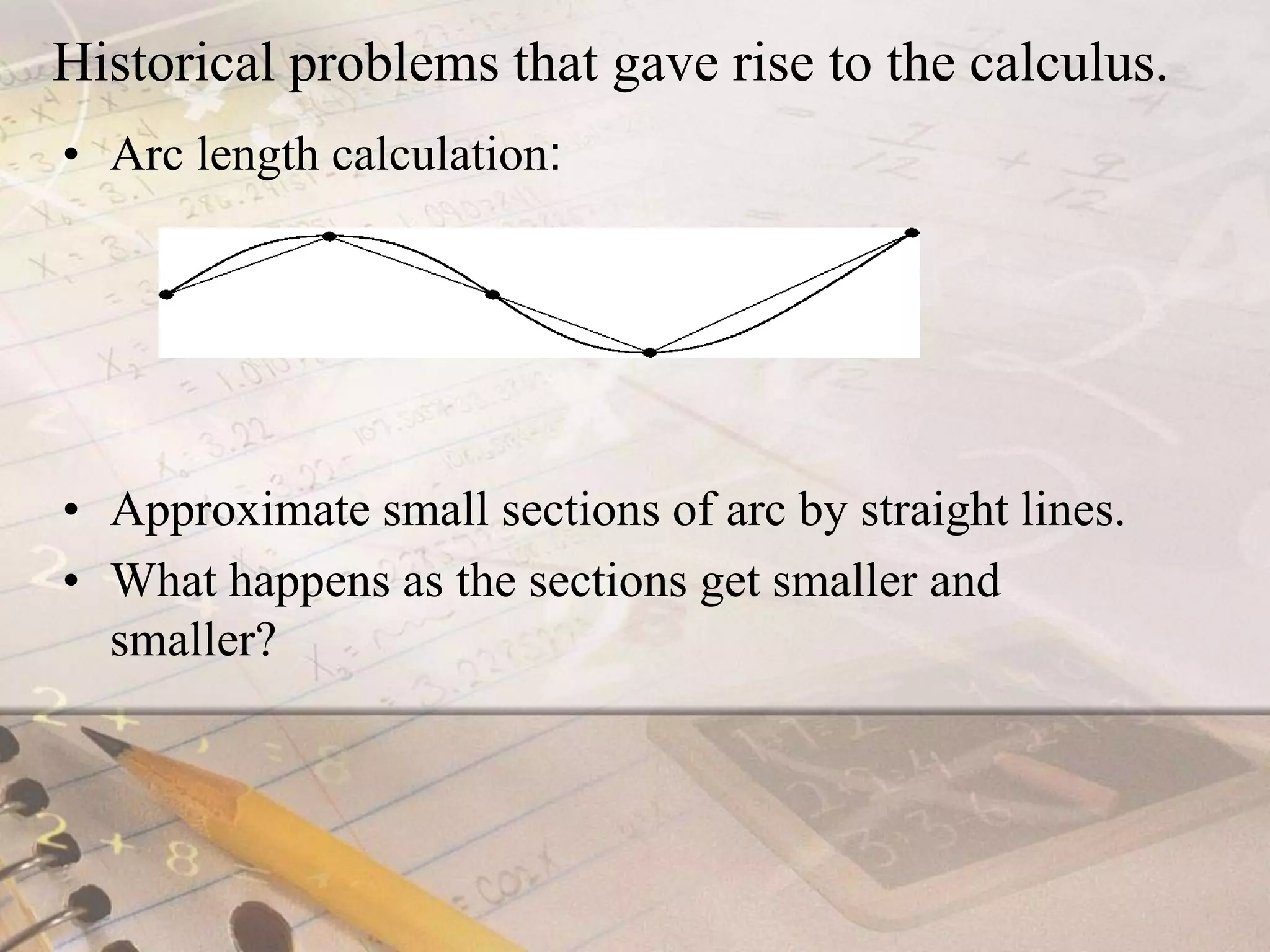
Historical problems that gave rise to the calculus.Arc length calculation:Approximate small sections of arc by straight lines. What happens as the sections get smaller and smaller?
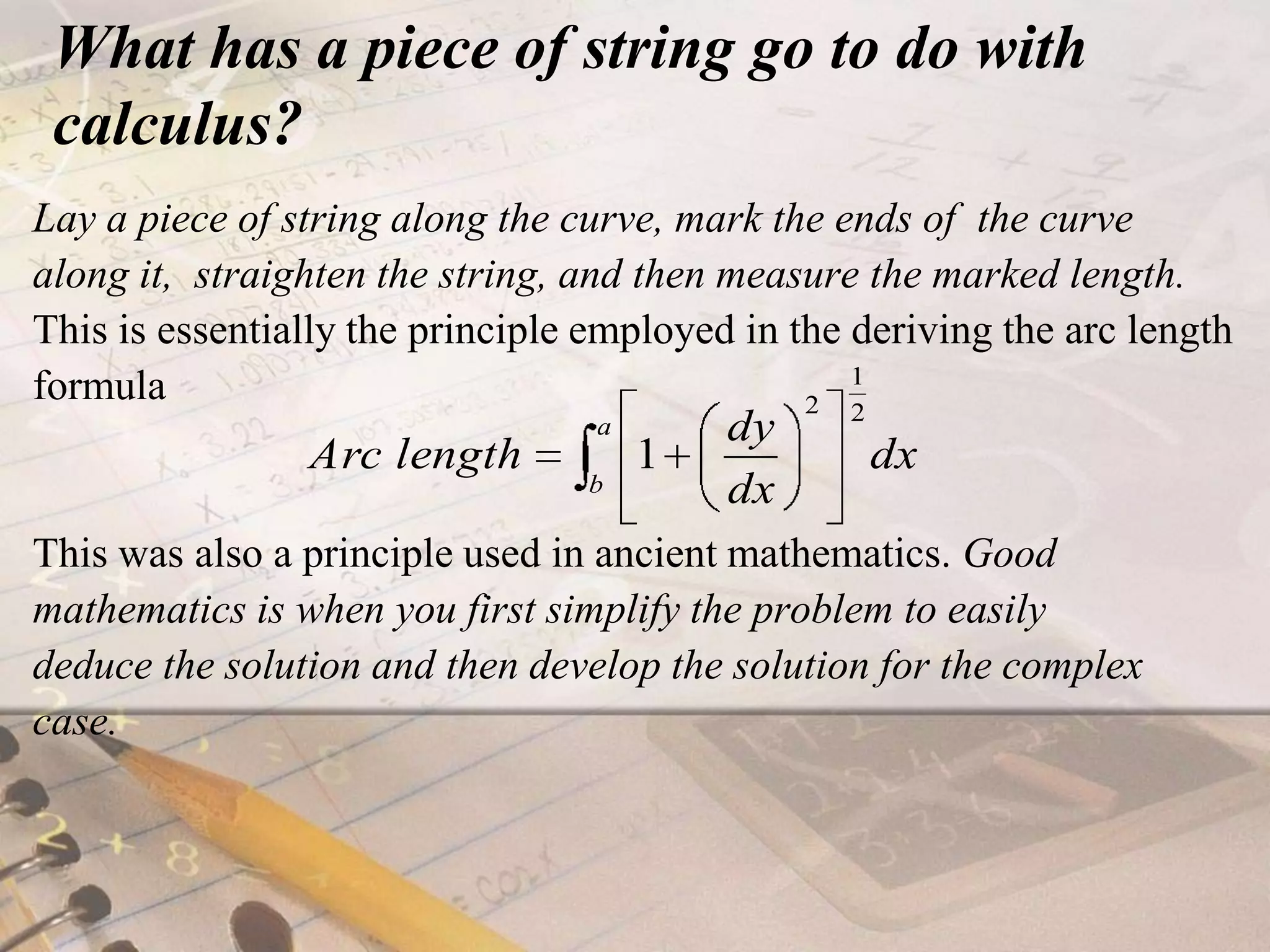
Arc length calculation using the calculusEach arc segment ≈ (dx2 + dy2)1/2 = (1 + [dy/dx]2)1/2 ×dxSo the total arc length ≈ Sum of all (1 + [dy/dx]2)1/2 ×dx’ s                                                            = ∫ (1 + [dy/dx]2)1/2 dxA2A3yA4dy =y2-y1A1dxAnxxnx1x4x2x3
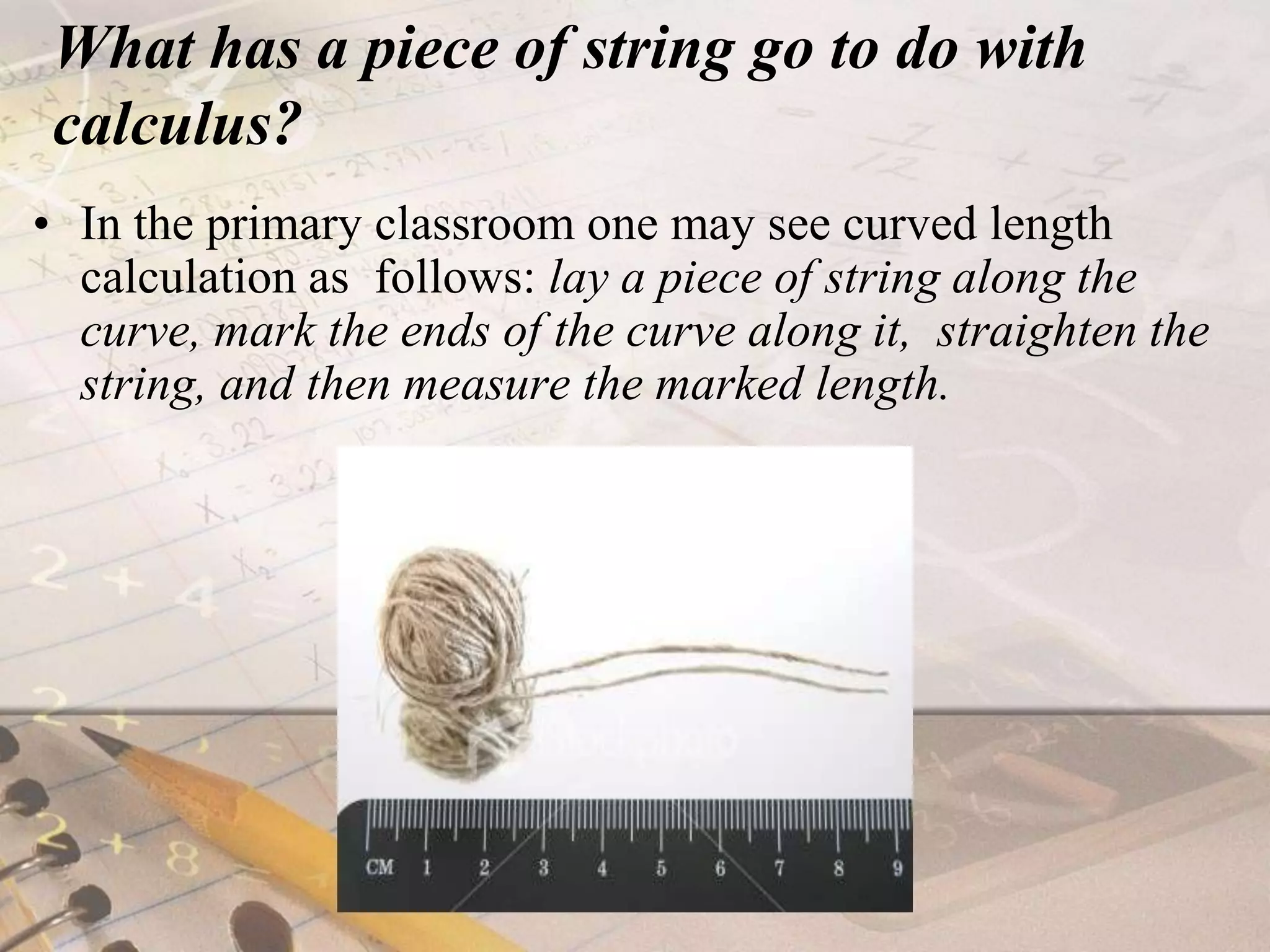
What has a piece of string go to do with calculus?In the primary classroom one may see curved length calculation as  follows: lay a piece of string along the curve, mark the ends of the curve along it,  straighten the string, and then measure the marked length.
What has a piece of string go to do with calculus?Lay a piece of string along the curve, mark the ends of  the curve along it,  straighten the string, and then measure the marked length. This is essentially the principle employed in the deriving the arc length formulaThis was also a principle used in ancient mathematics. Good mathematics is when you first simplify the problem to easily deduce the solution and then develop the solution for the complex case.
Anecdotes from the history of mathematics : Ways of selling mathematics5. Using one’s imagination
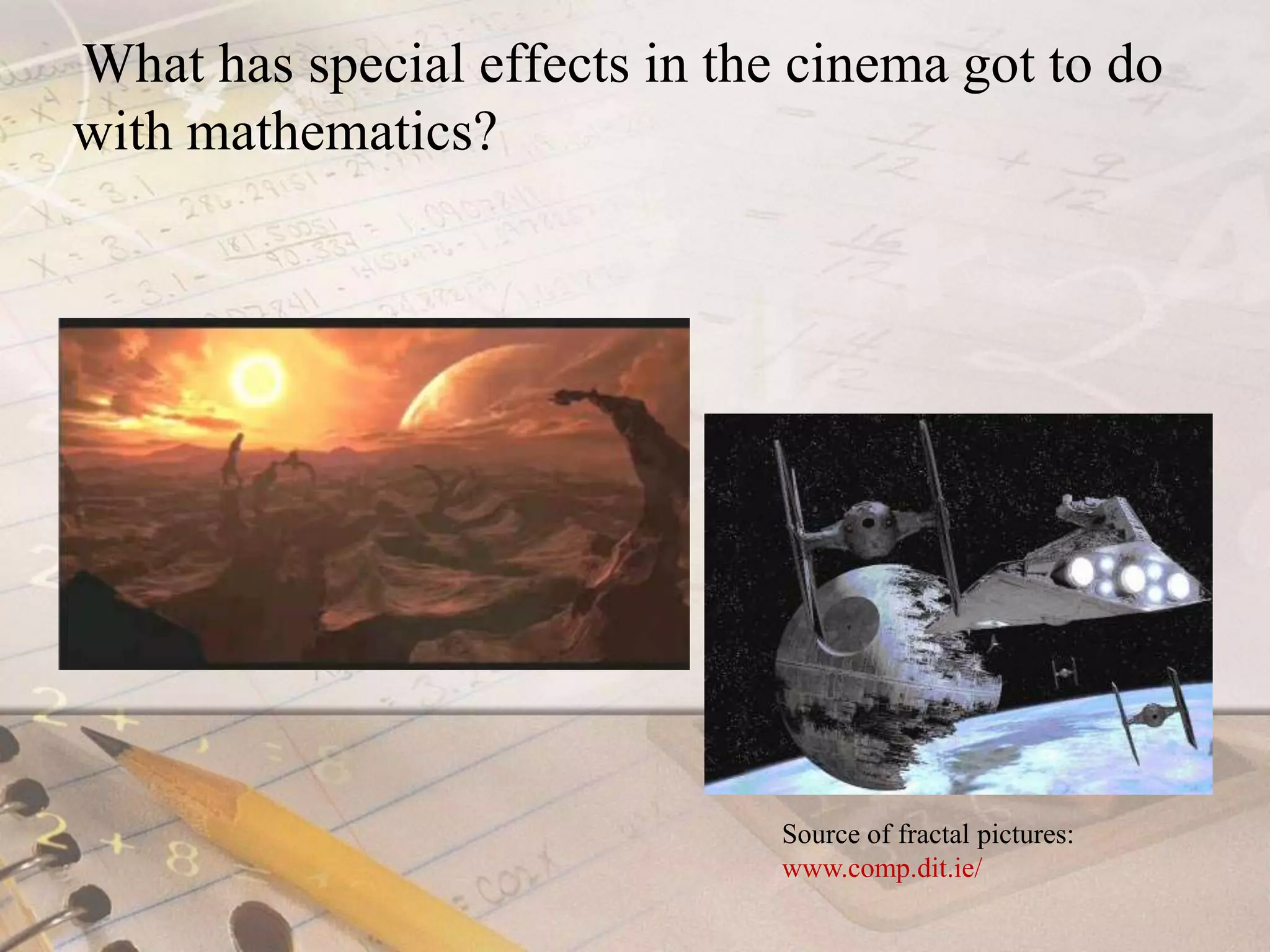
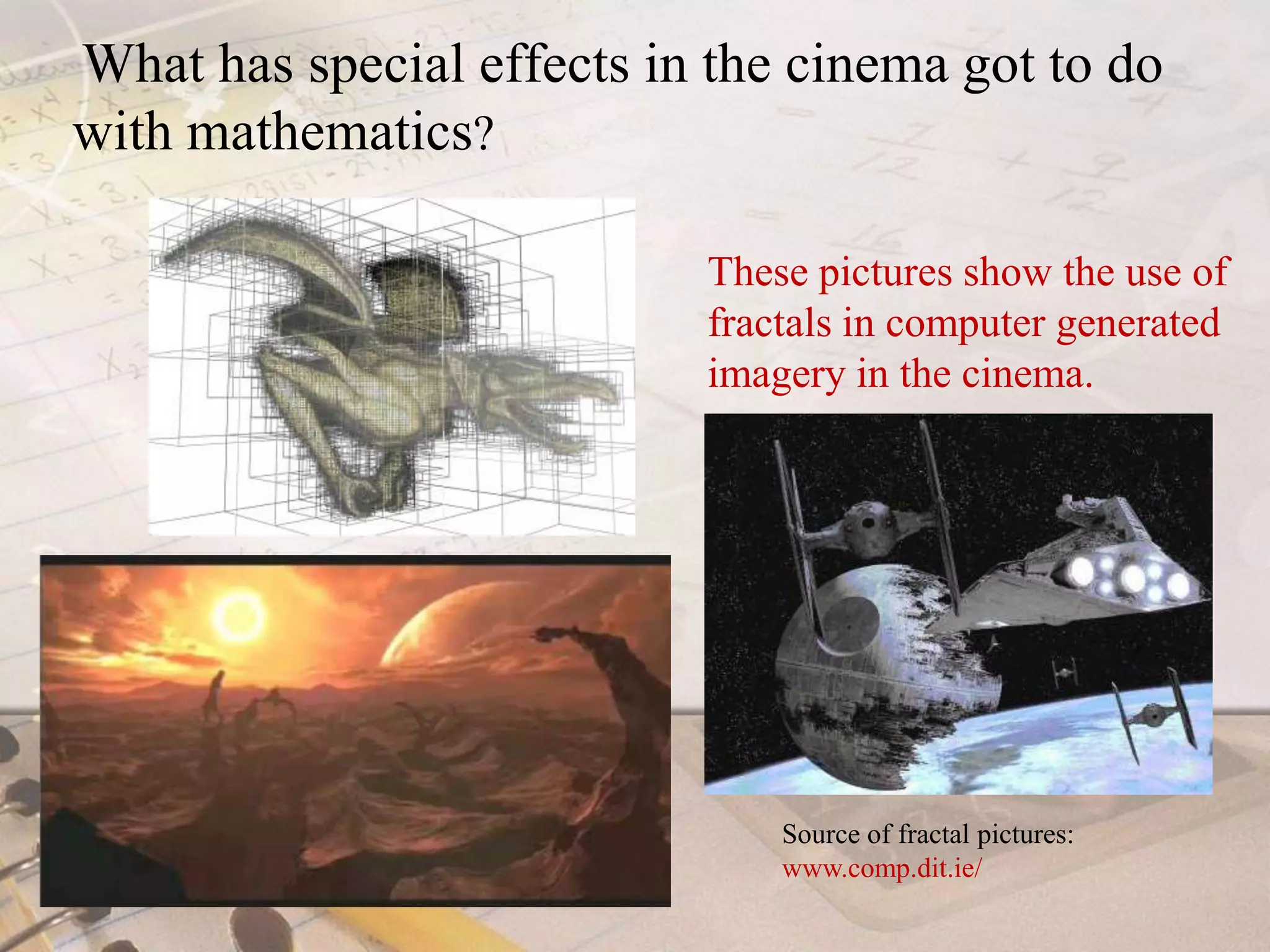
What has special effects in the cinema got to do with mathematics?Source of fractal pictures: www.comp.dit.ie/
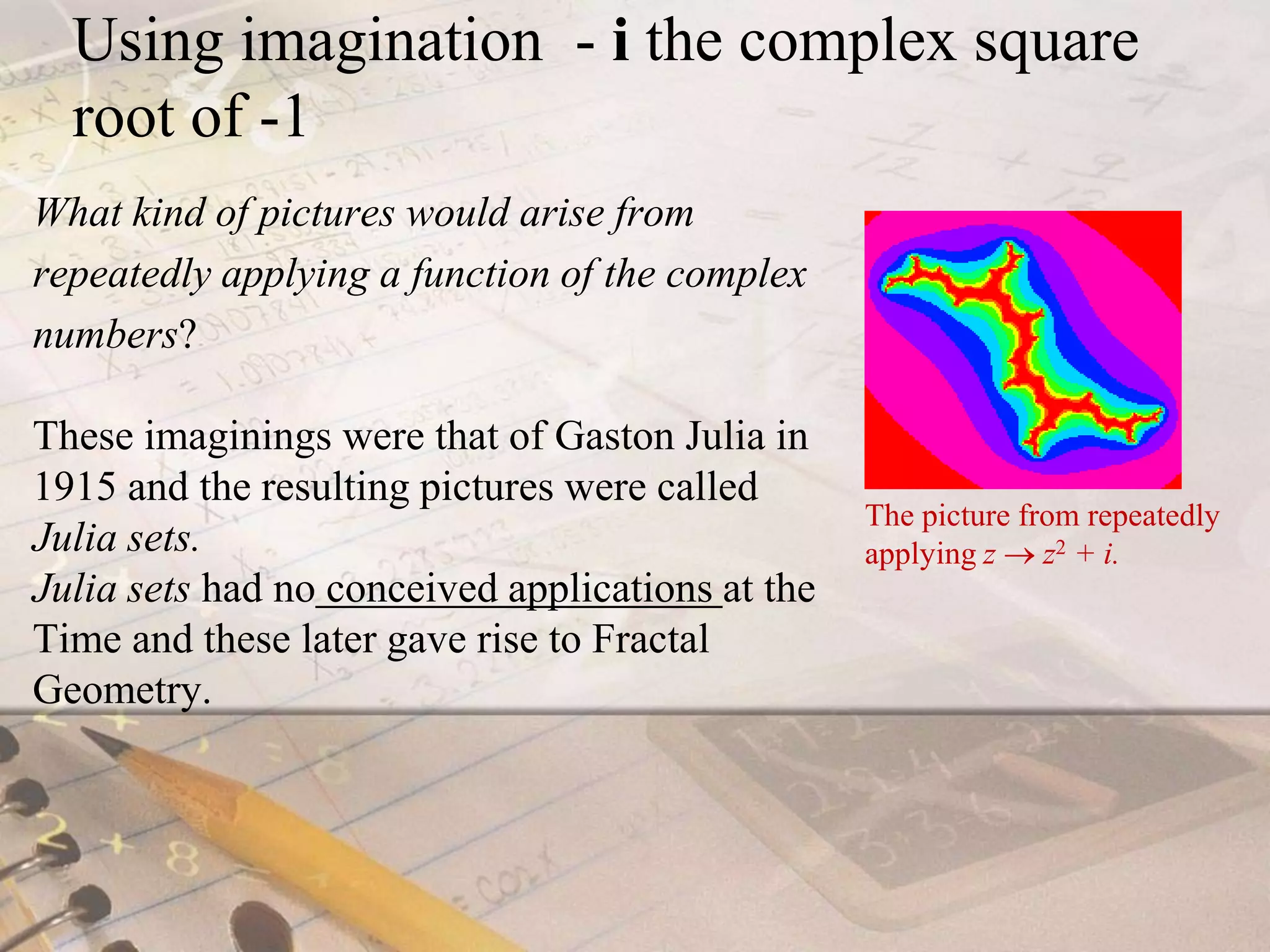
Using imagination  - i the complex square root of -1 What kind of pictures would arise from repeatedly applying a function of the complex numbers? These imaginings were that of Gaston Julia in 1915 and the resulting pictures were called Julia sets. Julia sets had noconceived applications at the Time and these later gave rise to Fractal Geometry.                             The picture from repeatedly applying z  z2 + i.
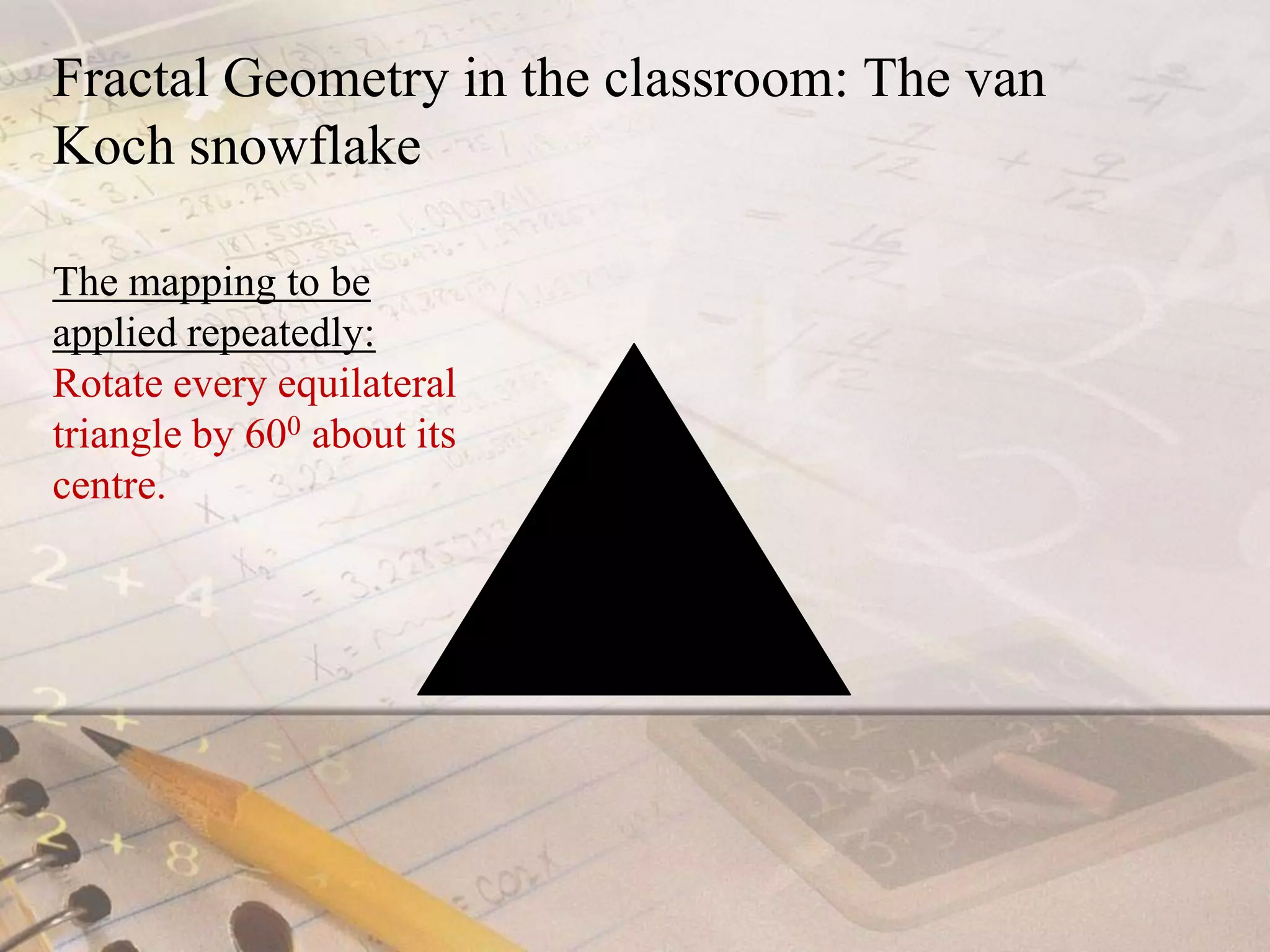
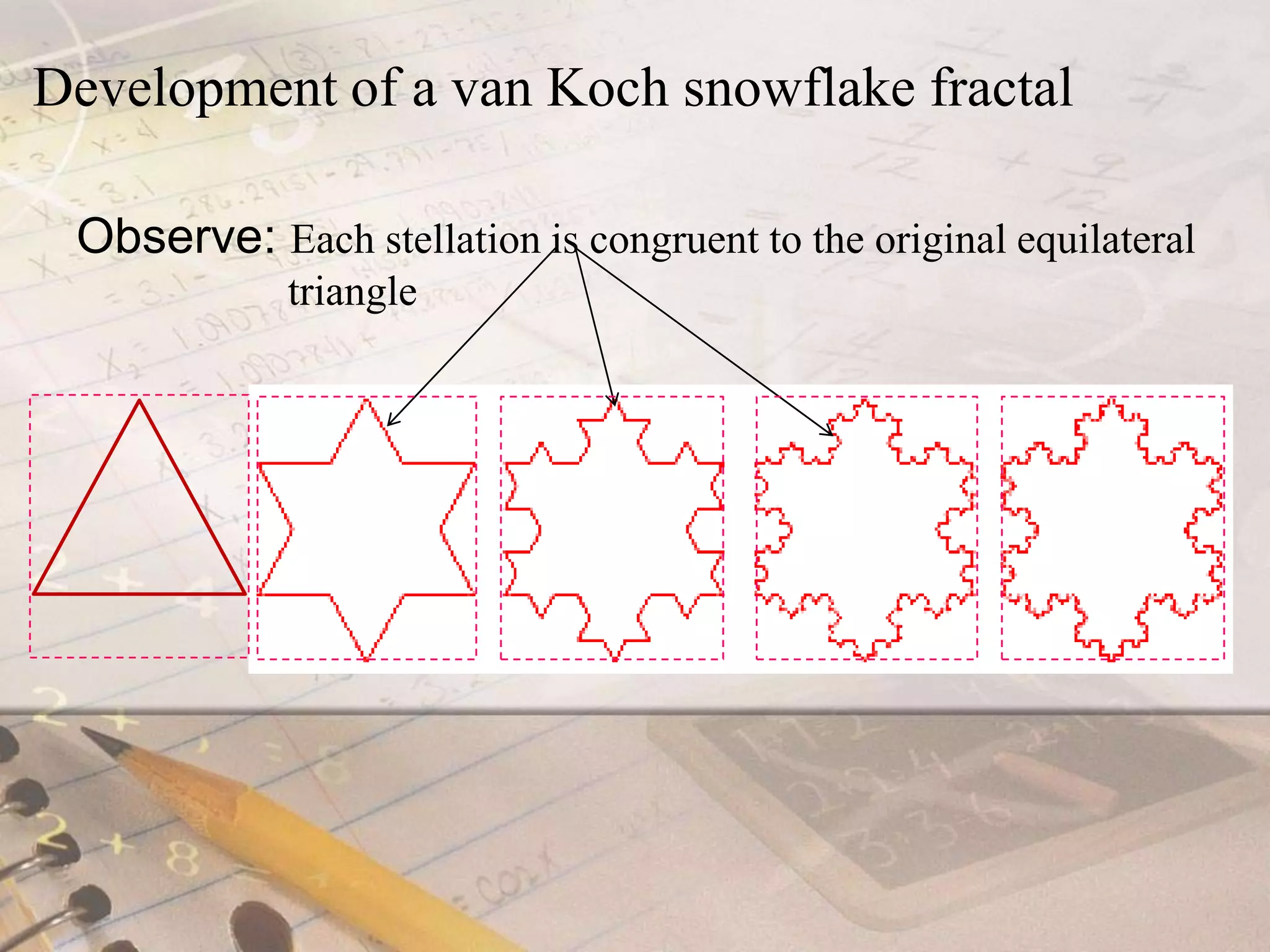
Fractal Geometry in the classroom: The van Koch snowflakeThe mapping to be applied repeatedly: Rotate every equilateral triangle by 600about its centre.
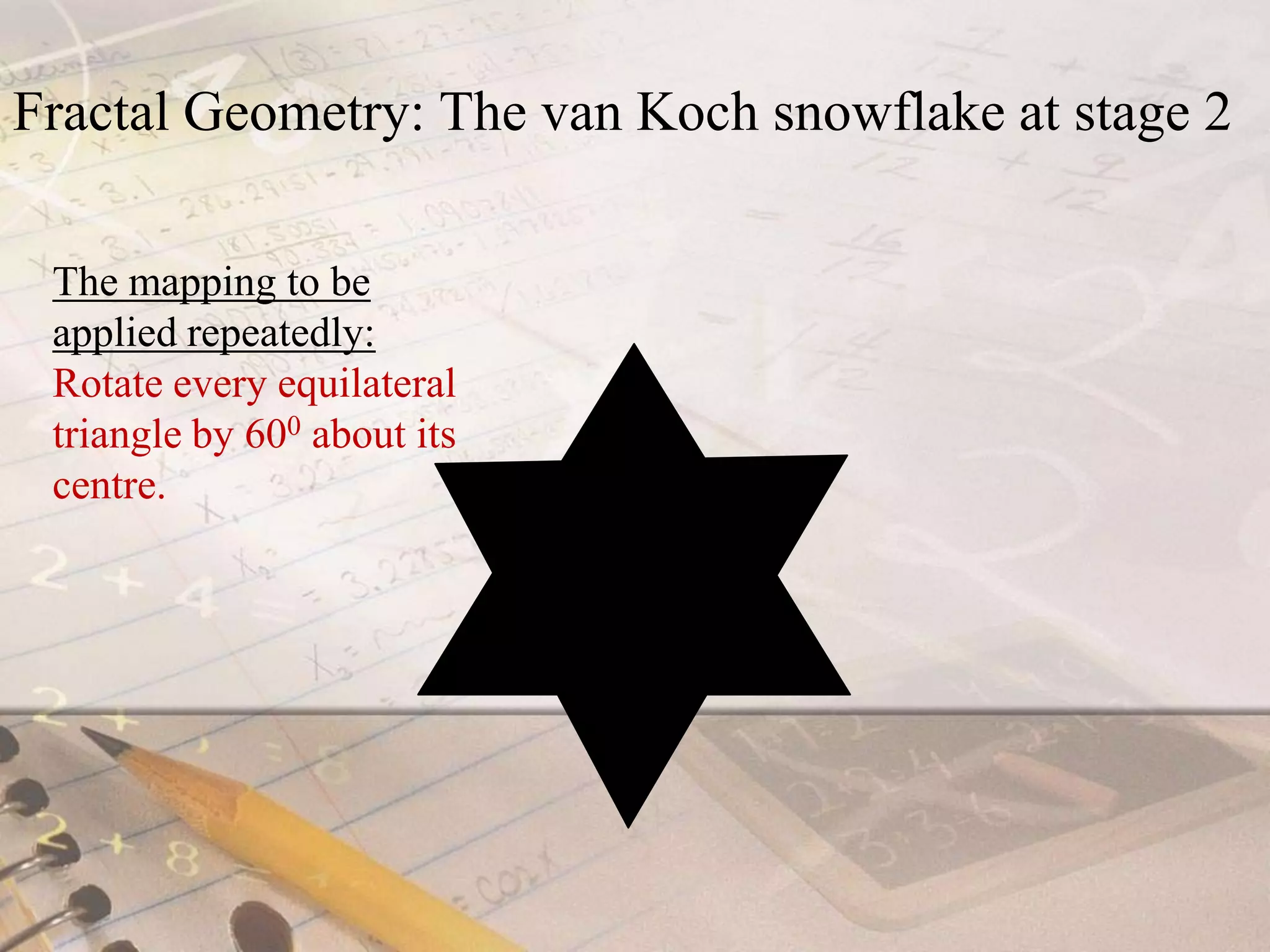
Fractal Geometry: The van Koch snowflake at stage 2The mapping to be applied repeatedly: Rotate every equilateral triangle by 600about its centre.
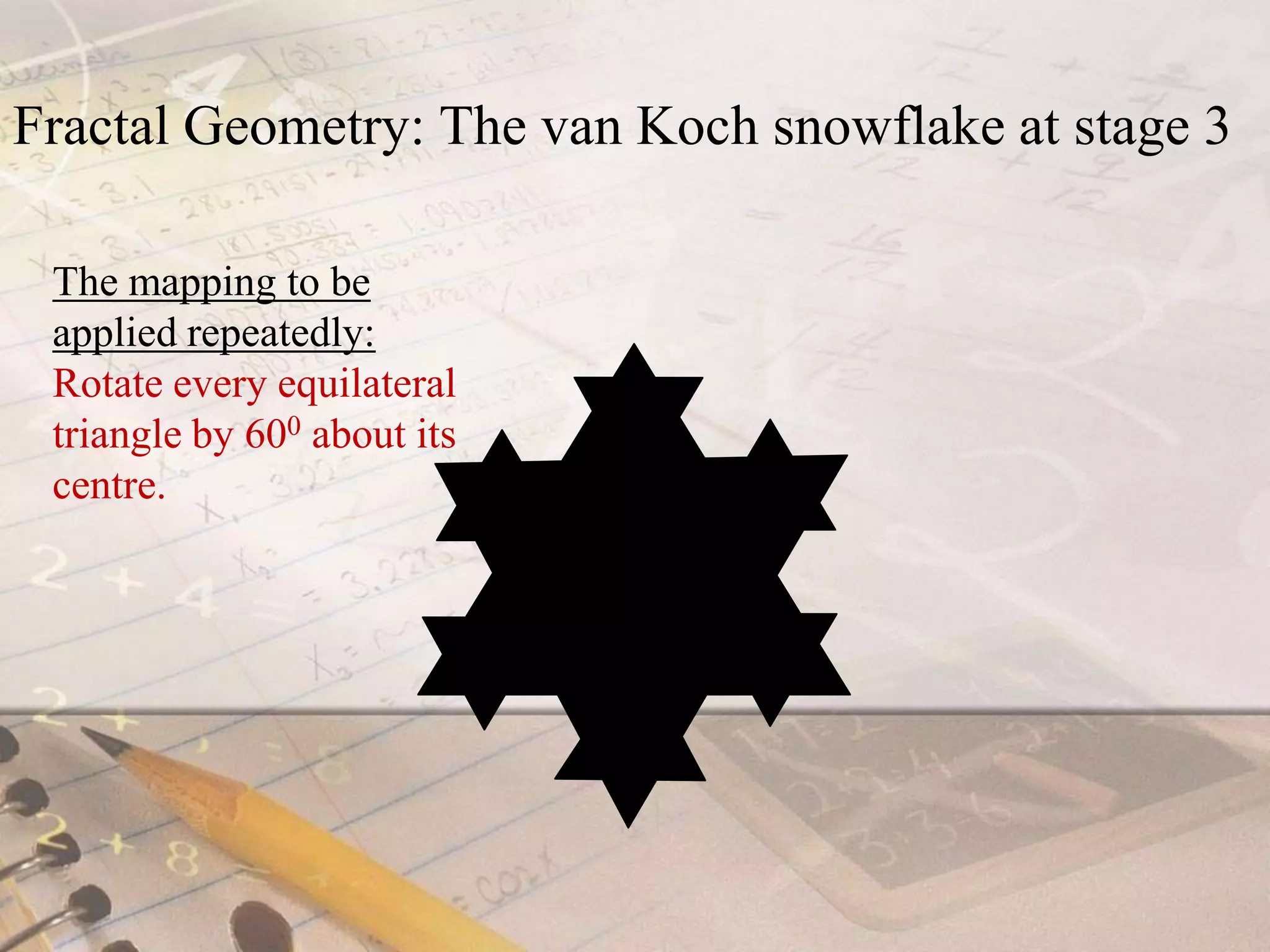
Fractal Geometry: The van Koch snowflake at stage 3The mapping to be applied repeatedly: Rotate every equilateral triangle by 600about its centre.v
Development of a van Koch snowflake fractalObserve: Each stellation is congruent to the original equilateral 	 	        triangle
An application of fractal geometryThe van Koch snowflake fractal has the amazing property that its perimeter tends to infinity while its area is finite [certainly less than the area of the bounding rectangle containing it].This is the perfect design for antennae for mobile phone and microwave communications.Source of fractal antenna picture: Wikipedia
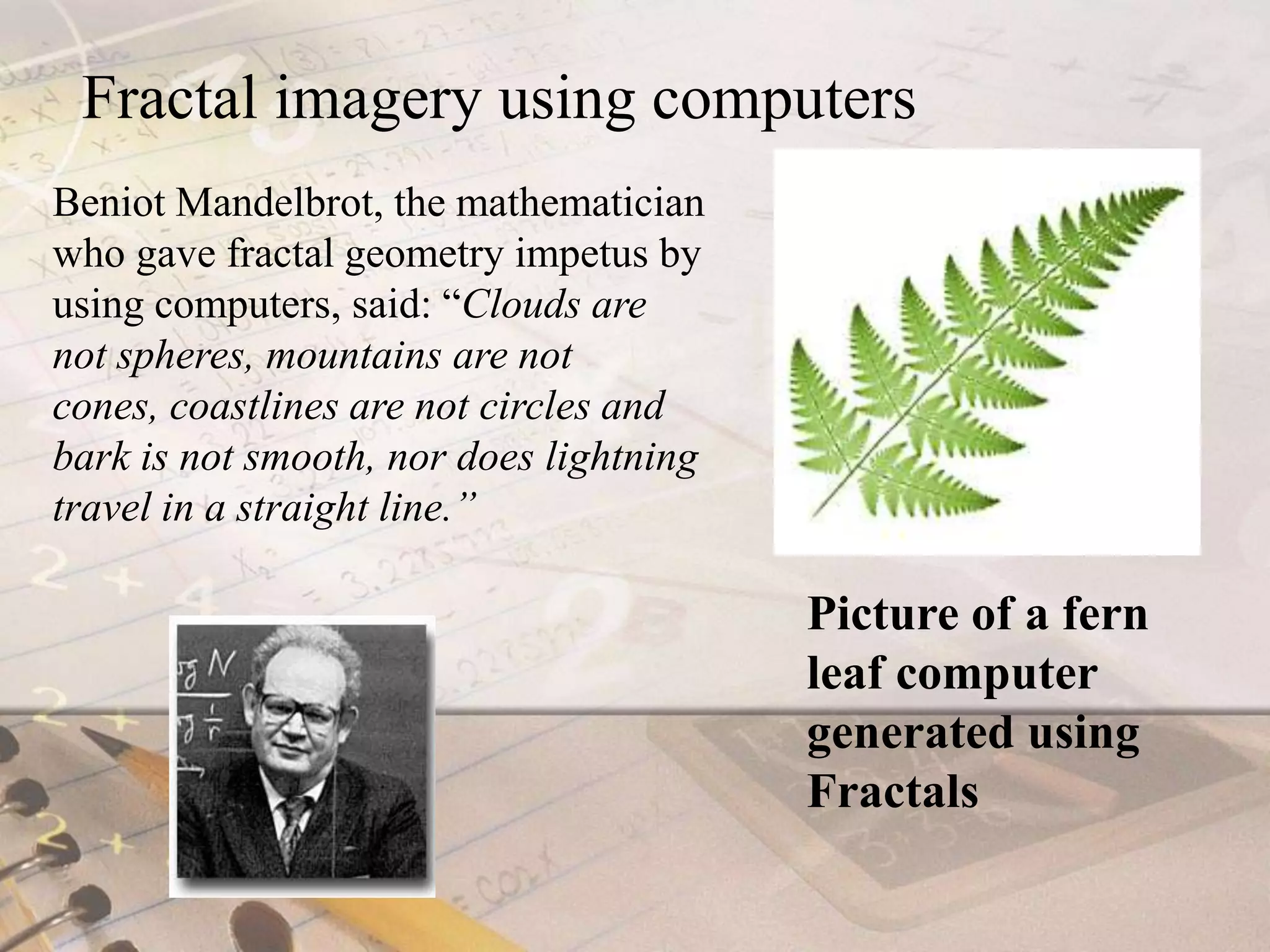
Fractal imagery using computersBeniot Mandelbrot, the mathematician who gave fractal geometry impetus by using computers, said: “Clouds are not spheres, mountains are not cones, coastlines are not circles and bark is not smooth, nor does lightning travel in a straight line.”Picture of a fern leaf computer generated using Fractals
What has special effects in the cinema got to do with mathematics?These pictures show the use of fractals in computer generated imagery in the cinema.Source of fractal pictures: www.comp.dit.ie/
Anecdotes from the history of mathematics : Ways of selling mathematics6. Using one’s imagination 2
What has the auto-focus in your camera got to do with mathematics?
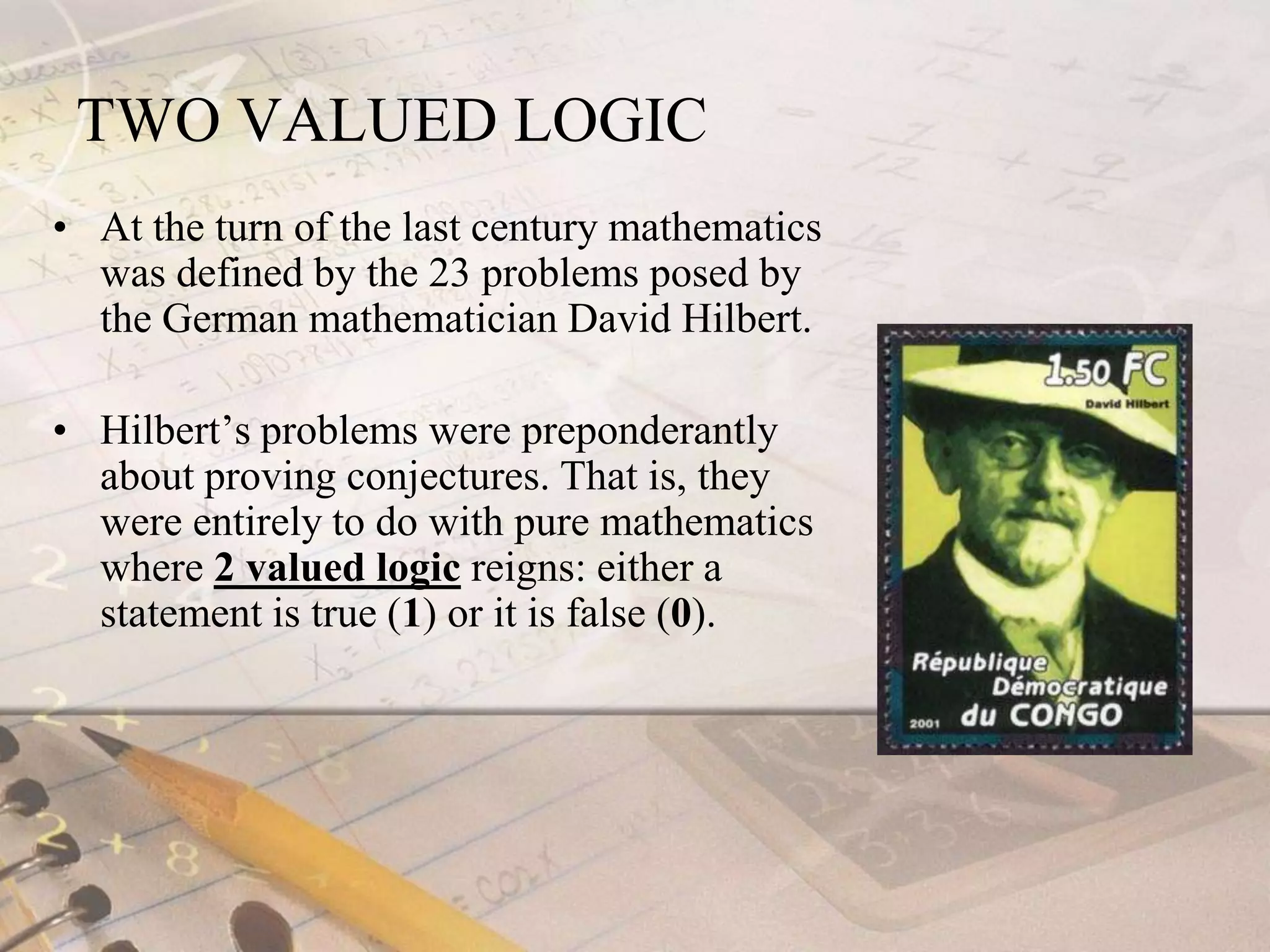
TWO VALUED LOGICAt the turn of the last century mathematics was defined by the 23 problems posed by the German mathematician David Hilbert. Hilbert’s problems were preponderantly about proving conjectures. That is, they were entirely to do with pure mathematics where 2 valued logic reigns: either a statement is true (1) or it is false (0).
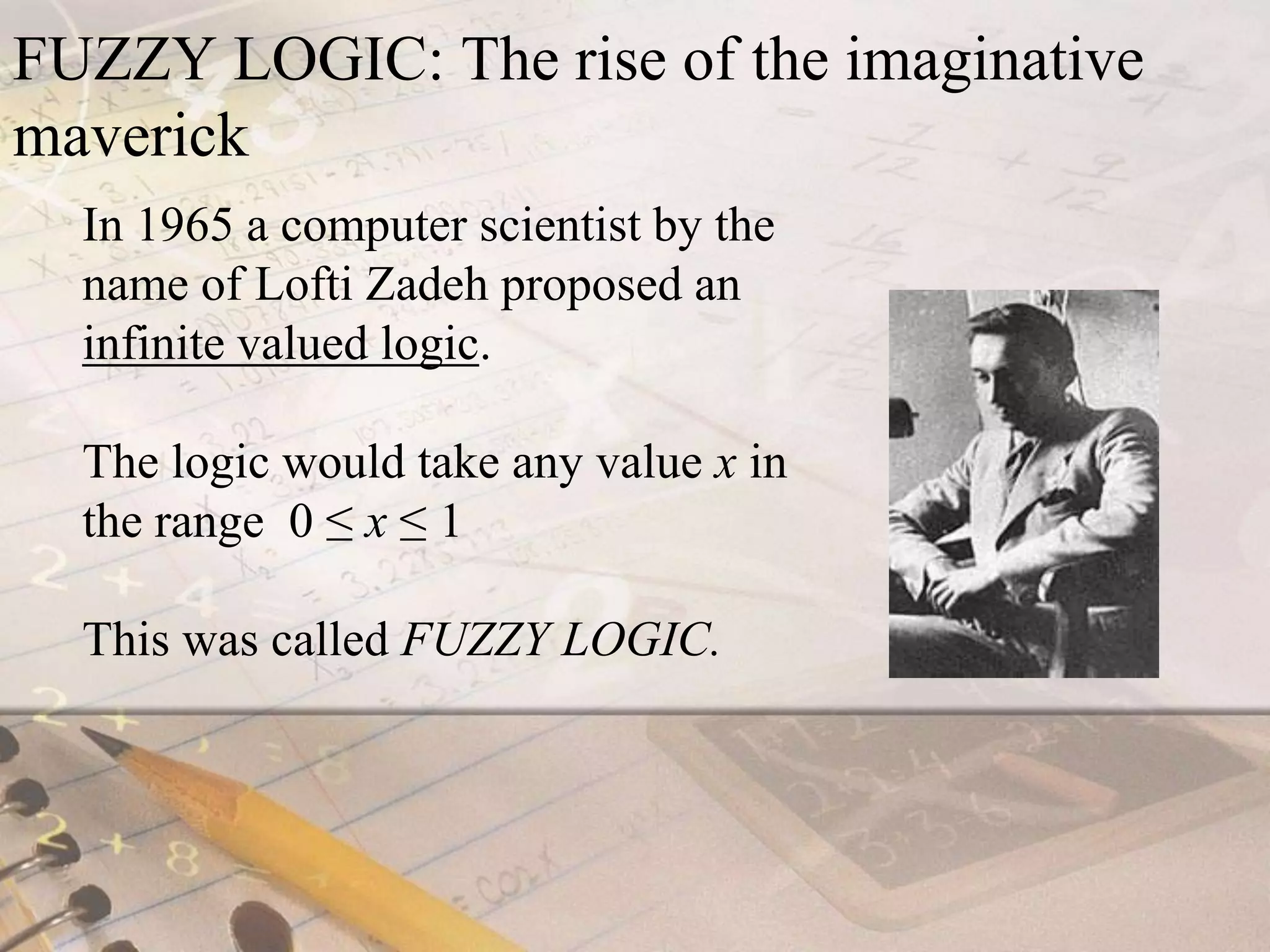
FUZZY LOGIC: The rise of the imaginative maverickIn 1965 a computer scientist by the name of Lofti Zadeh proposed an infinite valued logic.The logic would take any value x in the range  0 ≤ x ≤ 1This was called FUZZY LOGIC.
                   FUZZY LOGICFuzzy logic was not an abstract phenomenon.  Zadeh knew it could be applied from the outset.“Well, I knew it was going to be important. That much I knew. In fact, I had thought about sealing it in a dated envelope with my predictions and then opening it 20-30 years later to see if my intuitions were right. I used to think about it this way: that one day Fuzzy Logic would turn out to be one of the most important things to come out of our Electrical Engineering Computer Systems Division at Berkeley.”
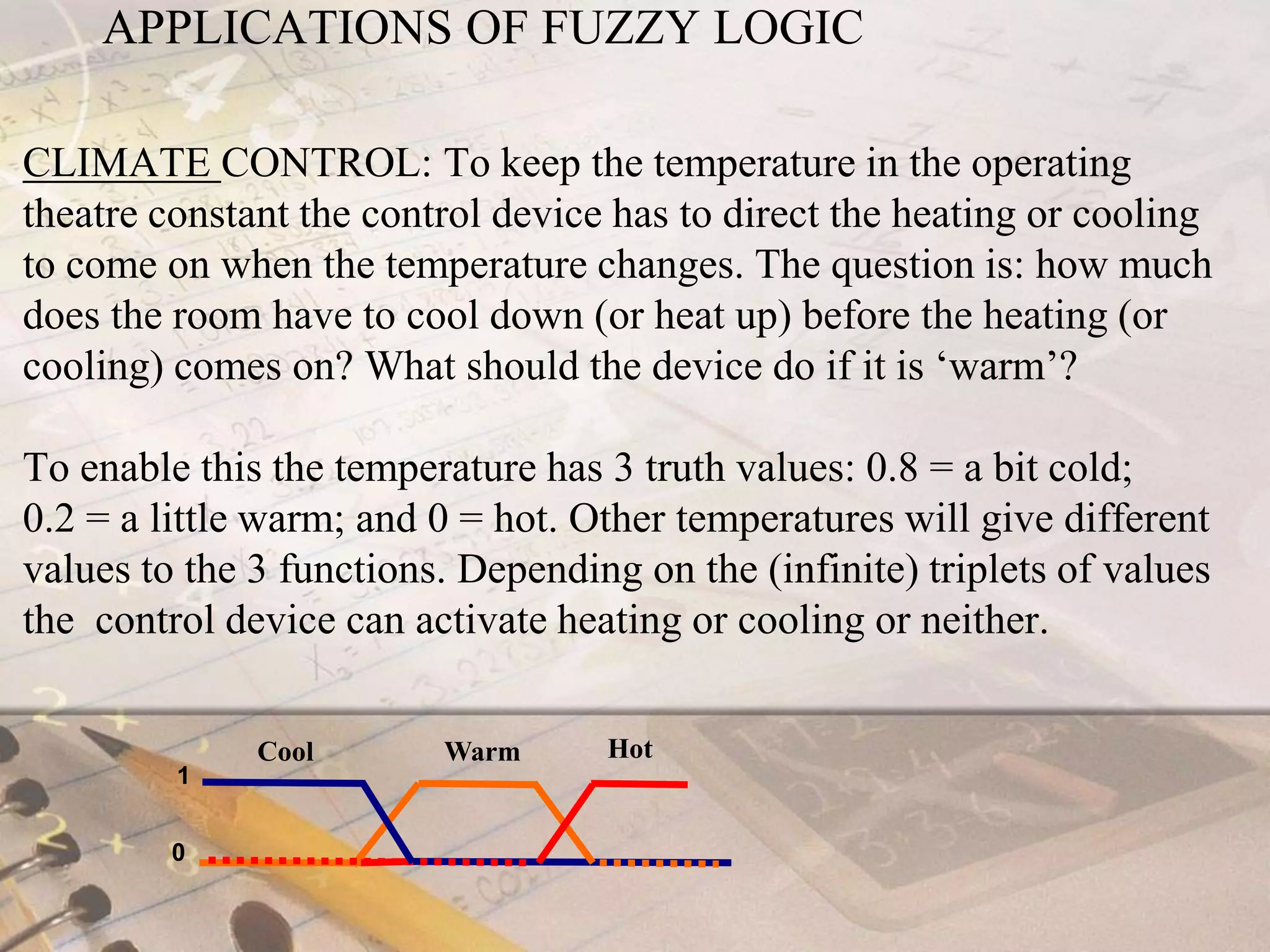
APPLICATIONS OF FUZZY LOGICCLIMATE CONTROL: To keep the temperature in the operating theatre constant the control device has to direct the heating or cooling to come on when the temperature changes. The question is: how much does the room have to cool down (or heat up) before the heating (or cooling) comes on? What should the device do if it is ‘warm’? To enable this the temperature has 3 truth values: 0.8 = a bit cold; 0.2 = a little warm; and 0 = hot. Other temperatures will give different values to the 3 functions. Depending on the (infinite) triplets of values the  control device can activate heating or cooling or neither.1HotCoolWarm0
The success of Fuzzy Logic.Amongst hundreds of industrial applications of Fuzzy Logic are the following: Handwriting recognition by computers (Sony)Medicine technology: cancer diagnosis (Kawasaki Medical School)Back light control for camcorders (Sanyo)Single button control for washing-machines (Matsushita)Voice Recognition (CSK, Hitachi, Ricoh)Improved fuel-consumption for automobiles (Nippon Tools)Source: http://www.esru.strath.ac.uk/Reference/concepts/fuzzy/fuzzy_appl.10.htm
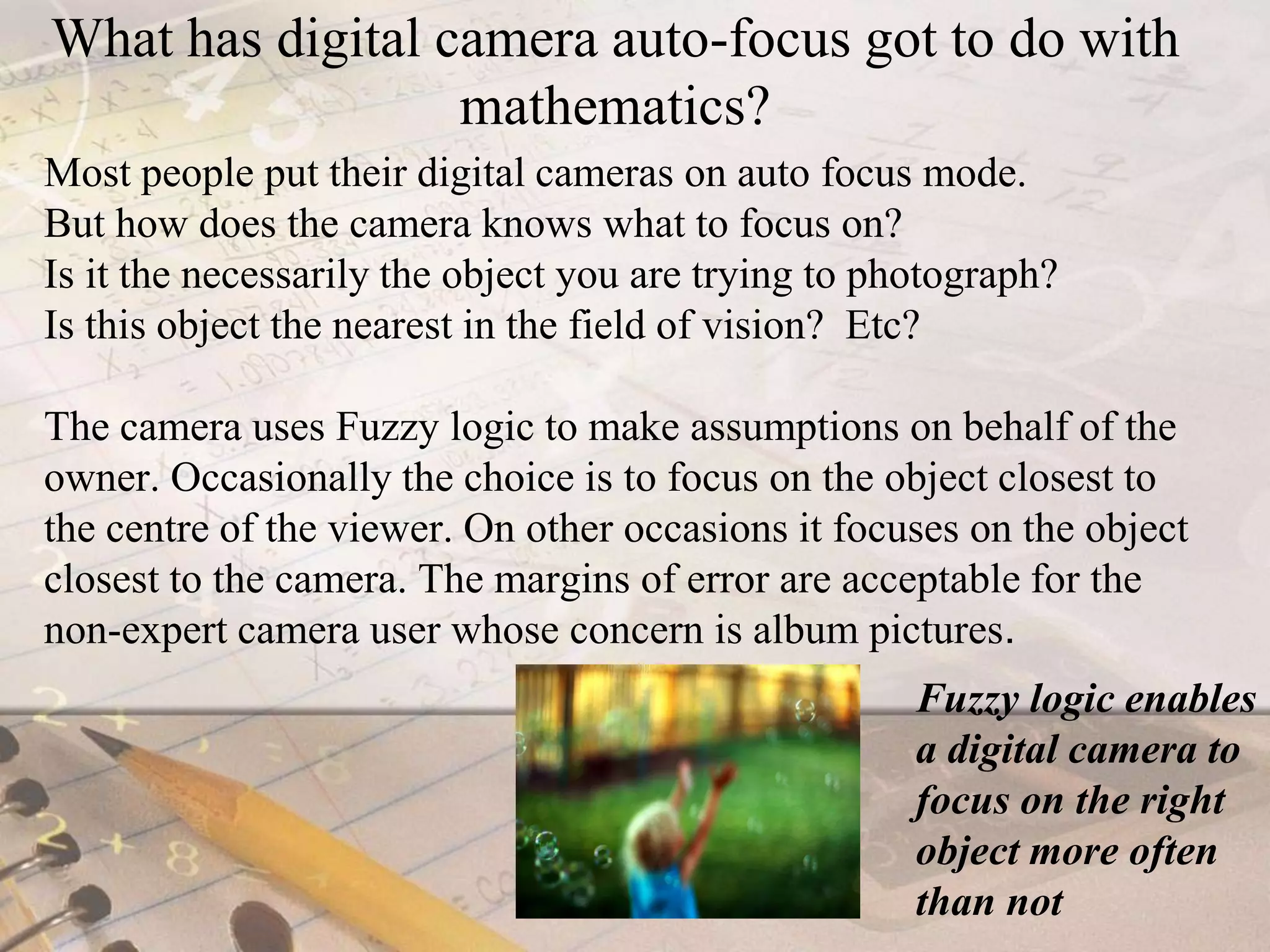
What has digital camera auto-focus got to do with mathematics?Most people put their digital cameras on auto focus mode. But how does the camera knows what to focus on? Is it the necessarily the object you are trying to photograph? Is this object the nearest in the field of vision?  Etc?The camera uses Fuzzy logic to make assumptions on behalf of the owner. Occasionally the choice is to focus on the object closest to  the centre of the viewer. On other occasions it focuses on the object closest to the camera. The margins of error are acceptable for the non-expert camera user whose concern is album pictures. Fuzzy logic enables a digital camera to focus on the right object more often than not

Anecdotes from the history of mathematics ways of selling mathemati

  • 1.
    Anecdotes from thehistory of mathematics : Ways of selling mathematics1. Numbers
  • 2.
    To start offwith – a puzzle:What has this 1835 painting by Turner got to do with progress in mathematics?
  • 3.
    Number sense Cardinal number sense Number words Counting (influenced by anatomy) Discovery of zero Development of arithmetic
  • 4.
    Number sense –critical for survival of the speciesThe ability to recognize whether a small collection of objects has increased or decreased Have we lost someone whilst out hunting? Is our group size sufficient to defend against or attack the opposing tribe?
  • 5.
    Early cardinal numbersense – giving prototypical structure to number senseThe size of the community/group compared with a fixed collection of objects or marks- pebbles, notches on a stick, or fingers on the hand.
  • 6.
    The development ofnumber wordsThe abstraction of number words to abstract symbols came much later. As Bertrand Russell stated "It must have required many ages to discover that a brace of pheasants and a couple of days were both instances of the number 2”.
  • 7.
    CountingTo be ableto count one has to place numbers/number words in order or succession.This is ordinal number sense: one, two, three, .........
  • 8.
    Words to symbols- symbolic ordinal number systemsBabylonian (present day Iraq – c 3000 BC): Base 60Egyptian (c 300 BC): Base 10Indian ( c 11th century AD): Base 10
  • 9.
    Need for thedevelopment of arithmetic Calculations in trade, taxation, and the recording of timeOrganising military affairsThe need to record calculations on paper led to widespread adoption of different arithmetic by the 15th century.
  • 10.
    Early Arithmetic37 ×11 and you don’t know place value arithmetic?
  • 11.
    Early Arithmetic23÷ 4and you don’t know place value arithmetic?
  • 12.
    Indo-Arabic Arithmetic37 ×11 and you know place value arithmetic?23÷ 4 and you know place value arithmetic?In the first example notice the use of 0 as place value: the 0 in 407 signifies zero=no tens. Also multiplication proceeds Right to Left. Division in reverse.
  • 13.
    A feature ofthe Hindu-Arabic NumeralsThere is direct evidence that the original Hindu numerals were meant to be used in two ways.Either in the Left-Right orientation: Increase in place value L to R 213 = 2 + 10 + 300Or the Right-left orientation: Increase in place value R to L 213 = 200+ 10 + 3 See A.K. Bag: Mathematics in Ancient and Medieval India, Chaukhamba Orientalia, 1976, Delhi
  • 14.
    A feature ofthe Indo-Arabic NumeralsIslamic mathematicians adopted the Indian system and transmitted it Westwards. Arabic being written in the right-left orientation is probably the reason why the right-left orientation is universally used.
  • 15.
    The 1835 paintingby Turner depicts .........the houses of parliament burning in 1834Resistance to the new arithmetic … tally sticks were in use until the 19th century …. The fire indirectly due to the enormous tally sticks kept in the houses.
  • 16.
    The 1835 paintingby TurnerCharles Dickens commented at the time: "... it took until 1826 to get these sticks abolished. ….In 1834 there was a considerable accumulation of them. The sticks were housed in Westminster…… and so the order went out that they should be privately and confidentially burned. It came to pass that they were burned in a stove in the House of Lords. The stove, overgorged with these preposterous sticks, set fire to the panelling; the panelling set fire to the House of Commons; the two houses were reduced to ashes"
  • 17.
    Anecdotes from thehistory of mathematics : Ways of selling mathematics2. Algebra
  • 18.
    First - apuzzle:What has bone setting got to do with algebra?
  • 19.
    Key developments inancient and medieval algebraExtraction of square roots Method for solution of practical problems Method for approximate solutions of these problems
  • 20.
    Some problems ofancient and medieval times that required algebra.Right angled triangles. Length of the hypotenuse.Implied the need to extract square roots.
  • 21.
    Extracting square roots- The Babylonian methodStep 1 Given a non-square number N find a number a such that a2 is near N.Step 2Then set b = |N – a2|andc = b/2aStep 3N  a + c if a2 < N; N  a – c otherwiseExample N = 2 Step 1. Choose a =17/12 Step 2. Then b = 289/144 –2 = 1/144 and c = 1/144  34/12 = 1/(1234)Step 3 2 = 17/12 - 1/(1234) = 1.414215686…
  • 22.
    Solving simple equations– Early generalisationsThe rule of three. To find the cost multiply the fruit by the requisition, and divide the resulting product by the argument.Example 1. If A = 6[the argument] books cost F = 12 units [the fruit], what will R = 10 [requisition] books cost? Rule of 3 Cost = F× R = 12 × 10 = 20 units A 6
  • 23.
    Solving quadratic equations:Al Khwarizmi(820) and Pedro Nunes (1567)The Fourth rule: x2 +10x = 50 Make a square with x and half the number of things.(x+5)2 = 25 + 50 x= √75 - 5 number5xnumber of thingsHalf the number of things55x25 Picture (x+5)2 -25 = 50 (x + half the number of things) squared = square of (half the number of things) placed next to the number.5xx2xTo find x subtract from the root half the number of things
  • 24.
    Cubic equations –Jamshid al Kashi (15th century AD)Problem from antiquity: Find sin 10.Al Kashiknew sin 30 ≈ 0.0523359562429448 and that sin 3 = 3sin  – 4sin3 . sin 30 = 3sin 10 – 4sin3 10 If x = sin 10 then 3x – 4x3 = 0.0523359562429448 Re-arranging gives x = (0.0523359562429448 + 4x3)/31st approximation x0 = 0.0162nd approximation x1 = (0.0523359562429448 + 4x03)/3 = 0.01745078008098163rd approximation x2 = (0.0523359562429448 + 4x13)/3 =0.0174524044560038
  • 25.
    al-Kashi‘s fixed pointiterationThis is exactly the fixed-point iteration used in post 16mathematics. x = g(x)In the example g(x) = (0.0523359562429448 + 4x3)/3y = xy = g(x)Location of exact rootx1x2x3
  • 26.
    What has bonesetting got to do with algebra?Al-Khwarizmi wrote the first treatise on algebra: Hisab al-jabr w’al-muqabala in 820 AD. The word algebra is a corruption of al-jabr which means restoration. In Spain, where the Arabs held sway for a long period, there arose a profession of ‘algebrista’s’ who dealt in bone setting.
  • 27.
    What has bonesetting got to do with algebra?álgebra. Del lat. tardío algebra, y este abrev. del ár. clás. algabru walmuqabalah, reducción y cotejo. 1. f. Parte de las matemáticas en la cual las operaciones aritméticas son generalizadas empleando números, letras y signos. 2. f. desus. Arte de restituir a su lugar los huesos dislocados Translation: the art of restoring broken bones to their correct positions
  • 28.
    Anecdotes from thehistory of mathematics : Ways of selling mathematics3. Geometry: the mother of algebra
  • 29.
    How do thesepaintings show how geometry influenced art?Pietro Perugino fresco at the Sistine Chapel (1481)Melchior Broederlam(c1394)
  • 30.
    Some features inthe development of GeometryPractical knowledge for construction of buildings Practical knowledge for patterning and art Generalisation of geometry Axiomatic deductive geometry
  • 31.
    Practical geometry inreal lifeThe 3, 4, 5 rope for ensuring a right angle in buildingconstruction – ropes.Artisans in ancient and medieval times used a loop ofrope of length 12 units knotted at 3 and 4 units toensure a right angle was formed.534
  • 32.
    Practical calculation ofareas – the quadrilateralThe surveyors rule - first evidenced in Babylonian mathematics (c 2000 BC) – for calculating the area of a quadrilateral. Walk along the 4 sides a, b, c, and d – measure – substitute into the formula. The formula gives exact area only in the case of a rectangle. In all other cases it is an overestimate.abdc
  • 33.
    Greek Geometry -EuclidEuclid (c. 300 BC) theorised geometry deriving results using axioms and deductive logic in a series of 13 books called the Elements. One such axiom is that an isosceles triangles has equal angles opposite the equal sides.A long line of non-Greek, mainly Islamic, scholars called Euclidisi’s kept the Elements alive by manually producing editions of the work after Greek culture fell in decay.
  • 34.
    The importance ofEuclid and Greek geometryGreek geometry was constructed in a culture of democracy where all issues were subject to debate.Greek geometry naturally followed this tradition of having to argue the case against all sceptics. It could be argued that this democratic, intellectual feature enabled Euclidean geometry to plant itself in foreign soil and, therefore, survive long after the decline of Greek culture.
  • 35.
    Geometry of planepatterns - tessellationsJust how does a builder make a pattern that repeats in order to tile a floor or a wall? North African geometers between the 8th and 16th centuries worked out that there were just 17 different types of tessellations A result mathematically proved only in 1935. Four of the 17 possibilities are depicted in these pictures of tilings from the Alhambra in Granada, Spain (all 17 are to be found there). P3 P4P6M P4G
  • 36.
    Geometry the motherof algebraThere are just 7 types of frieze patternsThe realisation that Islamic geometers had given structure to patterns in the plane motivated 19th and 20th century mathematicians algebriasing geometry.The study of geometric symmetry directly leads to methods for the solutions of polynomials – Galois Theory.
  • 37.
    Geometrical perspective –how geometry influenced artFilippo Brunelleschi (1377 –1446 )discovered theory of perspective. Essentially in parallel lines on a horizontal plane depicted in the vertical plane meet – at the vanishing point. Only objects in perspective look realistic.Cuboid with 1 vanishing point
  • 38.
    Pietro Perugino’s frescoclearly shows perspective. While Broederlam’s painting does not look natural … parallel lines in the painting meet at different points.Melchior Broederlam(c1394)Pietro Perugino fresco (1481)
  • 39.
    Anecdotes from thehistory of mathematics : Ways of selling mathematics4. Who said calculus was hard?
  • 40.
    What has apiece of string go to do with calculus?
  • 41.
    Some key pointsin the history of calculusEarly work on integration; calculation of areas and volumesThe realisation that integration means sum of power series The conquest of infinity: summation of infinite terms Calculation of lengths of curved lines
  • 42.
    Integration: the determinationof lengths, areas and volumes. Early Integration.Archimedes (c 225 BC) approximated the length of a circle and, hence, of π by approximating a circle by inscribed and circumscribed regular polygons. Using one of 96 sides he found π is between 223⁄71 and 22⁄7. So π ~ 3.1419.Tsu Ch’ung Chi c.430 - c.501) did the same thing reputedly using a polygon of 24,576 sides thereby computing the value of πcorrect to 6 d.p.
  • 43.
    Early Integration ofarea under a curve – the technical problemThe area A under the curve y=xkbetween 0 and n is approximated by the areas of the rectangles, each of width1 and height given by xkA ≈ 1k+ 2k + 3k + ……(n-1)k + nkNeed to be able to sum powers of integers.Archimedes and Ibn al Haytam (965-1039) were able to do this for some values of n. Later (12th -14th centuries) al Samawal (Iraq), Zhu Shijie (China), and Narayana Pandit (India) for general values of n.y= xk
  • 44.
    Early Integration ofarea under a curve – Better approximationsThe area A under the curve y=xkbetween 0 and 1is approximated by the areas of the rectangles, each of width1/nand height given by xkA ≈ 1k + 2k + 3k + ……(n-1)k + nk nk+1As n ->∞ the sum on the left becomes the exact area.The first appearance of a solution (A= 1/(k+1) ) was in 1530 – in the Yuktibhasa of Jyesthadeva. Later tackled in the 17th century by Fermat, Pascal, Wallis, etc.y=xk
  • 45.
    Infinity conquered –the calculation of the derivativeDerivative at P =gradient of tangent at PPf(x)Derivative =f(x-h)x - hxNewton and Leibniz independently discovered the generalised method late 17th century
  • 46.
    Historical problems thatgave rise to the calculus.Arc length calculation:Approximate small sections of arc by straight lines. What happens as the sections get smaller and smaller?
  • 47.
    Arc length calculationusing the calculusEach arc segment ≈ (dx2 + dy2)1/2 = (1 + [dy/dx]2)1/2 ×dxSo the total arc length ≈ Sum of all (1 + [dy/dx]2)1/2 ×dx’ s = ∫ (1 + [dy/dx]2)1/2 dxA2A3yA4dy =y2-y1A1dxAnxxnx1x4x2x3
  • 48.
    What has apiece of string go to do with calculus?In the primary classroom one may see curved length calculation as follows: lay a piece of string along the curve, mark the ends of the curve along it, straighten the string, and then measure the marked length.
  • 49.
    What has apiece of string go to do with calculus?Lay a piece of string along the curve, mark the ends of the curve along it, straighten the string, and then measure the marked length. This is essentially the principle employed in the deriving the arc length formulaThis was also a principle used in ancient mathematics. Good mathematics is when you first simplify the problem to easily deduce the solution and then develop the solution for the complex case.
  • 50.
    Anecdotes from thehistory of mathematics : Ways of selling mathematics5. Using one’s imagination
  • 51.
    What has specialeffects in the cinema got to do with mathematics?Source of fractal pictures: www.comp.dit.ie/
  • 52.
    Using imagination - i the complex square root of -1 What kind of pictures would arise from repeatedly applying a function of the complex numbers? These imaginings were that of Gaston Julia in 1915 and the resulting pictures were called Julia sets. Julia sets had noconceived applications at the Time and these later gave rise to Fractal Geometry. The picture from repeatedly applying z  z2 + i.
  • 53.
    Fractal Geometry inthe classroom: The van Koch snowflakeThe mapping to be applied repeatedly: Rotate every equilateral triangle by 600about its centre.
  • 54.
    Fractal Geometry: Thevan Koch snowflake at stage 2The mapping to be applied repeatedly: Rotate every equilateral triangle by 600about its centre.
  • 55.
    Fractal Geometry: Thevan Koch snowflake at stage 3The mapping to be applied repeatedly: Rotate every equilateral triangle by 600about its centre.v
  • 56.
    Development of avan Koch snowflake fractalObserve: Each stellation is congruent to the original equilateral triangle
  • 57.
    An application offractal geometryThe van Koch snowflake fractal has the amazing property that its perimeter tends to infinity while its area is finite [certainly less than the area of the bounding rectangle containing it].This is the perfect design for antennae for mobile phone and microwave communications.Source of fractal antenna picture: Wikipedia
  • 58.
    Fractal imagery usingcomputersBeniot Mandelbrot, the mathematician who gave fractal geometry impetus by using computers, said: “Clouds are not spheres, mountains are not cones, coastlines are not circles and bark is not smooth, nor does lightning travel in a straight line.”Picture of a fern leaf computer generated using Fractals
  • 59.
    What has specialeffects in the cinema got to do with mathematics?These pictures show the use of fractals in computer generated imagery in the cinema.Source of fractal pictures: www.comp.dit.ie/
  • 60.
    Anecdotes from thehistory of mathematics : Ways of selling mathematics6. Using one’s imagination 2
  • 61.
    What has theauto-focus in your camera got to do with mathematics?
  • 62.
    TWO VALUED LOGICAtthe turn of the last century mathematics was defined by the 23 problems posed by the German mathematician David Hilbert. Hilbert’s problems were preponderantly about proving conjectures. That is, they were entirely to do with pure mathematics where 2 valued logic reigns: either a statement is true (1) or it is false (0).
  • 63.
    FUZZY LOGIC: Therise of the imaginative maverickIn 1965 a computer scientist by the name of Lofti Zadeh proposed an infinite valued logic.The logic would take any value x in the range 0 ≤ x ≤ 1This was called FUZZY LOGIC.
  • 64.
    FUZZY LOGICFuzzy logic was not an abstract phenomenon. Zadeh knew it could be applied from the outset.“Well, I knew it was going to be important. That much I knew. In fact, I had thought about sealing it in a dated envelope with my predictions and then opening it 20-30 years later to see if my intuitions were right. I used to think about it this way: that one day Fuzzy Logic would turn out to be one of the most important things to come out of our Electrical Engineering Computer Systems Division at Berkeley.”
  • 65.
    APPLICATIONS OF FUZZYLOGICCLIMATE CONTROL: To keep the temperature in the operating theatre constant the control device has to direct the heating or cooling to come on when the temperature changes. The question is: how much does the room have to cool down (or heat up) before the heating (or cooling) comes on? What should the device do if it is ‘warm’? To enable this the temperature has 3 truth values: 0.8 = a bit cold; 0.2 = a little warm; and 0 = hot. Other temperatures will give different values to the 3 functions. Depending on the (infinite) triplets of values the control device can activate heating or cooling or neither.1HotCoolWarm0
  • 66.
    The success ofFuzzy Logic.Amongst hundreds of industrial applications of Fuzzy Logic are the following: Handwriting recognition by computers (Sony)Medicine technology: cancer diagnosis (Kawasaki Medical School)Back light control for camcorders (Sanyo)Single button control for washing-machines (Matsushita)Voice Recognition (CSK, Hitachi, Ricoh)Improved fuel-consumption for automobiles (Nippon Tools)Source: http://www.esru.strath.ac.uk/Reference/concepts/fuzzy/fuzzy_appl.10.htm
  • 67.
    What has digitalcamera auto-focus got to do with mathematics?Most people put their digital cameras on auto focus mode. But how does the camera knows what to focus on? Is it the necessarily the object you are trying to photograph? Is this object the nearest in the field of vision? Etc?The camera uses Fuzzy logic to make assumptions on behalf of the owner. Occasionally the choice is to focus on the object closest to the centre of the viewer. On other occasions it focuses on the object closest to the camera. The margins of error are acceptable for the non-expert camera user whose concern is album pictures. Fuzzy logic enables a digital camera to focus on the right object more often than not