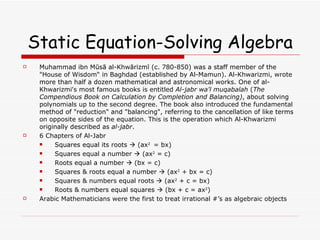
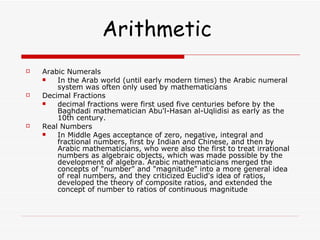
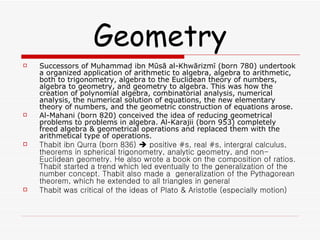
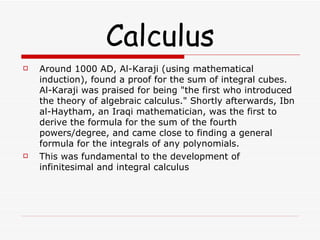
Islamic mathematics refers to the mathematical advancements made in the Islamic world from 622-1600, flourishing particularly during the Abbasid Caliphate, where scholars translated classical texts and developed new concepts. Influential mathematicians such as Al-Khwārizmī established algebra and contributed to the understanding of numbers, geometry, and astronomy, affecting later developments in various fields. The integration of cultural and scientific exchange laid the groundwork for mathematical practices still relevant today.