YEAR 11 MATHS Equivalent fractions
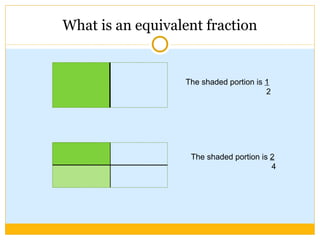
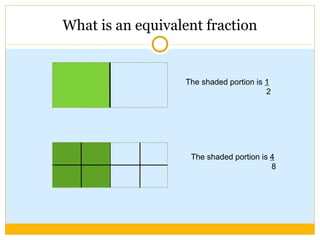
What is an equivalent fraction The shaded portion is  1 2 The shaded portion is  2 4
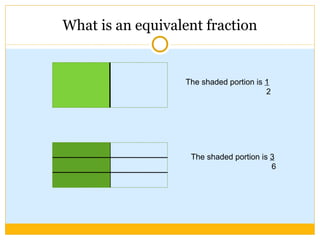
What is an equivalent fraction The shaded portion is  1 2 The shaded portion is  3 6
What is an equivalent fraction The shaded portion is  1 2 The shaded portion is  4 8
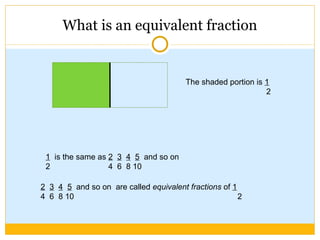
What is an equivalent fraction The shaded portion is  1 2 1   is the same as  2   3   4   5   and so on 2  4  6  8 10  2   3   4   5   and so on  are called  equivalent fractions  of  1 4  6  8 10  2
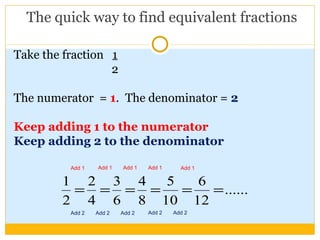
The quick way to find equivalent fractions Take the fraction  1 2 The numerator  =  1 .   The denominator =  2 Keep adding 1 to the numerator Keep adding 2 to the denominator Add 1 Add 2 Add 1 Add 1 Add 1 Add 1 Add 2 Add 2 Add 2 Add 2
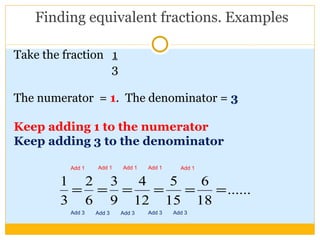
Finding equivalent fractions. Examples Take the fraction  1 3 The numerator  =  1 .   The denominator =  3 Keep adding 1 to the numerator Keep adding 3 to the denominator Add 1 Add 3 Add 1 Add 1 Add 1 Add 1 Add 3 Add 3 Add 3 Add 3
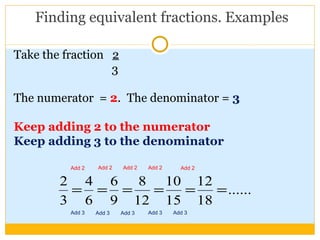
Finding equivalent fractions. Examples Take the fraction  2 3 The numerator  =  2 .   The denominator =  3 Keep adding 2 to the numerator Keep adding 3 to the denominator Add 2 Add 3 Add 2 Add 2 Add 2 Add 2 Add 3 Add 3 Add 3 Add 3
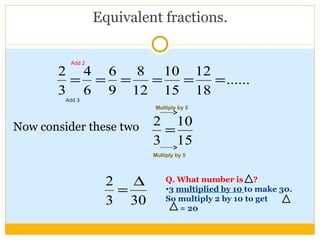
Equivalent fractions.  Now consider these two Multiply by 5  Add 3 Add 2 Multiply by 5  Q. What number is  ? 3  multiplied by 10  to make 30. So multiply 2 by 10 to get  = 20
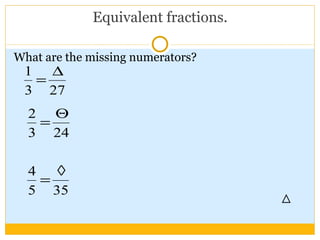
Equivalent fractions.  What are the missing numerators?
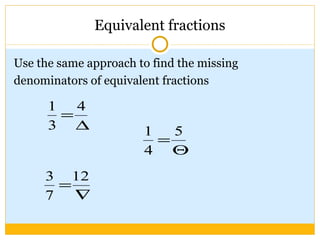
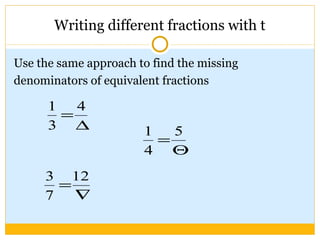
Equivalent fractions Use the same approach to find the missing denominators of equivalent fractions
Writing different fractions with t Use the same approach to find the missing denominators of equivalent fractions
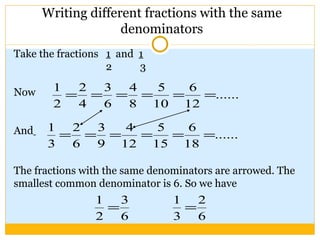
Writing different fractions with the same denominators Take the fractions  1   and  1 2  3 Now And   The fractions with the same denominators are arrowed. The smallest common denominator is 6. So we have
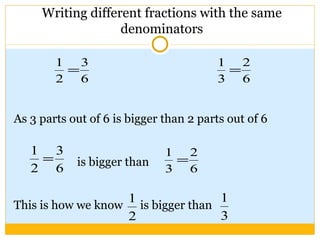
Writing different fractions with the same denominators As 3 parts out of 6 is bigger than 2 parts out of 6 is bigger than  This is how we know  is bigger than
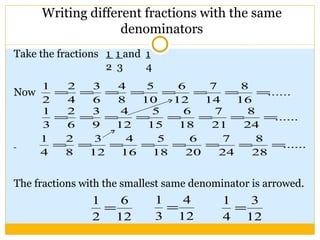
Writing different fractions with the same denominators Take the fractions  1  1  and  1 2  3  4 Now The fractions with the smallest same denominator is arrowed.
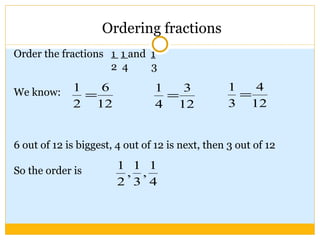
Ordering fractions Order the fractions  1  1  and  1 2  4  3 We know: 6 out of 12 is biggest, 4 out of 12 is next, then 3 out of 12 So the order is
Classwork  Ex A page 366 Q1 Q4 Q6 Q7
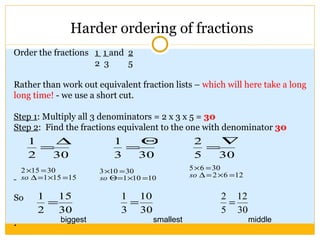
Harder ordering of fractions Order the fractions  1  1  and  2 2  3  5 Rather than work out equivalent fraction lists –  which will here take a long long time!  - we use a short cut. Step 1 : Multiply all 3 denominators = 2 x 3 x 5 =  30 Step 2 :  Find the fractions equivalent to the one with denominator  30 So .  biggest smallest middle
Classwork Ex A P 366 Q3 Ex B p 368 Q1 Q2 Q4

Teaching equivalent fractions

  • 1.
    YEAR 11 MATHSEquivalent fractions
  • 2.
    What is anequivalent fraction The shaded portion is 1 2 The shaded portion is 2 4
  • 3.
    What is anequivalent fraction The shaded portion is 1 2 The shaded portion is 3 6
  • 4.
    What is anequivalent fraction The shaded portion is 1 2 The shaded portion is 4 8
  • 5.
    What is anequivalent fraction The shaded portion is 1 2 1 is the same as 2 3 4 5 and so on 2 4 6 8 10 2 3 4 5 and so on are called equivalent fractions of 1 4 6 8 10 2
  • 6.
    The quick wayto find equivalent fractions Take the fraction 1 2 The numerator = 1 . The denominator = 2 Keep adding 1 to the numerator Keep adding 2 to the denominator Add 1 Add 2 Add 1 Add 1 Add 1 Add 1 Add 2 Add 2 Add 2 Add 2
  • 7.
    Finding equivalent fractions.Examples Take the fraction 1 3 The numerator = 1 . The denominator = 3 Keep adding 1 to the numerator Keep adding 3 to the denominator Add 1 Add 3 Add 1 Add 1 Add 1 Add 1 Add 3 Add 3 Add 3 Add 3
  • 8.
    Finding equivalent fractions.Examples Take the fraction 2 3 The numerator = 2 . The denominator = 3 Keep adding 2 to the numerator Keep adding 3 to the denominator Add 2 Add 3 Add 2 Add 2 Add 2 Add 2 Add 3 Add 3 Add 3 Add 3
  • 9.
    Equivalent fractions. Now consider these two Multiply by 5 Add 3 Add 2 Multiply by 5 Q. What number is ? 3 multiplied by 10 to make 30. So multiply 2 by 10 to get = 20
  • 10.
    Equivalent fractions. What are the missing numerators?
  • 11.
    Equivalent fractions Usethe same approach to find the missing denominators of equivalent fractions
  • 12.
    Writing different fractionswith t Use the same approach to find the missing denominators of equivalent fractions
  • 13.
    Writing different fractionswith the same denominators Take the fractions 1 and 1 2 3 Now And The fractions with the same denominators are arrowed. The smallest common denominator is 6. So we have
  • 14.
    Writing different fractionswith the same denominators As 3 parts out of 6 is bigger than 2 parts out of 6 is bigger than This is how we know is bigger than
  • 15.
    Writing different fractionswith the same denominators Take the fractions 1 1 and 1 2 3 4 Now The fractions with the smallest same denominator is arrowed.
  • 16.
    Ordering fractions Orderthe fractions 1 1 and 1 2 4 3 We know: 6 out of 12 is biggest, 4 out of 12 is next, then 3 out of 12 So the order is
  • 17.
    Classwork ExA page 366 Q1 Q4 Q6 Q7
  • 18.
    Harder ordering offractions Order the fractions 1 1 and 2 2 3 5 Rather than work out equivalent fraction lists – which will here take a long long time! - we use a short cut. Step 1 : Multiply all 3 denominators = 2 x 3 x 5 = 30 Step 2 : Find the fractions equivalent to the one with denominator 30 So . biggest smallest middle
  • 19.
    Classwork Ex AP 366 Q3 Ex B p 368 Q1 Q2 Q4