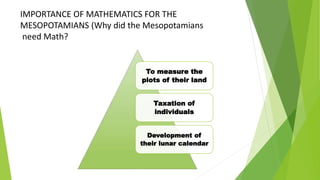
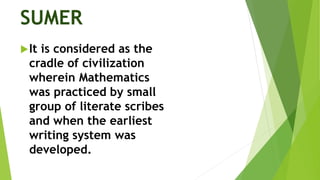
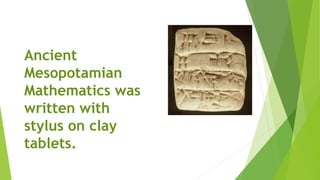
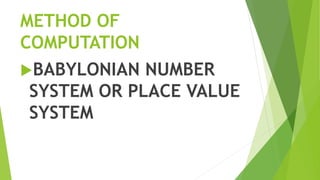
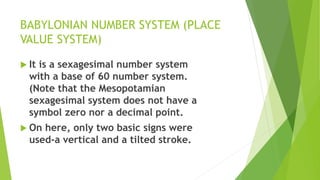
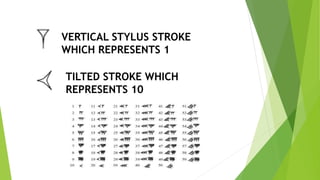
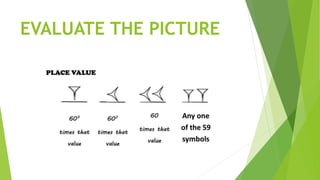
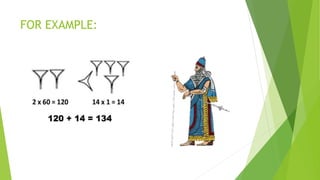
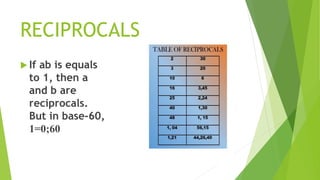
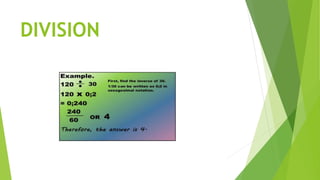
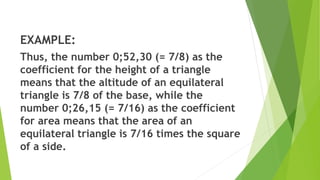
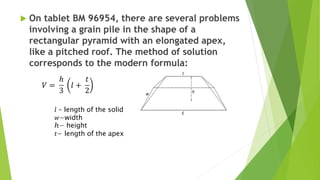
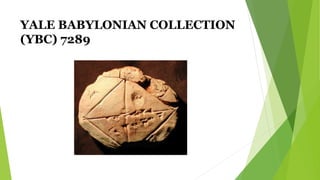
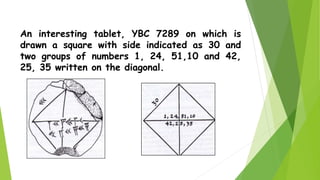
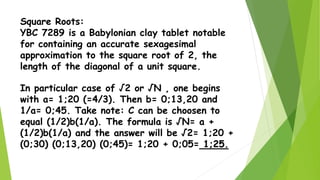
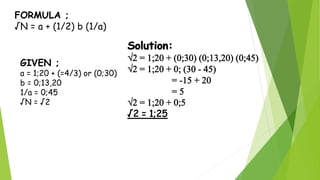
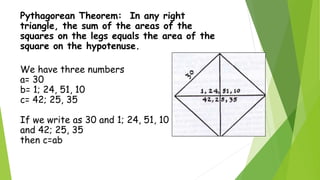
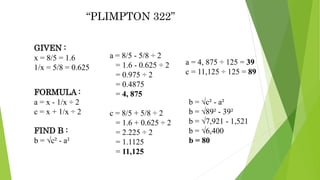
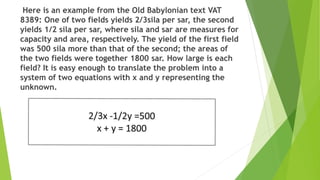
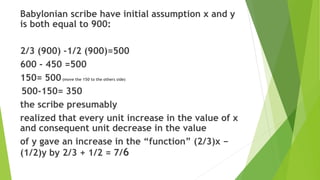
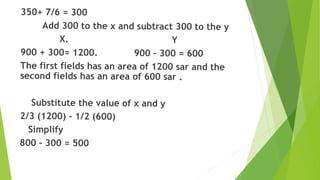
Ancient Mesopotamian mathematics was developed by scribes in Babylonia and Sumer in the 3rd millennium BC. They used a place-value number system with a base of 60 and performed calculations on clay tablets. Geometry problems involved finding areas and volumes by using coefficient lists of constants. The Mesopotamians could approximate square roots and knew the Pythagorean theorem, as evidenced on a tablet dated around 1900 BC. They could also solve basic equations, as shown by a problem on a tablet involving the yields of two fields.

![For example, here a problem from
tablet YBC 4652: I found a stone but
did not weight it ; after I added one
seventh and one eleventh [ of the
total ] it weighted 1 mina ( = 60 gin)](https://image.slidesharecdn.com/history-of-mathematics2-221021010550-e7244dd6/85/HISTORY-OF-MATHEMATICS-2-pptx-37-320.jpg)