
Sperm Sorting techniques in
high Sperm DNA Fragmentation Index
Sanjeev Maheshwari,
Jindal IVF & Sant Memorial Nursing Home
Chandigarh India
Introduction
• Sperm DNA damage can be defined as any chemical
change in the normal structure of the DNA.
• Sperm DNA fragmentation (sDF) is one of the most
common disturbances affecting the genetic material
in the form of single or double strand breaks.
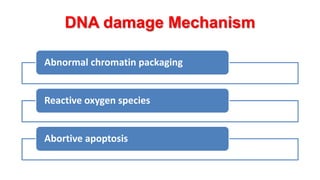
DNA damage Mechanism
Abnormal chromatin packaging
Reactive oxygen species
Abortive apoptosis
Indications of Sperm DNA
Fragmentation Testing
• Unexplained or persistent infertility
• Failure to conceive after 5-6 intra uterine insemination (IUI) cycles
despite good count and motility
• Low fertilization rates or poor embryo quality in IVF cycles
• Recurrent miscarriage
• Prolonged stay in an environment that exposes to reproductive toxins
• Abnormal semen analysis
• Advancing male age (>45 years)
• Smokers
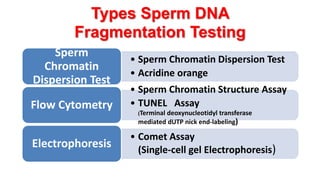
Types Sperm DNA
Fragmentation Testing
• Sperm Chromatin Dispersion Test
• Acridine orange
Sperm
Chromatin
Dispersion Test
• Sperm Chromatin Structure Assay
• TUNEL Assay
(Terminal deoxynucleotidyl transferase
mediated dUTP nick end-labeling)
Flow Cytometry
• Comet Assay
(Single-cell gel Electrophoresis)
Electrophoresis
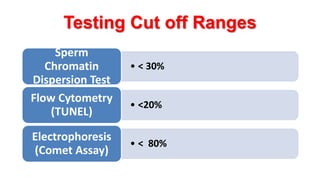
Testing Cut off Ranges
• < 30%
Sperm
Chromatin
Dispersion Test
• <20%
Flow Cytometry
(TUNEL)
• < 80%
Electrophoresis
(Comet Assay)
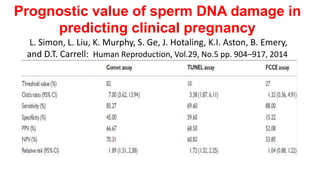
Prognostic value of sperm DNA damage in
predicting clinical pregnancy
L. Simon, L. Liu, K. Murphy, S. Ge, J. Hotaling, K.I. Aston, B. Emery,
and D.T. Carrell: Human Reproduction, Vol.29, No.5 pp. 904–917, 2014
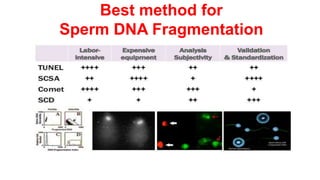
Best method for
Sperm DNA Fragmentation
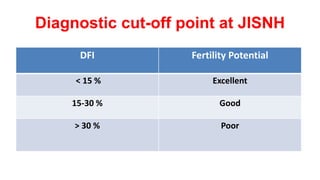
Diagnostic cut-off point at JISNH
DFI Fertility Potential
< 15 % Excellent
15-30 % Good
> 30 % Poor
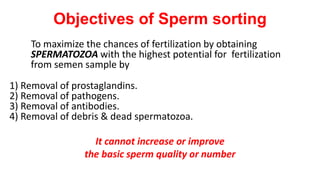
Objectives of Sperm sorting
To maximize the chances of fertilization by obtaining
SPERMATOZOA with the highest potential for fertilization
from semen sample by
1) Removal of prostaglandins.
2) Removal of pathogens.
3) Removal of antibodies.
4) Removal of debris & dead spermatozoa.
It cannot increase or improve
the basic sperm quality or number
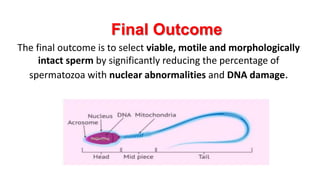
The final outcome is to select viable, motile and morphologically
intact sperm by significantly reducing the percentage of
spermatozoa with nuclear abnormalities and DNA damage.
Final Outcome
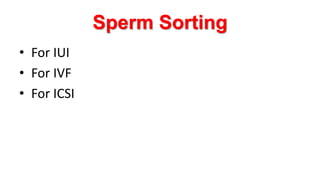
Sperm Sorting
• For IUI
• For IVF
• For ICSI
Selection of Technique
Ideal technique
• Quick, easy and cost-effective.
• Isolate as much motile sperm as
possible.
• No sperm damage or physiological
alterations.
• Eliminate dead spermatozoa and non
sperm elements, toxic or bioactive
substances like decapacitation factors
or ROS.
• Allow processing of larger volumes of
ejaculates
Proper technique
Since none of the methods available
meets all these requirements, a
variety of sperm separation
techniques is mandatory in clinical
practice to obtain an optimal yield
of functionally competent
spermatozoa for insemination
purposes. Depending on the
ejaculate quality, these methods
have different efficiency and areas
of use
Functional & Molecular Assay
• Capacitation tests
• Zona-free hamster penetration
assay
• Membrane integrity tests
• Antisperm antibodies
• Vital staining
• Biochemical analysis
• Peroxidase staining
• Sperm ubuquitin tag
immunoassay (SUTI)
• Semen culture
• Hypo-osmotic swelling test
• Sperm penetration assay
Hemizona assay
• Creatinkinase
• Reactive Oxygen Species (ROS)
• CASA
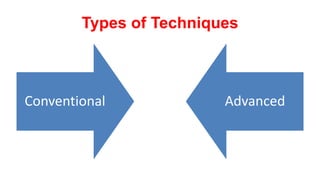
Types of Techniques
Conventional Advanced
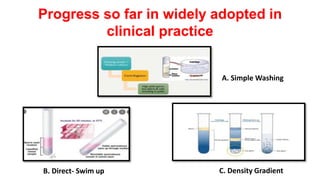
Progress so far in widely adopted in
clinical practice
B. Direct- Swim up C. Density Gradient
A. Simple Washing
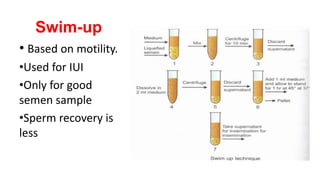
Swim-up
• Based on motility.
•Used for IUI
•Only for good
semen sample
•Sperm recovery is
less
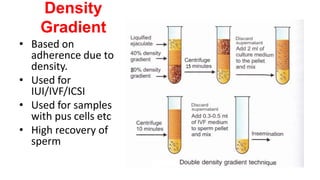
Density
Gradient
• Based on
adherence due to
density.
• Used for
IUI/IVF/ICSI
• Used for samples
with pus cells etc
• High recovery of
sperm
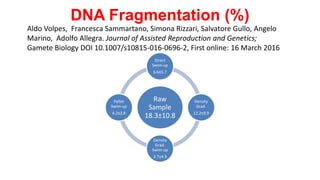
DNA Fragmentation (%)
Raw
Sample
18.3±10.8
Direct
Swim-up
6.6±5.7
Density
Grad.
12.2±9.9
Density
Grad.
Swim-up
3.7±4.9
Pellet
Swim-up
4.2±3.8
Aldo Volpes, Francesca Sammartano, Simona Rizzari, Salvatore Gullo, Angelo
Marino, Adolfo Allegra. Journal of Assisted Reproduction and Genetics;
Gamete Biology DOI 10.1007/s10815-016-0696-2, First online: 16 March 2016
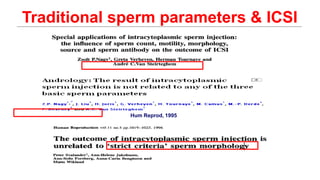
Traditional sperm parameters & ICSI
Success of ICSI independent of traditional sperm parameters
Hum Reprod, 1995
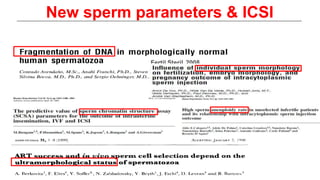
New sperm parameters & ICSI
Fertil Steril, 2008
New sperm parameters are associated with ICSI outcome
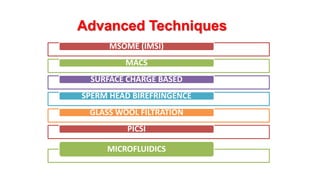
Advanced Techniques
MSOME (IMSI)
MACS
SURFACE CHARGE BASED
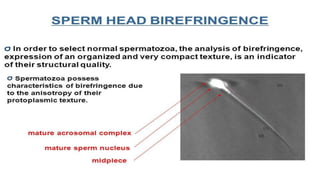
SPERM HEAD BIREFRINGENCE
GLASS WOOL FILTRATION
PICSI
MICROFLUIDICS
MSOME
(Motile Sperm Organelle Morph. Exam)
• Examination performed in real time on living Sperm.
• Inverted light microscope
• Equipped with high-power Nomarski optics instead
of Hoffman Modulation Contrast
• Enhanced by digital imaging to achieve a
magnification up to 6300.
• More accurate examination of spermatozoa
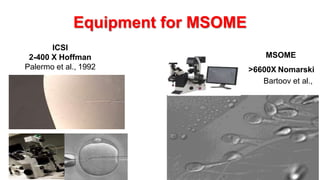
MSOME
>6600X Nomarski
Bartoov et al.,
ICSI
2-400 X Hoffman
Palermo et al., 1992
Equipment for MSOME
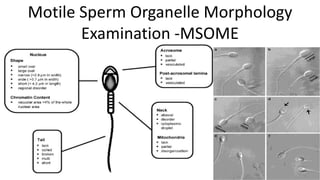
Motile Sperm Organelle Morphology
Examination -MSOME
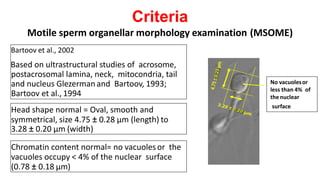
Criteria
Motile sperm organellar morphology examination (MSOME)
Bartoov et al., 2002
Based on ultrastructural studies of acrosome,
postacrosomal lamina, neck, mitocondria, tail
and nucleus Glezerman and Bartoov, 1993;
Bartoov et al., 1994
Head shape normal = Oval, smooth and
symmetrical, size 4.75 ± 0.28 μm (length) to
3.28 ± 0.20 μm (width)
Chromatin content normal= no vacuolesor the
vacuoles occupy < 4% of the nuclear surface
(0.78 ± 0.18 μm)
No vacuolesor
less than 4% of
thenuclear
surface
VACUOLES
• Association between vacuoles and sperm DNA fragmentation
(Garolla et al., 2008; Franco et al., 2008; Berkovitz et al., 2005;
Oliveira et al., 2010)
• Association between vacuoles and aneuploidy (Garolla et al.,
2008)
• Lower risk of sex chromosome abnormalities in IMSI vs. IVF
(OR 0.57, CI 0.37-0.90) Figueira et al.,2011
Vacuoles
Fertilization & embryo development
• Vacuoles associated with lower fertilization rates (Cassuto et al., 2009;
Franco et al., 2008)
• Correlation between presence and size of vacuoles and cleavage stage
embryo development (Berkovitz et al., 2005; 2006a,b)
• No correlation between presence and size of vacuoles and cleavage
stage embryo development (Hazout et al., 2006; Antinori et al., 2009;
Mauri et al., 2010; Balaban et al., 2011)
• Correlation between presence and size of vacuoles and blastocyst
development Vanderzwalmen et al., 2008
IMSI vs. ICSI
Implantation and pregnancy
 Implantation and pregnancy results higher in IMSI vs
ICSI group Bartoov et al., 2003; Berkovitz et al., 2005; Hazout et al 2006;
Berkovitz et al., 2006a, 2006b;
 Abortion rates lower in IMSI vs. ICSI group Bartoov et al., 2003;
Berkovitz et al., 2005; Hazout et al 2006; Berkovitz et al., 2006a, 2006b
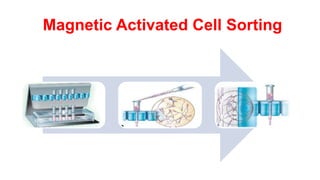
Magnetic Activated Cell Sorting
What is MACS?
• Magnetic activated cell sorting of human
spermatozoa
• An advanced sperm preparation technique working
on the principle to separate sperm cells with
apoptotic features .
Apoptosis
• Apoptosis is the programmed cell death that
occurs because of the DNA fragmentation
which is seen in the sperm of infertile men.
• Sperm cells with apoptotic features can
remain normally shaped
• They may still be able to fertilize an oocyte.
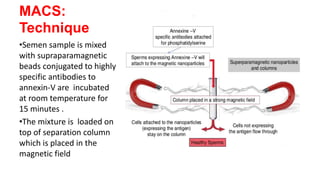
MACS:
Technique
•Semen sample is mixed
with supraparamagnetic
beads conjugated to highly
specific antibodies to
annexin-V are incubated
at room temperature for
15 minutes .
•The mixture is loaded on
top of separation column
which is placed in the
magnetic field
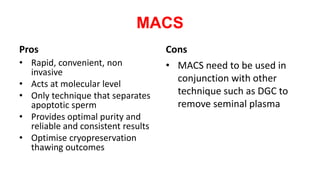
MACS
Pros
• Rapid, convenient, non
invasive
• Acts at molecular level
• Only technique that separates
apoptotic sperm
• Provides optimal purity and
reliable and consistent results
• Optimise cryopreservation
thawing outcomes
Cons
• MACS need to be used in
conjunction with other
technique such as DGC to
remove seminal plasma
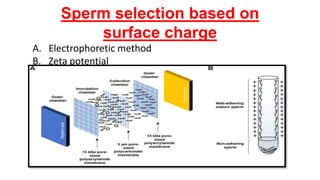
Sperm selection based on
surface charge
A. Electrophoretic method
B. Zeta potential
Principle
• Mature spermatozoa carry an electronegative surface charge, which
is attributed to sialic acid residues including CD52 found on sperm
plasma membrane.
• CD52 is acquired during epididymal maturation. Its presence
indicates normal sperm morphology and capacitation; therefore, it
can be considered as an indication of sperm maturity and quality.
Electrophoresis technique
• External electrical current is applied and mature negatively charged
spermatozoa moves towards positive electrode
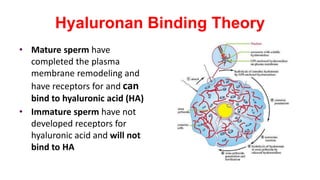
Hyaluronan Binding Theory
• Mature sperm have
completed the plasma
membrane remodeling and
have receptors for and can
bind to hyaluronic acid (HA)
• Immature sperm have not
developed receptors for
hyaluronic acid and will not
bind to HA
Hyaluronan Binding Theory
A sperms ability to bind to HA correlates to:
• Kruger Strict Morphology
• Cellular maturity,
• Less rates of chromosomal aneuploidy,
• Less rates of DNA fragmentation,
• Increased chromatin integrity
• Normal head morphology = better fertilizing potential
40
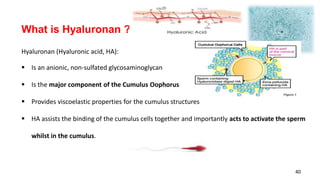
Hyaluronan (Hyaluronic acid, HA):
 Is an anionic, non-sulfated glycosaminoglycan
 Is the major component of the Cumulus Oophorus complex surrounding the human oocyte.
 Provides viscoelastic properties for the cumulus structures
 HA assists the binding of the cumulus cells together and importantly acts to activate the sperm
whilst in the cumulus.
What is Hyaluronan ?
41
Low HBA score ≤65% :
• Decreased quality of sperm sample = evaluate further treatment
(IUI/IVF/ICSI)
• Decreased likelihood of selecting best sperm for ICSI using morphology
evaluation only
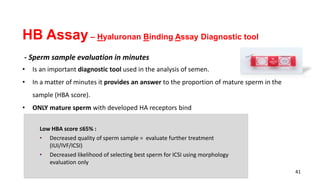
HB Assay – Hyaluronan Binding Assay Diagnostic tool
- Sperm sample evaluation in minutes
• Is an important diagnostic tool used in the analysis of semen.
• In a matter of minutes it provides an answer to the proportion of mature sperm in the
sample (HBA score).
• ONLY mature sperm with developed HA receptors bind
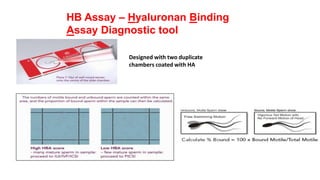
HB Assay – Hyaluronan Binding
Assay Diagnostic tool
Designed with two duplicate
chambers coated with HA
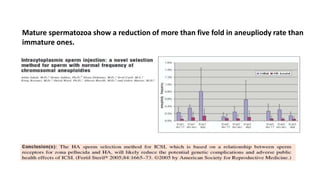
Mature spermatozoa show a reduction of more than five fold in aneupliody rate than
immature ones.
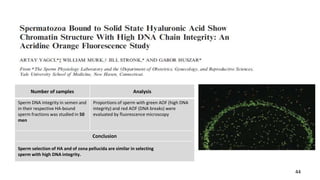
44
Number of samples Analysis
Sperm DNA integrity in semen and
in their respective HA-bound
sperm fractions was studied in 50
men
Proportions of sperm with green AOF (high DNA
integrity) and red AOF (DNA breaks) were
evaluated by fluorescence microscopy
Conclusion
Sperm selection of HA and of zona pellucida are similar in selecting
sperm with high DNA integrity.
45
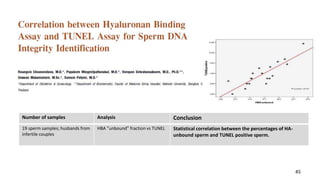
Number of samples Analysis Conclusion
19 sperm samples; husbands from
infertile couples
HBA ”unbound” fraction vs TUNEL Statistical correlation between the percentages of HA-
unbound sperm and TUNEL positive sperm.
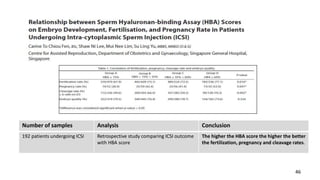
46
Number of samples Analysis Conclusion
192 patients undergoing ICSI Retrospective study comparing ICSI outcome
with HBA score
The higher the HBA score the higher the better
the fertilization, pregnancy and cleavage rates.
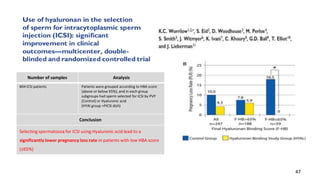
47
Number of samples Analysis
804 ICSI patients Patients were grouped according to HBA score
(above or below 65%), and in each group
subgroups had sperm selected for ICSI by PVP
(Control) or Hyaluronic acid
(HYAl group =PICSI dish)
Conclusion
Selecting spermatozoa for ICSI using Hyaluronic acid lead to a
significantly lower pregnancy loss rate in patients with low HBA score
(≤65%)
48
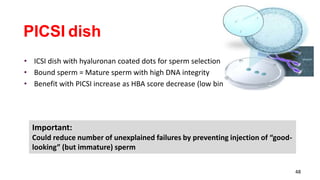
PICSI dish
• ICSI dish with hyaluronan coated dots for sperm selection
• Bound sperm = Mature sperm with high DNA integrity
• Benefit with PICSI increase as HBA score decrease (low binder samples)
Important:
Could reduce number of unexplained failures by preventing injection of “good-
looking” (but immature) sperm
PICSI
Pros
• Physiological/Natural
process of selecting sperm
Cons
• Sperm are selected
individually i.e. more
demanding and longer
process .
• Used media can affect
sperm
• Only for motile sperm
50
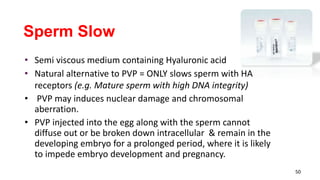
Sperm Slow
• Semi viscous medium containing Hyaluronic acid
• Natural alternative to PVP = ONLY slows sperm with HA
receptors (e.g. Mature sperm with high DNA integrity)
• PVP may induces nuclear damage and chromosomal
aberration.
• PVP injected into the egg along with the sperm cannot
diffuse out or be broken down intracellular & remain in the
developing embryo for a prolonged period, where it is likely
to impede embryo development and pregnancy.
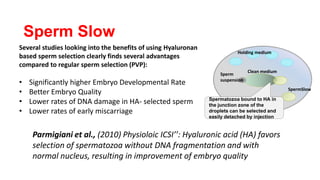
Sperm Slow
SpermSlow
Clean medium
Sperm
suspension
Spermatozoa bound to HA in
the junction zone of the
droplets can be selected and
easily detached by injection
Holding medium
Several studies looking into the benefits of using Hyaluronan
based sperm selection clearly finds several advantages
compared to regular sperm selection (PVP):
• Significantly higher Embryo Developmental Rate
• Better Embryo Quality
• Lower rates of DNA damage in HA- selected sperm
• Lower rates of early miscarriage
Parmigiani et al., (2010) Physioloic ICSI’’: Hyaluronic acid (HA) favors
selection of spermatozoa without DNA fragmentation and with
normal nucleus, resulting in improvement of embryo quality
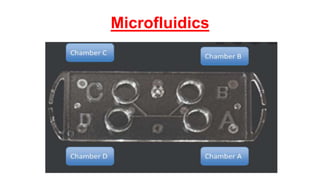
Microfluidics
“MICROFLUIDIC” refers to technology utilizing
characteristics of fluid movement in a micro or nano
environment.
Microfluidics for sperm sorting: Active selection
Active selection means a set of strategies using the active
swimming of the sperm cells that takes inspiration from the
natural selection that occurs in the female reproductive
tract based on mainly 3 phenomena:
• Chemotaxis
• Thermotaxis
• Rheotaxis.
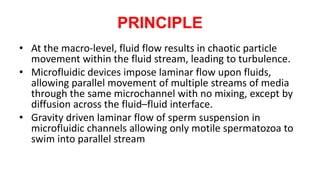
PRINCIPLE
• At the macro-level, fluid flow results in chaotic particle
movement within the fluid stream, leading to turbulence.
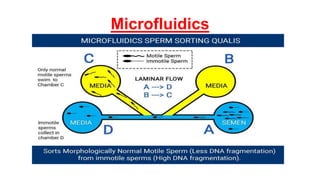
• Microfluidic devices impose laminar flow upon fluids,
allowing parallel movement of multiple streams of media
through the same microchannel with no mixing, except by
diffusion across the fluid–fluid interface.
• Gravity driven laminar flow of sperm suspension in
microfluidic channels allowing only motile spermatozoa to
swim into parallel stream
Microfluidics
Microfluidics
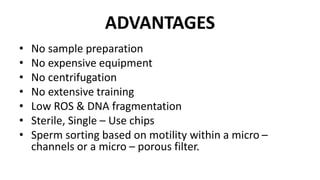
ADVANTAGES
• No sample preparation
• No expensive equipment
• No centrifugation
• No extensive training
• Low ROS & DNA fragmentation
• Sterile, Single – Use chips
• Sperm sorting based on motility within a micro –
channels or a micro – porous filter.
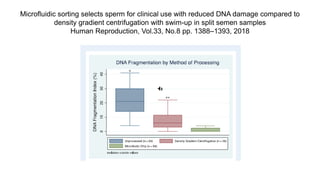
Microfluidic sorting selects sperm for clinical use with reduced DNA damage compared to
density gradient centrifugation with swim-up in split semen samples
Human Reproduction, Vol.33, No.8 pp. 1388–1393, 2018
Sperm Preparation in High DFI.pptx

Sperm Preparation in High DFI.pptx

  • 1.
    Sperm Sorting techniquesin high Sperm DNA Fragmentation Index Sanjeev Maheshwari, Jindal IVF & Sant Memorial Nursing Home Chandigarh India
  • 2.
    Introduction • Sperm DNAdamage can be defined as any chemical change in the normal structure of the DNA. • Sperm DNA fragmentation (sDF) is one of the most common disturbances affecting the genetic material in the form of single or double strand breaks.
  • 3.
    DNA damage Mechanism Abnormalchromatin packaging Reactive oxygen species Abortive apoptosis
  • 4.
    Indications of SpermDNA Fragmentation Testing • Unexplained or persistent infertility • Failure to conceive after 5-6 intra uterine insemination (IUI) cycles despite good count and motility • Low fertilization rates or poor embryo quality in IVF cycles • Recurrent miscarriage • Prolonged stay in an environment that exposes to reproductive toxins • Abnormal semen analysis • Advancing male age (>45 years) • Smokers
  • 5.
    Types Sperm DNA FragmentationTesting • Sperm Chromatin Dispersion Test • Acridine orange Sperm Chromatin Dispersion Test • Sperm Chromatin Structure Assay • TUNEL Assay (Terminal deoxynucleotidyl transferase mediated dUTP nick end-labeling) Flow Cytometry • Comet Assay (Single-cell gel Electrophoresis) Electrophoresis
  • 6.
    Testing Cut offRanges • < 30% Sperm Chromatin Dispersion Test • <20% Flow Cytometry (TUNEL) • < 80% Electrophoresis (Comet Assay)
  • 7.
    Prognostic value ofsperm DNA damage in predicting clinical pregnancy L. Simon, L. Liu, K. Murphy, S. Ge, J. Hotaling, K.I. Aston, B. Emery, and D.T. Carrell: Human Reproduction, Vol.29, No.5 pp. 904–917, 2014
  • 8.
    Best method for SpermDNA Fragmentation
  • 9.
    Diagnostic cut-off pointat JISNH DFI Fertility Potential < 15 % Excellent 15-30 % Good > 30 % Poor
  • 10.
    Objectives of Spermsorting To maximize the chances of fertilization by obtaining SPERMATOZOA with the highest potential for fertilization from semen sample by 1) Removal of prostaglandins. 2) Removal of pathogens. 3) Removal of antibodies. 4) Removal of debris & dead spermatozoa. It cannot increase or improve the basic sperm quality or number
  • 11.
    The final outcomeis to select viable, motile and morphologically intact sperm by significantly reducing the percentage of spermatozoa with nuclear abnormalities and DNA damage. Final Outcome
  • 12.
    Sperm Sorting • ForIUI • For IVF • For ICSI
  • 13.
    Selection of Technique Idealtechnique • Quick, easy and cost-effective. • Isolate as much motile sperm as possible. • No sperm damage or physiological alterations. • Eliminate dead spermatozoa and non sperm elements, toxic or bioactive substances like decapacitation factors or ROS. • Allow processing of larger volumes of ejaculates Proper technique Since none of the methods available meets all these requirements, a variety of sperm separation techniques is mandatory in clinical practice to obtain an optimal yield of functionally competent spermatozoa for insemination purposes. Depending on the ejaculate quality, these methods have different efficiency and areas of use
  • 14.
    Functional & MolecularAssay • Capacitation tests • Zona-free hamster penetration assay • Membrane integrity tests • Antisperm antibodies • Vital staining • Biochemical analysis • Peroxidase staining • Sperm ubuquitin tag immunoassay (SUTI) • Semen culture • Hypo-osmotic swelling test • Sperm penetration assay Hemizona assay • Creatinkinase • Reactive Oxygen Species (ROS) • CASA
  • 15.
  • 16.
    Progress so farin widely adopted in clinical practice B. Direct- Swim up C. Density Gradient A. Simple Washing
  • 17.
    Swim-up • Based onmotility. •Used for IUI •Only for good semen sample •Sperm recovery is less
  • 18.
    Density Gradient • Based on adherencedue to density. • Used for IUI/IVF/ICSI • Used for samples with pus cells etc • High recovery of sperm
  • 19.
    DNA Fragmentation (%) Raw Sample 18.3±10.8 Direct Swim-up 6.6±5.7 Density Grad. 12.2±9.9 Density Grad. Swim-up 3.7±4.9 Pellet Swim-up 4.2±3.8 AldoVolpes, Francesca Sammartano, Simona Rizzari, Salvatore Gullo, Angelo Marino, Adolfo Allegra. Journal of Assisted Reproduction and Genetics; Gamete Biology DOI 10.1007/s10815-016-0696-2, First online: 16 March 2016
  • 20.
    Traditional sperm parameters& ICSI Success of ICSI independent of traditional sperm parameters Hum Reprod, 1995
  • 21.
    New sperm parameters& ICSI Fertil Steril, 2008 New sperm parameters are associated with ICSI outcome
  • 22.
    Advanced Techniques MSOME (IMSI) MACS SURFACECHARGE BASED SPERM HEAD BIREFRINGENCE GLASS WOOL FILTRATION PICSI MICROFLUIDICS
  • 23.
    MSOME (Motile Sperm OrganelleMorph. Exam) • Examination performed in real time on living Sperm. • Inverted light microscope • Equipped with high-power Nomarski optics instead of Hoffman Modulation Contrast • Enhanced by digital imaging to achieve a magnification up to 6300. • More accurate examination of spermatozoa
  • 24.
    MSOME >6600X Nomarski Bartoov etal., ICSI 2-400 X Hoffman Palermo et al., 1992 Equipment for MSOME
  • 25.
    Motile Sperm OrganelleMorphology Examination -MSOME
  • 26.
    Criteria Motile sperm organellarmorphology examination (MSOME) Bartoov et al., 2002 Based on ultrastructural studies of acrosome, postacrosomal lamina, neck, mitocondria, tail and nucleus Glezerman and Bartoov, 1993; Bartoov et al., 1994 Head shape normal = Oval, smooth and symmetrical, size 4.75 ± 0.28 μm (length) to 3.28 ± 0.20 μm (width) Chromatin content normal= no vacuolesor the vacuoles occupy < 4% of the nuclear surface (0.78 ± 0.18 μm) No vacuolesor less than 4% of thenuclear surface
  • 27.
    VACUOLES • Association betweenvacuoles and sperm DNA fragmentation (Garolla et al., 2008; Franco et al., 2008; Berkovitz et al., 2005; Oliveira et al., 2010) • Association between vacuoles and aneuploidy (Garolla et al., 2008) • Lower risk of sex chromosome abnormalities in IMSI vs. IVF (OR 0.57, CI 0.37-0.90) Figueira et al.,2011
  • 28.
    Vacuoles Fertilization & embryodevelopment • Vacuoles associated with lower fertilization rates (Cassuto et al., 2009; Franco et al., 2008) • Correlation between presence and size of vacuoles and cleavage stage embryo development (Berkovitz et al., 2005; 2006a,b) • No correlation between presence and size of vacuoles and cleavage stage embryo development (Hazout et al., 2006; Antinori et al., 2009; Mauri et al., 2010; Balaban et al., 2011) • Correlation between presence and size of vacuoles and blastocyst development Vanderzwalmen et al., 2008
  • 29.
    IMSI vs. ICSI Implantationand pregnancy  Implantation and pregnancy results higher in IMSI vs ICSI group Bartoov et al., 2003; Berkovitz et al., 2005; Hazout et al 2006; Berkovitz et al., 2006a, 2006b;  Abortion rates lower in IMSI vs. ICSI group Bartoov et al., 2003; Berkovitz et al., 2005; Hazout et al 2006; Berkovitz et al., 2006a, 2006b
  • 30.
  • 31.
    What is MACS? •Magnetic activated cell sorting of human spermatozoa • An advanced sperm preparation technique working on the principle to separate sperm cells with apoptotic features .
  • 32.
    Apoptosis • Apoptosis isthe programmed cell death that occurs because of the DNA fragmentation which is seen in the sperm of infertile men. • Sperm cells with apoptotic features can remain normally shaped • They may still be able to fertilize an oocyte.
  • 33.
    MACS: Technique •Semen sample ismixed with supraparamagnetic beads conjugated to highly specific antibodies to annexin-V are incubated at room temperature for 15 minutes . •The mixture is loaded on top of separation column which is placed in the magnetic field
  • 34.
    MACS Pros • Rapid, convenient,non invasive • Acts at molecular level • Only technique that separates apoptotic sperm • Provides optimal purity and reliable and consistent results • Optimise cryopreservation thawing outcomes Cons • MACS need to be used in conjunction with other technique such as DGC to remove seminal plasma
  • 35.
    Sperm selection basedon surface charge A. Electrophoretic method B. Zeta potential
  • 36.
    Principle • Mature spermatozoacarry an electronegative surface charge, which is attributed to sialic acid residues including CD52 found on sperm plasma membrane. • CD52 is acquired during epididymal maturation. Its presence indicates normal sperm morphology and capacitation; therefore, it can be considered as an indication of sperm maturity and quality. Electrophoresis technique • External electrical current is applied and mature negatively charged spermatozoa moves towards positive electrode
  • 38.
    Hyaluronan Binding Theory •Mature sperm have completed the plasma membrane remodeling and have receptors for and can bind to hyaluronic acid (HA) • Immature sperm have not developed receptors for hyaluronic acid and will not bind to HA
  • 39.
    Hyaluronan Binding Theory Asperms ability to bind to HA correlates to: • Kruger Strict Morphology • Cellular maturity, • Less rates of chromosomal aneuploidy, • Less rates of DNA fragmentation, • Increased chromatin integrity • Normal head morphology = better fertilizing potential
  • 40.
    40 Hyaluronan (Hyaluronic acid,HA):  Is an anionic, non-sulfated glycosaminoglycan  Is the major component of the Cumulus Oophorus complex surrounding the human oocyte.  Provides viscoelastic properties for the cumulus structures  HA assists the binding of the cumulus cells together and importantly acts to activate the sperm whilst in the cumulus. What is Hyaluronan ?
  • 41.
    41 Low HBA score≤65% : • Decreased quality of sperm sample = evaluate further treatment (IUI/IVF/ICSI) • Decreased likelihood of selecting best sperm for ICSI using morphology evaluation only HB Assay – Hyaluronan Binding Assay Diagnostic tool - Sperm sample evaluation in minutes • Is an important diagnostic tool used in the analysis of semen. • In a matter of minutes it provides an answer to the proportion of mature sperm in the sample (HBA score). • ONLY mature sperm with developed HA receptors bind
  • 42.
    HB Assay –Hyaluronan Binding Assay Diagnostic tool Designed with two duplicate chambers coated with HA
  • 43.
    Mature spermatozoa showa reduction of more than five fold in aneupliody rate than immature ones.
  • 44.
    44 Number of samplesAnalysis Sperm DNA integrity in semen and in their respective HA-bound sperm fractions was studied in 50 men Proportions of sperm with green AOF (high DNA integrity) and red AOF (DNA breaks) were evaluated by fluorescence microscopy Conclusion Sperm selection of HA and of zona pellucida are similar in selecting sperm with high DNA integrity.
  • 45.
    45 Number of samplesAnalysis Conclusion 19 sperm samples; husbands from infertile couples HBA ”unbound” fraction vs TUNEL Statistical correlation between the percentages of HA- unbound sperm and TUNEL positive sperm.
  • 46.
    46 Number of samplesAnalysis Conclusion 192 patients undergoing ICSI Retrospective study comparing ICSI outcome with HBA score The higher the HBA score the higher the better the fertilization, pregnancy and cleavage rates.
  • 47.
    47 Number of samplesAnalysis 804 ICSI patients Patients were grouped according to HBA score (above or below 65%), and in each group subgroups had sperm selected for ICSI by PVP (Control) or Hyaluronic acid (HYAl group =PICSI dish) Conclusion Selecting spermatozoa for ICSI using Hyaluronic acid lead to a significantly lower pregnancy loss rate in patients with low HBA score (≤65%)
  • 48.
    48 PICSI dish • ICSIdish with hyaluronan coated dots for sperm selection • Bound sperm = Mature sperm with high DNA integrity • Benefit with PICSI increase as HBA score decrease (low binder samples) Important: Could reduce number of unexplained failures by preventing injection of “good- looking” (but immature) sperm
  • 49.
    PICSI Pros • Physiological/Natural process ofselecting sperm Cons • Sperm are selected individually i.e. more demanding and longer process . • Used media can affect sperm • Only for motile sperm
  • 50.
    50 Sperm Slow • Semiviscous medium containing Hyaluronic acid • Natural alternative to PVP = ONLY slows sperm with HA receptors (e.g. Mature sperm with high DNA integrity) • PVP may induces nuclear damage and chromosomal aberration. • PVP injected into the egg along with the sperm cannot diffuse out or be broken down intracellular & remain in the developing embryo for a prolonged period, where it is likely to impede embryo development and pregnancy.
  • 51.
    Sperm Slow SpermSlow Clean medium Sperm suspension Spermatozoabound to HA in the junction zone of the droplets can be selected and easily detached by injection Holding medium Several studies looking into the benefits of using Hyaluronan based sperm selection clearly finds several advantages compared to regular sperm selection (PVP): • Significantly higher Embryo Developmental Rate • Better Embryo Quality • Lower rates of DNA damage in HA- selected sperm • Lower rates of early miscarriage Parmigiani et al., (2010) Physioloic ICSI’’: Hyaluronic acid (HA) favors selection of spermatozoa without DNA fragmentation and with normal nucleus, resulting in improvement of embryo quality
  • 52.
    Microfluidics “MICROFLUIDIC” refers totechnology utilizing characteristics of fluid movement in a micro or nano environment. Microfluidics for sperm sorting: Active selection Active selection means a set of strategies using the active swimming of the sperm cells that takes inspiration from the natural selection that occurs in the female reproductive tract based on mainly 3 phenomena: • Chemotaxis • Thermotaxis • Rheotaxis.
  • 53.
    PRINCIPLE • At themacro-level, fluid flow results in chaotic particle movement within the fluid stream, leading to turbulence. • Microfluidic devices impose laminar flow upon fluids, allowing parallel movement of multiple streams of media through the same microchannel with no mixing, except by diffusion across the fluid–fluid interface. • Gravity driven laminar flow of sperm suspension in microfluidic channels allowing only motile spermatozoa to swim into parallel stream
  • 54.
  • 55.
  • 56.
    ADVANTAGES • No samplepreparation • No expensive equipment • No centrifugation • No extensive training • Low ROS & DNA fragmentation • Sterile, Single – Use chips • Sperm sorting based on motility within a micro – channels or a micro – porous filter.
  • 57.
    Microfluidic sorting selectssperm for clinical use with reduced DNA damage compared to density gradient centrifugation with swim-up in split semen samples Human Reproduction, Vol.33, No.8 pp. 1388–1393, 2018