The Evolution of AndroidKit, Ian & Raith
The beginningJuly 2005 Google acquire Android incorporated.Rumours begin of Google launching operating system and entering mobile space.5th November 2007 the Open Handset Alliance is formed (Texas instruments, Broadcom, Intel, Nvidia, QualcomTheir goal was to establish open standards for mobile devices.The Android platform was launched.9th December 2008 14 new members joined including Arm holdings, ToshibaAndroid has been available as ‘open source’ since 21st October 2008 – vendors can add propriety extensions with the necessity of permission.
Android History   1.1 released 9thFebruary 2009
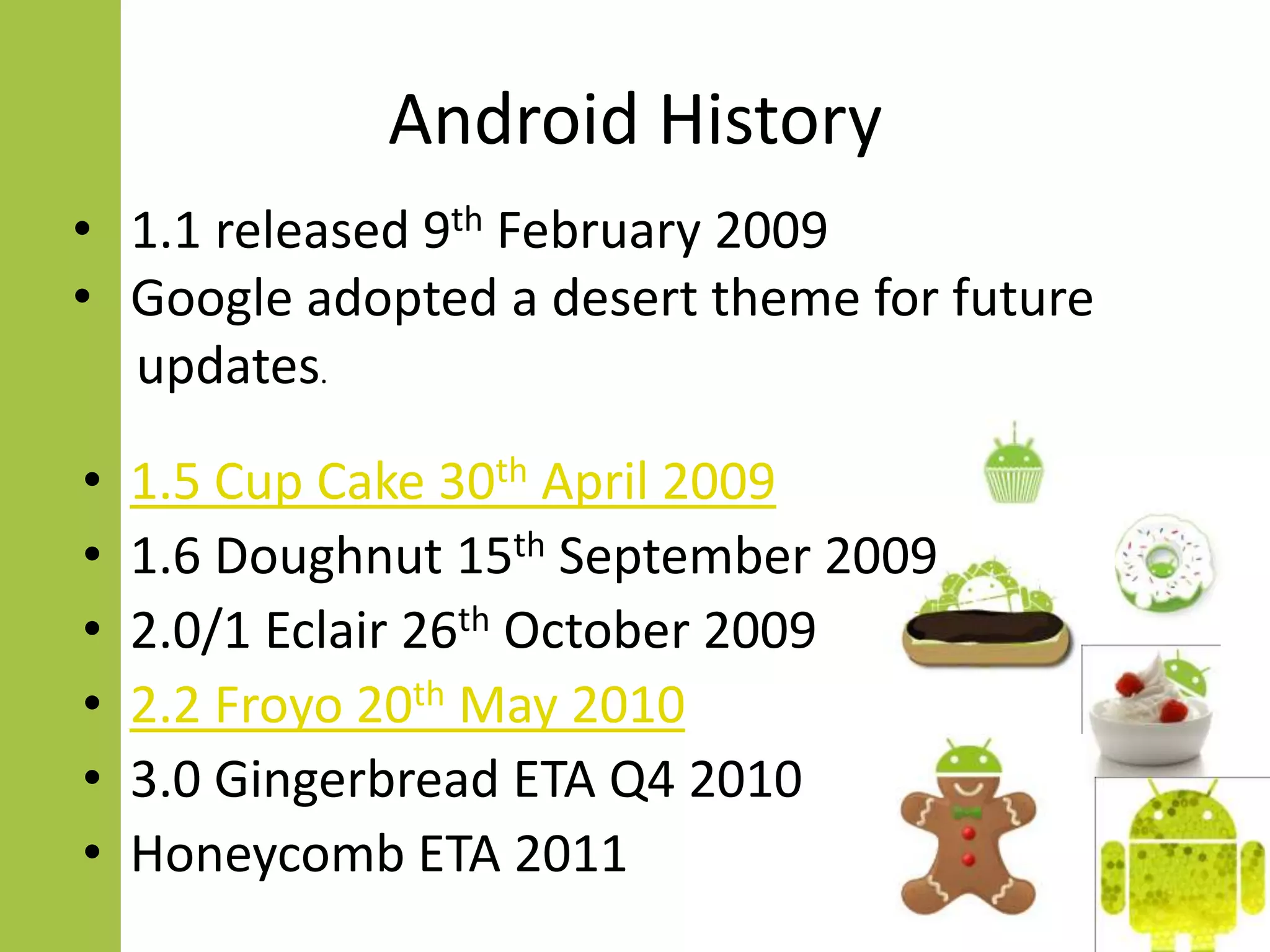
   Google adopted a desert theme for future     updates.1.5 Cup Cake 30th April 2009 1.6 Doughnut 15th September 20092.0/1 Eclair 26th October 2009  2.2 Froyo 20th May 2010 3.0 Gingerbread ETA Q4 2010Honeycomb ETA 2011
Open Source & its BenefitsApps – virtually all apps developed and made available. No curation of applications (with some exceptions).Highest number of free applications – currently 57% of available apps (twice as much as Apple App Store).Exponential growth – 17th March 2009 2,300 Apps.  December 2009 20,000.  August 2010 80,000+ with over a billion downloads.Downloads available from developers websites not limited to the Android Market Place.Flash support available with no license needed.
Open Source – The pit fallsFragmentation – multiple versions in circulation which lead to confusion to users.Inconsistent upgrade path – variations due to diversity in hardware.Hardware variations – different interface leading to inconsistent user experience (Windows Phone 7 – min hardware specs agreed).OEM Skins.Quality and depth of apps – no app management or approval.Is it too open?  Malicious software, data harvesting.

The evolution of_android

  • 1.
    The Evolution ofAndroidKit, Ian & Raith
  • 2.
    The beginningJuly 2005Google acquire Android incorporated.Rumours begin of Google launching operating system and entering mobile space.5th November 2007 the Open Handset Alliance is formed (Texas instruments, Broadcom, Intel, Nvidia, QualcomTheir goal was to establish open standards for mobile devices.The Android platform was launched.9th December 2008 14 new members joined including Arm holdings, ToshibaAndroid has been available as ‘open source’ since 21st October 2008 – vendors can add propriety extensions with the necessity of permission.
  • 3.
    Android History 1.1 released 9thFebruary 2009
  • 4.
    Google adopted a desert theme for future updates.1.5 Cup Cake 30th April 2009 1.6 Doughnut 15th September 20092.0/1 Eclair 26th October 2009 2.2 Froyo 20th May 2010 3.0 Gingerbread ETA Q4 2010Honeycomb ETA 2011
  • 5.
    Open Source &its BenefitsApps – virtually all apps developed and made available. No curation of applications (with some exceptions).Highest number of free applications – currently 57% of available apps (twice as much as Apple App Store).Exponential growth – 17th March 2009 2,300 Apps. December 2009 20,000. August 2010 80,000+ with over a billion downloads.Downloads available from developers websites not limited to the Android Market Place.Flash support available with no license needed.
  • 6.
    Open Source –The pit fallsFragmentation – multiple versions in circulation which lead to confusion to users.Inconsistent upgrade path – variations due to diversity in hardware.Hardware variations – different interface leading to inconsistent user experience (Windows Phone 7 – min hardware specs agreed).OEM Skins.Quality and depth of apps – no app management or approval.Is it too open? Malicious software, data harvesting.
  • 7.
    Future AndroidSony PSPphone – Android 3.0 Gingerbread.Tablets.For consistency a more controlled approach.Minimum hardware specifications (in relation to hardware variations).