I.E.T MJPROHILKHAND UNIVERSITY
Prepared by
MITHILESH RAJBHAR
Roll no-13CS22
Contents
• Introduction of android
• Android architecture
• Security
• Features of android
• Android versions
• Advantages of android
• Disadvantage of android
• Conclusion
• Reference
Introduction
Android is a mobile operating system developed by Google, based on the Linux
kernel and designed primarily for touchscreen mobile devices such as
smartphones and tablets. Android's user interface is mainly based on direct
manipulation, using touch gestures that loosely correspond to real-world actions,
such as swiping, tapping and pinching, to manipulate on-screen objects, along
with a virtual keyboard for text input. In addition to touchscreen devices, Google
has further developed Android TV for televisions, Android Auto for cars, and
Android Wear for wrist watches, each with a specialized user interface. Variants of
Android are also used on notebooks, game consoles, digital cameras, and other
electronics.
ANDROID ARCHITECTURE
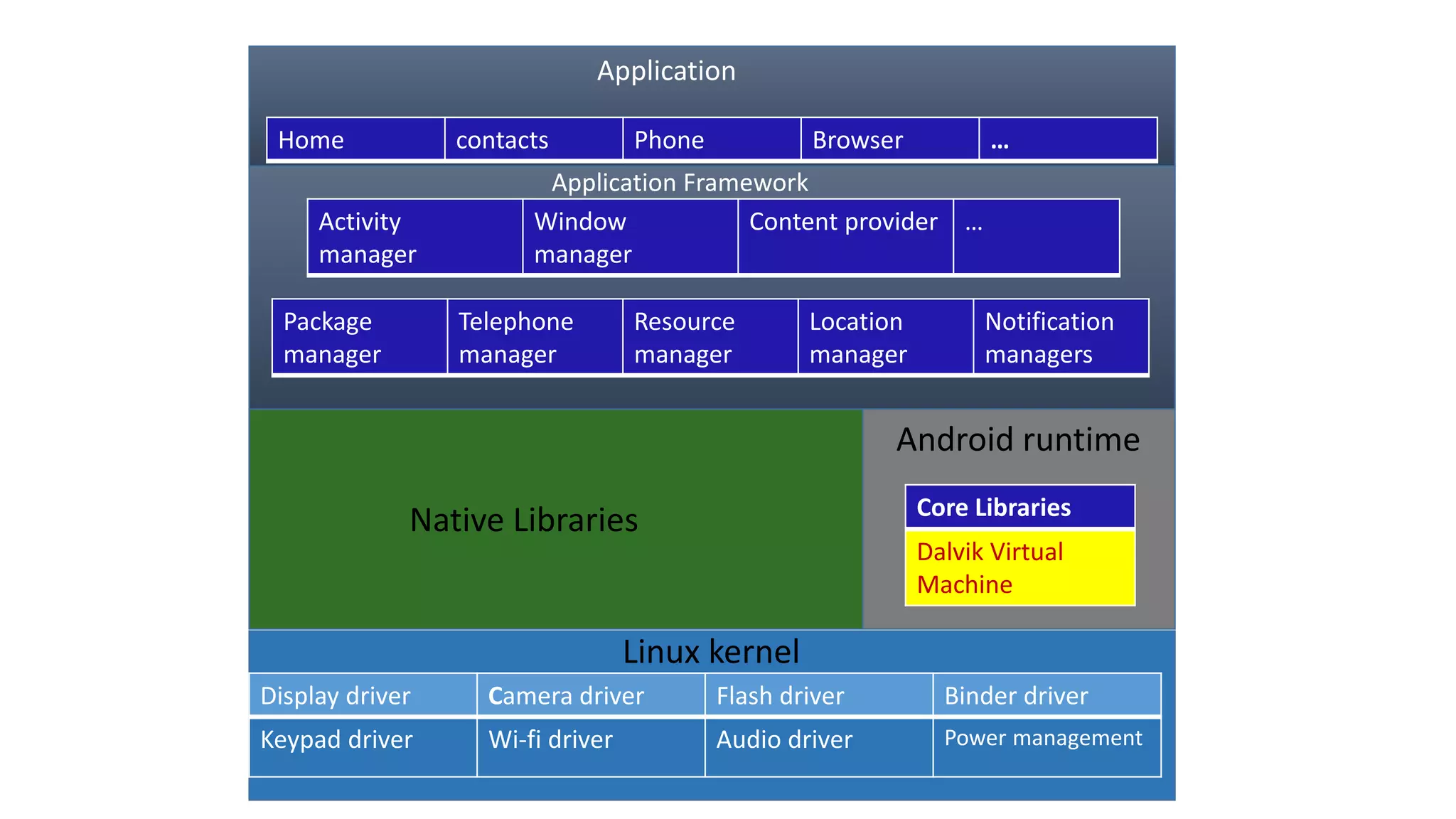
The software stack is split into Four Layers::
• The application layer
• The application framework
• The libraries and runtime
• The kernel
Application
Home contacts Phone Browser …
Application Framework
Activity
manager
Window
manager
Content provider …
Package
manager
Telephone
manager
Resource
manager
Location
manager
Notification
managers
Core Libraries
Dalvik Virtual
Machine
Native Libraries
Android runtime
Linux kernel
Display driver Camera driver Flash driver Binder driver
Keypad driver Wi-fi driver Audio driver Power management
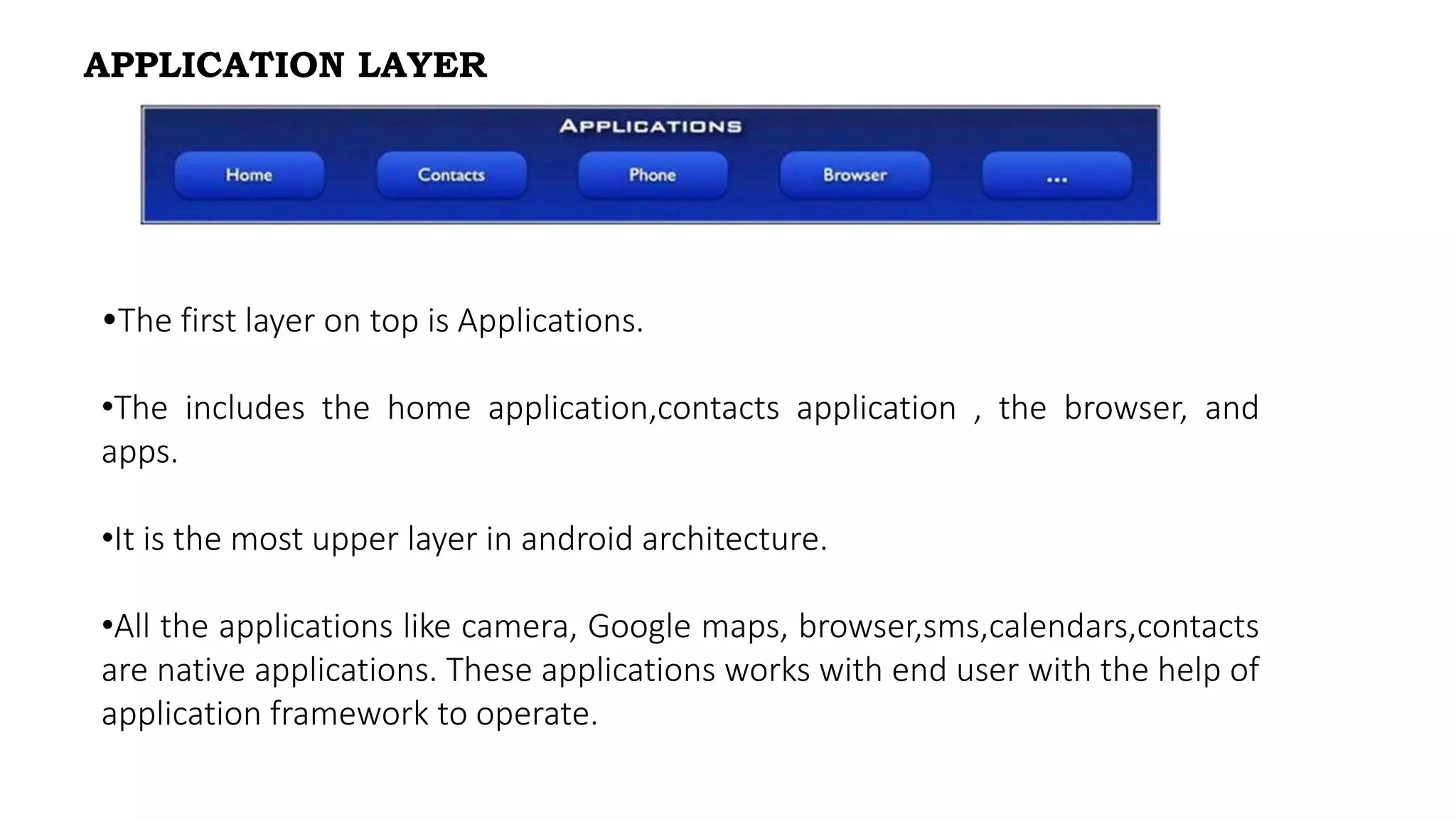
APPLICATION LAYER
•The first layer on top is Applications.
•The includes the home application,contacts application , the browser, and
apps.
•It is the most upper layer in android architecture.
•All the applications like camera, Google maps, browser,sms,calendars,contacts
are native applications. These applications works with end user with the help of
application framework to operate.
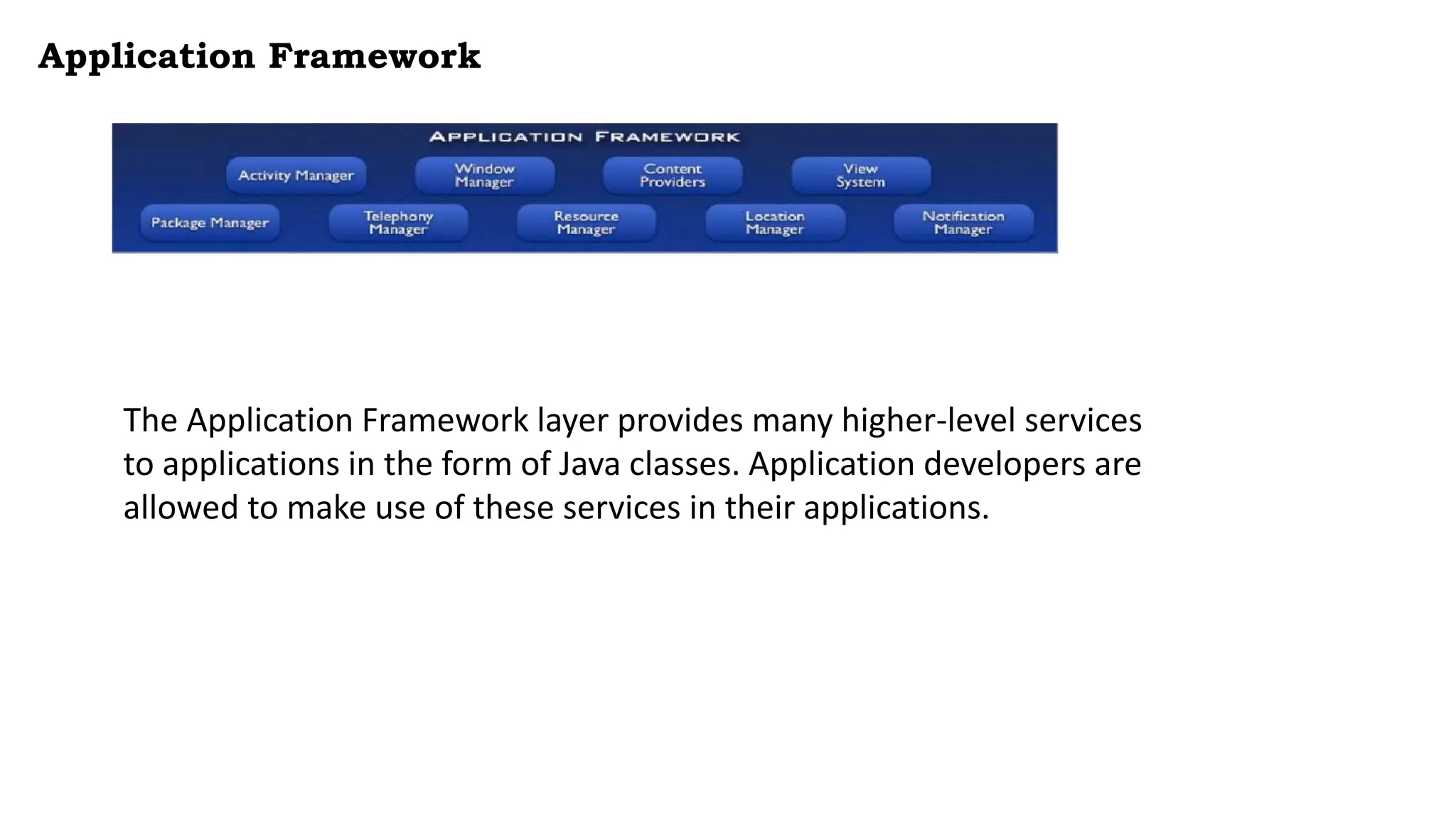
Application Framework
The Application Framework layer provides many higher-level services
to applications in the form of Java classes. Application developers are
allowed to make use of these services in their applications.
These are as follows:-
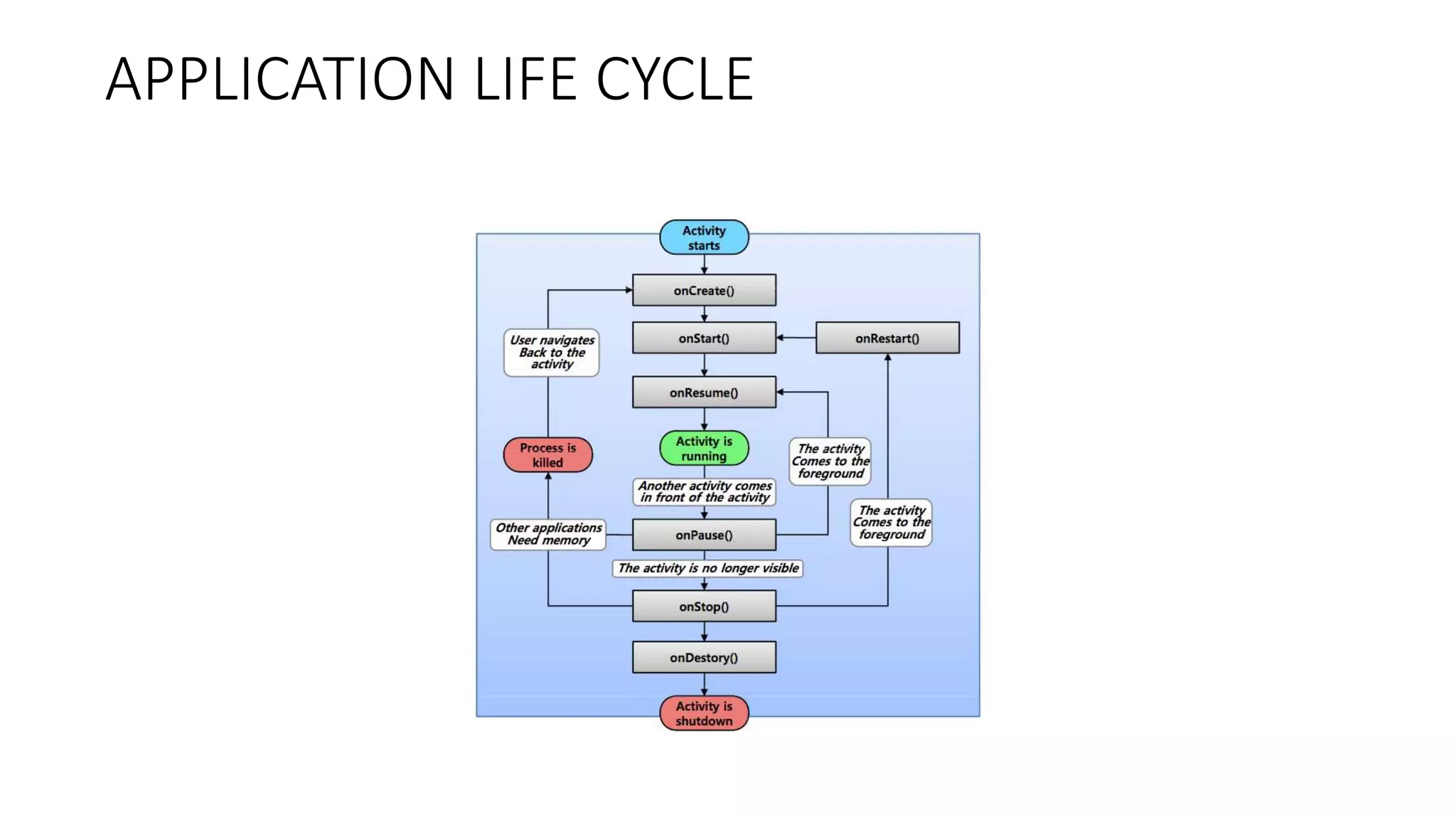
• Activity manager:-It manages the lifecycle of applications. It enable proper
management of all the activities. All the activities are controlled by activity manager.
• Resource manager:-It provides access to non-code resources such as graphics etc.
• Notification manager:-It enables all applications to display custom alerts in status
bar.
• Location manager:-This class provides access to the system location services
• Package manager:-It is use to retrieve the data about installed packages on device.
• Window manager:-It is use to create views and layouts.
• Telephony manager:-It is use to handle settings of network connection and all
information about services on device.
• Content provider:-They handle data and database management issues.
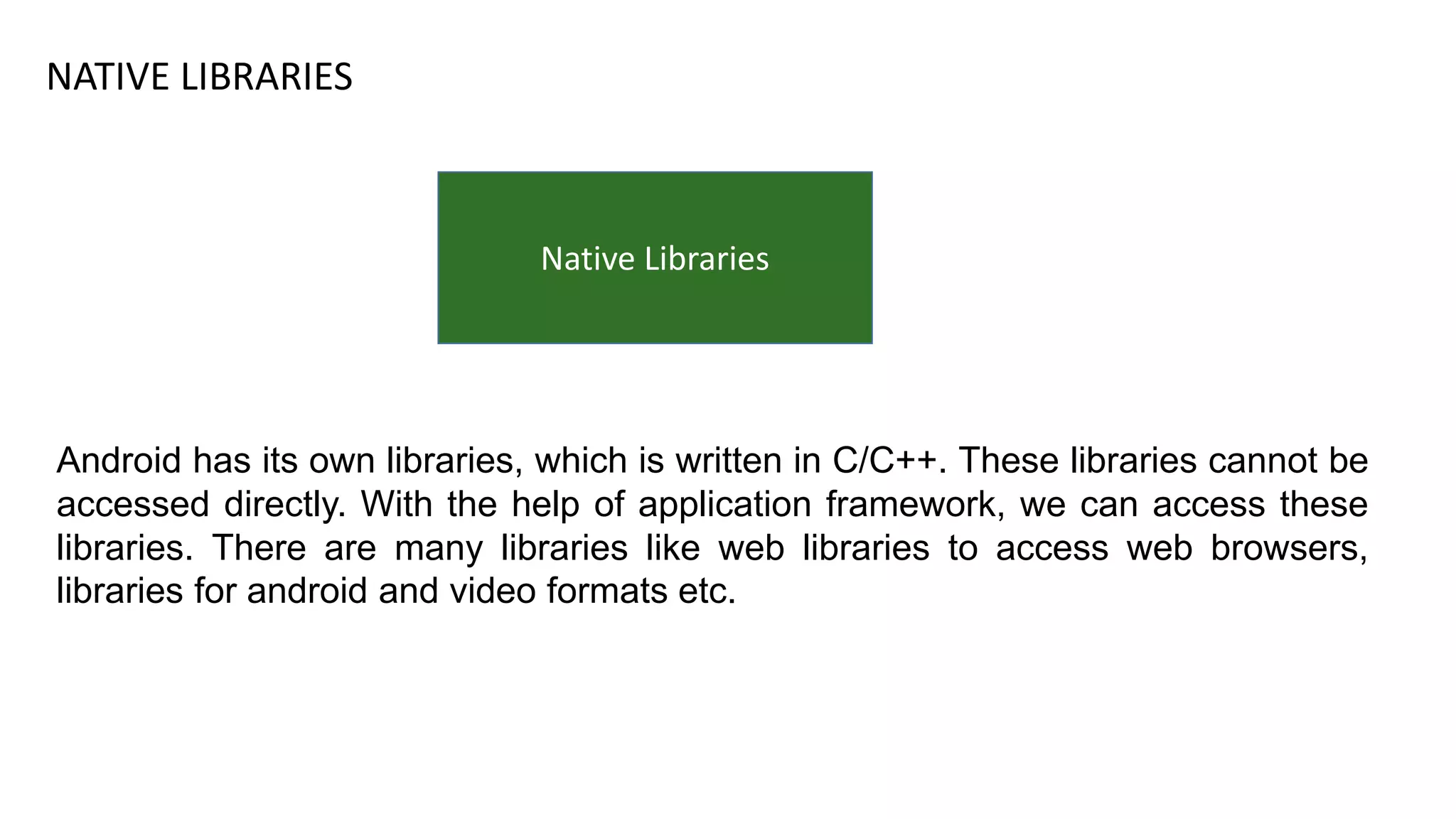
NATIVE LIBRARIES
Android has its own libraries, which is written in C/C++. These libraries cannot be
accessed directly. With the help of application framework, we can access these
libraries. There are many libraries like web libraries to access web browsers,
libraries for android and video formats etc.
Native Libraries
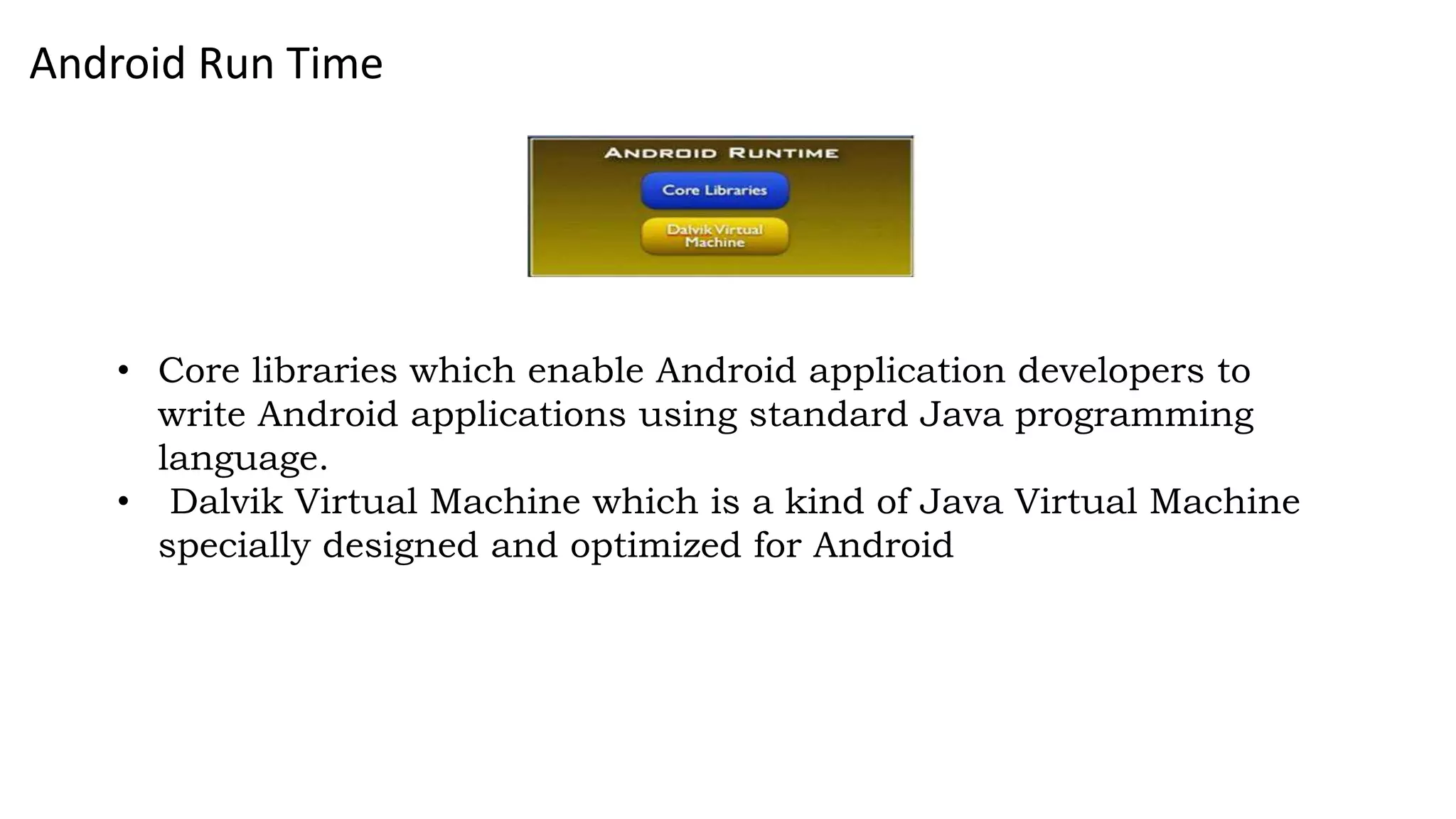
Android Run Time
• Core libraries which enable Android application developers to
write Android applications using standard Java programming
language.
• Dalvik Virtual Machine which is a kind of Java Virtual Machine
specially designed and optimized for Android
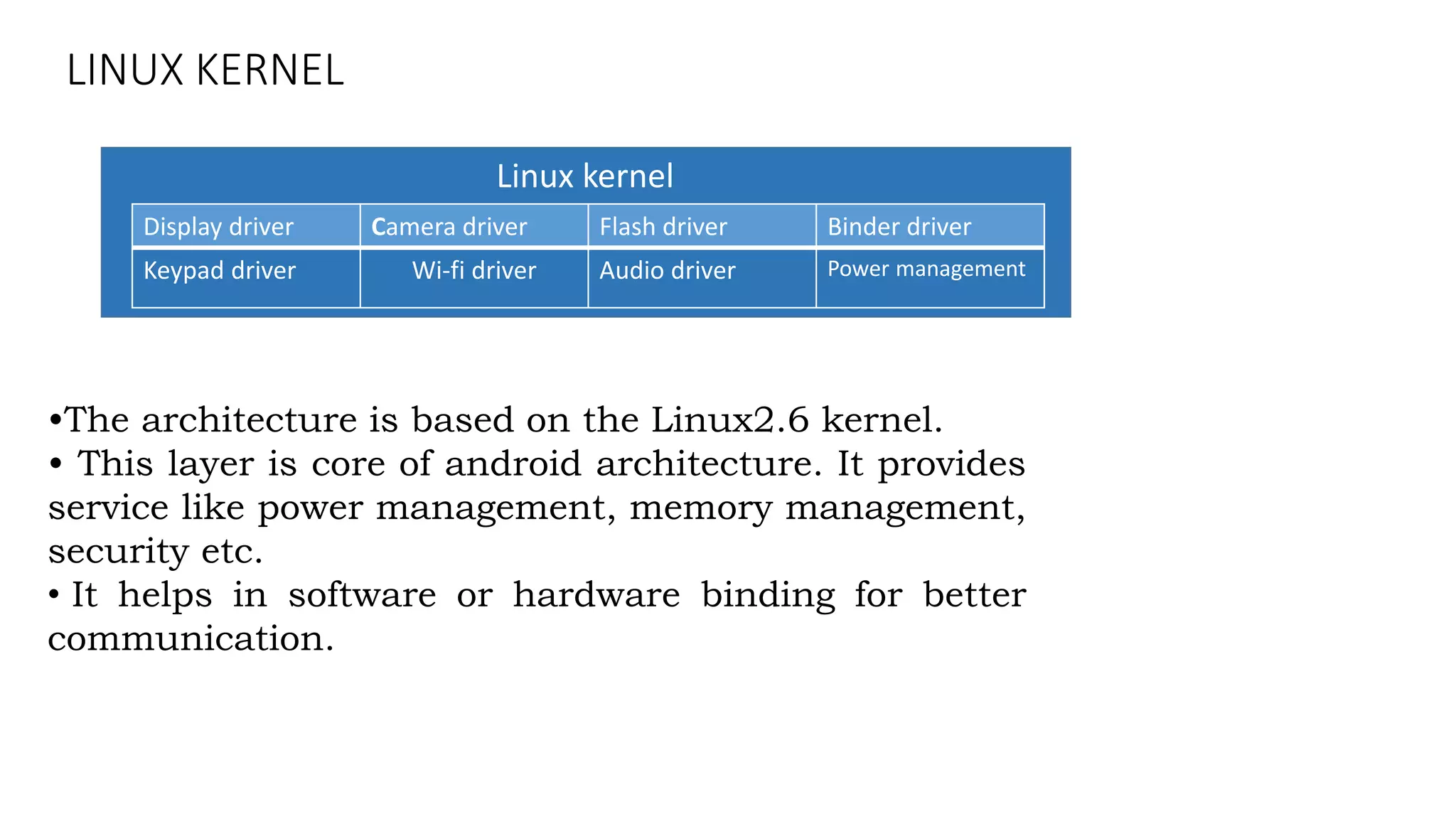
LINUX KERNEL
Linux kernel
Display driver Camera driver Flash driver Binder driver
Keypad driver Wi-fi driver Audio driver Power management
•The architecture is based on the Linux2.6 kernel.
• This layer is core of android architecture. It provides
service like power management, memory management,
security etc.
• It helps in software or hardware binding for better
communication.
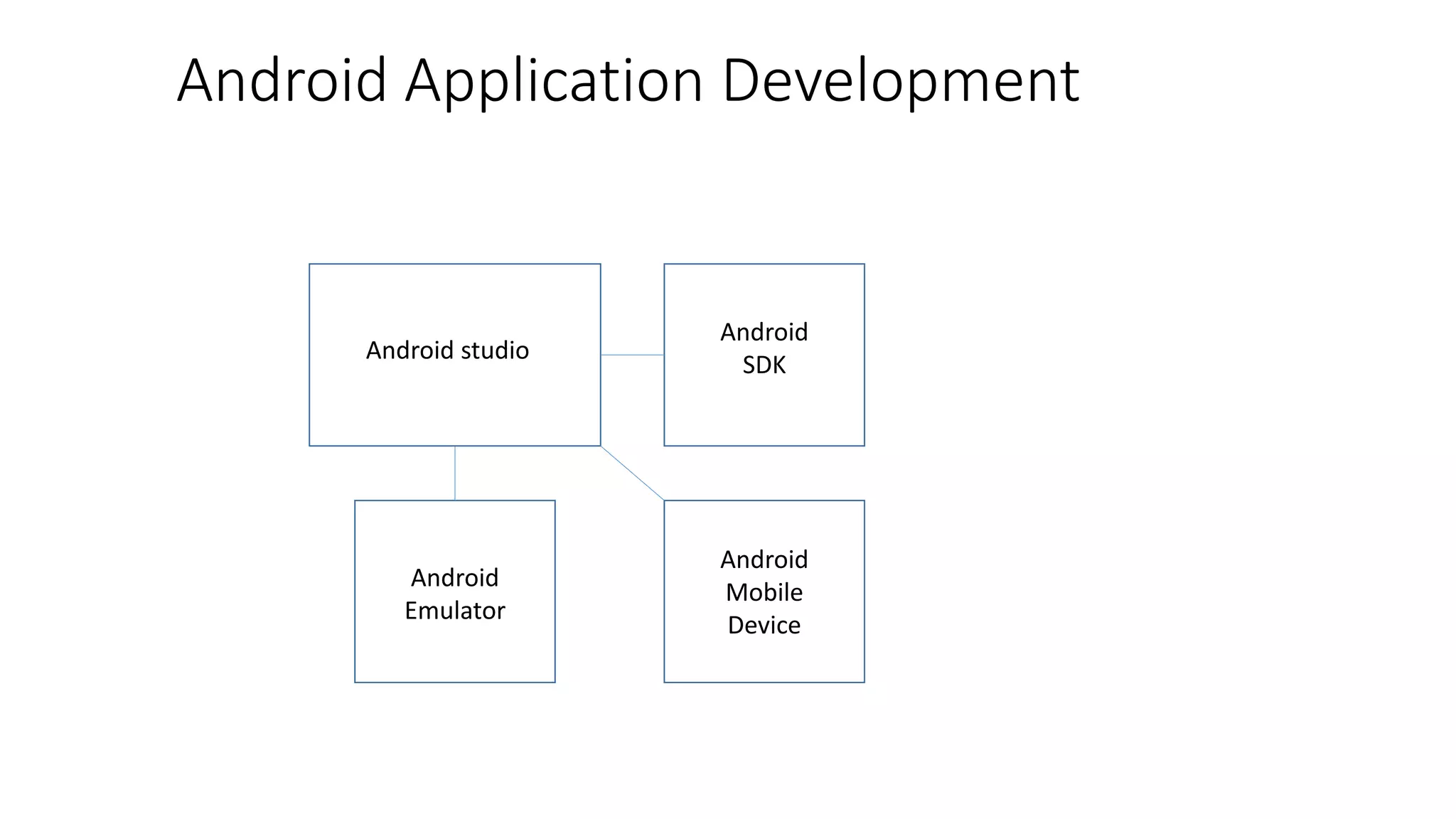
Android Application Development
Android studio
Android
SDK
Android
Emulator
Android
Mobile
Device
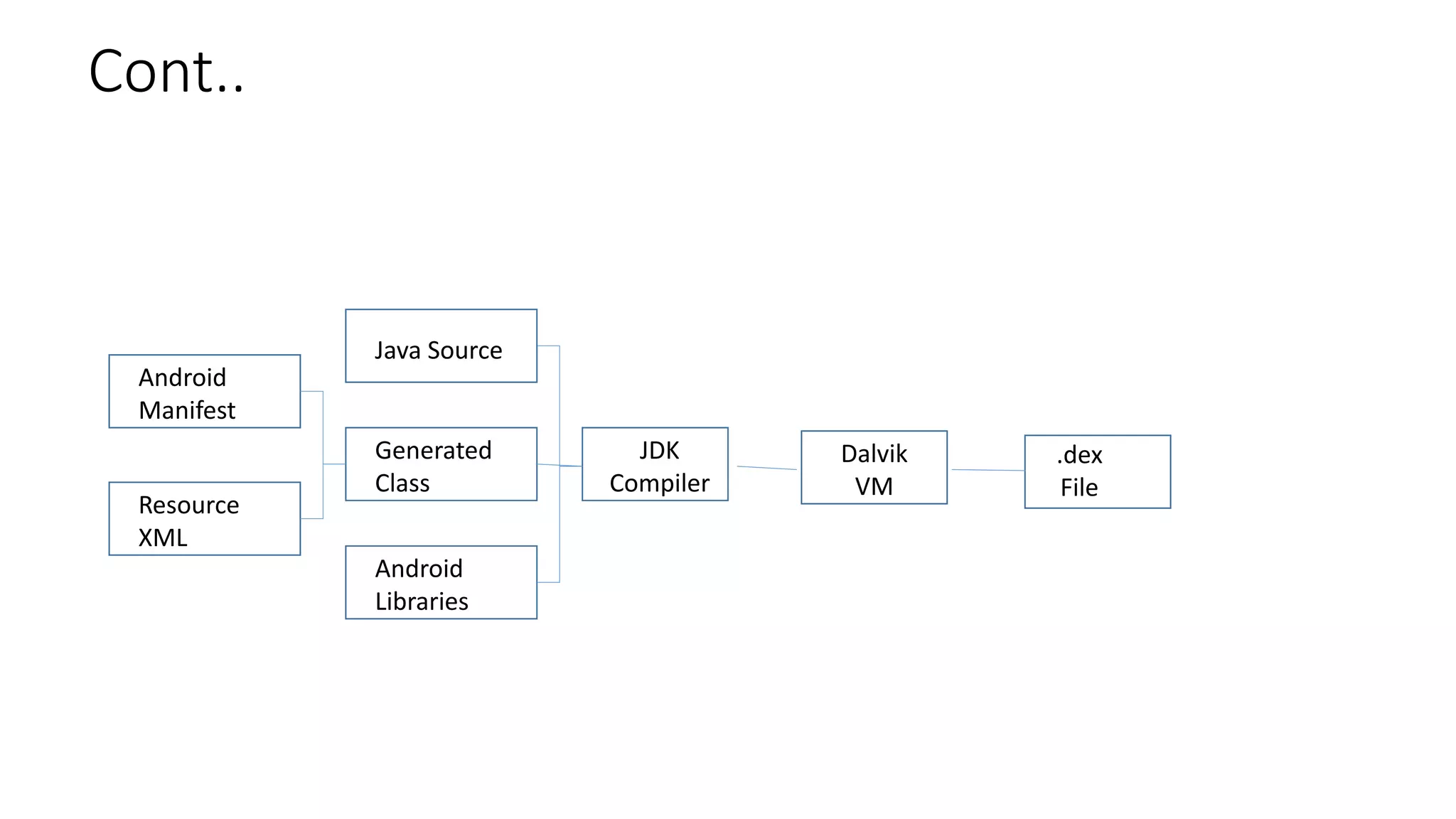
Cont..
Android
Manifest
Resource
XML
Java Source
Generated
Class
JDK
Compiler
Android
Libraries
.dex
File
Dalvik
VM
APPLICATION LIFE CYCLE
Security
• Android is a multi-process system, in which each application (and parts of
the system) runs in its own process. Most security between applications
and the system is enforced at the process level through standard Linux
facilities, such as user and group IDs that are assigned to applications.
• Android is designed having multi layer security which provides flexibility
for this platform. When attackers attempt attack on device, android
platform help to reduce the portability of the attack.
There are key components of android security which are described as
follows:
Design review:-When a security model is designed then it will be
reviewed by the developers so that risk level will be very less while
using the model.
Code review and penetrating testing:- The goal of this code review is
that in which it will be checked that how the system will become
strong?
Open source and community review:- Android uses open source
technologies that have significant external review such as Linux
kernel.
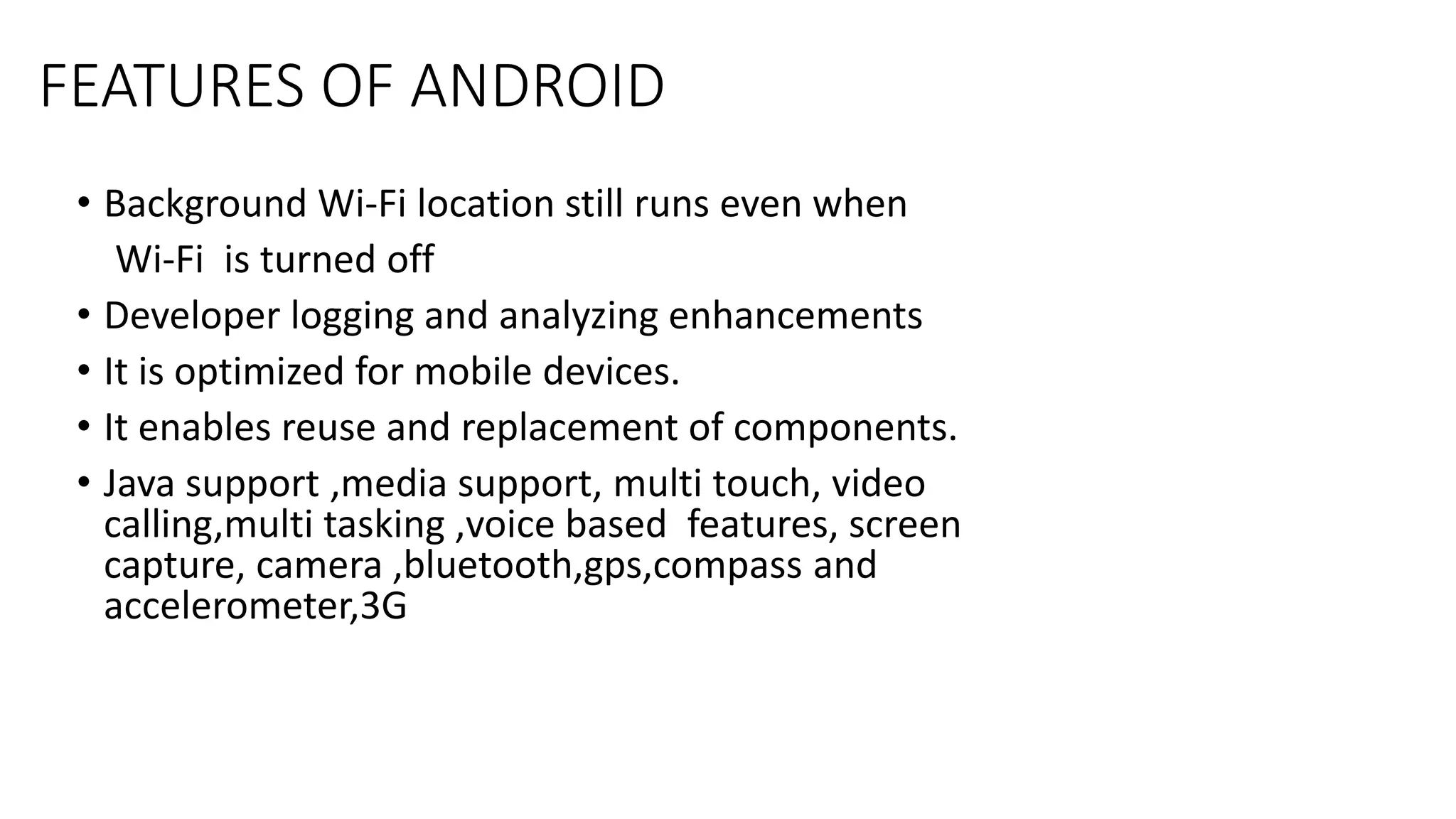
FEATURES OF ANDROID
• Background Wi-Fi location still runs even when
Wi-Fi is turned off
• Developer logging and analyzing enhancements
• It is optimized for mobile devices.
• It enables reuse and replacement of components.
• Java support ,media support, multi touch, video
calling,multi tasking ,voice based features, screen
capture, camera ,bluetooth,gps,compass and
accelerometer,3G
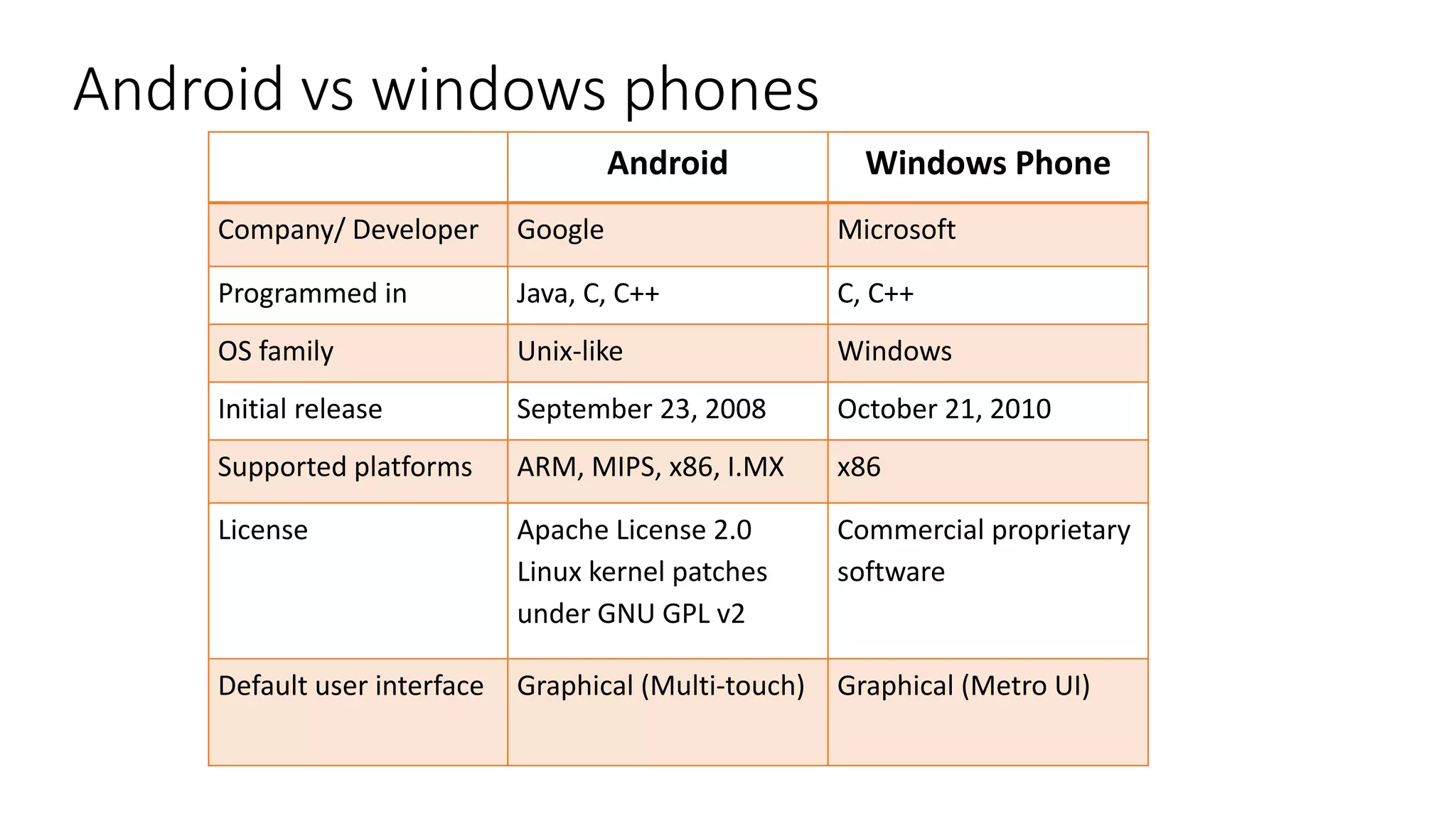
Android vs windows phones
Android Windows Phone
Company/ Developer Google Microsoft
Programmed in Java, C, C++ C, C++
OS family Unix-like Windows
Initial release September 23, 2008 October 21, 2010
Supported platforms ARM, MIPS, x86, I.MX x86
License Apache License 2.0
Linux kernel patches
under GNU GPL v2
Commercial proprietary
software
Default user interface Graphical (Multi-touch) Graphical (Metro UI)
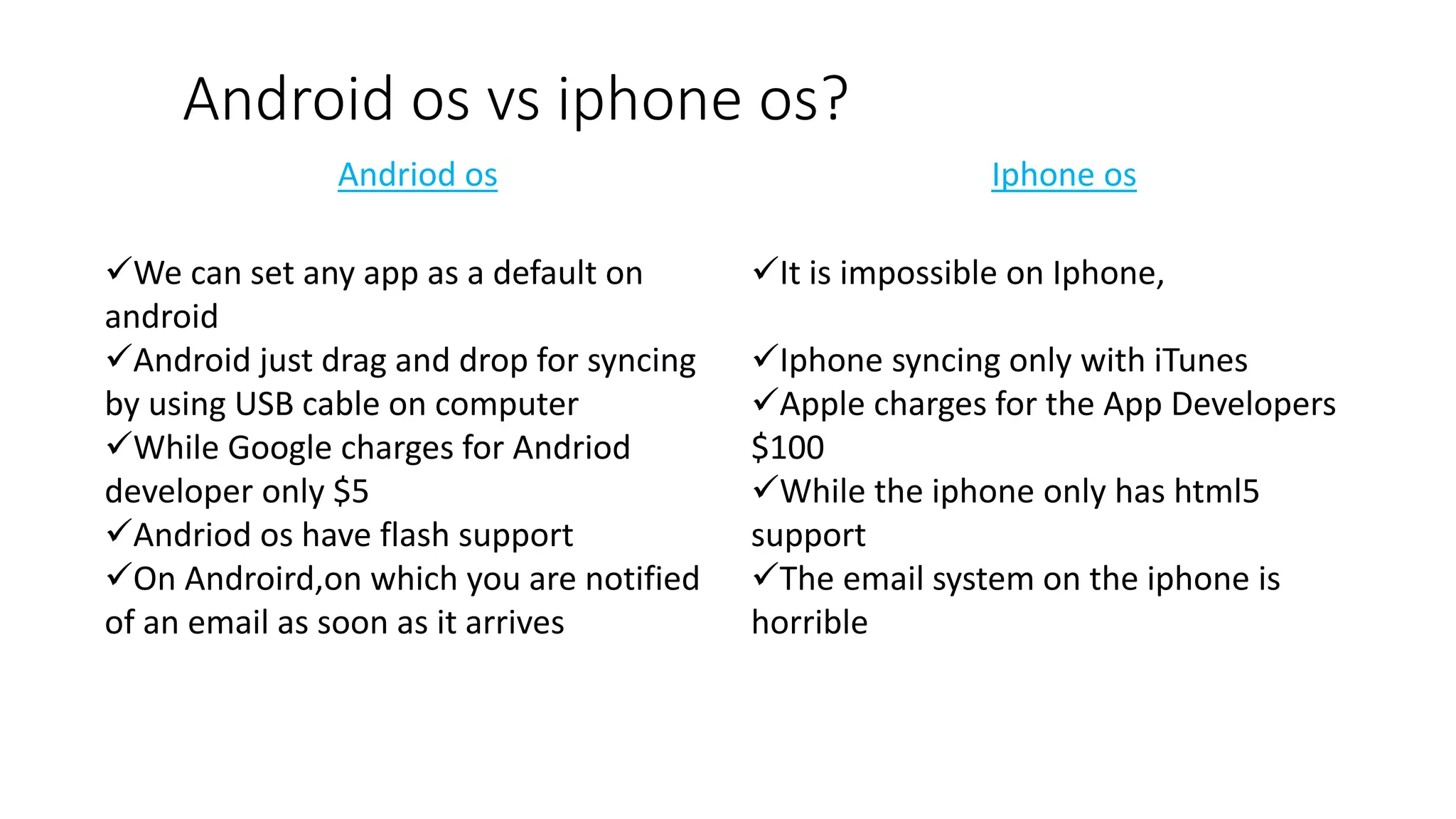
Android os vs iphone os?
Andriod os Iphone os
We can set any app as a default on
android
Android just drag and drop for syncing
by using USB cable on computer
While Google charges for Andriod
developer only $5
Andriod os have flash support
On Androird,on which you are notified
of an email as soon as it arrives
It is impossible on Iphone,
Iphone syncing only with iTunes
Apple charges for the App Developers
$100
While the iphone only has html5
support
The email system on the iphone is
horrible
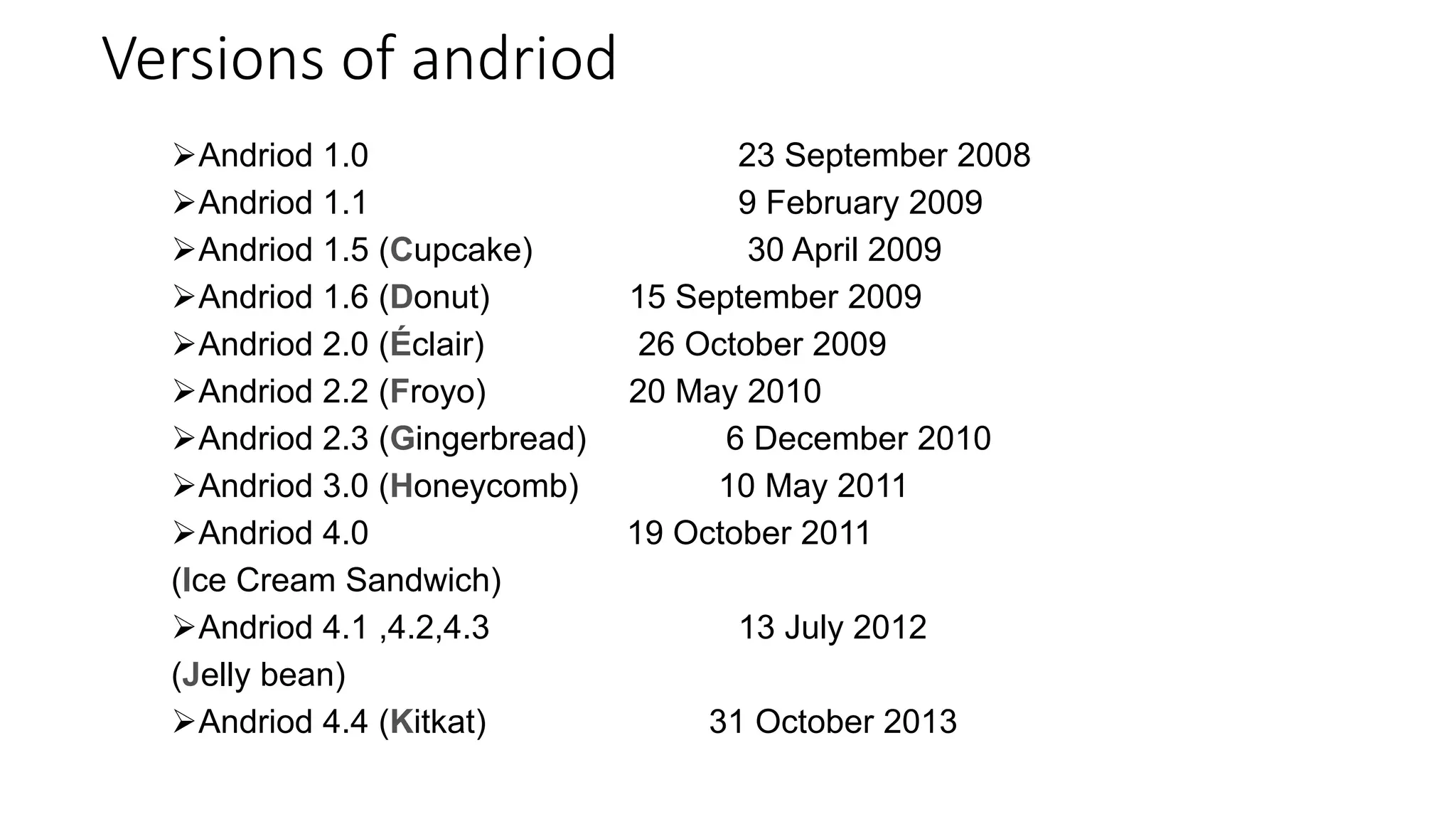
Versions of andriod
Andriod 1.0 23 September 2008
Andriod 1.1 9 February 2009
Andriod 1.5 (Cupcake) 30 April 2009
Andriod 1.6 (Donut) 15 September 2009
Andriod 2.0 (Éclair) 26 October 2009
Andriod 2.2 (Froyo) 20 May 2010
Andriod 2.3 (Gingerbread) 6 December 2010
Andriod 3.0 (Honeycomb) 10 May 2011
Andriod 4.0 19 October 2011
(Ice Cream Sandwich)
Andriod 4.1 ,4.2,4.3 13 July 2012
(Jelly bean)
Andriod 4.4 (Kitkat) 31 October 2013
Latest android version
• Marshmallow(android 6)
• Nougat(android 7)
ADVANTAGES
•The ability for anyone to customize the Google Android
platform
•It gives you better notification.
•It lets you choose your hardware.
•It has better app market(1,80,000 application)
•A more mature platform
• With the support of many applications, the user can
change the screen display.
•With Google chrome you can open many window at
once.
• Supports all Google services: Android operating system
supports all of Google services ranging from Gmail to Google
reader. all Google services can you have with one operating
system, namely Android.
DIS-ADVANTAGES
• Android Market is less control of the manager, sometimes there are
malware.
• Wasteful Batteries, This is because the OS is a lot of "process" in the
background causing the battery quickly drains.
• Sometimes slow device company issued an official version of
Android your own .
• Extremely inconsistence in design among apps.
• Very unstable and often hang or crash
Conclusion
Android is a disruptive technology, which was introduced
initially on mobile handsets, but has much wider potential.
References
• http://en.wikipedia.org/wiki/Android_(operating_syst
em)
• http://www.openhandsetalliance.com/android_overv
iew.html
• http://www.android.com
THANK YOU

Android

  • 1.
    I.E.T MJPROHILKHAND UNIVERSITY Preparedby MITHILESH RAJBHAR Roll no-13CS22
  • 2.
    Contents • Introduction ofandroid • Android architecture • Security • Features of android • Android versions • Advantages of android • Disadvantage of android • Conclusion • Reference
  • 3.
    Introduction Android is amobile operating system developed by Google, based on the Linux kernel and designed primarily for touchscreen mobile devices such as smartphones and tablets. Android's user interface is mainly based on direct manipulation, using touch gestures that loosely correspond to real-world actions, such as swiping, tapping and pinching, to manipulate on-screen objects, along with a virtual keyboard for text input. In addition to touchscreen devices, Google has further developed Android TV for televisions, Android Auto for cars, and Android Wear for wrist watches, each with a specialized user interface. Variants of Android are also used on notebooks, game consoles, digital cameras, and other electronics.
  • 4.
    ANDROID ARCHITECTURE The softwarestack is split into Four Layers:: • The application layer • The application framework • The libraries and runtime • The kernel
  • 5.
    Application Home contacts PhoneBrowser … Application Framework Activity manager Window manager Content provider … Package manager Telephone manager Resource manager Location manager Notification managers Core Libraries Dalvik Virtual Machine Native Libraries Android runtime Linux kernel Display driver Camera driver Flash driver Binder driver Keypad driver Wi-fi driver Audio driver Power management
  • 6.
    APPLICATION LAYER •The firstlayer on top is Applications. •The includes the home application,contacts application , the browser, and apps. •It is the most upper layer in android architecture. •All the applications like camera, Google maps, browser,sms,calendars,contacts are native applications. These applications works with end user with the help of application framework to operate.
  • 7.
    Application Framework The ApplicationFramework layer provides many higher-level services to applications in the form of Java classes. Application developers are allowed to make use of these services in their applications.
  • 8.
    These are asfollows:- • Activity manager:-It manages the lifecycle of applications. It enable proper management of all the activities. All the activities are controlled by activity manager. • Resource manager:-It provides access to non-code resources such as graphics etc. • Notification manager:-It enables all applications to display custom alerts in status bar. • Location manager:-This class provides access to the system location services • Package manager:-It is use to retrieve the data about installed packages on device. • Window manager:-It is use to create views and layouts. • Telephony manager:-It is use to handle settings of network connection and all information about services on device. • Content provider:-They handle data and database management issues.
  • 9.
    NATIVE LIBRARIES Android hasits own libraries, which is written in C/C++. These libraries cannot be accessed directly. With the help of application framework, we can access these libraries. There are many libraries like web libraries to access web browsers, libraries for android and video formats etc. Native Libraries
  • 10.
    Android Run Time •Core libraries which enable Android application developers to write Android applications using standard Java programming language. • Dalvik Virtual Machine which is a kind of Java Virtual Machine specially designed and optimized for Android
  • 11.
    LINUX KERNEL Linux kernel Displaydriver Camera driver Flash driver Binder driver Keypad driver Wi-fi driver Audio driver Power management •The architecture is based on the Linux2.6 kernel. • This layer is core of android architecture. It provides service like power management, memory management, security etc. • It helps in software or hardware binding for better communication.
  • 12.
    Android Application Development Androidstudio Android SDK Android Emulator Android Mobile Device
  • 13.
  • 14.
  • 15.
    Security • Android isa multi-process system, in which each application (and parts of the system) runs in its own process. Most security between applications and the system is enforced at the process level through standard Linux facilities, such as user and group IDs that are assigned to applications. • Android is designed having multi layer security which provides flexibility for this platform. When attackers attempt attack on device, android platform help to reduce the portability of the attack.
  • 16.
    There are keycomponents of android security which are described as follows: Design review:-When a security model is designed then it will be reviewed by the developers so that risk level will be very less while using the model. Code review and penetrating testing:- The goal of this code review is that in which it will be checked that how the system will become strong? Open source and community review:- Android uses open source technologies that have significant external review such as Linux kernel.
  • 17.
    FEATURES OF ANDROID •Background Wi-Fi location still runs even when Wi-Fi is turned off • Developer logging and analyzing enhancements • It is optimized for mobile devices. • It enables reuse and replacement of components. • Java support ,media support, multi touch, video calling,multi tasking ,voice based features, screen capture, camera ,bluetooth,gps,compass and accelerometer,3G
  • 18.
    Android vs windowsphones Android Windows Phone Company/ Developer Google Microsoft Programmed in Java, C, C++ C, C++ OS family Unix-like Windows Initial release September 23, 2008 October 21, 2010 Supported platforms ARM, MIPS, x86, I.MX x86 License Apache License 2.0 Linux kernel patches under GNU GPL v2 Commercial proprietary software Default user interface Graphical (Multi-touch) Graphical (Metro UI)
  • 19.
    Android os vsiphone os? Andriod os Iphone os We can set any app as a default on android Android just drag and drop for syncing by using USB cable on computer While Google charges for Andriod developer only $5 Andriod os have flash support On Androird,on which you are notified of an email as soon as it arrives It is impossible on Iphone, Iphone syncing only with iTunes Apple charges for the App Developers $100 While the iphone only has html5 support The email system on the iphone is horrible
  • 20.
    Versions of andriod Andriod1.0 23 September 2008 Andriod 1.1 9 February 2009 Andriod 1.5 (Cupcake) 30 April 2009 Andriod 1.6 (Donut) 15 September 2009 Andriod 2.0 (Éclair) 26 October 2009 Andriod 2.2 (Froyo) 20 May 2010 Andriod 2.3 (Gingerbread) 6 December 2010 Andriod 3.0 (Honeycomb) 10 May 2011 Andriod 4.0 19 October 2011 (Ice Cream Sandwich) Andriod 4.1 ,4.2,4.3 13 July 2012 (Jelly bean) Andriod 4.4 (Kitkat) 31 October 2013
  • 21.
    Latest android version •Marshmallow(android 6) • Nougat(android 7)
  • 22.
    ADVANTAGES •The ability foranyone to customize the Google Android platform •It gives you better notification. •It lets you choose your hardware. •It has better app market(1,80,000 application) •A more mature platform • With the support of many applications, the user can change the screen display. •With Google chrome you can open many window at once. • Supports all Google services: Android operating system supports all of Google services ranging from Gmail to Google reader. all Google services can you have with one operating system, namely Android.
  • 23.
    DIS-ADVANTAGES • Android Marketis less control of the manager, sometimes there are malware. • Wasteful Batteries, This is because the OS is a lot of "process" in the background causing the battery quickly drains. • Sometimes slow device company issued an official version of Android your own . • Extremely inconsistence in design among apps. • Very unstable and often hang or crash
  • 24.
    Conclusion Android is adisruptive technology, which was introduced initially on mobile handsets, but has much wider potential.
  • 25.
  • 26.