Introduction to Mobile
Application Development
BY
IQRA MUNAWER
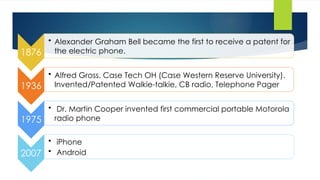
1876
• Alexander Graham Bell became the first to receive a patent for
the electric phone.
1936
• Alfred Gross. Case Tech OH (Case Western Reserve University).
Invented/Patented Walkie-talkie, CB radio, Telephone Pager
1975
• Dr. Martin Cooper invented first commercial portable Motorola
radio phone
2007
• iPhone
• Android
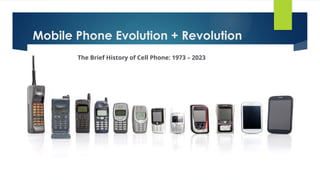
Mobile Phone Evolution + Revolution
The Brief History of Cell Phone: 1973 – 2023
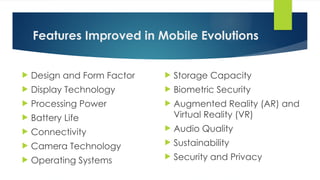
Features Improved in Mobile Evolutions
 Design and Form Factor
 Display Technology
 Processing Power
 Battery Life
 Connectivity
 Camera Technology
 Operating Systems
 Storage Capacity
 Biometric Security
 Augmented Reality (AR) and
Virtual Reality (VR)
 Audio Quality
 Sustainability
 Security and Privacy
Mobile applications
 What are they?
Any application that runs on a mobile device
 Types
Web apps: run in a web browser
HTML, JavaScript, Flash, server-side components, etc.
Native: compiled binaries for the device
Development Environment
 Most platforms have an SDK that you can download and build
against
 Every platform has an emulator that you can use to test your
apps
 Most emulators are configurable to match a variety of mobile
devices
Various screen sizes, memory limitations, etc
Development Tools
 Android
 Flutter
 Java
 Kotlin
 React Native
What is Android
 A software platform and Smart phone OS, it is based on the Linux kernel.
 Android is Framework for developing mobile apps. Framework is set of
 Interfaces and classes .Framework follow the structure.
 Allows writing managed code in the Java language.
 Android is an open-source platform founded in October 2003 by Andy Rubin
and backed by Google in November 2007.
 Developed by Google and later the Open Handset Alliance (OHA).
 Unveiling of the Android platform was announced on 5 November
2007(Android beta) with the founding of OHA.
 Google provides an on-line electronic market for third-party developers to
sell-distribute their custom applications.
Open Handset Alliance
 A consortium of 80+ technology and mobile business
companies.
 Quoting from www.OpenHandsetAlliance.com site
 Member firms include HTC, Sony, Dell, Intel, Motorola,
Qualcomm, Texas Instruments, Google, Samsung
Electronics, LG Electronics, T-Mobile, Nvidia, and Wind
River Systems
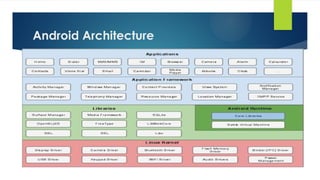
Android Architecture
Application
 Applications is the top layer of android architecture.
 Pre-installed applications like home, contacts, camera,
gallery etc. and third-party applications downloaded from
the play store will be installed on this layer only.
Application Framework
 High Level building blocks, will be used to create
applications
 Enabling and simplifying the reuse of components
Developers have full access to the same
framework APIs used by the core applications.
Users are allowed to extend or even replace
components.
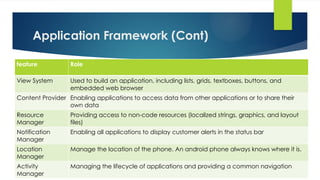
Application Framework (Cont)
feature Role
View System Used to build an application, including lists, grids, textboxes, buttons, and
embedded web browser
Content Provider Enabling applications to access data from other applications or to share their
own data
Resource
Manager
Providing access to non-code resources (localized strings, graphics, and layout
files)
Notification
Manager
Enabling all applications to display customer alerts in the status bar
Location
Manager
Manage the location of the phone. An android phone always knows where it is.
Activity
Manager
Managing the lifecycle of applications and providing a common navigation
Android Runtime
 Most important part of Android
 Provides Core libraries and the Dalvik virtual machine(DVM)
 Like Java Virtual Machine (JVM), Dalvik Virtual Machine (DVM) is
a virtual machine and specially designed and optimized for
android to ensure that a device can run multiple instances
efficiently. It depends on the layer Linux kernel for threading and
low-level memory management. The core libraries enable us to
implement android applications using the standard JAVA or
Kotlin programming languages.
Dalvik Virtual Machine
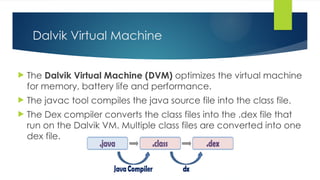
 The Dalvik Virtual Machine (DVM) optimizes the virtual machine
for memory, battery life and performance.
 The javac tool compiles the java source file into the class file.
 The Dex compiler converts the class files into the .dex file that
run on the Dalvik VM. Multiple class files are converted into one
dex file.
Platform Libraries
 It includes various C/C++ core libraries and Java based libraries such as Media, Graphics,
Surface Manager, OpenGL etc. to provide a support for android development.
 Media library provides support to play and record an audio and video formats.
 Surface manager responsible for managing access to the display subsystem.
 SGL and OpenGL both cross-language, cross-platform application program interface (API)
are used for 2D and 3D computer graphics.
 SQLite provides database support and Free Type provides font support.
 Web-Kit This open-source web browser engine provides all the functionality to display
web content and to simplify page loading.
 SSL (Secure Sockets Layer) is security technology to establish an encrypted link between
a web server and a web browser.
Linux Kernel
 Linux Kernel is heart of the android architecture. It manages all the available drivers such as display
drivers, camera drivers, Bluetooth drivers, audio drivers, memory drivers, etc. which are required
during the runtime.
 It provide an abstraction layer between the device hardware and the other components of
android architecture. The features of Linux kernel are:
 Security: The Linux kernel handles the security between the application and the system.
 Memory Management: It efficiently handles the memory management thereby providing the
freedom to develop our apps.
 Process Management: Manages the process well, allocates resources to processes whenever they
need them.
 Network Stack: It effectively handles the network communication.
 Driver Model: It ensures that the application works properly on the device and hardware
manufacturers responsible for building their drivers into the Linux build.
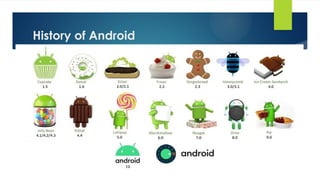
History of Android
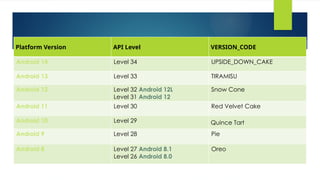
What is API level?
 API Level is an integer value that uniquely identifies the
framework API revision offered by a version of the Android
platform.
 Some popular android versions and API levels are here
Platform Version API Level VERSION_CODE
Android 14 Level 34 UPSIDE_DOWN_CAKE
Android 13 Level 33 TIRAMISU
Android 12 Level 32 Android 12L
Level 31 Android 12
Snow Cone
Android 11 Level 30 Red Velvet Cake
Android 10 Level 29 Quince Tart
Android 9 Level 28 Pie
Android 8 Level 27 Android 8.1
Level 26 Android 8.0
Oreo

Intro to Mobile app development Android.pptx

  • 1.
    Introduction to Mobile ApplicationDevelopment BY IQRA MUNAWER
  • 2.
    1876 • Alexander GrahamBell became the first to receive a patent for the electric phone. 1936 • Alfred Gross. Case Tech OH (Case Western Reserve University). Invented/Patented Walkie-talkie, CB radio, Telephone Pager 1975 • Dr. Martin Cooper invented first commercial portable Motorola radio phone 2007 • iPhone • Android
  • 3.
    Mobile Phone Evolution+ Revolution The Brief History of Cell Phone: 1973 – 2023
  • 4.
    Features Improved inMobile Evolutions  Design and Form Factor  Display Technology  Processing Power  Battery Life  Connectivity  Camera Technology  Operating Systems  Storage Capacity  Biometric Security  Augmented Reality (AR) and Virtual Reality (VR)  Audio Quality  Sustainability  Security and Privacy
  • 5.
    Mobile applications  Whatare they? Any application that runs on a mobile device  Types Web apps: run in a web browser HTML, JavaScript, Flash, server-side components, etc. Native: compiled binaries for the device
  • 6.
    Development Environment  Mostplatforms have an SDK that you can download and build against  Every platform has an emulator that you can use to test your apps  Most emulators are configurable to match a variety of mobile devices Various screen sizes, memory limitations, etc
  • 7.
    Development Tools  Android Flutter  Java  Kotlin  React Native
  • 8.
    What is Android A software platform and Smart phone OS, it is based on the Linux kernel.  Android is Framework for developing mobile apps. Framework is set of  Interfaces and classes .Framework follow the structure.  Allows writing managed code in the Java language.  Android is an open-source platform founded in October 2003 by Andy Rubin and backed by Google in November 2007.  Developed by Google and later the Open Handset Alliance (OHA).  Unveiling of the Android platform was announced on 5 November 2007(Android beta) with the founding of OHA.  Google provides an on-line electronic market for third-party developers to sell-distribute their custom applications.
  • 9.
    Open Handset Alliance A consortium of 80+ technology and mobile business companies.  Quoting from www.OpenHandsetAlliance.com site  Member firms include HTC, Sony, Dell, Intel, Motorola, Qualcomm, Texas Instruments, Google, Samsung Electronics, LG Electronics, T-Mobile, Nvidia, and Wind River Systems
  • 10.
  • 11.
    Application  Applications isthe top layer of android architecture.  Pre-installed applications like home, contacts, camera, gallery etc. and third-party applications downloaded from the play store will be installed on this layer only.
  • 12.
    Application Framework  HighLevel building blocks, will be used to create applications  Enabling and simplifying the reuse of components Developers have full access to the same framework APIs used by the core applications. Users are allowed to extend or even replace components.
  • 13.
    Application Framework (Cont) featureRole View System Used to build an application, including lists, grids, textboxes, buttons, and embedded web browser Content Provider Enabling applications to access data from other applications or to share their own data Resource Manager Providing access to non-code resources (localized strings, graphics, and layout files) Notification Manager Enabling all applications to display customer alerts in the status bar Location Manager Manage the location of the phone. An android phone always knows where it is. Activity Manager Managing the lifecycle of applications and providing a common navigation
  • 14.
    Android Runtime  Mostimportant part of Android  Provides Core libraries and the Dalvik virtual machine(DVM)  Like Java Virtual Machine (JVM), Dalvik Virtual Machine (DVM) is a virtual machine and specially designed and optimized for android to ensure that a device can run multiple instances efficiently. It depends on the layer Linux kernel for threading and low-level memory management. The core libraries enable us to implement android applications using the standard JAVA or Kotlin programming languages.
  • 15.
    Dalvik Virtual Machine The Dalvik Virtual Machine (DVM) optimizes the virtual machine for memory, battery life and performance.  The javac tool compiles the java source file into the class file.  The Dex compiler converts the class files into the .dex file that run on the Dalvik VM. Multiple class files are converted into one dex file.
  • 16.
    Platform Libraries  Itincludes various C/C++ core libraries and Java based libraries such as Media, Graphics, Surface Manager, OpenGL etc. to provide a support for android development.  Media library provides support to play and record an audio and video formats.  Surface manager responsible for managing access to the display subsystem.  SGL and OpenGL both cross-language, cross-platform application program interface (API) are used for 2D and 3D computer graphics.  SQLite provides database support and Free Type provides font support.  Web-Kit This open-source web browser engine provides all the functionality to display web content and to simplify page loading.  SSL (Secure Sockets Layer) is security technology to establish an encrypted link between a web server and a web browser.
  • 17.
    Linux Kernel  LinuxKernel is heart of the android architecture. It manages all the available drivers such as display drivers, camera drivers, Bluetooth drivers, audio drivers, memory drivers, etc. which are required during the runtime.  It provide an abstraction layer between the device hardware and the other components of android architecture. The features of Linux kernel are:  Security: The Linux kernel handles the security between the application and the system.  Memory Management: It efficiently handles the memory management thereby providing the freedom to develop our apps.  Process Management: Manages the process well, allocates resources to processes whenever they need them.  Network Stack: It effectively handles the network communication.  Driver Model: It ensures that the application works properly on the device and hardware manufacturers responsible for building their drivers into the Linux build.
  • 18.
  • 19.
    What is APIlevel?  API Level is an integer value that uniquely identifies the framework API revision offered by a version of the Android platform.  Some popular android versions and API levels are here
  • 20.
    Platform Version APILevel VERSION_CODE Android 14 Level 34 UPSIDE_DOWN_CAKE Android 13 Level 33 TIRAMISU Android 12 Level 32 Android 12L Level 31 Android 12 Snow Cone Android 11 Level 30 Red Velvet Cake Android 10 Level 29 Quince Tart Android 9 Level 28 Pie Android 8 Level 27 Android 8.1 Level 26 Android 8.0 Oreo