Android Technology .
Paper by : Omkar S. Tembe
Vipul S.Phadtare
( B.C.A.III )
D.G.College of Commerce , Satara.1
 Android is an open source operating system, created by Google
specifically for use on mobile devices (cell phones and tablets)
 Android is the software stack for mobile devices that includes …..
1) An operating system
2) Middleware
3) Key Applications
 Android can be programmed in C/C++ but most app development is done
in Java as Java gives access to C Libraries via JNI (JNI = Java Native Interface)
 Supports Bluetooth, Wi-Fi, and 3G and 4G networking
 Introduction :-
2
 2005
a) Google acquired Android Inc. to start Android platform
b) Work on Dalvik Virtual Machine begun
 2007
a) Open Handset Alliance announced
b) Early look at SDK
 2008
a) Google sponsored 1st Android Developer Challenge
b) T-Mobile G1 announced
c) SDK 1.0 released
d) Android released open source (Apache License)
e) Android Dev Phone 1 released
 History :-
3
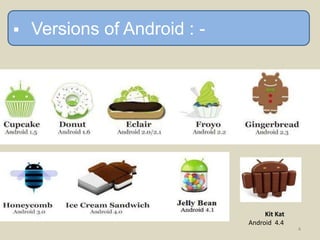
 Versions of Android : -
Kit Kat
Android 4.4
4
 Versions of Android (Tabular Form): -
Version Code Name Release Date Distribution (%)
4.4 Kit Kat September 3 , 2013 0%
4.3 Jelly Bean July 24, 2013 0%
4.2 Jelly Bean November 13, 2012 8.5%
4.1 Jelly Bean July 9, 2012 36.6%
4.0.3-4.0.4 Ice Cream Sandwich December 16, 2011 21.7%
3.2 Honey Comb July 15, 2011 0.1%
3.1 Honey Comb
May 10, 2011 0 %
2.3.3-2.3.7 Ginger Bread February 9, 2011 30.7%
2.3-2.3.2 Ginger Bread December 6, 2010 0%
2.2 Froyo May 20, 2010 2.4%
2.0-2.1 Eclair October 26, 2009 0%
1.6 Donut September 15, 2009 0%
1.5 Cupcake April 30, 2009 0% 5
 Distribution of Android Devices :-
Data collected during a 14-day period ending on
January 3, 2012
Ginger Bread
Froyo
Eclair
6
 Distribution of Android Devices :-
Data collected during a 7-day period ending on Sept 4, 2013.
Any versions with less than 0.1% distribution are not shown
7
 Application Framework
 Dalvik virtual machine
 Integrated (web kit) browser
 2D and 3D graphics APIs with HW
 SQLite
 Video and audio codecs
 Bluetooth, EDGE, 3G, and Wi-Fi
 Camera, GPS, compass, and accelerometer
 Features of Android : -
8
 Architecture of Android :-
9
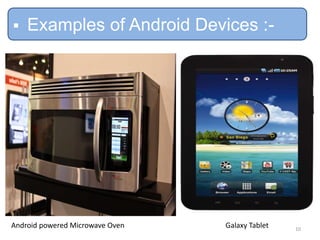
 Examples of Android Devices :-
Android powered Microwave Oven Galaxy Tablet 10
 Built using Java and new SDK libraries
 Java code compiled into Dalvik byte code (.dex)
 Optimized for mobile devices (better memory management,
battery utilization, etc.)
 Dalvik VM runs .dex files
 By default, each app is run in its own Linux process
 Process started when app’s code needs to be executed
 Threads can be started to handle time-consuming operations
 Each process has its own Dalvik VM
 By default, each app is assigned unique Linux ID
 Permissions are set so app’s files are only visible to that app
 Android Apps ( Introduction ) :-
11
 Android Application Development :-
Eclipse IDE
Android
SDK
Android
Emulator
Android
Mobile
Device
12
 Development Process Of Android
Application :-
13
Definition : Any application that runs on a mobile
device.
Types
1) Web apps : run in a web browser
HTML, JavaScript, Flash, server-side
components , etc.
2) Native : compiled binaries for the device
often make use of web services
 Mobile Applications ( Introduction ) :-
14
 Android Market :-
 Has various categories, allows ratings
 Have both free/paid apps
 Featured apps on web and on phone
 The Android Market (and iTunes/App Store) is great for developers
1) Level playing field, allowing third-party apps
2) Revenue sharing
 Requires Google Developer Account : $25 fee
 Link to a Merchant Account
 Google Checkout
 Link to your checking account
 Google takes 30% of app purchase price
15
 Paid apps in Android Market, various other markets
 Free, ad-supported apps in Android Market
1) Ad networks (Google Ad Mob, Quattro Wireless)
2) Sell your own ads
 Services to other developers
1) Ex. Skyhook Wireless
(http://www.skyhookwireless.com/)
 Contests (Android Developer Challenge)
 Selling products from within your app
 Android Market :-
16
 Android Market :-
17
 Scope of Android :-
 Augmented Campus Reality
camera + maps + compass = heads up info
 Games
multi-player (Bluetooth, Wi-Fi, cell)
location-based (scavenger hunt)
 Custom overlays for maps
weather, traffic, friends
 Web scraping
news filters
sport scores
news eliminators
 Distributed computing
10,000 phones all donating their idle time
tiny terminal (phone) + fast cpu/network (server)
 Shared whiteboard
18
Android Power: http://blogs.computerworld.com/raphael
The Droid Guy: http://thedroidguy.com/
Seeing through Windows: http://blogs.computerworld.com/gralla
Phandroid: http://phandroid.com/
Android Guys: http://www.androidguys.com/
CW: http://www.computerworld.com/s/article/9178688/
Wireless & Mobile News: http://www.wirelessandmobilenews.com/android
 References :-
19
Thank you !!!
20

Android Technology

  • 1.
    Android Technology . Paperby : Omkar S. Tembe Vipul S.Phadtare ( B.C.A.III ) D.G.College of Commerce , Satara.1
  • 2.
     Android isan open source operating system, created by Google specifically for use on mobile devices (cell phones and tablets)  Android is the software stack for mobile devices that includes ….. 1) An operating system 2) Middleware 3) Key Applications  Android can be programmed in C/C++ but most app development is done in Java as Java gives access to C Libraries via JNI (JNI = Java Native Interface)  Supports Bluetooth, Wi-Fi, and 3G and 4G networking  Introduction :- 2
  • 3.
     2005 a) Googleacquired Android Inc. to start Android platform b) Work on Dalvik Virtual Machine begun  2007 a) Open Handset Alliance announced b) Early look at SDK  2008 a) Google sponsored 1st Android Developer Challenge b) T-Mobile G1 announced c) SDK 1.0 released d) Android released open source (Apache License) e) Android Dev Phone 1 released  History :- 3
  • 4.
     Versions ofAndroid : - Kit Kat Android 4.4 4
  • 5.
     Versions ofAndroid (Tabular Form): - Version Code Name Release Date Distribution (%) 4.4 Kit Kat September 3 , 2013 0% 4.3 Jelly Bean July 24, 2013 0% 4.2 Jelly Bean November 13, 2012 8.5% 4.1 Jelly Bean July 9, 2012 36.6% 4.0.3-4.0.4 Ice Cream Sandwich December 16, 2011 21.7% 3.2 Honey Comb July 15, 2011 0.1% 3.1 Honey Comb May 10, 2011 0 % 2.3.3-2.3.7 Ginger Bread February 9, 2011 30.7% 2.3-2.3.2 Ginger Bread December 6, 2010 0% 2.2 Froyo May 20, 2010 2.4% 2.0-2.1 Eclair October 26, 2009 0% 1.6 Donut September 15, 2009 0% 1.5 Cupcake April 30, 2009 0% 5
  • 6.
     Distribution ofAndroid Devices :- Data collected during a 14-day period ending on January 3, 2012 Ginger Bread Froyo Eclair 6
  • 7.
     Distribution ofAndroid Devices :- Data collected during a 7-day period ending on Sept 4, 2013. Any versions with less than 0.1% distribution are not shown 7
  • 8.
     Application Framework Dalvik virtual machine  Integrated (web kit) browser  2D and 3D graphics APIs with HW  SQLite  Video and audio codecs  Bluetooth, EDGE, 3G, and Wi-Fi  Camera, GPS, compass, and accelerometer  Features of Android : - 8
  • 9.
     Architecture ofAndroid :- 9
  • 10.
     Examples ofAndroid Devices :- Android powered Microwave Oven Galaxy Tablet 10
  • 11.
     Built usingJava and new SDK libraries  Java code compiled into Dalvik byte code (.dex)  Optimized for mobile devices (better memory management, battery utilization, etc.)  Dalvik VM runs .dex files  By default, each app is run in its own Linux process  Process started when app’s code needs to be executed  Threads can be started to handle time-consuming operations  Each process has its own Dalvik VM  By default, each app is assigned unique Linux ID  Permissions are set so app’s files are only visible to that app  Android Apps ( Introduction ) :- 11
  • 12.
     Android ApplicationDevelopment :- Eclipse IDE Android SDK Android Emulator Android Mobile Device 12
  • 13.
     Development ProcessOf Android Application :- 13
  • 14.
    Definition : Anyapplication that runs on a mobile device. Types 1) Web apps : run in a web browser HTML, JavaScript, Flash, server-side components , etc. 2) Native : compiled binaries for the device often make use of web services  Mobile Applications ( Introduction ) :- 14
  • 15.
     Android Market:-  Has various categories, allows ratings  Have both free/paid apps  Featured apps on web and on phone  The Android Market (and iTunes/App Store) is great for developers 1) Level playing field, allowing third-party apps 2) Revenue sharing  Requires Google Developer Account : $25 fee  Link to a Merchant Account  Google Checkout  Link to your checking account  Google takes 30% of app purchase price 15
  • 16.
     Paid appsin Android Market, various other markets  Free, ad-supported apps in Android Market 1) Ad networks (Google Ad Mob, Quattro Wireless) 2) Sell your own ads  Services to other developers 1) Ex. Skyhook Wireless (http://www.skyhookwireless.com/)  Contests (Android Developer Challenge)  Selling products from within your app  Android Market :- 16
  • 17.
  • 18.
     Scope ofAndroid :-  Augmented Campus Reality camera + maps + compass = heads up info  Games multi-player (Bluetooth, Wi-Fi, cell) location-based (scavenger hunt)  Custom overlays for maps weather, traffic, friends  Web scraping news filters sport scores news eliminators  Distributed computing 10,000 phones all donating their idle time tiny terminal (phone) + fast cpu/network (server)  Shared whiteboard 18
  • 19.
    Android Power: http://blogs.computerworld.com/raphael TheDroid Guy: http://thedroidguy.com/ Seeing through Windows: http://blogs.computerworld.com/gralla Phandroid: http://phandroid.com/ Android Guys: http://www.androidguys.com/ CW: http://www.computerworld.com/s/article/9178688/ Wireless & Mobile News: http://www.wirelessandmobilenews.com/android  References :- 19
  • 20.