What is ANDROID ??
• Android is a mobile operating system.
• It is based upon a modified version of
the Linux kernel.
• Android is a software stack:
– Operating system
– Middleware
– Application
ϙ Why was it created ?
• Software development.
• Run on very small electronic device.
• Full phone software stack including
applications.
• Android is open & free.
▐ ARCHITECTURE 葶
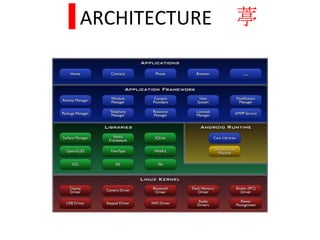
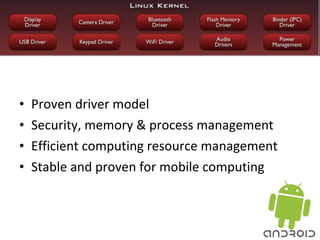
• Proven driver model
• Security, memory & process management
• Efficient computing resource management
• Stable and proven for mobile computing
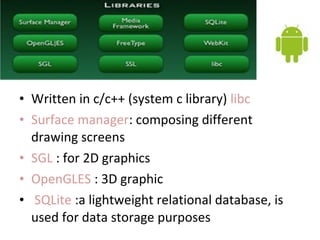
• Written in c/c++ (system c library) libc
• Surface manager: composing different
drawing screens
• SGL : for 2D graphics
• OpenGLES : 3D graphic
• SQLite :a lightweight relational database, is
used for data storage purposes
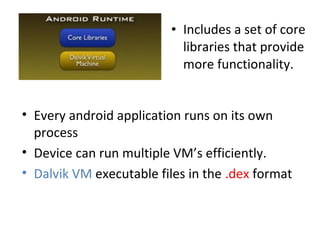
• Includes a set of core
libraries that provide
more functionality.
• Every android application runs on its own
process
• Device can run multiple VM’s efficiently.
• Dalvik VM executable files in the .dex format
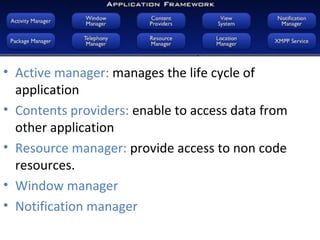
• Active manager: manages the life cycle of
application
• Contents providers: enable to access data from
other application
• Resource manager: provide access to non code
resources.
• Window manager
• Notification manager
◄ INTRESTING ►
• Unit sales for Android OS smart phones ranked
first among all smartphone OS.(2010)
• There are currently over 100,000 apps available
for Android.
• Android was purchased by Google in 2005.
• Android has native support for multi-
touch which was initially made available in
handsets such as the HTC Hero.
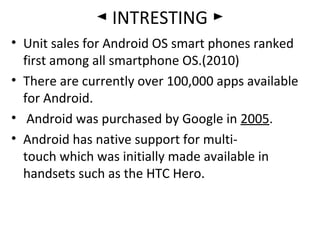
The Android Emulator default home
screen
 The functions of one system using a 
different system, so that the second 
system behaves like the first system
Benefits
Emulators maintain the original look, feel, and
behavior of the digital object
Conclusion 
 
• Android is a disruptive technology, which was
introduced initially on mobile handsets, but
has much wider potential
Android PPT
Android PPT

Android PPT

  • 2.
    What is ANDROID?? • Android is a mobile operating system. • It is based upon a modified version of the Linux kernel. • Android is a software stack: – Operating system – Middleware – Application
  • 3.
    ϙ Why wasit created ? • Software development. • Run on very small electronic device. • Full phone software stack including applications. • Android is open & free.
  • 4.
  • 5.
    • Proven drivermodel • Security, memory & process management • Efficient computing resource management • Stable and proven for mobile computing
  • 6.
    • Written inc/c++ (system c library) libc • Surface manager: composing different drawing screens • SGL : for 2D graphics • OpenGLES : 3D graphic • SQLite :a lightweight relational database, is used for data storage purposes
  • 7.
    • Includes aset of core libraries that provide more functionality. • Every android application runs on its own process • Device can run multiple VM’s efficiently. • Dalvik VM executable files in the .dex format
  • 8.
    • Active manager:manages the life cycle of application • Contents providers: enable to access data from other application • Resource manager: provide access to non code resources. • Window manager • Notification manager
  • 9.
    ◄ INTRESTING ► •Unit sales for Android OS smart phones ranked first among all smartphone OS.(2010) • There are currently over 100,000 apps available for Android. • Android was purchased by Google in 2005. • Android has native support for multi- touch which was initially made available in handsets such as the HTC Hero.
  • 10.
    The Android Emulatordefault home screen  The functions of one system using a  different system, so that the second  system behaves like the first system Benefits Emulators maintain the original look, feel, and behavior of the digital object
  • 11.
    Conclusion    • Android isa disruptive technology, which was introduced initially on mobile handsets, but has much wider potential