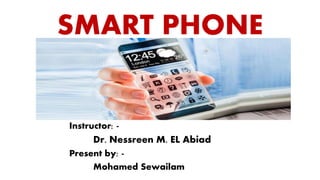
SMART PHONE
Instructor: -
Dr. Nessreen M. EL Abiad
Present by: -
Mohamed Sewailam
3
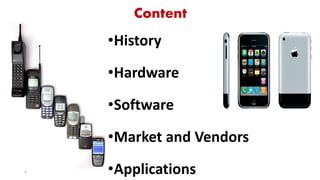
•History
•Hardware
•Software
•Market and Vendors
•Applications
Content
History
1950
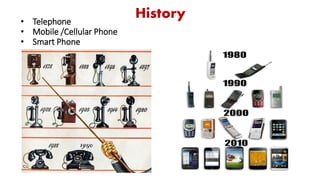
• Telephone
• Mobile /Cellular Phone
• Smart Phone
History
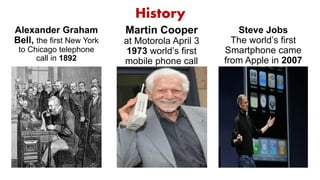
Alexander Graham
Bell, the first New York
to Chicago telephone
call in 1892
Martin Cooper
at Motorola April 3
1973 world’s first
mobile phone call
Steve Jobs
The world’s first
Smartphone came
from Apple in 2007
Hardware
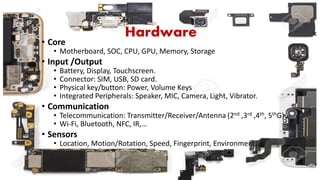
• Core
• Motherboard, SOC, CPU, GPU, Memory, Storage
• Input /Output
• Battery, Display, Touchscreen.
• Connector: SIM, USB, SD card.
• Physical key/button: Power, Volume Keys
• Integrated Peripherals: Speaker, MIC, Camera, Light, Vibrator.
• Communication
• Telecommunication: Transmitter/Receiver/Antenna (2nd ,3rd ,4th, 5thG)
• Wi-Fi, Bluetooth, NFC, IR,…
• Sensors
• Location, Motion/Rotation, Speed, Fingerprint, Environment,….
Hardware
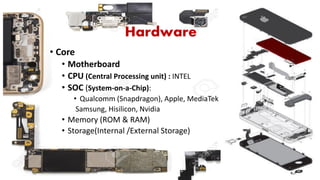
• Core
• Motherboard
• CPU (Central Processing unit) : INTEL
• SOC (System-on-a-Chip):
• Qualcomm (Snapdragon), Apple, MediaTek
Samsung, Hisilicon, Nvidia
• Memory (ROM & RAM)
• Storage(Internal /External Storage)
Hardware
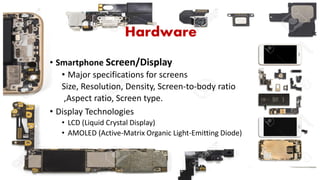
• Smartphone Screen/Display
• Major specifications for screens
Size, Resolution, Density, Screen-to-body ratio
,Aspect ratio, Screen type.
• Display Technologies
• LCD (Liquid Crystal Display)
• AMOLED (Active-Matrix Organic Light-Emitting Diode)
Software and Operating System
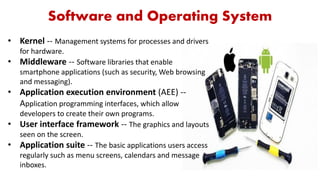
• Kernel -- Management systems for processes and drivers
for hardware.
• Middleware -- Software libraries that enable
smartphone applications (such as security, Web browsing
and messaging).
• Application execution environment (AEE) --
Application programming interfaces, which allow
developers to create their own programs.
• User interface framework -- The graphics and layouts
seen on the screen.
• Application suite -- The basic applications users access
regularly such as menu screens, calendars and message
inboxes.
Software and Operating System
• Symbian OS: was developed by Symbian Ltd in 1998 for
the use of mobile phones. Nokia was the first company to
release Symbian OS on its mobile phone at that time.
• Android OS: mobile OS based on the Linux
Kernel and open-source software, was developed
by Google. The first Android device in 2008.
• IPhone OS / IOS: The IOS was developed by the Apple
for the use on its device. The iOS operating system is not
available for any other mobiles.
• Windows Mobile OS: was developed by Microsoft..
• Harmony OS: is the latest mobile operating system that
was developed in August 2019 by Huawei for the use of its
devices. It is designed primarily for IOT devices.
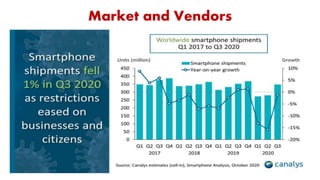
Market and Vendors
Market and Vendors
Vendor
Q3 2020
shipments
(million)
Q3 2020
Market share
Q3 2019
shipments
(million)
Q3 2019
Market share
Annual
growth
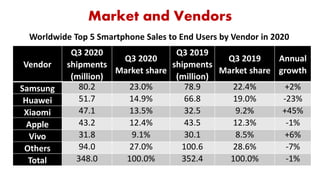
Samsung 80.2 23.0% 78.9 22.4% +2%
Huawei 51.7 14.9% 66.8 19.0% -23%
Xiaomi 47.1 13.5% 32.5 9.2% +45%
Apple 43.2 12.4% 43.5 12.3% -1%
Vivo 31.8 9.1% 30.1 8.5% +6%
Others 94.0 27.0% 100.6 28.6% -7%
Total 348.0 100.0% 352.4 100.0% -1%
Worldwide Top 5 Smartphone Sales to End Users by Vendor in 2020
Market and Vendors
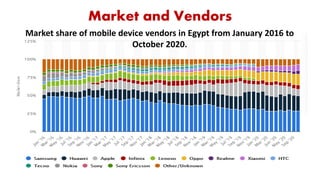
Market share of mobile device vendors in Egypt from January 2016 to
October 2020.
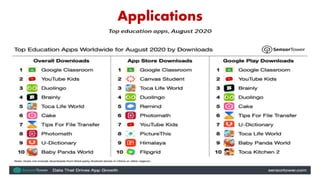
Applications
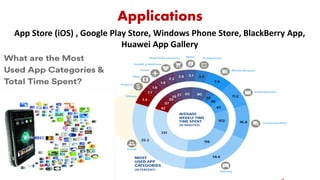
App Store (iOS) , Google Play Store, Windows Phone Store, BlackBerry App,
Huawei App Gallery
Applications
Smart Phones
Smart Phones
Smart Phones

Smart Phones

  • 2.
    SMART PHONE Instructor: - Dr.Nessreen M. EL Abiad Present by: - Mohamed Sewailam
  • 3.
  • 4.
    History 1950 • Telephone • Mobile/Cellular Phone • Smart Phone
  • 5.
    History Alexander Graham Bell, thefirst New York to Chicago telephone call in 1892 Martin Cooper at Motorola April 3 1973 world’s first mobile phone call Steve Jobs The world’s first Smartphone came from Apple in 2007
  • 6.
    Hardware • Core • Motherboard,SOC, CPU, GPU, Memory, Storage • Input /Output • Battery, Display, Touchscreen. • Connector: SIM, USB, SD card. • Physical key/button: Power, Volume Keys • Integrated Peripherals: Speaker, MIC, Camera, Light, Vibrator. • Communication • Telecommunication: Transmitter/Receiver/Antenna (2nd ,3rd ,4th, 5thG) • Wi-Fi, Bluetooth, NFC, IR,… • Sensors • Location, Motion/Rotation, Speed, Fingerprint, Environment,….
  • 7.
    Hardware • Core • Motherboard •CPU (Central Processing unit) : INTEL • SOC (System-on-a-Chip): • Qualcomm (Snapdragon), Apple, MediaTek Samsung, Hisilicon, Nvidia • Memory (ROM & RAM) • Storage(Internal /External Storage)
  • 8.
    Hardware • Smartphone Screen/Display •Major specifications for screens Size, Resolution, Density, Screen-to-body ratio ,Aspect ratio, Screen type. • Display Technologies • LCD (Liquid Crystal Display) • AMOLED (Active-Matrix Organic Light-Emitting Diode)
  • 9.
    Software and OperatingSystem • Kernel -- Management systems for processes and drivers for hardware. • Middleware -- Software libraries that enable smartphone applications (such as security, Web browsing and messaging). • Application execution environment (AEE) -- Application programming interfaces, which allow developers to create their own programs. • User interface framework -- The graphics and layouts seen on the screen. • Application suite -- The basic applications users access regularly such as menu screens, calendars and message inboxes.
  • 10.
    Software and OperatingSystem • Symbian OS: was developed by Symbian Ltd in 1998 for the use of mobile phones. Nokia was the first company to release Symbian OS on its mobile phone at that time. • Android OS: mobile OS based on the Linux Kernel and open-source software, was developed by Google. The first Android device in 2008. • IPhone OS / IOS: The IOS was developed by the Apple for the use on its device. The iOS operating system is not available for any other mobiles. • Windows Mobile OS: was developed by Microsoft.. • Harmony OS: is the latest mobile operating system that was developed in August 2019 by Huawei for the use of its devices. It is designed primarily for IOT devices.
  • 11.
  • 12.
    Market and Vendors Vendor Q32020 shipments (million) Q3 2020 Market share Q3 2019 shipments (million) Q3 2019 Market share Annual growth Samsung 80.2 23.0% 78.9 22.4% +2% Huawei 51.7 14.9% 66.8 19.0% -23% Xiaomi 47.1 13.5% 32.5 9.2% +45% Apple 43.2 12.4% 43.5 12.3% -1% Vivo 31.8 9.1% 30.1 8.5% +6% Others 94.0 27.0% 100.6 28.6% -7% Total 348.0 100.0% 352.4 100.0% -1% Worldwide Top 5 Smartphone Sales to End Users by Vendor in 2020
  • 13.
    Market and Vendors Marketshare of mobile device vendors in Egypt from January 2016 to October 2020.
  • 14.
    Applications App Store (iOS), Google Play Store, Windows Phone Store, BlackBerry App, Huawei App Gallery
  • 15.