Android as a technology
 Introduction
 History of Android
 Android Appilcations
 How Android is different
 Programming for Android
 Subskills of Android
 Android in competetion with other
technologies
 Market Intelligence for Android developers,
support and testing resources
 Android in future
Topics of Discussion
 Android is a computing platform designed for use in some smart phones and other devices. This technology,
which is owned by Google, Inc., includes an operating system, software, and applications. The operating system
is based on Linux®, which provides advanced computer processing. Android™ technology is maintained and
continually developed by the Android Open Source Project (AOSP).
 History of Android
 Google purchased Android Inc., a 22-month-old Palo Alto, California, startup in July 2005. Android Inc. was co-
founded by Andy Rubin, maker of mobile device Danger Inc.™ The purchase was key in Google's move into the
wireless technology market. In 2008, Google introduced the HTC Dream™ as the first marketed phone to use
Android™ technology. Since that time, this platform use has expanded to other smart phones, tablet computers,
E-readers, netbooks, and other devices.
 Android Appilcations
Although Android technology is increasingly being used on a range of devices, the most common hardware to use
this platform is mobile phones. A large community of developers regularly write applications (apps), including
games, social networking, and business modules, for Android smart phones. There are a wide range of free
Android apps, including games and productivity titles, and paid apps are even more common. Android products —
which are used by thousands of developers because they are freely available for download — has given software
developers the opportunity to sell their creations to a wide group of consumers.
What is Android
Android technology is based on Java software applications. This technology requires the use of a
special software development kit (SDK) to create applications for an Android device. The SDK is
freely available for download from the Internet. For this reason, and because it will work on
multiple operating systems, many software developers prefer Android products over those used in
other smart phones. Android technology provides specific application programming interface (API)
modules to developers that take advantage of this. The touch screen enables the user to select
and scroll through information with the stroke of a finger.
However there are other supporting programming languages that can be used to develop Android:
C++ - NDK for libraries, not apps
 Python, bash, et. al. - Via the Scripting Environment
 Corona- One is to use the Corona SDK . Corona is a high level SDK built on the LUA
programming language. LUA is much simpler to learn than Java and the SDK takes away a lot of
the pain in developing Android app.
 Phonegap technology / Cardova - which used HTML 5, JavaScript, CSS
Programming for Android
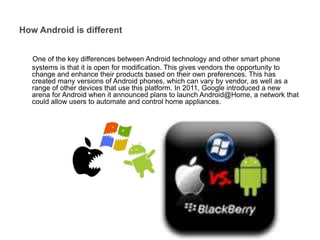
One of the key differences between Android technology and other smart phone
systems is that it is open for modification. This gives vendors the opportunity to
change and enhance their products based on their own preferences. This has
created many versions of Android phones, which can vary by vendor, as well as a
range of other devices that use this platform. In 2011, Google introduced a new
arena for Android when it announced plans to launch Android@Home, a network that
could allow users to automate and control home appliances.
How Android is different
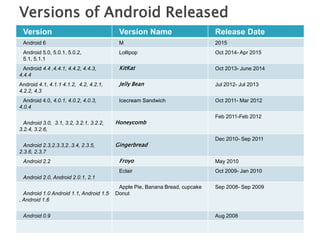
Version Version Name Release Date
Android 6 M 2015
Android 5.0, 5.0.1, 5.0.2,
5.1, 5.1.1
Lollipop Oct 2014- Apr 2015
Android 4.4 ,4.4.1, 4.4.2, 4.4.3,
4.4.4
KitKat Oct 2013- June 2014
Android 4.1, 4.1.1 4.1.2, 4.2, 4.2.1,
4.2.2, 4.3
Jelly Bean Jul 2012- Jul 2013
Android 4.0, 4.0.1, 4.0.2, 4.0.3,
4.0.4
Icecream Sandwich Oct 2011- Mar 2012
Android 3.0, 3.1, 3.2, 3.2.1, 3.2.2,
3.2.4, 3.2.6,
Honeycomb
Feb 2011-Feb 2012
Android 2.3,2.3.3,2..3.4, 2.3.5,
2.3.6, 2.3.7
Gingerbread
Dec 2010- Sep 2011
Android 2.2 Froyo May 2010
Android 2.0, Android 2.0.1, 2.1
Eclair Oct 2009- Jan 2010
Android 1.0 Android 1.1, Android 1.5
, Android 1.6
Apple Pie, Banana Bread, cupcake
Donut
Sep 2008- Sep 2009
Android 0.9 Aug 2008
Versions of Android Released
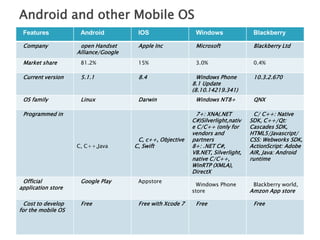
Features Android IOS Windows Blackberry
Company open Handset
Alliance/Google
Apple Inc Microsoft Blackberry Ltd
Market share 81.2% 15% 3.0% 0.4%
Current version 5.1.1 8.4 Windows Phone
8.1 Update
(8.10.14219.341)
10.3.2.670
OS family Linux Darwin Windows NT8+ QNX
Programmed in
C, C++,Java
C, c++, Objective
C, Swift
7+: XNA(.NET
C#)Silverlight,nativ
e C/C++ (only for
vendors and
partners
8+: .NET C#,
VB.NET, Silverlight,
native C/C++,
WinRTP (XMLA),
DirectX
C/ C++: Native
SDK, C++/Qt:
Cascades SDK,
HTML5/Javascript/
CSS: Webworks SDK,
ActionScript: Adobe
AIR, Java: Android
runtime
Official
application store
Google Play Appstore
Windows Phone
store
Blackberry world,
Amzon App store
Cost to develop
for the mobile OS
Free Free with Xcode 7 Free Free
Android and other Mobile OS
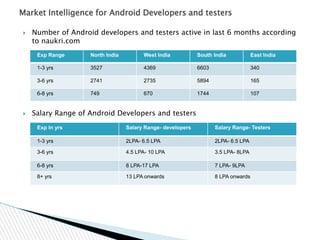
 Number of Android developers and testers active in last 6 months according
to naukri.com
 Salary Range of Android Developers and testers
Market Intelligence for Android Developers and testers
Exp Range North India West India South India East India
1-3 yrs 3527 4369 6603 340
3-6 yrs 2741 2735 5894 165
6-8 yrs 749 670 1744 107
Exp in yrs Salary Range- developers Salary Range- Testers
1-3 yrs 2LPA- 6.5 LPA 2LPA- 6.5 LPA
3-6 yrs 4.5 LPA- 10 LPA 3.5 LPA- 8LPA
6-8 yrs 8 LPA-17 LPA 7 LPA- 9LPA
8+ yrs 13 LPA onwards 8 LPA onwards
Availibility of resources in terms of
notice period
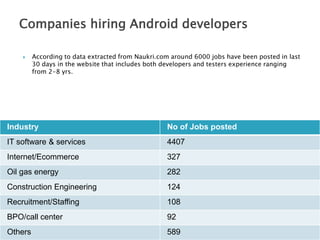
 According to data extracted from Naukri.com around 6000 jobs have been posted in last
30 days in the website that includes both developers and testers experience ranging
from 2-8 yrs.
Companies hiring Android developers
Industry No of Jobs posted
IT software & services 4407
Internet/Ecommerce 327
Oil gas energy 282
Construction Engineering 124
Recruitment/Staffing 108
BPO/call center 92
Others 589
The mobile application industry is considered
a very competitive industry and mobile
application developer andmobile application
developement firms must do everything in
their authority to ensure they remain on top
of their competition in order to survive in the
mobile application industry.
Today market demand for applications that
can run on iOS, Android and Html-5-based
mobile browsers is surging. The android
developers are getting flooded with the
requests to develop mobile
applications which are currently used in the
The mobile application industry is considered a very competitive industry and mobile application developer andmobile
application developement firms must do everything in their authority to ensure they remain on top of their competition in
order to survive in the mobile application industry.
Today market demand for applications that can run on iOS, Android and Html-5-based mobile browsers is surging. The
android developers are getting flooded with the requests to develop mobile applications which are currently used in the
development and manufacture of these apps for the tech markets.
According to the survey by BZ Research, 57.1% organizations are currently building mobile apps using Android and IOS and
there would be an increase of 13.2% more organizations in next six months. Out of the whole lot of organizations which
develop mobile apps, 88.1% are building apps for tablet PCs while 82.3% are busy making apps for smartphones. Android
app stores are in dire need for quality content, and their promotion opportunities for Android developers are the most
favorable. For instance, it’s 20 times more likely for a high-quality app to get featured on an alternative store than on
Google Play. One of the prospective strategies is to develop applications that are quite rare and very specialized but are in
high demand.
According to a January 2015 Gartner report, "Android surpassed a billion shipments of devices in 2014, and will continue to
grow at a double-digit pace in 2016, with a 26 percent increase year over year." This made it the first time that any
general-purpose operating system has reached more than one billion end users within a year: by reaching close to 1.16
billion end users in 2014, Android shipped over four times more than iOS and OS X combined, and over three times more
than Microsoft Windows. Gartner expected the whole mobile phone market to "reach two billion units in 2016", including
Android
.
Future of Android
Android as a technology

Android as a technology

  • 1.
    Android as atechnology
  • 2.
     Introduction  Historyof Android  Android Appilcations  How Android is different  Programming for Android  Subskills of Android  Android in competetion with other technologies  Market Intelligence for Android developers, support and testing resources  Android in future Topics of Discussion
  • 3.
     Android isa computing platform designed for use in some smart phones and other devices. This technology, which is owned by Google, Inc., includes an operating system, software, and applications. The operating system is based on Linux®, which provides advanced computer processing. Android™ technology is maintained and continually developed by the Android Open Source Project (AOSP).  History of Android  Google purchased Android Inc., a 22-month-old Palo Alto, California, startup in July 2005. Android Inc. was co- founded by Andy Rubin, maker of mobile device Danger Inc.™ The purchase was key in Google's move into the wireless technology market. In 2008, Google introduced the HTC Dream™ as the first marketed phone to use Android™ technology. Since that time, this platform use has expanded to other smart phones, tablet computers, E-readers, netbooks, and other devices.  Android Appilcations Although Android technology is increasingly being used on a range of devices, the most common hardware to use this platform is mobile phones. A large community of developers regularly write applications (apps), including games, social networking, and business modules, for Android smart phones. There are a wide range of free Android apps, including games and productivity titles, and paid apps are even more common. Android products — which are used by thousands of developers because they are freely available for download — has given software developers the opportunity to sell their creations to a wide group of consumers. What is Android
  • 4.
    Android technology isbased on Java software applications. This technology requires the use of a special software development kit (SDK) to create applications for an Android device. The SDK is freely available for download from the Internet. For this reason, and because it will work on multiple operating systems, many software developers prefer Android products over those used in other smart phones. Android technology provides specific application programming interface (API) modules to developers that take advantage of this. The touch screen enables the user to select and scroll through information with the stroke of a finger. However there are other supporting programming languages that can be used to develop Android: C++ - NDK for libraries, not apps  Python, bash, et. al. - Via the Scripting Environment  Corona- One is to use the Corona SDK . Corona is a high level SDK built on the LUA programming language. LUA is much simpler to learn than Java and the SDK takes away a lot of the pain in developing Android app.  Phonegap technology / Cardova - which used HTML 5, JavaScript, CSS Programming for Android
  • 5.
    One of thekey differences between Android technology and other smart phone systems is that it is open for modification. This gives vendors the opportunity to change and enhance their products based on their own preferences. This has created many versions of Android phones, which can vary by vendor, as well as a range of other devices that use this platform. In 2011, Google introduced a new arena for Android when it announced plans to launch Android@Home, a network that could allow users to automate and control home appliances. How Android is different
  • 6.
    Version Version NameRelease Date Android 6 M 2015 Android 5.0, 5.0.1, 5.0.2, 5.1, 5.1.1 Lollipop Oct 2014- Apr 2015 Android 4.4 ,4.4.1, 4.4.2, 4.4.3, 4.4.4 KitKat Oct 2013- June 2014 Android 4.1, 4.1.1 4.1.2, 4.2, 4.2.1, 4.2.2, 4.3 Jelly Bean Jul 2012- Jul 2013 Android 4.0, 4.0.1, 4.0.2, 4.0.3, 4.0.4 Icecream Sandwich Oct 2011- Mar 2012 Android 3.0, 3.1, 3.2, 3.2.1, 3.2.2, 3.2.4, 3.2.6, Honeycomb Feb 2011-Feb 2012 Android 2.3,2.3.3,2..3.4, 2.3.5, 2.3.6, 2.3.7 Gingerbread Dec 2010- Sep 2011 Android 2.2 Froyo May 2010 Android 2.0, Android 2.0.1, 2.1 Eclair Oct 2009- Jan 2010 Android 1.0 Android 1.1, Android 1.5 , Android 1.6 Apple Pie, Banana Bread, cupcake Donut Sep 2008- Sep 2009 Android 0.9 Aug 2008 Versions of Android Released
  • 7.
    Features Android IOSWindows Blackberry Company open Handset Alliance/Google Apple Inc Microsoft Blackberry Ltd Market share 81.2% 15% 3.0% 0.4% Current version 5.1.1 8.4 Windows Phone 8.1 Update (8.10.14219.341) 10.3.2.670 OS family Linux Darwin Windows NT8+ QNX Programmed in C, C++,Java C, c++, Objective C, Swift 7+: XNA(.NET C#)Silverlight,nativ e C/C++ (only for vendors and partners 8+: .NET C#, VB.NET, Silverlight, native C/C++, WinRTP (XMLA), DirectX C/ C++: Native SDK, C++/Qt: Cascades SDK, HTML5/Javascript/ CSS: Webworks SDK, ActionScript: Adobe AIR, Java: Android runtime Official application store Google Play Appstore Windows Phone store Blackberry world, Amzon App store Cost to develop for the mobile OS Free Free with Xcode 7 Free Free Android and other Mobile OS
  • 8.
     Number ofAndroid developers and testers active in last 6 months according to naukri.com  Salary Range of Android Developers and testers Market Intelligence for Android Developers and testers Exp Range North India West India South India East India 1-3 yrs 3527 4369 6603 340 3-6 yrs 2741 2735 5894 165 6-8 yrs 749 670 1744 107 Exp in yrs Salary Range- developers Salary Range- Testers 1-3 yrs 2LPA- 6.5 LPA 2LPA- 6.5 LPA 3-6 yrs 4.5 LPA- 10 LPA 3.5 LPA- 8LPA 6-8 yrs 8 LPA-17 LPA 7 LPA- 9LPA 8+ yrs 13 LPA onwards 8 LPA onwards
  • 9.
    Availibility of resourcesin terms of notice period
  • 10.
     According todata extracted from Naukri.com around 6000 jobs have been posted in last 30 days in the website that includes both developers and testers experience ranging from 2-8 yrs. Companies hiring Android developers Industry No of Jobs posted IT software & services 4407 Internet/Ecommerce 327 Oil gas energy 282 Construction Engineering 124 Recruitment/Staffing 108 BPO/call center 92 Others 589
  • 11.
    The mobile applicationindustry is considered a very competitive industry and mobile application developer andmobile application developement firms must do everything in their authority to ensure they remain on top of their competition in order to survive in the mobile application industry. Today market demand for applications that can run on iOS, Android and Html-5-based mobile browsers is surging. The android developers are getting flooded with the requests to develop mobile applications which are currently used in the
  • 12.
    The mobile applicationindustry is considered a very competitive industry and mobile application developer andmobile application developement firms must do everything in their authority to ensure they remain on top of their competition in order to survive in the mobile application industry. Today market demand for applications that can run on iOS, Android and Html-5-based mobile browsers is surging. The android developers are getting flooded with the requests to develop mobile applications which are currently used in the development and manufacture of these apps for the tech markets. According to the survey by BZ Research, 57.1% organizations are currently building mobile apps using Android and IOS and there would be an increase of 13.2% more organizations in next six months. Out of the whole lot of organizations which develop mobile apps, 88.1% are building apps for tablet PCs while 82.3% are busy making apps for smartphones. Android app stores are in dire need for quality content, and their promotion opportunities for Android developers are the most favorable. For instance, it’s 20 times more likely for a high-quality app to get featured on an alternative store than on Google Play. One of the prospective strategies is to develop applications that are quite rare and very specialized but are in high demand. According to a January 2015 Gartner report, "Android surpassed a billion shipments of devices in 2014, and will continue to grow at a double-digit pace in 2016, with a 26 percent increase year over year." This made it the first time that any general-purpose operating system has reached more than one billion end users within a year: by reaching close to 1.16 billion end users in 2014, Android shipped over four times more than iOS and OS X combined, and over three times more than Microsoft Windows. Gartner expected the whole mobile phone market to "reach two billion units in 2016", including Android . Future of Android