What is ANDROID
• Google's Android is an open-source platform that's
currently available on a wide variety of smart phones.
• Android is a software stack for
mobile devices that includes an
operating system, middleware and
key applications.
THE ANDROID’S BEGINNIG
Android, Inc. was founded in Palo Alto,
California,USA in October 2003
FOUNDERS:
• Andy Rubin
(co-founder of Danger)
• Rich Miner
(co-founder of Wildfire Communications, Inc.),
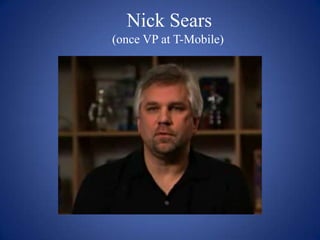
• Nick Sears
(once VP at T-Mobile)
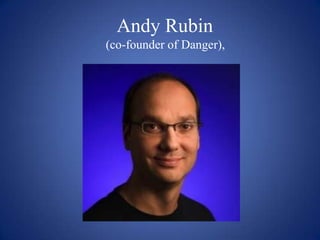
Andy Rubin
(co-founder of Danger),
Rich Miner
(co-founder of Wildfire Communications Inc.)
Nick Sears
(once VP at T-Mobile)
Open Handset Alliance
• Google’s android OS is an Operating System
that can be used in any android capable
device (Android smart phones)
• It is used in wide verity of android smart
phones & android tablets that are
manufactured by different companies
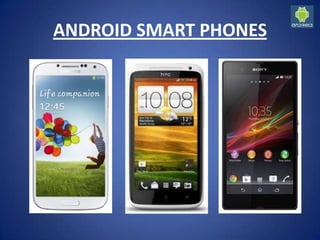
ANDROID SMART PHONES
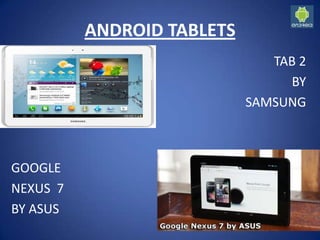
ANDROID TABLETS
GOOGLE
NEXUS 7
BY ASUS
TAB 2
BY
SAMSUNG
Open Handset Alliance
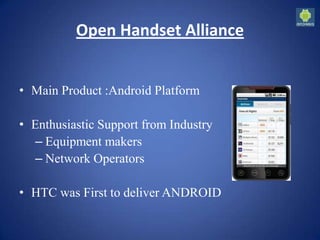
• Main Product :Android Platform
• Enthusiastic Support from Industry
– Equipment makers
– Network Operators
• HTC was First to deliver ANDROID
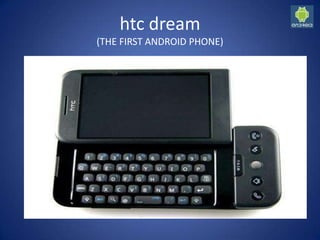
htc dream
(THE FIRST ANDROID PHONE)
ANDROID OS
(Operating System)
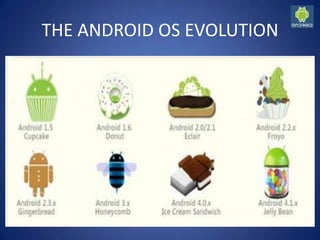
• The first Android OS is Cupcake 1.5
• The operating system has various
improvement since the beginning
• The newest OS is the Android 4.1.2
it is called JELLY BEAN
THE ANDROID OS EVOLUTION
ANDROID ARCHITECTURE
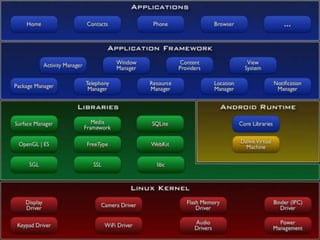
The software stack is split into Four Layers::
• The application layer
• The application framework
• The libraries and runtime
• The kernel
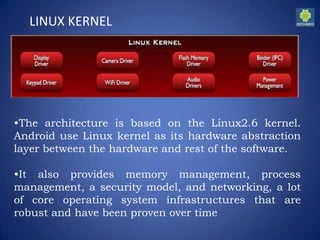
LINUX KERNEL
•The architecture is based on the Linux2.6 kernel.
Android use Linux kernel as its hardware abstraction
layer between the hardware and rest of the software.
•It also provides memory management, process
management, a security model, and networking, a lot
of core operating system infrastructures that are
robust and have been proven over time
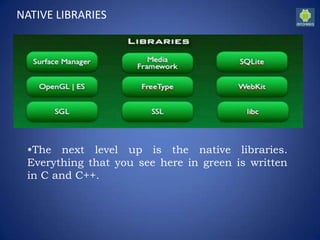
NATIVE LIBRARIES
•The next level up is the native libraries.
Everything that you see here in green is written
in C and C++.
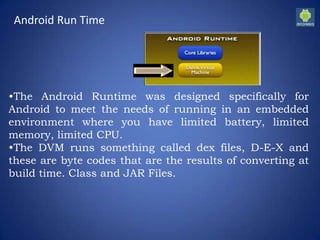
Android Run Time
•The Android Runtime was designed specifically for
Android to meet the needs of running in an embedded
environment where you have limited battery, limited
memory, limited CPU.
•The DVM runs something called dex files, D-E-X and
these are byte codes that are the results of converting at
build time. Class and JAR Files.
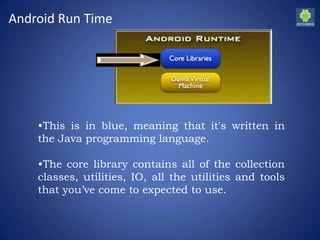
Android Run Time
•This is in blue, meaning that it's written in
the Java programming language.
•The core library contains all of the collection
classes, utilities, IO, all the utilities and tools
that you’ve come to expected to use.
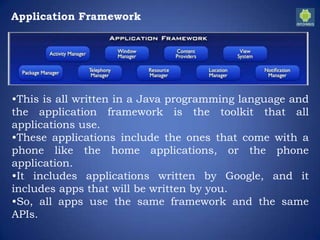
Application Framework
•This is all written in a Java programming language and
the application framework is the toolkit that all
applications use.
•These applications include the ones that come with a
phone like the home applications, or the phone
application.
•It includes applications written by Google, and it
includes apps that will be written by you.
•So, all apps use the same framework and the same
APIs.
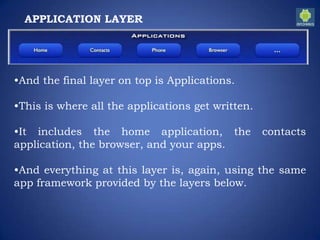
APPLICATION LAYER
•And the final layer on top is Applications.
•This is where all the applications get written.
•It includes the home application, the contacts
application, the browser, and your apps.
•And everything at this layer is, again, using the same
app framework provided by the layers below.
ADVANTAGES
•The ability for anyone to customize the Google Android platform
•The consumer will benefit from having a wide range of mobile
applications to choose from since the monopoly will be broken by
Google Android
•Users will be able to customize a mobile phones using Google
Android platform like never before
•Features like weather details, opening screen, live RSS feeds and
even the icons on the opening screen will be able to be customized
•As a result of many mobile phones carrying Google Android,
companies will come up with such innovative products like the
location
•In addition the entertainment functionalities will be taken a notch
higher by Google Android being able to offer online real time
multiplayer games
LIMITATIONS OF ANDROID
Development requirements in
Java
Android SDK
Eclipse IDE (optional)
Bluetooth limitations
Firefox mobile isn't coming to android
because of android limitations
CONCLUSION
We hope that the next versions of Android have
overcome the actual limitations and that the
future possibilities became a reality and may this
software is also developed to use in PC’s also.

Android

  • 2.
    What is ANDROID •Google's Android is an open-source platform that's currently available on a wide variety of smart phones. • Android is a software stack for mobile devices that includes an operating system, middleware and key applications.
  • 3.
    THE ANDROID’S BEGINNIG Android,Inc. was founded in Palo Alto, California,USA in October 2003 FOUNDERS: • Andy Rubin (co-founder of Danger) • Rich Miner (co-founder of Wildfire Communications, Inc.), • Nick Sears (once VP at T-Mobile)
  • 4.
  • 5.
    Rich Miner (co-founder ofWildfire Communications Inc.)
  • 6.
    Nick Sears (once VPat T-Mobile)
  • 7.
    Open Handset Alliance •Google’s android OS is an Operating System that can be used in any android capable device (Android smart phones) • It is used in wide verity of android smart phones & android tablets that are manufactured by different companies
  • 8.
  • 9.
    ANDROID TABLETS GOOGLE NEXUS 7 BYASUS TAB 2 BY SAMSUNG
  • 10.
    Open Handset Alliance •Main Product :Android Platform • Enthusiastic Support from Industry – Equipment makers – Network Operators • HTC was First to deliver ANDROID
  • 11.
    htc dream (THE FIRSTANDROID PHONE)
  • 12.
    ANDROID OS (Operating System) •The first Android OS is Cupcake 1.5 • The operating system has various improvement since the beginning • The newest OS is the Android 4.1.2 it is called JELLY BEAN
  • 13.
    THE ANDROID OSEVOLUTION
  • 14.
    ANDROID ARCHITECTURE The softwarestack is split into Four Layers:: • The application layer • The application framework • The libraries and runtime • The kernel
  • 16.
    LINUX KERNEL •The architectureis based on the Linux2.6 kernel. Android use Linux kernel as its hardware abstraction layer between the hardware and rest of the software. •It also provides memory management, process management, a security model, and networking, a lot of core operating system infrastructures that are robust and have been proven over time
  • 17.
    NATIVE LIBRARIES •The nextlevel up is the native libraries. Everything that you see here in green is written in C and C++.
  • 18.
    Android Run Time •TheAndroid Runtime was designed specifically for Android to meet the needs of running in an embedded environment where you have limited battery, limited memory, limited CPU. •The DVM runs something called dex files, D-E-X and these are byte codes that are the results of converting at build time. Class and JAR Files.
  • 19.
    Android Run Time •Thisis in blue, meaning that it's written in the Java programming language. •The core library contains all of the collection classes, utilities, IO, all the utilities and tools that you’ve come to expected to use.
  • 20.
    Application Framework •This isall written in a Java programming language and the application framework is the toolkit that all applications use. •These applications include the ones that come with a phone like the home applications, or the phone application. •It includes applications written by Google, and it includes apps that will be written by you. •So, all apps use the same framework and the same APIs.
  • 21.
    APPLICATION LAYER •And thefinal layer on top is Applications. •This is where all the applications get written. •It includes the home application, the contacts application, the browser, and your apps. •And everything at this layer is, again, using the same app framework provided by the layers below.
  • 22.
    ADVANTAGES •The ability foranyone to customize the Google Android platform •The consumer will benefit from having a wide range of mobile applications to choose from since the monopoly will be broken by Google Android •Users will be able to customize a mobile phones using Google Android platform like never before •Features like weather details, opening screen, live RSS feeds and even the icons on the opening screen will be able to be customized •As a result of many mobile phones carrying Google Android, companies will come up with such innovative products like the location •In addition the entertainment functionalities will be taken a notch higher by Google Android being able to offer online real time multiplayer games
  • 23.
    LIMITATIONS OF ANDROID Developmentrequirements in Java Android SDK Eclipse IDE (optional) Bluetooth limitations Firefox mobile isn't coming to android because of android limitations
  • 24.
    CONCLUSION We hope thatthe next versions of Android have overcome the actual limitations and that the future possibilities became a reality and may this software is also developed to use in PC’s also.