CONCEPT OF ANDROID
OS BY
AJITH KUMAR
CONTENTS
• PREFACE
• ANDROID WHAT AND WHY ?
• VERSIONS OF ANDROID
• ARCHITECHTURE OF ANDROID WITH LAYERS
• SECURITY AND PRIVACY
• DEMO
• APPLICATIONS
• BEYOND SMARTPHONES AND TABLETS
• FUTURE DEVELOPMENTS
• IMAGES
PREFACE
This presentation is delivered to you for improving the
knowledge about android Operating system which is now the order
of the day. According to our view this Android is a boon for
everyone. At this time we would like to convey our gratitude to our
Parents and all our friends and for encouraging us to prepare this
presentation.
ANDROID WHAT AND WHY?
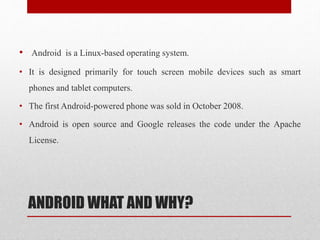
• Android is a Linux-based operating system.
• It is designed primarily for touch screen mobile devices such as smart
phones and tablet computers.
• The first Android-powered phone was sold in October 2008.
• Android is open source and Google releases the code under the Apache
License.
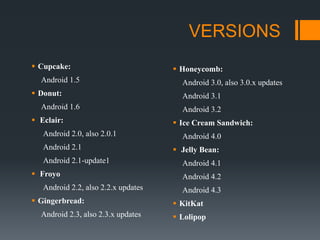
VERSIONS
 Cupcake:
Android 1.5
 Donut:
Android 1.6
 Eclair:
Android 2.0, also 2.0.1
Android 2.1
Android 2.1-update1
 Froyo
Android 2.2, also 2.2.x updates
 Gingerbread:
Android 2.3, also 2.3.x updates
 Honeycomb:
Android 3.0, also 3.0.x updates
Android 3.1
Android 3.2
 Ice Cream Sandwich:
Android 4.0
 Jelly Bean:
Android 4.1
Android 4.2
Android 4.3
 KitKat
 Lolipop
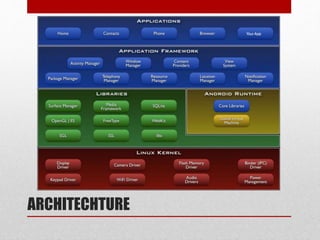
ARCHITECHTURE
LINUX KERNAL
 The basic layer is the Linux kernel.
 It is this Linux that interacts with the hardware and contains all the
essential hardware drivers.
 Android uses the Linux for all its core functionality such as
Memory management, process management, networking, security
settings etc.
APPLICATION FRAMEWORK
• These are the blocks that our applications directly interacts with.
• These programs manage the basic functions of phone like resource
management, voice call management etc.
LIBRARIES
 Surface Manager
It is used for compositing window manager with off-screen buffering.
 Media framework
Media framework provides the recording and playback of different media
formats.
 SQ Lite
SQ Lite is the database engine used in android for data storage purposes.
 Web Kit
It is the browser engine used to display HTML content.
LIBRARIES
• OpenGL
Used to render 2D or 3D graphics content to the screen.
• Android Runtime
Android Runtime consists of Dalvik Virtual machine and Core Java
libraries.
• Dalvik Virtual Machine
It is developed by Dan Bornstein of Google.
APPLICATIONS
 Applications are the top layer in the Android architecture and this is where
our applications are gonna fit.
 Several standard applications come Pre-installed with every device, such
as:
SMS client app
Dialer
Web browser
Contact manager
MEMORY MANAGEMENT
• Android devices are usually battery-powered.
• Android manages the apps stored in memory automatically.
• This process is designed to be invisible to the user.
• Android is designed to manage memory (RAM) to keep power
consumption at a minimum, in contrast to desktop operating systems.
SECURITY AND PRIVACY
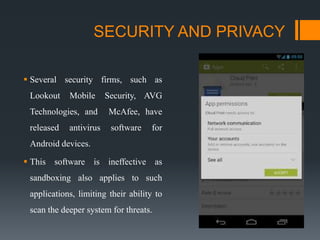
 Several security firms, such as
Lookout Mobile Security, AVG
Technologies, and McAfee, have
released antivirus software for
Android devices.
 This software is ineffective as
sandboxing also applies to such
applications, limiting their ability to
scan the deeper system for threats.
APPLICATIONS
• Applications are developed in the Java language using the Android
software development kit (SDK).
• The two major Android app stores are Google play store and Amazon
app store
BEYOND SMART PHONES AND TABLETS
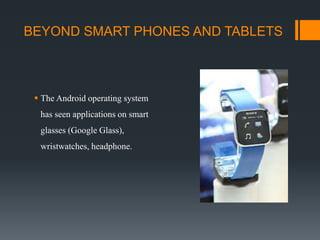
 The Android operating system
has seen applications on smart
glasses (Google Glass),
wristwatches, headphone.
FUTURE DEVELOPMENTS
• In 2011, Google demonstrated "Android @Home", a new home
automation technology which uses Android to control a range of
household devices including light switches, power sockets and
thermostats.
• Prototype light bulbs were announced that could be controlled from
an Android phone or tablet.

IMAGES
CREDITS & SOURCE
SOURCE:
 www.wikipedia.com
 www.google.com
 www.googleimages.com

ANDROID NEW EDITION

  • 1.
    CONCEPT OF ANDROID OSBY AJITH KUMAR
  • 2.
    CONTENTS • PREFACE • ANDROIDWHAT AND WHY ? • VERSIONS OF ANDROID • ARCHITECHTURE OF ANDROID WITH LAYERS • SECURITY AND PRIVACY • DEMO • APPLICATIONS • BEYOND SMARTPHONES AND TABLETS • FUTURE DEVELOPMENTS • IMAGES
  • 3.
    PREFACE This presentation isdelivered to you for improving the knowledge about android Operating system which is now the order of the day. According to our view this Android is a boon for everyone. At this time we would like to convey our gratitude to our Parents and all our friends and for encouraging us to prepare this presentation.
  • 4.
    ANDROID WHAT ANDWHY? • Android is a Linux-based operating system. • It is designed primarily for touch screen mobile devices such as smart phones and tablet computers. • The first Android-powered phone was sold in October 2008. • Android is open source and Google releases the code under the Apache License.
  • 5.
    VERSIONS  Cupcake: Android 1.5 Donut: Android 1.6  Eclair: Android 2.0, also 2.0.1 Android 2.1 Android 2.1-update1  Froyo Android 2.2, also 2.2.x updates  Gingerbread: Android 2.3, also 2.3.x updates  Honeycomb: Android 3.0, also 3.0.x updates Android 3.1 Android 3.2  Ice Cream Sandwich: Android 4.0  Jelly Bean: Android 4.1 Android 4.2 Android 4.3  KitKat  Lolipop
  • 7.
  • 8.
    LINUX KERNAL  Thebasic layer is the Linux kernel.  It is this Linux that interacts with the hardware and contains all the essential hardware drivers.  Android uses the Linux for all its core functionality such as Memory management, process management, networking, security settings etc.
  • 9.
    APPLICATION FRAMEWORK • Theseare the blocks that our applications directly interacts with. • These programs manage the basic functions of phone like resource management, voice call management etc.
  • 10.
    LIBRARIES  Surface Manager Itis used for compositing window manager with off-screen buffering.  Media framework Media framework provides the recording and playback of different media formats.  SQ Lite SQ Lite is the database engine used in android for data storage purposes.  Web Kit It is the browser engine used to display HTML content.
  • 11.
    LIBRARIES • OpenGL Used torender 2D or 3D graphics content to the screen. • Android Runtime Android Runtime consists of Dalvik Virtual machine and Core Java libraries. • Dalvik Virtual Machine It is developed by Dan Bornstein of Google.
  • 12.
    APPLICATIONS  Applications arethe top layer in the Android architecture and this is where our applications are gonna fit.  Several standard applications come Pre-installed with every device, such as: SMS client app Dialer Web browser Contact manager
  • 13.
    MEMORY MANAGEMENT • Androiddevices are usually battery-powered. • Android manages the apps stored in memory automatically. • This process is designed to be invisible to the user. • Android is designed to manage memory (RAM) to keep power consumption at a minimum, in contrast to desktop operating systems.
  • 14.
    SECURITY AND PRIVACY Several security firms, such as Lookout Mobile Security, AVG Technologies, and McAfee, have released antivirus software for Android devices.  This software is ineffective as sandboxing also applies to such applications, limiting their ability to scan the deeper system for threats.
  • 16.
    APPLICATIONS • Applications aredeveloped in the Java language using the Android software development kit (SDK). • The two major Android app stores are Google play store and Amazon app store
  • 17.
    BEYOND SMART PHONESAND TABLETS  The Android operating system has seen applications on smart glasses (Google Glass), wristwatches, headphone.
  • 18.
    FUTURE DEVELOPMENTS • In2011, Google demonstrated "Android @Home", a new home automation technology which uses Android to control a range of household devices including light switches, power sockets and thermostats. • Prototype light bulbs were announced that could be controlled from an Android phone or tablet.
  • 19.
  • 20.
    CREDITS & SOURCE SOURCE: www.wikipedia.com  www.google.com  www.googleimages.com