Overview Of Android
Made by:- Ank
Usn:- 1BY12MCA06
What is Android?
 History & Versions
Open source alliances
Open handset alliances
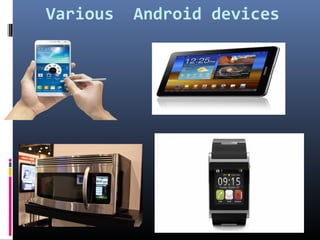
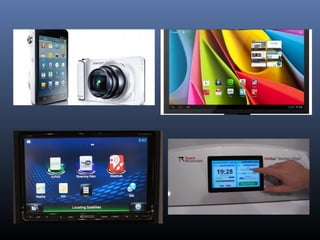
Various Android devices
Android Architecture overviews
Android market
Android framework and layers
Advantages
Limitations
Conclusion
Contents:-
What is ANDROID?
 Google's Android is  an  open-source  platform  that's 
currently available on a wide variety of smart phones 
and devices.
 Android is a software stack for
    smart phone devices that includes an 
    operating system, middleware and 
    key applications.
History
 The version history of the Android mobile system began
with the release of the Android beta in 5 November 2007.
The first commercial version, Android 1.0, was released
in 23 September 2008.
 Android is under ongoing development by Google and
the Open Handset Alliance (OHA), and has seen a
number of updates to its base operating system since its
initial release.
 Since April 2009, Android versions have been developed
under a confectionery-themed code name and released in
alphabetical order; the exceptions are versions 1.0 and 1.1
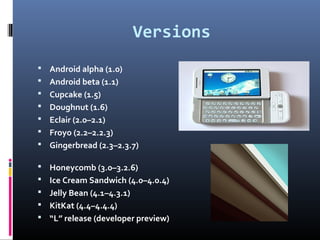
Versions
 Android alpha (1.0)
 Android beta (1.1)
 Cupcake (1.5)
 Doughnut (1.6)
 Eclair (2.0–2.1)
 Froyo (2.2–2.2.3)
 Gingerbread (2.3–2.3.7)
 Honeycomb (3.0–3.2.6)
 Ice Cream Sandwich (4.0–4.0.4)
 Jelly Bean (4.1–4.3.1)
 KitKat (4.4–4.4.4)
 “L” release (developer preview)
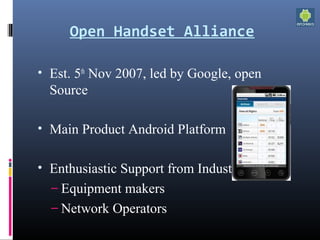
Open Handset Alliance
• Est. 5th
 Nov 2007, led by Google, open 
Source
• Main Product Android Platform
• Enthusiastic Support from Industry
– Equipment makers
– Network Operators
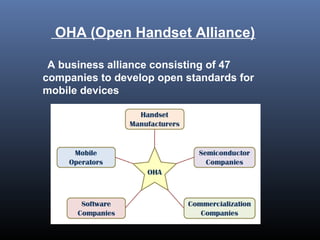
A business alliance consisting of 47
companies to develop open standards for
mobile devices
OHA (Open Handset Alliance)
Various Android devices
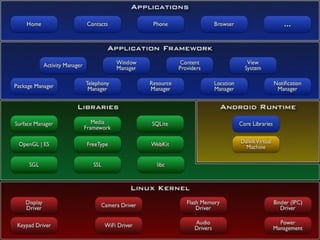
Android Architecture Overview
The software stack is split into Four
Layers::
• The application layer
• The application framework
• The libraries and runtime
• The kernel
LINUX
KERNEL
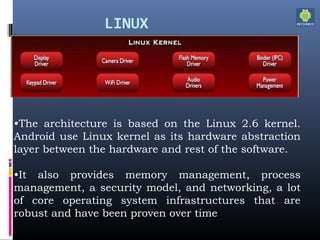
•The architecture is based on the Linux 2.6 kernel.
Android use Linux kernel as its hardware abstraction
layer between the hardware and rest of the software.
•It also provides memory management, process
management, a security model, and networking, a lot
of core operating system infrastructures that are
robust and have been proven over time
NATIVE LIBRARIES
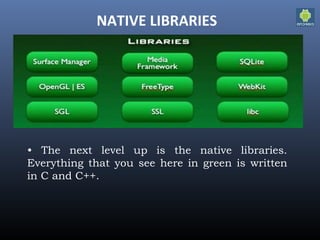
• The next level up is the native libraries.
Everything that you see here in green is written
in C and C++.
Android Run Time
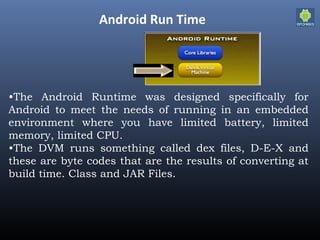
•The Android Runtime was designed specifically for
Android to meet the needs of running in an embedded
environment where you have limited battery, limited
memory, limited CPU.
•The DVM runs something called dex files, D-E-X and
these are byte codes that are the results of converting at
build time. Class and JAR Files.
Android Run Time
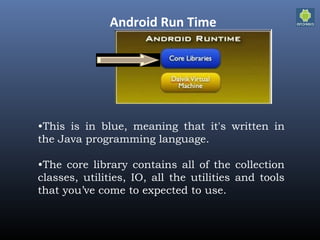
•This is in blue, meaning that it's written in
the Java programming language.
•The core library contains all of the collection
classes, utilities, IO, all the utilities and tools
that you’ve come to expected to use.
 
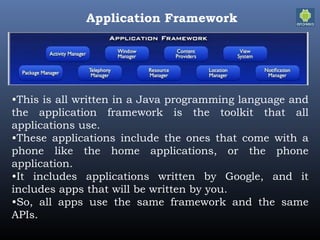
Application Framework
•This is all written in a Java programming language and
the application framework is the toolkit that all
applications use.
•These applications include the ones that come with a
phone like the home applications, or the phone
application.
•It includes applications written by Google, and it
includes apps that will be written by you.
•So, all apps use the same framework and the same
APIs.
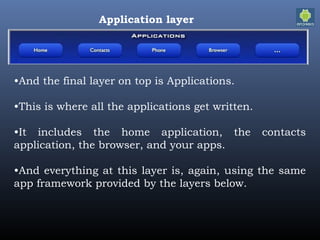
Application layer
•And the final layer on top is Applications.
•This is where all the applications get written.
•It includes the home application, the contacts
application, the browser, and your apps.
•And everything at this layer is, again, using the same
app framework provided by the layers below.
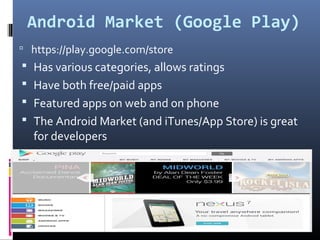
Android Market (Google Play)
 https://play.google.com/store
 Has various categories, allows ratings
 Have both free/paid apps
 Featured apps on web and on phone
 The Android Market (and iTunes/App Store) is great
for developers
ADVANTAGES
•The ability for anyone to customize the Google Android platform
•The consumer will benefit from having a wide range of mobile
applications to choose from since the monopoly will be broken by
Google Android
•Men will be able to customize a mobile phones using Google
Android platform like never before
•Features like weather details, opening screen, live RSS feeds and
even the icons on the opening screen will be able to be customized
•As a result of many mobile phones carrying Google Android,
companies will come up with such innovative products like the
location
•In addition the entertainment functionalities will be taken a notch
higher by Google Android being able to offer online real time
multiplayer games
LIMITATIONS OF ANDROID
Development requirements in
• Java
• Android SDK
• Eclipse IDE (optional)
• Bluetooth limitations
• Firefox mobile isn't coming to android because of android limitations
CONCLUSION
We hope that the next versions of
Android have overcome the actual
limitations and that the future
possibilities became a reality and may
this software is also developed to use in
PC’s also.
References
 http://www.android.com - Android Official Webpage
 http://code.google.com/android/ - Official Android
Google Code Webpage
 http://www.openhandsetalliance.com/ - Open
Handset Alliance Webpage
 http://www.androidwiki.com – Android Wiki
 H ttp://googleblog.blogspot.com/ - Official Google
Blog

http://en.wikipedia.org/wiki/Android_(mobile_phone_pla
tform)–Wikipedia
THANK YOU
Queries??????

android

  • 1.
    Overview Of Android Madeby:- Ank Usn:- 1BY12MCA06
  • 2.
    What is Android? History & Versions Open source alliances Open handset alliances Various Android devices Android Architecture overviews Android market Android framework and layers Advantages Limitations Conclusion Contents:-
  • 3.
    What is ANDROID? Google's Android is  an  open-source  platform  that's  currently available on a wide variety of smart phones  and devices.  Android is a software stack for     smart phone devices that includes an      operating system, middleware and      key applications.
  • 4.
    History  The versionhistory of the Android mobile system began with the release of the Android beta in 5 November 2007. The first commercial version, Android 1.0, was released in 23 September 2008.  Android is under ongoing development by Google and the Open Handset Alliance (OHA), and has seen a number of updates to its base operating system since its initial release.  Since April 2009, Android versions have been developed under a confectionery-themed code name and released in alphabetical order; the exceptions are versions 1.0 and 1.1
  • 5.
    Versions  Android alpha(1.0)  Android beta (1.1)  Cupcake (1.5)  Doughnut (1.6)  Eclair (2.0–2.1)  Froyo (2.2–2.2.3)  Gingerbread (2.3–2.3.7)  Honeycomb (3.0–3.2.6)  Ice Cream Sandwich (4.0–4.0.4)  Jelly Bean (4.1–4.3.1)  KitKat (4.4–4.4.4)  “L” release (developer preview)
  • 6.
    Open Handset Alliance •Est. 5th  Nov 2007, led by Google, open  Source • Main Product Android Platform • Enthusiastic Support from Industry – Equipment makers – Network Operators
  • 7.
    A business allianceconsisting of 47 companies to develop open standards for mobile devices OHA (Open Handset Alliance)
  • 8.
  • 10.
    Android Architecture Overview Thesoftware stack is split into Four Layers:: • The application layer • The application framework • The libraries and runtime • The kernel
  • 12.
    LINUX KERNEL •The architecture isbased on the Linux 2.6 kernel. Android use Linux kernel as its hardware abstraction layer between the hardware and rest of the software. •It also provides memory management, process management, a security model, and networking, a lot of core operating system infrastructures that are robust and have been proven over time
  • 13.
    NATIVE LIBRARIES • Thenext level up is the native libraries. Everything that you see here in green is written in C and C++.
  • 14.
    Android Run Time •TheAndroid Runtime was designed specifically for Android to meet the needs of running in an embedded environment where you have limited battery, limited memory, limited CPU. •The DVM runs something called dex files, D-E-X and these are byte codes that are the results of converting at build time. Class and JAR Files.
  • 15.
    Android Run Time •Thisis in blue, meaning that it's written in the Java programming language. •The core library contains all of the collection classes, utilities, IO, all the utilities and tools that you’ve come to expected to use.  
  • 16.
    Application Framework •This isall written in a Java programming language and the application framework is the toolkit that all applications use. •These applications include the ones that come with a phone like the home applications, or the phone application. •It includes applications written by Google, and it includes apps that will be written by you. •So, all apps use the same framework and the same APIs.
  • 17.
    Application layer •And thefinal layer on top is Applications. •This is where all the applications get written. •It includes the home application, the contacts application, the browser, and your apps. •And everything at this layer is, again, using the same app framework provided by the layers below.
  • 18.
    Android Market (GooglePlay)  https://play.google.com/store  Has various categories, allows ratings  Have both free/paid apps  Featured apps on web and on phone  The Android Market (and iTunes/App Store) is great for developers
  • 19.
    ADVANTAGES •The ability foranyone to customize the Google Android platform •The consumer will benefit from having a wide range of mobile applications to choose from since the monopoly will be broken by Google Android •Men will be able to customize a mobile phones using Google Android platform like never before •Features like weather details, opening screen, live RSS feeds and even the icons on the opening screen will be able to be customized •As a result of many mobile phones carrying Google Android, companies will come up with such innovative products like the location •In addition the entertainment functionalities will be taken a notch higher by Google Android being able to offer online real time multiplayer games
  • 20.
    LIMITATIONS OF ANDROID Developmentrequirements in • Java • Android SDK • Eclipse IDE (optional) • Bluetooth limitations • Firefox mobile isn't coming to android because of android limitations
  • 21.
    CONCLUSION We hope thatthe next versions of Android have overcome the actual limitations and that the future possibilities became a reality and may this software is also developed to use in PC’s also.
  • 22.
    References  http://www.android.com -Android Official Webpage  http://code.google.com/android/ - Official Android Google Code Webpage  http://www.openhandsetalliance.com/ - Open Handset Alliance Webpage  http://www.androidwiki.com – Android Wiki  H ttp://googleblog.blogspot.com/ - Official Google Blog  http://en.wikipedia.org/wiki/Android_(mobile_phone_pla tform)–Wikipedia
  • 23.