PRESENTED BY:-
SAGAR CHAVAN
AKSHIT MISTRY
Android Material
Sardar Vallabhbhai Patel Polytechnic
1.What is Android?
2.History
3.Android Architecture
1. Linux Kernel layer
2. Native Libraries
3. Android Runtime
4. Application Framework
5. Application
4.Application Life Cycle
5.Why Android?
6.Development Tools
7.Programming Language Used
8.Platform Usage
9.Applications
10.Advantages
11.Limitations
12.Future Scope
13.Conclusion
14.Bibliography
What is Android?
 Android is an operating system based on the Linux kernel, and
designed primarily for touchscreen mobile devices such as
smartphones and tablet computers
 Android's source code is released by Google under the Apache
License this permissive licensing allows the software to be freely
modified
History
 Google Inc. purchased the initial developer of the software in 2005.
from Android Inc. which was founded in Palo Alto, California,
United States in October, 2003 by Andy Rubin, Rich Miner.
 Open Handset Alliance was formed headed by Google which is
composed of companies like Intel, T-Mobile, Spring Nextel and
more.
Architecture
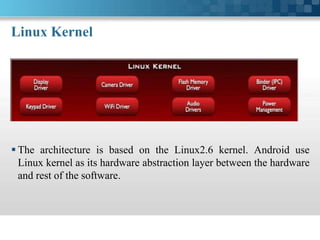
Linux Kernel
 The architecture is based on the Linux2.6 kernel. Android use
Linux kernel as its hardware abstraction layer between the hardware
and rest of the software.
Native Libraries
 The next level up is the native libraries. It Contain libraries for
Surface manager, SQLite etc.
Android Runtime
 This is in blue, meaning that it's written in the Java programming
 The DVM runs something called dex files, D-E-X and these are
byte codes that are the results of converting at build time. Class and
JAR Files.
Application Framework
This is all written in a Java programming language and
the application framework is the toolkit that all
applications use.
Application
And the final layer on top is Applications.
This is where all the applications get written.
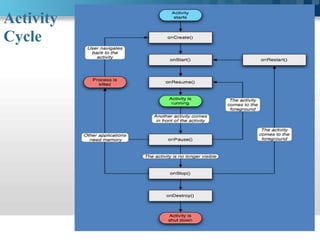
Activity
Cycle
Why Android??
 Open Source
 Flash Player Support
 Different Models
 Reasonable prices
 Google Apps
 Android Apps
Software Development
DEVELOPMENT REQUIREMENTS:-
• Java
• Android SDK
• Eclipse IDE +ADT Plugins
PROGRAMMING LANGUAGE USED:-
• Java – officially supported
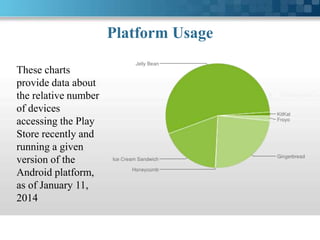
Platform Usage
These charts
provide data about
the relative number
of devices
accessing the Play
Store recently and
running a given
version of the
Android platform,
as of January 11,
2014
Advantages
 Android is open, because it is Linux based open source so it can be
developed by anyone.
 It is very user-friendly
 Easy access to the Android App Market: Android owners are people who
love to learn the phone, with Google's Android App Market you can
download applications for free.
 Easy in terms of notification: the operating system is able to inform you
of a new SMS, Email etc.
Limitations
 Wasteful Batteries, This is because the OS is a lot of "process" in
the background causing the battery quickly drains.
 Many Android phones are not as smooth or fast in operation as the
iPhone.
 The open platform also means that not every app will work on
every Android phone.
Applications
Android phones has many applications in our day-to-day life such
as:-
 Applications Like m-indicator
 Navigation
 E-mail Facility
 Quickly get the access to office documents
 Instant Messaging Applications
Future Possibilities
 Lock screens with shortcuts
Future Possibilities
 Better notifications
Future Possibilities
 Always-listening voice control
Future Possibilities
 Multi-touch swipe controls
Conclusion
Any Queries???
Bibliography
 http://www.techradar.com/news/software/operating-systems/android-in-2020-the-future-of-
google-s-mobile-os-explored-1168141
 http://developer.android.com/index.html
 http://efytimes.com/e1/fullnews.asp?edid=114450
 http://gizmodo.com/the-best-future-android-features-you-can-get-right-now-1183469083
 http://www.collegelib.com/t-an-introduction-to-android.html
THANK YOU

Android material2