[̲̅A̲̅][̲̅N̲̅][̲̅D̲̅][̲̅R̲̅][̲̅O̲̅][̲̅I̲̅][̲̅D̲̅]
THE NEXT GENERATION OPERATING SYSTEM
• Android Inc. was founded in Palo Alto
California on October 2003.One of the
founders of Android Inc, Andy Rubin wanted
to develop smarter mobile devices that are
more aware of its owner's location and
preferences.
• Later Google acquired Android Inc. on
August 17, 2005 and Rubin started working
with Google.
• At Google, the team led by Rubin developed a
mobile device platform powered by the Linux
kernel. And hence the android was developed.
• Android is a Linux-based operating system.
• Designed especially for Smartphone and
tablets, developed by Google combining with
other Open Handset Alliance (OHA).
• Initially Android was developed by Android
Inc which was later purchased by Google in
2005 and brought up with a project called
Android Open Source Project.
• Android being an open source has large
communities of developers writing
applications developed primarily in java.
• They are available to download from Google
play or other third party sites.
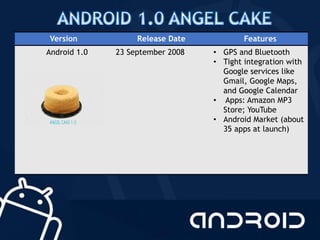
Version Release Date Features
Android 1.0 23 September 2008 • GPS and Bluetooth
• Tight integration with
Google services like
Gmail, Google Maps,
and Google Calendar
• Apps: Amazon MP3
Store; YouTube
• Android Market (about
35 apps at launch)
Version Release Date Features
Android 1.1 09 February 2009 • Market: Browsing
categories (Apps,
Games, Downloads)
and filters (Top Free,
Top Paid, Just In)
• Camera: Toggle
between camera and
video modes.
• Built in photo gallery
and camera with bulk
photo deleting
Version Release Date Features
Android 1.5 30 April 2009 • Virtual onscreen
keyboard
• Stereo Bluetooth
• Home screen widgets
and folders
• Direct upload to
YouTube and Picasa
Version Release Date Features
Android 1.6 15 September 2009 • Multiple User Account
• Search saved SMS and
MMS Messages
• Camera improvements
include support for
flash and digital zoom
• Bluetooth 2.1
Version Release Date Features
Android 2.0/2.1 26 October 2009 • Live wallpaper, up to
five home screens
• SPEECH-TO-TEXT
added to any text
field; microphone icon
for voice dictation in
e-mails, texts, and so
on
Version Release Date Features
Android 2.2 20 May 2010 • USB tethering and
hotspot support
• Android Market
update: Automatic
updates; installing
apps to the SD card
• Bluetooth support for
voice dialling and
contact sharing
Version Release Date Features
Android 2.3/2.3.7 06 December 2010 • Redesigned
copy/paste
• WebM video
compression support
• NFC (near-field
communication)
support
• Switch to front-facing
camera from camera
app
Version Release Date Features
Android 3.0-3.2 22 February 2011 • 3D graphics support
• Side-by-side browser
tabs; private browsing
• Video chatting with
Google Talk
• Bluetooth tethering
Version Release Date Features
Android 4.0 19 October 2011 • Support for
peripherals like
keyboards and game
pads
• Resizable widgets
• "Pay as you go"
support for 3G, 4G
tablets
• Various bug fixes and
enhancements
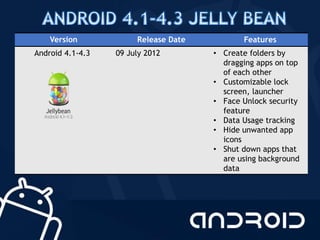
Version Release Date Features
Android 4.1-4.3 09 July 2012 • Create folders by
dragging apps on top
of each other
• Customizable lock
screen, launcher
• Face Unlock security
feature
• Data Usage tracking
• Hide unwanted app
icons
• Shut down apps that
are using background
data
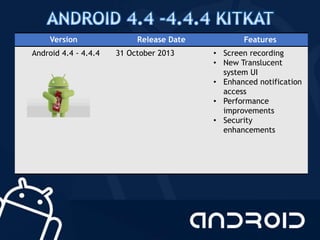
Version Release Date Features
Android 4.4 - 4.4.4 31 October 2013 • Screen recording
• New Translucent
system UI
• Enhanced notification
access
• Performance
improvements
• Security
enhancements
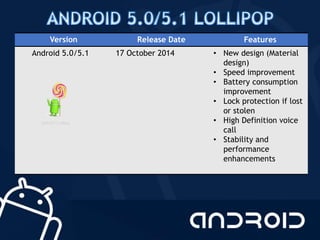
Version Release Date Features
Android 5.0/5.1 17 October 2014 • New design (Material
design)
• Speed improvement
• Battery consumption
improvement
• Lock protection if lost
or stolen
• High Definition voice
call
• Stability and
performance
enhancements
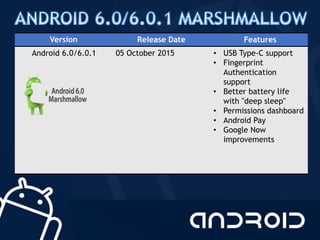
Version Release Date Features
Android 6.0/6.0.1 05 October 2015 • USB Type-C support
• Fingerprint
Authentication
support
• Better battery life
with "deep sleep"
• Permissions dashboard
• Android Pay
• Google Now
improvements
Version Release Date Features
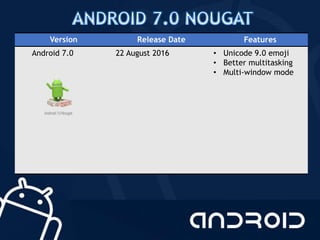
Android 7.0 22 August 2016 • Unicode 9.0 emoji
• Better multitasking
• Multi-window mode
1. STORAGE : SQLite, a lightweight relational
database, is used for data storage purposes.
2. CONNECTIVITY : Android supports
connectivity technologies including GSM ,EDGE,
CDMA, Bluetooth, WI-Fi, LTE And NFC.
3. MESSAGING: SMS and MMS are available
forms of messaging, including threaded text
messaging .
4. MULTIPLE LANGUAGE SUPPORT :
Android supports multiple languages.
5. WEB BROWSER : The web browser
available in Android is based on the open-source
Web Kit layout engine, coupled with Chrome’s
V8 JavaScript engine.
6. MULTI-TOUCH : Android has native
support for multi-touch .
7. SCREEN CAPTURE : Android supports capturing
a screenshot by pressing the power and volume-down
buttons at the same time.
8. TETHERING: Android supports tethering, which
allows a phone to be used as wireless/wired Wi-Fi
hotspot
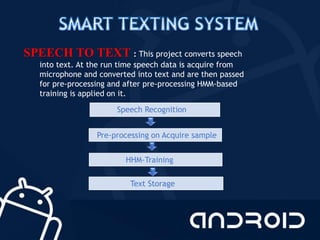
SPEECH TO TEXT : This project converts speech
into text. At the run time speech data is acquire from
microphone and converted into text and are then passed
for pre-processing and after pre-processing HMM-based
training is applied on it.
Speech Recognition
Pre-processing on Acquire sample
HHM-Training
Text Storage
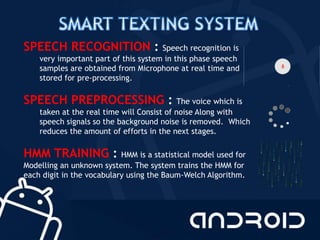
SPEECH RECOGNITION : Speech recognition is
very important part of this system in this phase speech
samples are obtained from Microphone at real time and
stored for pre-processing.
SPEECH PREPROCESSING : The voice which is
taken at the real time will Consist of noise Along with
speech signals so the background noise is removed. Which
reduces the amount of efforts in the next stages.
HMM TRAINING : HMM is a statistical model used for
Modelling an unknown system. The system trains the HMM for
each digit in the vocabulary using the Baum-Welch Algorithm.
From the Power Point Presentation We have
learned about “Android Operating System”... And
it’s “Versions” .The Services offered by the
Android Operating System.
Then We have learned about Smart Texting
System i.e “Speech-To–Text” .Which converts
speech to Text.
All About Android And Smart Texting System.

All About Android And Smart Texting System.

  • 1.
  • 2.
    • Android Inc.was founded in Palo Alto California on October 2003.One of the founders of Android Inc, Andy Rubin wanted to develop smarter mobile devices that are more aware of its owner's location and preferences. • Later Google acquired Android Inc. on August 17, 2005 and Rubin started working with Google. • At Google, the team led by Rubin developed a mobile device platform powered by the Linux kernel. And hence the android was developed.
  • 3.
    • Android isa Linux-based operating system. • Designed especially for Smartphone and tablets, developed by Google combining with other Open Handset Alliance (OHA). • Initially Android was developed by Android Inc which was later purchased by Google in 2005 and brought up with a project called Android Open Source Project. • Android being an open source has large communities of developers writing applications developed primarily in java. • They are available to download from Google play or other third party sites.
  • 5.
    Version Release DateFeatures Android 1.0 23 September 2008 • GPS and Bluetooth • Tight integration with Google services like Gmail, Google Maps, and Google Calendar • Apps: Amazon MP3 Store; YouTube • Android Market (about 35 apps at launch)
  • 6.
    Version Release DateFeatures Android 1.1 09 February 2009 • Market: Browsing categories (Apps, Games, Downloads) and filters (Top Free, Top Paid, Just In) • Camera: Toggle between camera and video modes. • Built in photo gallery and camera with bulk photo deleting
  • 7.
    Version Release DateFeatures Android 1.5 30 April 2009 • Virtual onscreen keyboard • Stereo Bluetooth • Home screen widgets and folders • Direct upload to YouTube and Picasa
  • 8.
    Version Release DateFeatures Android 1.6 15 September 2009 • Multiple User Account • Search saved SMS and MMS Messages • Camera improvements include support for flash and digital zoom • Bluetooth 2.1
  • 9.
    Version Release DateFeatures Android 2.0/2.1 26 October 2009 • Live wallpaper, up to five home screens • SPEECH-TO-TEXT added to any text field; microphone icon for voice dictation in e-mails, texts, and so on
  • 10.
    Version Release DateFeatures Android 2.2 20 May 2010 • USB tethering and hotspot support • Android Market update: Automatic updates; installing apps to the SD card • Bluetooth support for voice dialling and contact sharing
  • 11.
    Version Release DateFeatures Android 2.3/2.3.7 06 December 2010 • Redesigned copy/paste • WebM video compression support • NFC (near-field communication) support • Switch to front-facing camera from camera app
  • 12.
    Version Release DateFeatures Android 3.0-3.2 22 February 2011 • 3D graphics support • Side-by-side browser tabs; private browsing • Video chatting with Google Talk • Bluetooth tethering
  • 13.
    Version Release DateFeatures Android 4.0 19 October 2011 • Support for peripherals like keyboards and game pads • Resizable widgets • "Pay as you go" support for 3G, 4G tablets • Various bug fixes and enhancements
  • 14.
    Version Release DateFeatures Android 4.1-4.3 09 July 2012 • Create folders by dragging apps on top of each other • Customizable lock screen, launcher • Face Unlock security feature • Data Usage tracking • Hide unwanted app icons • Shut down apps that are using background data
  • 15.
    Version Release DateFeatures Android 4.4 - 4.4.4 31 October 2013 • Screen recording • New Translucent system UI • Enhanced notification access • Performance improvements • Security enhancements
  • 16.
    Version Release DateFeatures Android 5.0/5.1 17 October 2014 • New design (Material design) • Speed improvement • Battery consumption improvement • Lock protection if lost or stolen • High Definition voice call • Stability and performance enhancements
  • 17.
    Version Release DateFeatures Android 6.0/6.0.1 05 October 2015 • USB Type-C support • Fingerprint Authentication support • Better battery life with "deep sleep" • Permissions dashboard • Android Pay • Google Now improvements
  • 18.
    Version Release DateFeatures Android 7.0 22 August 2016 • Unicode 9.0 emoji • Better multitasking • Multi-window mode
  • 19.
    1. STORAGE :SQLite, a lightweight relational database, is used for data storage purposes. 2. CONNECTIVITY : Android supports connectivity technologies including GSM ,EDGE, CDMA, Bluetooth, WI-Fi, LTE And NFC. 3. MESSAGING: SMS and MMS are available forms of messaging, including threaded text messaging .
  • 20.
    4. MULTIPLE LANGUAGESUPPORT : Android supports multiple languages. 5. WEB BROWSER : The web browser available in Android is based on the open-source Web Kit layout engine, coupled with Chrome’s V8 JavaScript engine. 6. MULTI-TOUCH : Android has native support for multi-touch .
  • 21.
    7. SCREEN CAPTURE: Android supports capturing a screenshot by pressing the power and volume-down buttons at the same time. 8. TETHERING: Android supports tethering, which allows a phone to be used as wireless/wired Wi-Fi hotspot
  • 22.
    SPEECH TO TEXT: This project converts speech into text. At the run time speech data is acquire from microphone and converted into text and are then passed for pre-processing and after pre-processing HMM-based training is applied on it. Speech Recognition Pre-processing on Acquire sample HHM-Training Text Storage
  • 23.
    SPEECH RECOGNITION :Speech recognition is very important part of this system in this phase speech samples are obtained from Microphone at real time and stored for pre-processing. SPEECH PREPROCESSING : The voice which is taken at the real time will Consist of noise Along with speech signals so the background noise is removed. Which reduces the amount of efforts in the next stages. HMM TRAINING : HMM is a statistical model used for Modelling an unknown system. The system trains the HMM for each digit in the vocabulary using the Baum-Welch Algorithm.
  • 24.
    From the PowerPoint Presentation We have learned about “Android Operating System”... And it’s “Versions” .The Services offered by the Android Operating System. Then We have learned about Smart Texting System i.e “Speech-To–Text” .Which converts speech to Text.