Planning and Production of the Digipak
and Magazine Advert for ‘Coldplay’ and
their release of ‘Parachutes’
Ancillary Tasks
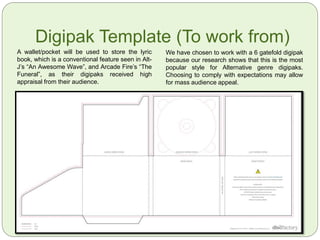
Digipak Template (To work from)
A wallet/pocket will be used to store the lyric
book, which is a conventional feature seen in Alt-
J’s “An Awesome Wave”, and Arcade Fire’s “The
Funeral”, as their digipaks received high
appraisal from their audience.
We have chosen to work with a 6 gatefold digipak
because our research shows that this is the most
popular style for Alternative genre digipaks.
Choosing to comply with expectations may allow
for mass audience appeal.
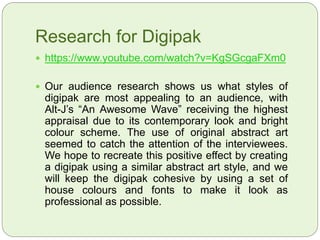
Research for Digipak
 https://www.youtube.com/watch?v=KgSGcgaFXm0
 Our audience research shows us what styles of
digipak are most appealing to an audience, with
Alt-J’s “An Awesome Wave” receiving the highest
appraisal due to its contemporary look and bright
colour scheme. The use of original abstract art
seemed to catch the attention of the interviewees.
We hope to recreate this positive effect by creating
a digipak using a similar abstract art style, and we
will keep the digipak cohesive by using a set of
house colours and fonts to make it look as
professional as possible.
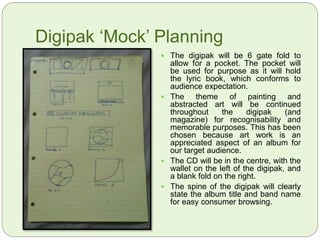
Digipak ‘Mock’ Planning
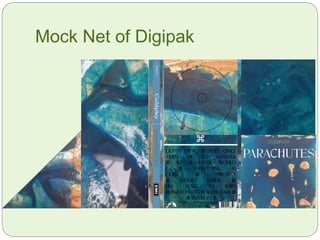
 The digipak will be 6 gate fold to
allow for a pocket. The pocket will
be used for purpose as it will hold
the lyric book, which conforms to
audience expectation.
 The theme of painting and
abstracted art will be continued
throughout the digipak (and
magazine) for recognisability and
memorable purposes. This has been
chosen because art work is an
appreciated aspect of an album for
our target audience.
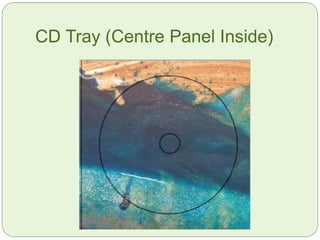
 The CD will be in the centre, with the
wallet on the left of the digipak, and
a blank fold on the right.
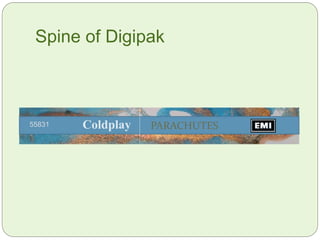
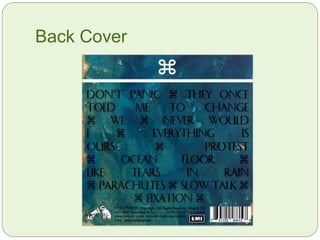
 The spine of the digipak will clearly
state the album title and band name
for easy consumer browsing.
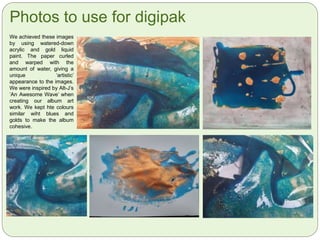
Photos to use for digipak
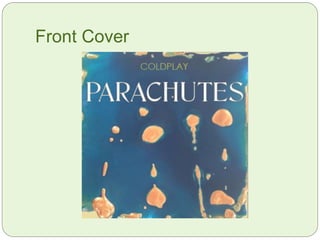
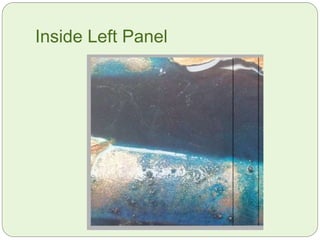
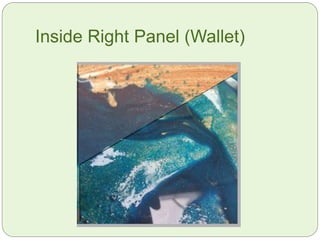
We achieved these images
by using watered-down
acrylic and gold liquid
paint. The paper curled
and warped with the
amount of water, giving a
unique ‘artistic’
appearance to the images.
We were inspired by Alt-J’s
‘An Awesome Wave’ when
creating our album art
work. We kept hte colours
similar wiht blues and
golds to make the album
cohesive.
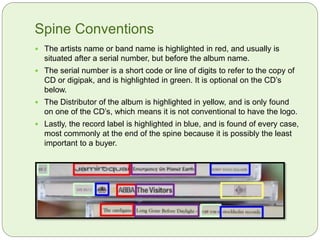
Spine Conventions
 The artists name or band name is highlighted in red, and usually is
situated after a serial number, but before the album name.
 The serial number is a short code or line of digits to refer to the copy of
CD or digipak, and is highlighted in green. It is optional on the CD’s
below.
 The Distributor of the album is highlighted in yellow, and is only found
on one of the CD’s, which means it is not conventional to have the logo.
 Lastly, the record label is highlighted in blue, and is found of every case,
most commonly at the end of the spine because it is possibly the least
important to a buyer.
Spine of Digipak
55831 Coldplay PARACHUTES
Front Cover
Back Cover
Inside Left Panel
CD Tray (Centre Panel Inside)
Inside Right Panel (Wallet)
Mock Net of Digipak
Digipak Lyric Book
 We decided to make a lyric book on Publisher. This was to portray the
conventional elements of our researched digipaks of the genre, as Arcade Fire
and Alt-J both had lyric books for their products.
 We kept the book looking cohesive and maintained the quirky original art-style
with images of paint splashes and a dirty paint palette.
CLOSE-UP OF LYRICS
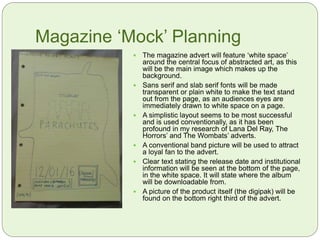
Magazine ‘Mock’ Planning
 The magazine advert will feature ‘white space’
around the central focus of abstracted art, as this
will be the main image which makes up the
background.
 Sans serif and slab serif fonts will be made
transparent or plain white to make the text stand
out from the page, as an audiences eyes are
immediately drawn to white space on a page.
 A simplistic layout seems to be most successful
and is used conventionally, as it has been
profound in my research of Lana Del Ray, The
Horrors’ and The Wombats’ adverts.
 A conventional band picture will be used to attract
a loyal fan to the advert.
 Clear text stating the release date and institutional
information will be seen at the bottom of the page,
in the white space. It will state where the album
will be downloadable from.
 A picture of the product itself (the digipak) will be
found on the bottom right third of the advert.
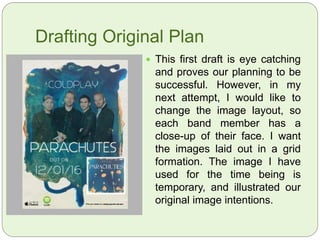
Drafting Original Plan
 This first draft is eye catching
and proves our planning to be
successful. However, in my
next attempt, I would like to
change the image layout, so
each band member has a
close-up of their face. I want
the images laid out in a grid
formation. The image I have
used for the time being is
temporary, and illustrated our
original image intentions.
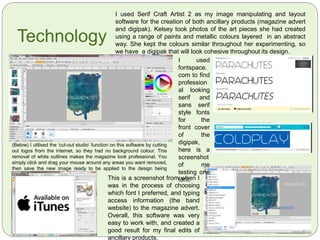
Technology
I used Serif Craft Artist 2 as my image manipulating and layout
software for the creation of both ancillary products (magazine advert
and digipak). Kelsey took photos of the art pieces she had created
using a range of paints and metallic colours layered in an abstract
way. She kept the colours similar throughout her experimenting, so
we have a digipak that will look cohesive throughout its design.
I used
fontspace.
com to find
profession
al looking
serif and
sans serif
style fonts
for the
front cover
of the
digipak,
here is a
screenshot
of me
testing one
font.
(Below) I utilised the ‘cut-out studio’ function on this software by cutting
out logos from the internet, so they had no background colour. This
removal of white outlines makes the magazine look professional. You
simply click and drag your mouse around any areas you want removed,
then save the new image ready to be applied to the design being
created.
This is a screenshot from when I
was in the process of choosing
which font I preferred, and typing
access information (the band
website) to the magazine advert.
Overall, this software was very
easy to work with, and created a
good result for my final edits of
ancillary products.
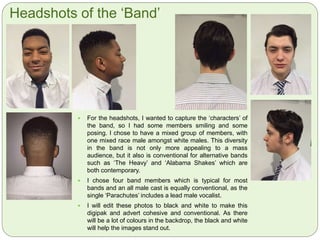
Headshots of the ‘Band’
 For the headshots, I wanted to capture the ‘characters’ of
the band, so I had some members smiling and some
posing. I chose to have a mixed group of members, with
one mixed race male amongst white males. This diversity
in the band is not only more appealing to a mass
audience, but it also is conventional for alternative bands
such as ‘The Heavy’ and ‘Alabama Shakes’ which are
both contemporary.
 I chose four band members which is typical for most
bands and an all male cast is equally conventional, as the
single ‘Parachutes’ includes a lead male vocalist.
 I will edit these photos to black and white to make this
digipak and advert cohesive and conventional. As there
will be a lot of colours in the backdrop, the black and white
will help the images stand out.
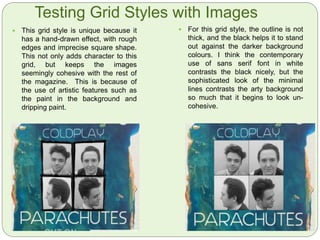
Testing Grid Styles with Images
 This grid style is unique because it
has a hand-drawn effect, with rough
edges and imprecise square shape.
This not only adds character to this
grid, but keeps the images
seemingly cohesive with the rest of
the magazine. This is because of
the use of artistic features such as
the paint in the background and
dripping paint.
 For this grid style, the outline is not
thick, and the black helps it to stand
out against the darker background
colours. I think the contemporary
use of sans serif font in white
contrasts the black nicely, but the
sophisticated look of the minimal
lines contrasts the arty background
so much that it begins to look un-
cohesive.
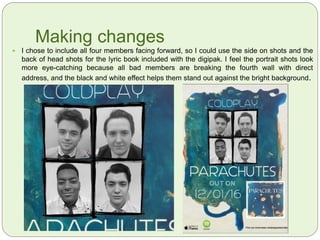
Making changes
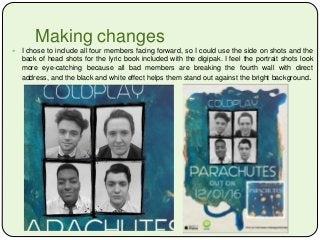
 I chose to include all four members facing forward, so I could use the side on shots and the
back of head shots for the lyric book included with the digipak. I feel the portrait shots look
more eye-catching because all bad members are breaking the fourth wall with direct
address, and the black and white effect helps them stand out against the bright background.
Final Magazine Advertisement
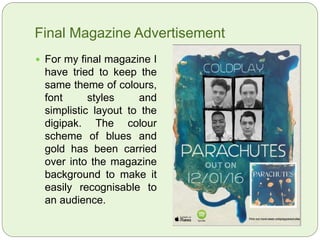
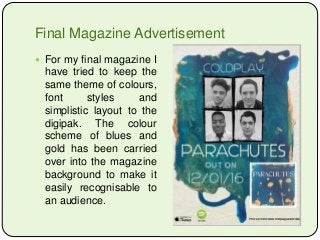
 For my final magazine I
have tried to keep the
same theme of colours,
font styles and
simplistic layout to the
digipak. The colour
scheme of blues and
gold has been carried
over into the magazine
background to make it
easily recognisable to
an audience.

PRODUCTION: Ancillary Tasks

  • 1.
    Planning and Productionof the Digipak and Magazine Advert for ‘Coldplay’ and their release of ‘Parachutes’ Ancillary Tasks
  • 2.
    Digipak Template (Towork from) A wallet/pocket will be used to store the lyric book, which is a conventional feature seen in Alt- J’s “An Awesome Wave”, and Arcade Fire’s “The Funeral”, as their digipaks received high appraisal from their audience. We have chosen to work with a 6 gatefold digipak because our research shows that this is the most popular style for Alternative genre digipaks. Choosing to comply with expectations may allow for mass audience appeal.
  • 3.
    Research for Digipak https://www.youtube.com/watch?v=KgSGcgaFXm0  Our audience research shows us what styles of digipak are most appealing to an audience, with Alt-J’s “An Awesome Wave” receiving the highest appraisal due to its contemporary look and bright colour scheme. The use of original abstract art seemed to catch the attention of the interviewees. We hope to recreate this positive effect by creating a digipak using a similar abstract art style, and we will keep the digipak cohesive by using a set of house colours and fonts to make it look as professional as possible.
  • 4.
    Digipak ‘Mock’ Planning The digipak will be 6 gate fold to allow for a pocket. The pocket will be used for purpose as it will hold the lyric book, which conforms to audience expectation.  The theme of painting and abstracted art will be continued throughout the digipak (and magazine) for recognisability and memorable purposes. This has been chosen because art work is an appreciated aspect of an album for our target audience.  The CD will be in the centre, with the wallet on the left of the digipak, and a blank fold on the right.  The spine of the digipak will clearly state the album title and band name for easy consumer browsing.
  • 5.
    Photos to usefor digipak We achieved these images by using watered-down acrylic and gold liquid paint. The paper curled and warped with the amount of water, giving a unique ‘artistic’ appearance to the images. We were inspired by Alt-J’s ‘An Awesome Wave’ when creating our album art work. We kept hte colours similar wiht blues and golds to make the album cohesive.
  • 6.
    Spine Conventions  Theartists name or band name is highlighted in red, and usually is situated after a serial number, but before the album name.  The serial number is a short code or line of digits to refer to the copy of CD or digipak, and is highlighted in green. It is optional on the CD’s below.  The Distributor of the album is highlighted in yellow, and is only found on one of the CD’s, which means it is not conventional to have the logo.  Lastly, the record label is highlighted in blue, and is found of every case, most commonly at the end of the spine because it is possibly the least important to a buyer.
  • 7.
    Spine of Digipak 55831Coldplay PARACHUTES
  • 8.
  • 9.
  • 10.
  • 11.
    CD Tray (CentrePanel Inside)
  • 12.
  • 13.
    Mock Net ofDigipak
  • 14.
    Digipak Lyric Book We decided to make a lyric book on Publisher. This was to portray the conventional elements of our researched digipaks of the genre, as Arcade Fire and Alt-J both had lyric books for their products.  We kept the book looking cohesive and maintained the quirky original art-style with images of paint splashes and a dirty paint palette.
  • 15.
  • 16.
    Magazine ‘Mock’ Planning The magazine advert will feature ‘white space’ around the central focus of abstracted art, as this will be the main image which makes up the background.  Sans serif and slab serif fonts will be made transparent or plain white to make the text stand out from the page, as an audiences eyes are immediately drawn to white space on a page.  A simplistic layout seems to be most successful and is used conventionally, as it has been profound in my research of Lana Del Ray, The Horrors’ and The Wombats’ adverts.  A conventional band picture will be used to attract a loyal fan to the advert.  Clear text stating the release date and institutional information will be seen at the bottom of the page, in the white space. It will state where the album will be downloadable from.  A picture of the product itself (the digipak) will be found on the bottom right third of the advert.
  • 17.
    Drafting Original Plan This first draft is eye catching and proves our planning to be successful. However, in my next attempt, I would like to change the image layout, so each band member has a close-up of their face. I want the images laid out in a grid formation. The image I have used for the time being is temporary, and illustrated our original image intentions.
  • 18.
    Technology I used SerifCraft Artist 2 as my image manipulating and layout software for the creation of both ancillary products (magazine advert and digipak). Kelsey took photos of the art pieces she had created using a range of paints and metallic colours layered in an abstract way. She kept the colours similar throughout her experimenting, so we have a digipak that will look cohesive throughout its design. I used fontspace. com to find profession al looking serif and sans serif style fonts for the front cover of the digipak, here is a screenshot of me testing one font. (Below) I utilised the ‘cut-out studio’ function on this software by cutting out logos from the internet, so they had no background colour. This removal of white outlines makes the magazine look professional. You simply click and drag your mouse around any areas you want removed, then save the new image ready to be applied to the design being created. This is a screenshot from when I was in the process of choosing which font I preferred, and typing access information (the band website) to the magazine advert. Overall, this software was very easy to work with, and created a good result for my final edits of ancillary products.
  • 19.
    Headshots of the‘Band’  For the headshots, I wanted to capture the ‘characters’ of the band, so I had some members smiling and some posing. I chose to have a mixed group of members, with one mixed race male amongst white males. This diversity in the band is not only more appealing to a mass audience, but it also is conventional for alternative bands such as ‘The Heavy’ and ‘Alabama Shakes’ which are both contemporary.  I chose four band members which is typical for most bands and an all male cast is equally conventional, as the single ‘Parachutes’ includes a lead male vocalist.  I will edit these photos to black and white to make this digipak and advert cohesive and conventional. As there will be a lot of colours in the backdrop, the black and white will help the images stand out.
  • 20.
    Testing Grid Styleswith Images  This grid style is unique because it has a hand-drawn effect, with rough edges and imprecise square shape. This not only adds character to this grid, but keeps the images seemingly cohesive with the rest of the magazine. This is because of the use of artistic features such as the paint in the background and dripping paint.  For this grid style, the outline is not thick, and the black helps it to stand out against the darker background colours. I think the contemporary use of sans serif font in white contrasts the black nicely, but the sophisticated look of the minimal lines contrasts the arty background so much that it begins to look un- cohesive.
  • 21.
    Making changes  Ichose to include all four members facing forward, so I could use the side on shots and the back of head shots for the lyric book included with the digipak. I feel the portrait shots look more eye-catching because all bad members are breaking the fourth wall with direct address, and the black and white effect helps them stand out against the bright background.
  • 22.
    Final Magazine Advertisement For my final magazine I have tried to keep the same theme of colours, font styles and simplistic layout to the digipak. The colour scheme of blues and gold has been carried over into the magazine background to make it easily recognisable to an audience.