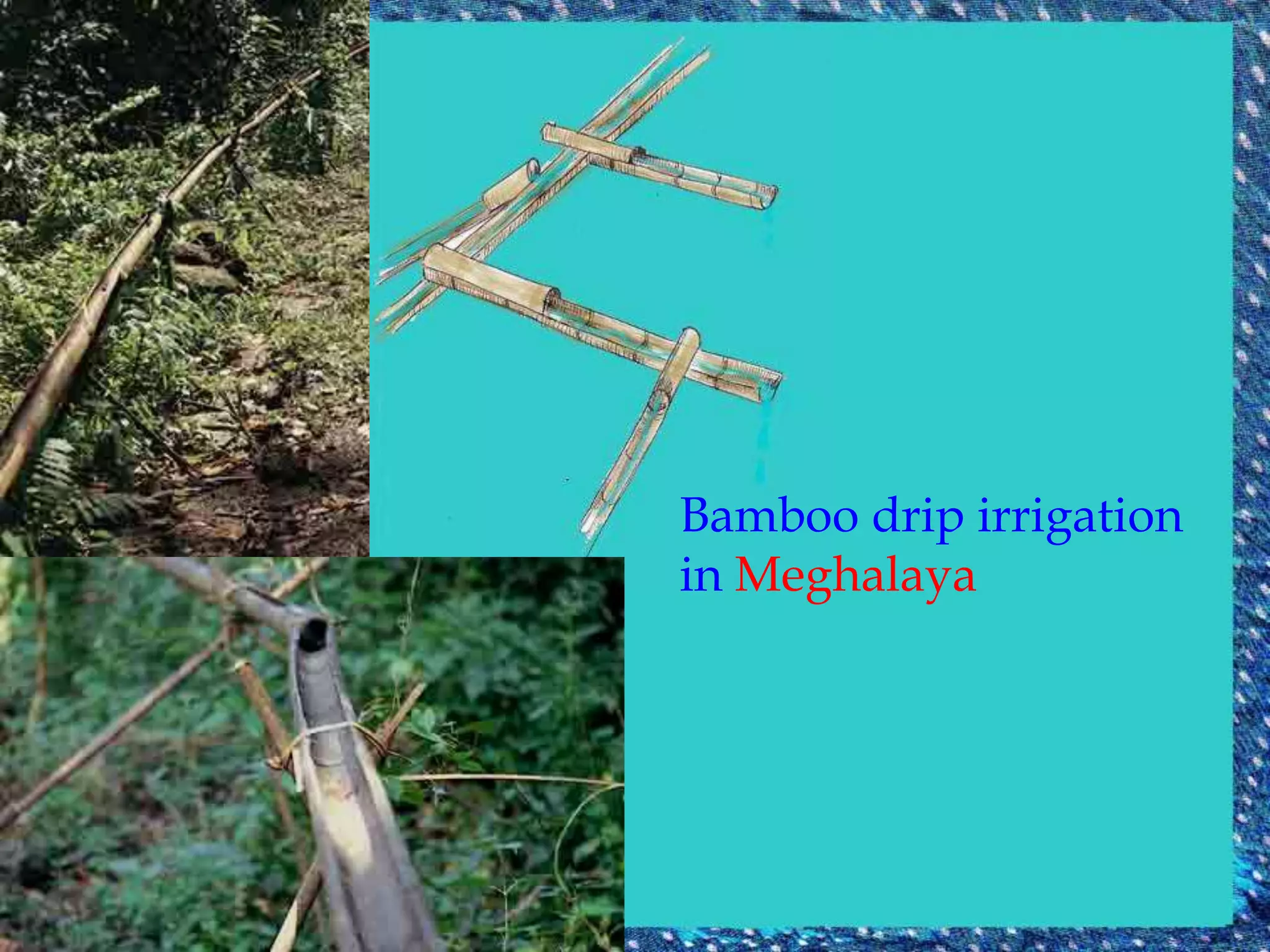
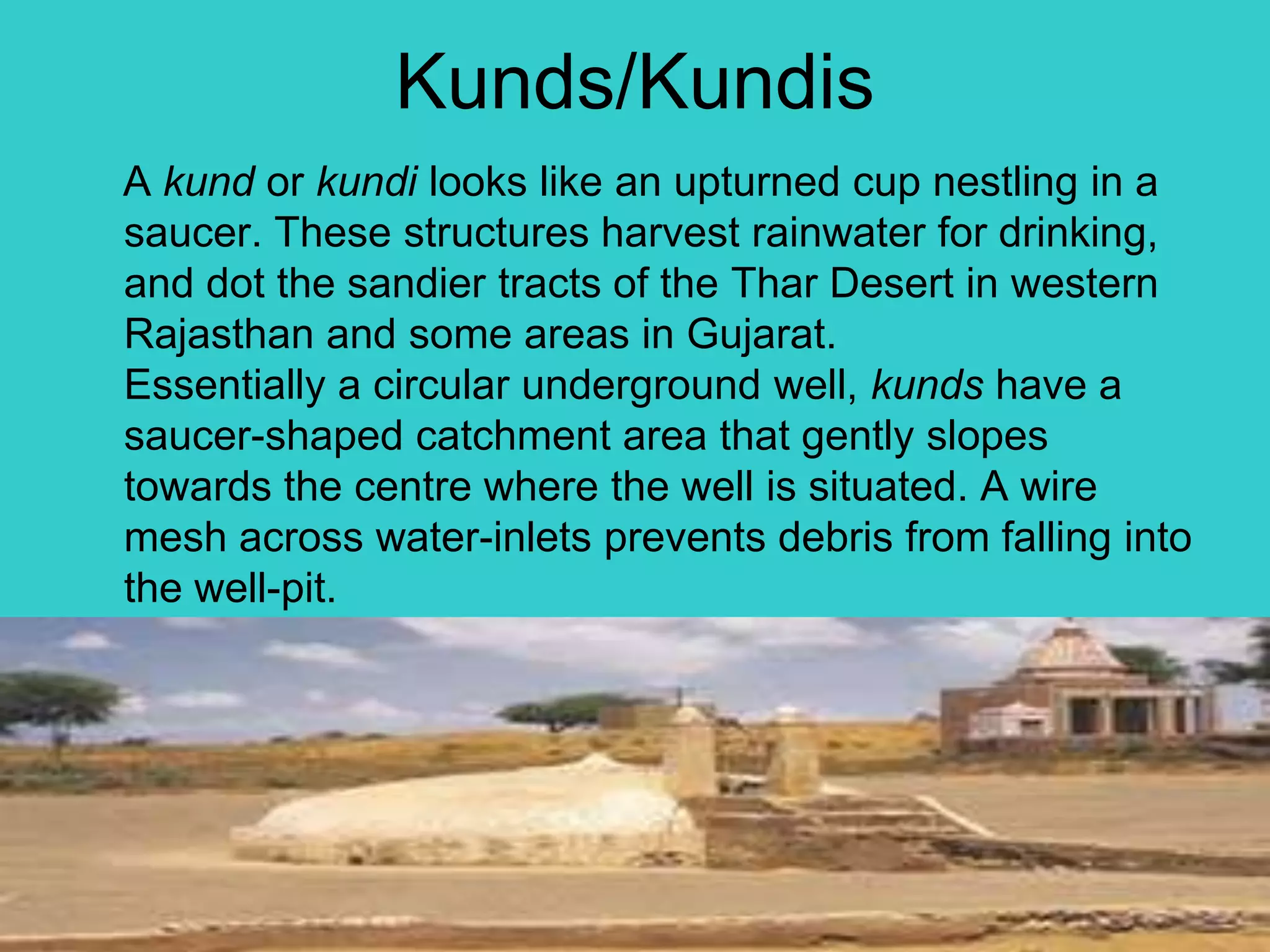
Rainwater harvesting has a long history in India and provides many benefits. It reduces costs, conserves water resources, and is a simple technique appropriate for both rural and urban areas. Traditional methods were widely used across India and involved collecting rainwater and storing it for multiple uses. Many regions developed innovative indigenous solutions, such as kunds in Rajasthan and bamboo drip irrigation in Meghalaya. While rainwater harvesting declined in some places, its importance is now being recognized again and modern techniques are reviving traditional methods.
RechargeNot new toIndiaRainwater storage reservoir at Dholavira (Rann of Kutch) – Harappan civilization (2500-1900 BC)
12.
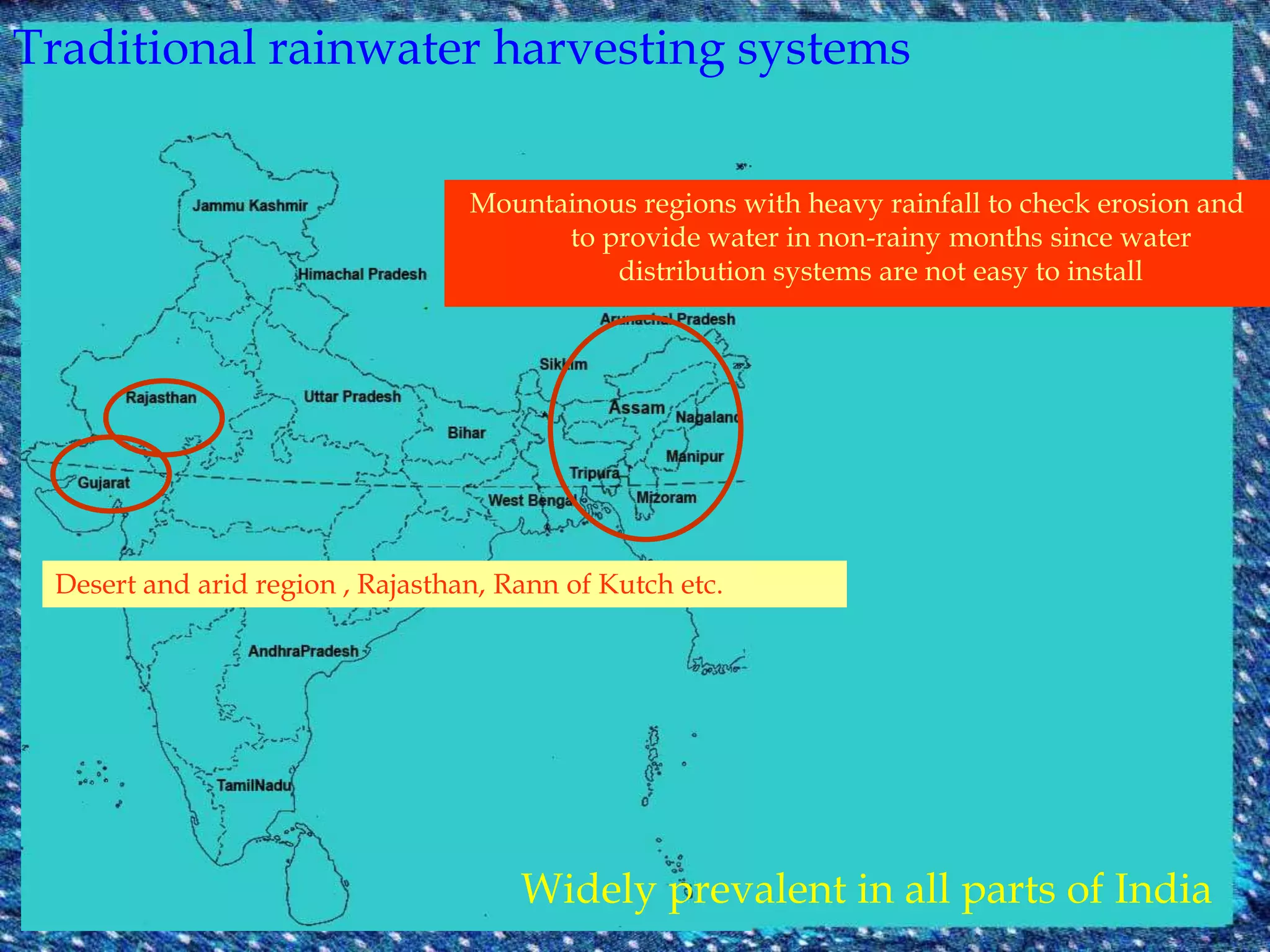
Mountainous rain-shadow regionslike Spiti valleyFlood plains to check floods during monsoonsThe Deccan plateau which has only monsoon fed(no perennial) riversTraditional rainwater harvesting systemsWidely prevalent in all parts of India
13.
Desert and aridregion , Rajasthan, Rann of Kutch etc.Traditional rainwater harvesting systemsMountainous regions with heavy rainfall to check erosion and to provide water in non-rainy months since water distribution systems are not easy to installWidely prevalent in all parts of India
14.
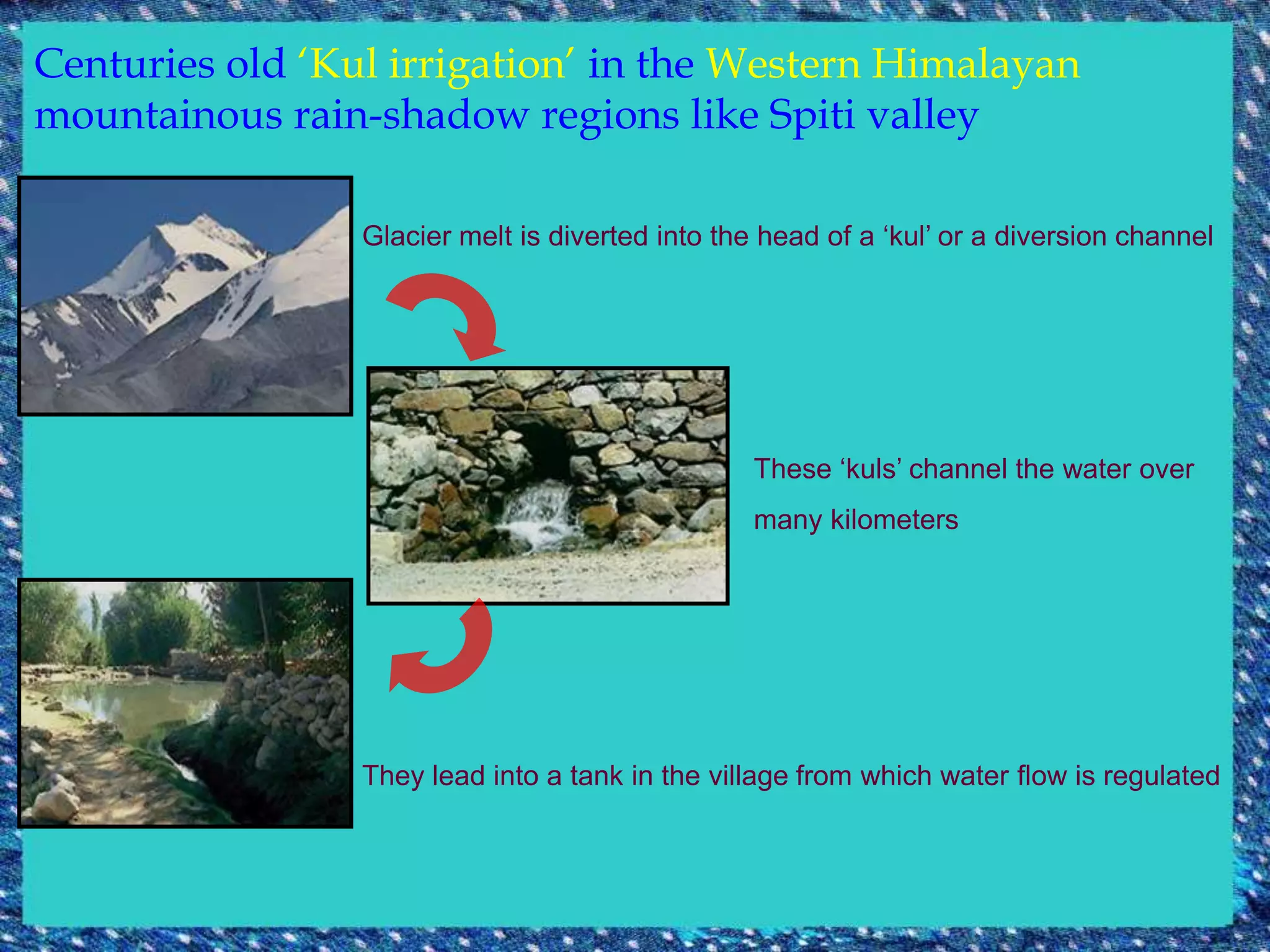
Centuries old ‘Kulirrigation’ in the Western Himalayan mountainous rain-shadow regions like Spiti valleyGlacier melt is diverted into the head of a ‘kul’ or a diversion channelThese ‘kuls’ channel the water over many kilometersThey lead into a tank in the village from which water flow is regulated
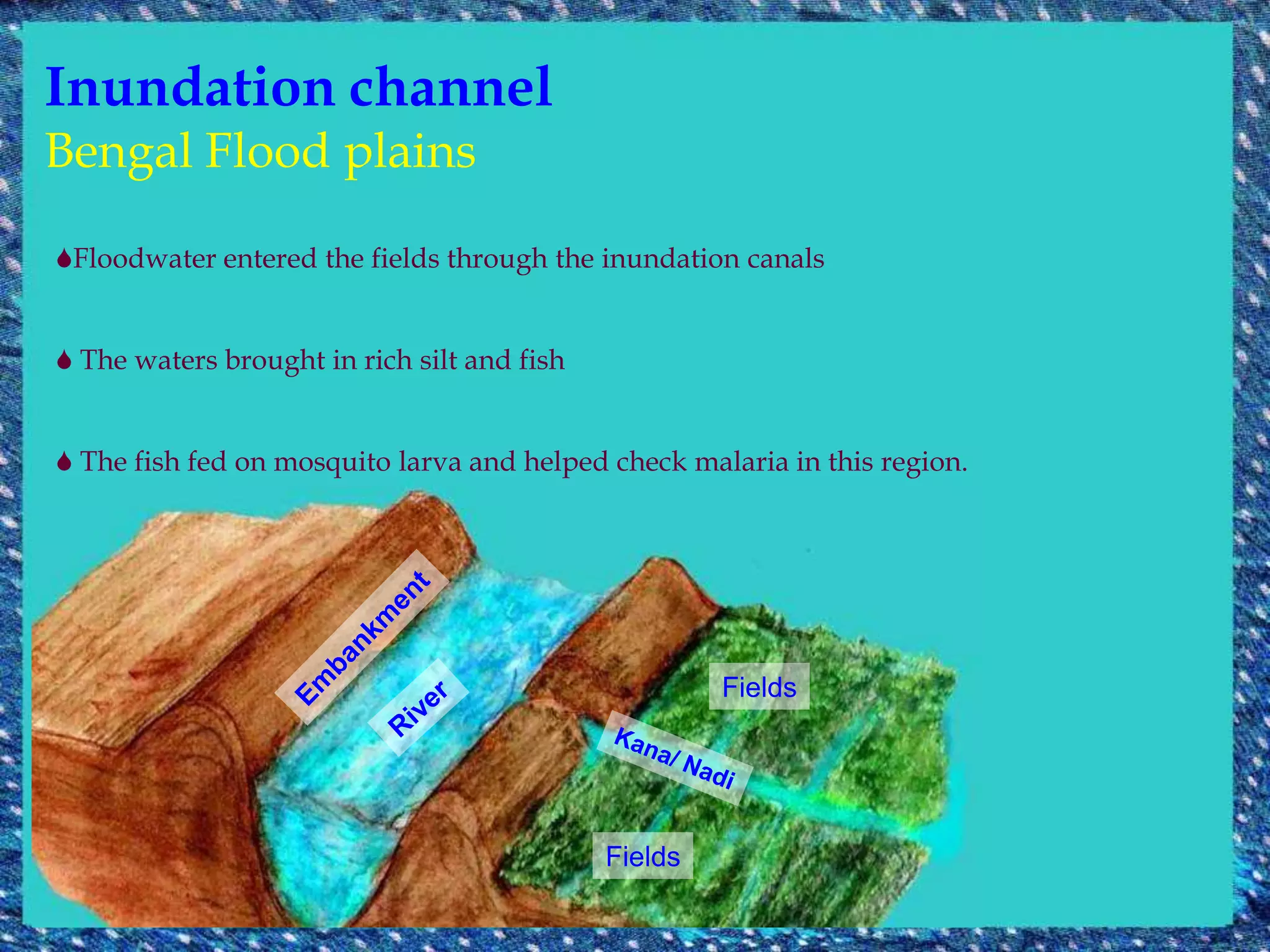
The fishfed on mosquito larva and helped check malaria in this region.EmbankmentRiverKana/ Nadi
18.
Khadins of Jaisalmer(harvestingstructures for agricultural fields) Designed by the Paliwal Brahmins of Jaisalmer, in 15th century
19.
Similar system also practised in Ur (Iraq), the Negev desert, and in south west Colorado
20.
An embankment prevents water from flowing away. Collected water seeps into the soil. This water saturates land, which is then used for growing crops
21.
Johads of Rajasthan(providewater for domestic use) Earthen or masonry rainwater harvesting structure, for providing water for domestic use to the communities.Photo by L R Burdak
22.
Johads of Rajasthan(providewater for domestic use)Photo by Farhad Contractor, taken in Alwar district of RajasthanRead about revival of Johads in ‘Reviving India’s water harvesting systems’
23.
Tankas of Bikaner,Barmer, Phalodi - RajasthanPipes from the rooftop lead rainwater into the tanka catchmentNote the slope provided for the rainwater (palar pani) to flow into the tanka
24.
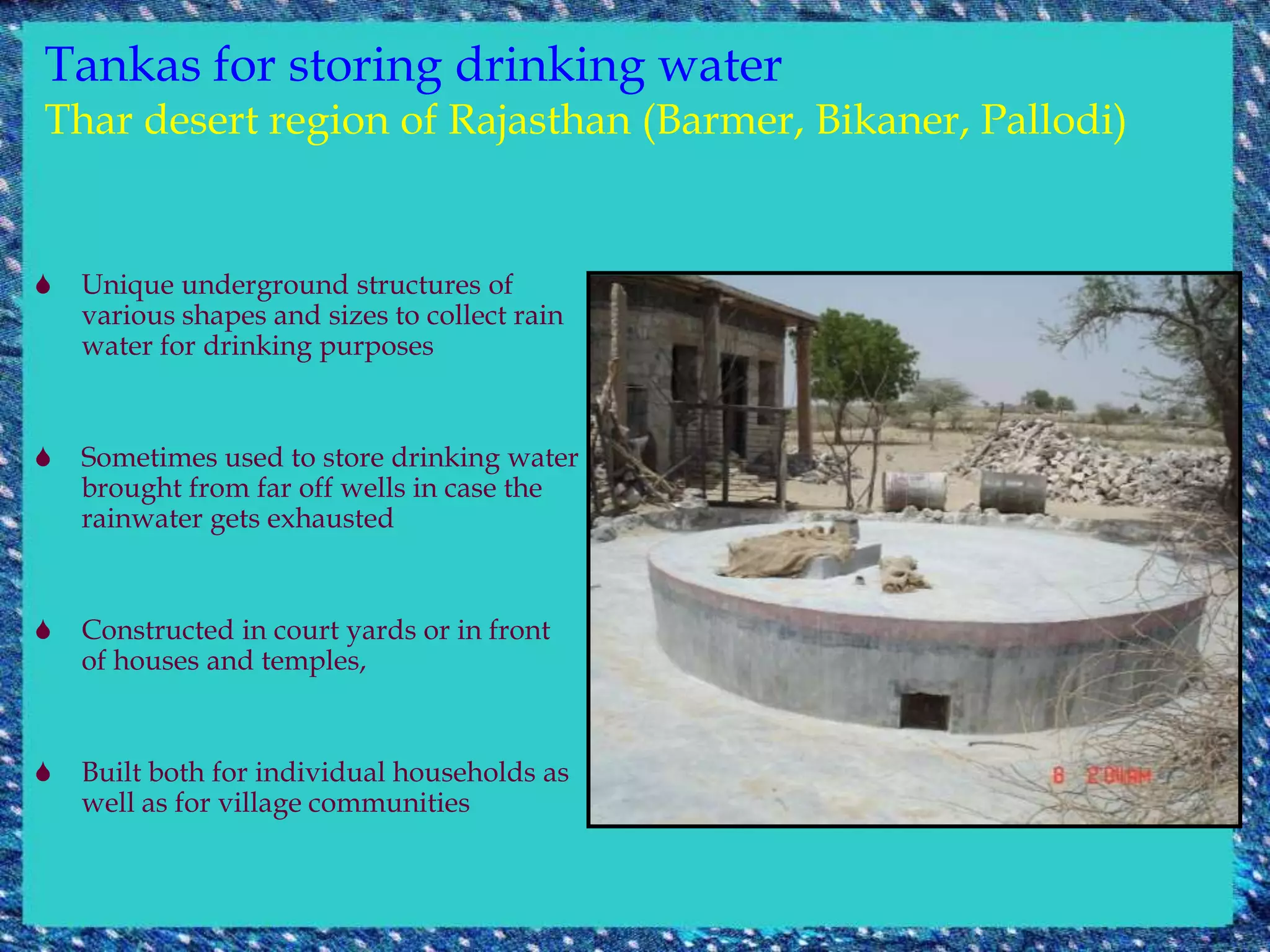
Tankas for storingdrinking waterThar desert region of Rajasthan (Barmer, Bikaner, Pallodi)Unique underground structures of various shapes and sizes to collect rain water for drinking purposes
25.
Sometimes used tostore drinking water brought from far off wells in case the rainwater gets exhausted
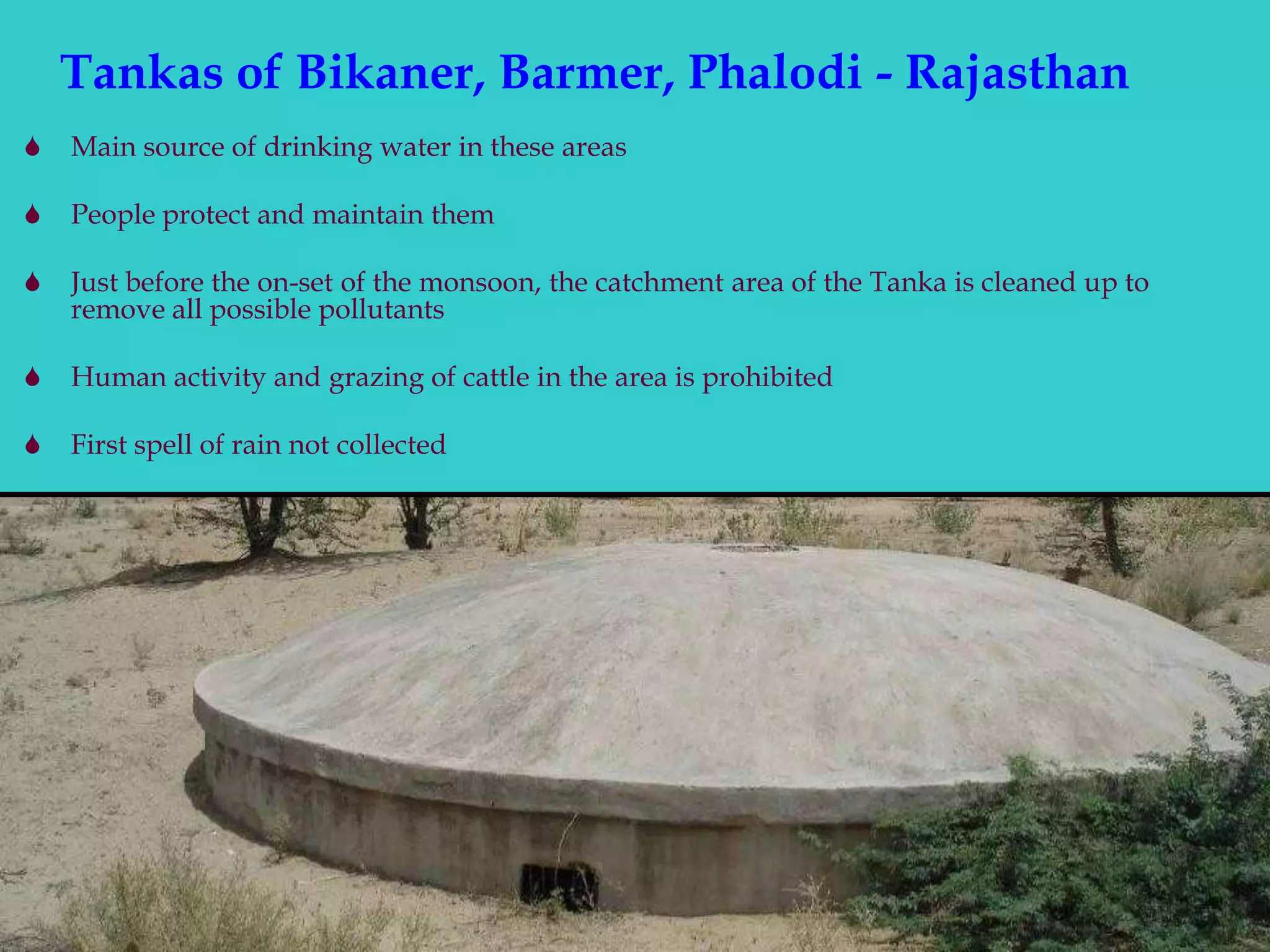
Built both forindividual households as well as for village communitiesTankas of Bikaner, Barmer, Phalodi - RajasthanMain source of drinking water in these areas
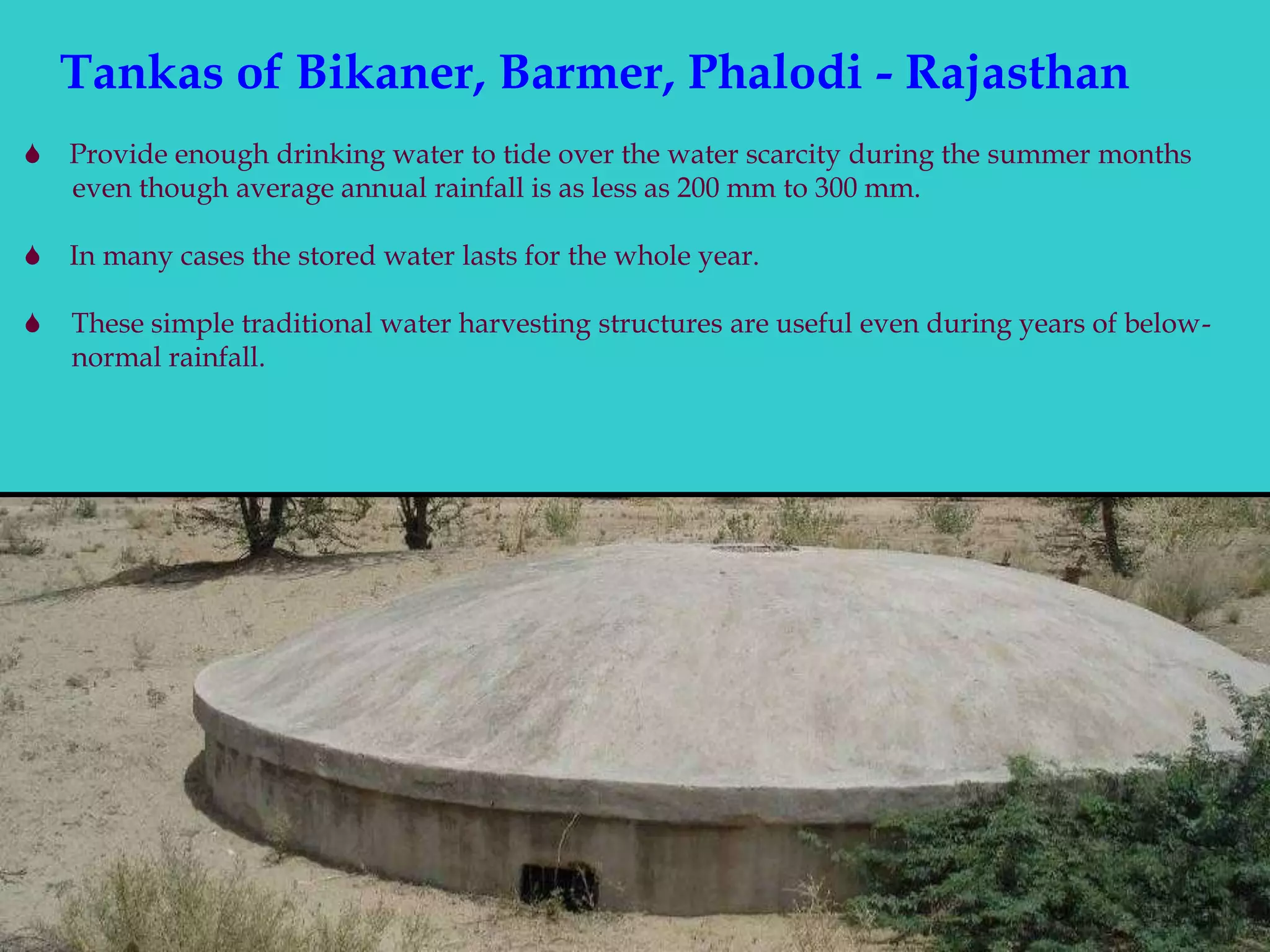
First spell ofrain not collected Tankas of Bikaner, Barmer, Phalodi - Rajasthan Provide enough drinking water to tide over the water scarcity during the summer months even though average annual rainfall is as less as 200 mm to 300 mm. In many cases the stored water lasts for the whole year.
32.
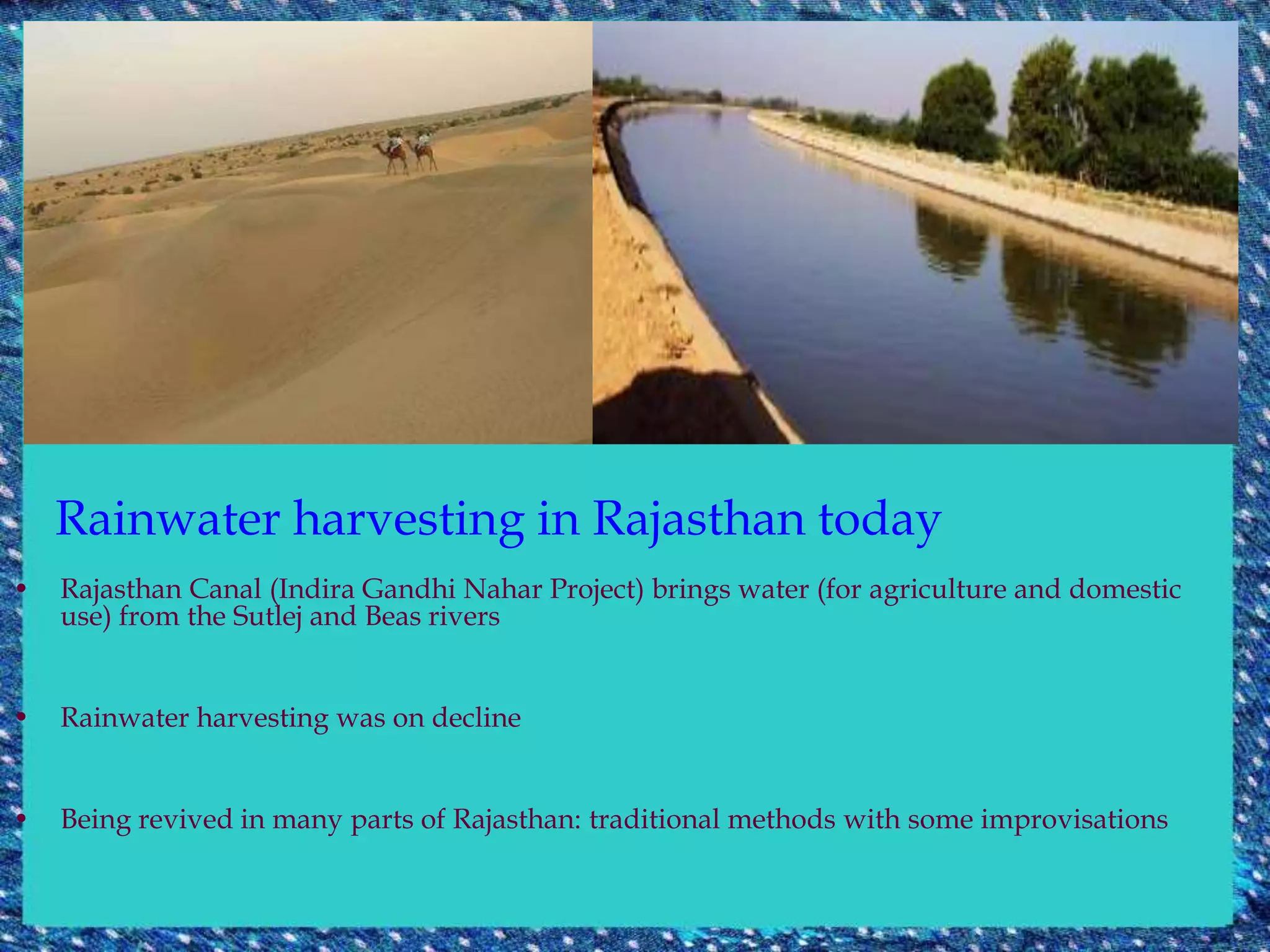
These simple traditionalwater harvesting structures are useful even during years of below-normal rainfall.Rainwater harvesting in Rajasthan todayRajasthan Canal (Indira Gandhi Nahar Project) brings water (for agriculture and domestic use) from the Sutlej and Beas riversRainwater harvesting was on declineBeing revived in many parts of Rajasthan: traditional methods with some improvisations
33.
Deccan PlateauThenWater harvestedin a system of tanks that were fed by seasonal streamsTanks recharged groundwaterDeccan PlateauNow Tanks neglected
34.
Many regions facing water scarcity
35.
Importance of rainwater harvesting being realized
36.
Rooftop rainwater harvesting getting a boostNo perennial rivers
37.
Rainwater harvesting inthe North Eastern statesMountainous regions with heavy rainfallUneven distribution of populationAbundant water resources but not tapped due to rugged terrainFace water scarcity in areas of high population density
18-20 litres ofwater entering the bamboo pipe system per minute gets transported over several hundred meters and finally gets reduced to 20-80 drops per minute at the site of the plant. Attempts made to introduce modern pipe systems but farmers prefer to use their indigenous form of irrigation. Kunds/Kundis A kund or kundi looks like an upturned cup nestling in a saucer. These structures harvest rainwater for drinking, and dot the sandier tracts of the Thar Desert in western Rajasthan and some areas in Gujarat. Essentially a circular underground well, kunds have a saucer-shaped catchment area that gently slopes towards the centre where the well is situated. A wire mesh across water-inlets prevents debris from falling into the well-pit.
44.
Kunds/ Kundis The sides of the well-pit are covered with (disinfectant) lime and ash. Most pits have a dome-shaped cover, or at least a lid, to protect the water. If need be, water can be drawn out with a bucket. The depth and diameter of kunds depend on their use (drinking, or domestic water requirements). They can be owned by only those with money to invest and land to construct it. Thus for the poor, large public kunds have to be built.
45.
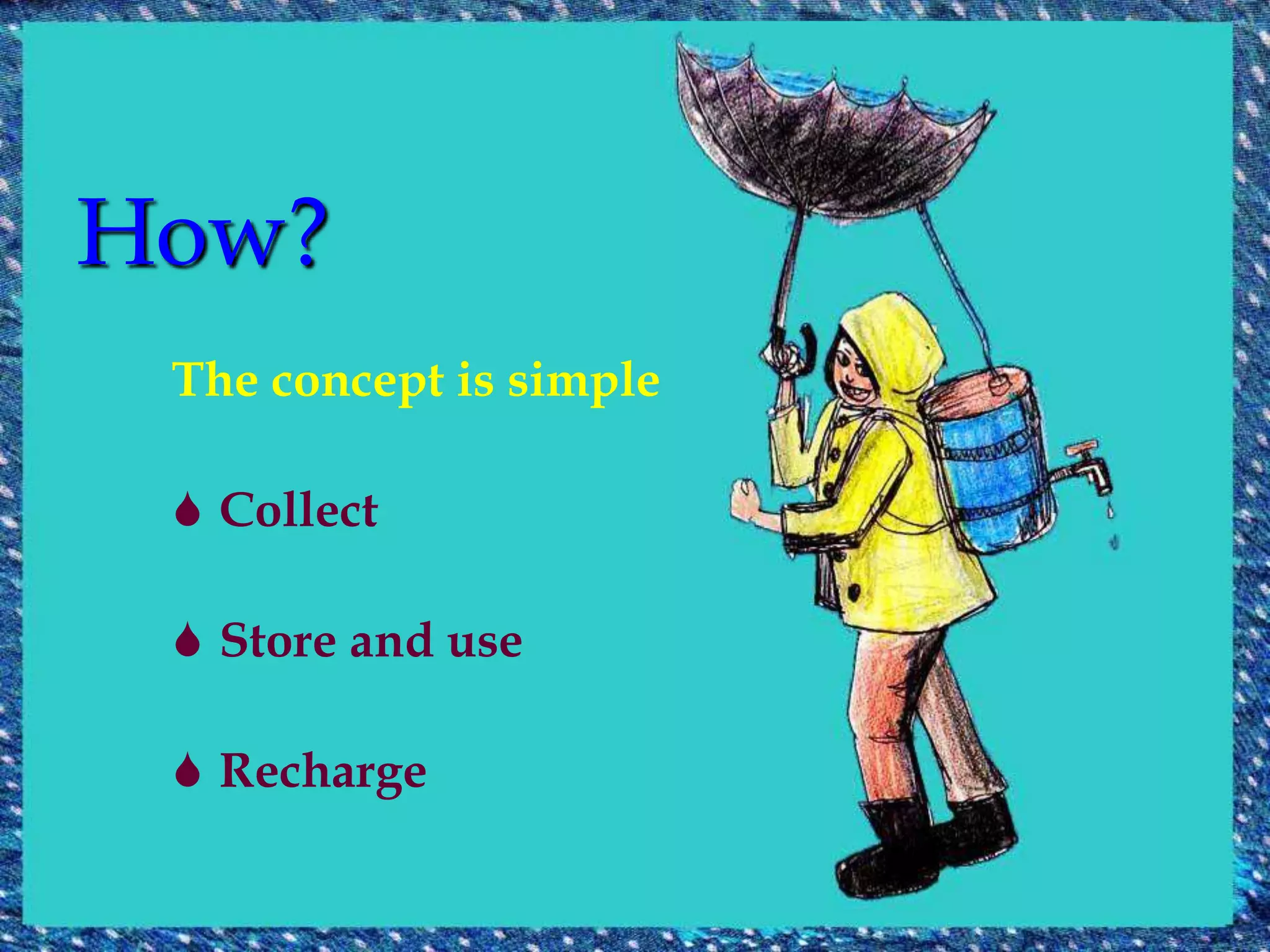
Rainwater harvesting todayCollection(Catchment)Flat / sloping roofs Transportation: Downtake pipesLeaf and grit filter, First flush deviceStorage in tanksRecharge into open wells / borewells / percolation pits / trenches
46.
Case studies ofinterest - LegislationTamil NaduRainwater harvesting made mandatory for all the buildings in the state
47.
If the rainwater harvesting structure is not provided as required, an authorized person can implement a rain water harvesting structure and the cost is recovered along with property tax".
48.
Citizens are alsowarned about disconnection of water supply connection if rainwater harvesting structures are not provided. Case studies of interest - ImplementationKarnatakaGendathur (Karnataka)- a remote village in Mysore district
49.
The first villageto have installed a maximum number of rainwater harvesting systems.
50.
Each of the200 houses have a rooftop rainwater harvesting system
The villagers ofGendathuruse rainwater for all their everyday needs; they even use it for drinking and cooking. LehLadakhChewangNorphel, 62, of Leh, Ladakh.
54.
In Ladakh, theannual average rainfall is 50 mm. The only source of water are glaciers, which melt in late summer. Water shortage felt at the start of the cropping season in early summer (May to June)
55.
Taps left openin winter, so that water does not freeze in the pipelines (Water wasted in winter)
56.
Norphel builds artificialglaciers by channelising glacier water into depressions lying in the shadow area of a mountain, hidden from sunlight.
57.
He places half-inch-wideiron pipes at the edge of the depression. As the water keeps collecting in the pipes, it freezes. As more water seeps in, it pushes out the frozen blocks, and in turn, itself gets frozen. This keeps happening in a continuous cycle, and these frozen blocks create a clean, artificial glacier.
58.
Norphel has madefour such glaciers.Maharashtra - PhadThe community-managed phad irrigation system, prevalent in northwestern Maharashtra, probably came into existence some 300-400 years ago. The system operated on three rivers in the Tapi basin - Panjhra, Mosam and Aram - in Dhule and Nasik districts (still in use in some places here).
59.
The size ofa phad can vary from 10-200 ha, the average being 100-125 ha. Every year, the village decides which phads to use and which to leave fallow. Only one type of crop is allowed in one phad. Generally, sugarcane is grown in one or two phads; seasonal crops are grown in the others. This ensures a healthy crop rotation system that maintains soil fertility, and reduces the danger of waterlogging and salinity. The phad system has given rise to a unique social system to manage water use.
60.
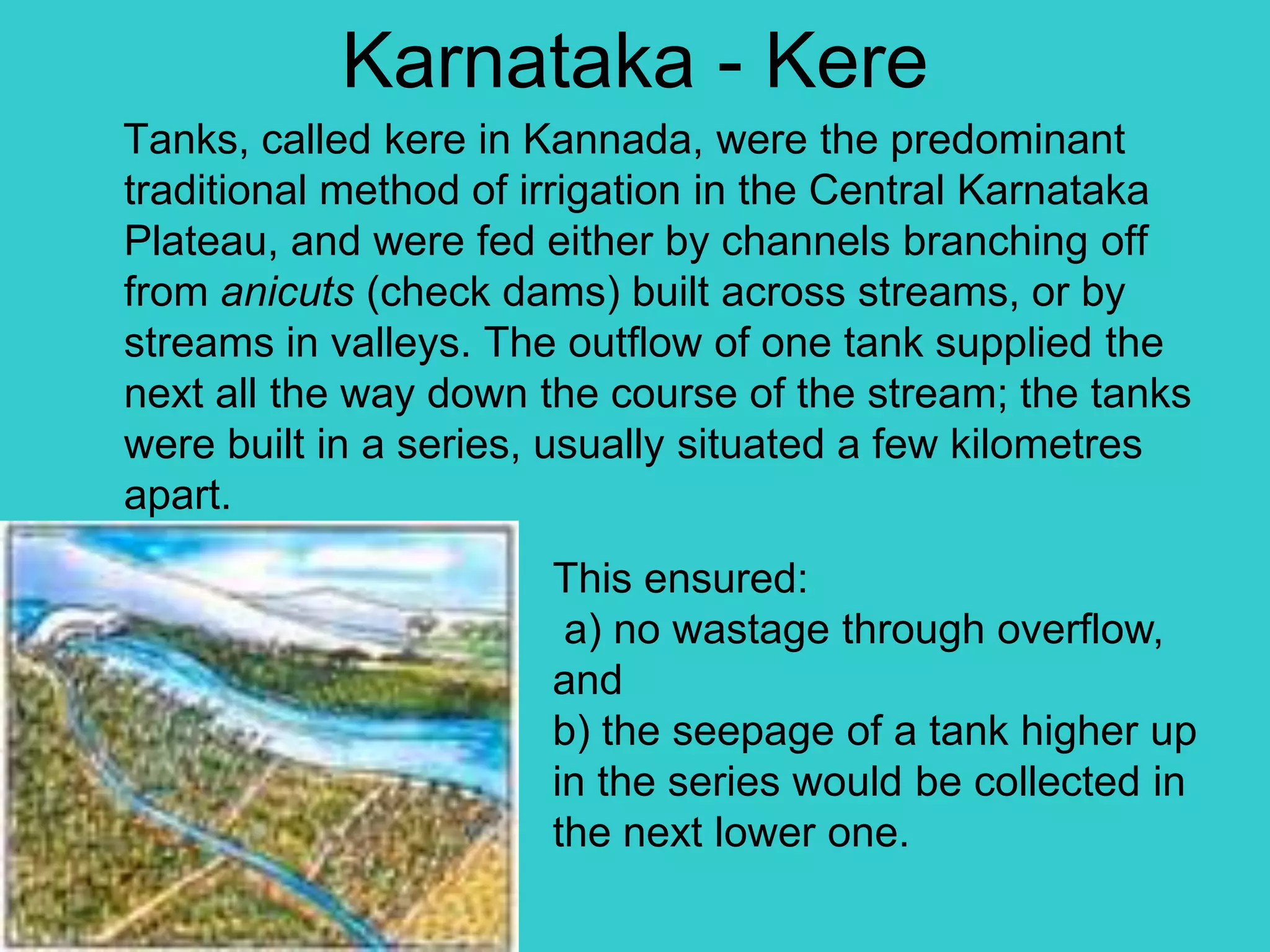
Karnataka - Kere Tanks, called kere in Kannada, were the predominant traditional method of irrigation in the Central Karnataka Plateau, and were fed either by channels branching off from anicuts (check dams) built across streams, or by streams in valleys. The outflow of one tank supplied the next all the way down the course of the stream; the tanks were built in a series, usually situated a few kilometres apart. This ensured: a) no wastage through overflow, andb) the seepage of a tank higher up in the series would be collected in the next lower one.
61.
Katas / Mundas/ BandhasKatas / Mundas / BandhasThe katas, mundas and bandhas were the main irrigation sources in the ancient tribal kingdom of the Gonds (now in Orissa and Madhya Pradesh). Most of these katas were built by the village headmen known as gountias, who in turn, received the land from the Gond kings. Land here is classified into four groups on the basis of its topography: aat, (highland); mal (sloped land); berna (medium land); and bahal (low land). This classification helps to select
62.
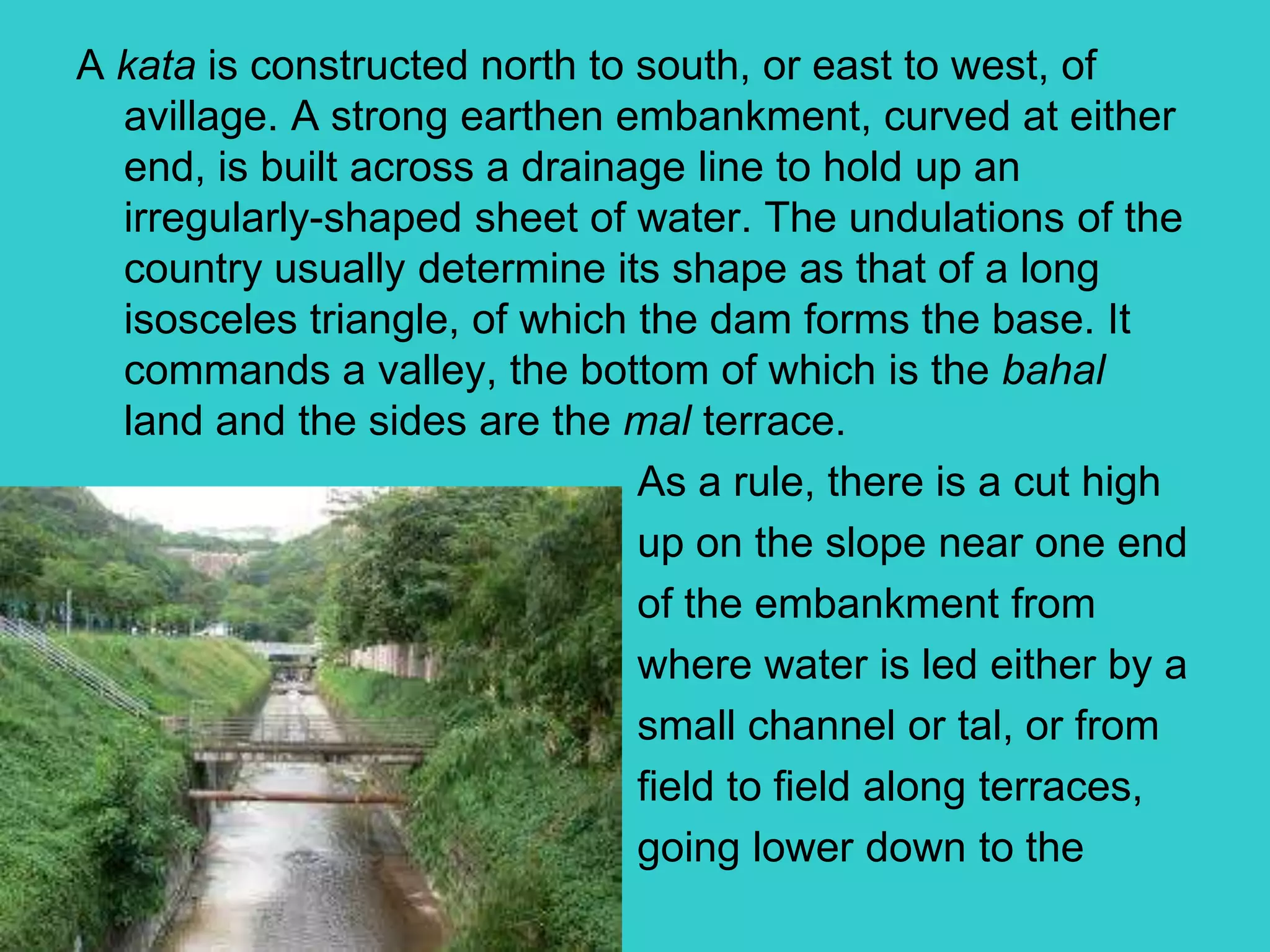
A kata isconstructed north to south, or east to west, of avillage. A strong earthen embankment, curved at either end, is built across a drainage line to hold up an irregularly-shaped sheet of water. The undulations of the country usually determine its shape as that of a long isosceles triangle, of which the dam forms the base. It commands a valley, the bottom of which is the bahal land and the sides are the mal terrace. As a rule, there is a cut high up on the slope near one end of the embankment from where water is led either by a small channel or tal, or from field to field along terraces, going lower down to the fields.
Divide the classinto 5 teamsTeam A selects 2 persons who will pick the clue and draw it out on the board for the other team members to guess. If the guessers get the right answer in 30 secs, they get 5 pointsIf the guessers get the right answer in 60 secs, they get 3 points Otherwise The chance then goes to Team B and so on.RulesNo mouthing of wordsNo names or numbers to be writtenNo actions
65.
Turn off theprojector now, so that the whole class cannot see the clues. The 2 representatives of Team Acan come up to the computer and see the clue.Ready?
66.
Round 1Team A– KhadinTeam B – JohadTeam C – TankaTeam D – KulTeam E – Inundation channel
67.
Round 2Team A– DholaviraTeam B – Spiti valleyTeam C – Rann of KutchTeam D – Deccan PlateauTeam E – Jaisalmer
68.
Round 3Team A– TharTeam B – North East IndiaTeam C – Bamboo drip irrigationTeam D – Indira Gandhi CanalTeam E – Gendathur
69.
Round 4Team A– collectionTeam B – storageTeam C – rechargeTeam D – filterTeam E – pipelines