Anatomy of thecloud:
The anatomy of cloud computing can be defined as the structure of the cloud. The anatomy of
cloud computing cannot be considered the same as cloud architecture.
It may not include any dependency on which the technology works, whereas architecture defines
and describes the technology over which it is working.
Architecture is a hierarchical structural view that defines the technology as well as the technology
over which it is dependent or/and the technology that are dependent on it. Thus ,the anatomy of
cloud computing can be considered a part of the architecture of the cloud.
The basic structure of the cloud is described ,elaborated, and minute structural details can be given.
Below figure depicts the most standard anatomy that is the base for the cloud.
It depends on the person to choose the depth of description of the cloud.
3.
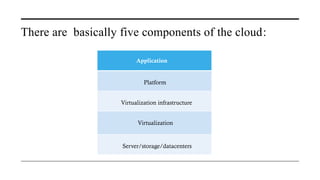
There are basicallyfive components of the cloud:
Application
Platform
Virtualization infrastructure
Virtualization
Server/storage/datacenters
4.
Application:
The uppermost layeris the application layer. In this layer, any applications can
be executed.
Example: Apps like Google Docs, Zoom, Gmail that you use on the cloud.
Platform:
This component consists of platforms that are responsible for the execution of
the application. This platform is between the infrastructure and the application.
Example: Operating System like Windows or Linux.
Virtualized Infrastructure:
The infrastructure consists of resources over which the other components work.
This provides computational capability to the user.
Example: Big servers in the cloud store your photos and process your Google
searches.
5.
Virtualization:
Virtualization is theprocess of making logical components of
resources over the existing physical resources. The logical components are
isolated and independent, which form the infrastructure.
Example: One big server can be divided into smaller virtual servers
that work like separate computers.
Server/Storage/Datacenters:
The physical hardware is provided by servers and storage units.
Example: Big computers and storage machines placed in data centers.





![UNIT I -Introduction to CLOUD COMPUTING [Autosaved].pptx](https://cdn.slidesharecdn.com/ss_thumbnails/uniti-introductiontocloudcomputingautosaved-250128091123-f66abd14-thumbnail.jpg?width=640&height=640&fit=bounds)


