Analytics with Descriptive,
Predictive and Prescriptive
Techniques
GOAL OF ANALYTICS IS TO GET ACTIONABLE
INSIGHTS RESULTING IN SMARTER DECISIONS
AND BETTER BUSINESS OUTCOMES.
Overview
 In the present scenario, the demand of analytics skill is due to
the extensive use of electronic databases for record keeping and
electronic commerce in digital economy.
 As the use of analytics grows quickly, companies will need
employees who understand the data.
 Analytic tools range from spreadsheets with statistical functions
to complex data mining and predictive modelling applications.
 To produce algorithms and analysis help businesses make better
decisions.
 As patterns and relationships in the data are uncovered, new
questions are asked and the analytic process iterates until the
business goal is met.
Overview
 Deployment of predictive models involves scoring data records
(typically in a database) and using the scores to optimize real-
time decisions within applications and business processes.
 BA also supports tactical decision making in response to
unforeseen events, and in many cases the decision making is
automated to support real-time responses.
 Analytics have revolutionized the way business is done around
the world.
 All companies, no matter what size, rely on data and analytics
to make critical business decisions.
 From understanding consumer behavior to predicting market
trends, even right down to product features, many moves are
driven by analytics and data in companies across the world.
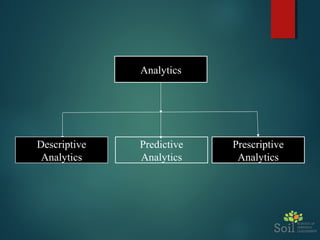
Analytics
Predictive
Analytics
Prescriptive
Analytics
Descriptive
Analytics
Descriptive Techniques
 Descriptive analytics looks at past performance and
understands that performance by mining data to look
for the reasons behind past success or failure.
 Descriptive analytics also capture and quantify
relationships among factors to allow assessment of risk
or potential associated with a particular set of
conditions and guiding decision making.
 Descriptive analysis can be utilized to develop further
analysis that can simulate large number of
individualized agents and make predictions.
Predictive Techniques
 Predictive analytics uses data to determine the
probable future outcome of an event or a likelihood of
a situation occurring.
 Predictive analytics encompasses a variety of
statistical techniques from modeling, machine
learning, and data mining that analyze current and
historical facts to make predictions about future
events.
 In business, predictive models exploit patterns found
in historical and transactional data to identify risks and
opportunities.
Prescriptive Techniques
 Prescriptive analytics synthesizes data,  mathematical 
sciences, business rules and machine learning to make 
predictions  and  suggests  decision  options  on  how  to 
take  advantage  of  a  future  opportunity  or  mitigate  a 
future  risk  and  illustrate  the  implication  of  each 
decision option.
 Prescriptive  analytics  not  only  anticipates  what  will 
happen and when it will happen, but also why it will 
happen.
 Prescriptive analytics can continually process new data 
to  improve  prediction  and  provide  better  decision 
options. 
Thank You

Analytics with Descriptive, Predictive and Prescriptive Techniques

  • 1.
    Analytics with Descriptive, Predictiveand Prescriptive Techniques GOAL OF ANALYTICS IS TO GET ACTIONABLE INSIGHTS RESULTING IN SMARTER DECISIONS AND BETTER BUSINESS OUTCOMES.
  • 2.
    Overview  In thepresent scenario, the demand of analytics skill is due to the extensive use of electronic databases for record keeping and electronic commerce in digital economy.  As the use of analytics grows quickly, companies will need employees who understand the data.  Analytic tools range from spreadsheets with statistical functions to complex data mining and predictive modelling applications.  To produce algorithms and analysis help businesses make better decisions.  As patterns and relationships in the data are uncovered, new questions are asked and the analytic process iterates until the business goal is met.
  • 3.
    Overview  Deployment ofpredictive models involves scoring data records (typically in a database) and using the scores to optimize real- time decisions within applications and business processes.  BA also supports tactical decision making in response to unforeseen events, and in many cases the decision making is automated to support real-time responses.  Analytics have revolutionized the way business is done around the world.  All companies, no matter what size, rely on data and analytics to make critical business decisions.  From understanding consumer behavior to predicting market trends, even right down to product features, many moves are driven by analytics and data in companies across the world.
  • 4.
  • 5.
    Descriptive Techniques  Descriptiveanalytics looks at past performance and understands that performance by mining data to look for the reasons behind past success or failure.  Descriptive analytics also capture and quantify relationships among factors to allow assessment of risk or potential associated with a particular set of conditions and guiding decision making.  Descriptive analysis can be utilized to develop further analysis that can simulate large number of individualized agents and make predictions.
  • 6.
    Predictive Techniques  Predictiveanalytics uses data to determine the probable future outcome of an event or a likelihood of a situation occurring.  Predictive analytics encompasses a variety of statistical techniques from modeling, machine learning, and data mining that analyze current and historical facts to make predictions about future events.  In business, predictive models exploit patterns found in historical and transactional data to identify risks and opportunities.
  • 7.
    Prescriptive Techniques  Prescriptiveanalytics synthesizes data,  mathematical  sciences, business rules and machine learning to make  predictions  and  suggests  decision  options  on  how  to  take  advantage  of  a  future  opportunity  or  mitigate  a  future  risk  and  illustrate  the  implication  of  each  decision option.  Prescriptive  analytics  not  only  anticipates  what  will  happen and when it will happen, but also why it will  happen.  Prescriptive analytics can continually process new data  to  improve  prediction  and  provide  better  decision  options. 
  • 8.