







Ergonomics
R.W. Marklin, Ph.D., CPE
Professor, Mechanical Engineering
Oct. 3, 2012
What is Ergonomics
A Primer
R.W. Marklin, Ph.D, CPE
Certified Professional Ergonomist
Dept. of Mechanical Engineering
Marquette University
Etymology of Ergonomics
Ergo: work from Greek
Nomos: laws, customs
Ergonomics is etymologically laws or
customs of work
But we need a less abstruse definition in
order to understand ergonomics in the
contemporary world
Definition of Ergonomics
Ergonomics is the science of evaluating
and designing products and work
environments around the strengths and
limitations of the human user in order to:
Maximize occupational health
Maximize ease of use
Maintain productivity of user
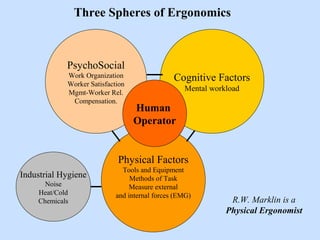
PsychoSocial
Work Organization
Worker Satisfaction
Mgmt-Worker Rel.
Compensation.
Cognitive Factors
Mental workload
Physical Factors
Tools and Equipment
Methods of Task
Measure external
and internal forces (EMG)
Human
Operator
Industrial Hygiene
Noise
Heat/Cold
Chemicals R.W. Marklin is a
Physical Ergonomist
Three Spheres of Ergonomics
Truck Cab Dimensions
Cab Design
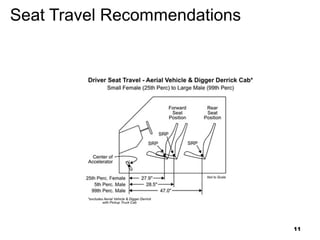
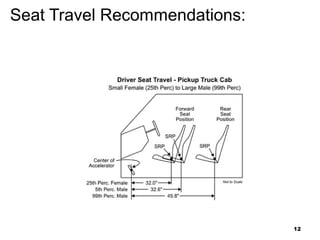
Seat Travel- Forward and Rear
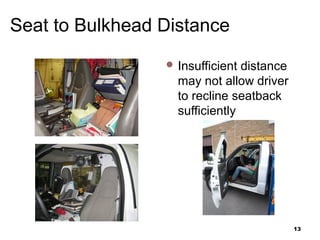
Seat to Bulkhead Distance
Steering Wheel Height
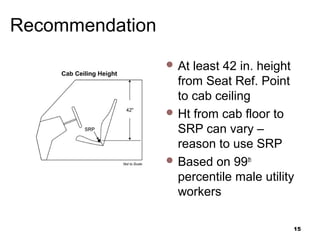
Cab Ceiling Height
Pedal Location
Height between Cab Floor and IP
7
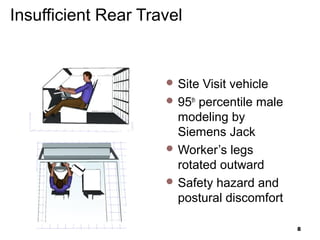
Insufficient Rear Travel
 Site Visit vehicle
 95th
percentile male
modeling by
Siemens Jack
 Worker’s legs
rotated outward
 Safety hazard and
postural discomfort
8
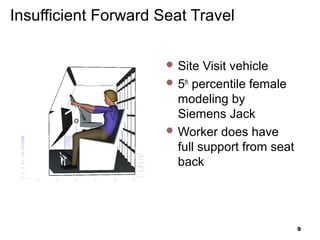
Insufficient Forward Seat Travelavel
 Site Visit vehicle
 5th
percentile female
modeling by
Siemens Jack
 Worker does have
full support from seat
back
9
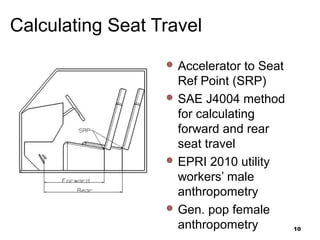
Calculating Seat Travel
 Accelerator to Seat
Ref Point (SRP)
 SAE J4004 method
for calculating
forward and rear
seat travel
 EPRI 2010 utility
workers’ male
anthropometry
 Gen. pop female
anthropometry 10
Seat Travel Recommendations:
AV / DD Cab
11
Seat Travel Recommendations:
Pickup Cab
12
Seat to Bulkhead Distance
 Insufficient distance
may not allow driver
to recline seatback
sufficiently
13
Recommendation
 Recommended
minimum seat to
bulkhead distance is
15.7 in.
 Seat dimensions
taken from database
of 27 site visit
vehicles
14
Recommendation
 At least 42 in. height
from Seat Ref. Point
to cab ceiling
 Ht from cab floor to
SRP can vary –
reason to use SRP
 Based on 99th
percentile male utility
workers
15
Pedal Location
 Insufficient distance
between brake and
accelerator
 Toe stuck under
pedal
 Boot overlaps both
pedals
 Workers have larger
feet than gen. pop
 Some workers drive
vehicles without
boots
16
This cab has sufficient distance
between brake and accelerator but
not between accelerator and hump.
Recommendation
 EPRI 2010
anthropometry study:
99th
percentile shoe
size was 14D
 2 in. clearance
added to ½ of boot
width
 Center of accelerator
used to
accommodate big
boots (overlap with 17
Recommendation
 99th
percentile boot
size
 Vehicle database
used for dimensions
and angle of
accelerator
18
Computer Keyboards
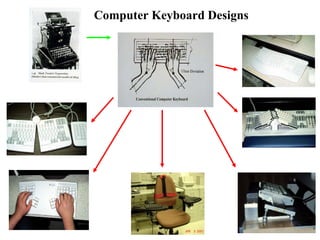
Computer Keyboard Designs
Conventional keyboard
Split keyboard
Sloped keyboard
Tilted keyboard
Epidemiology & Keyboards
Tittirandonda, Burastero, and Rempel
(1999) summary
Consistent relationship between
computer-related risk factors and MSDs,
specifically sustained awkward postures
of wrist
This presentation will address how
alternative keyboard designs can reduce
awkward postures risk factor
How Do MSDs’ Risk Factors Relate
to Conventional Computer
Keyboards?
 Posture
 Extended wrist
 Ulnarly deviated wrist
 Repetition
 3 key strokes per second
 Up to 50,000 to 100 000 key strokes
per day
 Force
 Minimal forces but exerted many times
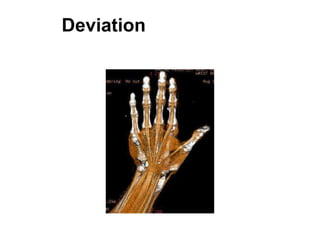
Wrist Deviation and Tendons
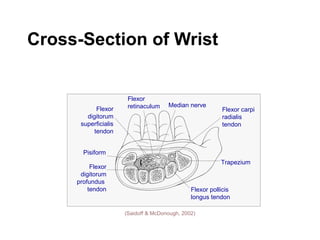
Cross-Section of Wrist
Trapezium
Flexor
digitorum
superficialis
tendon
Flexor
digitorum
profundus
tendon
Pisiform
Flexor pollicis
longus tendon
Flexor carpi
radialis
tendon
Flexor
retinaculum Median nerve
(Saidoff & McDonough, 2002)
Biomechanical Consequences
of a Deviated Wrist Position
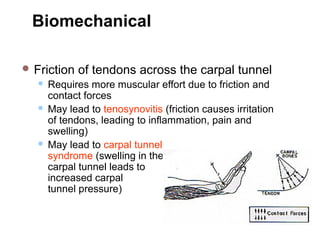
 Friction of tendons across the carpal tunnel
 Requires more muscular effort due to friction and
contact forces
 May lead to tenosynovitis (friction causes irritation
of tendons, leading to inflammation, pain and
swelling)
 May lead to carpal tunnel
syndrome (swelling in the
carpal tunnel leads to
increased carpal
tunnel pressure)
Carpal Tunnel Pressure
Pressure against median nerve in carpal
tunnel could cause carpal tunnel
syndrome
Pressure against tendons and their
sheaths could cause tenosynovitis
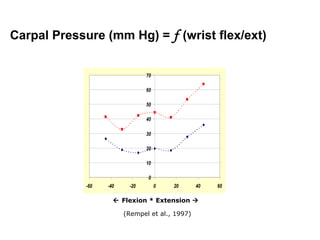
Carpal Pressure (mm Hg) = f (wrist flex/ext)
0
10
20
30
40
50
60
70
-60 -40 -20 0 20 40 60
 Flexion * Extension 
(Rempel et al., 1997)
Split Keyboard
 Slant angle of a keyboard
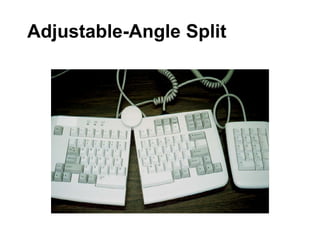
 Split fixed-angle
 Split adjustable-angle
10.5° slant
12.5° slant
The slant angle is half the opening angle
Sloped Keyboard
Slope angle of a keyboard
 Positive slope keyboard
 Negative slope keyboard
15° slope
-15° slope
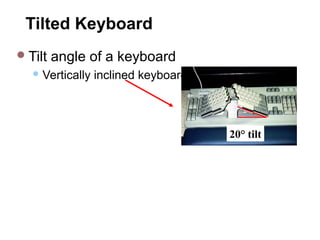
Tilted Keyboard
Tilt angle of a keyboard
 Vertically inclined keyboard
20° tilt
Conventional Keyboard Wrist Deviation
 Left hand
 Wrist Ulnar Dev.
 15.0 ± 7.7°
 Wrist Extension
 21.2 ± 8.8°
 Pronation
 62.2 ± 10.6°
 Right hand
 Wrist Ulnar Dev.
 10.1 ± 7.2°
 Wrist Extension
 17.0 ± 7.4°
 Pronation
 65.6 ± 8.3°
Simoneau et al. (1999)
N = 90 touch typists (approx. 60 wpm)
Age = 37.8 ± 9.3 years
Experience = 14.4 ± 8.8 years
Fixed-Angle Split Keyboard
Adjustable-Angle Split
Keyboard
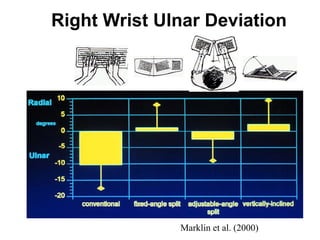
Right Wrist Ulnar Deviation
Marklin et al. (2000)
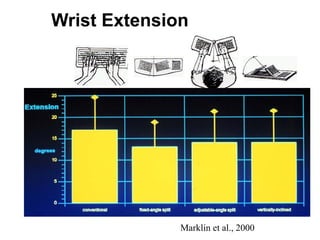
Wrist Extension
Marklin et al., 2000
Summary of Split Keyboards
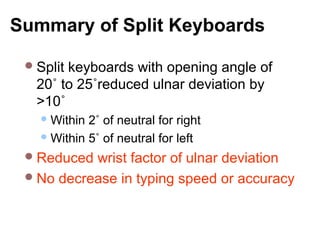
Split keyboards with opening angle of
20˚ to 25˚reduced ulnar deviation by
>10˚
Within 2˚ of neutral for right
Within 5˚ of neutral for left
Reduced wrist factor of ulnar deviation
No decrease in typing speed or accuracy
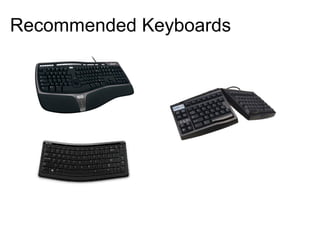
Recommended Keyboards
Electric Power Industry
Ergonomics Handbooks
EPRI Document
#1005199
November 2001
EPRI Document
#1005430
March 2004
EPRI Document
#1005574
March 2005
EPRI Document
#101042
January 2008
EPRI Document
#1014942
March 2008
Manhole Covers
Removing and Replacing Manhole Covers:
Current Work Practice
Manholes provide access to
underground vaults and utility corridors
Square: up to 3 ft x 4 ft
Round: up to 4 ft in diameter
123 to 209 lbs
Removing and Replacing Manhole Covers:
Current Work Practice
Hook and chain
Steel lifting hook
Removing and Replacing Manhole Covers:
Current Work Practice
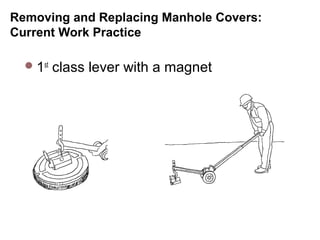
1st
class lever with a magnet
Removing and Replacing Manhole Covers:
Current Work Practice
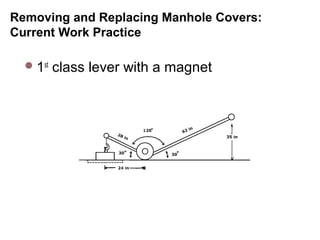
1st
class lever with a magnet
Removing and Replacing Manhole Covers:
Current Work Practice
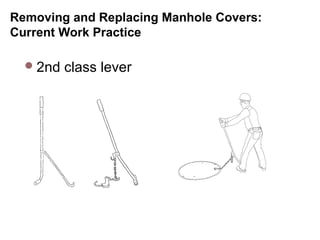
2nd class lever
Removing and Replacing Manhole Covers:
Problems
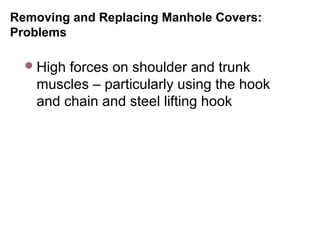
High forces on shoulder and trunk
muscles – particularly using the hook
and chain and steel lifting hook
Removing and Replacing Manhole Covers:
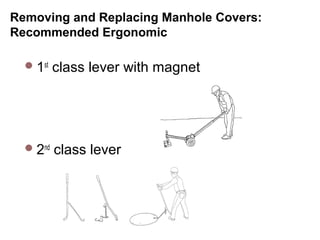
Recommended Ergonomic Recommendations
1st
class lever with magnet
2nd
class lever
Removing and Replacing Manhole Covers:
Benefits of 1st
class lever with magnet
Based on field study with 32.5 inch 175 lbs
cover
Peak force with handle attached to 175 lbs
cover: 177 lbf
Peak force with 1st
class lever: 68 lbf
Removing and Replacing Manhole Covers:
Benefits of 1st
class lever with magnet
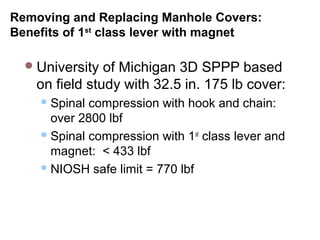
University of Michigan 3D SPPP based
on field study with 32.5 in. 175 lb cover:
Spinal compression with hook and chain:
over 2800 lbf
Spinal compression with 1st
class lever and
magnet: < 433 lbf
NIOSH safe limit = 770 lbf
Mobile Computers
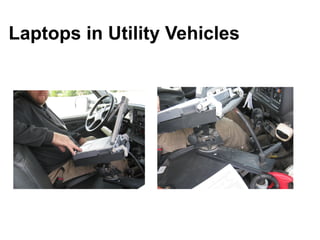
Laptops in Utility Vehicles
Mobile Computer Laboratory Study
Investigate the effects of different laptop
PC locations in a utility vehicle cab
Biomechanical effects
Performance and safety effects
Subjective assessment
60
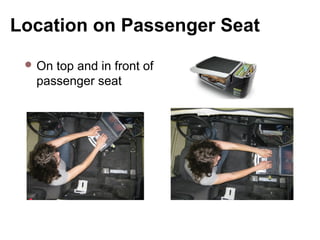
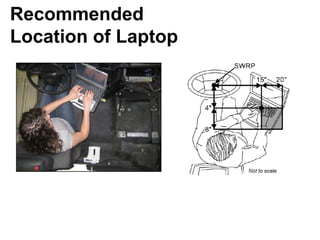
Location on Passenger Seat
 On top and in front of
passenger seat
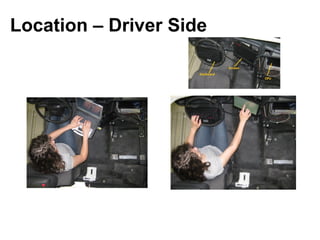
Location – Driver Side
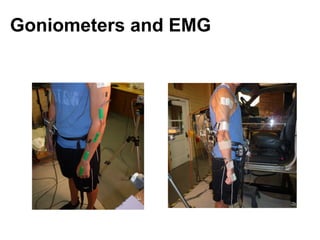
Goniometers and EMG
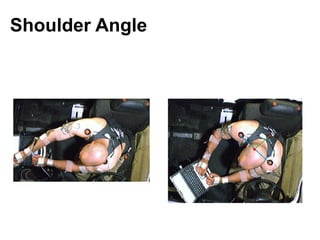
Shoulder Angle
Laboratory Study:
Dependent Variables
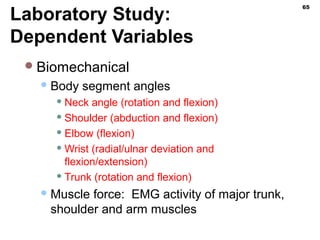
Biomechanical
Body segment angles
 Neck angle (rotation and flexion)
 Shoulder (abduction and flexion)
 Elbow (flexion)
 Wrist (radial/ulnar deviation and
flexion/extension)
 Trunk (rotation and flexion)
Muscle force: EMG activity of major trunk,
shoulder and arm muscles
65
Laboratory Study:
Dependent Variables
Comfort and effort
Assessed using ordinal subjective
assessment forms
Performance
Time to complete tasks on PC
Accuracy of tasks
Preference
Rank order of placement from worst to best
Selection of best placement
66
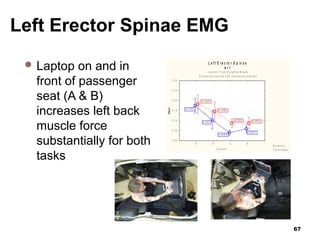
Left Erector Spinae EMG
67
 Laptop on and in
front of passenger
seat (A & B)
increases left back
muscle force
substantially for both
tasks
L e ft E r e c to r S p in a e
N = 7
L o c a t i o n * T a s k ; W e i g h t e d M e a n s
V e rt i c a l b a rs d e n o t e 0 . 9 5 c o n f i d e n c e i n t e r v a l s
K e y b o a rd
T o u c h s c r e e n
0 . 1 7 5 2
0 . 1 0 3
0 . 0 4 0 4
0 . 0 6 0 1
0 . 1 7 5 2
0 . 1 0 3
0 . 0 4 0 4
0 . 0 6 0 1
0 . 1 8 2 6
0 . 1 4 5 8
0 . 0 8 8 0 . 0 8 7 9
0 . 1 8 2 6
0 . 1 4 5 8
0 . 0 8 8 0 . 0 8 7 9
A B C D
L o c a t i o n
0 . 0 0
0 . 0 5
0 . 1 0
0 . 1 5
0 . 2 0
0 . 2 5
0 . 3 0
Mean
0 . 1 7 5 2
0 . 1 0 3
0 . 0 4 0 4
0 . 0 6 0 1
0 . 1 8 2 6
0 . 1 4 5 8
0 . 0 8 8 0 . 0 8 7 9
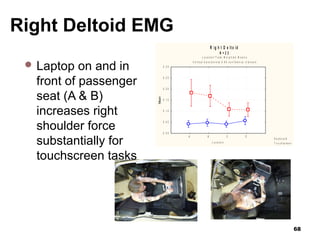
Right Deltoid EMG
68
 Laptop on and in
front of passenger
seat (A & B)
increases right
shoulder force
substantially for
touchscreen tasks
R ig h t D e lto id
N = 2 2
L o c a t i o n * T a s k ; W e i g h t e d M e a n s
V e r t i c a l b a r s d e n o t e 0 . 9 5 c o n f i d e n c e i n t e rv a l s
K e y b o a r d
T o u c h s c re e n
A B C D
L o c a t i o n
0 . 0 0
0 . 0 5
0 . 1 0
0 . 1 5
0 . 2 0
0 . 2 5
0 . 3 0
Mean
Recommended
Location of Laptop
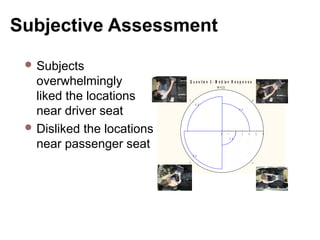
Subjective Assessment
 Subjects
overwhelmingly
liked the locations
near driver seat
 Disliked the locations
near passenger seat
Q u e s t io n 3 : M e d ia n R e s p o n s e
N = 2 2
4 . 0
5 . 0
5 . 5
2 . 0
0 1 2 3 4 5 6
BC
D A
4 . 0
5 . 0
5 . 5
2 . 0
Wind Turbines
Wind Turbines – Enormous, Plentiful
(>15,000 in US), and Growing
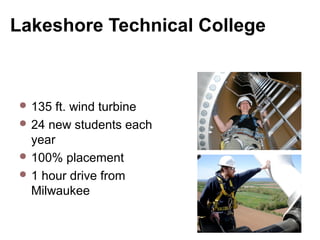
Lakeshore Technical College
 135 ft. wind turbine
 24 new students each
year
 100% placement
 1 hour drive from
Milwaukee
73
Wind Power Maintenance
Tasks
Inspection and maintenance
Oil exchange and filters
Check torque on bolts
Parts removal and replacement
74
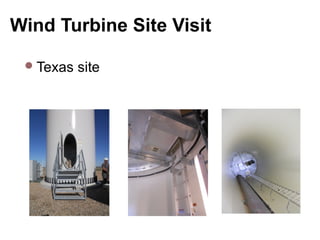
Wind Turbine Site Visit
Texas site
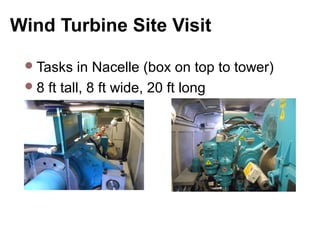
Wind Turbine Site Visit
Tasks in Nacelle (box on top to tower)
8 ft tall, 8 ft wide, 20 ft long
Muchas Gracias

Ergonomics for senior design 10 3-12