Phenol
Govinda Pathak
Chemistry Lecturer
Samakhusi, Kathmandu 44600
Nepal
Email: Pathakgovinda32@gmail.com
Phenol
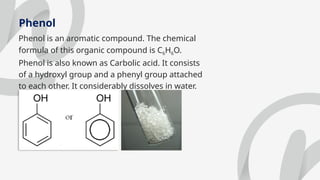
Phenol is an aromatic compound. The chemical
formula of this organic compound is C6H6O.
Phenol is also known as Carbolic acid. It consists
of a hydroxyl group and a phenyl group attached
to each other. It considerably dissolves in water.
Phenol
• General Properties of Phenol
• The molecular formula of phenol is
C6H5OH and molecular mass 94.113 amu.
• It is a transparent crystalline solid with a
sweet and tarry odour.
• The density is 1.07 grams per centimeter
cube, melting point is 40.5 °C and boiling
point is 181.7 °C
Nomenclature of Phenol
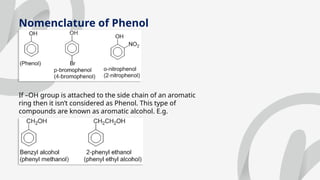
If –OH group is attached to the side chain of an aromatic
ring then it isn’t considered as Phenol. This type of
compounds are known as aromatic alcohol. E.g.
Question
• Write there method for preparation of
phenol. Write action of method with
a. Zn metal
b. Phthalic anhydride
c. CHCl3/KOH
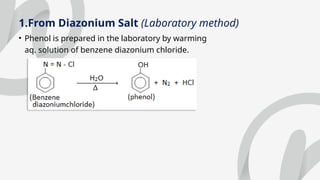
1.From Diazonium Salt (Laboratory method)
• Phenol is prepared in the laboratory by warming
aq. solution of benzene diazonium chloride.
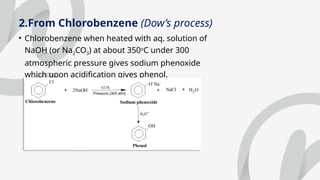
2.From Chlorobenzene (Dow’s process)
• Chlorobenzene when heated with aq. solution of
NaOH (or Na2CO3) at about 350o
C under 300
atmospheric pressure gives sodium phenoxide
which upon acidification gives phenol.
2.From Chlorobenzene (Dow’s process)
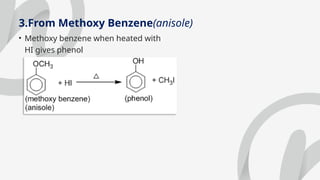
3.From Methoxy Benzene(anisole)
• Methoxy benzene when heated with
HI gives phenol
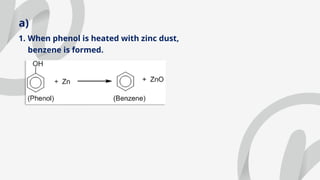
a)
1. When phenol is heated with zinc dust,
benzene is formed.
b)
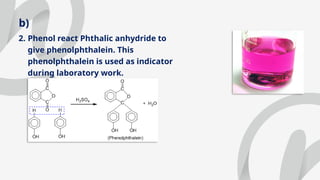
2. Phenol react Phthalic anhydride to
give phenolphthalein. This
phenolphthalein is used as indicator
during laboratory work.
b)
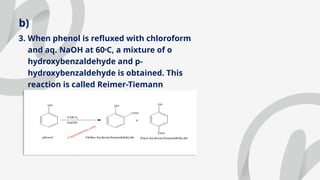
3. When phenol is refluxed with chloroform
and aq. NaOH at 600
C, a mixture of o
hydroxybenzaldehyde and p-
hydroxybenzaldehyde is obtained. This
reaction is called Reimer-Tiemann
reaction.
Question
• What happened when phenol is heated with
i. Formaldehyde
ii. Azobenzene
• Answer
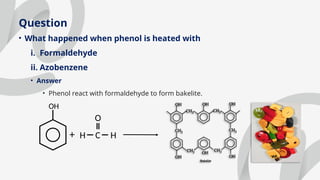
• Phenol react with formaldehyde to form bakelite.
OH
+ H C H
O
Question
Coupling Reaction
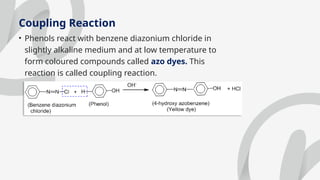
• Phenols react with benzene diazonium chloride in
slightly alkaline medium and at low temperature to
form coloured compounds called azo dyes. This
reaction is called coupling reaction.
Phenol
• An aromatic hydrocarbon (A) is used to manufacture
phenol by reacting with air at high temperature in
presence of minerals acid. (8 marks)
a. Write the IUPAC name and common name of
hydrocarbon(A).
b. Write the series of reaction to convert (A) to phenol.
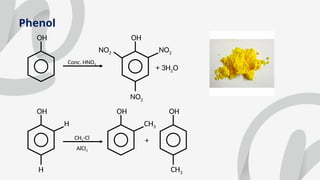
c. Convert phenol into i) picric acid ii) p cresol and iii)
phenolphthalein
d. Write the colour of product when phenol react with a) FeCl3
b) aq Br2
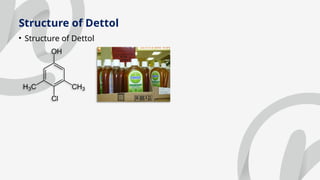
e. Draw the structure of an antiseptic Dettol.
Phenol
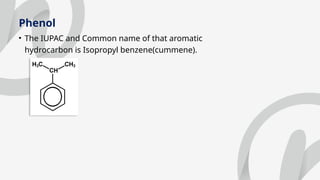
• The IUPAC and Common name of that aromatic
hydrocarbon is Isopropyl benzene(cummene).
Phenol
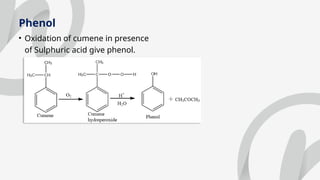
• Oxidation of cumene in presence
of Sulphuric acid give phenol.
Phenol
OH OH
Conc. HNO3
NO2
NO2
+ 3H2O
NO2
OH
H
H
CH3-Cl
AlCl3
OH
CH3
+
OH
CH3
Structure of Dettol
• Structure of Dettol
Some Important Short
Question Related to Phenol.
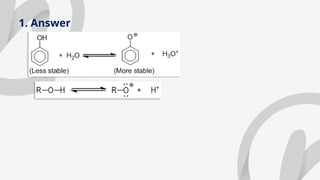
1. Phenol is more acidic than alcohol.
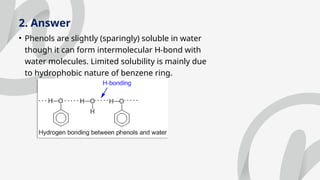
2. Phenol is slightly soluble in water but alcohol is
highly soluble in water.
3. –OH group of phenol is ortho and para directing
towards electrophilic substitution reaction.
4. Phenol has higher boiling point than arene and
haloarene of comparable molecular mass.
5. 2,4,6-trinitrophenol is more acidic than phenol.
6. Picric acid reacts with NaHCO3 or Na2CO3 but
phenol can’t
1. Answer
2. Answer
• Phenols are slightly (sparingly) soluble in water
though it can form intermolecular H-bond with
water molecules. Limited solubility is mainly due
to hydrophobic nature of benzene ring.
3. Answer
4. Answer
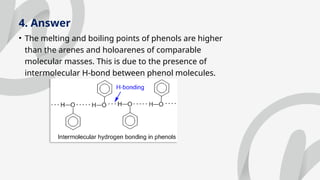
• The melting and boiling points of phenols are higher
than the arenes and holoarenes of comparable
molecular masses. This is due to the presence of
intermolecular H-bond between phenol molecules.
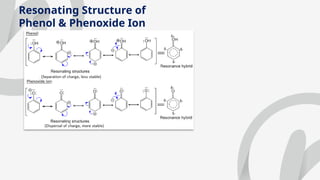
Resonating Structure of
Phenol & Phenoxide Ion
Transforming Education

Phenol (1).pptx -Class 12_Govinda Pathak

  • 1.
    Phenol Govinda Pathak Chemistry Lecturer Samakhusi,Kathmandu 44600 Nepal Email: Pathakgovinda32@gmail.com
  • 2.
    Phenol Phenol is anaromatic compound. The chemical formula of this organic compound is C6H6O. Phenol is also known as Carbolic acid. It consists of a hydroxyl group and a phenyl group attached to each other. It considerably dissolves in water.
  • 3.
    Phenol • General Propertiesof Phenol • The molecular formula of phenol is C6H5OH and molecular mass 94.113 amu. • It is a transparent crystalline solid with a sweet and tarry odour. • The density is 1.07 grams per centimeter cube, melting point is 40.5 °C and boiling point is 181.7 °C
  • 4.
    Nomenclature of Phenol If–OH group is attached to the side chain of an aromatic ring then it isn’t considered as Phenol. This type of compounds are known as aromatic alcohol. E.g.
  • 5.
    Question • Write theremethod for preparation of phenol. Write action of method with a. Zn metal b. Phthalic anhydride c. CHCl3/KOH
  • 6.
    1.From Diazonium Salt(Laboratory method) • Phenol is prepared in the laboratory by warming aq. solution of benzene diazonium chloride.
  • 7.
    2.From Chlorobenzene (Dow’sprocess) • Chlorobenzene when heated with aq. solution of NaOH (or Na2CO3) at about 350o C under 300 atmospheric pressure gives sodium phenoxide which upon acidification gives phenol.
  • 8.
  • 9.
    3.From Methoxy Benzene(anisole) •Methoxy benzene when heated with HI gives phenol
  • 10.
    a) 1. When phenolis heated with zinc dust, benzene is formed.
  • 11.
    b) 2. Phenol reactPhthalic anhydride to give phenolphthalein. This phenolphthalein is used as indicator during laboratory work.
  • 12.
    b) 3. When phenolis refluxed with chloroform and aq. NaOH at 600 C, a mixture of o hydroxybenzaldehyde and p- hydroxybenzaldehyde is obtained. This reaction is called Reimer-Tiemann reaction.
  • 13.
    Question • What happenedwhen phenol is heated with i. Formaldehyde ii. Azobenzene • Answer • Phenol react with formaldehyde to form bakelite. OH + H C H O
  • 14.
  • 15.
    Coupling Reaction • Phenolsreact with benzene diazonium chloride in slightly alkaline medium and at low temperature to form coloured compounds called azo dyes. This reaction is called coupling reaction.
  • 16.
    Phenol • An aromatichydrocarbon (A) is used to manufacture phenol by reacting with air at high temperature in presence of minerals acid. (8 marks) a. Write the IUPAC name and common name of hydrocarbon(A). b. Write the series of reaction to convert (A) to phenol. c. Convert phenol into i) picric acid ii) p cresol and iii) phenolphthalein d. Write the colour of product when phenol react with a) FeCl3 b) aq Br2 e. Draw the structure of an antiseptic Dettol.
  • 17.
    Phenol • The IUPACand Common name of that aromatic hydrocarbon is Isopropyl benzene(cummene).
  • 18.
    Phenol • Oxidation ofcumene in presence of Sulphuric acid give phenol.
  • 19.
    Phenol OH OH Conc. HNO3 NO2 NO2 +3H2O NO2 OH H H CH3-Cl AlCl3 OH CH3 + OH CH3
  • 20.
    Structure of Dettol •Structure of Dettol
  • 21.
    Some Important Short QuestionRelated to Phenol. 1. Phenol is more acidic than alcohol. 2. Phenol is slightly soluble in water but alcohol is highly soluble in water. 3. –OH group of phenol is ortho and para directing towards electrophilic substitution reaction. 4. Phenol has higher boiling point than arene and haloarene of comparable molecular mass. 5. 2,4,6-trinitrophenol is more acidic than phenol. 6. Picric acid reacts with NaHCO3 or Na2CO3 but phenol can’t
  • 22.
  • 23.
    2. Answer • Phenolsare slightly (sparingly) soluble in water though it can form intermolecular H-bond with water molecules. Limited solubility is mainly due to hydrophobic nature of benzene ring.
  • 24.
  • 25.
    4. Answer • Themelting and boiling points of phenols are higher than the arenes and holoarenes of comparable molecular masses. This is due to the presence of intermolecular H-bond between phenol molecules.
  • 26.
  • 27.