


T.C.
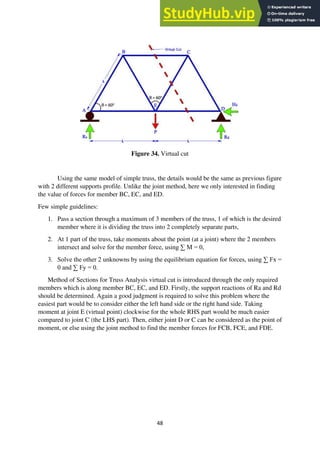
TRAKYA UNIVERSITY
ENGINEERING FACULTY
MECHANICAL ENGINEERING DEPARTMENT
ANALYSIS OF A TRUSS USING FINITE ELEMENT METHODS
PROJECT 3
UMUT BEKAR
Supervisor: Dr. TOLGA AKSENCER
June 2022
EDİRNE
i
T.C.
TRAKYA UNIVERSITY
ENGINEERING FACULTY
MECHANICAL ENGINEERING DEPARTMENT
ANALYSIS OF A TRUSS USING FINITE ELEMENT METHODS
PROJECT 3
UMUT BEKAR
Supervisor: Dr. TOLGA AKSENCER
June 2022
EDİRNE
ii
Project Summary:
In this project there is an example where reaction forces are found using the finite
element method. Firstly, it was solved with manually algebraic solution, then the result was
reached using the ANSYS program and the results of the two solution methods were
compared.
The finite element method, which has a history of 60 years, in recent years the use of
finite element analysis (FEA) as a design tool has grown rapidly. The finite element method is
a numerical procedure that can be used to obtain solutions to a large class of engineering
problems involving stress analysis, heat transfer, electromagnetism, and fluid flow. Easy-to-
use, comprehensive packages such as ANSYS, a general-purpose finite element computer
program, have become common tools in the hands of design engineers. This project is created
to assist analysis engineers of finite element modeling to gain a clear understanding of the
basic concepts. The example that is solved using ANSYS shows in detail how to use ANSYS
to model and analyses a truss analysis of an engineering problem.
In the first section, fundamentals about the finite element method and simple
definitions of matrix solutions used in analysis solutions are given. In addition to this section,
the use of the MatLab program in the finite element method is explained. In the second
section, the classification and properties of trusses and statically solving methods of truss
problems are given. The formulations and definitions required for the solution of trusses with
the finite element method are included in this section. In the third chapter, the manual solution
of determining the reaction forces of a truss structure under loaded forces using the finite
element method is given. In the fourth section, the example for which reaction forces were
found was modeled on ANSYS and solved by the program. In the final section, the results of
the example for which reaction forces were found by manually and the ANSYS Static
Structural module were compared and the consistency between the results was examined.
Keywords: Finite Element Method, Trusses, ANSYS, Reaction Forces, Nodal Displacement
iii
THANKS
I would like to thank dear Dr. Tolga AKSENCER, who guided the
preparation of this project and for his assistance in taking his time to answer my
questions.
In addition, I would like to thank my dear family, who always supported
me financially and morally throughout my education life, and who was by my
side in all circumstances.
UMUT BEKAR
iv
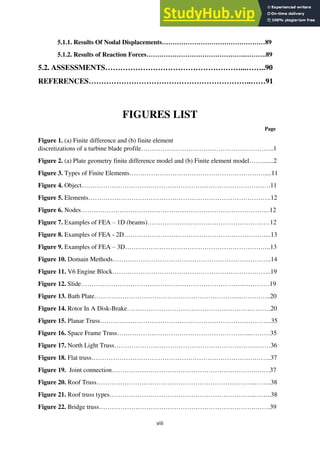
CONTENTS
page
Cover Page…………………………………………………………………………….i
Summary……………………………………………………………………………...ii
Thanks………………………………………………………………………………...iii
Contents………………………………………………………………………………iv
Figures List……………………………………………………………………….….viii
Table List………………………………………………………………………...........x
SECTION 1
1.1. INTRODUCTION TO FINITE ELEMENT ANALYSIS………..…….1
1.1.1. Finite Element Method………………………………………………………..1
1.1.2. History Of the Method…………………………………………………….….1
1.1.3. How The Finite Element Method Works……………………………………4
1.1.3.1. Discretize The Continuum…………………………………….……5
1.1.3.2. Select Interpolation Functions……………………………….…….5
1.1.3.3. Find The Element Properties………………………………………6
1.1.3.4. Assemble The Element Properties to Obtain The System
Equations…………………………………………………………………….6
1.1.3.5. Impose The Boundary Conditions……………………….…….…..6
1.1.3.6. Solve The System Equations………………………………………..6
1.1.3.7. Make Additional Computations……………………….……..…….6
1.1.4. Range Of Applications…………………………………………….…………..7
1.1.5. Commercial Finite Element Software…………………………….………….7
1.2. FINITE ELEMENT ANALYSIS (FEA)-FINITE ELEMENT
METHOD (FEM) FUNDAMENTALS……………………………….……..10
1.2.1. The Purpose of FEA………………………………………………………….10
1.2.2. Common FEA Applications………………………………………………….10
1.2.3. Elements & Nodes - Nodal Quantity………………………………….……..11
1.2.4. Advantages Of FEA………….……………………………………...………..13
1.2.5. Principles of FEA……………………………………………….…………….14
v
1.2.6. Shape Functions……………………………………………….…………….14
1.2.7. Degrees of Freedom………………………………………………..………..15
1.2.8. Stiffness Matrix…………………………………………………...…………15
1.2.9. Truss Element…………………………………………………...…………..15
1.2.10. Truss Element Stiffness Matrix………………………………...…………16
1.3. USING FINITE ELEMENT ANALYSIS FOR ENGINEERING
PROBLEMS…………………………………………………………………..17
1.3.1. Numerical Methods…………………………………………………………..17
1.3.2. A Brief History of the Finite Element Method and ANSYS……………….18
1.3.3. Basic Steps in the Finite Element Method………………………….……….19
1.3.3.1. Preprocessing Phase……………………………………….……….19
1.3.3.2. Solution Phase……………………………………………..………..21
1.3.3.3. Postprocessing Phase………………………………………...……..21
1.4. MATRIX ALGEBRA FOR FINITE ELEMENT METHOD……...….22
1.4.1. Basic Definitions……………………………………………………….……..22
1.4.2. Column Matrix and Row Matrix……………………………………………22
1.4.3. Diagonal, Unit, and Band (Banded) Matrix……………………….………..23
1.4.4. Upper and Lower Triangular Matrix…………………………….…………24
1.4.5. Matrix Addition or Subtraction………………………………….………….24
1.4.6. Matrix Multiplication……………………………………………..………….25
1.4.6.1. Multiplying a Matrix by a Scalar Quantity…………..…………..25
1.4.6.2. Multiplying a Matrix by Another Matrix……………..…………..25
1.4.6.3. Partitioning of a Matrix…………………………………………….27
1.4.6.4. Addition and Subtraction Operations Using Partitioned
Matrices………………………………………………………………………27
1.4.6.5. Matrix Multiplication Using Partitioned Matrices………...……..28
1.4.7. Transpose of a Matrix……………………………………………….………..29
1.5. FINITE ELEMENT ANALYSIS OF SPACE TRUSS USING
MATLAB………………………………………………………………...…….32
1.5.1. Finite Element Formulation…………………………………………...……..32
vi
SECTION 2
2.1. TRUSSES…………………………………………………………………34
2.1.1. Introduction To Trusses……………………………………………….…….34
2.1.1.1. Types Of Truss………………………………………………..…….34
2.1.1.1.1. Simple Truss………………………………………..….….34
2.1.1.1.2. Planar Truss………………………………………..……..34
2.1.1.1.3. Space Frame Truss……………………………………….35
2.1.1.1.4. Truss Forms………………………………………………35
2.1.1.1.5. Pratt Truss………………………………………………..35
2.1.1.1.6. Warren Truss……………………………………….…….36
2.1.1.1.7. North Light Truss……………………………….….…….36
2.1.1.1.8. King Post Truss………………………………….….…….36
2.1.1.1.9. Queen Post Truss…………………………………..……..36
2.1.1.1.10. Flat Truss………………………………………..………36
2.1.1.2. Analysis of Statically Determinate Trusses……………...………..37
2.1.1.2.1. Common Types of Trusses………………………..……..37
2.1.1.2.2. Roof Trusses………………………………………..…….37
2.1.1.2.3. Bridge Trusses……………………………………...…….39
2.1.1.2.4. Classification of Coplanar Trusses………………..…….41
2.1.1.2.4.1. Simple Truss…………………………………….41
2.1.1.2.4.2. Compound Truss……………………….………41
2.1.1.2.4.3. Complex Truss……………………...…………..42
2.1.2. Determinacy…………………………………………………………………..43
2.1.3. Stability…………………………………………………………….………….43
2.1.4. External Stability ……………………………………………….……………43
2.1.5. Internal Stability ……………………………………………………………..43
2.2. METHODS FOR TRUSS ANALYSIS………………………….………45
2.2.1. Method of Joints for Truss Analysis……………………………...…………45
2.2.2. Method of Sections for Truss Analysis……………...………………………47
vii
2.2.3. Graphical Method of Truss Analysis (Maxwell’s Diagram)……….………49
2.3. COMPUTER-AIDED DESIGN METHODS FOR ADDITIVE
FABRICATION OF TRUSS STRUCTURES………………………....……51
2.4. TRUSS FORMULATION………………………………………….……53
2.4.1. Definition of a Truss………………………………………………………….53
2.4.2. Finite Element Formulation…………………………………………………54
2.4.3. Finite Element Analysis as a Solution Method for Truss
Problems in Statics………………………………………………………….………61
2.4.4. The Simple Plane Truss Problem - Statically Determinate…………..……61
2.4.5. The Linear Algebra Formulation……………………………………………61
2.4.6. The FEA Formulation…………………………………………………..……63
SECTION 3
3.1. MANUAL SOLUTION……………………………………………..……68
3.1.1. Example……………………………………………………………..…………68
3.1.2. Preprocessing Phase…………………………………………………….…….68
3.1.2.1. Discretize The Problem Into Nodes And Elements……………….68
3.1.2.2. Assume A Solution That Approximates The Behavior Of An
Element………………………………………………………………………69
3.1.2.3. Develop Equations For Elements………………………………….69
3.1.2.4. Assemble Elements…………………………………………..……..73
3.1.2.5. Apply The Boundary Conditions And Loads…………………….74
3.1.3. Solution Phase…………………………………………………………..…….74
3.1.3.1. Solve A System Of Algebraic Equations Simultaneously…..……74
SECTION 4
4.1. MODELING AND ANALYSIS…………………………………………76
4.1.1. Modeling Of Truss with Ansys Program…………………………….……..76
4.1.2. Preparation of the Analysis Conditions……………………………...……..80
4.2. Results Of Example………………………………………………..…….86
SECTION 5
5.1. RESULTS ………………………………………………………………..89
viii
5.1.1. Results Of Nodal Displacements…………………………………………89
5.1.2. Results of Reaction Forces……………………………………….……….89
5.2. ASSESSMENTS………………………………………………...……..90
REFERENCES………………………………………………………..……91
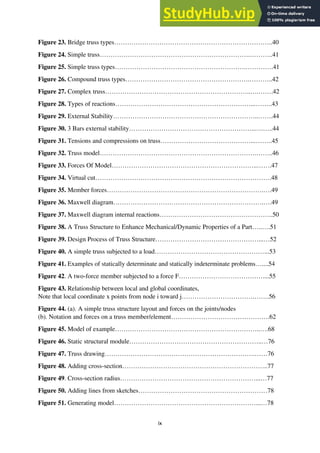
FIGURES LIST
Page
Figure 1. (a) Finite difference and (b) finite element
discretizations of a turbine blade profile……………………………………………………..1
Figure 2. (a) Plate geometry finite difference model and (b) Finite element model…….......2
Figure 3. Types of Finite Elements………………………………………………………....11
Figure 4. Object…………………………………………………………………………….11
Figure 5. Elements………………………………………………………………………….12
Figure 6. Nodes…………………………………………………………………………….12
Figure 7. Examples of FEA – 1D (beams)…………………………………………………12
Figure 8. Examples of FEA - 2D…………………………………………………………...13
Figure 9. Examples of FEA – 3D…………………………………………………………..13
Figure 10. Domain Methods………………………………………………………………..14
Figure 11. V6 Engine Block………………………………………………………………..19
Figure 12. Slide………………………………………………………………….…………19
Figure 13. Bath Plate…………………………………………………………...…………..20
Figure 14. Rotor In A Disk-Brake………………………………………………….………20
Figure 15. Planar Truss……………………………………………………………………..35
Figure 16. Space Frame Truss……………………………………………………...………35
Figure 17. North Light Truss………………………………………………………….……36
Figure 18. Flat truss……………………………………………………………….………..37
Figure 19. Joint connection………………………………………………………….…….37
Figure 20. Roof Truss………………………………………………………………..……..38
Figure 21. Roof truss types…………………………………………………………..……..38
Figure 22. Bridge truss……………………………………………………………….…….39
ix
Figure 23. Bridge truss types………………………………………………………………..40
Figure 24. Simple truss…………………………………………………………….………..41
Figure 25. Simple truss types…………………………………………………….………….41
Figure 26. Compound truss types………………………………………………….………..42
Figure 27. Complex truss…………………………………………………………..….…….42
Figure 28. Types of reactions………………………………………………………...……..43
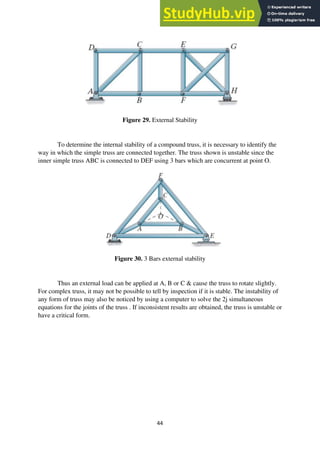
Figure 29. External Stability…………………………………………………………..…….44
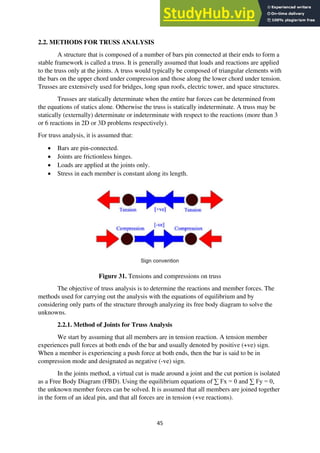
Figure 30. 3 Bars external stability…………………………………………………..….…..44
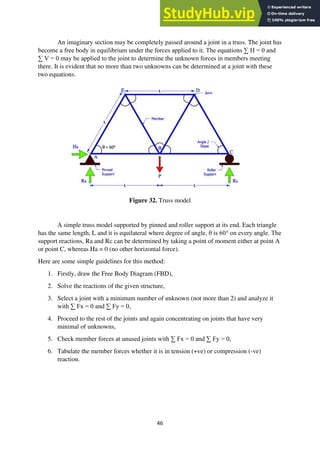
Figure 31. Tensions and compressions on truss……………………………………...……..45
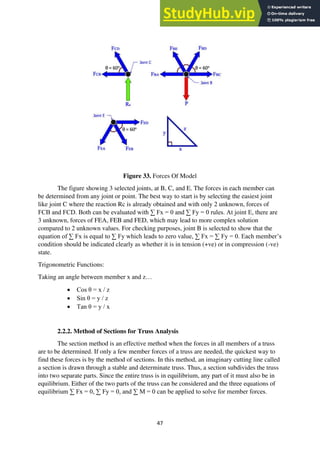
Figure 32. Truss model……………………………………………………………….……..46
Figure 33. Forces Of Model…………………………………………………………..…….47
Figure 34. Virtual cut……………………………………………………………………….48
Figure 35. Member forces……………………………………………………………….….49
Figure 36. Maxwell diagram…………………………………………………………….….49
Figure 37. Maxwell diagram internal reactions……………………………………………..50
Figure 38. A Truss Structure to Enhance Mechanical/Dynamic Properties of a Part…..….51
Figure 39. Design Process of Truss Structure…………………………………………...…52
Figure 40. A simple truss subjected to a load……………………………………………...53
Figure 41. Examples of statically determinate and statically indeterminate problems…....54
Figure 42. A two-force member subjected to a force F…………………………………....55
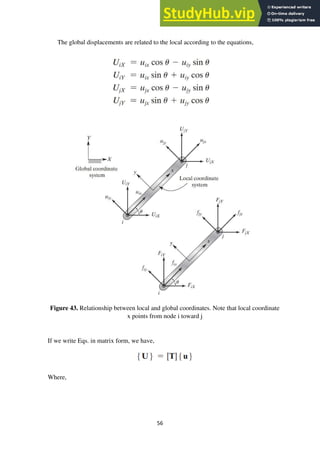
Figure 43. Relationship between local and global coordinates,
Note that local coordinate x points from node i toward j…………………………….…….56
Figure 44. (a). A simple truss structure layout and forces on the joints/nodes
(b). Notation and forces on a truss member/element……………………………………….62
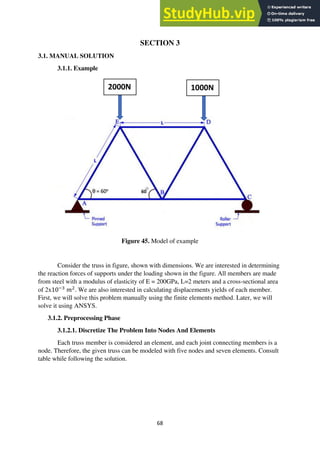
Figure 45. Model of example…………………………………………………………..….68
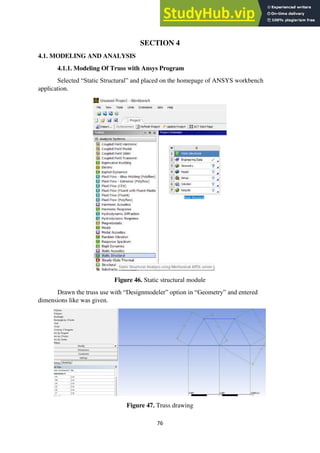
Figure 46. Static structural module……………………………………………………..…76
Figure 47. Truss drawing…………………………………………………………….……76
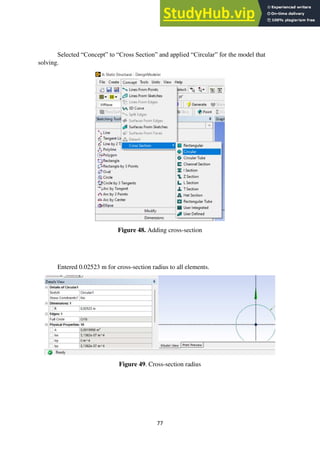
Figure 48. Adding cross-section…………………………………………………………..77
Figure 49. Cross-section radius………………………………………………………...…77
Figure 50. Adding lines from sketches……………………………………………………78
Figure 51. Generating model…………………………………………………………...…78
x
Figure 52. Choosing cross-section…………………………………………………………79
Figure 53. Completing model……………………………………………………...………79
Figure 54. Model editing …………………………………………………………….……80
Figure 55. Meshing ………………………………………………………………………..80
Figure 56. Adding fixed support………………………………………………………...…81
Figure 57. Point of fixed support………………………………………………….……….81
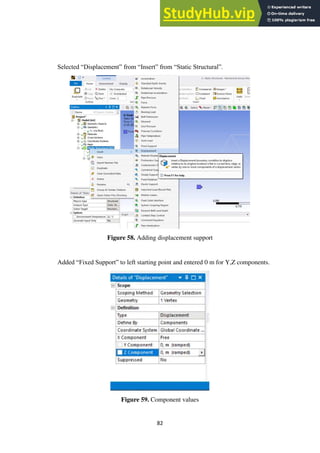
Figure 58. Adding displacement support…………………………………………………..82
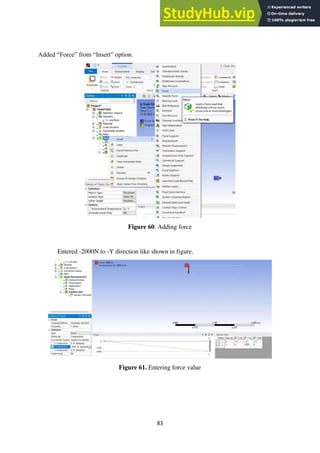
Figure 59. Component values……………………………………………………….……..82
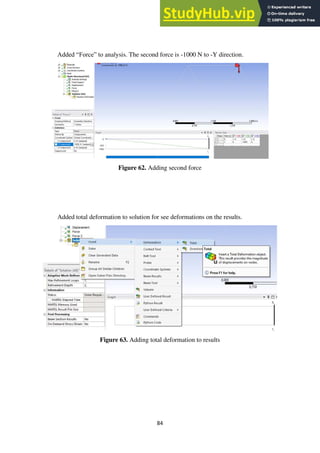
Figure 60. Adding force……………………………………………………………………83
Figure 61. Entering force value……………………………………………………………83
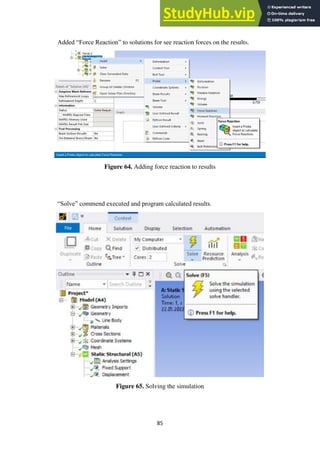
Figure 62. Adding second force……………………………………………………………84
Figure 63. Adding total deformation to results…………………………………………….84
Figure 64. Adding force reaction to results…………………………………………..……85
Figure 65. Solving the simulation………………………………………………………….85
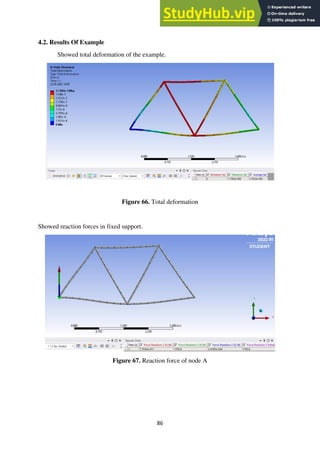
Figure 66. Total deformation………………………………………………………………86
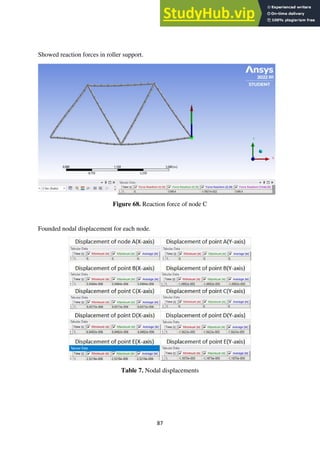
Figure 67. Reaction force of node A………………………………………………………86
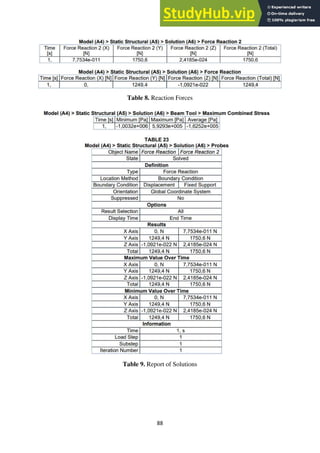
Figure 68. Reaction force of node C………………………………………………………87
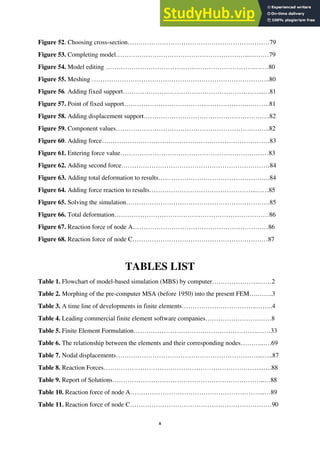
TABLES LIST
Table 1. Flowchart of model-based simulation (MBS) by computer………………….……2
Table 2. Morphing of the pre-computer MSA (before 1950) into the present FEM….…….3
Table 3. A time line of developments in finite elements……………………………..……..4
Table 4. Leading commercial finite element software companies…………………….……8
Table 5. Finite Element Formulation………………………………………………….……33
Table 6. The relationship between the elements and their corresponding nodes………..….69
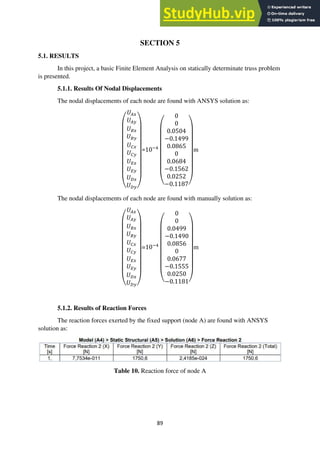
Table 7. Nodal displacements…………………………………………………………...…..87
Table 8. Reaction Forces………………………………………………………………...….88
Table 9. Report of Solutions……………………………………………………………..…88
Table 10. Reaction force of node A……………………………………………………...…89
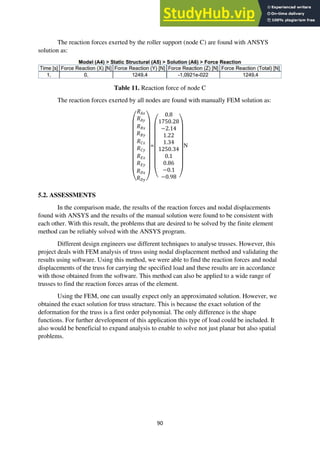
Table 11. Reaction force of node C…………………………………………………………90
1
SECTION 1
1.1. INTRODUCTION TO FINITE ELEMENT ANALYSIS
1.1.1. Finite Element Method
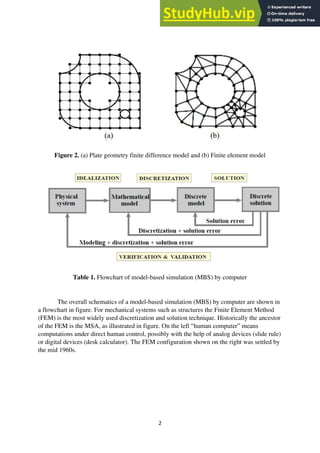
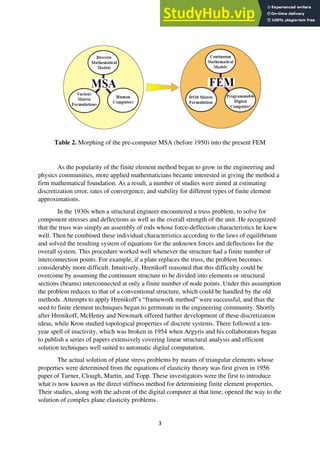
Several approximate numerical analysis methods have evolved over the years. As an
example of how a finite difference model and a finite element model might be used to
represent a complex geometrical shape, consider the turbine blade cross-section in Figure and
plate geometry in figure b. A uniform finite difference mesh would reasonably cover the blade
(the solution region), but the boundaries must be approximated by a series of horizontal and
vertical lines (or “stair steps”). On the other hand, the finite element model (using the simplest
two-dimensional element-the triangle) gives a better approximation of the region. Also, a
better approximation to the boundary shape results because the curved boundary is
represented by straight lines of any inclination. This is not intended to suggest that finite
element models are decidedly better than finite difference models for all problems. The only
purpose of these examples is to demonstrate that the finite element method is particularly well
suited for problems with complex geometries and numerical solutions to even very
complicated stress problems can now be obtained routinely using finite element analysis
(FEA).
1.1.2. History Of the Method
Although the label finite element method first appeared in 1960, when it was used by
Clough in a paper on plane elasticity problems, the ideas of finite element analysis date back
much further. The first efforts to use piecewise continuous functions defined over triangular
domains appear in the applied mathematics literature with the work of Courant in 1943.
Courant developed the idea of the minimization of a functional using linear approximation
over sub-regions, with the values being specified at discrete points which in essence become
the node points of a mesh of elements.
Figure 1. (a) Finite difference and (b) finite element discretizations of a turbine blade profile
2
Figure 2. (a) Plate geometry finite difference model and (b) Finite element model
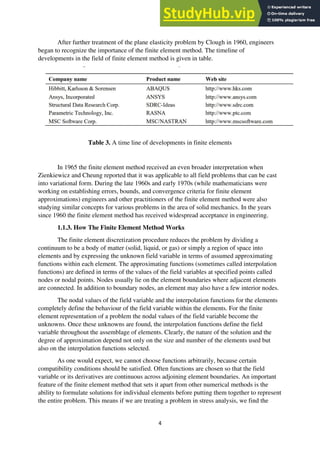
Table 1. Flowchart of model-based simulation (MBS) by computer
The overall schematics of a model-based simulation (MBS) by computer are shown in
a flowchart in figure. For mechanical systems such as structures the Finite Element Method
(FEM) is the most widely used discretization and solution technique. Historically the ancestor
of the FEM is the MSA, as illustrated in figure. On the left “human computer” means
computations under direct human control, possibly with the help of analog devices (slide rule)
or digital devices (desk calculator). The FEM configuration shown on the right was settled by
the mid 1960s.
3
Table 2. Morphing of the pre-computer MSA (before 1950) into the present FEM
As the popularity of the finite element method began to grow in the engineering and
physics communities, more applied mathematicians became interested in giving the method a
firm mathematical foundation. As a result, a number of studies were aimed at estimating
discretization error, rates of convergence, and stability for different types of finite element
approximations.
In the 1930s when a structural engineer encountered a truss problem, to solve for
component stresses and deflections as well as the overall strength of the unit. He recognized
that the truss was simply an assembly of rods whose force-deflection characteristics he knew
well. Then he combined these individual characteristics according to the laws of equilibrium
and solved the resulting system of equations for the unknown forces and deflections for the
overall system. This procedure worked well whenever the structure had a finite number of
interconnection points. For example, if a plate replaces the truss, the problem becomes
considerably more difficult. Intuitively, Hrenikoff reasoned that this difficulty could be
overcome by assuming the continuum structure to be divided into elements or structural
sections (beams) interconnected at only a finite number of node points. Under this assumption
the problem reduces to that of a conventional structure, which could be handled by the old
methods. Attempts to apply Hrenikoff’s “framework method” were successful, and thus the
seed to finite element techniques began to germinate in the engineering community. Shortly
after Hrenikoff, McHenry and Newmark offered further development of these discretization
ideas, while Kron studied topological properties of discrete systems. There followed a ten-
year spell of inactivity, which was broken in 1954 when Argyris and his collaborators began
to publish a series of papers extensively covering linear structural analysis and efficient
solution techniques well suited to automatic digital computation.
The actual solution of plane stress problems by means of triangular elements whose
properties were determined from the equations of elasticity theory was first given in 1956
paper of Turner, Clough, Martin, and Topp. These investigators were the first to introduce
what is now known as the direct stiffness method for determining finite element properties.
Their studies, along with the advent of the digital computer at that time, opened the way to the
solution of complex plane elasticity problems.
4
After further treatment of the plane elasticity problem by Clough in 1960, engineers
began to recognize the importance of the finite element method. The timeline of
developments in the field of finite element method is given in table.
Table 3. A time line of developments in finite elements
In 1965 the finite element method received an even broader interpretation when
Zienkiewicz and Cheung reported that it was applicable to all field problems that can be cast
into variational form. During the late 1960s and early 1970s (while mathematicians were
working on establishing errors, bounds, and convergence criteria for finite element
approximations) engineers and other practitioners of the finite element method were also
studying similar concepts for various problems in the area of solid mechanics. In the years
since 1960 the finite element method has received widespread acceptance in engineering.
1.1.3. How The Finite Element Method Works
The finite element discretization procedure reduces the problem by dividing a
continuum to be a body of matter (solid, liquid, or gas) or simply a region of space into
elements and by expressing the unknown field variable in terms of assumed approximating
functions within each element. The approximating functions (sometimes called interpolation
functions) are defined in terms of the values of the field variables at specified points called
nodes or nodal points. Nodes usually lie on the element boundaries where adjacent elements
are connected. In addition to boundary nodes, an element may also have a few interior nodes.
The nodal values of the field variable and the interpolation functions for the elements
completely define the behaviour of the field variable within the elements. For the finite
element representation of a problem the nodal values of the field variable become the
unknowns. Once these unknowns are found, the interpolation functions define the field
variable throughout the assemblage of elements. Clearly, the nature of the solution and the
degree of approximation depend not only on the size and number of the elements used but
also on the interpolation functions selected.
As one would expect, we cannot choose functions arbitrarily, because certain
compatibility conditions should be satisfied. Often functions are chosen so that the field
variable or its derivatives are continuous across adjoining element boundaries. An important
feature of the finite element method that sets it apart from other numerical methods is the
ability to formulate solutions for individual elements before putting them together to represent
the entire problem. This means if we are treating a problem in stress analysis, we find the
5
force–displacement or stiffness characteristics of each individual element and then assemble
the elements to find the stiffness of the whole structure.
In essence, a complex problem reduces to a series of greatly simplified problems.
Another advantage of the finite element method is the variety of ways in which one can
formulate the properties of individual elements. There are basically three different
approaches. The first approach to obtaining element properties is called the direct approach
because its origin is traceable to the direct stiffness method of structural analysis. Although
the direct approach can be used only for relatively simple problems, it is the easiest to
understand when meeting the finite element method for the first time. The direct approach
suggests the need for matrix algebra in dealing with finite element equations. Element
properties obtained by the direct approach can also be determined by the variational approach.
The variational approach relies on the calculus of variations. For problems in solid mechanics
the functional turns out to be the potential energy, the complementary energy, or some variant
of these, such as the Reissner variational principle. Knowledge of the variational approach is
necessary to work beyond the introductory level and to extend the finite element method to a
wide variety of engineering problems. Whereas the direct approach can be used to formulate
element properties for only the simplest element shapes, the variational approach can be
employed for both simple and sophisticated element shapes.
A third and even more versatile approach to deriving element properties has its basis
in mathematics and is known as the weighted residuals approach. The weighted residuals
approach begins with the governing equations of the problem and proceeds without relying on
a variational statement. This approach is advantageous because it thereby becomes possible to
extend the finite element method to problems where no functional is available. The method of
weighted residuals is widely used to derive element properties for non-structural applications
such as heat transfer and fluid mechanics. Regardless of the approach used to find the element
properties, the solution of a continuum problem by the finite element method always follows
an orderly step-by-step process. To summarize in general terms how the finite element
method works these are the steps.
1.1.3.1. Discretize The Continuum
The first step is to divide the continuum or solution region into elements. The turbine
blade has been divided into triangular elements that might be used to find the temperature
distribution or stress distribution in the blade. A variety of element shapes may be used, and
different element shapes may be employed in the same solution region. Indeed, when
analyzing an elastic structure that has different types of components such as plates and beams,
it is not only desirable but also necessary to use different elements in the same solution.
Although the number and type of elements in a given problem are matters of engineering
judgment, the analyst can rely on the experience of others for guidelines.
1.1.3.2. Select Interpolation Functions
The next step is to assign nodes to each element and then choose the interpolation
function to represent the variation of the field variable over the element. The field variable
may be a scalar, a vector, or a higher-order tensor. Often, polynomials are selected as
interpolation functions for the field variable because they are easy to integrate and
differentiate. The degree of the polynomial chosen depends on the number of nodes assigned
6
to the element, the nature and number of unknowns at each node, and certain continuity
requirements imposed at the nodes and along the element boundaries. The magnitude of the
field variable as well as the magnitude of its derivatives may be the unknowns at the nodes.
1.1.3.3. Find The Element Properties
Once the finite element model has been established (that is, once the elements and
their interpolation functions have been selected), we are ready to determine the matrix
equations expressing the properties of the individual elements. For this task we may use one
of the three approaches just mentioned: the direct approach, the variational approach, or the
weighted residuals approach.
1.1.3.4. Assemble The Element Properties to Obtain The System Equations
To find the properties of the overall system modelled by the network of elements we
must “assemble” all the element properties. In other words, we combine the matrix equations
expressing the behavior of the elements and form the matrix equations expressing the
behavior of the entire system. The matrix equations for the system have the same form as the
equations for an individual element except that they contain many more terms because they
include all nodes. The basis for the assembly procedure stems from the fact that at a node,
where elements are interconnected, the value of the field variable is the same for each element
sharing that node. A unique feature of the finite element method is that the system equations
are generated by assembly of the individual element equations. In contrast, in the finite
difference method the system equations are generated by writing nodal equations.
1.1.3.5. Impose The Boundary Conditions
Before the system equations are ready for the solution, they must be modified to
account for the boundary conditions of the problem. At this stage, we impose known nodal
values of the dependent variables or nodal loads.
1.1.3.6. Solve The System Equations
The assembly process gives a set of simultaneous equations that we solve to obtain the
unknown nodal values of the problem. If the problem describes steady or equilibrium
behavior, then we must solve a set of linear or nonlinear algebraic equations. If the problem is
unsteady, the nodal unknowns are a function of time, and we must solve a set of linear or
nonlinear ordinary differential equations.
1.1.3.7. Make Additional Computations If Desired
Many times we use the solution of the system equations to calculate other important
parameters. For example, in a structural problem the nodal unknowns are displacement
components. From these displacements we calculate element strains and stresses. Similarly, in
a heat-conduction problem the nodal unknowns are temperatures, and from these we calculate
element heat fluxes.
7
1.1.4. Range Of Applications
Applications of the finite element method divide into three categories, depending on
the nature of the problem to be solved. In the first category are the problems known as
equilibrium problems or time-independent problems. The majority of applications of the finite
element method fall into this category, for the solution of equilibrium problems in the solid
mechanics area, we need to find the displacement distribution and the stress distribution for a
given mechanical or thermal loading. Similarly, for the solution of equilibrium problems in
fluid mechanics, we need to find pressure, velocity, temperature, and density distributions
under steady-state conditions.
In the second category are the so-called eigen value problems of solid and fluid
mechanics. These are steady-state problems whose solution often requires the determination
of natural frequencies and modes of vibration of solids and fluids. Examples of eigen value
problems involving both solid and fluid mechanics appear in civil engineering when the
interaction of lakes and dams is considered and in aerospace engineering when the sloshing of
liquid fuels in flexible tanks is involved. Another class of eigen value problems includes the
stability of structures and the stability of laminar flows.
The third category is the multitude of timedependent or propagation problems of
continuum mechanics. This category is composed of the problems that result when the time
dimension is added to the problems of the first two categories. Just about every branch of
engineering is a potential user of the finite element method. But the mere fact that this method
can be used to solve a particular problem does not mean that it is the most practical solution
technique. Often several are attractive but civil, mechanical, and aerospace engineers are the
most frequent users of the method. In addition to structural analysis other areas of applications
include heat transfer, fluid mechanics, electromagnetism, biomechanics, geomechanics, and
acoustics. The method finds acceptance in multidisciplinary problems where there is a
coupling between two or more of the disciplines. Examples include thermal structures where
there is a natural coupling between heat transfer and displacements, as well as aeroelasticity
where there is a strong coupling between external flow and the distortion of the wing.
Techniques are available to solve a given problem. Each technique has its relative merits, and
no technique enjoys the lofty distinction of being “the best” for all problems, the range of
possible applications of the finite element method extends to all engineering disciplines.
1.1.5. Commercial Finite Element Software
The first commercial finite element software made its appearance in 1964. The
Control Data Corporation sold it in a time-sharing environment. No pre-processors (mesh
generators) were available, so engineers had to prepare data element by element and node by
node. A keypunched IBM (Hollerith) card represented each element and each node. Batch-
mode line plots were used to check geometry and to post-process results. Only linear
problems could be addressed. Nevertheless it represented a breakthrough in the complexity of
the problem that could be handled in a practical time frame. Later, finite element software
could be purchased or leased to run on corporate computers.
Typically, the corporate computer had been purchased to process financial data, so
that computer availability to the engineer was restricted, perhaps to nights and weekends. The
introduction of workstations circa 1980 brought several breakthrough advantages. Interactive
8
graphics were practical and availability of computer power to solve problems on a dedicated
basis was achieved. Finally, the introduction of personal computers (PCs) powerful enough to
run finite element software provides extremely cost effective problem solving.
Today we have hundreds of commercial software packages to choose from. A small
number of these dominate the market. It is difficult to make comparisons purely on a finite
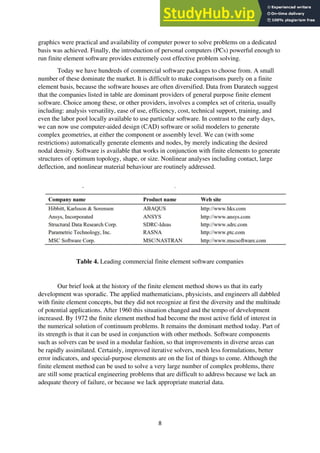
element basis, because the software houses are often diversified. Data from Daratech suggest
that the companies listed in table are dominant providers of general purpose finite element
software. Choice among these, or other providers, involves a complex set of criteria, usually
including: analysis versatility, ease of use, efficiency, cost, technical support, training, and
even the labor pool locally available to use particular software. In contrast to the early days,
we can now use computer-aided design (CAD) software or solid modelers to generate
complex geometries, at either the component or assembly level. We can (with some
restrictions) automatically generate elements and nodes, by merely indicating the desired
nodal density. Software is available that works in conjunction with finite elements to generate
structures of optimum topology, shape, or size. Nonlinear analyses including contact, large
deflection, and nonlinear material behaviour are routinely addressed.
Table 4. Leading commercial finite element software companies
Our brief look at the history of the finite element method shows us that its early
development was sporadic. The applied mathematicians, physicists, and engineers all dabbled
with finite element concepts, but they did not recognize at first the diversity and the multitude
of potential applications. After 1960 this situation changed and the tempo of development
increased. By 1972 the finite element method had become the most active field of interest in
the numerical solution of continuum problems. It remains the dominant method today. Part of
its strength is that it can be used in conjunction with other methods. Software components
such as solvers can be used in a modular fashion, so that improvements in diverse areas can
be rapidly assimilated. Certainly, improved iterative solvers, mesh less formulations, better
error indicators, and special-purpose elements are on the list of things to come. Although the
finite element method can be used to solve a very large number of complex problems, there
are still some practical engineering problems that are difficult to address because we lack an
adequate theory of failure, or because we lack appropriate material data.
9
The mechanical and thermal properties of many nonmetallic materials are difficult to
acquire, especially over a range of temperatures. Fatigue data is often lacking. Fatigue failure
theory often lags our ability to calculate changing complex stress states. Data on friction is
often difficult to obtain. Calculations based on the assumption of Coulomb friction are often
unrealistic. There is a general paucity of thermal data, especially regarding absorbvity and
emissivity needed for radiation calculations.
The World Wide Web should offer a means of placing material properties into
accessible databases. From a practitioner’s viewpoint, the finite element method, like any
other numerical analysis techniques, can always be made more efficient and easier to use. As
the method is applied to larger and more complex problems, it becomes increasingly
important that the solution process remains economical.
The rapid growth in engineering usage of computer technology will undoubtedly
continue to have a significant effect on the advancement of the finite element method.
Improved efficiency achieved by computer technology advancements such as parallel
processing will surely occur. Since the mid 1970s interactive finite element programs on
small but powerful personal computers and workstations have played a major role in the
remarkable growth of computer-aided design. With continuing economic pressures to improve
engineering productivity, this decade will see an accelerated role of the finite element method
in the design process. This methodology is still exciting and an important part of an
engineer’s tool kit.
10
1.2. FINITE ELEMENT ANALYSIS (FEA)-FINITE ELEMENT METHOD (FEM)
FUNDAMENTALS
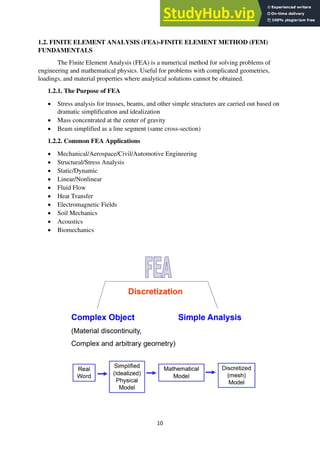
The Finite Element Analysis (FEA) is a numerical method for solving problems of
engineering and mathematical physics. Useful for problems with complicated geometries,
loadings, and material properties where analytical solutions cannot be obtained.
1.2.1. The Purpose of FEA
• Stress analysis for trusses, beams, and other simple structures are carried out based on
dramatic simplification and idealization
• Mass concentrated at the center of gravity
• Beam simplified as a line segment (same cross-section)
1.2.2. Common FEA Applications
• Mechanical/Aerospace/Civil/Automotive Engineering
• Structural/Stress Analysis
• Static/Dynamic
• Linear/Nonlinear
• Fluid Flow
• Heat Transfer
• Electromagnetic Fields
• Soil Mechanics
• Acoustics
• Biomechanics
11
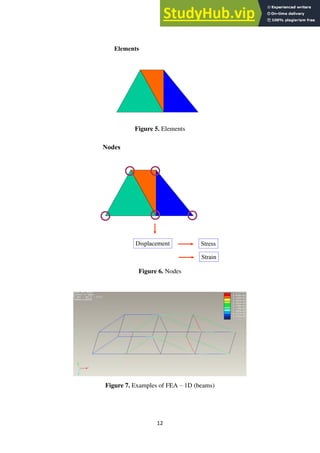
Model body by dividing it into an equivalent system of many smaller bodies or units
(finite elements) interconnected at points common to two or more elements (nodes or nodal
points) and/or boundary lines and/or surfaces.
Figure 3. Types of Finite Elements
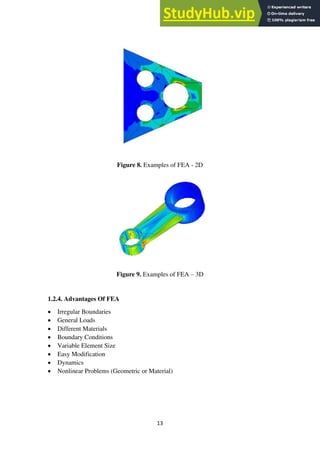
1.2.3. Elements & Nodes - Nodal Quantity
Obtain a set of algebraic equations to solve for unknown (first) nodal quantity
(displacement). Secondary quantities (stresses and strains) are expressed in terms of nodal
values of primary quantity.
Figure 4. Object
12
Figure 5. Elements
Figure 6. Nodes
Figure 7. Examples of FEA – 1D (beams)
13
Figure 8. Examples of FEA - 2D
Figure 9. Examples of FEA – 3D
1.2.4. Advantages Of FEA
• Irregular Boundaries
• General Loads
• Different Materials
• Boundary Conditions
• Variable Element Size
• Easy Modification
• Dynamics
• Nonlinear Problems (Geometric or Material)
14
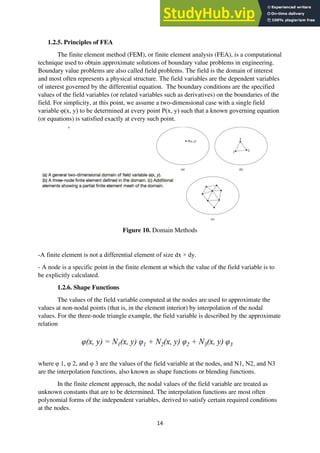
1.2.5. Principles of FEA
The finite element method (FEM), or finite element analysis (FEA), is a computational
technique used to obtain approximate solutions of boundary value problems in engineering.
Boundary value problems are also called field problems. The field is the domain of interest
and most often represents a physical structure. The field variables are the dependent variables
of interest governed by the differential equation. The boundary conditions are the specified
values of the field variables (or related variables such as derivatives) on the boundaries of the
field. For simplicity, at this point, we assume a two-dimensional case with a single field
variable φ(x, y) to be determined at every point P(x, y) such that a known governing equation
(or equations) is satisfied exactly at every such point.
Figure 10. Domain Methods
-A finite element is not a differential element of size dx × dy.
- A node is a specific point in the finite element at which the value of the field variable is to
be explicitly calculated.
1.2.6. Shape Functions
The values of the field variable computed at the nodes are used to approximate the
values at non-nodal points (that is, in the element interior) by interpolation of the nodal
values. For the three-node triangle example, the field variable is described by the approximate
relation
where φ 1, φ 2, and φ 3 are the values of the field variable at the nodes, and N1, N2, and N3
are the interpolation functions, also known as shape functions or blending functions.
In the finite element approach, the nodal values of the field variable are treated as
unknown constants that are to be determined. The interpolation functions are most often
polynomial forms of the independent variables, derived to satisfy certain required conditions
at the nodes.
15
The interpolation functions are predetermined, known functions of the independent
variables; and these functions describe the variation of the field variable within the finite
element.
1.2.7. Degrees of Freedom
Again a two-dimensional case with a single field variable φ(x, y). The triangular
element described is said to have 3 degrees of freedom, as three nodal values of the field
variable are required to describe the field variable everywhere in the element (scalar).
In general, the number of degrees of freedom associated with a finite element is equal
to the product of the number of nodes and the number of values of the field variable (and
possibly its derivatives) that must be computed at each node.
1.2.8. Stiffness Matrix
The primary characteristics of a finite element are embodied in the element stiffness
matrix. For a structural finite element, the stiffness matrix contains the geometric and material
behavior information that indicates the resistance of the element to deformation when
subjected to loading. Such deformation may include axial, bending, shear, and torsional
effects. For finite elements used in nonstructural analyses, such as fluid flow and heat transfer,
the term stiffness matrix is also used, since the matrix represents the resistance of the element
to change when subjected to external influences.
1.2.9. Truss Element
The spring element is also often used to represent the elastic nature of supports for
more complicated systems. A more generally applicable, yet similar, element is an elastic bar
subjected to axial forces only. This element, which we simply call a bar or truss element, is
particularly useful in the analysis of both two- and threedimensional frame or truss structures.
Formulation of the finite element characteristics of an elastic bar element is based on the
following assumptions:
1.The bar is geometrically straight.
2.The material obeys Hooke’s law.
3.Forces are applied only at the ends of the bar.
4.The bar supports axial loading only; bending, torsion, and shear are not
transmitted to the element via the nature of its connections to other elements.
16
1.2.10. Truss Element Stiffness Matrix
Let’s obtain an expression for the stiffness matrix K for the beam element. Recall from
elementary strength of materials that the deflection δ of an elastic bar of length L and uniform
cross-sectional area A when subjected to axial load P :
where E is the modulus of elasticity of the material. Then the equivalent spring constant k:
Therefore the stiffness matrix for one element is:
And the equilibrium equation in matrix form:
17
1.3. USING FINITE ELEMENT ANALYSIS FOR ENGINEERING PROBLEMS
In general, engineering problems are mathematical models of physical situations.
Mathematical models of many engineering problems are differential equations with a set of
corresponding boundary and/or initial conditions. The differential equations are derived by
applying the fundamental laws and principles of nature to a system or a control volume. These
governing equations represent balance of mass, force, or energy. When possible, the exact
solution of these equations renders detailed behavior of a system under a given set of
conditions. The analytical solutions are composed of two parts: (1) a homogenous part and (2)
a particular part. In any given engineering problem, there are two sets of design parameters
that influence the way in which a system behaves. First, there are those parameters that
provide information regarding the natural behavior of a given system. These parameters
include material and geometric properties such as modulus of elasticity, thermal conductivity,
viscosity, and area, and second moment of area.
On the other hand, there are parameters that produce disturbances in a system.
Examples of these parameters include external forces, moments, temperature difference
across a medium, and pressure difference in fluid flow.
The system characteristics dictate the natural behavior of a system, and they always
appear in the homogenous part of the solution of a governing differential equation. In
contrast, the parameters that cause the disturbances appear in the particular solution. It is
important to understand the role of these parameters in finite element modeling in terms of
their respective appearances in stiffness or conductance matrices and load or forcing matrices.
The system characteristics will always show up in the stiffness matrix, conductance matrix, or
resistance matrix, whereas the disturbance parameters will always appear in the load matrix.
1.3.1. Numerical Methods
There are many practical engineering problems for which we cannot obtain exact
solutions. This inability to obtain an exact solution may be attributed to either the complex
nature of governing differential equations or the difficulties that arise from dealing with the
boundary and initial conditions. To deal with such problems, we resort to numerical
approximations. In contrast to analytical solutions, which show the exact behavior of a system
at any point within the system, numerical solutions approximate exact solutions only at
discrete points, called nodes. The first step of any numerical procedure is discretization. This
process divides the medium of interest into a number of small subregions (elements) and
nodes. There are two common classes of numerical methods: (1) finite difference methods
and (2) finite element methods. With finite difference methods, the differential equation is
written for each node, and the derivatives are replaced by difference equations. This approach
results in a set of simultaneous linear equations. Although finite difference methods are easy
to understand and employ in simple problems, they become difficult to apply to problems
with complex geometries or complex boundary conditions. This situation is also true for
problems with non-isotropic material properties.
18
In contrast, the finite element method uses integral formulations rather than difference
equations to create a system of algebraic equations. Moreover, a continuous function is
assumed to represent the approximate solution for each element. The complete solution is
then generated by connecting or assembling the individual solutions, allowing for continuity
at the interelement boundaries.
1.3.2. A Brief History of the Finite Element Method and ANSYS
The finite element method is a numerical procedure that can be applied to obtain
solutions to a variety of problems in engineering. Steady, transient, linear, or nonlinear
problems in stress analysis, heat transfer, fluid flow, and electromagnetism problems may be
analyzed with finite element methods. The origin of the modern finite element method may be
traced back to the early 1900s when some investigators approximated and modeled elastic
continua using discrete equivalent elastic bars. However, Courant (1943) has been credited
with being the first person to develop the finite element method. In a paper published in the
early 1940s, Courant used piecewise polynomial interpolation over triangular subregions to
investigate torsion problems.
The next significant step in the utilization of finite element methods was taken by
Boeing in the 1950s when Boeing, followed by others, used triangular stress elements to
model airplane wings. Yet, it was not until 1960 that Clough made the term finite element
popular. During the 1960s, investigators began to apply the finite element method to other
areas of engineering, such as heat transfer and seepage flow problems. Zienkiewicz and
Cheung (1967) wrote the first book entirely devoted to the finite element method in 1967. In
1971, ANSYS was released for the first time.
ANSYS is a comprehensive general-purpose finite element computer program that
contains more than 100,000 lines of code. ANSYS is capable of performing static, dynamic,
heat transfer, fluid flow, and electromagnetism analyses. ANSYS has been a leading FEA
program for over 40 years. The current version of ANSYS has a completely new look, with
multiple windows incorporating a graphical user interface (GUI), pulldown menus, dialog
boxes, and a tool bar. Today, you will find ANSYS in use in many engineering fields,
including aerospace, automotive, electronics, and nuclear. In order to use ANSYS or any
other “canned” FEA computer program intelligently, it is imperative that one first fully
understands the underlying basic concepts and limitations of the finite element methods.
ANSYS is a very powerful and impressive engineering tool that may be used to solve
a variety of problems. However, a user without a basic understanding of the finite element
methods will find himself or herself in the same predicament as a computer technician with
access to many impressive instruments and tools, but who cannot fix a computer.
19
1.3.3. Basic Steps in the Finite Element Method
The basic steps involved in any finite element analysis consist of the following:
1.3.3.1. Preprocessing Phase
1. Create and discretize the solution domain into finite elements; that is, subdivide the
problem into nodes and elements.
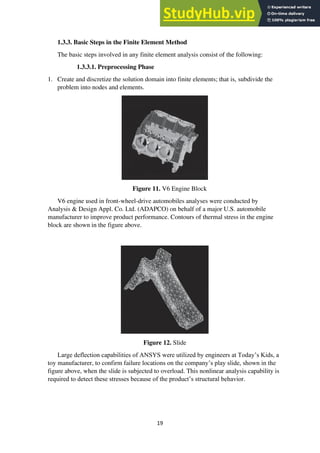
Figure 11. V6 Engine Block
V6 engine used in front-wheel-drive automobiles analyses were conducted by
Analysis & Design Appl. Co. Ltd. (ADAPCO) on behalf of a major U.S. automobile
manufacturer to improve product performance. Contours of thermal stress in the engine
block are shown in the figure above.
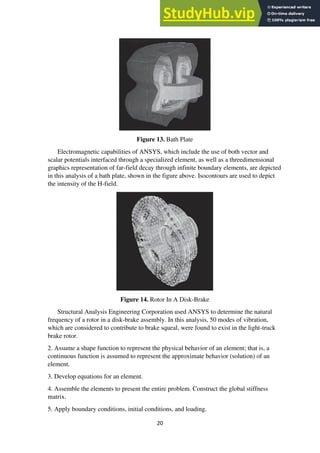
Figure 12. Slide
Large deflection capabilities of ANSYS were utilized by engineers at Today’s Kids, a
toy manufacturer, to confirm failure locations on the company’s play slide, shown in the
figure above, when the slide is subjected to overload. This nonlinear analysis capability is
required to detect these stresses because of the product’s structural behavior.
20
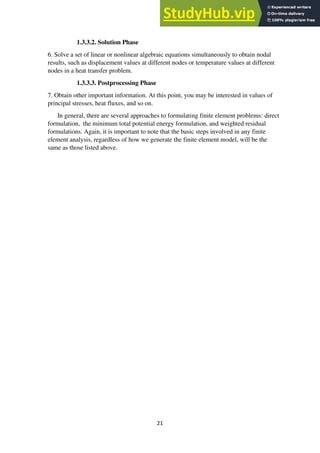
Figure 13. Bath Plate
Electromagnetic capabilities of ANSYS, which include the use of both vector and
scalar potentials interfaced through a specialized element, as well as a threedimensional
graphics representation of far-field decay through infinite boundary elements, are depicted
in this analysis of a bath plate, shown in the figure above. Isocontours are used to depict
the intensity of the H-field.
Figure 14. Rotor In A Disk-Brake
Structural Analysis Engineering Corporation used ANSYS to determine the natural
frequency of a rotor in a disk-brake assembly. In this analysis, 50 modes of vibration,
which are considered to contribute to brake squeal, were found to exist in the light-truck
brake rotor.
2. Assume a shape function to represent the physical behavior of an element; that is, a
continuous function is assumed to represent the approximate behavior (solution) of an
element.
3. Develop equations for an element.
4. Assemble the elements to present the entire problem. Construct the global stiffness
matrix.
5. Apply boundary conditions, initial conditions, and loading.
21
1.3.3.2. Solution Phase
6. Solve a set of linear or nonlinear algebraic equations simultaneously to obtain nodal
results, such as displacement values at different nodes or temperature values at different
nodes in a heat transfer problem.
1.3.3.3. Postprocessing Phase
7. Obtain other important information. At this point, you may be interested in values of
principal stresses, heat fluxes, and so on.
In general, there are several approaches to formulating finite element problems: direct
formulation, the minimum total potential energy formulation, and weighted residual
formulations. Again, it is important to note that the basic steps involved in any finite
element analysis, regardless of how we generate the finite element model, will be the
same as those listed above.
22
1.4. MATRIX ALGEBRA FOR FINITE ELEMENT METHOD
These steps include discretizing the problem into elements and nodes, assuming a
function that represents behavior of an element, developing a set of equations for an
element, assembling the elemental formulations to present the entire problem, and
applying the boundary conditions and loading. These steps lead to a set of linear
(nonlinear for some problems) algebraic equations that must be solved simultaneously. A
good understanding of matrix algebra is essential in formulation and solution of finite
element models. As is the case with any topic, matrix algebra has its own terminology and
follows a set of rules.
1.4.1. Basic Definitions
A matrix is an array of numbers or mathematical terms. The numbers or the
mathematical terms that make up the matrix are called the elements of matrix. The size of
a matrix is defined by its number of rows and columns. A matrix may consist of m rows
and n columns. For example,
Matrix [N] is a 3 by 3 matrix whose elements are numbers, [T] is a 4 x 4 that has sine
and cosine terms as its elements, {L} is a 3 x 1 matrix with its elements representing
partial derivatives, and [I] is a 2 x 2 matrix with integrals for its elements. The [N], [T],
and [I] are square matrices. A square matrix has the same number of rows and columns.
The element of a matrix is denoted by its location.
1.4.2. Column Matrix and Row Matrix
A column matrix is defined as a matrix that has one column but could have many
rows. On the other hand, a row matrix is a matrix that has one row but could have many
columns. Examples of column and row matrices follow.
23
1.4.3. Diagonal, Unit, and Band (Banded) Matrix
A diagonal matrix is one that has elements only along its principal diagonal; the
elements are zero everywhere else. An example of a 4 x 4 diagonal matrix follows:
The diagonal along which 𝑎1, 𝑎2, 𝑎3, and 𝑎4 lies is called the principal diagonal. An
identity or unit matrix is a diagonal matrix whose elements consist of a value 1. An
example of an identity matrix follows:
A banded matrix is a matrix that has a band of nonzero elements parallel to its
principal diagonal. As shown in the example that follows, all other elements outside the
band are zero.
24
1.4.4. Upper and Lower Triangular Matrix
An upper triangular matrix is one that has zero elements below the principal diagonal,
and the lower triangular matrix is one that has zero elements above the principal diagonal.
Examples of upper triangular and lower triangular matrices are shown below.
1.4.5. Matrix Addition or Subtraction
Two matrices can be added together or subtracted from each other provided that
they are of the same size each matrix must have the same number of rows and columns.
We can add matrix [A]m x n of dimension m by n to matrix [B]m x n of the same
dimension by adding the like elements. Matrix subtraction follows a similar rule, as
shown.
The rule for matrix addition or subtraction can be generalized in the following manner.
Let us denote the elements of matrix [A] by 𝑎𝑖𝑗 and the elements of matrix [B] by 𝑏𝑖𝑗,
where the number of rows i varies from 1 to m and the number of columns j varies from 1
to n. If we were to add matrix [A] to matrix [B] and denote the resulting matrix by [C], it
follows that
25
1.4.6. Matrix Multiplication
1.4.6.1. Multiplying a Matrix by a Scalar Quantity
When a matrix [A] of size m x n is multiplied by a scalar quantity such as b, the
operation results in a matrix of the same size m x n, whose elements are the product of
elements in the original matrix and the scalar quantity. For example, when we multiply
matrix [A] of size m x n by a scalar quantity b, this operation results in another matrix of
size m x n, whose elements are computed by multiplying each element of matrix [A] by b,
as shown below.
1.4.6.2. Multiplying a Matrix by Another Matrix
Whereas any size matrix can be multiplied by a scalar quantity, matrix multiplication
can be performed only when the number of columns in the premultiplier matrix is equal to
the number of rows in the postmultiplier matrix. For example, matrix [A] of size m x n
can be premultiplied by matrix [B] of size n x p because the number of columns n in
matrix [A] is equal to number of rows n in matrix [B]. Moreover, the multiplication results
in another matrix, say [C], of size m x p. Matrix multiplication is carried out according to
the following rule:
where the elements in the first column of the [C] matrix are computed from
26
and the elements in the second column of the [C] matrix are
and similarly, the elements in the other columns are computed, leading to the last column
of the [C] matrix
The multiplication procedure that leads to the values of the elements in the [C] matrix may
be represented in a compact summation form by
When multiplying matrices, keep in mind the following rules. Matrix multiplication is not
commutative except for very special cases.
[A][B] ≠ [B][A]
Matrix multiplication is associative; that is
[A]([B][C]) = ([A][B])[C]
The distributive law holds true for matrix multiplication; that is
([A] + [B])[C] = [A][C] + [B][C]
Or
[A]([B] + [C]) = [A][B] + [A][C]
For a square matrix, the matrix may be raised to an integer power n in the following
manner:
This may be a good place to point out that if [I] is an identity matrix and [A] is a square
matrix of matching size, then it can be readily shown that the product of
[I][ A] = [A][ I] = [A].
27
1.4.6.3. Partitioning of a Matrix
Finite element formulation of complex problems typically involves relatively large
sized matrices. For these situations, when performing numerical analysis dealing with
matrix operations, it may be advantageous to partition the matrix and deal with a subset of
elements. The partitioned matrices require less computer memory to perform the
operations. Traditionally, dashed horizontal and vertical lines are used to show how a
matrix is partitioned. For example, we may partition matrix [A] into four smaller matrices
in the following manner:
It is important to note that matrix [A] could have been partitioned in a number of other
ways, and the way a matrix is partitioned would define the size of submatrices.
1.4.6.4. Addition and Subtraction Operations Using Partitioned Matrices
Now let us turn our attention to matrix operations dealing with addition, subtraction,
or multiplication of two matrices that are partitioned. Consider matrix [B] having the same
size (5 x 6) as matrix [A]. If we partition matrix [B] in exactly the same way we
partitioned [A] previously, then we can add the submatrices in the following manner:
28
Where
Then, using submatrices we can write,
1.4.6.5. Matrix Multiplication Using Partitioned Matrices
As mentioned earlier, matrix multiplication can be performed only when the number
of columns in the premultiplier matrix is equal to the number of rows in the postmultiplier
matrix. Referring to [A] and [B] matrices of the preceding section, because the number of
columns in matrix [A] does not match the number of rows of matrix [B], then matrix [B]
cannot be premultiplied by matrix [A]. To demonstrate matrix multiplication using
submatrices, consider matrix [C] of size 6 x 3, which is partitioned in the manner shown
below.
Where,
29
Next, consider premultiplying matrix [C] by matrix [A]. Let us refer to the results of
this multiplication by matrix [D] of size 5 x 3. In addition to paying attention to the size
requirement for matrix multiplication, to carry out the multiplication using partitioned
matrices, the premultiplying and postmultiplying matrices must be partitioned in such a
way that the resulting submatrices conform to the multiplication rule. That is, if we
partition matrix [A] between the third and the fourth columns, then matrix [C] must be
partitioned between the third and the fourth rows. However, the column partitioning of
matrix [C] may be done arbitrarily, because regardless of how the columns are partitioned,
the resulting submatrices will still conform to the multiplication rule. In other words,
instead of partitioning matrix [C] between columns two and three, we could have
partitioned the matrix between columns one and two and still carried out the
multiplication using the resulting submatrices.
1.4.7. Transpose of a Matrix
The finite element formulation lends itself to situations wherein it is desirable to
rearrange the rows of a matrix into the columns of another matrix. Which is shown here
again for the sake of continuity and convenience.
and its position in the global matrix,
Instead of putting together [K] (1G) by inspection as we did, we could obtain [K] (1G)
using the following procedure:
30
Where,
[𝐴1] T, called the transpose of [𝐴1], is obtained by taking the first and the second rows of
[𝐴1] and making them into the first and the second columns of the transpose matrix. It is
easily verified that by carrying out the multiplication, we will arrive at the same result that
was obtained by inspection.
Similarly, we could have performed the following operation to obtain [𝐾](2𝐺)
:
31
As you have seen from the previous examples, we can use a positioning matrix, such
as [A] and its transpose, and methodically create the global stiffness matrix for finite
element models.
In general, to obtain the transpose of a matrix [B] of size m x n, the first row of the
given matrix becomes the first column of the [B] T, the second row of [B] becomes the
second column of [B] T, and so on, leading to the mth row of [B] becoming the mth
column of the [B] T, resulting in a matrix with the size of n x m. Clearly, if you take the
transpose of [B] T, you will end up with [B]. That is,
We write the solution matrices, which are column matrices, as row matrices using the
transpose of the solution another use for transpose of a matrix. For example, we represent
the displacement solution
When performing matrix operations dealing with transpose of matrices, the following
identities are true:
This is a good place to define a symmetric matrix. A symmetric matrix is a square
matrix whose elements are symmetrical with respect to its principal diagonal.
Note that for a symmetric matrix, element amn is equal to anm. That is, amn = anm for
all values of n and m. Therefore, for a symmetric matrix, [A] = [A] T.
32
1.5. FINITE ELEMENT ANALYSIS OF SPACE TRUSS USING MATLAB
Space Truss is a lightweight rigid structure consists of members and nodes
interlocking in a triangular geometric pattern. The inherent rigidity of triangular geometric
pattern derives its strength. On the application of imposed load, tension and compression
loads are transmitted along the length of the member. The advantage of using space trusses as
roof structure is to provide rigidity along all the three directions comparatively higher strength
than the normal truss. Finite Element Analysis of a space truss involves many matrix
operations. Sometimes it is tedious to solve manually if the size of the matrix goes higher.
Matrix is the fundamental object of MATLAB. MATLAB is a trademark of The Math Works,
Inc., USA and majorly designed to perform matrix operations. MATLAB based program is
simple coding system with matrix functions, conditionals (if and switch), loops (for and
while) and Graphics (2Dplots and 3Dplots). MATLAB is a simpler package but its
application stands in all fields of science and Engineering. Schmidt et al, have studied that
with greater degrees of freedom, space trusses became more sensitive to compression
members, joints and stiffness of the member-node joints normally neglected in the design and
it consequently proven to be failure of the structure.
1.5.1. Finite Element Formulation
Finite Element Analysis is a numerical method to solve Engineering problems and
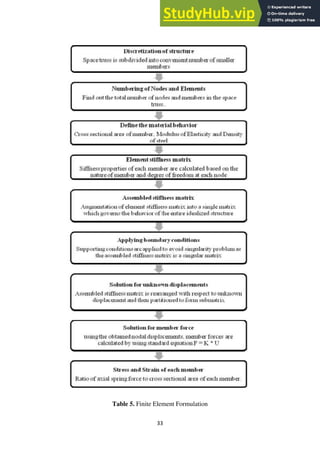
Mathematical physics. A space truss is subdivided into smaller elements called members.
Then the assemblage of these members connected at a finite number of joints called Nodes.
The properties of each type of member is obtained and assembled together and solved as
whole to get solution. Static analysis of space truss is done by stiffness method where
formulation is simpler for most structural analysis problems. Algorithms for solving space
truss problem are formulated below:
33
Table 5. Finite Element Formulation
34
SECTION 2
2.1. TRUSSES
2.1.1. Introduction To Trusses
A truss is a structure that consists of members organised into connected triangles so
that the overall assembly behaves as a single object. Trusses are most commonly used in
bridges, roofs and towers.
A truss is made up of a web of triangles joined together to enable the even distribution
of weight and the handling of changing tension and compression without bending or shearing.
The triangle is geometrically stable when compared to a four (or more) -sided shape which
requires that the corner joints are fixed to prevent shearing.
Trusses consist of triangular units constructed with straight members. The ends of
these members are connected at joints, known as nodes. They are able to carry significant
loads, transferring them to supporting structures such as load-bearing beams, walls or the
ground.
In general, trusses are used to:
• Achieve long spans.
• Minimise the weight of a structure.
• Reduced deflection.
• Support heavy loads.
Trusses are typically made up of three basic elements:
• A top chord which is usually in compression.
• A bottom chord which is usually in tension.
• Bracing between the top and bottom chords.
The top and bottom chords of the truss provide resistance to compression and tension and
so resistance to overall bending, whilst the bracing resists shear forces.
The efficiency of trusses means that they require less material to support loads compared
with solid beams. Generally, the overall efficiency of a truss is optimised by using less
material in the chords and more in the bracing elements.
2.1.1.1. Types Of Truss
2.1.1.1.1. Simple Truss
This is a single triangle such as might be found in a framed roof consisting of rafters
and a ceiling joist.
2.1.1.1.2. Planar Truss
A planar truss is a truss in which all the members lie in a two-dimensional plane. This
type of truss is typically used in series, with the trusses laid out in a parallel arrangement to
form roofs, bridges, and so on.
35
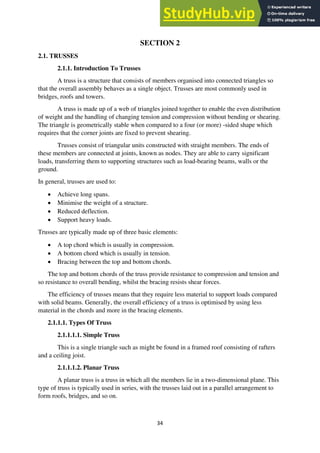
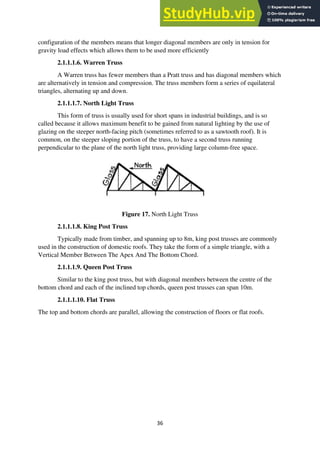
Figure 15. Planar Truss
2.1.1.1.3. Space Frame Truss
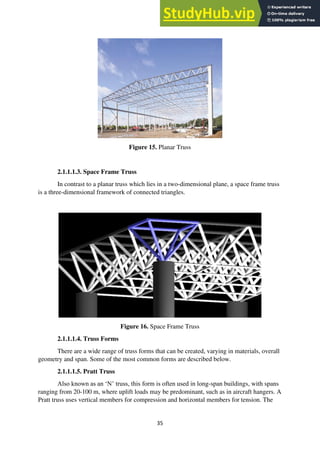
In contrast to a planar truss which lies in a two-dimensional plane, a space frame truss
is a three-dimensional framework of connected triangles.
Figure 16. Space Frame Truss
2.1.1.1.4. Truss Forms
There are a wide range of truss forms that can be created, varying in materials, overall
geometry and span. Some of the most common forms are described below.
2.1.1.1.5. Pratt Truss
Also known as an ‘N’ truss, this form is often used in long-span buildings, with spans
ranging from 20-100 m, where uplift loads may be predominant, such as in aircraft hangers. A
Pratt truss uses vertical members for compression and horizontal members for tension. The
36
configuration of the members means that longer diagonal members are only in tension for
gravity load effects which allows them to be used more efficiently
2.1.1.1.6. Warren Truss
A Warren truss has fewer members than a Pratt truss and has diagonal members which
are alternatively in tension and compression. The truss members form a series of equilateral
triangles, alternating up and down.
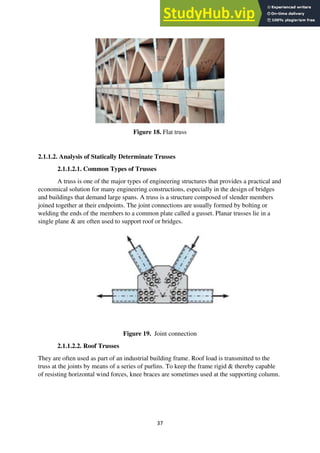
2.1.1.1.7. North Light Truss
This form of truss is usually used for short spans in industrial buildings, and is so
called because it allows maximum benefit to be gained from natural lighting by the use of
glazing on the steeper north-facing pitch (sometimes referred to as a sawtooth roof). It is
common, on the steeper sloping portion of the truss, to have a second truss running
perpendicular to the plane of the north light truss, providing large column-free space.
Figure 17. North Light Truss
2.1.1.1.8. King Post Truss
Typically made from timber, and spanning up to 8m, king post trusses are commonly
used in the construction of domestic roofs. They take the form of a simple triangle, with a
Vertical Member Between The Apex And The Bottom Chord.
2.1.1.1.9. Queen Post Truss
Similar to the king post truss, but with diagonal members between the centre of the
bottom chord and each of the inclined top chords, queen post trusses can span 10m.
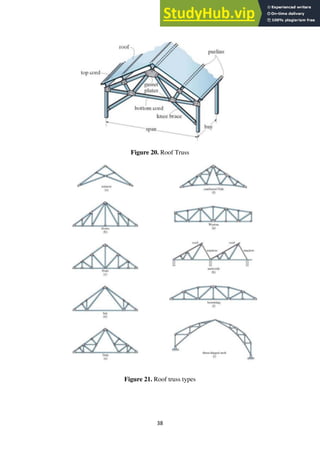
2.1.1.1.10. Flat Truss
The top and bottom chords are parallel, allowing the construction of floors or flat roofs.
37
Figure 18. Flat truss
2.1.1.2. Analysis of Statically Determinate Trusses
2.1.1.2.1. Common Types of Trusses
A truss is one of the major types of engineering structures that provides a practical and
economical solution for many engineering constructions, especially in the design of bridges
and buildings that demand large spans. A truss is a structure composed of slender members
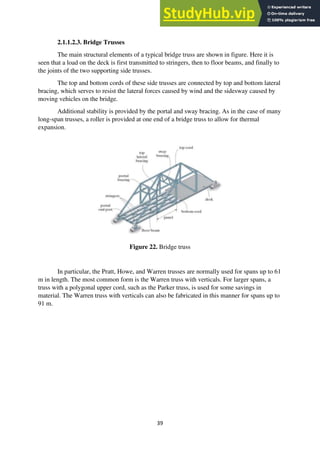
joined together at their endpoints. The joint connections are usually formed by bolting or
welding the ends of the members to a common plate called a gusset. Planar trusses lie in a
single plane & are often used to support roof or bridges.
Figure 19. Joint connection
2.1.1.2.2. Roof Trusses
They are often used as part of an industrial building frame. Roof load is transmitted to the
truss at the joints by means of a series of purlins. To keep the frame rigid & thereby capable
of resisting horizontal wind forces, knee braces are sometimes used at the supporting column.
38
Figure 20. Roof Truss
Figure 21. Roof truss types
39
2.1.1.2.3. Bridge Trusses
The main structural elements of a typical bridge truss are shown in figure. Here it is
seen that a load on the deck is first transmitted to stringers, then to floor beams, and finally to
the joints of the two supporting side trusses.
The top and bottom cords of these side trusses are connected by top and bottom lateral
bracing, which serves to resist the lateral forces caused by wind and the sidesway caused by
moving vehicles on the bridge.
Additional stability is provided by the portal and sway bracing. As in the case of many
long-span trusses, a roller is provided at one end of a bridge truss to allow for thermal
expansion.
Figure 22. Bridge truss
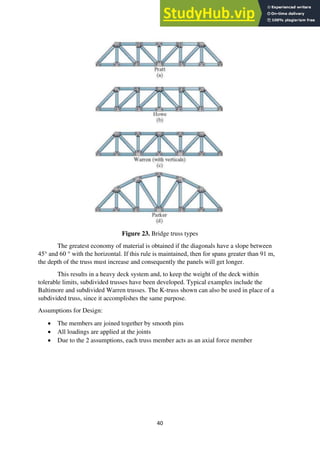
In particular, the Pratt, Howe, and Warren trusses are normally used for spans up to 61
m in length. The most common form is the Warren truss with verticals. For larger spans, a
truss with a polygonal upper cord, such as the Parker truss, is used for some savings in
material. The Warren truss with verticals can also be fabricated in this manner for spans up to
91 m.
40
Figure 23. Bridge truss types
The greatest economy of material is obtained if the diagonals have a slope between
45° and 60 ° with the horizontal. If this rule is maintained, then for spans greater than 91 m,
the depth of the truss must increase and consequently the panels will get longer.
This results in a heavy deck system and, to keep the weight of the deck within
tolerable limits, subdivided trusses have been developed. Typical examples include the
Baltimore and subdivided Warren trusses. The K-truss shown can also be used in place of a
subdivided truss, since it accomplishes the same purpose.
Assumptions for Design:
• The members are joined together by smooth pins
• All loadings are applied at the joints
• Due to the 2 assumptions, each truss member acts as an axial force member
41
2.1.1.2.4. Classification of Coplanar Trusses
2.1.1.2.4.1. Simple Truss
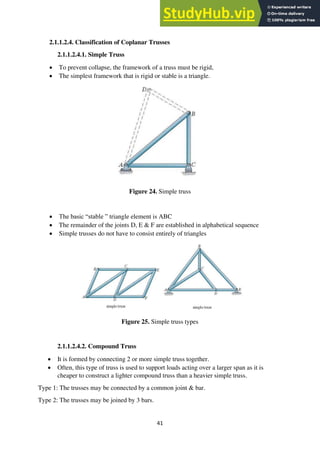
• To prevent collapse, the framework of a truss must be rigid,
• The simplest framework that is rigid or stable is a triangle.
Figure 24. Simple truss
• The basic “stable ” triangle element is ABC
• The remainder of the joints D, E & F are established in alphabetical sequence
• Simple trusses do not have to consist entirely of triangles
Figure 25. Simple truss types
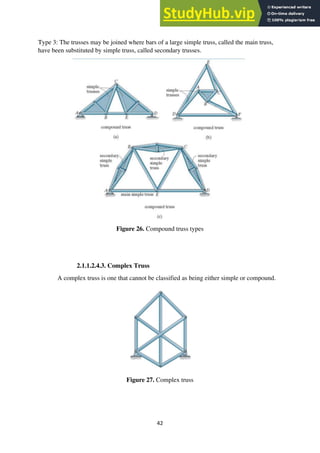
2.1.1.2.4.2. Compound Truss
• It is formed by connecting 2 or more simple truss together.
• Often, this type of truss is used to support loads acting over a larger span as it is
cheaper to construct a lighter compound truss than a heavier simple truss.
Type 1: The trusses may be connected by a common joint & bar.
Type 2: The trusses may be joined by 3 bars.
42
Type 3: The trusses may be joined where bars of a large simple truss, called the main truss,
have been substituted by simple truss, called secondary trusses.
Figure 26. Compound truss types
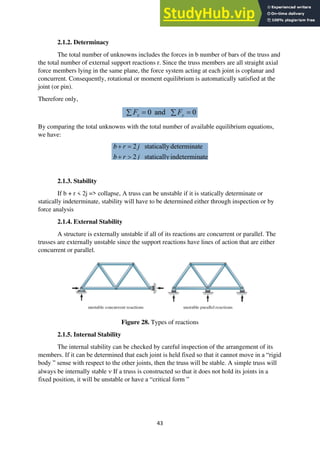
2.1.1.2.4.3. Complex Truss
A complex truss is one that cannot be classified as being either simple or compound.
Figure 27. Complex truss
43
2.1.2. Determinacy
The total number of unknowns includes the forces in b number of bars of the truss and
the total number of external support reactions r. Since the truss members are all straight axial
force members lying in the same plane, the force system acting at each joint is coplanar and
concurrent. Consequently, rotational or moment equilibrium is automatically satisfied at the
joint (or pin).
Therefore only,
By comparing the total unknowns with the total number of available equilibrium equations,
we have:
2.1.3. Stability
If b + r < 2j => collapse, A truss can be unstable if it is statically determinate or
statically indeterminate, stability will have to be determined either through inspection or by
force analysis
2.1.4. External Stability
A structure is externally unstable if all of its reactions are concurrent or parallel. The
trusses are externally unstable since the support reactions have lines of action that are either
concurrent or parallel.
Figure 28. Types of reactions
2.1.5. Internal Stability
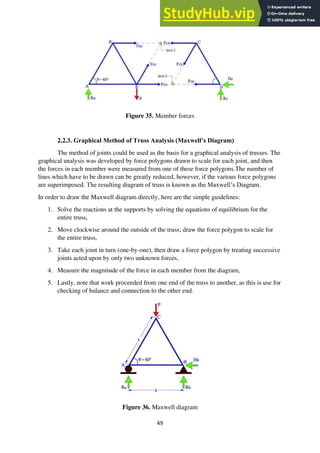
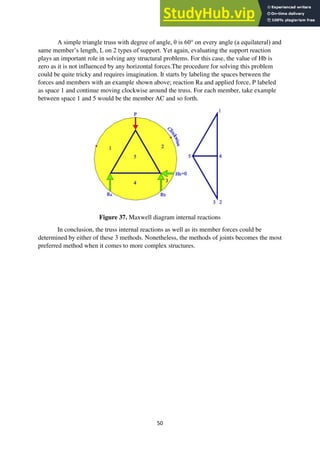
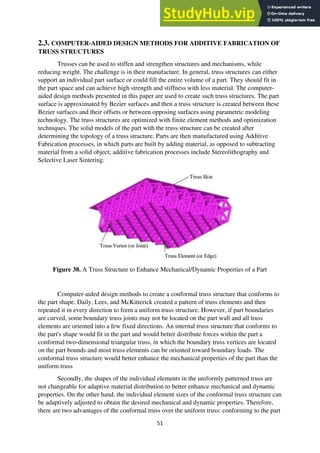
The internal stability can be checked by careful inspection of the arrangement of its
members. If it can be determined that each joint is held fixed so that it cannot move in a “rigid
body ” sense with respect to the other joints, then the truss will be stable. A simple truss will
always be internally stable  If a truss is constructed so that it does not hold its joints in a
fixed position, it will be unstable or have a “critical form ”
44
Figure 29. External Stability
To determine the internal stability of a compound truss, it is necessary to identify the
way in which the simple truss are connected together. The truss shown is unstable since the
inner simple truss ABC is connected to DEF using 3 bars which are concurrent at point O.
Figure 30. 3 Bars external stability
Thus an external load can be applied at A, B or C & cause the truss to rotate slightly.
For complex truss, it may not be possible to tell by inspection if it is stable. The instability of
any form of truss may also be noticed by using a computer to solve the 2j simultaneous
equations for the joints of the truss . If inconsistent results are obtained, the truss is unstable or
have a critical form.
45
2.2. METHODS FOR TRUSS ANALYSIS
A structure that is composed of a number of bars pin connected at their ends to form a
stable framework is called a truss. It is generally assumed that loads and reactions are applied
to the truss only at the joints. A truss would typically be composed of triangular elements with
the bars on the upper chord under compression and those along the lower chord under tension.
Trusses are extensively used for bridges, long span roofs, electric tower, and space structures.
Trusses are statically determinate when the entire bar forces can be determined from
the equations of statics alone. Otherwise the truss is statically indeterminate. A truss may be
statically (externally) determinate or indeterminate with respect to the reactions (more than 3
or 6 reactions in 2D or 3D problems respectively).
For truss analysis, it is assumed that:
• Bars are pin-connected.
• Joints are frictionless hinges.
• Loads are applied at the joints only.
• Stress in each member is constant along its length.
Figure 31. Tensions and compressions on truss
The objective of truss analysis is to determine the reactions and member forces. The
methods used for carrying out the analysis with the equations of equilibrium and by
considering only parts of the structure through analyzing its free body diagram to solve the
unknowns.
2.2.1. Method of Joints for Truss Analysis
We start by assuming that all members are in tension reaction. A tension member
experiences pull forces at both ends of the bar and usually denoted by positive (+ve) sign.
When a member is experiencing a push force at both ends, then the bar is said to be in
compression mode and designated as negative (-ve) sign.
In the joints method, a virtual cut is made around a joint and the cut portion is isolated
as a Free Body Diagram (FBD). Using the equilibrium equations of ∑ Fx = 0 and ∑ Fy = 0,
the unknown member forces can be solved. It is assumed that all members are joined together
in the form of an ideal pin, and that all forces are in tension (+ve reactions).
46
An imaginary section may be completely passed around a joint in a truss. The joint has
become a free body in equilibrium under the forces applied to it. The equations ∑ H = 0 and
∑ V = 0 may be applied to the joint to determine the unknown forces in members meeting
there. It is evident that no more than two unknowns can be determined at a joint with these
two equations.
Figure 32. Truss model
A simple truss model supported by pinned and roller support at its end. Each triangle
has the same length, L and it is equilateral where degree of angle, θ is 60° on every angle. The
support reactions, Ra and Rc can be determined by taking a point of moment either at point A
or point C, whereas Ha = 0 (no other horizontal force).
Here are some simple guidelines for this method:
1. Firstly, draw the Free Body Diagram (FBD),
2. Solve the reactions of the given structure,
3. Select a joint with a minimum number of unknown (not more than 2) and analyze it
with ∑ Fx = 0 and ∑ Fy = 0,
4. Proceed to the rest of the joints and again concentrating on joints that have very
minimal of unknowns,
5. Check member forces at unused joints with ∑ Fx = 0 and ∑ Fy = 0,
6. Tabulate the member forces whether it is in tension (+ve) or compression (-ve)
reaction.
47
Figure 33. Forces Of Model
The figure showing 3 selected joints, at B, C, and E. The forces in each member can
be determined from any joint or point. The best way to start is by selecting the easiest joint
like joint C where the reaction Rc is already obtained and with only 2 unknown, forces of
FCB and FCD. Both can be evaluated with ∑ Fx = 0 and ∑ Fy = 0 rules. At joint E, there are
3 unknown, forces of FEA, FEB and FED, which may lead to more complex solution
compared to 2 unknown values. For checking purposes, joint B is selected to show that the
equation of ∑ Fx is equal to ∑ Fy which leads to zero value, ∑ Fx = ∑ Fy = 0. Each member’s
condition should be indicated clearly as whether it is in tension (+ve) or in compression (-ve)
state.
Trigonometric Functions:
Taking an angle between member x and z…
• Cos θ = x / z
• Sin θ = y / z
• Tan θ = y / x
2.2.2. Method of Sections for Truss Analysis
The section method is an effective method when the forces in all members of a truss
are to be determined. If only a few member forces of a truss are needed, the quickest way to
find these forces is by the method of sections. In this method, an imaginary cutting line called
a section is drawn through a stable and determinate truss. Thus, a section subdivides the truss
into two separate parts. Since the entire truss is in equilibrium, any part of it must also be in
equilibrium. Either of the two parts of the truss can be considered and the three equations of
equilibrium ∑ Fx = 0, ∑ Fy = 0, and ∑ M = 0 can be applied to solve for member forces.
48
Figure 34. Virtual cut
Using the same model of simple truss, the details would be the same as previous figure
with 2 different supports profile. Unlike the joint method, here we only interested in finding
the value of forces for member BC, EC, and ED.
Few simple guidelines:
1. Pass a section through a maximum of 3 members of the truss, 1 of which is the desired
member where it is dividing the truss into 2 completely separate parts,
2. At 1 part of the truss, take moments about the point (at a joint) where the 2 members
intersect and solve for the member force, using ∑ M = 0,
3. Solve the other 2 unknowns by using the equilibrium equation for forces, using ∑ Fx =
0 and ∑ Fy = 0.
Method of Sections for Truss Analysis virtual cut is introduced through the only required
members which is along member BC, EC, and ED. Firstly, the support reactions of Ra and Rd
should be determined. Again a good judgment is required to solve this problem where the
easiest part would be to consider either the left hand side or the right hand side. Taking
moment at joint E (virtual point) clockwise for the whole RHS part would be much easier
compared to joint C (the LHS part). Then, either joint D or C can be considered as the point of
moment, or else using the joint method to find the member forces for FCB, FCE, and FDE.
49
Figure 35. Member forces
2.2.3. Graphical Method of Truss Analysis (Maxwell’s Diagram)
The method of joints could be used as the basis for a graphical analysis of trusses. The
graphical analysis was developed by force polygons drawn to scale for each joint, and then
the forces in each member were measured from one of these force polygons.The number of
lines which have to be drawn can be greatly reduced, however, if the various force polygons
are superimposed. The resulting diagram of truss is known as the Maxwell’s Diagram.
In order to draw the Maxwell diagram directly, here are the simple guidelines:
1. Solve the reactions at the supports by solving the equations of equilibrium for the
entire truss,
2. Move clockwise around the outside of the truss; draw the force polygon to scale for
the entire truss,
3. Take each joint in turn (one-by-one), then draw a force polygon by treating successive
joints acted upon by only two unknown forces,
4. Measure the magnitude of the force in each member from the diagram,
5. Lastly, note that work proceeded from one end of the truss to another, as this is use for
checking of balance and connection to the other end.
Figure 36. Maxwell diagram
50
A simple triangle truss with degree of angle, θ is 60° on every angle (a equilateral) and
same member’s length, L on 2 types of support. Yet again, evaluating the support reaction
plays an important role in solving any structural problems. For this case, the value of Hb is
zero as it is not influenced by any horizontal forces.The procedure for solving this problem
could be quite tricky and requires imagination. It starts by labeling the spaces between the
forces and members with an example shown above; reaction Ra and applied force, P labeled
as space 1 and continue moving clockwise around the truss. For each member, take example
between space 1 and 5 would be the member AC and so forth.
Figure 37. Maxwell diagram internal reactions
In conclusion, the truss internal reactions as well as its member forces could be
determined by either of these 3 methods. Nonetheless, the methods of joints becomes the most
preferred method when it comes to more complex structures.
51
2.3. COMPUTER-AIDED DESIGN METHODS FOR ADDITIVE FABRICATION OF
TRUSS STRUCTURES
Trusses can be used to stiffen and strengthen structures and mechanisms, while
reducing weight. The challenge is in their manufacture. In general, truss structures can either
support an individual part surface or could fill the entire volume of a part. They should fit in
the part space and can achieve high strength and stiffness with less material. The computer-
aided design methods presented in this paper are used to create such truss structures. The part
surface is approximated by Bezier surfaces and then a truss structure is created between these
Bezier surfaces and their offsets or between opposing surfaces using parametric modeling
technology. The truss structures are optimized with finite element methods and optimization
techniques. The solid models of the part with the truss structure can be created after
determining the topology of a truss structure. Parts are then manufactured using Additive
Fabrication processes, in which parts are built by adding material, as opposed to subtracting
material from a solid object; additive fabrication processes include Stereolithography and
Selective Laser Sintering.
Figure 38. A Truss Structure to Enhance Mechanical/Dynamic Properties of a Part
Computer-aided design methods to create a conformal truss structure that conforms to
the part shape. Daily, Lees, and McKitterick created a pattern of truss elements and then
repeated it in every direction to form a uniform truss structure. However, if part boundaries
are curved, some boundary truss joints may not be located on the part wall and all truss
elements are oriented into a few fixed directions. An internal truss structure that conforms to
the part's shape would fit in the part and would better distribute forces within the part a
conformal two-dimensional triangular truss, in which the boundary truss vertices are located
on the part bounds and most truss elements can be oriented toward boundary loads. The
conformal truss structure would better enhance the mechanical properties of the part than the
uniform truss
Secondly, the shapes of the individual elements in the uniformly patterned truss are
not changeable for adaptive material distribution to better enhance mechanical and dynamic
properties. On the other hand, the individual element sizes of the conformal truss structure can
be adaptively adjusted to obtain the desired mechanical and dynamic properties. Therefore,
there are two advantages of the conformal truss over the uniform truss: conforming to the part
52
shape, and adaptively enhancing the mechanical and dynamic properties. Hence, a truss
structure that conforms to part shape is desired. The complex geometry of the conformal truss
structures is far beyond that of typical CAD models. Parametric modeling technologies, finite
element method, optimization approaches, and solid modeling techniques have to be
investigated to design and represent the conformal truss structures; these investigations will
allow us to better enhance the mechanical and dynamic properties of parts.
The design process of truss structure, which consists of five sequential steps: Step I
The part is shelled in the original geometric modeling package to obtain the STL model of the
thin skin for the part that covers the truss structure. Step II The part surface is manually
decomposed and approximated with a series of bicubic Bezier surface patches. Step III The
truss topology is created between Bezier patches in a Matlab program using parametric
modeling techniques. Conformal truss topology contains information about the truss vertex
coordinates (Vertex Topology) and the edge connections (Edge Topology). Step IV The truss
topology is optimized with finite element methods and engineering optimization techniques in
ANSYS. The optimization objective is to minimize the material mass, but still get the
required mechanical properties. Step V The solid modeling technology is applied to create the
solid model (STL) of the truss structure with software developed using ACIS as the geometric
modeling kernel.
Figure 39. Design Process of Truss Structure
53
2.4. TRUSS FORMULATION
2.4.1. Definition of a Truss
A truss is an engineering structure consisting of straight members connected at their ends
by means of bolts, rivets, pins, or welding. The members found in trusses may consist of steel
or aluminium tubes, wooden struts, metal bars, angles, and channels. Trusses offer practical
solutions to many structural problems in engineering, such as power transmission towers,
bridges, and roofs of buildings. A plane truss is defined as a truss whose members lie in a
single plane. The forces acting on such a truss must also lie in this plane. Members of a truss
are generally considered to be two-force members. This term means that internal forces act in
equal and opposite directions along the members, as shown in the figure.
In the analysis that follows, it is assumed that the members are connected by smooth pins
and by a ball-and-socket joint in three-dimensional trusses. Moreover, it can be shown that as
long as the center lines of the joining members intersect at a common point, trusses with
bolted or welded joints may be treated as having smooth pins (no bending). Another important
assumption deals with the way loads are applied. All loads must be applied at the joints. This
assumption is true for most situations because trusses are designed so that the majority of the
load is applied at the joints. Usually, the weights of members are negligible compared to those
of the applied loads. However, if the weights of the members are to be considered, then half
of the weight of each member is applied to the connecting joints. Statically determinate truss
problems are covered in many elementary mechanics texts. This class of problems is analysed
by the methods of joints or sections. These methods do not provide information on deflection
of the joints because the truss members are treated as rigid bodies. Because the truss members
are assumed to be rigid bodies, statically indeterminate problems are impossible to analyze.
The finite element method allows us to remove the rigid body restriction and solve this class
of problems. The figure depicts examples of statically determinate and statically
indeterminate problems.
Figure 40. A simple truss subjected to a load
54
2.4.2. Finite Element Formulation
Let us consider the deflection of a single member when it is subjected to force F, as shown
in the figure. The forthcoming derivation of the stiffness coefficient is identical to the analysis
of a centrally loaded member. As a review and for the sake of continuity and convenience, the
steps to derive the elements’ equivalent stiffness coefficients are presented here. Recall that
the average stresses in any two-force member are given by
The average strain of the member can be expressed by,
Over the elastic region, the stress and strain are related by Hooke’s law,
Figure 41. Examples of statically determinate and statically indeterminate problems
55
Figure 42. A two-force member subjected to a force F
Combining Eqs. and simplifying, we have,
Note that Eq. is similar to the equation of a linear spring, F = kx. Therefore, a centrally
loaded member of uniform cross section may be modeled as a spring with an equivalent
stiffness of,
A relatively small balcony truss with five nodes and six elements is shown in the
figure. From this truss, consider isolating a member with an arbitrary orientation.
In general, two frames of reference are required to describe truss problems: a global
coordinate system and a local frame of reference. We choose a fixed global coordinate
system, XY to represent the location of each joint (node) and to keep track of the
orientation of each member (element), using angles such as u; to apply the constraints and
the applied loads in terms of their respective global components; and to represent the
solution—that is, the displacement of each joint in global directions. We will also need a
local, or an elemental, coordinate system xy, to describe the two-force member behavior
of individual members (elements). The relationship between the local (element)
descriptions and the global descriptions is shown in the figure.
56
The global displacements are related to the local according to the equations,
Figure 43. Relationship between local and global coordinates. Note that local coordinate
x points from node i toward j
If we write Eqs. in matrix form, we have,
Where,
57
{U} and {u} represent the displacements of nodes i and j with respect to the global XY
and the local xy frame of references, respectively. [T] is the transformation matrix that allows
for the transfer of local deformations to their respective global values. In a similar way, the
local and global forces may be related according to the equations
or, in matrix form,
Where,
are components of forces acting at nodes i and j with respect to global coordinates, and
represent the local components of the forces at nodes i and j.
A general relationship between the local and the global properties was derived in the
preceding steps. However, we need to keep in mind that for a given member the forces in
the local y-direction are zero. This fact is simply because under the two-force assumption,
a member can only be stretched or shortened along its longitudinal axis (local x-axis).
58
In other words, the internal forces act only in the local x-direction as shown in the
figure. We do not initially set these terms equal to zero in order to maintain a general
matrix description that will make the derivation of the element stiffness matrix easier.
This process will become clear when we set the y-components of the displacements and
forces equal to zero. The local internal forces and displacements are related through the
stiffness matrix,
Where,
and using matrix form we can write,
After substituting for {f} and {u} in terms of {F} and {U}, we have,
59
In the figure Internal forces for an arbitrary truss element. Note that the static equilibrium
conditions require that the sum of fix and fjx be zero. Also note that the sum of fix and fjx
is zero regardless of which representation is selected.
The inverse of the transformation matrix [T] and is,
Multiplying both sides of Eq. by [T] and simplifying, we obtain,
Substituting for values of the [T], [k], [𝑇]−1
, and {U} matrices in Eq. and multiplying, we
are left with,
60
The equations express the relationship between the applied forces, the element stiffness
matrix [𝑘]ⅇ
, and the global deflection of the nodes of an arbitrary element. The stiffness
matrix [𝑘]ⅇ
for any member (element) of the truss is,
61
2.4.3. Finite Element Analysis as a Solution Method for Truss Problems in Statics
Finite Element Analysis (FEA) is a very powerful tool that is used in virtually any area
in the field of Mechanical Engineering and many other disciplines. Many institutions have an
FEA course as a technical elective in senior level. However, it is beneficial for the mechanical
engineering students to have exposure to this tool as frequently as possible in their
engineering education, and as early as possible. Many educators introduce FEA in lower level
mechanical engineering courses, most likely in Mechanics of Materials.
FEA can be introduced to students at an even earlier point in the curriculum, i.e.
Statics. The conventional deformation based FEA analysis of truss problems can be taught by
introducing first the deformation theory, which usually appears in the Mechanics of Materials
course. However, this extra burden of covering the deformation theory in order to introduce
FEA in Statics is not necessary. This paper describes the member force based FEA analysis of
plane truss problems that can be introduced to the students as a solution method for the truss
problems without involving the additional knowledge of deformation theory.
2.4.4. The Simple Plane Truss Problem - Statically Determinate
A simple plane truss problem is statically determinate. A general layout of the
simplest configuration of such a plane truss problem with three truss members, one fixed joint
and one sliding joint, which is sliding on the plane of angle θ(sliding) to the x axis. This setup
is used as an example in deriving the equations for both the conventional solution and the
FEA solution. Each joint is numbered consecutively starting from 1. The order assigned to
number the joints does not play a factor in the analysis as long as all the joint numbers are
consecutive starting from 1. Similarly, each truss member is also numbered consecutively
starting from 1 and the number is denoted with a circle around it to distinguish it from the
joint number. The conventional assumptions of smooth pin joints and loads applied only at
joints are followed. As used in this Figure and throughout this paper, the subscript of a
variable denotes the joint number while the superscript denotes the truss member number. The
sign convention used here is that tension is positive. Thus a positive truss member force F(e)
means a tensional force in truss member e while a negative F(e) means a compressional force.
The force acting on the sliding joint R(sliding) is positive pointing toward the sliding plane.
The two joints of the truss member e are denoted as i(e) and j(e). The angle of the truss
member is then defined as the angle from the positive x direction to the direction of i(e).j(e).
2.4.5. The Linear Algebra Formulation
A conventional way of solving this problem systematically is to gather all the
equations and solve them using linear algebra. The force balance at all the joints gives:
Joint 1:
Joint 2:
62
Figure 44. (a). A simple truss structure layout and forces on the joints/nodes (b). Notation and
forces on a truss member/element
Joint 3:
We have 6 equations for this problem and also 6 unknowns to solve for: three truss
member forces F(1),F(2),F(3), two fixed joint reaction forces R(fixed,x), R(fixed,y) y and one
sliding joint reaction force R(sliding), which is normal to the sliding plane. Moving the
known quantities to the right hand side of the equations and putting the equations into matrix
form yields:
Where as [K] is the coefficient matrix, {FR} is the unknown reaction force vector and
{FA} is the applied force vector from this simple linear algebra formulation. The solution is
then simply:
When a simple plane truss problem has more members and joints, two force balance
equations are written for each joint, and then all the equations are assembled into the matrix
63
form. Again, as the numbers of members and joints increase, it is troublesome to get this
matrix form. This is when, the Finite Element Analysis, as a numerical method, can be used to
efficiently and automatically generate this matrix form to solve the problem.
2.4.6. The FEA Formulation
Now, we follow the conventions of FEA to name the truss members as elements and
the joints as nodes in this analysis, and the names are interchangeable from here on in this
paper. Only the internal forces in the truss members/elements and the reaction forces at the
joints/nodes are of concern. For each element, the force inside the element F(e) contributes to
the load on the joints as:
Here {F}e is the elemental force vector that is acting on the i(e) and j(e) nodes of the
element e. Note the first two components are acting on the joint i(e) (the i joint of the truss
member e) while the last two components are acting on the joint j(e).
On each joint i, we have the force balance of:
The first two terms only exist if the i node or the j node of the element e is the current
node of interest i, respectively. The last three terms exist if the current node of interest i is a
fixed joint, a sliding joint, or a joint with external force(s), respectively. Applying this vector
equation on all N(node) e nodes will give us a total of N(eq)=2N(node) independent
equations.
To assemble all the equations into matrix form, we first extend the elemental force
vector {F}e of element e in Equation 3 to the global force vector {F}eG including force
components on all the nodes (1,2,3) in the problem. For element 1,
Note that the positions corresponding to forces on node 2 are padded with zeros as
element 1 is on nodes 1 (i node) and 3 (j node). Similarly, we have for elements 2 and 3:
64
The global reaction force vector for fixed joint(s) can also be written including the
force components on all the nodes as:
Where as node 1 is the fixed node and the positions corresponding to force on nodes 2
and 3 are padded with zeros. Similarly, the global reaction force vector for sliding joint(s) can
be written as:
as node 3 is the sliding node.
The global applied force vector can be written as:
as the external force is applied at node 2.
Applying the above global force vectors to Equation (4), we have:
Or,
65
Simplifying and moving the known applied force vector to the right side of the equation, we
have:
which is exactly the same as Equation (1) from the direct linear algebra formulation. A close
examination of the Equation (12) yields that by arranging the unknown reaction force vector
as:
the coefficient matrix [K] of the final system of equations has the following properties:
• The first N(elem) columns correspond to the global force vectors of the N(elem) elements,
without the truss member forces as they are the unknowns.
• The next 2N(fixed) columns correspond to the global force vectors of the N(fixed) fixed
joints, without the x and y reaction force components as they are the unknowns.
• The last N(sliding) columns correspond to the global force vectors of the sliding joints,
without the normal (to the sliding plane) reaction forces as they are the unknowns.
66
As a result, the coefficient matrix [K] can be determined by simply assembling all the
global force vectors. So, the finite element analysis process starts with getting the force vector
components due to the elemental forces and put then into the corresponding column positions
in the coefficient matrix [K]. Then the two different kinds of boundary conditions, namely the
fixed and sliding conditions, are applied and the related force components are determined and
put in the corresponding column positions in the coefficient matrix [K]. Finally the loading
information is gathered to determine the global applied force vector {FA}.
The above FEA formulation can be applied to any truss problem with any number of
members or joints. Note that there are N(unk) = N(elem) + 2N(fixed) + N(sliding) unknowns
in the unknown force vector. The number of equations we have is N(eq) = 2N(node) due to
both the x and the y components of the force balance on each node. N(eq) and N(unk) are then
the number of rows and the number of columns for the coefficient matrix [K], respectively.
Now from the knowledge of linear algebra, we can determine that:
The final assembled coefficient matrix [K] can then go through the check as described
in this equation.
which consists of 7 steps, as related to the current analysis:
1. Discretization - We have a naturally discretized system in truss with truss members as
elements and joints as nodes.
2. Interpolation - The truss member force is used as it is, no need for approximation in this
case.
3. Elemental formulation - Determine the elemental force vectors for each element.
67
4. Assembly - Extend the elemental force vectors to global force vectors and put them in
corresponding columns of the coefficient matrix [K].
5. Applying boundary and loading conditions - Generate the global reaction force vectors
and put them in corresponding columns of the coefficient matrix [K]. Generate the global
applied force vector.
6. Solution - Solve the problem using the matrix manipulation.
7. Getting other information - The stress, strain, joint displacement can be determined given
the geometry and material properties of the truss members, and of course the deformation
theory.
68
SECTION 3
3.1. MANUAL SOLUTION
3.1.1. Example
Figure 45. Model of example
Consider the truss in figure, shown with dimensions. We are interested in determining
the reaction forces of supports under the loading shown in the figure. All members are made
from steel with a modulus of elasticity of E = 200GPa, L=2 meters and a cross-sectional area
of 2x10⁻³
𝑚2
. We are also interested in calculating displacements yields of each member.
First, we will solve this problem manually using the finite elements method. Later, we will
solve it using ANSYS.
3.1.2. Preprocessing Phase
3.1.2.1. Discretize The Problem Into Nodes And Elements
Each truss member is considered an element, and each joint connecting members is a
node. Therefore, the given truss can be modeled with five nodes and seven elements. Consult
table while following the solution.
2000N 1000N
69
Table 6. The relationship between the elements and their corresponding nodes
3.1.2.2. Assume A Solution That Approximates The Behavior Of An Element
We will model the elastic behavior of each element as a spring with an equivalent
stiffness of k as given. All elements have the same length, cross-sectional area, and modulus
of elasticity, the equivalent stiffness constant for the elements (members) is
k =
𝐴𝐸
𝐿
=
(0.0002 𝑚2)(2 𝑥 1011 𝑁
𝑚2)
2 𝑚
= 2𝑥108 𝑁
𝑚
3.1.2.3. Develop Equations For Elements
For elements (AB), (BC), and (ED), the local and the global coordinate systems are
aligned, which means that u = 0. We find that the stiffness matrices are
[𝑲](ⅇ)
= 𝑘 [
𝑐𝑜𝑠2
𝜃 𝑠𝑖𝑛𝜃. 𝑐𝑜𝑠𝜃 −𝑐𝑜𝑠2
𝜃 −𝑠𝑖𝑛𝜃. 𝑐𝑜𝑠𝜃
𝑠𝑖𝑛𝜃. 𝑐𝑜𝑠𝜃 𝑠𝑖𝑛2
𝜃 −𝑠𝑖𝑛𝜃. 𝑐𝑜𝑠𝜃 −𝑠𝑖𝑛2
𝜃
−𝑐𝑜𝑠2
𝜃 −𝑠𝑖𝑛𝜃. 𝑐𝑜𝑠𝜃 𝑐𝑜𝑠2
𝜃 𝑠𝑖𝑛𝜃. 𝑐𝑜𝑠𝜃
−𝑠𝑖𝑛𝜃. 𝑐𝑜𝑠𝜃 −𝑠𝑖𝑛2
𝜃 𝑠𝑖𝑛𝜃. 𝑐𝑜𝑠𝜃 𝑠𝑖𝑛2
𝜃
]
[𝑲](𝐴𝐵)
= 2𝑥108
[
𝑐𝑜𝑠2
(0) 𝑠𝑖𝑛(0). 𝑐𝑜𝑠(0) −𝑐𝑜𝑠2
(0) −𝑠𝑖𝑛(0). 𝑐𝑜𝑠(0)
sin (0). 𝑐𝑜𝑠(0) 𝑠𝑖𝑛2
(0) −𝑠𝑖𝑛(0). 𝑐𝑜𝑠(0) −𝑠𝑖𝑛2
(0)
−𝑐𝑜𝑠2
(0) −𝑠𝑖𝑛(0). 𝑐𝑜𝑠(0) 𝑐𝑜𝑠2
(0) 𝑠𝑖𝑛(0). 𝑐𝑜𝑠(0)
−𝑠𝑖𝑛(0). 𝑐𝑜𝑠(0) −𝑠𝑖𝑛2
(0) 𝑠𝑖𝑛(0). 𝑐𝑜𝑠(0) 𝑠𝑖𝑛2
(0) ]
[𝑲](𝐴𝐵)
= 2𝑥108
[
1 0 −1 0
0 0 0 0
−1 0 1 0
0 0 0 0
]
𝑈𝐴𝑥
𝑈𝐴𝑦
𝑈𝐵𝑥
𝑈𝐵𝑦
and the position of element (AB)’s stiffness matrix in the global matrix is
Element Node i Node j ᶱ see figures
AB A B 0⁰
BC B C 0⁰
AE A E 60⁰
EB B E 120⁰
BD B D 60⁰
DC C D 120⁰
ED E D 0⁰
70
[𝑲](𝐴𝐵)𝐺
= 108
[
2 0 −2 0 0 0 0 0 0 0
0 0 0 0 0 0 0 0 0 0
−2 0 2 0 0 0 0 0 0 0
0 0 0 0 0 0 0 0 0 0
0 0 0 0 0 0 0 0 0 0
0 0 0 0 0 0 0 0 0 0
0 0 0 0 0 0 0 0 0 0
0 0 0 0 0 0 0 0 0 0
0 0 0 0 0 0 0 0 0 0
0 0 0 0 0 0 0 0 0 0]
𝑈𝐴𝑥
𝑈𝐴𝑦
𝑈𝐵𝑥
𝑈𝐵𝑦
𝑈𝐶𝑥
𝑈𝐶𝑦
𝑈𝐸𝑥
𝑈𝐸𝑦
𝑈𝐷𝑥
𝑈𝐷𝑦
Note that the nodal displacement matrix is shown alongside element (AB)’s position
in the global matrix to aid us in observing the location of element (AB)’s stiffness matrix in
the global matrix. Similarly, the stiffness matrix for element (BC) is
[𝑲](𝐵𝐶)
= 2𝑥108
[
1 0 −1 0
0 0 0 0
−1 0 1 0
0 0 0 0
]
𝑈𝐵𝑥
𝑈𝐵𝑦
𝑈𝐶𝑥
𝑈𝐶𝑦
and its position in the global matrix is
[𝑲](𝐵𝐶)𝐺
= 108
[
0 0 0 0 0 0 0 0 0 0
0 0 0 0 0 0 0 0 0 0
0 0 2 0 −2 0 0 0 0 0
0 0 0 0 0 0 0 0 0 0
0 0 −2 0 2 0 0 0 0 0
0 0 0 0 0 0 0 0 0 0
0 0 0 0 0 0 0 0 0 0
0 0 0 0 0 0 0 0 0 0
0 0 0 0 0 0 0 0 0 0
0 0 0 0 0 0 0 0 0 0]
𝑈𝐴𝑥
𝑈𝐴𝑦
𝑈𝐵𝑥
𝑈𝐵𝑦
𝑈𝐶𝑥
𝑈𝐶𝑦
𝑈𝐸𝑥
𝑈𝐸𝑦
𝑈𝐷𝑥
𝑈𝐷𝑦
The stiffness matrix for element (ED) is
[𝑲](𝐸𝐷)
= 2𝑥108
[
1 0 −1 0
0 0 0 0
−1 0 1 0
0 0 0 0
]
𝑈𝐸𝑥
𝑈𝐸𝑦
𝑈𝐷𝑥
𝑈𝐷𝑦
and its position in the global matrix is
71
[𝑲](𝐸𝐷)𝐺
= 108
[
0 0 0 0 0 0 0 0 0 0
0 0 0 0 0 0 0 0 0 0
0 0 0 0 0 0 0 0 0 0
0 0 0 0 0 0 0 0 0 0
0 0 0 0 0 0 0 0 0 0
0 0 0 0 0 0 0 0 0 0
0 0 0 0 0 0 2 0 −2 0
0 0 0 0 0 0 0 0 0 0
0 0 0 0 0 0 −2 0 2 0
0 0 0 0 0 0 0 0 0 0]
𝑈𝐴𝑥
𝑈𝐴𝑦
𝑈𝐵𝑥
𝑈𝐵𝑦
𝑈𝐶𝑥
𝑈𝐶𝑦
𝑈𝐸𝑥
𝑈𝐸𝑦
𝑈𝐷𝑥
𝑈𝐷𝑦
For element (AE), the orientation of the local coordinate system with respect to the
global coordinates is shown in figure. Thus, for element (AE), 𝜃 = 60, which leads to the
stiffness matrix
[𝑲](𝐴𝐸)
= 2𝑥108
[
𝑐𝑜𝑠2
(60) 𝑠𝑖𝑛(60). 𝑐𝑜𝑠(60) −𝑐𝑜𝑠2
(60) −𝑠𝑖𝑛(60). 𝑐𝑜𝑠(60)
sin (60). 𝑐𝑜𝑠(60) 𝑠𝑖𝑛2
(60) −𝑠𝑖𝑛(60). 𝑐𝑜𝑠(60) −𝑠𝑖𝑛2
(60)
−𝑐𝑜𝑠2
(60) −𝑠𝑖𝑛(60). 𝑐𝑜𝑠(60) 𝑐𝑜𝑠2
(60) 𝑠𝑖𝑛(60). 𝑐𝑜𝑠(60)
−𝑠𝑖𝑛(60). 𝑐𝑜𝑠(60) −𝑠𝑖𝑛2
(60) 𝑠𝑖𝑛(60). 𝑐𝑜𝑠(60) 𝑠𝑖𝑛2
(60) ]
[𝑲](𝐴𝐸)
= 108
[
0.5 0.86 −0.5 −0.86
0.86 1.5 −0.86 −1.5
−0.5 −0.86 0.5 0.86
−0.86 −1.5 0.86 1.5
]
𝑈𝐴𝑥
𝑈𝐴𝑦
𝑈𝐸𝑥
𝑈𝐸𝑦
and its global position
[𝑲](𝐴𝐸)𝐺
= 108
[
0.5 0.86 0 0 0 0 −0.5 −0.86 0 0
0.86 1.5 0 0 0 0 −0.86 −1.5 0 0
0 0 0 0 0 0 0 0 0 0
0 0 0 0 0 0 0 0 0 0
0 0 0 0 0 0 0 0 0 0
0 0 0 0 0 0 0 0 0 0
−0.5 −0.86 0 0 0 0 0.5 0.86 0 0
−0.86 −1.5 0 0 0 0 0.86 1.5 0 0
0 0 0 0 0 0 0 0 0 0
0 0 0 0 0 0 0 0 0 0]
𝑈𝐴𝑥
𝑈𝐴𝑦
𝑈𝐵𝑥
𝑈𝐵𝑦
𝑈𝐶𝑥
𝑈𝐶𝑦
𝑈𝐸𝑥
𝑈𝐸𝑦
𝑈𝐷𝑥
𝑈𝐷𝑦
The stiffness matrix for element (BD) is
[𝑲](𝐵𝐷)
= 108
[
0.5 0.86 −0.5 −0.86
0.86 1.5 −0.86 −1.5
−0.5 −0.86 0.5 0.86
−0.86 −1.5 0.86 1.5
]
𝑈𝐵𝑥
𝑈𝐵𝑦
𝑈𝐷𝑥
𝑈𝐷𝑦
72
and its global position
[𝑲](𝐵𝐷)𝐺
= 108
[
0 0 0 0 0 0 0 0 0 0
0 0 0 0 0 0 0 0 0 0
0 0 0.5 0.86 0 0 0 0 0 0
0 0 0.86 1.5 0 0 0 0 0 0
0 0 0 0 0 0 0 0 0 0
0 0 0 0 0 0 0 0 0 0
0 0 0 0 0 0 0 0 0 0
0 0 0 0 0 0 0 0 0 0
0 0 −0.5 −0.86 0 0 0 0 0.5 0.86
0 0 −0.86 −1.5 0 0 0 0 0.86 1.5 ]
𝑈𝐴𝑥
𝑈𝐴𝑦
𝑈𝐵𝑥
𝑈𝐵𝑦
𝑈𝐶𝑥
𝑈𝐶𝑦
𝑈𝐸𝑥
𝑈𝐸𝑦
𝑈𝐷𝑥
𝑈𝐷𝑦
For element (EB), the orientation of the local coordinate system with respect to the
global coordinates is shown in figure. Thus, for element (EB), 𝜗 = 120, yielding the stiffness
matrix
[𝑲](𝐸𝐵)
= 2𝑥108
[
𝑐𝑜𝑠2(120) 𝑠𝑖𝑛(120). 𝑐𝑜𝑠(120) −𝑐𝑜𝑠2(120) −𝑠𝑖𝑛(120). 𝑐𝑜𝑠(120)
sin (120). 𝑐𝑜𝑠(120) 𝑠𝑖𝑛2
(120) −𝑠𝑖𝑛(120). 𝑐𝑜𝑠(120) −𝑠𝑖𝑛2
(120)
−𝑐𝑜𝑠2
(120) −𝑠𝑖𝑛(120). 𝑐𝑜𝑠(120) 𝑐𝑜𝑠2
(120) 𝑠𝑖𝑛(120). 𝑐𝑜𝑠(120)
−𝑠𝑖𝑛(120). 𝑐𝑜𝑠(120) −𝑠𝑖𝑛2(120) 𝑠𝑖𝑛(120). 𝑐𝑜𝑠(120) 𝑠𝑖𝑛2(120) ]
[𝑲](𝐸𝐵)
= 108
[
0.5 −0.86 −0.5 0.86
−0.86 1.5 0.86 −1.5
−0.5 0.86 0.5 −0.86
0.86 −1.5 −0.86 1.5
]
𝑈𝐵𝑥
𝑈𝐵𝑦
𝑈𝐸𝑥
𝑈𝐸𝑦
and its global position
[𝑲](𝐸𝐵)𝐺
= 108
[
0 0 0 0 0 0 0 0 0 0
0 0 0 0 0 0 0 0 0 0
0 0 0.5 −0.86 0 0 −0.5 0.86 0 0
0 0 −0.86 1.5 0 0 0.86 −1.5 0 0
0 0 0 0 0 0 0 0 0 0
0 0 0 0 0 0 0 0 0 0
0 0 −0.5 0.86 0 0 0.5 −0.86 0 0
0 0 0.86 −1.5 0 0 −0.86 1.5 0 0
0 0 0 0 0 0 0 0 0 0
0 0 0 0 0 0 0 0 0 0]
𝑈𝐴𝑥
𝑈𝐴𝑦
𝑈𝐵𝑥
𝑈𝐵𝑦
𝑈𝐶𝑥
𝑈𝐶𝑦
𝑈𝐸𝑥
𝑈𝐸𝑦
𝑈𝐷𝑥
𝑈𝐷𝑦
The stiffness matrix for element (DC) is
73
[𝑲](𝐷𝐶)
= 108
[
0.5 −0.86 −0.5 0.86
−0.86 1.5 0.86 −1.5
−0.5 0.86 0.5 −0.86
0.86 −1.5 −0.86 1.5
]
𝑈𝐶𝑥
𝑈𝐶𝑦
𝑈𝐷𝑥
𝑈𝐷𝑦
and its global position
[𝑲](𝐷𝐶)𝐺
= 108
[
0 0 0 0 0 0 0 0 0 0
0 0 0 0 0 0 0 0 0 0
0 0 0 0 0 0 0 0 0 0
0 0 0 0 0 0 0 0 0 0
0 0 0 0 0.5 −0.86 0 0 −0.5 0.86
0 0 0 0 −0.86 1.5 0 0 0.86 −1.5
0 0 0 0 0 0 0 0 0 0
0 0 0 0 0 0 0 0 0 0
0 0 0 0 −0.5 0.86 0 0 0.5 −0.86
0 0 0 0 0.86 −1.5 0 0 −0.86 1.5 ]
𝑈𝐴𝑥
𝑈𝐴𝑦
𝑈𝐵𝑥
𝑈𝐵𝑦
𝑈𝐶𝑥
𝑈𝐶𝑦
𝑈𝐸𝑥
𝑈𝐸𝑦
𝑈𝐷𝑥
𝑈𝐷𝑦
It is worth noting again that the nodal displacements associated with each element are
shown next to each element’s stiffness matrix. This practice makes it easier to connect
(assemble) the individual stiffness matrices into the global stiffness matrix for the truss.
3.1.2.4. Assemble Elements
The global stiffness matrix is obtained by assembling, or adding together, the individual
elements’ matrices:
[𝑲]𝐺
= [𝑲](𝐴𝐵)𝐺
+[𝑲](𝐵𝐶)𝐺
+[𝑲](𝐴𝐸)𝐺
+[𝑲](𝐵𝐷)𝐺
+[𝑲](𝐸𝐵)𝐺
+[𝑲](𝐷𝐶)𝐺
+[𝑲](𝐸𝐷)𝐺
[𝑲]𝐺
=108
[
0.5 + 2 0.86 −2 0 0 0 −0.5 −0.86 0 0
0.86 1.5 0 0 0 0 −0.86 −1.5 0 0
−2 0 0.5 + 0.5 + 2 + 2 −0.86 + 0.86 −2 0 −0.5 0.86 −0.5 −0.86
0 0 −0.86 + 0.86 1.5 + 1.5 0 0 0.86 −1.5 −0.86 −1.5
0 0 −2 0 0.5 + 2 −0.86 0 0 −0.5 0.86
0 0 0 0 0.86 1.5 0 0 0.86 −1.5
−0.5 −0.86 −0.5 0.86 0 0 0.5 + 0.5 + 2 −0.86 + 0.86 −2 0
−0.86 −1.5 0.86 −1.5 0 0 −0.86 + 0.86 1.5 + 1.5 0 0
0 0 −0.5 −0.86 −0.5 0.86 −2 0 0.5 + 0.5 + 2 −0.86 + 0.86
0 0 −0.86 −1.5 0.86 −1.5 0 0 −0.86 + 0.86 1.5 + 1.5 ]
𝑈𝐴𝑥
𝑈𝐴𝑦
𝑈𝐵𝑥
𝑈𝐵𝑦
𝑈𝐶𝑥
𝑈𝐶𝑦
𝑈𝐸𝑥
𝑈𝐸𝑦
𝑈𝐷𝑥
𝑈𝐷𝑦
[𝑲]𝐺
=108
[
2.5 0.86 −2 0 0 0 −0.5 −0.86 0 0
0.86 1.5 0 0 0 0 −0.86 −1.5 0 0
−2 0 5 0 −2 0 −0.5 0.86 −0.5 −0.86
0 0 0 3 0 0 0.86 −1.5 −0.86 −1.5
0 0 −2 0 2.5 −0.86 0 0 −0.5 0.86
0 0 0 0 −0.86 1.5 0 0 0.86 −1.5
−0.5 −0.86 −0.5 0.86 0 0 3 0 −2 0
−0.86 −1.5 0.86 −1.5 0 0 0 3 0 0
0 0 −0.5 −0.86 −0.5 0.86 −2 0 3 0
0 0 −0.86 −1.5 0.86 −1.5 0 0 0 3 ]
𝑈𝐴𝑥
𝑈𝐴𝑦
𝑈𝐵𝑥
𝑈𝐵𝑦
𝑈𝐶𝑥
𝑈𝐶𝑦
𝑈𝐸𝑥
𝑈𝐸𝑦
𝑈𝐷𝑥
𝑈𝐷𝑦
74
3.1.2.5. Apply The Boundary Conditions And Loads
The following boundary conditions apply to this problem: nodes A is pinned support
and C is roller support, which implies that 𝑈𝐴𝑥 = 0, 𝑈𝐴𝑦= 0, and 𝑈𝐶𝑦= 0. Incorporating these
conditions into the global stiffness matrix and applying the external loads at nodes E and D
such that 𝐹𝐸𝑦 = -2000 N and 𝐹𝐷𝑦 = -1000 N results in a set of linear equations that must be
solved simultaneously:
108
[
1 0 0 0 0 0 0 0 0 0
0 1 0 0 0 0 0 0 0 0
0 0 5 0 −2 0 −0.5 0.86 −0.5 −0.86
0 0 0 3 0 0 0.86 −1.5 −0.86 −1.5
0 0 −2 0 2.5 0 0 0 −0.5 0.86
0 0 0 0 0 1 0 0 0 0
0 0 −0.5 0.86 0 0 3 0 −2 0
0 0 0.86 −1.5 0 0 0 3 0 0
0 0 −0.5 −0.86 −0.5 0 −2 0 3 0
0 0 −0.86 −1.5 0.86 0 0 0 0 3 ]
(
𝑈𝐴𝑥
𝑈𝐴𝑦
𝑈𝐵𝑥
𝑈𝐵𝑦
𝑈𝐶𝑥
𝑈𝐶𝑦
𝑈𝐸𝑥
𝑈𝐸𝑦
𝑈𝐷𝑥
𝑈𝐷𝑦)
=
(
0
0
0
0
0
0
0
−2000𝑁
0
−1000𝑁)
Because 𝑈𝐴𝑥 = 0, 𝑈𝐴𝑦= 0, and 𝑈𝐶𝑦= 0, we can eliminate the first, second, and sixth rows and
columns from our calculation such that we need only solve a 7 X 7matrix:
108
[
5 0 −2 −0.5 0.86 −0.5 −0.86
0 3 0 0.86 −1.5 −0.86 −1.5
−2 0 2.5 0 0 −0.5 0.86
−0.5 0.86 0 3 0 −2 0
0.86 −1.5 0 0 3 0 0
−0.5 −0.86 −0.5 −2 0 3 0
−0.86 −1.5 0.86 0 0 0 3 ] (
𝑈𝐵𝑥
𝑈𝐵𝑦
𝑈𝐶𝑥
𝑈𝐸𝑥
𝑈𝐸𝑦
𝑈𝐷𝑥
𝑈𝐷𝑦)
=
(
0
0
0
0
−2000𝑁
0
−1000𝑁)
3.1.3. Solution Phase
3.1.3.1. Solve A System Of Algebraic Equations Simultaneously
Solving the above matrix for the unknown displacements yields 𝑈𝐵𝑥=0.0499𝑋10−4
m,
𝑈𝐵𝑦=−0.1490𝑋10−4
m, 𝑈𝐶𝑥 =0.0856𝑋10−4
m, 𝑈𝐸𝑥 =0.0677𝑋10−4
𝑚,
𝑈𝐸𝑦=−0.1555𝑋10−4
m, and 𝑈𝐷𝑥 =0.0250𝑋10−4
𝑚, 𝑈𝐷𝑦 = −0.1181𝑋10−4
𝑚 Thus, the
global displacement matrix is
(
𝑈𝐴𝑥
𝑈𝐴𝑦
𝑈𝐵𝑥
𝑈𝐵𝑦
𝑈𝐶𝑥
𝑈𝐶𝑦
𝑈𝐸𝑥
𝑈𝐸𝑦
𝑈𝐷𝑥
𝑈𝐷𝑦)
=10−4
(
0
0
0.0499
−0.1490
0.0856
0
0.0677
−0.1555
0.0250
−0.1181)
m
75
The reaction forces can be computed from,
{R}= [𝑲]𝐺
{U} – {F}
such that
(
𝑅𝐴𝑥
𝑅𝐴𝑦
𝑅𝐵𝑥
𝑅𝐵𝑦
𝑅𝐶𝑥
𝑅𝐶𝑦
𝑅𝐸𝑥
𝑅𝐸𝑦
𝑅𝐷𝑥
𝑅𝐷𝑦)
=108
[
2.5 0.86 −2 0 0 0 −0.5 −0.86 0 0
0.86 1.5 0 0 0 0 −0.86 −1.5 0 0
−2 0 5 0 −2 0 −0.5 0.86 −0.5 −0.86
0 0 0 3 0 0 0.86 −1.5 −0.86 −1.5
0 0 −2 0 2.5 −0.86 0 0 −0.5 0.86
0 0 0 0 −0.86 1.5 0 0 0.86 −1.5
−0.5 −0.86 −0.5 0.86 0 0 3 0 −2 0
−0.86 −1.5 0.86 −1.5 0 0 0 3 0 0
0 0 −0.5 −0.86 −0.5 0.86 −2 0 3 0
0 0 −0.86 −1.5 0.86 −1.5 0 0 0 3 ]
10−4
(
0
0
0.0499
−0.1490
0.0856
0
0.0677
−0.1555
0.0250
−0.1181)
-
(
0
0
0
0
0
0
0
−2000
0
−1000)
That the entire stiffness, displacement, and load matrices are used. Performing matrix
operations yields the reaction results
(
𝑅𝐴𝑥
𝑅𝐴𝑦
𝑅𝐵𝑥
𝑅𝐵𝑦
𝑅𝐶𝑥
𝑅𝐶𝑦
𝑅𝐸𝑥
𝑅𝐸𝑦
𝑅𝐷𝑥
𝑅𝐷𝑦)
=
(
0.8
1750.28
−2.14
1.22
1.34
1250.34
0.1
0.86
−0.1
−0.98 )
N
76
SECTION 4
4.1. MODELING AND ANALYSIS
4.1.1. Modeling Of Truss with Ansys Program
Selected “Static Structural” and placed on the homepage of ANSYS workbench
application.
Figure 46. Static structural module
Drawn the truss use with “Designmodeler” option in “Geometry” and entered
dimensions like was given.
Figure 47. Truss drawing
77
Selected “Concept” to “Cross Section” and applied “Circular” for the model that
solving.
Figure 48. Adding cross-section
Entered 0.02523 m for cross-section radius to all elements.
Figure 49. Cross-section radius
78
Selected “Lines From Sketches” from “Concept” menu for create a combined truss structure.
Figure 50. Adding lines from sketches
Generated model in plane.
Figure 51. Generating model
79
From “Details of Line Body” selected “Circular1” for “Cross Section”.
Figure 52. Choosing cross-section
Generated cross-section command and completed modelling.
Figure 53. Completing model
80
4.1.2. Preparation of the Analysis Conditions
Selected “Edit” command from “Model” button in workbench for enter conditions like
supports, forces and etc.
Figure 54. Model editing
Generated mesh for slicing elements.
Figure 55. Meshing
81
Selected “Fixed Support” from “Insert” from “Static Structural” options.
Figure 56. Adding fixed support
Added “Fixed Support” to left starting point.
Figure 57. Point of fixed support
82
Selected “Displacement” from “Insert” from “Static Structural”.
Figure 58. Adding displacement support
Added “Fixed Support” to left starting point and entered 0 m for Y,Z components.
Figure 59. Component values
83
Added “Force” from “Insert” option.
Figure 60. Adding force
Entered -2000N to -Y direction like shown in figure.
Figure 61. Entering force value
84
Added “Force” to analysis. The second force is -1000 N to -Y direction.
Figure 62. Adding second force
Added total deformation to solution for see deformations on the results.
Figure 63. Adding total deformation to results
85
Added “Force Reaction” to solutions for see reaction forces on the results.
Figure 64. Adding force reaction to results
“Solve” commend executed and program calculated results.
Figure 65. Solving the simulation
86
4.2. Results Of Example
Showed total deformation of the example.
Figure 66. Total deformation
Showed reaction forces in fixed support.
Figure 67. Reaction force of node A
87
Showed reaction forces in roller support.
Figure 68. Reaction force of node C
Founded nodal displacement for each node.
Table 7. Nodal displacements
88
Table 8. Reaction Forces
Table 9. Report of Solutions
89
SECTION 5
5.1. RESULTS
In this project, a basic Finite Element Analysis on statically determinate truss problem
is presented.
5.1.1. Results Of Nodal Displacements
The nodal displacements of each node are found with ANSYS solution as:
(
𝑈𝐴𝑥
𝑈𝐴𝑦
𝑈𝐵𝑥
𝑈𝐵𝑦
𝑈𝐶𝑥
𝑈𝐶𝑦
𝑈𝐸𝑥
𝑈𝐸𝑦
𝑈𝐷𝑥
𝑈𝐷𝑦)
=10−4
(
0
0
0.0504
−0.1499
0.0865
0
0.0684
−0.1562
0.0252
−0.1187)
m
The nodal displacements of each node are found with manually solution as:
(
𝑈𝐴𝑥
𝑈𝐴𝑦
𝑈𝐵𝑥
𝑈𝐵𝑦
𝑈𝐶𝑥
𝑈𝐶𝑦
𝑈𝐸𝑥
𝑈𝐸𝑦
𝑈𝐷𝑥
𝑈𝐷𝑦)
=10−4
(
0
0
0.0499
−0.1490
0.0856
0
0.0677
−0.1555
0.0250
−0.1181)
m
5.1.2. Results of Reaction Forces
The reaction forces exerted by the fixed support (node A) are found with ANSYS
solution as:
Table 10. Reaction force of node A
90
The reaction forces exerted by the roller support (node C) are found with ANSYS
solution as:
Table 11. Reaction force of node C
The reaction forces exerted by all nodes are found with manually FEM solution as:
5.2. ASSESSMENTS
In the comparison made, the results of the reaction forces and nodal displacements
found with ANSYS and the results of the manual solution were found to be consistent with
each other. With this result, the problems that are desired to be solved by the finite element
method can be reliably solved with the ANSYS program.
Different design engineers use different techniques to analyse trusses. However, this
project deals with FEM analysis of truss using nodal displacement method and validating the
results using software. Using this method, we were able to find the reaction forces and nodal
displacements of the truss for carrying the specified load and these results are in accordance
with those obtained from the software. This method can also be applied to a wide range of
trusses to find the reaction forces areas of the element.
Using the FEM, one can usually expect only an approximated solution. However, we
obtained the exact solution for truss structure. This is because the exact solution of the
deformation for the truss is a first order polynomial. The only difference is the shape
functions. For further development of this application this type of load could be included. It
also would be beneficial to expand analysis to enable to solve not just planar but also spatial
problems.
(
𝑅𝐴𝑥
𝑅𝐴𝑦
𝑅𝐵𝑥
𝑅𝐵𝑦
𝑅𝐶𝑥
𝑅𝐶𝑦
𝑅𝐸𝑥
𝑅𝐸𝑦
𝑅𝐷𝑥
𝑅𝐷𝑦 )
=
(
0.8
1750.28
−2.14
1.22
1.34
1250.34
0.1
0.86
−0.1
−0.98 )
N
91
REFERENCES
[1] FINITE ELEMENT ANALYSIS: THEORY AND APPLICATION WITH ANSYS, 4th edition, ISBN
978-0-13-384080-3, by Saeed Moaveni, published by Pearson Education © 2015.
[2] THERMOMECHANICAL FINITE ELEMENT MODELING OF STEEL LADLE CONTAINING
ALUMINA SPINEL REFRACTORY LINING, Soheil Samadi, Shengli Jin, Dietmer Gruber, Harald
Harmuth, Finite Elements in Analysis and Design 206 (2022) 103762, Leoben, 8700, Austria.
[3] THE FINITE ELEMENT METHOD: THEORY, IMPLEMENTATION, AND APPLICATIONS, Larson
M. Springer, New York, 2013.
[4] FINITE ELEMENT METHODS, Schwab C., Oxford University Press, New York, 1998.
[5] ADVANCES IN FINITE ELEMENT METHOD, Song Cen, Chenfeng Li, Sellakkutti Rajendran,
and Zhiqiang Hu, 4 State Key Laboratory of Ocean Engineering, Shanghai Jiao Tong
University, Shanghai 200240, China, March 2014.
[6] FINITE ELEMENT METHOD: AN OVERVIEW, Vishal JAGOTA , Aman Preet Singh SETHI and
Khushmeet KUMAR, Department of Mechanical Engineering, Shoolini University, Solan,
India, January 2013.
[7] 3D FINITE ELEMENT ANALYSIS OF A CONCRETE DAM BEHAVIOR UNDER CHANGING
HYDROSTATIC LOAD A CASE STUDY, Pavel Žvanut, Slovenian National Building and Civil
Engineering Institute, Ljubljana, Slovenia
[8] FINITE ELEMENT ANALYSIS OF SPACE TRUSS USING MATLAB, P. Sangeetha, P. Naveen
Kumar and R.Senthil, India College of Engineering, Guindy, Anna University, Chennai, India,
ARPN Journal of Engineering and Applied Sciences, ISSN 1819-6608, VOL. 10, NO. 8, MAY
2015
92
[9] ANALYSIS OF A SELECTED NODE OF A TRUSS MADE OF COLDROLLED SECTIONS BASED ON
THE FINITE ELEMENT METHOD, Maciej MAJOR, Izabela MAJOR, Jaroslaw KALINOWSKI,
Mariusz KOSIN, DOI: 10.31490/tces-2018-0011, VOLUME: 18 | NUMBER: 2 | 2018 |
[10] COMPUTER-AIDED DESIGN METHODS FOR ADDITIVE FABRICATION OF TRUSS
STRUCTURES, Hongqing Wang, David Rosen, The George W. Woodruff School of Mechanical
Engineering Georgia Institute of Technology Atlanta, GA 30332-0405 USA 404- 894- 9668,
May 2014
[11] FINITE ELEMENT ANALYSIS ON CANTILEVER TRUSS USING NODAL DISPLACEMENT
METHOD, Yash Thakur, Yash Yogesh Bichu, Prathamesh Belgaonkar, Ved Gavade, Yogita
Potdar, 590008, India, International Research Journal of Engineering and Technology (IRJET)
e-ISSN: 2395-0056 Volume: 08 Issue: 06 | June 2021
[12] COMPUTING OF TRUSS STRUCTURE USING MATLAB, Alžbeta Bakošová, Jan Krmela,
Marián Handrik, Faculty of Industrial Technologies in Púchov, Alexander Dubček University
of Trenčín. Ivana Krasku 491/30, 02001 Púchov. August 2020, Vol. 20, No. 3
MANUFACTURING TECHNOLOGY ISSN 1213–2489, 279 DOI: 10.21062/mft.2020.059 © 2020
[13] TEACHING FINITE ELEMENT ANALYSIS AS A SOLUTION METHOD FOR TRUSS PROBLEMS
IN STATICS, Jiaxin Zhao Indiana University–Purdue University Fort Wayne, Session 1566,
American Society for Engineering Education Annual Conference & Exposition, American
Society for Engineering, 2004.
[14] ANALYSIS OF STATICALLY DETERMINATE TRUSSES, THEORY OF STRUCTURES, Asst. Prof.
Dr. Cenk Üstündağ.
[15] THE FINITE ELEMENT METHOD: ITS BASIS AND FUNDAMENTALS (6th ed.), Zienkiewicz,
O.C., Taylor R.L., Zhu J.Z., Oxford, UK: Elsevier Butterworth Heinemann, ISBN 978-07506632,
(2005).
[16] TRUSS OPTIMIZATION WITH DISCRETE DESIGN VARIABLES: A CRITICAL REVIEW, Mathias
Stolpe, Struct Multidisc Optim (2016) 53:349–374 DOI 10.1007/s00158-015-1333-x,
Springer-Verlag Berlin Heidelberg 2015.
93
[17] BENDING BEHAVIOR OF COMPOSITE SANDWICH STRUCTURES WITH GRADED
CORRUGATED TRUSS CORES, Yang Suna , Li-cheng Guoa, Tian-shu Wanga, Su-yang Zhonga,
Hai-zhu Pan, ScienceDirect Volume 185, Pages 446-454 February 2018.
[18] https://skyciv.com/docs/tutorials/truss-tutorials/types-of-truss-structures/ , December
8, 2021
[19] SHAPE AND CROSS-SECTION OPTIMISATION OF A TRUSS STRUCTURE. IN: COMPUTERS
AND STRUCTURES. GIL, L., ANDREU, Vol. 79, pp. 681 – 689, (2000).

ANALYSIS OF A TRUSS USING FINITE ELEMENT METHODS

  • 1.
    T.C. TRAKYA UNIVERSITY ENGINEERING FACULTY MECHANICALENGINEERING DEPARTMENT ANALYSIS OF A TRUSS USING FINITE ELEMENT METHODS PROJECT 3 UMUT BEKAR Supervisor: Dr. TOLGA AKSENCER June 2022 EDİRNE
  • 2.
    i T.C. TRAKYA UNIVERSITY ENGINEERING FACULTY MECHANICALENGINEERING DEPARTMENT ANALYSIS OF A TRUSS USING FINITE ELEMENT METHODS PROJECT 3 UMUT BEKAR Supervisor: Dr. TOLGA AKSENCER June 2022 EDİRNE
  • 3.
    ii Project Summary: In thisproject there is an example where reaction forces are found using the finite element method. Firstly, it was solved with manually algebraic solution, then the result was reached using the ANSYS program and the results of the two solution methods were compared. The finite element method, which has a history of 60 years, in recent years the use of finite element analysis (FEA) as a design tool has grown rapidly. The finite element method is a numerical procedure that can be used to obtain solutions to a large class of engineering problems involving stress analysis, heat transfer, electromagnetism, and fluid flow. Easy-to- use, comprehensive packages such as ANSYS, a general-purpose finite element computer program, have become common tools in the hands of design engineers. This project is created to assist analysis engineers of finite element modeling to gain a clear understanding of the basic concepts. The example that is solved using ANSYS shows in detail how to use ANSYS to model and analyses a truss analysis of an engineering problem. In the first section, fundamentals about the finite element method and simple definitions of matrix solutions used in analysis solutions are given. In addition to this section, the use of the MatLab program in the finite element method is explained. In the second section, the classification and properties of trusses and statically solving methods of truss problems are given. The formulations and definitions required for the solution of trusses with the finite element method are included in this section. In the third chapter, the manual solution of determining the reaction forces of a truss structure under loaded forces using the finite element method is given. In the fourth section, the example for which reaction forces were found was modeled on ANSYS and solved by the program. In the final section, the results of the example for which reaction forces were found by manually and the ANSYS Static Structural module were compared and the consistency between the results was examined. Keywords: Finite Element Method, Trusses, ANSYS, Reaction Forces, Nodal Displacement
  • 4.
    iii THANKS I would liketo thank dear Dr. Tolga AKSENCER, who guided the preparation of this project and for his assistance in taking his time to answer my questions. In addition, I would like to thank my dear family, who always supported me financially and morally throughout my education life, and who was by my side in all circumstances. UMUT BEKAR
  • 5.
    iv CONTENTS page Cover Page…………………………………………………………………………….i Summary……………………………………………………………………………...ii Thanks………………………………………………………………………………...iii Contents………………………………………………………………………………iv Figures List……………………………………………………………………….….viii TableList………………………………………………………………………...........x SECTION 1 1.1. INTRODUCTION TO FINITE ELEMENT ANALYSIS………..…….1 1.1.1. Finite Element Method………………………………………………………..1 1.1.2. History Of the Method…………………………………………………….….1 1.1.3. How The Finite Element Method Works……………………………………4 1.1.3.1. Discretize The Continuum…………………………………….……5 1.1.3.2. Select Interpolation Functions……………………………….…….5 1.1.3.3. Find The Element Properties………………………………………6 1.1.3.4. Assemble The Element Properties to Obtain The System Equations…………………………………………………………………….6 1.1.3.5. Impose The Boundary Conditions……………………….…….…..6 1.1.3.6. Solve The System Equations………………………………………..6 1.1.3.7. Make Additional Computations……………………….……..…….6 1.1.4. Range Of Applications…………………………………………….…………..7 1.1.5. Commercial Finite Element Software…………………………….………….7 1.2. FINITE ELEMENT ANALYSIS (FEA)-FINITE ELEMENT METHOD (FEM) FUNDAMENTALS……………………………….……..10 1.2.1. The Purpose of FEA………………………………………………………….10 1.2.2. Common FEA Applications………………………………………………….10 1.2.3. Elements & Nodes - Nodal Quantity………………………………….……..11 1.2.4. Advantages Of FEA………….……………………………………...………..13 1.2.5. Principles of FEA……………………………………………….…………….14
  • 6.
    v 1.2.6. Shape Functions……………………………………………….…………….14 1.2.7.Degrees of Freedom………………………………………………..………..15 1.2.8. Stiffness Matrix…………………………………………………...…………15 1.2.9. Truss Element…………………………………………………...…………..15 1.2.10. Truss Element Stiffness Matrix………………………………...…………16 1.3. USING FINITE ELEMENT ANALYSIS FOR ENGINEERING PROBLEMS…………………………………………………………………..17 1.3.1. Numerical Methods…………………………………………………………..17 1.3.2. A Brief History of the Finite Element Method and ANSYS……………….18 1.3.3. Basic Steps in the Finite Element Method………………………….……….19 1.3.3.1. Preprocessing Phase……………………………………….……….19 1.3.3.2. Solution Phase……………………………………………..………..21 1.3.3.3. Postprocessing Phase………………………………………...……..21 1.4. MATRIX ALGEBRA FOR FINITE ELEMENT METHOD……...….22 1.4.1. Basic Definitions……………………………………………………….……..22 1.4.2. Column Matrix and Row Matrix……………………………………………22 1.4.3. Diagonal, Unit, and Band (Banded) Matrix……………………….………..23 1.4.4. Upper and Lower Triangular Matrix…………………………….…………24 1.4.5. Matrix Addition or Subtraction………………………………….………….24 1.4.6. Matrix Multiplication……………………………………………..………….25 1.4.6.1. Multiplying a Matrix by a Scalar Quantity…………..…………..25 1.4.6.2. Multiplying a Matrix by Another Matrix……………..…………..25 1.4.6.3. Partitioning of a Matrix…………………………………………….27 1.4.6.4. Addition and Subtraction Operations Using Partitioned Matrices………………………………………………………………………27 1.4.6.5. Matrix Multiplication Using Partitioned Matrices………...……..28 1.4.7. Transpose of a Matrix……………………………………………….………..29 1.5. FINITE ELEMENT ANALYSIS OF SPACE TRUSS USING MATLAB………………………………………………………………...…….32 1.5.1. Finite Element Formulation…………………………………………...……..32
  • 7.
    vi SECTION 2 2.1. TRUSSES…………………………………………………………………34 2.1.1.Introduction To Trusses……………………………………………….…….34 2.1.1.1. Types Of Truss………………………………………………..…….34 2.1.1.1.1. Simple Truss………………………………………..….….34 2.1.1.1.2. Planar Truss………………………………………..……..34 2.1.1.1.3. Space Frame Truss……………………………………….35 2.1.1.1.4. Truss Forms………………………………………………35 2.1.1.1.5. Pratt Truss………………………………………………..35 2.1.1.1.6. Warren Truss……………………………………….…….36 2.1.1.1.7. North Light Truss……………………………….….…….36 2.1.1.1.8. King Post Truss………………………………….….…….36 2.1.1.1.9. Queen Post Truss…………………………………..……..36 2.1.1.1.10. Flat Truss………………………………………..………36 2.1.1.2. Analysis of Statically Determinate Trusses……………...………..37 2.1.1.2.1. Common Types of Trusses………………………..……..37 2.1.1.2.2. Roof Trusses………………………………………..…….37 2.1.1.2.3. Bridge Trusses……………………………………...…….39 2.1.1.2.4. Classification of Coplanar Trusses………………..…….41 2.1.1.2.4.1. Simple Truss…………………………………….41 2.1.1.2.4.2. Compound Truss……………………….………41 2.1.1.2.4.3. Complex Truss……………………...…………..42 2.1.2. Determinacy…………………………………………………………………..43 2.1.3. Stability…………………………………………………………….………….43 2.1.4. External Stability ……………………………………………….……………43 2.1.5. Internal Stability ……………………………………………………………..43 2.2. METHODS FOR TRUSS ANALYSIS………………………….………45 2.2.1. Method of Joints for Truss Analysis……………………………...…………45 2.2.2. Method of Sections for Truss Analysis……………...………………………47
  • 8.
    vii 2.2.3. Graphical Methodof Truss Analysis (Maxwell’s Diagram)……….………49 2.3. COMPUTER-AIDED DESIGN METHODS FOR ADDITIVE FABRICATION OF TRUSS STRUCTURES………………………....……51 2.4. TRUSS FORMULATION………………………………………….……53 2.4.1. Definition of a Truss………………………………………………………….53 2.4.2. Finite Element Formulation…………………………………………………54 2.4.3. Finite Element Analysis as a Solution Method for Truss Problems in Statics………………………………………………………….………61 2.4.4. The Simple Plane Truss Problem - Statically Determinate…………..……61 2.4.5. The Linear Algebra Formulation……………………………………………61 2.4.6. The FEA Formulation…………………………………………………..……63 SECTION 3 3.1. MANUAL SOLUTION……………………………………………..……68 3.1.1. Example……………………………………………………………..…………68 3.1.2. Preprocessing Phase…………………………………………………….…….68 3.1.2.1. Discretize The Problem Into Nodes And Elements……………….68 3.1.2.2. Assume A Solution That Approximates The Behavior Of An Element………………………………………………………………………69 3.1.2.3. Develop Equations For Elements………………………………….69 3.1.2.4. Assemble Elements…………………………………………..……..73 3.1.2.5. Apply The Boundary Conditions And Loads…………………….74 3.1.3. Solution Phase…………………………………………………………..…….74 3.1.3.1. Solve A System Of Algebraic Equations Simultaneously…..……74 SECTION 4 4.1. MODELING AND ANALYSIS…………………………………………76 4.1.1. Modeling Of Truss with Ansys Program…………………………….……..76 4.1.2. Preparation of the Analysis Conditions……………………………...……..80 4.2. Results Of Example………………………………………………..…….86 SECTION 5 5.1. RESULTS ………………………………………………………………..89
  • 9.
    viii 5.1.1. Results OfNodal Displacements…………………………………………89 5.1.2. Results of Reaction Forces……………………………………….……….89 5.2. ASSESSMENTS………………………………………………...……..90 REFERENCES………………………………………………………..……91 FIGURES LIST Page Figure 1. (a) Finite difference and (b) finite element discretizations of a turbine blade profile……………………………………………………..1 Figure 2. (a) Plate geometry finite difference model and (b) Finite element model…….......2 Figure 3. Types of Finite Elements………………………………………………………....11 Figure 4. Object…………………………………………………………………………….11 Figure 5. Elements………………………………………………………………………….12 Figure 6. Nodes…………………………………………………………………………….12 Figure 7. Examples of FEA – 1D (beams)…………………………………………………12 Figure 8. Examples of FEA - 2D…………………………………………………………...13 Figure 9. Examples of FEA – 3D…………………………………………………………..13 Figure 10. Domain Methods………………………………………………………………..14 Figure 11. V6 Engine Block………………………………………………………………..19 Figure 12. Slide………………………………………………………………….…………19 Figure 13. Bath Plate…………………………………………………………...…………..20 Figure 14. Rotor In A Disk-Brake………………………………………………….………20 Figure 15. Planar Truss……………………………………………………………………..35 Figure 16. Space Frame Truss……………………………………………………...………35 Figure 17. North Light Truss………………………………………………………….……36 Figure 18. Flat truss……………………………………………………………….………..37 Figure 19. Joint connection………………………………………………………….…….37 Figure 20. Roof Truss………………………………………………………………..……..38 Figure 21. Roof truss types…………………………………………………………..……..38 Figure 22. Bridge truss……………………………………………………………….…….39
  • 10.
    ix Figure 23. Bridgetruss types………………………………………………………………..40 Figure 24. Simple truss…………………………………………………………….………..41 Figure 25. Simple truss types…………………………………………………….………….41 Figure 26. Compound truss types………………………………………………….………..42 Figure 27. Complex truss…………………………………………………………..….…….42 Figure 28. Types of reactions………………………………………………………...……..43 Figure 29. External Stability…………………………………………………………..…….44 Figure 30. 3 Bars external stability…………………………………………………..….…..44 Figure 31. Tensions and compressions on truss……………………………………...……..45 Figure 32. Truss model……………………………………………………………….……..46 Figure 33. Forces Of Model…………………………………………………………..…….47 Figure 34. Virtual cut……………………………………………………………………….48 Figure 35. Member forces……………………………………………………………….….49 Figure 36. Maxwell diagram…………………………………………………………….….49 Figure 37. Maxwell diagram internal reactions……………………………………………..50 Figure 38. A Truss Structure to Enhance Mechanical/Dynamic Properties of a Part…..….51 Figure 39. Design Process of Truss Structure…………………………………………...…52 Figure 40. A simple truss subjected to a load……………………………………………...53 Figure 41. Examples of statically determinate and statically indeterminate problems…....54 Figure 42. A two-force member subjected to a force F…………………………………....55 Figure 43. Relationship between local and global coordinates, Note that local coordinate x points from node i toward j…………………………….…….56 Figure 44. (a). A simple truss structure layout and forces on the joints/nodes (b). Notation and forces on a truss member/element……………………………………….62 Figure 45. Model of example…………………………………………………………..….68 Figure 46. Static structural module……………………………………………………..…76 Figure 47. Truss drawing…………………………………………………………….……76 Figure 48. Adding cross-section…………………………………………………………..77 Figure 49. Cross-section radius………………………………………………………...…77 Figure 50. Adding lines from sketches……………………………………………………78 Figure 51. Generating model…………………………………………………………...…78
  • 11.
    x Figure 52. Choosingcross-section…………………………………………………………79 Figure 53. Completing model……………………………………………………...………79 Figure 54. Model editing …………………………………………………………….……80 Figure 55. Meshing ………………………………………………………………………..80 Figure 56. Adding fixed support………………………………………………………...…81 Figure 57. Point of fixed support………………………………………………….……….81 Figure 58. Adding displacement support…………………………………………………..82 Figure 59. Component values……………………………………………………….……..82 Figure 60. Adding force……………………………………………………………………83 Figure 61. Entering force value……………………………………………………………83 Figure 62. Adding second force……………………………………………………………84 Figure 63. Adding total deformation to results…………………………………………….84 Figure 64. Adding force reaction to results…………………………………………..……85 Figure 65. Solving the simulation………………………………………………………….85 Figure 66. Total deformation………………………………………………………………86 Figure 67. Reaction force of node A………………………………………………………86 Figure 68. Reaction force of node C………………………………………………………87 TABLES LIST Table 1. Flowchart of model-based simulation (MBS) by computer………………….……2 Table 2. Morphing of the pre-computer MSA (before 1950) into the present FEM….…….3 Table 3. A time line of developments in finite elements……………………………..……..4 Table 4. Leading commercial finite element software companies…………………….……8 Table 5. Finite Element Formulation………………………………………………….……33 Table 6. The relationship between the elements and their corresponding nodes………..….69 Table 7. Nodal displacements…………………………………………………………...…..87 Table 8. Reaction Forces………………………………………………………………...….88 Table 9. Report of Solutions……………………………………………………………..…88 Table 10. Reaction force of node A……………………………………………………...…89 Table 11. Reaction force of node C…………………………………………………………90
  • 12.
    1 SECTION 1 1.1. INTRODUCTIONTO FINITE ELEMENT ANALYSIS 1.1.1. Finite Element Method Several approximate numerical analysis methods have evolved over the years. As an example of how a finite difference model and a finite element model might be used to represent a complex geometrical shape, consider the turbine blade cross-section in Figure and plate geometry in figure b. A uniform finite difference mesh would reasonably cover the blade (the solution region), but the boundaries must be approximated by a series of horizontal and vertical lines (or “stair steps”). On the other hand, the finite element model (using the simplest two-dimensional element-the triangle) gives a better approximation of the region. Also, a better approximation to the boundary shape results because the curved boundary is represented by straight lines of any inclination. This is not intended to suggest that finite element models are decidedly better than finite difference models for all problems. The only purpose of these examples is to demonstrate that the finite element method is particularly well suited for problems with complex geometries and numerical solutions to even very complicated stress problems can now be obtained routinely using finite element analysis (FEA). 1.1.2. History Of the Method Although the label finite element method first appeared in 1960, when it was used by Clough in a paper on plane elasticity problems, the ideas of finite element analysis date back much further. The first efforts to use piecewise continuous functions defined over triangular domains appear in the applied mathematics literature with the work of Courant in 1943. Courant developed the idea of the minimization of a functional using linear approximation over sub-regions, with the values being specified at discrete points which in essence become the node points of a mesh of elements. Figure 1. (a) Finite difference and (b) finite element discretizations of a turbine blade profile
  • 13.
    2 Figure 2. (a)Plate geometry finite difference model and (b) Finite element model Table 1. Flowchart of model-based simulation (MBS) by computer The overall schematics of a model-based simulation (MBS) by computer are shown in a flowchart in figure. For mechanical systems such as structures the Finite Element Method (FEM) is the most widely used discretization and solution technique. Historically the ancestor of the FEM is the MSA, as illustrated in figure. On the left “human computer” means computations under direct human control, possibly with the help of analog devices (slide rule) or digital devices (desk calculator). The FEM configuration shown on the right was settled by the mid 1960s.
  • 14.
    3 Table 2. Morphingof the pre-computer MSA (before 1950) into the present FEM As the popularity of the finite element method began to grow in the engineering and physics communities, more applied mathematicians became interested in giving the method a firm mathematical foundation. As a result, a number of studies were aimed at estimating discretization error, rates of convergence, and stability for different types of finite element approximations. In the 1930s when a structural engineer encountered a truss problem, to solve for component stresses and deflections as well as the overall strength of the unit. He recognized that the truss was simply an assembly of rods whose force-deflection characteristics he knew well. Then he combined these individual characteristics according to the laws of equilibrium and solved the resulting system of equations for the unknown forces and deflections for the overall system. This procedure worked well whenever the structure had a finite number of interconnection points. For example, if a plate replaces the truss, the problem becomes considerably more difficult. Intuitively, Hrenikoff reasoned that this difficulty could be overcome by assuming the continuum structure to be divided into elements or structural sections (beams) interconnected at only a finite number of node points. Under this assumption the problem reduces to that of a conventional structure, which could be handled by the old methods. Attempts to apply Hrenikoff’s “framework method” were successful, and thus the seed to finite element techniques began to germinate in the engineering community. Shortly after Hrenikoff, McHenry and Newmark offered further development of these discretization ideas, while Kron studied topological properties of discrete systems. There followed a ten- year spell of inactivity, which was broken in 1954 when Argyris and his collaborators began to publish a series of papers extensively covering linear structural analysis and efficient solution techniques well suited to automatic digital computation. The actual solution of plane stress problems by means of triangular elements whose properties were determined from the equations of elasticity theory was first given in 1956 paper of Turner, Clough, Martin, and Topp. These investigators were the first to introduce what is now known as the direct stiffness method for determining finite element properties. Their studies, along with the advent of the digital computer at that time, opened the way to the solution of complex plane elasticity problems.
  • 15.
    4 After further treatmentof the plane elasticity problem by Clough in 1960, engineers began to recognize the importance of the finite element method. The timeline of developments in the field of finite element method is given in table. Table 3. A time line of developments in finite elements In 1965 the finite element method received an even broader interpretation when Zienkiewicz and Cheung reported that it was applicable to all field problems that can be cast into variational form. During the late 1960s and early 1970s (while mathematicians were working on establishing errors, bounds, and convergence criteria for finite element approximations) engineers and other practitioners of the finite element method were also studying similar concepts for various problems in the area of solid mechanics. In the years since 1960 the finite element method has received widespread acceptance in engineering. 1.1.3. How The Finite Element Method Works The finite element discretization procedure reduces the problem by dividing a continuum to be a body of matter (solid, liquid, or gas) or simply a region of space into elements and by expressing the unknown field variable in terms of assumed approximating functions within each element. The approximating functions (sometimes called interpolation functions) are defined in terms of the values of the field variables at specified points called nodes or nodal points. Nodes usually lie on the element boundaries where adjacent elements are connected. In addition to boundary nodes, an element may also have a few interior nodes. The nodal values of the field variable and the interpolation functions for the elements completely define the behaviour of the field variable within the elements. For the finite element representation of a problem the nodal values of the field variable become the unknowns. Once these unknowns are found, the interpolation functions define the field variable throughout the assemblage of elements. Clearly, the nature of the solution and the degree of approximation depend not only on the size and number of the elements used but also on the interpolation functions selected. As one would expect, we cannot choose functions arbitrarily, because certain compatibility conditions should be satisfied. Often functions are chosen so that the field variable or its derivatives are continuous across adjoining element boundaries. An important feature of the finite element method that sets it apart from other numerical methods is the ability to formulate solutions for individual elements before putting them together to represent the entire problem. This means if we are treating a problem in stress analysis, we find the
  • 16.
    5 force–displacement or stiffnesscharacteristics of each individual element and then assemble the elements to find the stiffness of the whole structure. In essence, a complex problem reduces to a series of greatly simplified problems. Another advantage of the finite element method is the variety of ways in which one can formulate the properties of individual elements. There are basically three different approaches. The first approach to obtaining element properties is called the direct approach because its origin is traceable to the direct stiffness method of structural analysis. Although the direct approach can be used only for relatively simple problems, it is the easiest to understand when meeting the finite element method for the first time. The direct approach suggests the need for matrix algebra in dealing with finite element equations. Element properties obtained by the direct approach can also be determined by the variational approach. The variational approach relies on the calculus of variations. For problems in solid mechanics the functional turns out to be the potential energy, the complementary energy, or some variant of these, such as the Reissner variational principle. Knowledge of the variational approach is necessary to work beyond the introductory level and to extend the finite element method to a wide variety of engineering problems. Whereas the direct approach can be used to formulate element properties for only the simplest element shapes, the variational approach can be employed for both simple and sophisticated element shapes. A third and even more versatile approach to deriving element properties has its basis in mathematics and is known as the weighted residuals approach. The weighted residuals approach begins with the governing equations of the problem and proceeds without relying on a variational statement. This approach is advantageous because it thereby becomes possible to extend the finite element method to problems where no functional is available. The method of weighted residuals is widely used to derive element properties for non-structural applications such as heat transfer and fluid mechanics. Regardless of the approach used to find the element properties, the solution of a continuum problem by the finite element method always follows an orderly step-by-step process. To summarize in general terms how the finite element method works these are the steps. 1.1.3.1. Discretize The Continuum The first step is to divide the continuum or solution region into elements. The turbine blade has been divided into triangular elements that might be used to find the temperature distribution or stress distribution in the blade. A variety of element shapes may be used, and different element shapes may be employed in the same solution region. Indeed, when analyzing an elastic structure that has different types of components such as plates and beams, it is not only desirable but also necessary to use different elements in the same solution. Although the number and type of elements in a given problem are matters of engineering judgment, the analyst can rely on the experience of others for guidelines. 1.1.3.2. Select Interpolation Functions The next step is to assign nodes to each element and then choose the interpolation function to represent the variation of the field variable over the element. The field variable may be a scalar, a vector, or a higher-order tensor. Often, polynomials are selected as interpolation functions for the field variable because they are easy to integrate and differentiate. The degree of the polynomial chosen depends on the number of nodes assigned
  • 17.
    6 to the element,the nature and number of unknowns at each node, and certain continuity requirements imposed at the nodes and along the element boundaries. The magnitude of the field variable as well as the magnitude of its derivatives may be the unknowns at the nodes. 1.1.3.3. Find The Element Properties Once the finite element model has been established (that is, once the elements and their interpolation functions have been selected), we are ready to determine the matrix equations expressing the properties of the individual elements. For this task we may use one of the three approaches just mentioned: the direct approach, the variational approach, or the weighted residuals approach. 1.1.3.4. Assemble The Element Properties to Obtain The System Equations To find the properties of the overall system modelled by the network of elements we must “assemble” all the element properties. In other words, we combine the matrix equations expressing the behavior of the elements and form the matrix equations expressing the behavior of the entire system. The matrix equations for the system have the same form as the equations for an individual element except that they contain many more terms because they include all nodes. The basis for the assembly procedure stems from the fact that at a node, where elements are interconnected, the value of the field variable is the same for each element sharing that node. A unique feature of the finite element method is that the system equations are generated by assembly of the individual element equations. In contrast, in the finite difference method the system equations are generated by writing nodal equations. 1.1.3.5. Impose The Boundary Conditions Before the system equations are ready for the solution, they must be modified to account for the boundary conditions of the problem. At this stage, we impose known nodal values of the dependent variables or nodal loads. 1.1.3.6. Solve The System Equations The assembly process gives a set of simultaneous equations that we solve to obtain the unknown nodal values of the problem. If the problem describes steady or equilibrium behavior, then we must solve a set of linear or nonlinear algebraic equations. If the problem is unsteady, the nodal unknowns are a function of time, and we must solve a set of linear or nonlinear ordinary differential equations. 1.1.3.7. Make Additional Computations If Desired Many times we use the solution of the system equations to calculate other important parameters. For example, in a structural problem the nodal unknowns are displacement components. From these displacements we calculate element strains and stresses. Similarly, in a heat-conduction problem the nodal unknowns are temperatures, and from these we calculate element heat fluxes.
  • 18.
    7 1.1.4. Range OfApplications Applications of the finite element method divide into three categories, depending on the nature of the problem to be solved. In the first category are the problems known as equilibrium problems or time-independent problems. The majority of applications of the finite element method fall into this category, for the solution of equilibrium problems in the solid mechanics area, we need to find the displacement distribution and the stress distribution for a given mechanical or thermal loading. Similarly, for the solution of equilibrium problems in fluid mechanics, we need to find pressure, velocity, temperature, and density distributions under steady-state conditions. In the second category are the so-called eigen value problems of solid and fluid mechanics. These are steady-state problems whose solution often requires the determination of natural frequencies and modes of vibration of solids and fluids. Examples of eigen value problems involving both solid and fluid mechanics appear in civil engineering when the interaction of lakes and dams is considered and in aerospace engineering when the sloshing of liquid fuels in flexible tanks is involved. Another class of eigen value problems includes the stability of structures and the stability of laminar flows. The third category is the multitude of timedependent or propagation problems of continuum mechanics. This category is composed of the problems that result when the time dimension is added to the problems of the first two categories. Just about every branch of engineering is a potential user of the finite element method. But the mere fact that this method can be used to solve a particular problem does not mean that it is the most practical solution technique. Often several are attractive but civil, mechanical, and aerospace engineers are the most frequent users of the method. In addition to structural analysis other areas of applications include heat transfer, fluid mechanics, electromagnetism, biomechanics, geomechanics, and acoustics. The method finds acceptance in multidisciplinary problems where there is a coupling between two or more of the disciplines. Examples include thermal structures where there is a natural coupling between heat transfer and displacements, as well as aeroelasticity where there is a strong coupling between external flow and the distortion of the wing. Techniques are available to solve a given problem. Each technique has its relative merits, and no technique enjoys the lofty distinction of being “the best” for all problems, the range of possible applications of the finite element method extends to all engineering disciplines. 1.1.5. Commercial Finite Element Software The first commercial finite element software made its appearance in 1964. The Control Data Corporation sold it in a time-sharing environment. No pre-processors (mesh generators) were available, so engineers had to prepare data element by element and node by node. A keypunched IBM (Hollerith) card represented each element and each node. Batch- mode line plots were used to check geometry and to post-process results. Only linear problems could be addressed. Nevertheless it represented a breakthrough in the complexity of the problem that could be handled in a practical time frame. Later, finite element software could be purchased or leased to run on corporate computers. Typically, the corporate computer had been purchased to process financial data, so that computer availability to the engineer was restricted, perhaps to nights and weekends. The introduction of workstations circa 1980 brought several breakthrough advantages. Interactive
  • 19.
    8 graphics were practicaland availability of computer power to solve problems on a dedicated basis was achieved. Finally, the introduction of personal computers (PCs) powerful enough to run finite element software provides extremely cost effective problem solving. Today we have hundreds of commercial software packages to choose from. A small number of these dominate the market. It is difficult to make comparisons purely on a finite element basis, because the software houses are often diversified. Data from Daratech suggest that the companies listed in table are dominant providers of general purpose finite element software. Choice among these, or other providers, involves a complex set of criteria, usually including: analysis versatility, ease of use, efficiency, cost, technical support, training, and even the labor pool locally available to use particular software. In contrast to the early days, we can now use computer-aided design (CAD) software or solid modelers to generate complex geometries, at either the component or assembly level. We can (with some restrictions) automatically generate elements and nodes, by merely indicating the desired nodal density. Software is available that works in conjunction with finite elements to generate structures of optimum topology, shape, or size. Nonlinear analyses including contact, large deflection, and nonlinear material behaviour are routinely addressed. Table 4. Leading commercial finite element software companies Our brief look at the history of the finite element method shows us that its early development was sporadic. The applied mathematicians, physicists, and engineers all dabbled with finite element concepts, but they did not recognize at first the diversity and the multitude of potential applications. After 1960 this situation changed and the tempo of development increased. By 1972 the finite element method had become the most active field of interest in the numerical solution of continuum problems. It remains the dominant method today. Part of its strength is that it can be used in conjunction with other methods. Software components such as solvers can be used in a modular fashion, so that improvements in diverse areas can be rapidly assimilated. Certainly, improved iterative solvers, mesh less formulations, better error indicators, and special-purpose elements are on the list of things to come. Although the finite element method can be used to solve a very large number of complex problems, there are still some practical engineering problems that are difficult to address because we lack an adequate theory of failure, or because we lack appropriate material data.
  • 20.
    9 The mechanical andthermal properties of many nonmetallic materials are difficult to acquire, especially over a range of temperatures. Fatigue data is often lacking. Fatigue failure theory often lags our ability to calculate changing complex stress states. Data on friction is often difficult to obtain. Calculations based on the assumption of Coulomb friction are often unrealistic. There is a general paucity of thermal data, especially regarding absorbvity and emissivity needed for radiation calculations. The World Wide Web should offer a means of placing material properties into accessible databases. From a practitioner’s viewpoint, the finite element method, like any other numerical analysis techniques, can always be made more efficient and easier to use. As the method is applied to larger and more complex problems, it becomes increasingly important that the solution process remains economical. The rapid growth in engineering usage of computer technology will undoubtedly continue to have a significant effect on the advancement of the finite element method. Improved efficiency achieved by computer technology advancements such as parallel processing will surely occur. Since the mid 1970s interactive finite element programs on small but powerful personal computers and workstations have played a major role in the remarkable growth of computer-aided design. With continuing economic pressures to improve engineering productivity, this decade will see an accelerated role of the finite element method in the design process. This methodology is still exciting and an important part of an engineer’s tool kit.
  • 21.
    10 1.2. FINITE ELEMENTANALYSIS (FEA)-FINITE ELEMENT METHOD (FEM) FUNDAMENTALS The Finite Element Analysis (FEA) is a numerical method for solving problems of engineering and mathematical physics. Useful for problems with complicated geometries, loadings, and material properties where analytical solutions cannot be obtained. 1.2.1. The Purpose of FEA • Stress analysis for trusses, beams, and other simple structures are carried out based on dramatic simplification and idealization • Mass concentrated at the center of gravity • Beam simplified as a line segment (same cross-section) 1.2.2. Common FEA Applications • Mechanical/Aerospace/Civil/Automotive Engineering • Structural/Stress Analysis • Static/Dynamic • Linear/Nonlinear • Fluid Flow • Heat Transfer • Electromagnetic Fields • Soil Mechanics • Acoustics • Biomechanics
  • 22.
    11 Model body bydividing it into an equivalent system of many smaller bodies or units (finite elements) interconnected at points common to two or more elements (nodes or nodal points) and/or boundary lines and/or surfaces. Figure 3. Types of Finite Elements 1.2.3. Elements & Nodes - Nodal Quantity Obtain a set of algebraic equations to solve for unknown (first) nodal quantity (displacement). Secondary quantities (stresses and strains) are expressed in terms of nodal values of primary quantity. Figure 4. Object
  • 23.
    12 Figure 5. Elements Figure6. Nodes Figure 7. Examples of FEA – 1D (beams)
  • 24.
    13 Figure 8. Examplesof FEA - 2D Figure 9. Examples of FEA – 3D 1.2.4. Advantages Of FEA • Irregular Boundaries • General Loads • Different Materials • Boundary Conditions • Variable Element Size • Easy Modification • Dynamics • Nonlinear Problems (Geometric or Material)
  • 25.
    14 1.2.5. Principles ofFEA The finite element method (FEM), or finite element analysis (FEA), is a computational technique used to obtain approximate solutions of boundary value problems in engineering. Boundary value problems are also called field problems. The field is the domain of interest and most often represents a physical structure. The field variables are the dependent variables of interest governed by the differential equation. The boundary conditions are the specified values of the field variables (or related variables such as derivatives) on the boundaries of the field. For simplicity, at this point, we assume a two-dimensional case with a single field variable φ(x, y) to be determined at every point P(x, y) such that a known governing equation (or equations) is satisfied exactly at every such point. Figure 10. Domain Methods -A finite element is not a differential element of size dx × dy. - A node is a specific point in the finite element at which the value of the field variable is to be explicitly calculated. 1.2.6. Shape Functions The values of the field variable computed at the nodes are used to approximate the values at non-nodal points (that is, in the element interior) by interpolation of the nodal values. For the three-node triangle example, the field variable is described by the approximate relation where φ 1, φ 2, and φ 3 are the values of the field variable at the nodes, and N1, N2, and N3 are the interpolation functions, also known as shape functions or blending functions. In the finite element approach, the nodal values of the field variable are treated as unknown constants that are to be determined. The interpolation functions are most often polynomial forms of the independent variables, derived to satisfy certain required conditions at the nodes.
  • 26.
    15 The interpolation functionsare predetermined, known functions of the independent variables; and these functions describe the variation of the field variable within the finite element. 1.2.7. Degrees of Freedom Again a two-dimensional case with a single field variable φ(x, y). The triangular element described is said to have 3 degrees of freedom, as three nodal values of the field variable are required to describe the field variable everywhere in the element (scalar). In general, the number of degrees of freedom associated with a finite element is equal to the product of the number of nodes and the number of values of the field variable (and possibly its derivatives) that must be computed at each node. 1.2.8. Stiffness Matrix The primary characteristics of a finite element are embodied in the element stiffness matrix. For a structural finite element, the stiffness matrix contains the geometric and material behavior information that indicates the resistance of the element to deformation when subjected to loading. Such deformation may include axial, bending, shear, and torsional effects. For finite elements used in nonstructural analyses, such as fluid flow and heat transfer, the term stiffness matrix is also used, since the matrix represents the resistance of the element to change when subjected to external influences. 1.2.9. Truss Element The spring element is also often used to represent the elastic nature of supports for more complicated systems. A more generally applicable, yet similar, element is an elastic bar subjected to axial forces only. This element, which we simply call a bar or truss element, is particularly useful in the analysis of both two- and threedimensional frame or truss structures. Formulation of the finite element characteristics of an elastic bar element is based on the following assumptions: 1.The bar is geometrically straight. 2.The material obeys Hooke’s law. 3.Forces are applied only at the ends of the bar. 4.The bar supports axial loading only; bending, torsion, and shear are not transmitted to the element via the nature of its connections to other elements.
  • 27.
    16 1.2.10. Truss ElementStiffness Matrix Let’s obtain an expression for the stiffness matrix K for the beam element. Recall from elementary strength of materials that the deflection δ of an elastic bar of length L and uniform cross-sectional area A when subjected to axial load P : where E is the modulus of elasticity of the material. Then the equivalent spring constant k: Therefore the stiffness matrix for one element is: And the equilibrium equation in matrix form:
  • 28.
    17 1.3. USING FINITEELEMENT ANALYSIS FOR ENGINEERING PROBLEMS In general, engineering problems are mathematical models of physical situations. Mathematical models of many engineering problems are differential equations with a set of corresponding boundary and/or initial conditions. The differential equations are derived by applying the fundamental laws and principles of nature to a system or a control volume. These governing equations represent balance of mass, force, or energy. When possible, the exact solution of these equations renders detailed behavior of a system under a given set of conditions. The analytical solutions are composed of two parts: (1) a homogenous part and (2) a particular part. In any given engineering problem, there are two sets of design parameters that influence the way in which a system behaves. First, there are those parameters that provide information regarding the natural behavior of a given system. These parameters include material and geometric properties such as modulus of elasticity, thermal conductivity, viscosity, and area, and second moment of area. On the other hand, there are parameters that produce disturbances in a system. Examples of these parameters include external forces, moments, temperature difference across a medium, and pressure difference in fluid flow. The system characteristics dictate the natural behavior of a system, and they always appear in the homogenous part of the solution of a governing differential equation. In contrast, the parameters that cause the disturbances appear in the particular solution. It is important to understand the role of these parameters in finite element modeling in terms of their respective appearances in stiffness or conductance matrices and load or forcing matrices. The system characteristics will always show up in the stiffness matrix, conductance matrix, or resistance matrix, whereas the disturbance parameters will always appear in the load matrix. 1.3.1. Numerical Methods There are many practical engineering problems for which we cannot obtain exact solutions. This inability to obtain an exact solution may be attributed to either the complex nature of governing differential equations or the difficulties that arise from dealing with the boundary and initial conditions. To deal with such problems, we resort to numerical approximations. In contrast to analytical solutions, which show the exact behavior of a system at any point within the system, numerical solutions approximate exact solutions only at discrete points, called nodes. The first step of any numerical procedure is discretization. This process divides the medium of interest into a number of small subregions (elements) and nodes. There are two common classes of numerical methods: (1) finite difference methods and (2) finite element methods. With finite difference methods, the differential equation is written for each node, and the derivatives are replaced by difference equations. This approach results in a set of simultaneous linear equations. Although finite difference methods are easy to understand and employ in simple problems, they become difficult to apply to problems with complex geometries or complex boundary conditions. This situation is also true for problems with non-isotropic material properties.
  • 29.
    18 In contrast, thefinite element method uses integral formulations rather than difference equations to create a system of algebraic equations. Moreover, a continuous function is assumed to represent the approximate solution for each element. The complete solution is then generated by connecting or assembling the individual solutions, allowing for continuity at the interelement boundaries. 1.3.2. A Brief History of the Finite Element Method and ANSYS The finite element method is a numerical procedure that can be applied to obtain solutions to a variety of problems in engineering. Steady, transient, linear, or nonlinear problems in stress analysis, heat transfer, fluid flow, and electromagnetism problems may be analyzed with finite element methods. The origin of the modern finite element method may be traced back to the early 1900s when some investigators approximated and modeled elastic continua using discrete equivalent elastic bars. However, Courant (1943) has been credited with being the first person to develop the finite element method. In a paper published in the early 1940s, Courant used piecewise polynomial interpolation over triangular subregions to investigate torsion problems. The next significant step in the utilization of finite element methods was taken by Boeing in the 1950s when Boeing, followed by others, used triangular stress elements to model airplane wings. Yet, it was not until 1960 that Clough made the term finite element popular. During the 1960s, investigators began to apply the finite element method to other areas of engineering, such as heat transfer and seepage flow problems. Zienkiewicz and Cheung (1967) wrote the first book entirely devoted to the finite element method in 1967. In 1971, ANSYS was released for the first time. ANSYS is a comprehensive general-purpose finite element computer program that contains more than 100,000 lines of code. ANSYS is capable of performing static, dynamic, heat transfer, fluid flow, and electromagnetism analyses. ANSYS has been a leading FEA program for over 40 years. The current version of ANSYS has a completely new look, with multiple windows incorporating a graphical user interface (GUI), pulldown menus, dialog boxes, and a tool bar. Today, you will find ANSYS in use in many engineering fields, including aerospace, automotive, electronics, and nuclear. In order to use ANSYS or any other “canned” FEA computer program intelligently, it is imperative that one first fully understands the underlying basic concepts and limitations of the finite element methods. ANSYS is a very powerful and impressive engineering tool that may be used to solve a variety of problems. However, a user without a basic understanding of the finite element methods will find himself or herself in the same predicament as a computer technician with access to many impressive instruments and tools, but who cannot fix a computer.
  • 30.
    19 1.3.3. Basic Stepsin the Finite Element Method The basic steps involved in any finite element analysis consist of the following: 1.3.3.1. Preprocessing Phase 1. Create and discretize the solution domain into finite elements; that is, subdivide the problem into nodes and elements. Figure 11. V6 Engine Block V6 engine used in front-wheel-drive automobiles analyses were conducted by Analysis & Design Appl. Co. Ltd. (ADAPCO) on behalf of a major U.S. automobile manufacturer to improve product performance. Contours of thermal stress in the engine block are shown in the figure above. Figure 12. Slide Large deflection capabilities of ANSYS were utilized by engineers at Today’s Kids, a toy manufacturer, to confirm failure locations on the company’s play slide, shown in the figure above, when the slide is subjected to overload. This nonlinear analysis capability is required to detect these stresses because of the product’s structural behavior.
  • 31.
    20 Figure 13. BathPlate Electromagnetic capabilities of ANSYS, which include the use of both vector and scalar potentials interfaced through a specialized element, as well as a threedimensional graphics representation of far-field decay through infinite boundary elements, are depicted in this analysis of a bath plate, shown in the figure above. Isocontours are used to depict the intensity of the H-field. Figure 14. Rotor In A Disk-Brake Structural Analysis Engineering Corporation used ANSYS to determine the natural frequency of a rotor in a disk-brake assembly. In this analysis, 50 modes of vibration, which are considered to contribute to brake squeal, were found to exist in the light-truck brake rotor. 2. Assume a shape function to represent the physical behavior of an element; that is, a continuous function is assumed to represent the approximate behavior (solution) of an element. 3. Develop equations for an element. 4. Assemble the elements to present the entire problem. Construct the global stiffness matrix. 5. Apply boundary conditions, initial conditions, and loading.
  • 32.
    21 1.3.3.2. Solution Phase 6.Solve a set of linear or nonlinear algebraic equations simultaneously to obtain nodal results, such as displacement values at different nodes or temperature values at different nodes in a heat transfer problem. 1.3.3.3. Postprocessing Phase 7. Obtain other important information. At this point, you may be interested in values of principal stresses, heat fluxes, and so on. In general, there are several approaches to formulating finite element problems: direct formulation, the minimum total potential energy formulation, and weighted residual formulations. Again, it is important to note that the basic steps involved in any finite element analysis, regardless of how we generate the finite element model, will be the same as those listed above.
  • 33.
    22 1.4. MATRIX ALGEBRAFOR FINITE ELEMENT METHOD These steps include discretizing the problem into elements and nodes, assuming a function that represents behavior of an element, developing a set of equations for an element, assembling the elemental formulations to present the entire problem, and applying the boundary conditions and loading. These steps lead to a set of linear (nonlinear for some problems) algebraic equations that must be solved simultaneously. A good understanding of matrix algebra is essential in formulation and solution of finite element models. As is the case with any topic, matrix algebra has its own terminology and follows a set of rules. 1.4.1. Basic Definitions A matrix is an array of numbers or mathematical terms. The numbers or the mathematical terms that make up the matrix are called the elements of matrix. The size of a matrix is defined by its number of rows and columns. A matrix may consist of m rows and n columns. For example, Matrix [N] is a 3 by 3 matrix whose elements are numbers, [T] is a 4 x 4 that has sine and cosine terms as its elements, {L} is a 3 x 1 matrix with its elements representing partial derivatives, and [I] is a 2 x 2 matrix with integrals for its elements. The [N], [T], and [I] are square matrices. A square matrix has the same number of rows and columns. The element of a matrix is denoted by its location. 1.4.2. Column Matrix and Row Matrix A column matrix is defined as a matrix that has one column but could have many rows. On the other hand, a row matrix is a matrix that has one row but could have many columns. Examples of column and row matrices follow.
  • 34.
    23 1.4.3. Diagonal, Unit,and Band (Banded) Matrix A diagonal matrix is one that has elements only along its principal diagonal; the elements are zero everywhere else. An example of a 4 x 4 diagonal matrix follows: The diagonal along which 𝑎1, 𝑎2, 𝑎3, and 𝑎4 lies is called the principal diagonal. An identity or unit matrix is a diagonal matrix whose elements consist of a value 1. An example of an identity matrix follows: A banded matrix is a matrix that has a band of nonzero elements parallel to its principal diagonal. As shown in the example that follows, all other elements outside the band are zero.
  • 35.
    24 1.4.4. Upper andLower Triangular Matrix An upper triangular matrix is one that has zero elements below the principal diagonal, and the lower triangular matrix is one that has zero elements above the principal diagonal. Examples of upper triangular and lower triangular matrices are shown below. 1.4.5. Matrix Addition or Subtraction Two matrices can be added together or subtracted from each other provided that they are of the same size each matrix must have the same number of rows and columns. We can add matrix [A]m x n of dimension m by n to matrix [B]m x n of the same dimension by adding the like elements. Matrix subtraction follows a similar rule, as shown. The rule for matrix addition or subtraction can be generalized in the following manner. Let us denote the elements of matrix [A] by 𝑎𝑖𝑗 and the elements of matrix [B] by 𝑏𝑖𝑗, where the number of rows i varies from 1 to m and the number of columns j varies from 1 to n. If we were to add matrix [A] to matrix [B] and denote the resulting matrix by [C], it follows that
  • 36.
    25 1.4.6. Matrix Multiplication 1.4.6.1.Multiplying a Matrix by a Scalar Quantity When a matrix [A] of size m x n is multiplied by a scalar quantity such as b, the operation results in a matrix of the same size m x n, whose elements are the product of elements in the original matrix and the scalar quantity. For example, when we multiply matrix [A] of size m x n by a scalar quantity b, this operation results in another matrix of size m x n, whose elements are computed by multiplying each element of matrix [A] by b, as shown below. 1.4.6.2. Multiplying a Matrix by Another Matrix Whereas any size matrix can be multiplied by a scalar quantity, matrix multiplication can be performed only when the number of columns in the premultiplier matrix is equal to the number of rows in the postmultiplier matrix. For example, matrix [A] of size m x n can be premultiplied by matrix [B] of size n x p because the number of columns n in matrix [A] is equal to number of rows n in matrix [B]. Moreover, the multiplication results in another matrix, say [C], of size m x p. Matrix multiplication is carried out according to the following rule: where the elements in the first column of the [C] matrix are computed from
  • 37.
    26 and the elementsin the second column of the [C] matrix are and similarly, the elements in the other columns are computed, leading to the last column of the [C] matrix The multiplication procedure that leads to the values of the elements in the [C] matrix may be represented in a compact summation form by When multiplying matrices, keep in mind the following rules. Matrix multiplication is not commutative except for very special cases. [A][B] ≠ [B][A] Matrix multiplication is associative; that is [A]([B][C]) = ([A][B])[C] The distributive law holds true for matrix multiplication; that is ([A] + [B])[C] = [A][C] + [B][C] Or [A]([B] + [C]) = [A][B] + [A][C] For a square matrix, the matrix may be raised to an integer power n in the following manner: This may be a good place to point out that if [I] is an identity matrix and [A] is a square matrix of matching size, then it can be readily shown that the product of [I][ A] = [A][ I] = [A].
  • 38.
    27 1.4.6.3. Partitioning ofa Matrix Finite element formulation of complex problems typically involves relatively large sized matrices. For these situations, when performing numerical analysis dealing with matrix operations, it may be advantageous to partition the matrix and deal with a subset of elements. The partitioned matrices require less computer memory to perform the operations. Traditionally, dashed horizontal and vertical lines are used to show how a matrix is partitioned. For example, we may partition matrix [A] into four smaller matrices in the following manner: It is important to note that matrix [A] could have been partitioned in a number of other ways, and the way a matrix is partitioned would define the size of submatrices. 1.4.6.4. Addition and Subtraction Operations Using Partitioned Matrices Now let us turn our attention to matrix operations dealing with addition, subtraction, or multiplication of two matrices that are partitioned. Consider matrix [B] having the same size (5 x 6) as matrix [A]. If we partition matrix [B] in exactly the same way we partitioned [A] previously, then we can add the submatrices in the following manner:
  • 39.
    28 Where Then, using submatriceswe can write, 1.4.6.5. Matrix Multiplication Using Partitioned Matrices As mentioned earlier, matrix multiplication can be performed only when the number of columns in the premultiplier matrix is equal to the number of rows in the postmultiplier matrix. Referring to [A] and [B] matrices of the preceding section, because the number of columns in matrix [A] does not match the number of rows of matrix [B], then matrix [B] cannot be premultiplied by matrix [A]. To demonstrate matrix multiplication using submatrices, consider matrix [C] of size 6 x 3, which is partitioned in the manner shown below. Where,
  • 40.
    29 Next, consider premultiplyingmatrix [C] by matrix [A]. Let us refer to the results of this multiplication by matrix [D] of size 5 x 3. In addition to paying attention to the size requirement for matrix multiplication, to carry out the multiplication using partitioned matrices, the premultiplying and postmultiplying matrices must be partitioned in such a way that the resulting submatrices conform to the multiplication rule. That is, if we partition matrix [A] between the third and the fourth columns, then matrix [C] must be partitioned between the third and the fourth rows. However, the column partitioning of matrix [C] may be done arbitrarily, because regardless of how the columns are partitioned, the resulting submatrices will still conform to the multiplication rule. In other words, instead of partitioning matrix [C] between columns two and three, we could have partitioned the matrix between columns one and two and still carried out the multiplication using the resulting submatrices. 1.4.7. Transpose of a Matrix The finite element formulation lends itself to situations wherein it is desirable to rearrange the rows of a matrix into the columns of another matrix. Which is shown here again for the sake of continuity and convenience. and its position in the global matrix, Instead of putting together [K] (1G) by inspection as we did, we could obtain [K] (1G) using the following procedure:
  • 41.
    30 Where, [𝐴1] T, calledthe transpose of [𝐴1], is obtained by taking the first and the second rows of [𝐴1] and making them into the first and the second columns of the transpose matrix. It is easily verified that by carrying out the multiplication, we will arrive at the same result that was obtained by inspection. Similarly, we could have performed the following operation to obtain [𝐾](2𝐺) :
  • 42.
    31 As you haveseen from the previous examples, we can use a positioning matrix, such as [A] and its transpose, and methodically create the global stiffness matrix for finite element models. In general, to obtain the transpose of a matrix [B] of size m x n, the first row of the given matrix becomes the first column of the [B] T, the second row of [B] becomes the second column of [B] T, and so on, leading to the mth row of [B] becoming the mth column of the [B] T, resulting in a matrix with the size of n x m. Clearly, if you take the transpose of [B] T, you will end up with [B]. That is, We write the solution matrices, which are column matrices, as row matrices using the transpose of the solution another use for transpose of a matrix. For example, we represent the displacement solution When performing matrix operations dealing with transpose of matrices, the following identities are true: This is a good place to define a symmetric matrix. A symmetric matrix is a square matrix whose elements are symmetrical with respect to its principal diagonal. Note that for a symmetric matrix, element amn is equal to anm. That is, amn = anm for all values of n and m. Therefore, for a symmetric matrix, [A] = [A] T.
  • 43.
    32 1.5. FINITE ELEMENTANALYSIS OF SPACE TRUSS USING MATLAB Space Truss is a lightweight rigid structure consists of members and nodes interlocking in a triangular geometric pattern. The inherent rigidity of triangular geometric pattern derives its strength. On the application of imposed load, tension and compression loads are transmitted along the length of the member. The advantage of using space trusses as roof structure is to provide rigidity along all the three directions comparatively higher strength than the normal truss. Finite Element Analysis of a space truss involves many matrix operations. Sometimes it is tedious to solve manually if the size of the matrix goes higher. Matrix is the fundamental object of MATLAB. MATLAB is a trademark of The Math Works, Inc., USA and majorly designed to perform matrix operations. MATLAB based program is simple coding system with matrix functions, conditionals (if and switch), loops (for and while) and Graphics (2Dplots and 3Dplots). MATLAB is a simpler package but its application stands in all fields of science and Engineering. Schmidt et al, have studied that with greater degrees of freedom, space trusses became more sensitive to compression members, joints and stiffness of the member-node joints normally neglected in the design and it consequently proven to be failure of the structure. 1.5.1. Finite Element Formulation Finite Element Analysis is a numerical method to solve Engineering problems and Mathematical physics. A space truss is subdivided into smaller elements called members. Then the assemblage of these members connected at a finite number of joints called Nodes. The properties of each type of member is obtained and assembled together and solved as whole to get solution. Static analysis of space truss is done by stiffness method where formulation is simpler for most structural analysis problems. Algorithms for solving space truss problem are formulated below:
  • 44.
    33 Table 5. FiniteElement Formulation
  • 45.
    34 SECTION 2 2.1. TRUSSES 2.1.1.Introduction To Trusses A truss is a structure that consists of members organised into connected triangles so that the overall assembly behaves as a single object. Trusses are most commonly used in bridges, roofs and towers. A truss is made up of a web of triangles joined together to enable the even distribution of weight and the handling of changing tension and compression without bending or shearing. The triangle is geometrically stable when compared to a four (or more) -sided shape which requires that the corner joints are fixed to prevent shearing. Trusses consist of triangular units constructed with straight members. The ends of these members are connected at joints, known as nodes. They are able to carry significant loads, transferring them to supporting structures such as load-bearing beams, walls or the ground. In general, trusses are used to: • Achieve long spans. • Minimise the weight of a structure. • Reduced deflection. • Support heavy loads. Trusses are typically made up of three basic elements: • A top chord which is usually in compression. • A bottom chord which is usually in tension. • Bracing between the top and bottom chords. The top and bottom chords of the truss provide resistance to compression and tension and so resistance to overall bending, whilst the bracing resists shear forces. The efficiency of trusses means that they require less material to support loads compared with solid beams. Generally, the overall efficiency of a truss is optimised by using less material in the chords and more in the bracing elements. 2.1.1.1. Types Of Truss 2.1.1.1.1. Simple Truss This is a single triangle such as might be found in a framed roof consisting of rafters and a ceiling joist. 2.1.1.1.2. Planar Truss A planar truss is a truss in which all the members lie in a two-dimensional plane. This type of truss is typically used in series, with the trusses laid out in a parallel arrangement to form roofs, bridges, and so on.
  • 46.
    35 Figure 15. PlanarTruss 2.1.1.1.3. Space Frame Truss In contrast to a planar truss which lies in a two-dimensional plane, a space frame truss is a three-dimensional framework of connected triangles. Figure 16. Space Frame Truss 2.1.1.1.4. Truss Forms There are a wide range of truss forms that can be created, varying in materials, overall geometry and span. Some of the most common forms are described below. 2.1.1.1.5. Pratt Truss Also known as an ‘N’ truss, this form is often used in long-span buildings, with spans ranging from 20-100 m, where uplift loads may be predominant, such as in aircraft hangers. A Pratt truss uses vertical members for compression and horizontal members for tension. The
  • 47.
    36 configuration of themembers means that longer diagonal members are only in tension for gravity load effects which allows them to be used more efficiently 2.1.1.1.6. Warren Truss A Warren truss has fewer members than a Pratt truss and has diagonal members which are alternatively in tension and compression. The truss members form a series of equilateral triangles, alternating up and down. 2.1.1.1.7. North Light Truss This form of truss is usually used for short spans in industrial buildings, and is so called because it allows maximum benefit to be gained from natural lighting by the use of glazing on the steeper north-facing pitch (sometimes referred to as a sawtooth roof). It is common, on the steeper sloping portion of the truss, to have a second truss running perpendicular to the plane of the north light truss, providing large column-free space. Figure 17. North Light Truss 2.1.1.1.8. King Post Truss Typically made from timber, and spanning up to 8m, king post trusses are commonly used in the construction of domestic roofs. They take the form of a simple triangle, with a Vertical Member Between The Apex And The Bottom Chord. 2.1.1.1.9. Queen Post Truss Similar to the king post truss, but with diagonal members between the centre of the bottom chord and each of the inclined top chords, queen post trusses can span 10m. 2.1.1.1.10. Flat Truss The top and bottom chords are parallel, allowing the construction of floors or flat roofs.
  • 48.
    37 Figure 18. Flattruss 2.1.1.2. Analysis of Statically Determinate Trusses 2.1.1.2.1. Common Types of Trusses A truss is one of the major types of engineering structures that provides a practical and economical solution for many engineering constructions, especially in the design of bridges and buildings that demand large spans. A truss is a structure composed of slender members joined together at their endpoints. The joint connections are usually formed by bolting or welding the ends of the members to a common plate called a gusset. Planar trusses lie in a single plane & are often used to support roof or bridges. Figure 19. Joint connection 2.1.1.2.2. Roof Trusses They are often used as part of an industrial building frame. Roof load is transmitted to the truss at the joints by means of a series of purlins. To keep the frame rigid & thereby capable of resisting horizontal wind forces, knee braces are sometimes used at the supporting column.
  • 49.
    38 Figure 20. RoofTruss Figure 21. Roof truss types
  • 50.
    39 2.1.1.2.3. Bridge Trusses Themain structural elements of a typical bridge truss are shown in figure. Here it is seen that a load on the deck is first transmitted to stringers, then to floor beams, and finally to the joints of the two supporting side trusses. The top and bottom cords of these side trusses are connected by top and bottom lateral bracing, which serves to resist the lateral forces caused by wind and the sidesway caused by moving vehicles on the bridge. Additional stability is provided by the portal and sway bracing. As in the case of many long-span trusses, a roller is provided at one end of a bridge truss to allow for thermal expansion. Figure 22. Bridge truss In particular, the Pratt, Howe, and Warren trusses are normally used for spans up to 61 m in length. The most common form is the Warren truss with verticals. For larger spans, a truss with a polygonal upper cord, such as the Parker truss, is used for some savings in material. The Warren truss with verticals can also be fabricated in this manner for spans up to 91 m.
  • 51.
    40 Figure 23. Bridgetruss types The greatest economy of material is obtained if the diagonals have a slope between 45° and 60 ° with the horizontal. If this rule is maintained, then for spans greater than 91 m, the depth of the truss must increase and consequently the panels will get longer. This results in a heavy deck system and, to keep the weight of the deck within tolerable limits, subdivided trusses have been developed. Typical examples include the Baltimore and subdivided Warren trusses. The K-truss shown can also be used in place of a subdivided truss, since it accomplishes the same purpose. Assumptions for Design: • The members are joined together by smooth pins • All loadings are applied at the joints • Due to the 2 assumptions, each truss member acts as an axial force member
  • 52.
    41 2.1.1.2.4. Classification ofCoplanar Trusses 2.1.1.2.4.1. Simple Truss • To prevent collapse, the framework of a truss must be rigid, • The simplest framework that is rigid or stable is a triangle. Figure 24. Simple truss • The basic “stable ” triangle element is ABC • The remainder of the joints D, E & F are established in alphabetical sequence • Simple trusses do not have to consist entirely of triangles Figure 25. Simple truss types 2.1.1.2.4.2. Compound Truss • It is formed by connecting 2 or more simple truss together. • Often, this type of truss is used to support loads acting over a larger span as it is cheaper to construct a lighter compound truss than a heavier simple truss. Type 1: The trusses may be connected by a common joint & bar. Type 2: The trusses may be joined by 3 bars.
  • 53.
    42 Type 3: Thetrusses may be joined where bars of a large simple truss, called the main truss, have been substituted by simple truss, called secondary trusses. Figure 26. Compound truss types 2.1.1.2.4.3. Complex Truss A complex truss is one that cannot be classified as being either simple or compound. Figure 27. Complex truss
  • 54.
    43 2.1.2. Determinacy The totalnumber of unknowns includes the forces in b number of bars of the truss and the total number of external support reactions r. Since the truss members are all straight axial force members lying in the same plane, the force system acting at each joint is coplanar and concurrent. Consequently, rotational or moment equilibrium is automatically satisfied at the joint (or pin). Therefore only, By comparing the total unknowns with the total number of available equilibrium equations, we have: 2.1.3. Stability If b + r < 2j => collapse, A truss can be unstable if it is statically determinate or statically indeterminate, stability will have to be determined either through inspection or by force analysis 2.1.4. External Stability A structure is externally unstable if all of its reactions are concurrent or parallel. The trusses are externally unstable since the support reactions have lines of action that are either concurrent or parallel. Figure 28. Types of reactions 2.1.5. Internal Stability The internal stability can be checked by careful inspection of the arrangement of its members. If it can be determined that each joint is held fixed so that it cannot move in a “rigid body ” sense with respect to the other joints, then the truss will be stable. A simple truss will always be internally stable  If a truss is constructed so that it does not hold its joints in a fixed position, it will be unstable or have a “critical form ”
  • 55.
    44 Figure 29. ExternalStability To determine the internal stability of a compound truss, it is necessary to identify the way in which the simple truss are connected together. The truss shown is unstable since the inner simple truss ABC is connected to DEF using 3 bars which are concurrent at point O. Figure 30. 3 Bars external stability Thus an external load can be applied at A, B or C & cause the truss to rotate slightly. For complex truss, it may not be possible to tell by inspection if it is stable. The instability of any form of truss may also be noticed by using a computer to solve the 2j simultaneous equations for the joints of the truss . If inconsistent results are obtained, the truss is unstable or have a critical form.
  • 56.
    45 2.2. METHODS FORTRUSS ANALYSIS A structure that is composed of a number of bars pin connected at their ends to form a stable framework is called a truss. It is generally assumed that loads and reactions are applied to the truss only at the joints. A truss would typically be composed of triangular elements with the bars on the upper chord under compression and those along the lower chord under tension. Trusses are extensively used for bridges, long span roofs, electric tower, and space structures. Trusses are statically determinate when the entire bar forces can be determined from the equations of statics alone. Otherwise the truss is statically indeterminate. A truss may be statically (externally) determinate or indeterminate with respect to the reactions (more than 3 or 6 reactions in 2D or 3D problems respectively). For truss analysis, it is assumed that: • Bars are pin-connected. • Joints are frictionless hinges. • Loads are applied at the joints only. • Stress in each member is constant along its length. Figure 31. Tensions and compressions on truss The objective of truss analysis is to determine the reactions and member forces. The methods used for carrying out the analysis with the equations of equilibrium and by considering only parts of the structure through analyzing its free body diagram to solve the unknowns. 2.2.1. Method of Joints for Truss Analysis We start by assuming that all members are in tension reaction. A tension member experiences pull forces at both ends of the bar and usually denoted by positive (+ve) sign. When a member is experiencing a push force at both ends, then the bar is said to be in compression mode and designated as negative (-ve) sign. In the joints method, a virtual cut is made around a joint and the cut portion is isolated as a Free Body Diagram (FBD). Using the equilibrium equations of ∑ Fx = 0 and ∑ Fy = 0, the unknown member forces can be solved. It is assumed that all members are joined together in the form of an ideal pin, and that all forces are in tension (+ve reactions).
  • 57.
    46 An imaginary sectionmay be completely passed around a joint in a truss. The joint has become a free body in equilibrium under the forces applied to it. The equations ∑ H = 0 and ∑ V = 0 may be applied to the joint to determine the unknown forces in members meeting there. It is evident that no more than two unknowns can be determined at a joint with these two equations. Figure 32. Truss model A simple truss model supported by pinned and roller support at its end. Each triangle has the same length, L and it is equilateral where degree of angle, θ is 60° on every angle. The support reactions, Ra and Rc can be determined by taking a point of moment either at point A or point C, whereas Ha = 0 (no other horizontal force). Here are some simple guidelines for this method: 1. Firstly, draw the Free Body Diagram (FBD), 2. Solve the reactions of the given structure, 3. Select a joint with a minimum number of unknown (not more than 2) and analyze it with ∑ Fx = 0 and ∑ Fy = 0, 4. Proceed to the rest of the joints and again concentrating on joints that have very minimal of unknowns, 5. Check member forces at unused joints with ∑ Fx = 0 and ∑ Fy = 0, 6. Tabulate the member forces whether it is in tension (+ve) or compression (-ve) reaction.
  • 58.
    47 Figure 33. ForcesOf Model The figure showing 3 selected joints, at B, C, and E. The forces in each member can be determined from any joint or point. The best way to start is by selecting the easiest joint like joint C where the reaction Rc is already obtained and with only 2 unknown, forces of FCB and FCD. Both can be evaluated with ∑ Fx = 0 and ∑ Fy = 0 rules. At joint E, there are 3 unknown, forces of FEA, FEB and FED, which may lead to more complex solution compared to 2 unknown values. For checking purposes, joint B is selected to show that the equation of ∑ Fx is equal to ∑ Fy which leads to zero value, ∑ Fx = ∑ Fy = 0. Each member’s condition should be indicated clearly as whether it is in tension (+ve) or in compression (-ve) state. Trigonometric Functions: Taking an angle between member x and z… • Cos θ = x / z • Sin θ = y / z • Tan θ = y / x 2.2.2. Method of Sections for Truss Analysis The section method is an effective method when the forces in all members of a truss are to be determined. If only a few member forces of a truss are needed, the quickest way to find these forces is by the method of sections. In this method, an imaginary cutting line called a section is drawn through a stable and determinate truss. Thus, a section subdivides the truss into two separate parts. Since the entire truss is in equilibrium, any part of it must also be in equilibrium. Either of the two parts of the truss can be considered and the three equations of equilibrium ∑ Fx = 0, ∑ Fy = 0, and ∑ M = 0 can be applied to solve for member forces.
  • 59.
    48 Figure 34. Virtualcut Using the same model of simple truss, the details would be the same as previous figure with 2 different supports profile. Unlike the joint method, here we only interested in finding the value of forces for member BC, EC, and ED. Few simple guidelines: 1. Pass a section through a maximum of 3 members of the truss, 1 of which is the desired member where it is dividing the truss into 2 completely separate parts, 2. At 1 part of the truss, take moments about the point (at a joint) where the 2 members intersect and solve for the member force, using ∑ M = 0, 3. Solve the other 2 unknowns by using the equilibrium equation for forces, using ∑ Fx = 0 and ∑ Fy = 0. Method of Sections for Truss Analysis virtual cut is introduced through the only required members which is along member BC, EC, and ED. Firstly, the support reactions of Ra and Rd should be determined. Again a good judgment is required to solve this problem where the easiest part would be to consider either the left hand side or the right hand side. Taking moment at joint E (virtual point) clockwise for the whole RHS part would be much easier compared to joint C (the LHS part). Then, either joint D or C can be considered as the point of moment, or else using the joint method to find the member forces for FCB, FCE, and FDE.
  • 60.
    49 Figure 35. Memberforces 2.2.3. Graphical Method of Truss Analysis (Maxwell’s Diagram) The method of joints could be used as the basis for a graphical analysis of trusses. The graphical analysis was developed by force polygons drawn to scale for each joint, and then the forces in each member were measured from one of these force polygons.The number of lines which have to be drawn can be greatly reduced, however, if the various force polygons are superimposed. The resulting diagram of truss is known as the Maxwell’s Diagram. In order to draw the Maxwell diagram directly, here are the simple guidelines: 1. Solve the reactions at the supports by solving the equations of equilibrium for the entire truss, 2. Move clockwise around the outside of the truss; draw the force polygon to scale for the entire truss, 3. Take each joint in turn (one-by-one), then draw a force polygon by treating successive joints acted upon by only two unknown forces, 4. Measure the magnitude of the force in each member from the diagram, 5. Lastly, note that work proceeded from one end of the truss to another, as this is use for checking of balance and connection to the other end. Figure 36. Maxwell diagram
  • 61.
    50 A simple triangletruss with degree of angle, θ is 60° on every angle (a equilateral) and same member’s length, L on 2 types of support. Yet again, evaluating the support reaction plays an important role in solving any structural problems. For this case, the value of Hb is zero as it is not influenced by any horizontal forces.The procedure for solving this problem could be quite tricky and requires imagination. It starts by labeling the spaces between the forces and members with an example shown above; reaction Ra and applied force, P labeled as space 1 and continue moving clockwise around the truss. For each member, take example between space 1 and 5 would be the member AC and so forth. Figure 37. Maxwell diagram internal reactions In conclusion, the truss internal reactions as well as its member forces could be determined by either of these 3 methods. Nonetheless, the methods of joints becomes the most preferred method when it comes to more complex structures.
  • 62.
    51 2.3. COMPUTER-AIDED DESIGNMETHODS FOR ADDITIVE FABRICATION OF TRUSS STRUCTURES Trusses can be used to stiffen and strengthen structures and mechanisms, while reducing weight. The challenge is in their manufacture. In general, truss structures can either support an individual part surface or could fill the entire volume of a part. They should fit in the part space and can achieve high strength and stiffness with less material. The computer- aided design methods presented in this paper are used to create such truss structures. The part surface is approximated by Bezier surfaces and then a truss structure is created between these Bezier surfaces and their offsets or between opposing surfaces using parametric modeling technology. The truss structures are optimized with finite element methods and optimization techniques. The solid models of the part with the truss structure can be created after determining the topology of a truss structure. Parts are then manufactured using Additive Fabrication processes, in which parts are built by adding material, as opposed to subtracting material from a solid object; additive fabrication processes include Stereolithography and Selective Laser Sintering. Figure 38. A Truss Structure to Enhance Mechanical/Dynamic Properties of a Part Computer-aided design methods to create a conformal truss structure that conforms to the part shape. Daily, Lees, and McKitterick created a pattern of truss elements and then repeated it in every direction to form a uniform truss structure. However, if part boundaries are curved, some boundary truss joints may not be located on the part wall and all truss elements are oriented into a few fixed directions. An internal truss structure that conforms to the part's shape would fit in the part and would better distribute forces within the part a conformal two-dimensional triangular truss, in which the boundary truss vertices are located on the part bounds and most truss elements can be oriented toward boundary loads. The conformal truss structure would better enhance the mechanical properties of the part than the uniform truss Secondly, the shapes of the individual elements in the uniformly patterned truss are not changeable for adaptive material distribution to better enhance mechanical and dynamic properties. On the other hand, the individual element sizes of the conformal truss structure can be adaptively adjusted to obtain the desired mechanical and dynamic properties. Therefore, there are two advantages of the conformal truss over the uniform truss: conforming to the part
  • 63.
    52 shape, and adaptivelyenhancing the mechanical and dynamic properties. Hence, a truss structure that conforms to part shape is desired. The complex geometry of the conformal truss structures is far beyond that of typical CAD models. Parametric modeling technologies, finite element method, optimization approaches, and solid modeling techniques have to be investigated to design and represent the conformal truss structures; these investigations will allow us to better enhance the mechanical and dynamic properties of parts. The design process of truss structure, which consists of five sequential steps: Step I The part is shelled in the original geometric modeling package to obtain the STL model of the thin skin for the part that covers the truss structure. Step II The part surface is manually decomposed and approximated with a series of bicubic Bezier surface patches. Step III The truss topology is created between Bezier patches in a Matlab program using parametric modeling techniques. Conformal truss topology contains information about the truss vertex coordinates (Vertex Topology) and the edge connections (Edge Topology). Step IV The truss topology is optimized with finite element methods and engineering optimization techniques in ANSYS. The optimization objective is to minimize the material mass, but still get the required mechanical properties. Step V The solid modeling technology is applied to create the solid model (STL) of the truss structure with software developed using ACIS as the geometric modeling kernel. Figure 39. Design Process of Truss Structure
  • 64.
    53 2.4. TRUSS FORMULATION 2.4.1.Definition of a Truss A truss is an engineering structure consisting of straight members connected at their ends by means of bolts, rivets, pins, or welding. The members found in trusses may consist of steel or aluminium tubes, wooden struts, metal bars, angles, and channels. Trusses offer practical solutions to many structural problems in engineering, such as power transmission towers, bridges, and roofs of buildings. A plane truss is defined as a truss whose members lie in a single plane. The forces acting on such a truss must also lie in this plane. Members of a truss are generally considered to be two-force members. This term means that internal forces act in equal and opposite directions along the members, as shown in the figure. In the analysis that follows, it is assumed that the members are connected by smooth pins and by a ball-and-socket joint in three-dimensional trusses. Moreover, it can be shown that as long as the center lines of the joining members intersect at a common point, trusses with bolted or welded joints may be treated as having smooth pins (no bending). Another important assumption deals with the way loads are applied. All loads must be applied at the joints. This assumption is true for most situations because trusses are designed so that the majority of the load is applied at the joints. Usually, the weights of members are negligible compared to those of the applied loads. However, if the weights of the members are to be considered, then half of the weight of each member is applied to the connecting joints. Statically determinate truss problems are covered in many elementary mechanics texts. This class of problems is analysed by the methods of joints or sections. These methods do not provide information on deflection of the joints because the truss members are treated as rigid bodies. Because the truss members are assumed to be rigid bodies, statically indeterminate problems are impossible to analyze. The finite element method allows us to remove the rigid body restriction and solve this class of problems. The figure depicts examples of statically determinate and statically indeterminate problems. Figure 40. A simple truss subjected to a load
  • 65.
    54 2.4.2. Finite ElementFormulation Let us consider the deflection of a single member when it is subjected to force F, as shown in the figure. The forthcoming derivation of the stiffness coefficient is identical to the analysis of a centrally loaded member. As a review and for the sake of continuity and convenience, the steps to derive the elements’ equivalent stiffness coefficients are presented here. Recall that the average stresses in any two-force member are given by The average strain of the member can be expressed by, Over the elastic region, the stress and strain are related by Hooke’s law, Figure 41. Examples of statically determinate and statically indeterminate problems
  • 66.
    55 Figure 42. Atwo-force member subjected to a force F Combining Eqs. and simplifying, we have, Note that Eq. is similar to the equation of a linear spring, F = kx. Therefore, a centrally loaded member of uniform cross section may be modeled as a spring with an equivalent stiffness of, A relatively small balcony truss with five nodes and six elements is shown in the figure. From this truss, consider isolating a member with an arbitrary orientation. In general, two frames of reference are required to describe truss problems: a global coordinate system and a local frame of reference. We choose a fixed global coordinate system, XY to represent the location of each joint (node) and to keep track of the orientation of each member (element), using angles such as u; to apply the constraints and the applied loads in terms of their respective global components; and to represent the solution—that is, the displacement of each joint in global directions. We will also need a local, or an elemental, coordinate system xy, to describe the two-force member behavior of individual members (elements). The relationship between the local (element) descriptions and the global descriptions is shown in the figure.
  • 67.
    56 The global displacementsare related to the local according to the equations, Figure 43. Relationship between local and global coordinates. Note that local coordinate x points from node i toward j If we write Eqs. in matrix form, we have, Where,
  • 68.
    57 {U} and {u}represent the displacements of nodes i and j with respect to the global XY and the local xy frame of references, respectively. [T] is the transformation matrix that allows for the transfer of local deformations to their respective global values. In a similar way, the local and global forces may be related according to the equations or, in matrix form, Where, are components of forces acting at nodes i and j with respect to global coordinates, and represent the local components of the forces at nodes i and j. A general relationship between the local and the global properties was derived in the preceding steps. However, we need to keep in mind that for a given member the forces in the local y-direction are zero. This fact is simply because under the two-force assumption, a member can only be stretched or shortened along its longitudinal axis (local x-axis).
  • 69.
    58 In other words,the internal forces act only in the local x-direction as shown in the figure. We do not initially set these terms equal to zero in order to maintain a general matrix description that will make the derivation of the element stiffness matrix easier. This process will become clear when we set the y-components of the displacements and forces equal to zero. The local internal forces and displacements are related through the stiffness matrix, Where, and using matrix form we can write, After substituting for {f} and {u} in terms of {F} and {U}, we have,
  • 70.
    59 In the figureInternal forces for an arbitrary truss element. Note that the static equilibrium conditions require that the sum of fix and fjx be zero. Also note that the sum of fix and fjx is zero regardless of which representation is selected. The inverse of the transformation matrix [T] and is, Multiplying both sides of Eq. by [T] and simplifying, we obtain, Substituting for values of the [T], [k], [𝑇]−1 , and {U} matrices in Eq. and multiplying, we are left with,
  • 71.
    60 The equations expressthe relationship between the applied forces, the element stiffness matrix [𝑘]ⅇ , and the global deflection of the nodes of an arbitrary element. The stiffness matrix [𝑘]ⅇ for any member (element) of the truss is,
  • 72.
    61 2.4.3. Finite ElementAnalysis as a Solution Method for Truss Problems in Statics Finite Element Analysis (FEA) is a very powerful tool that is used in virtually any area in the field of Mechanical Engineering and many other disciplines. Many institutions have an FEA course as a technical elective in senior level. However, it is beneficial for the mechanical engineering students to have exposure to this tool as frequently as possible in their engineering education, and as early as possible. Many educators introduce FEA in lower level mechanical engineering courses, most likely in Mechanics of Materials. FEA can be introduced to students at an even earlier point in the curriculum, i.e. Statics. The conventional deformation based FEA analysis of truss problems can be taught by introducing first the deformation theory, which usually appears in the Mechanics of Materials course. However, this extra burden of covering the deformation theory in order to introduce FEA in Statics is not necessary. This paper describes the member force based FEA analysis of plane truss problems that can be introduced to the students as a solution method for the truss problems without involving the additional knowledge of deformation theory. 2.4.4. The Simple Plane Truss Problem - Statically Determinate A simple plane truss problem is statically determinate. A general layout of the simplest configuration of such a plane truss problem with three truss members, one fixed joint and one sliding joint, which is sliding on the plane of angle θ(sliding) to the x axis. This setup is used as an example in deriving the equations for both the conventional solution and the FEA solution. Each joint is numbered consecutively starting from 1. The order assigned to number the joints does not play a factor in the analysis as long as all the joint numbers are consecutive starting from 1. Similarly, each truss member is also numbered consecutively starting from 1 and the number is denoted with a circle around it to distinguish it from the joint number. The conventional assumptions of smooth pin joints and loads applied only at joints are followed. As used in this Figure and throughout this paper, the subscript of a variable denotes the joint number while the superscript denotes the truss member number. The sign convention used here is that tension is positive. Thus a positive truss member force F(e) means a tensional force in truss member e while a negative F(e) means a compressional force. The force acting on the sliding joint R(sliding) is positive pointing toward the sliding plane. The two joints of the truss member e are denoted as i(e) and j(e). The angle of the truss member is then defined as the angle from the positive x direction to the direction of i(e).j(e). 2.4.5. The Linear Algebra Formulation A conventional way of solving this problem systematically is to gather all the equations and solve them using linear algebra. The force balance at all the joints gives: Joint 1: Joint 2:
  • 73.
    62 Figure 44. (a).A simple truss structure layout and forces on the joints/nodes (b). Notation and forces on a truss member/element Joint 3: We have 6 equations for this problem and also 6 unknowns to solve for: three truss member forces F(1),F(2),F(3), two fixed joint reaction forces R(fixed,x), R(fixed,y) y and one sliding joint reaction force R(sliding), which is normal to the sliding plane. Moving the known quantities to the right hand side of the equations and putting the equations into matrix form yields: Where as [K] is the coefficient matrix, {FR} is the unknown reaction force vector and {FA} is the applied force vector from this simple linear algebra formulation. The solution is then simply: When a simple plane truss problem has more members and joints, two force balance equations are written for each joint, and then all the equations are assembled into the matrix
  • 74.
    63 form. Again, asthe numbers of members and joints increase, it is troublesome to get this matrix form. This is when, the Finite Element Analysis, as a numerical method, can be used to efficiently and automatically generate this matrix form to solve the problem. 2.4.6. The FEA Formulation Now, we follow the conventions of FEA to name the truss members as elements and the joints as nodes in this analysis, and the names are interchangeable from here on in this paper. Only the internal forces in the truss members/elements and the reaction forces at the joints/nodes are of concern. For each element, the force inside the element F(e) contributes to the load on the joints as: Here {F}e is the elemental force vector that is acting on the i(e) and j(e) nodes of the element e. Note the first two components are acting on the joint i(e) (the i joint of the truss member e) while the last two components are acting on the joint j(e). On each joint i, we have the force balance of: The first two terms only exist if the i node or the j node of the element e is the current node of interest i, respectively. The last three terms exist if the current node of interest i is a fixed joint, a sliding joint, or a joint with external force(s), respectively. Applying this vector equation on all N(node) e nodes will give us a total of N(eq)=2N(node) independent equations. To assemble all the equations into matrix form, we first extend the elemental force vector {F}e of element e in Equation 3 to the global force vector {F}eG including force components on all the nodes (1,2,3) in the problem. For element 1, Note that the positions corresponding to forces on node 2 are padded with zeros as element 1 is on nodes 1 (i node) and 3 (j node). Similarly, we have for elements 2 and 3:
  • 75.
    64 The global reactionforce vector for fixed joint(s) can also be written including the force components on all the nodes as: Where as node 1 is the fixed node and the positions corresponding to force on nodes 2 and 3 are padded with zeros. Similarly, the global reaction force vector for sliding joint(s) can be written as: as node 3 is the sliding node. The global applied force vector can be written as: as the external force is applied at node 2. Applying the above global force vectors to Equation (4), we have: Or,
  • 76.
    65 Simplifying and movingthe known applied force vector to the right side of the equation, we have: which is exactly the same as Equation (1) from the direct linear algebra formulation. A close examination of the Equation (12) yields that by arranging the unknown reaction force vector as: the coefficient matrix [K] of the final system of equations has the following properties: • The first N(elem) columns correspond to the global force vectors of the N(elem) elements, without the truss member forces as they are the unknowns. • The next 2N(fixed) columns correspond to the global force vectors of the N(fixed) fixed joints, without the x and y reaction force components as they are the unknowns. • The last N(sliding) columns correspond to the global force vectors of the sliding joints, without the normal (to the sliding plane) reaction forces as they are the unknowns.
  • 77.
    66 As a result,the coefficient matrix [K] can be determined by simply assembling all the global force vectors. So, the finite element analysis process starts with getting the force vector components due to the elemental forces and put then into the corresponding column positions in the coefficient matrix [K]. Then the two different kinds of boundary conditions, namely the fixed and sliding conditions, are applied and the related force components are determined and put in the corresponding column positions in the coefficient matrix [K]. Finally the loading information is gathered to determine the global applied force vector {FA}. The above FEA formulation can be applied to any truss problem with any number of members or joints. Note that there are N(unk) = N(elem) + 2N(fixed) + N(sliding) unknowns in the unknown force vector. The number of equations we have is N(eq) = 2N(node) due to both the x and the y components of the force balance on each node. N(eq) and N(unk) are then the number of rows and the number of columns for the coefficient matrix [K], respectively. Now from the knowledge of linear algebra, we can determine that: The final assembled coefficient matrix [K] can then go through the check as described in this equation. which consists of 7 steps, as related to the current analysis: 1. Discretization - We have a naturally discretized system in truss with truss members as elements and joints as nodes. 2. Interpolation - The truss member force is used as it is, no need for approximation in this case. 3. Elemental formulation - Determine the elemental force vectors for each element.
  • 78.
    67 4. Assembly -Extend the elemental force vectors to global force vectors and put them in corresponding columns of the coefficient matrix [K]. 5. Applying boundary and loading conditions - Generate the global reaction force vectors and put them in corresponding columns of the coefficient matrix [K]. Generate the global applied force vector. 6. Solution - Solve the problem using the matrix manipulation. 7. Getting other information - The stress, strain, joint displacement can be determined given the geometry and material properties of the truss members, and of course the deformation theory.
  • 79.
    68 SECTION 3 3.1. MANUALSOLUTION 3.1.1. Example Figure 45. Model of example Consider the truss in figure, shown with dimensions. We are interested in determining the reaction forces of supports under the loading shown in the figure. All members are made from steel with a modulus of elasticity of E = 200GPa, L=2 meters and a cross-sectional area of 2x10⁻³ 𝑚2 . We are also interested in calculating displacements yields of each member. First, we will solve this problem manually using the finite elements method. Later, we will solve it using ANSYS. 3.1.2. Preprocessing Phase 3.1.2.1. Discretize The Problem Into Nodes And Elements Each truss member is considered an element, and each joint connecting members is a node. Therefore, the given truss can be modeled with five nodes and seven elements. Consult table while following the solution. 2000N 1000N
  • 80.
    69 Table 6. Therelationship between the elements and their corresponding nodes 3.1.2.2. Assume A Solution That Approximates The Behavior Of An Element We will model the elastic behavior of each element as a spring with an equivalent stiffness of k as given. All elements have the same length, cross-sectional area, and modulus of elasticity, the equivalent stiffness constant for the elements (members) is k = 𝐴𝐸 𝐿 = (0.0002 𝑚2)(2 𝑥 1011 𝑁 𝑚2) 2 𝑚 = 2𝑥108 𝑁 𝑚 3.1.2.3. Develop Equations For Elements For elements (AB), (BC), and (ED), the local and the global coordinate systems are aligned, which means that u = 0. We find that the stiffness matrices are [𝑲](ⅇ) = 𝑘 [ 𝑐𝑜𝑠2 𝜃 𝑠𝑖𝑛𝜃. 𝑐𝑜𝑠𝜃 −𝑐𝑜𝑠2 𝜃 −𝑠𝑖𝑛𝜃. 𝑐𝑜𝑠𝜃 𝑠𝑖𝑛𝜃. 𝑐𝑜𝑠𝜃 𝑠𝑖𝑛2 𝜃 −𝑠𝑖𝑛𝜃. 𝑐𝑜𝑠𝜃 −𝑠𝑖𝑛2 𝜃 −𝑐𝑜𝑠2 𝜃 −𝑠𝑖𝑛𝜃. 𝑐𝑜𝑠𝜃 𝑐𝑜𝑠2 𝜃 𝑠𝑖𝑛𝜃. 𝑐𝑜𝑠𝜃 −𝑠𝑖𝑛𝜃. 𝑐𝑜𝑠𝜃 −𝑠𝑖𝑛2 𝜃 𝑠𝑖𝑛𝜃. 𝑐𝑜𝑠𝜃 𝑠𝑖𝑛2 𝜃 ] [𝑲](𝐴𝐵) = 2𝑥108 [ 𝑐𝑜𝑠2 (0) 𝑠𝑖𝑛(0). 𝑐𝑜𝑠(0) −𝑐𝑜𝑠2 (0) −𝑠𝑖𝑛(0). 𝑐𝑜𝑠(0) sin (0). 𝑐𝑜𝑠(0) 𝑠𝑖𝑛2 (0) −𝑠𝑖𝑛(0). 𝑐𝑜𝑠(0) −𝑠𝑖𝑛2 (0) −𝑐𝑜𝑠2 (0) −𝑠𝑖𝑛(0). 𝑐𝑜𝑠(0) 𝑐𝑜𝑠2 (0) 𝑠𝑖𝑛(0). 𝑐𝑜𝑠(0) −𝑠𝑖𝑛(0). 𝑐𝑜𝑠(0) −𝑠𝑖𝑛2 (0) 𝑠𝑖𝑛(0). 𝑐𝑜𝑠(0) 𝑠𝑖𝑛2 (0) ] [𝑲](𝐴𝐵) = 2𝑥108 [ 1 0 −1 0 0 0 0 0 −1 0 1 0 0 0 0 0 ] 𝑈𝐴𝑥 𝑈𝐴𝑦 𝑈𝐵𝑥 𝑈𝐵𝑦 and the position of element (AB)’s stiffness matrix in the global matrix is Element Node i Node j ᶱ see figures AB A B 0⁰ BC B C 0⁰ AE A E 60⁰ EB B E 120⁰ BD B D 60⁰ DC C D 120⁰ ED E D 0⁰
  • 81.
    70 [𝑲](𝐴𝐵)𝐺 = 108 [ 2 0−2 0 0 0 0 0 0 0 0 0 0 0 0 0 0 0 0 0 −2 0 2 0 0 0 0 0 0 0 0 0 0 0 0 0 0 0 0 0 0 0 0 0 0 0 0 0 0 0 0 0 0 0 0 0 0 0 0 0 0 0 0 0 0 0 0 0 0 0 0 0 0 0 0 0 0 0 0 0 0 0 0 0 0 0 0 0 0 0 0 0 0 0 0 0 0 0 0 0] 𝑈𝐴𝑥 𝑈𝐴𝑦 𝑈𝐵𝑥 𝑈𝐵𝑦 𝑈𝐶𝑥 𝑈𝐶𝑦 𝑈𝐸𝑥 𝑈𝐸𝑦 𝑈𝐷𝑥 𝑈𝐷𝑦 Note that the nodal displacement matrix is shown alongside element (AB)’s position in the global matrix to aid us in observing the location of element (AB)’s stiffness matrix in the global matrix. Similarly, the stiffness matrix for element (BC) is [𝑲](𝐵𝐶) = 2𝑥108 [ 1 0 −1 0 0 0 0 0 −1 0 1 0 0 0 0 0 ] 𝑈𝐵𝑥 𝑈𝐵𝑦 𝑈𝐶𝑥 𝑈𝐶𝑦 and its position in the global matrix is [𝑲](𝐵𝐶)𝐺 = 108 [ 0 0 0 0 0 0 0 0 0 0 0 0 0 0 0 0 0 0 0 0 0 0 2 0 −2 0 0 0 0 0 0 0 0 0 0 0 0 0 0 0 0 0 −2 0 2 0 0 0 0 0 0 0 0 0 0 0 0 0 0 0 0 0 0 0 0 0 0 0 0 0 0 0 0 0 0 0 0 0 0 0 0 0 0 0 0 0 0 0 0 0 0 0 0 0 0 0 0 0 0 0] 𝑈𝐴𝑥 𝑈𝐴𝑦 𝑈𝐵𝑥 𝑈𝐵𝑦 𝑈𝐶𝑥 𝑈𝐶𝑦 𝑈𝐸𝑥 𝑈𝐸𝑦 𝑈𝐷𝑥 𝑈𝐷𝑦 The stiffness matrix for element (ED) is [𝑲](𝐸𝐷) = 2𝑥108 [ 1 0 −1 0 0 0 0 0 −1 0 1 0 0 0 0 0 ] 𝑈𝐸𝑥 𝑈𝐸𝑦 𝑈𝐷𝑥 𝑈𝐷𝑦 and its position in the global matrix is
  • 82.
    71 [𝑲](𝐸𝐷)𝐺 = 108 [ 0 00 0 0 0 0 0 0 0 0 0 0 0 0 0 0 0 0 0 0 0 0 0 0 0 0 0 0 0 0 0 0 0 0 0 0 0 0 0 0 0 0 0 0 0 0 0 0 0 0 0 0 0 0 0 0 0 0 0 0 0 0 0 0 0 2 0 −2 0 0 0 0 0 0 0 0 0 0 0 0 0 0 0 0 0 −2 0 2 0 0 0 0 0 0 0 0 0 0 0] 𝑈𝐴𝑥 𝑈𝐴𝑦 𝑈𝐵𝑥 𝑈𝐵𝑦 𝑈𝐶𝑥 𝑈𝐶𝑦 𝑈𝐸𝑥 𝑈𝐸𝑦 𝑈𝐷𝑥 𝑈𝐷𝑦 For element (AE), the orientation of the local coordinate system with respect to the global coordinates is shown in figure. Thus, for element (AE), 𝜃 = 60, which leads to the stiffness matrix [𝑲](𝐴𝐸) = 2𝑥108 [ 𝑐𝑜𝑠2 (60) 𝑠𝑖𝑛(60). 𝑐𝑜𝑠(60) −𝑐𝑜𝑠2 (60) −𝑠𝑖𝑛(60). 𝑐𝑜𝑠(60) sin (60). 𝑐𝑜𝑠(60) 𝑠𝑖𝑛2 (60) −𝑠𝑖𝑛(60). 𝑐𝑜𝑠(60) −𝑠𝑖𝑛2 (60) −𝑐𝑜𝑠2 (60) −𝑠𝑖𝑛(60). 𝑐𝑜𝑠(60) 𝑐𝑜𝑠2 (60) 𝑠𝑖𝑛(60). 𝑐𝑜𝑠(60) −𝑠𝑖𝑛(60). 𝑐𝑜𝑠(60) −𝑠𝑖𝑛2 (60) 𝑠𝑖𝑛(60). 𝑐𝑜𝑠(60) 𝑠𝑖𝑛2 (60) ] [𝑲](𝐴𝐸) = 108 [ 0.5 0.86 −0.5 −0.86 0.86 1.5 −0.86 −1.5 −0.5 −0.86 0.5 0.86 −0.86 −1.5 0.86 1.5 ] 𝑈𝐴𝑥 𝑈𝐴𝑦 𝑈𝐸𝑥 𝑈𝐸𝑦 and its global position [𝑲](𝐴𝐸)𝐺 = 108 [ 0.5 0.86 0 0 0 0 −0.5 −0.86 0 0 0.86 1.5 0 0 0 0 −0.86 −1.5 0 0 0 0 0 0 0 0 0 0 0 0 0 0 0 0 0 0 0 0 0 0 0 0 0 0 0 0 0 0 0 0 0 0 0 0 0 0 0 0 0 0 −0.5 −0.86 0 0 0 0 0.5 0.86 0 0 −0.86 −1.5 0 0 0 0 0.86 1.5 0 0 0 0 0 0 0 0 0 0 0 0 0 0 0 0 0 0 0 0 0 0] 𝑈𝐴𝑥 𝑈𝐴𝑦 𝑈𝐵𝑥 𝑈𝐵𝑦 𝑈𝐶𝑥 𝑈𝐶𝑦 𝑈𝐸𝑥 𝑈𝐸𝑦 𝑈𝐷𝑥 𝑈𝐷𝑦 The stiffness matrix for element (BD) is [𝑲](𝐵𝐷) = 108 [ 0.5 0.86 −0.5 −0.86 0.86 1.5 −0.86 −1.5 −0.5 −0.86 0.5 0.86 −0.86 −1.5 0.86 1.5 ] 𝑈𝐵𝑥 𝑈𝐵𝑦 𝑈𝐷𝑥 𝑈𝐷𝑦
  • 83.
    72 and its globalposition [𝑲](𝐵𝐷)𝐺 = 108 [ 0 0 0 0 0 0 0 0 0 0 0 0 0 0 0 0 0 0 0 0 0 0 0.5 0.86 0 0 0 0 0 0 0 0 0.86 1.5 0 0 0 0 0 0 0 0 0 0 0 0 0 0 0 0 0 0 0 0 0 0 0 0 0 0 0 0 0 0 0 0 0 0 0 0 0 0 0 0 0 0 0 0 0 0 0 0 −0.5 −0.86 0 0 0 0 0.5 0.86 0 0 −0.86 −1.5 0 0 0 0 0.86 1.5 ] 𝑈𝐴𝑥 𝑈𝐴𝑦 𝑈𝐵𝑥 𝑈𝐵𝑦 𝑈𝐶𝑥 𝑈𝐶𝑦 𝑈𝐸𝑥 𝑈𝐸𝑦 𝑈𝐷𝑥 𝑈𝐷𝑦 For element (EB), the orientation of the local coordinate system with respect to the global coordinates is shown in figure. Thus, for element (EB), 𝜗 = 120, yielding the stiffness matrix [𝑲](𝐸𝐵) = 2𝑥108 [ 𝑐𝑜𝑠2(120) 𝑠𝑖𝑛(120). 𝑐𝑜𝑠(120) −𝑐𝑜𝑠2(120) −𝑠𝑖𝑛(120). 𝑐𝑜𝑠(120) sin (120). 𝑐𝑜𝑠(120) 𝑠𝑖𝑛2 (120) −𝑠𝑖𝑛(120). 𝑐𝑜𝑠(120) −𝑠𝑖𝑛2 (120) −𝑐𝑜𝑠2 (120) −𝑠𝑖𝑛(120). 𝑐𝑜𝑠(120) 𝑐𝑜𝑠2 (120) 𝑠𝑖𝑛(120). 𝑐𝑜𝑠(120) −𝑠𝑖𝑛(120). 𝑐𝑜𝑠(120) −𝑠𝑖𝑛2(120) 𝑠𝑖𝑛(120). 𝑐𝑜𝑠(120) 𝑠𝑖𝑛2(120) ] [𝑲](𝐸𝐵) = 108 [ 0.5 −0.86 −0.5 0.86 −0.86 1.5 0.86 −1.5 −0.5 0.86 0.5 −0.86 0.86 −1.5 −0.86 1.5 ] 𝑈𝐵𝑥 𝑈𝐵𝑦 𝑈𝐸𝑥 𝑈𝐸𝑦 and its global position [𝑲](𝐸𝐵)𝐺 = 108 [ 0 0 0 0 0 0 0 0 0 0 0 0 0 0 0 0 0 0 0 0 0 0 0.5 −0.86 0 0 −0.5 0.86 0 0 0 0 −0.86 1.5 0 0 0.86 −1.5 0 0 0 0 0 0 0 0 0 0 0 0 0 0 0 0 0 0 0 0 0 0 0 0 −0.5 0.86 0 0 0.5 −0.86 0 0 0 0 0.86 −1.5 0 0 −0.86 1.5 0 0 0 0 0 0 0 0 0 0 0 0 0 0 0 0 0 0 0 0 0 0] 𝑈𝐴𝑥 𝑈𝐴𝑦 𝑈𝐵𝑥 𝑈𝐵𝑦 𝑈𝐶𝑥 𝑈𝐶𝑦 𝑈𝐸𝑥 𝑈𝐸𝑦 𝑈𝐷𝑥 𝑈𝐷𝑦 The stiffness matrix for element (DC) is
  • 84.
    73 [𝑲](𝐷𝐶) = 108 [ 0.5 −0.86−0.5 0.86 −0.86 1.5 0.86 −1.5 −0.5 0.86 0.5 −0.86 0.86 −1.5 −0.86 1.5 ] 𝑈𝐶𝑥 𝑈𝐶𝑦 𝑈𝐷𝑥 𝑈𝐷𝑦 and its global position [𝑲](𝐷𝐶)𝐺 = 108 [ 0 0 0 0 0 0 0 0 0 0 0 0 0 0 0 0 0 0 0 0 0 0 0 0 0 0 0 0 0 0 0 0 0 0 0 0 0 0 0 0 0 0 0 0 0.5 −0.86 0 0 −0.5 0.86 0 0 0 0 −0.86 1.5 0 0 0.86 −1.5 0 0 0 0 0 0 0 0 0 0 0 0 0 0 0 0 0 0 0 0 0 0 0 0 −0.5 0.86 0 0 0.5 −0.86 0 0 0 0 0.86 −1.5 0 0 −0.86 1.5 ] 𝑈𝐴𝑥 𝑈𝐴𝑦 𝑈𝐵𝑥 𝑈𝐵𝑦 𝑈𝐶𝑥 𝑈𝐶𝑦 𝑈𝐸𝑥 𝑈𝐸𝑦 𝑈𝐷𝑥 𝑈𝐷𝑦 It is worth noting again that the nodal displacements associated with each element are shown next to each element’s stiffness matrix. This practice makes it easier to connect (assemble) the individual stiffness matrices into the global stiffness matrix for the truss. 3.1.2.4. Assemble Elements The global stiffness matrix is obtained by assembling, or adding together, the individual elements’ matrices: [𝑲]𝐺 = [𝑲](𝐴𝐵)𝐺 +[𝑲](𝐵𝐶)𝐺 +[𝑲](𝐴𝐸)𝐺 +[𝑲](𝐵𝐷)𝐺 +[𝑲](𝐸𝐵)𝐺 +[𝑲](𝐷𝐶)𝐺 +[𝑲](𝐸𝐷)𝐺 [𝑲]𝐺 =108 [ 0.5 + 2 0.86 −2 0 0 0 −0.5 −0.86 0 0 0.86 1.5 0 0 0 0 −0.86 −1.5 0 0 −2 0 0.5 + 0.5 + 2 + 2 −0.86 + 0.86 −2 0 −0.5 0.86 −0.5 −0.86 0 0 −0.86 + 0.86 1.5 + 1.5 0 0 0.86 −1.5 −0.86 −1.5 0 0 −2 0 0.5 + 2 −0.86 0 0 −0.5 0.86 0 0 0 0 0.86 1.5 0 0 0.86 −1.5 −0.5 −0.86 −0.5 0.86 0 0 0.5 + 0.5 + 2 −0.86 + 0.86 −2 0 −0.86 −1.5 0.86 −1.5 0 0 −0.86 + 0.86 1.5 + 1.5 0 0 0 0 −0.5 −0.86 −0.5 0.86 −2 0 0.5 + 0.5 + 2 −0.86 + 0.86 0 0 −0.86 −1.5 0.86 −1.5 0 0 −0.86 + 0.86 1.5 + 1.5 ] 𝑈𝐴𝑥 𝑈𝐴𝑦 𝑈𝐵𝑥 𝑈𝐵𝑦 𝑈𝐶𝑥 𝑈𝐶𝑦 𝑈𝐸𝑥 𝑈𝐸𝑦 𝑈𝐷𝑥 𝑈𝐷𝑦 [𝑲]𝐺 =108 [ 2.5 0.86 −2 0 0 0 −0.5 −0.86 0 0 0.86 1.5 0 0 0 0 −0.86 −1.5 0 0 −2 0 5 0 −2 0 −0.5 0.86 −0.5 −0.86 0 0 0 3 0 0 0.86 −1.5 −0.86 −1.5 0 0 −2 0 2.5 −0.86 0 0 −0.5 0.86 0 0 0 0 −0.86 1.5 0 0 0.86 −1.5 −0.5 −0.86 −0.5 0.86 0 0 3 0 −2 0 −0.86 −1.5 0.86 −1.5 0 0 0 3 0 0 0 0 −0.5 −0.86 −0.5 0.86 −2 0 3 0 0 0 −0.86 −1.5 0.86 −1.5 0 0 0 3 ] 𝑈𝐴𝑥 𝑈𝐴𝑦 𝑈𝐵𝑥 𝑈𝐵𝑦 𝑈𝐶𝑥 𝑈𝐶𝑦 𝑈𝐸𝑥 𝑈𝐸𝑦 𝑈𝐷𝑥 𝑈𝐷𝑦
  • 85.
    74 3.1.2.5. Apply TheBoundary Conditions And Loads The following boundary conditions apply to this problem: nodes A is pinned support and C is roller support, which implies that 𝑈𝐴𝑥 = 0, 𝑈𝐴𝑦= 0, and 𝑈𝐶𝑦= 0. Incorporating these conditions into the global stiffness matrix and applying the external loads at nodes E and D such that 𝐹𝐸𝑦 = -2000 N and 𝐹𝐷𝑦 = -1000 N results in a set of linear equations that must be solved simultaneously: 108 [ 1 0 0 0 0 0 0 0 0 0 0 1 0 0 0 0 0 0 0 0 0 0 5 0 −2 0 −0.5 0.86 −0.5 −0.86 0 0 0 3 0 0 0.86 −1.5 −0.86 −1.5 0 0 −2 0 2.5 0 0 0 −0.5 0.86 0 0 0 0 0 1 0 0 0 0 0 0 −0.5 0.86 0 0 3 0 −2 0 0 0 0.86 −1.5 0 0 0 3 0 0 0 0 −0.5 −0.86 −0.5 0 −2 0 3 0 0 0 −0.86 −1.5 0.86 0 0 0 0 3 ] ( 𝑈𝐴𝑥 𝑈𝐴𝑦 𝑈𝐵𝑥 𝑈𝐵𝑦 𝑈𝐶𝑥 𝑈𝐶𝑦 𝑈𝐸𝑥 𝑈𝐸𝑦 𝑈𝐷𝑥 𝑈𝐷𝑦) = ( 0 0 0 0 0 0 0 −2000𝑁 0 −1000𝑁) Because 𝑈𝐴𝑥 = 0, 𝑈𝐴𝑦= 0, and 𝑈𝐶𝑦= 0, we can eliminate the first, second, and sixth rows and columns from our calculation such that we need only solve a 7 X 7matrix: 108 [ 5 0 −2 −0.5 0.86 −0.5 −0.86 0 3 0 0.86 −1.5 −0.86 −1.5 −2 0 2.5 0 0 −0.5 0.86 −0.5 0.86 0 3 0 −2 0 0.86 −1.5 0 0 3 0 0 −0.5 −0.86 −0.5 −2 0 3 0 −0.86 −1.5 0.86 0 0 0 3 ] ( 𝑈𝐵𝑥 𝑈𝐵𝑦 𝑈𝐶𝑥 𝑈𝐸𝑥 𝑈𝐸𝑦 𝑈𝐷𝑥 𝑈𝐷𝑦) = ( 0 0 0 0 −2000𝑁 0 −1000𝑁) 3.1.3. Solution Phase 3.1.3.1. Solve A System Of Algebraic Equations Simultaneously Solving the above matrix for the unknown displacements yields 𝑈𝐵𝑥=0.0499𝑋10−4 m, 𝑈𝐵𝑦=−0.1490𝑋10−4 m, 𝑈𝐶𝑥 =0.0856𝑋10−4 m, 𝑈𝐸𝑥 =0.0677𝑋10−4 𝑚, 𝑈𝐸𝑦=−0.1555𝑋10−4 m, and 𝑈𝐷𝑥 =0.0250𝑋10−4 𝑚, 𝑈𝐷𝑦 = −0.1181𝑋10−4 𝑚 Thus, the global displacement matrix is ( 𝑈𝐴𝑥 𝑈𝐴𝑦 𝑈𝐵𝑥 𝑈𝐵𝑦 𝑈𝐶𝑥 𝑈𝐶𝑦 𝑈𝐸𝑥 𝑈𝐸𝑦 𝑈𝐷𝑥 𝑈𝐷𝑦) =10−4 ( 0 0 0.0499 −0.1490 0.0856 0 0.0677 −0.1555 0.0250 −0.1181) m
  • 86.
    75 The reaction forcescan be computed from, {R}= [𝑲]𝐺 {U} – {F} such that ( 𝑅𝐴𝑥 𝑅𝐴𝑦 𝑅𝐵𝑥 𝑅𝐵𝑦 𝑅𝐶𝑥 𝑅𝐶𝑦 𝑅𝐸𝑥 𝑅𝐸𝑦 𝑅𝐷𝑥 𝑅𝐷𝑦) =108 [ 2.5 0.86 −2 0 0 0 −0.5 −0.86 0 0 0.86 1.5 0 0 0 0 −0.86 −1.5 0 0 −2 0 5 0 −2 0 −0.5 0.86 −0.5 −0.86 0 0 0 3 0 0 0.86 −1.5 −0.86 −1.5 0 0 −2 0 2.5 −0.86 0 0 −0.5 0.86 0 0 0 0 −0.86 1.5 0 0 0.86 −1.5 −0.5 −0.86 −0.5 0.86 0 0 3 0 −2 0 −0.86 −1.5 0.86 −1.5 0 0 0 3 0 0 0 0 −0.5 −0.86 −0.5 0.86 −2 0 3 0 0 0 −0.86 −1.5 0.86 −1.5 0 0 0 3 ] 10−4 ( 0 0 0.0499 −0.1490 0.0856 0 0.0677 −0.1555 0.0250 −0.1181) - ( 0 0 0 0 0 0 0 −2000 0 −1000) That the entire stiffness, displacement, and load matrices are used. Performing matrix operations yields the reaction results ( 𝑅𝐴𝑥 𝑅𝐴𝑦 𝑅𝐵𝑥 𝑅𝐵𝑦 𝑅𝐶𝑥 𝑅𝐶𝑦 𝑅𝐸𝑥 𝑅𝐸𝑦 𝑅𝐷𝑥 𝑅𝐷𝑦) = ( 0.8 1750.28 −2.14 1.22 1.34 1250.34 0.1 0.86 −0.1 −0.98 ) N
  • 87.
    76 SECTION 4 4.1. MODELINGAND ANALYSIS 4.1.1. Modeling Of Truss with Ansys Program Selected “Static Structural” and placed on the homepage of ANSYS workbench application. Figure 46. Static structural module Drawn the truss use with “Designmodeler” option in “Geometry” and entered dimensions like was given. Figure 47. Truss drawing
  • 88.
    77 Selected “Concept” to“Cross Section” and applied “Circular” for the model that solving. Figure 48. Adding cross-section Entered 0.02523 m for cross-section radius to all elements. Figure 49. Cross-section radius
  • 89.
    78 Selected “Lines FromSketches” from “Concept” menu for create a combined truss structure. Figure 50. Adding lines from sketches Generated model in plane. Figure 51. Generating model
  • 90.
    79 From “Details ofLine Body” selected “Circular1” for “Cross Section”. Figure 52. Choosing cross-section Generated cross-section command and completed modelling. Figure 53. Completing model
  • 91.
    80 4.1.2. Preparation ofthe Analysis Conditions Selected “Edit” command from “Model” button in workbench for enter conditions like supports, forces and etc. Figure 54. Model editing Generated mesh for slicing elements. Figure 55. Meshing
  • 92.
    81 Selected “Fixed Support”from “Insert” from “Static Structural” options. Figure 56. Adding fixed support Added “Fixed Support” to left starting point. Figure 57. Point of fixed support
  • 93.
    82 Selected “Displacement” from“Insert” from “Static Structural”. Figure 58. Adding displacement support Added “Fixed Support” to left starting point and entered 0 m for Y,Z components. Figure 59. Component values
  • 94.
    83 Added “Force” from“Insert” option. Figure 60. Adding force Entered -2000N to -Y direction like shown in figure. Figure 61. Entering force value
  • 95.
    84 Added “Force” toanalysis. The second force is -1000 N to -Y direction. Figure 62. Adding second force Added total deformation to solution for see deformations on the results. Figure 63. Adding total deformation to results
  • 96.
    85 Added “Force Reaction”to solutions for see reaction forces on the results. Figure 64. Adding force reaction to results “Solve” commend executed and program calculated results. Figure 65. Solving the simulation
  • 97.
    86 4.2. Results OfExample Showed total deformation of the example. Figure 66. Total deformation Showed reaction forces in fixed support. Figure 67. Reaction force of node A
  • 98.
    87 Showed reaction forcesin roller support. Figure 68. Reaction force of node C Founded nodal displacement for each node. Table 7. Nodal displacements
  • 99.
    88 Table 8. ReactionForces Table 9. Report of Solutions
  • 100.
    89 SECTION 5 5.1. RESULTS Inthis project, a basic Finite Element Analysis on statically determinate truss problem is presented. 5.1.1. Results Of Nodal Displacements The nodal displacements of each node are found with ANSYS solution as: ( 𝑈𝐴𝑥 𝑈𝐴𝑦 𝑈𝐵𝑥 𝑈𝐵𝑦 𝑈𝐶𝑥 𝑈𝐶𝑦 𝑈𝐸𝑥 𝑈𝐸𝑦 𝑈𝐷𝑥 𝑈𝐷𝑦) =10−4 ( 0 0 0.0504 −0.1499 0.0865 0 0.0684 −0.1562 0.0252 −0.1187) m The nodal displacements of each node are found with manually solution as: ( 𝑈𝐴𝑥 𝑈𝐴𝑦 𝑈𝐵𝑥 𝑈𝐵𝑦 𝑈𝐶𝑥 𝑈𝐶𝑦 𝑈𝐸𝑥 𝑈𝐸𝑦 𝑈𝐷𝑥 𝑈𝐷𝑦) =10−4 ( 0 0 0.0499 −0.1490 0.0856 0 0.0677 −0.1555 0.0250 −0.1181) m 5.1.2. Results of Reaction Forces The reaction forces exerted by the fixed support (node A) are found with ANSYS solution as: Table 10. Reaction force of node A
  • 101.
    90 The reaction forcesexerted by the roller support (node C) are found with ANSYS solution as: Table 11. Reaction force of node C The reaction forces exerted by all nodes are found with manually FEM solution as: 5.2. ASSESSMENTS In the comparison made, the results of the reaction forces and nodal displacements found with ANSYS and the results of the manual solution were found to be consistent with each other. With this result, the problems that are desired to be solved by the finite element method can be reliably solved with the ANSYS program. Different design engineers use different techniques to analyse trusses. However, this project deals with FEM analysis of truss using nodal displacement method and validating the results using software. Using this method, we were able to find the reaction forces and nodal displacements of the truss for carrying the specified load and these results are in accordance with those obtained from the software. This method can also be applied to a wide range of trusses to find the reaction forces areas of the element. Using the FEM, one can usually expect only an approximated solution. However, we obtained the exact solution for truss structure. This is because the exact solution of the deformation for the truss is a first order polynomial. The only difference is the shape functions. For further development of this application this type of load could be included. It also would be beneficial to expand analysis to enable to solve not just planar but also spatial problems. ( 𝑅𝐴𝑥 𝑅𝐴𝑦 𝑅𝐵𝑥 𝑅𝐵𝑦 𝑅𝐶𝑥 𝑅𝐶𝑦 𝑅𝐸𝑥 𝑅𝐸𝑦 𝑅𝐷𝑥 𝑅𝐷𝑦 ) = ( 0.8 1750.28 −2.14 1.22 1.34 1250.34 0.1 0.86 −0.1 −0.98 ) N
  • 102.
    91 REFERENCES [1] FINITE ELEMENTANALYSIS: THEORY AND APPLICATION WITH ANSYS, 4th edition, ISBN 978-0-13-384080-3, by Saeed Moaveni, published by Pearson Education © 2015. [2] THERMOMECHANICAL FINITE ELEMENT MODELING OF STEEL LADLE CONTAINING ALUMINA SPINEL REFRACTORY LINING, Soheil Samadi, Shengli Jin, Dietmer Gruber, Harald Harmuth, Finite Elements in Analysis and Design 206 (2022) 103762, Leoben, 8700, Austria. [3] THE FINITE ELEMENT METHOD: THEORY, IMPLEMENTATION, AND APPLICATIONS, Larson M. Springer, New York, 2013. [4] FINITE ELEMENT METHODS, Schwab C., Oxford University Press, New York, 1998. [5] ADVANCES IN FINITE ELEMENT METHOD, Song Cen, Chenfeng Li, Sellakkutti Rajendran, and Zhiqiang Hu, 4 State Key Laboratory of Ocean Engineering, Shanghai Jiao Tong University, Shanghai 200240, China, March 2014. [6] FINITE ELEMENT METHOD: AN OVERVIEW, Vishal JAGOTA , Aman Preet Singh SETHI and Khushmeet KUMAR, Department of Mechanical Engineering, Shoolini University, Solan, India, January 2013. [7] 3D FINITE ELEMENT ANALYSIS OF A CONCRETE DAM BEHAVIOR UNDER CHANGING HYDROSTATIC LOAD A CASE STUDY, Pavel Žvanut, Slovenian National Building and Civil Engineering Institute, Ljubljana, Slovenia [8] FINITE ELEMENT ANALYSIS OF SPACE TRUSS USING MATLAB, P. Sangeetha, P. Naveen Kumar and R.Senthil, India College of Engineering, Guindy, Anna University, Chennai, India, ARPN Journal of Engineering and Applied Sciences, ISSN 1819-6608, VOL. 10, NO. 8, MAY 2015
  • 103.
    92 [9] ANALYSIS OFA SELECTED NODE OF A TRUSS MADE OF COLDROLLED SECTIONS BASED ON THE FINITE ELEMENT METHOD, Maciej MAJOR, Izabela MAJOR, Jaroslaw KALINOWSKI, Mariusz KOSIN, DOI: 10.31490/tces-2018-0011, VOLUME: 18 | NUMBER: 2 | 2018 | [10] COMPUTER-AIDED DESIGN METHODS FOR ADDITIVE FABRICATION OF TRUSS STRUCTURES, Hongqing Wang, David Rosen, The George W. Woodruff School of Mechanical Engineering Georgia Institute of Technology Atlanta, GA 30332-0405 USA 404- 894- 9668, May 2014 [11] FINITE ELEMENT ANALYSIS ON CANTILEVER TRUSS USING NODAL DISPLACEMENT METHOD, Yash Thakur, Yash Yogesh Bichu, Prathamesh Belgaonkar, Ved Gavade, Yogita Potdar, 590008, India, International Research Journal of Engineering and Technology (IRJET) e-ISSN: 2395-0056 Volume: 08 Issue: 06 | June 2021 [12] COMPUTING OF TRUSS STRUCTURE USING MATLAB, Alžbeta Bakošová, Jan Krmela, Marián Handrik, Faculty of Industrial Technologies in Púchov, Alexander Dubček University of Trenčín. Ivana Krasku 491/30, 02001 Púchov. August 2020, Vol. 20, No. 3 MANUFACTURING TECHNOLOGY ISSN 1213–2489, 279 DOI: 10.21062/mft.2020.059 © 2020 [13] TEACHING FINITE ELEMENT ANALYSIS AS A SOLUTION METHOD FOR TRUSS PROBLEMS IN STATICS, Jiaxin Zhao Indiana University–Purdue University Fort Wayne, Session 1566, American Society for Engineering Education Annual Conference & Exposition, American Society for Engineering, 2004. [14] ANALYSIS OF STATICALLY DETERMINATE TRUSSES, THEORY OF STRUCTURES, Asst. Prof. Dr. Cenk Üstündağ. [15] THE FINITE ELEMENT METHOD: ITS BASIS AND FUNDAMENTALS (6th ed.), Zienkiewicz, O.C., Taylor R.L., Zhu J.Z., Oxford, UK: Elsevier Butterworth Heinemann, ISBN 978-07506632, (2005). [16] TRUSS OPTIMIZATION WITH DISCRETE DESIGN VARIABLES: A CRITICAL REVIEW, Mathias Stolpe, Struct Multidisc Optim (2016) 53:349–374 DOI 10.1007/s00158-015-1333-x, Springer-Verlag Berlin Heidelberg 2015.
  • 104.
    93 [17] BENDING BEHAVIOROF COMPOSITE SANDWICH STRUCTURES WITH GRADED CORRUGATED TRUSS CORES, Yang Suna , Li-cheng Guoa, Tian-shu Wanga, Su-yang Zhonga, Hai-zhu Pan, ScienceDirect Volume 185, Pages 446-454 February 2018. [18] https://skyciv.com/docs/tutorials/truss-tutorials/types-of-truss-structures/ , December 8, 2021 [19] SHAPE AND CROSS-SECTION OPTIMISATION OF A TRUSS STRUCTURE. IN: COMPUTERS AND STRUCTURES. GIL, L., ANDREU, Vol. 79, pp. 681 – 689, (2000).