Applied Analysis & Technology © 2015
20 March 2015 : D2
Rev “x”
Slide 1 of 11
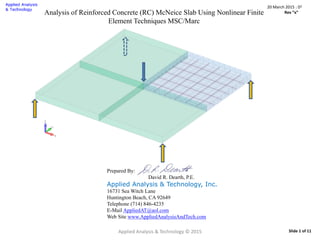
Analysis of Reinforced Concrete (RC) McNeice Slab Using Nonlinear Finite
Element Techniques MSC/Marc
Prepared By:
David R. Dearth, P.E.
Applied Analysis & Technology, Inc.
16731 Sea Witch Lane
Huntington Beach, CA 92649
Telephone (714) 846-4235
E-Mail AppliedAT@aol.com
Web Site www.AppliedAnalysisAndTech.com
Applied Analysis & Technology © 2015 Slide 2 of 11
Introduction
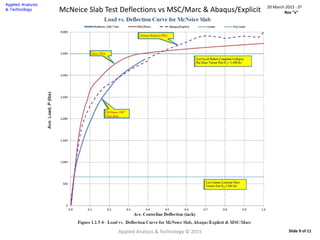
 McNeice (1.) tested a reinforced concrete (RC) slab in 1967.
 The purpose of this summary is to present results of addressing this RC Slab and
computing the load deflection curve using MSC/Marc for comparison to the
experimental test data.
 For comparison purposes the results from Abaqus example problem 1.1.5 using
Abaqus/Explicate at tension stiffening case ε = 0.002 in/in are also compared.
 For rectangular plates (or slabs) no general expression for deflection of plates with
corner supports as a function of central concentrated loading is available. The loading to
produce (a.) initial cracking and (b.) ultimate capacity is computed using the Marc
Vector plots of element cracking strain.
20 March 2015 : D2
Rev “x”
Applied Analysis & Technology © 2015 Slide 3 of 11
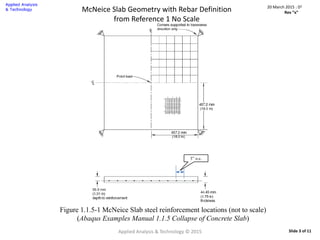
McNeice Slab Geometry with Rebar Definition
from Reference 1 No Scale
20 March 2015 : D2
Rev “x”
Figure 1.1.5-1 McNeice Slab steel reinforcement locations (not to scale)
(Abaqus Examples Manual 1.1.5 Collapse of Concrete Slab)
3” o.c.
Applied Analysis & Technology © 2015
20 March 2015 : D2
Rev “x”
Slide 4 of 11
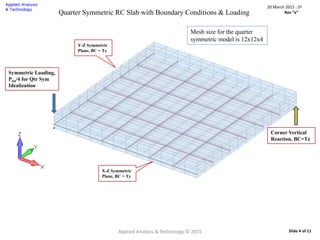
Quarter Symmetric RC Slab with Boundary Conditions & Loading
X-Z Symmetric
Plane, BC = Ty
Symmetric Loading,
Ptot/4 for Qtr Sym
Idealization
Corner Vertical
Reaction, BC=Tz
Y-Z Symmetric
Plane, BC = Tx
Mesh size for the quarter
symmetric model is 12x12x4
Applied Analysis & Technology © 2015
20 March 2015 : D2
Rev “x”
Slide 5 of 11
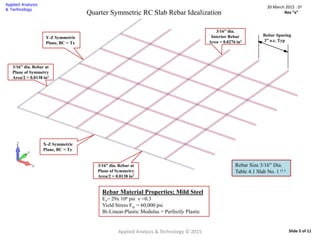
Quarter Symmetric RC Slab Rebar Idealization
3/16” dia.
Interior Rebar
Area = 0.0276 in2
3/16” dia. Rebar at
Plane of Symmetry
Area/2 = 0.0138 in2
3/16” dia. Rebar at
Plane of Symmetry
Area/2 = 0.0138 in2
Rebar Material Properties; Mild Steel
Es= 29x 106 psi ν =0.3
Yield Stress Fty = 60,000 psi
Bi-Linear-Plastic Modulus = Perfectly Plastic
X-Z Symmetric
Plane, BC = Ty
Y-Z Symmetric
Plane, BC = Tx
Rebar Spacing
3” o.c. Typ
Rebar Size 3/16” Dia.
Table 4.1 Slab No. 1 (1.)
Applied Analysis & Technology © 2015
20 March 2015 : D2
Rev “x”
Slide 6 of 11
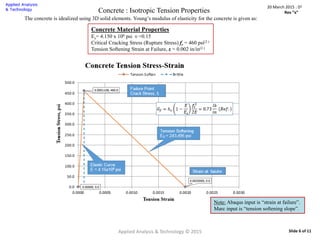
Concrete : Isotropic Tension Properties
The concrete is idealized using 3D solid elements. Young’s modulus of elasticity for the concrete is given as:
Concrete Material Properties
Es= 4.150 x 10⁶ psi ν =0.15
Critical Cracking Stress (Rupture Stress) fr = 460 psi(2.)
Tension Softening Strain at Failure, ε = 0.002 in/in(2.)
Note: Abaqus input is “strain at failure”.
Marc input is “tension softening slope”.
Applied Analysis & Technology © 2015
20 March 2015 : D2
Rev “x”
Slide 7 of 11
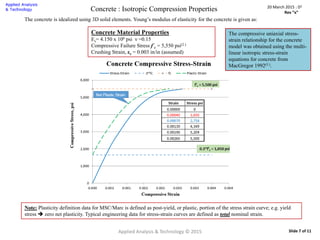
Concrete : Isotropic Compression Properties
The concrete is idealized using 3D solid elements. Young’s modulus of elasticity for the concrete is given as:
Concrete Material Properties
Es= 4.150 x 10⁶ psi ν =0.15
Compressive Failure Stress f’
c = 5,550 psi(2.)
Crushing Strain, εc = 0.003 in/in (assumed)
Note: Plasticity definition data for MSC/Marc is defined as post-yield, or plastic, portion of the stress strain curve; e.g. yield
stress  zero net plasticity. Typical engineering data for stress-strain curves are defined as total nominal strain.
The compressive uniaxial stress-
strain relationship for the concrete
model was obtained using the multi-
linear isotropic stress-strain
equations for concrete from
MacGregor 1992(3.).
Applied Analysis & Technology © 2015
20 March 2015 : D2
Rev “x”
Slide 8 of 11
Concrete : Isotropic Properties
The concrete is idealized using 3D solid elements. Young’s modulus of elasticity for the concrete is given as:
Concrete Material Properties
Elastic : Ee= 4.15 x10⁶ psi ν = 0.15
Cracking : Critical Cracking Stress (Rupture Stress) fr = 460 psi
Softening Modulus, Es= 243,495 psi [Failure Strain = 0.002 in/in]
Crushing Strain, εc = 0.003 in/in, Shear Retention : 20%
Plasticity : Elastic-Plastic, Isotropic Hardening, Buyukozturk Concrete
Concrete Isotropic Material Input Dialog
Applied Analysis & Technology © 2015 Slide 9 of 11
20 March 2015 : D2
Rev “x”McNeice Slab Test Deflections vs MSC/Marc & Abaqus/Explicit
Applied Analysis & Technology © 2015 Slide 10 of 11
20 March 2015 : D2
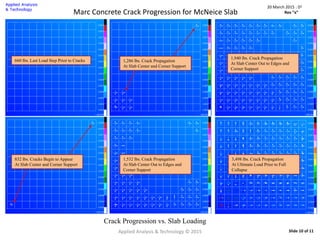
Rev “x”Marc Concrete Crack Progression for McNeice Slab
660 lbs. Last Load Step Prior to Cracks
Crack Progression vs. Slab Loading
832 lbs. Cracks Begin to Appear
At Slab Center and Corner Support
1,286 lbs. Crack Propagation
At Slab Center and Corner Support
1,532 lbs. Crack Propagation
At Slab Center Out to Edges and
Corner Support
1,940 lbs. Crack Propagation
At Slab Center Out to Edges and
Corner Support
3,498 lbs. Crack Propagation
At Ultimate Load Prior to Full
Collapse
Applied Analysis & Technology © 2015 Slide 11 of 11
References
1) McNeice, G.M., Elastic-Plastic Bending of Plates and Slabs by Finite Element
Method; Thesis Submitted to University of London for Degree Doctor of Philosophy,
Department of Civil and Municipal Engineering University College of London,
November 1967
2) Dassault Systems, 1.1.5 Collapse of Concrete Slab, Abaqus 6.11 Example Problems
Manual, Volume 1: Static and Dynamic Analyses, 2011
3) MacGregor, J.G. (1992), Reinforced Concrete Mechanics and Design, Prentice-Hall,
Inc., Englewood Cliffs, NJ.
20 March 2015 : D2
Rev “x”

Analysis McNeice Slab MSC-Marc

  • 1.
    Applied Analysis &Technology © 2015 20 March 2015 : D2 Rev “x” Slide 1 of 11 Analysis of Reinforced Concrete (RC) McNeice Slab Using Nonlinear Finite Element Techniques MSC/Marc Prepared By: David R. Dearth, P.E. Applied Analysis & Technology, Inc. 16731 Sea Witch Lane Huntington Beach, CA 92649 Telephone (714) 846-4235 E-Mail AppliedAT@aol.com Web Site www.AppliedAnalysisAndTech.com
  • 2.
    Applied Analysis &Technology © 2015 Slide 2 of 11 Introduction  McNeice (1.) tested a reinforced concrete (RC) slab in 1967.  The purpose of this summary is to present results of addressing this RC Slab and computing the load deflection curve using MSC/Marc for comparison to the experimental test data.  For comparison purposes the results from Abaqus example problem 1.1.5 using Abaqus/Explicate at tension stiffening case ε = 0.002 in/in are also compared.  For rectangular plates (or slabs) no general expression for deflection of plates with corner supports as a function of central concentrated loading is available. The loading to produce (a.) initial cracking and (b.) ultimate capacity is computed using the Marc Vector plots of element cracking strain. 20 March 2015 : D2 Rev “x”
  • 3.
    Applied Analysis &Technology © 2015 Slide 3 of 11 McNeice Slab Geometry with Rebar Definition from Reference 1 No Scale 20 March 2015 : D2 Rev “x” Figure 1.1.5-1 McNeice Slab steel reinforcement locations (not to scale) (Abaqus Examples Manual 1.1.5 Collapse of Concrete Slab) 3” o.c.
  • 4.
    Applied Analysis &Technology © 2015 20 March 2015 : D2 Rev “x” Slide 4 of 11 Quarter Symmetric RC Slab with Boundary Conditions & Loading X-Z Symmetric Plane, BC = Ty Symmetric Loading, Ptot/4 for Qtr Sym Idealization Corner Vertical Reaction, BC=Tz Y-Z Symmetric Plane, BC = Tx Mesh size for the quarter symmetric model is 12x12x4
  • 5.
    Applied Analysis &Technology © 2015 20 March 2015 : D2 Rev “x” Slide 5 of 11 Quarter Symmetric RC Slab Rebar Idealization 3/16” dia. Interior Rebar Area = 0.0276 in2 3/16” dia. Rebar at Plane of Symmetry Area/2 = 0.0138 in2 3/16” dia. Rebar at Plane of Symmetry Area/2 = 0.0138 in2 Rebar Material Properties; Mild Steel Es= 29x 106 psi ν =0.3 Yield Stress Fty = 60,000 psi Bi-Linear-Plastic Modulus = Perfectly Plastic X-Z Symmetric Plane, BC = Ty Y-Z Symmetric Plane, BC = Tx Rebar Spacing 3” o.c. Typ Rebar Size 3/16” Dia. Table 4.1 Slab No. 1 (1.)
  • 6.
    Applied Analysis &Technology © 2015 20 March 2015 : D2 Rev “x” Slide 6 of 11 Concrete : Isotropic Tension Properties The concrete is idealized using 3D solid elements. Young’s modulus of elasticity for the concrete is given as: Concrete Material Properties Es= 4.150 x 10⁶ psi ν =0.15 Critical Cracking Stress (Rupture Stress) fr = 460 psi(2.) Tension Softening Strain at Failure, ε = 0.002 in/in(2.) Note: Abaqus input is “strain at failure”. Marc input is “tension softening slope”.
  • 7.
    Applied Analysis &Technology © 2015 20 March 2015 : D2 Rev “x” Slide 7 of 11 Concrete : Isotropic Compression Properties The concrete is idealized using 3D solid elements. Young’s modulus of elasticity for the concrete is given as: Concrete Material Properties Es= 4.150 x 10⁶ psi ν =0.15 Compressive Failure Stress f’ c = 5,550 psi(2.) Crushing Strain, εc = 0.003 in/in (assumed) Note: Plasticity definition data for MSC/Marc is defined as post-yield, or plastic, portion of the stress strain curve; e.g. yield stress  zero net plasticity. Typical engineering data for stress-strain curves are defined as total nominal strain. The compressive uniaxial stress- strain relationship for the concrete model was obtained using the multi- linear isotropic stress-strain equations for concrete from MacGregor 1992(3.).
  • 8.
    Applied Analysis &Technology © 2015 20 March 2015 : D2 Rev “x” Slide 8 of 11 Concrete : Isotropic Properties The concrete is idealized using 3D solid elements. Young’s modulus of elasticity for the concrete is given as: Concrete Material Properties Elastic : Ee= 4.15 x10⁶ psi ν = 0.15 Cracking : Critical Cracking Stress (Rupture Stress) fr = 460 psi Softening Modulus, Es= 243,495 psi [Failure Strain = 0.002 in/in] Crushing Strain, εc = 0.003 in/in, Shear Retention : 20% Plasticity : Elastic-Plastic, Isotropic Hardening, Buyukozturk Concrete Concrete Isotropic Material Input Dialog
  • 9.
    Applied Analysis &Technology © 2015 Slide 9 of 11 20 March 2015 : D2 Rev “x”McNeice Slab Test Deflections vs MSC/Marc & Abaqus/Explicit
  • 10.
    Applied Analysis &Technology © 2015 Slide 10 of 11 20 March 2015 : D2 Rev “x”Marc Concrete Crack Progression for McNeice Slab 660 lbs. Last Load Step Prior to Cracks Crack Progression vs. Slab Loading 832 lbs. Cracks Begin to Appear At Slab Center and Corner Support 1,286 lbs. Crack Propagation At Slab Center and Corner Support 1,532 lbs. Crack Propagation At Slab Center Out to Edges and Corner Support 1,940 lbs. Crack Propagation At Slab Center Out to Edges and Corner Support 3,498 lbs. Crack Propagation At Ultimate Load Prior to Full Collapse
  • 11.
    Applied Analysis &Technology © 2015 Slide 11 of 11 References 1) McNeice, G.M., Elastic-Plastic Bending of Plates and Slabs by Finite Element Method; Thesis Submitted to University of London for Degree Doctor of Philosophy, Department of Civil and Municipal Engineering University College of London, November 1967 2) Dassault Systems, 1.1.5 Collapse of Concrete Slab, Abaqus 6.11 Example Problems Manual, Volume 1: Static and Dynamic Analyses, 2011 3) MacGregor, J.G. (1992), Reinforced Concrete Mechanics and Design, Prentice-Hall, Inc., Englewood Cliffs, NJ. 20 March 2015 : D2 Rev “x”