Important technical terms in concrete design
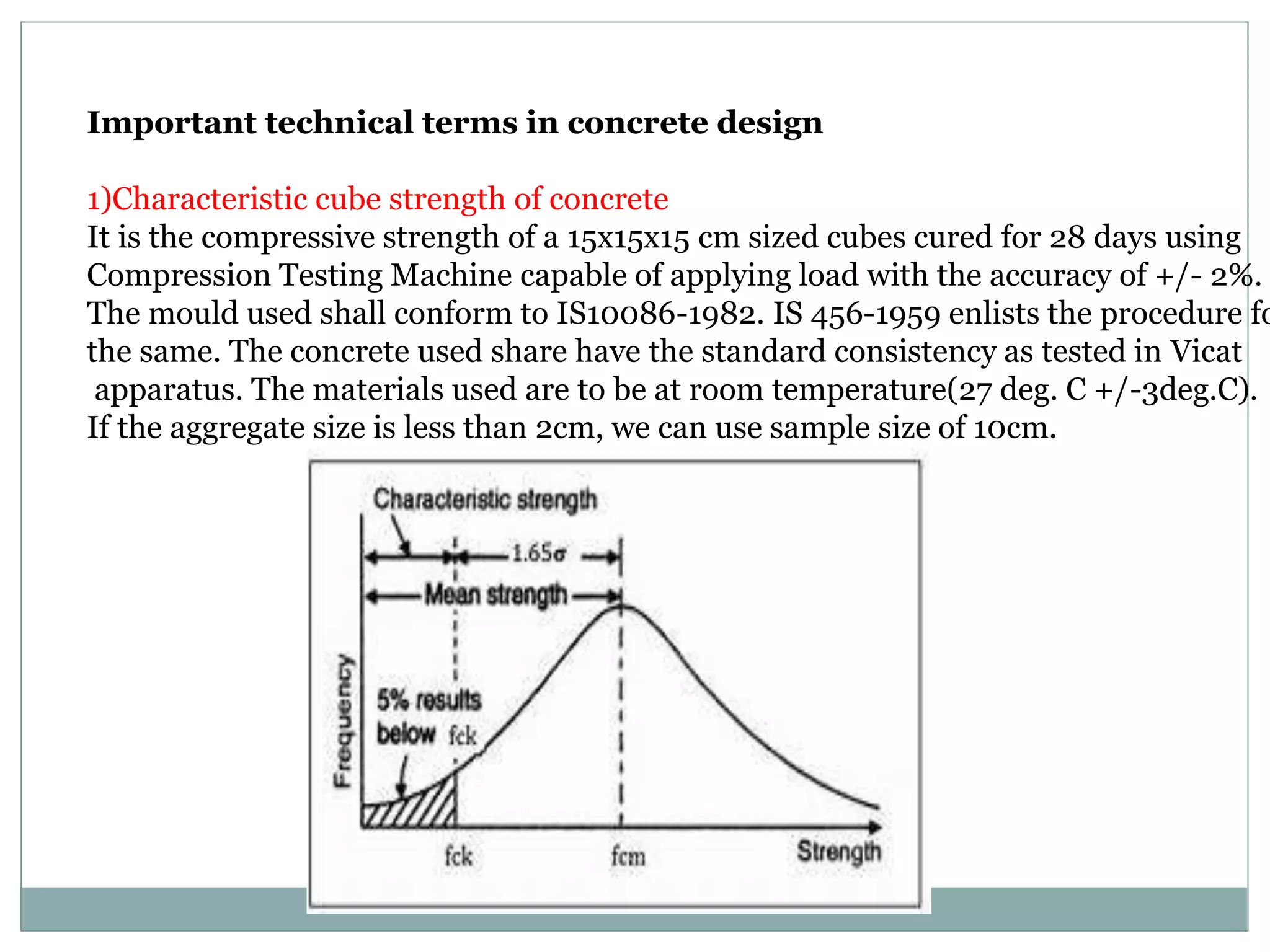
1)Characteristic cube strength of concrete
It is the compressive strength of a 15x15x15 cm sized cubes cured for 28 days using
Compression Testing Machine capable of applying load with the accuracy of +/- 2%.
The mould used shall conform to IS10086-1982. IS 456-1959 enlists the procedure fo
the same. The concrete used share have the standard consistency as tested in Vicat
apparatus. The materials used are to be at room temperature(27 deg. C +/-3deg.C).
If the aggregate size is less than 2cm, we can use sample size of 10cm.
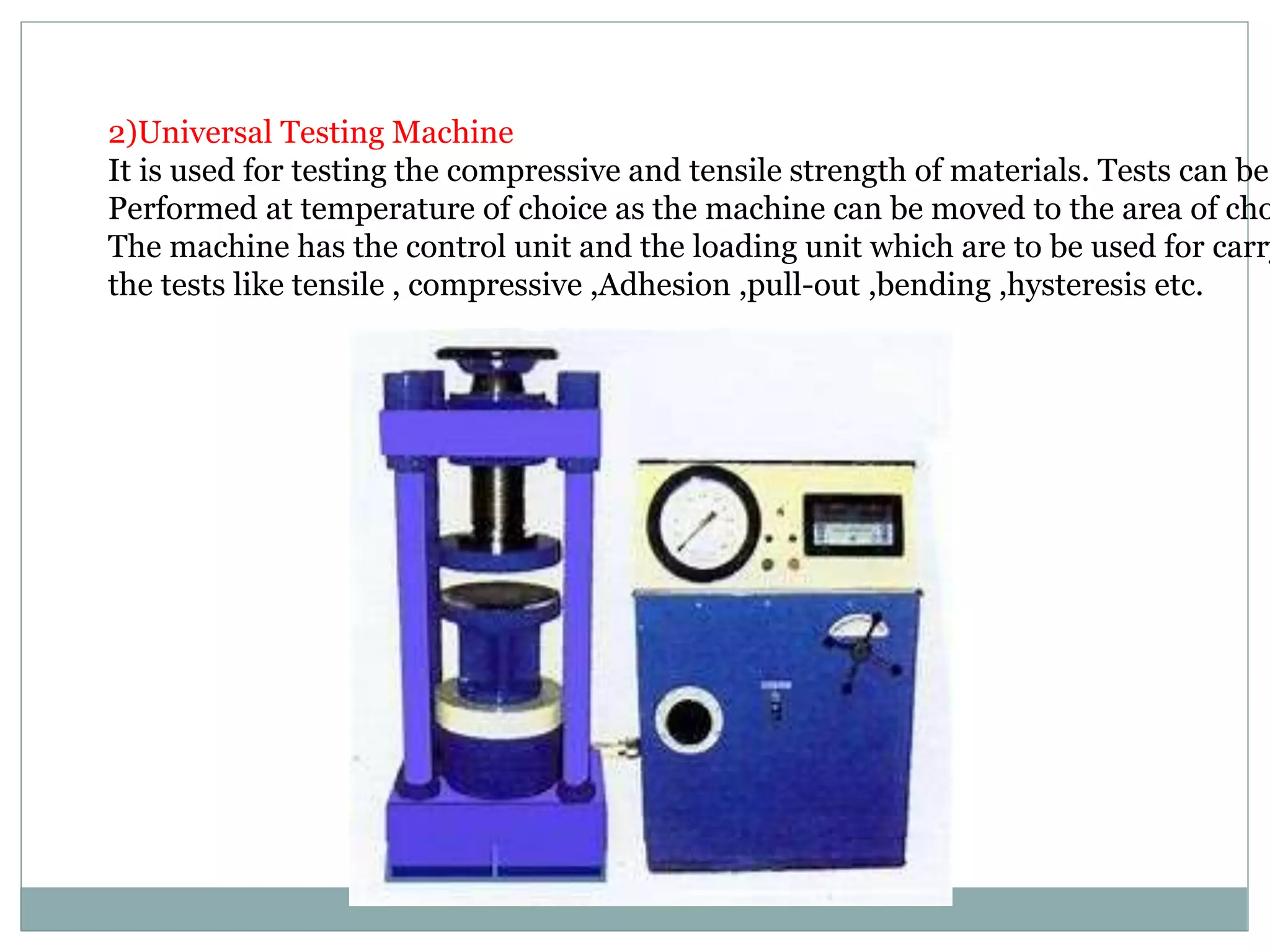
2)Universal Testing Machine
It is used for testing the compressive and tensile strength of materials. Tests can be
Performed at temperature of choice as the machine can be moved to the area of cho
The machine has the control unit and the loading unit which are to be used for carry
the tests like tensile , compressive ,Adhesion ,pull-out ,bending ,hysteresis etc.
3)Tensile strength of concrete
Concrete has a very low tensile strength as compared to its compressive strength.
The concrete is subjected to cracks due to shrinkage and creep. It is measured by
Split cylinder test carried out in compression testing machine as per IS 5816-1970 or
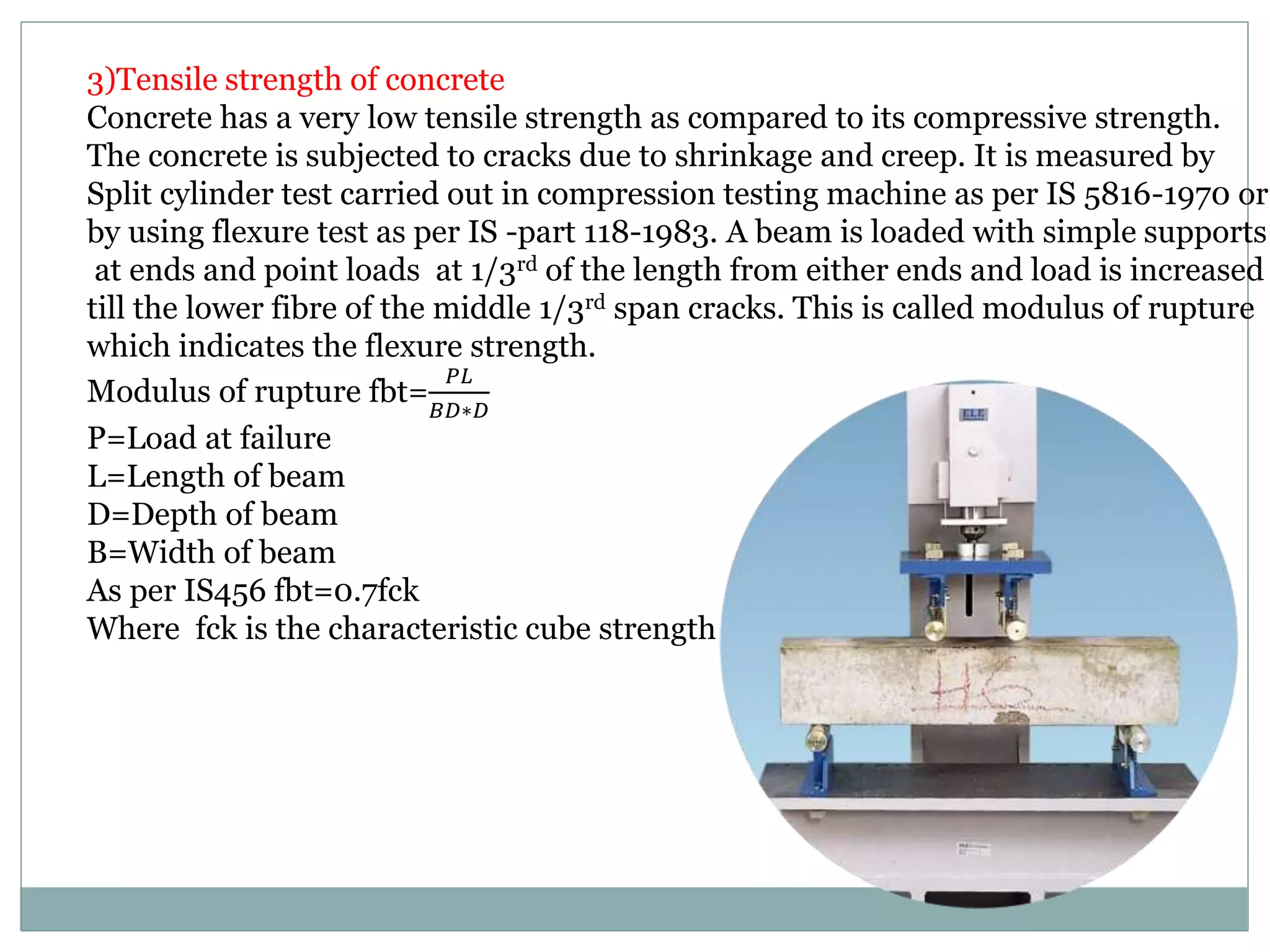
by using flexure test as per IS -part 118-1983. A beam is loaded with simple supports
at ends and point loads at 1/3rd of the length from either ends and load is increased
till the lower fibre of the middle 1/3rd span cracks. This is called modulus of rupture
which indicates the flexure strength.
Modulus of rupture fbt=
𝑃𝐿
𝐵𝐷∗𝐷
P=Load at failure
L=Length of beam
D=Depth of beam
B=Width of beam
As per IS456 fbt=0.7fck
Where fck is the characteristic cube strength
4)Cylindrical strength of concrete
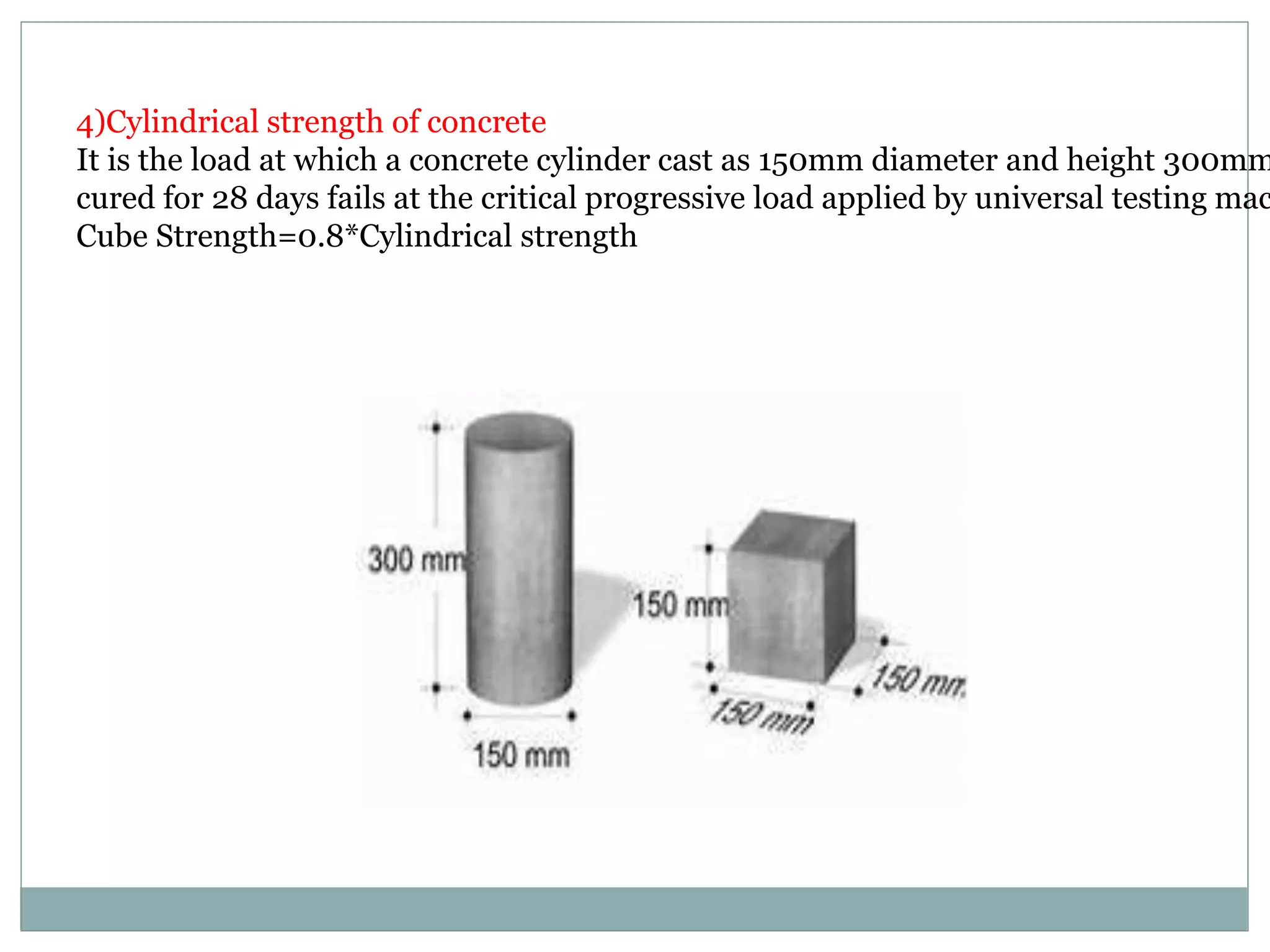
It is the load at which a concrete cylinder cast as 150mm diameter and height 300mm
cured for 28 days fails at the critical progressive load applied by universal testing mac
Cube Strength=0.8*Cylindrical strength
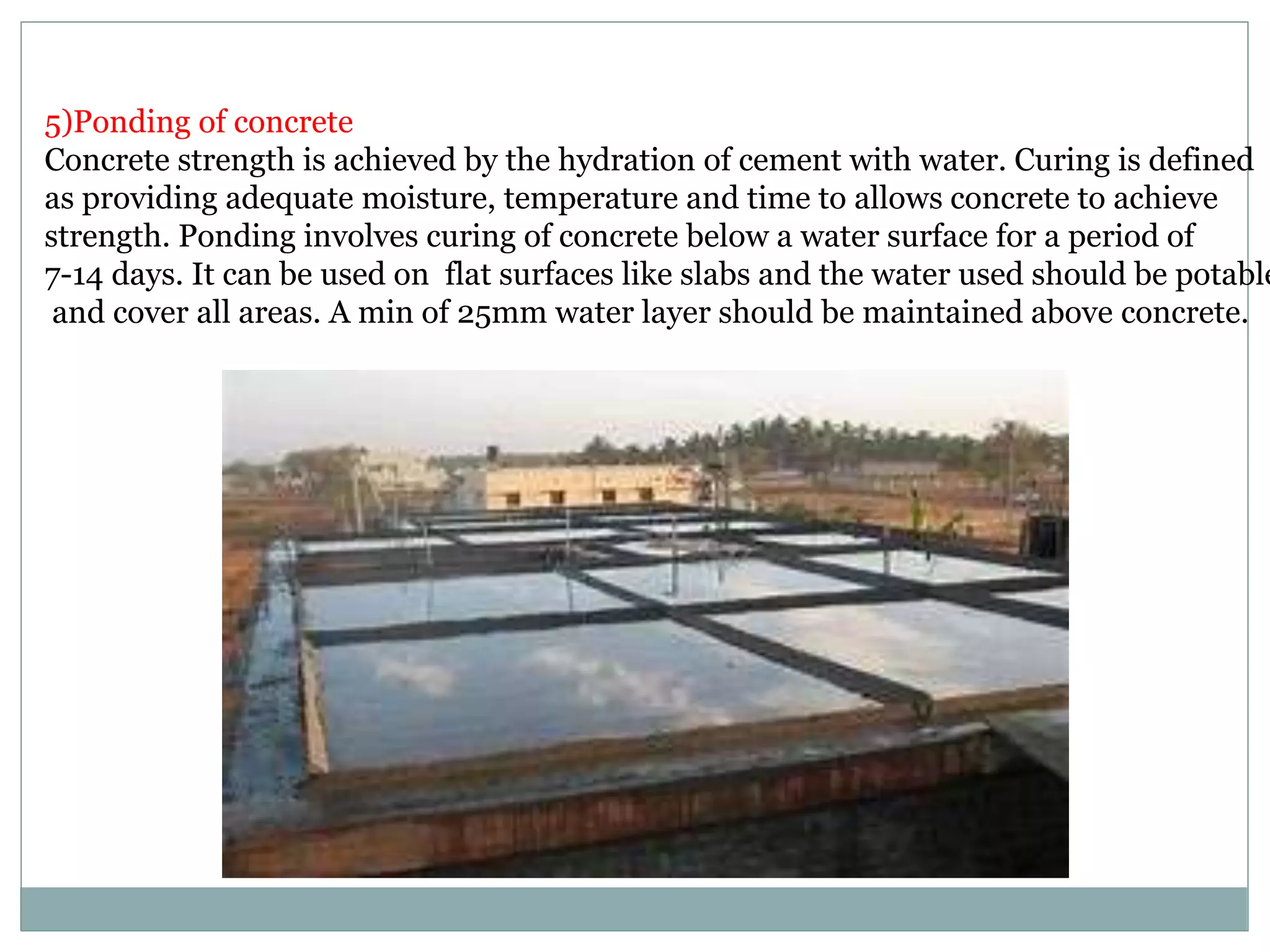
5)Ponding of concrete
Concrete strength is achieved by the hydration of cement with water. Curing is defined
as providing adequate moisture, temperature and time to allows concrete to achieve
strength. Ponding involves curing of concrete below a water surface for a period of
7-14 days. It can be used on flat surfaces like slabs and the water used should be potable
and cover all areas. A min of 25mm water layer should be maintained above concrete.
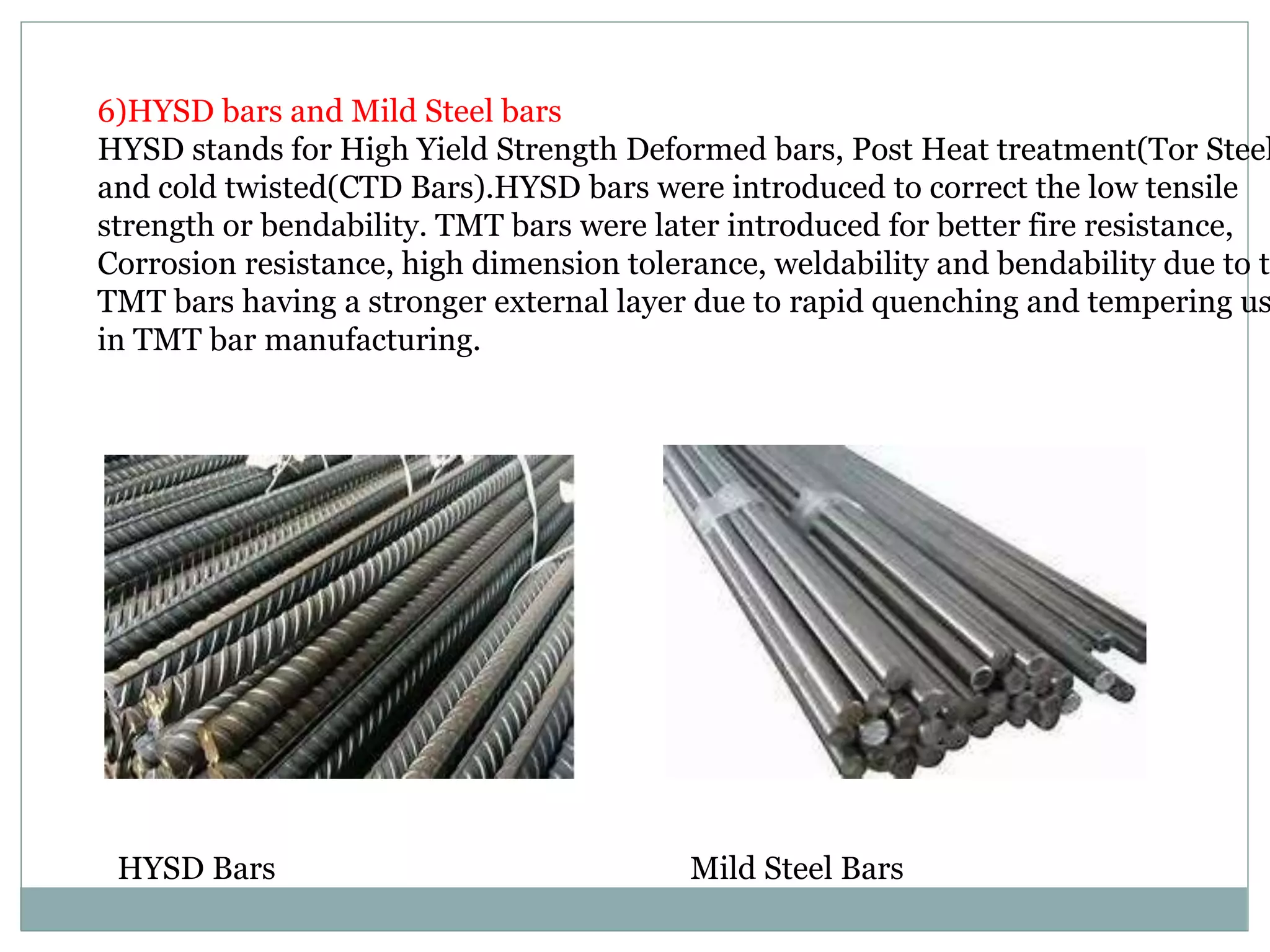
6)HYSD bars and Mild Steel bars
HYSD stands for High Yield Strength Deformed bars, Post Heat treatment(Tor Steel
and cold twisted(CTD Bars).HYSD bars were introduced to correct the low tensile
strength or bendability. TMT bars were later introduced for better fire resistance,
Corrosion resistance, high dimension tolerance, weldability and bendability due to th
TMT bars having a stronger external layer due to rapid quenching and tempering us
in TMT bar manufacturing.
HYSD Bars Mild Steel Bars
7)Effective cover in concrete
It is given for fire protection and corrosion resistance to rebars. Some minimum cove
requirements are:
1)At end of bar, a cover of 25mm or not less than twice the diameter of bar is to be
provided.
2)For columns, if size of bars
<12mm cover=30mm
>12mm cover=40mm
3)For beams, cover to be provided is diameter of bar or 30mm.
4)For slabs, cover to be provided is diameter of bar or 20mm.
5)For footings,
If footing on soil, cover=75mm
If footing on lean concrete, cover =50mm
Refer IS456 for further details
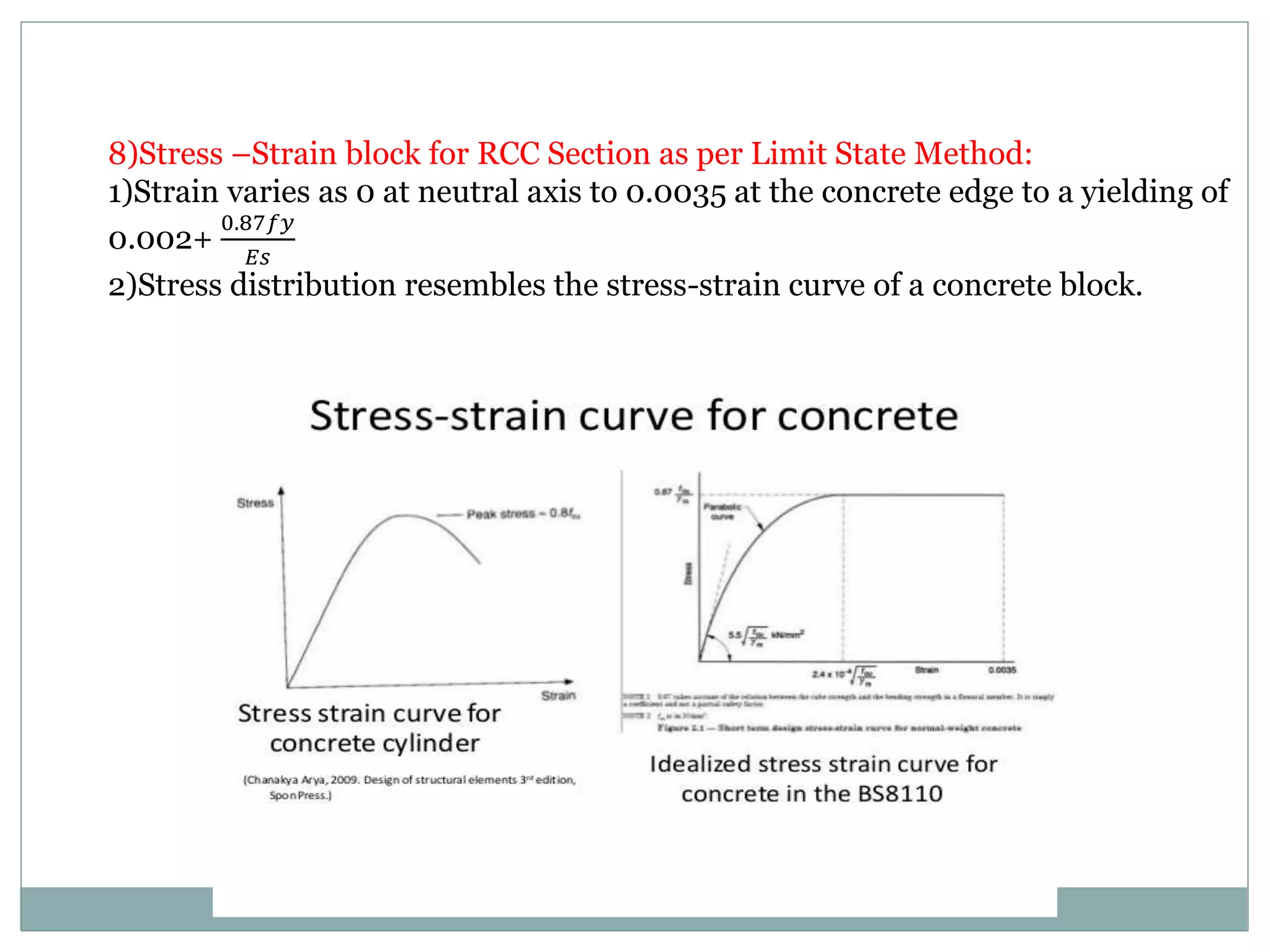
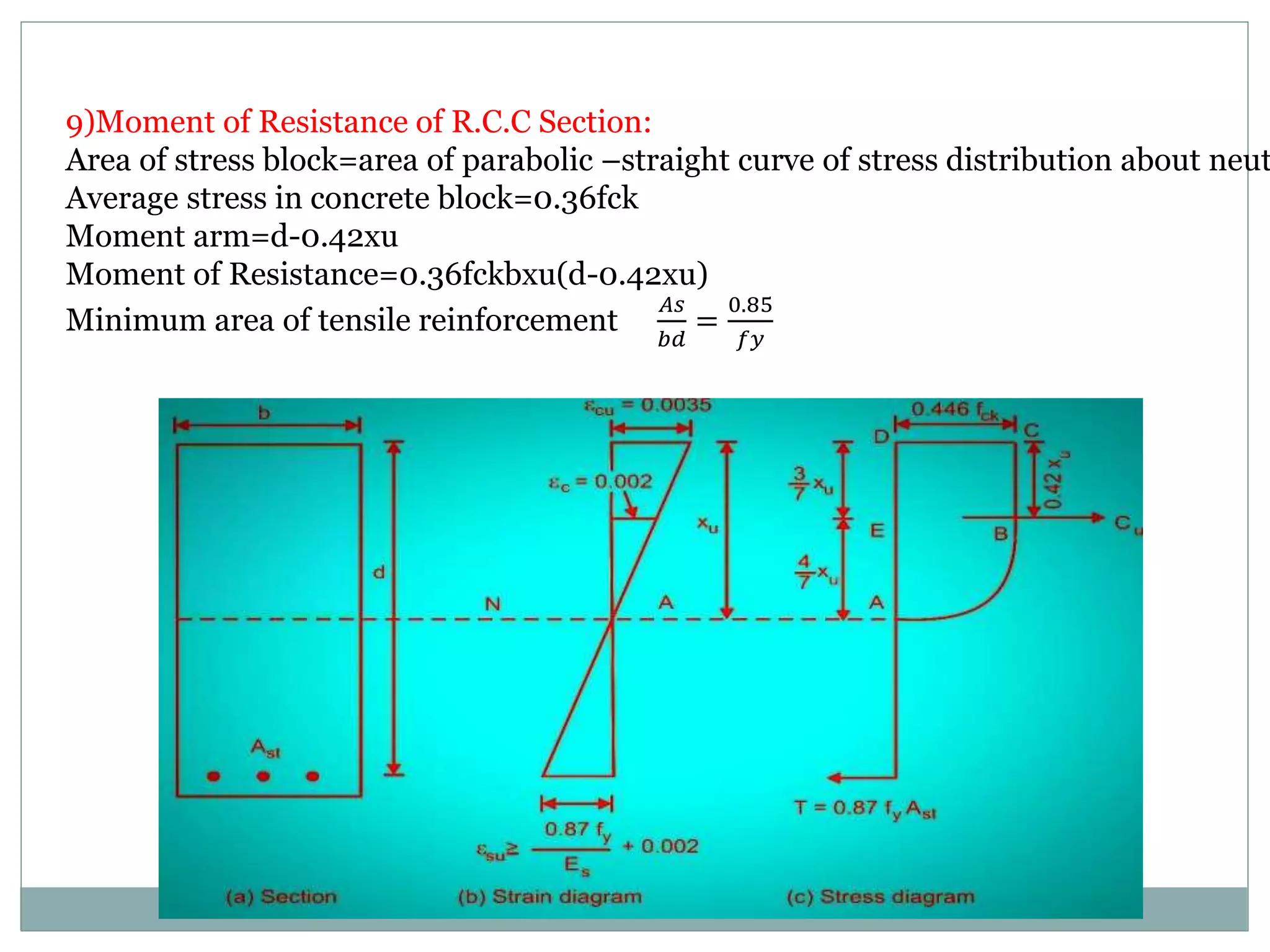
8)Stress –Strain block for RCC Section as per Limit State Method:
1)Strain varies as 0 at neutral axis to 0.0035 at the concrete edge to a yielding of
0.002+
0.87𝑓𝑦
𝐸𝑠
2)Stress distribution resembles the stress-strain curve of a concrete block.
9)Moment of Resistance of R.C.C Section:
Area of stress block=area of parabolic –straight curve of stress distribution about neut
Average stress in concrete block=0.36fck
Moment arm=d-0.42xu
Moment of Resistance=0.36fckbxu(d-0.42xu)
Minimum area of tensile reinforcement
𝐴𝑠
𝑏𝑑
=
0.85
𝑓𝑦
10)Shear resistance of R.C.C Section
The RCC Section is subjected to shear and tension which results in development of
diagonal plane of stress or principal plane where the stress is maximum. The stress
developed should be less than the concrete tensile strength. Hence the section is
checked for nominal shear stress,
𝑉
𝑏𝑑
= s < c
Where c is obtained from IS 456 based on percentage steel.
bsv(s-c)=Asv*0.87fy
As per IS Code provisions, minimum shear reinforcement
Asv*0.87fy=0.4bsv
Where Asv=area of vertical shear reinforcement
b =Width of section
fy =Yield strength of steel
sv =Spacing of bars
11)Bearing Strength of concrete
Bearing stress has to be checked when one concrete surface bears over the other
concrete surface.
Bearing stress =
𝑃(𝐿𝑜𝑎𝑑)
𝐴(𝐿𝑜𝑎𝑑𝑒𝑑 𝐴𝑟𝑒𝑎)
Bearing stress <
𝑓𝑐𝑘
1.5
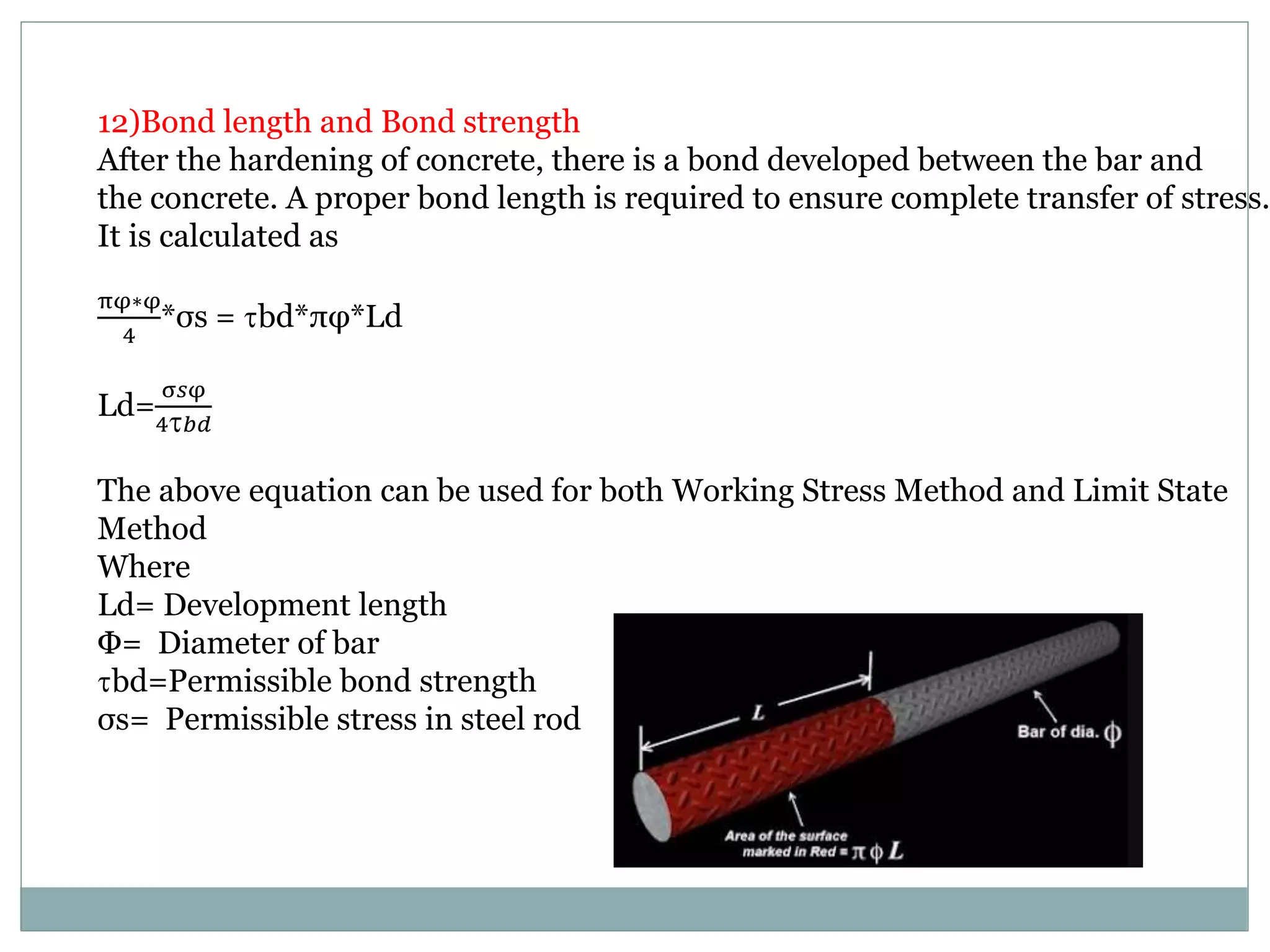
12)Bond length and Bond strength
After the hardening of concrete, there is a bond developed between the bar and
the concrete. A proper bond length is required to ensure complete transfer of stress.
It is calculated as
πφ∗φ
4
*σs = bd*πφ*Ld
Ld=
σ𝑠φ
4 𝑏𝑑
The above equation can be used for both Working Stress Method and Limit State
Method
Where
Ld= Development length
Φ= Diameter of bar
bd=Permissible bond strength
σs= Permissible stress in steel rod

Important Technical Terms in Concrete Design

  • 1.
    Important technical termsin concrete design 1)Characteristic cube strength of concrete It is the compressive strength of a 15x15x15 cm sized cubes cured for 28 days using Compression Testing Machine capable of applying load with the accuracy of +/- 2%. The mould used shall conform to IS10086-1982. IS 456-1959 enlists the procedure fo the same. The concrete used share have the standard consistency as tested in Vicat apparatus. The materials used are to be at room temperature(27 deg. C +/-3deg.C). If the aggregate size is less than 2cm, we can use sample size of 10cm.
  • 2.
    2)Universal Testing Machine Itis used for testing the compressive and tensile strength of materials. Tests can be Performed at temperature of choice as the machine can be moved to the area of cho The machine has the control unit and the loading unit which are to be used for carry the tests like tensile , compressive ,Adhesion ,pull-out ,bending ,hysteresis etc.
  • 3.
    3)Tensile strength ofconcrete Concrete has a very low tensile strength as compared to its compressive strength. The concrete is subjected to cracks due to shrinkage and creep. It is measured by Split cylinder test carried out in compression testing machine as per IS 5816-1970 or by using flexure test as per IS -part 118-1983. A beam is loaded with simple supports at ends and point loads at 1/3rd of the length from either ends and load is increased till the lower fibre of the middle 1/3rd span cracks. This is called modulus of rupture which indicates the flexure strength. Modulus of rupture fbt= 𝑃𝐿 𝐵𝐷∗𝐷 P=Load at failure L=Length of beam D=Depth of beam B=Width of beam As per IS456 fbt=0.7fck Where fck is the characteristic cube strength
  • 4.
    4)Cylindrical strength ofconcrete It is the load at which a concrete cylinder cast as 150mm diameter and height 300mm cured for 28 days fails at the critical progressive load applied by universal testing mac Cube Strength=0.8*Cylindrical strength
  • 5.
    5)Ponding of concrete Concretestrength is achieved by the hydration of cement with water. Curing is defined as providing adequate moisture, temperature and time to allows concrete to achieve strength. Ponding involves curing of concrete below a water surface for a period of 7-14 days. It can be used on flat surfaces like slabs and the water used should be potable and cover all areas. A min of 25mm water layer should be maintained above concrete.
  • 6.
    6)HYSD bars andMild Steel bars HYSD stands for High Yield Strength Deformed bars, Post Heat treatment(Tor Steel and cold twisted(CTD Bars).HYSD bars were introduced to correct the low tensile strength or bendability. TMT bars were later introduced for better fire resistance, Corrosion resistance, high dimension tolerance, weldability and bendability due to th TMT bars having a stronger external layer due to rapid quenching and tempering us in TMT bar manufacturing. HYSD Bars Mild Steel Bars
  • 7.
    7)Effective cover inconcrete It is given for fire protection and corrosion resistance to rebars. Some minimum cove requirements are: 1)At end of bar, a cover of 25mm or not less than twice the diameter of bar is to be provided. 2)For columns, if size of bars <12mm cover=30mm >12mm cover=40mm 3)For beams, cover to be provided is diameter of bar or 30mm. 4)For slabs, cover to be provided is diameter of bar or 20mm. 5)For footings, If footing on soil, cover=75mm If footing on lean concrete, cover =50mm Refer IS456 for further details
  • 8.
    8)Stress –Strain blockfor RCC Section as per Limit State Method: 1)Strain varies as 0 at neutral axis to 0.0035 at the concrete edge to a yielding of 0.002+ 0.87𝑓𝑦 𝐸𝑠 2)Stress distribution resembles the stress-strain curve of a concrete block.
  • 9.
    9)Moment of Resistanceof R.C.C Section: Area of stress block=area of parabolic –straight curve of stress distribution about neut Average stress in concrete block=0.36fck Moment arm=d-0.42xu Moment of Resistance=0.36fckbxu(d-0.42xu) Minimum area of tensile reinforcement 𝐴𝑠 𝑏𝑑 = 0.85 𝑓𝑦
  • 10.
    10)Shear resistance ofR.C.C Section The RCC Section is subjected to shear and tension which results in development of diagonal plane of stress or principal plane where the stress is maximum. The stress developed should be less than the concrete tensile strength. Hence the section is checked for nominal shear stress, 𝑉 𝑏𝑑 = s < c Where c is obtained from IS 456 based on percentage steel. bsv(s-c)=Asv*0.87fy As per IS Code provisions, minimum shear reinforcement Asv*0.87fy=0.4bsv Where Asv=area of vertical shear reinforcement b =Width of section fy =Yield strength of steel sv =Spacing of bars
  • 11.
    11)Bearing Strength ofconcrete Bearing stress has to be checked when one concrete surface bears over the other concrete surface. Bearing stress = 𝑃(𝐿𝑜𝑎𝑑) 𝐴(𝐿𝑜𝑎𝑑𝑒𝑑 𝐴𝑟𝑒𝑎) Bearing stress < 𝑓𝑐𝑘 1.5
  • 12.
    12)Bond length andBond strength After the hardening of concrete, there is a bond developed between the bar and the concrete. A proper bond length is required to ensure complete transfer of stress. It is calculated as πφ∗φ 4 *σs = bd*πφ*Ld Ld= σ𝑠φ 4 𝑏𝑑 The above equation can be used for both Working Stress Method and Limit State Method Where Ld= Development length Φ= Diameter of bar bd=Permissible bond strength σs= Permissible stress in steel rod