Applied Analysis & Technology © 2016
23 March 2016 : D2
Rev “x”
Slide 1 of 9
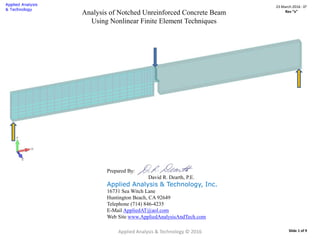
Analysis of Notched Unreinforced Concrete Beam
Using Nonlinear Finite Element Techniques
Prepared By:
David R. Dearth, P.E.
Applied Analysis & Technology, Inc.
16731 Sea Witch Lane
Huntington Beach, CA 92649
Telephone (714) 846-4235
E-Mail AppliedAT@aol.com
Web Site www.AppliedAnalysisAndTech.com
Introduction
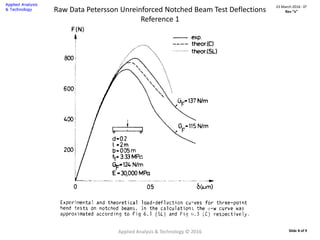
 Petersson, P.E (1.) tested an unreinforced notched concrete beam in 1981.
[Ref. Figure 8.16 Experimental and theoretical load-deflection curves for three-point bend tests on
notched beams.] See Slide 8.
 The purpose of this summary is to present results of addressing this Notched
Unreinforced Concrete Beam and computing the load deflection curve using MSC/Marc
for comparison to the experimental test data at the nominal fracture toughness, Gf = 124
N/m.
 For purposes of this analysis a medium mesh model definition was borrowed from an
Abaqus example problem “3.2.11 Notched unreinforced concrete beam under 3-point
bending”. (2.)
 Since Marc uses a linear tension softening modulus, Es, results from Abaqus/Standard
with linear tension softening are used for comparison. [Ref. Figure 3.2.11-6 Plane stress
Abaqus/Standard mesh refinement study – medium mesh.]
 Note: As noted in the Abaqus example, when linear tension softening is assumed in the
Abaqus solution, this leads to a response that is overly stiff compared with the
experimental observations of Petersson.
Applied Analysis & Technology © 2016
23 March 2016 : D2
Rev “x”
Slide 2 of 9
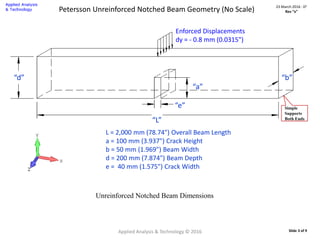
Petersson Unreinforced Notched Beam Geometry (No Scale)
Unreinforced Notched Beam Dimensions
Applied Analysis & Technology © 2016
23 March 2016 : D2
Rev “x”
Slide 3 of 9
Simple
Supports
Both Ends
“L”
“a”
“e”
“d”
Enforced Displacements
dy = - 0.8 mm (0.0315")
“b”
L = 2,000 mm (78.74") Overall Beam Length
a = 100 mm (3.937") Crack Height
b = 50 mm (1.969") Beam Width
d = 200 mm (7.874") Beam Depth
e = 40 mm (1.575") Crack Width
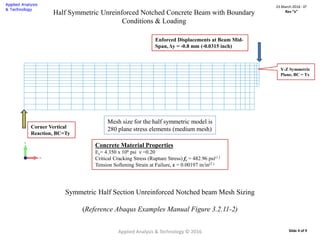
Half Symmetric Unreinforced Notched Concrete Beam with Boundary
Conditions & Loading
Y-Z Symmetric
Plane, BC = Tx
Enforced Displacements at Beam Mid-
Span, Δy = -0.8 mm (-0.0315 inch)
Corner Vertical
Reaction, BC=Ty
Mesh size for the half symmetric model is
280 plane stress elements (medium mesh)
Applied Analysis & Technology © 2016
23 March 2016 : D2
Rev “x”
Slide 4 of 9
Symmetric Half Section Unreinforced Notched beam Mesh Sizing
(Reference Abaqus Examples Manual Figure 3.2.11-2)
Concrete Material Properties
Ec= 4.350 x 10⁶ psi ν =0.20
Critical Cracking Stress (Rupture Stress) fr = 482.96 psi(1.)
Tension Softening Strain at Failure, ε = 0.00197 in/in(2.)
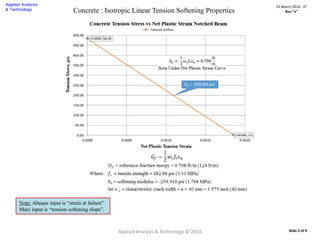
Concrete : Isotropic Linear Tension Softening Properties
Note: Abaqus input is “strain at failure”.
Marc input is “tension softening slope”.
Applied Analysis & Technology © 2016
23 March 2016 : D2
Rev “x”
Slide 5 of 9
Concrete : Isotropic Properties
The concrete is idealized using 2D Plane Stress elements. Young’s modulus of elasticity for the concrete is given as:
Concrete Material Properties
Elastic : Ec= 4.35 x10⁶ psi ν = 0.20
Cracking : Critical Cracking Stress (Rupture Stress) fr = 482.96 psi
Softening Modulus, Es= 259,410 psi [Failure Strain = 0.00197 in/in]
Crushing Strain, εc = 0.005 in/in, Shear Retention : 7.5%
Concrete Isotropic Material Input Dialog
Applied Analysis & Technology © 2016
23 March 2016 : D2
Rev “x”
Slide 6 of 9
Petersson Unreinforced Notched Beam Test Deflections
MSC/Marc vs Abaqus/Standard
Applied Analysis & Technology © 2016
23 March 2016 : D2
Rev “x”
Slide 7 of 9
Raw Data Petersson Unreinforced Notched Beam Test Deflections
Reference 1
Applied Analysis & Technology © 2016
23 March 2016 : D2
Rev “x”
Slide 8 of 9
References
1) Petersson, P. E., “Crack Growth and Development of Fracture Zones in Plain
Concrete and Similar Materials” Report No. TVBM-1006, Division of Building
Materials, University of Lund, Sweden, 1981
http://www.iaea.org/inis/collection/NCLCollectionStore/_Public/13/668/13668228.pdf
2) Dassault Systems, 3.2.11 Notched unreinforced concrete beam under 3-point bending
Abaqus 6.13 Abaqus Benchmarks Guide, 2013
http://129.97.46.200:2080/v6.13/books/bmk/default.htm
3) MSC/Marc Reference Manuals & Finite Element Analysis System: Volumes A, B, C, D"
MSC Software Corporation, 2 MacArthur Place, Santa Ana, California 92707
Applied Analysis & Technology © 2016
23 March 2016 : D2
Rev “x”
Slide 9 of 9

Analysis Petersson NotchedBeam MSC-Marc

  • 1.
    Applied Analysis &Technology © 2016 23 March 2016 : D2 Rev “x” Slide 1 of 9 Analysis of Notched Unreinforced Concrete Beam Using Nonlinear Finite Element Techniques Prepared By: David R. Dearth, P.E. Applied Analysis & Technology, Inc. 16731 Sea Witch Lane Huntington Beach, CA 92649 Telephone (714) 846-4235 E-Mail AppliedAT@aol.com Web Site www.AppliedAnalysisAndTech.com
  • 2.
    Introduction  Petersson, P.E(1.) tested an unreinforced notched concrete beam in 1981. [Ref. Figure 8.16 Experimental and theoretical load-deflection curves for three-point bend tests on notched beams.] See Slide 8.  The purpose of this summary is to present results of addressing this Notched Unreinforced Concrete Beam and computing the load deflection curve using MSC/Marc for comparison to the experimental test data at the nominal fracture toughness, Gf = 124 N/m.  For purposes of this analysis a medium mesh model definition was borrowed from an Abaqus example problem “3.2.11 Notched unreinforced concrete beam under 3-point bending”. (2.)  Since Marc uses a linear tension softening modulus, Es, results from Abaqus/Standard with linear tension softening are used for comparison. [Ref. Figure 3.2.11-6 Plane stress Abaqus/Standard mesh refinement study – medium mesh.]  Note: As noted in the Abaqus example, when linear tension softening is assumed in the Abaqus solution, this leads to a response that is overly stiff compared with the experimental observations of Petersson. Applied Analysis & Technology © 2016 23 March 2016 : D2 Rev “x” Slide 2 of 9
  • 3.
    Petersson Unreinforced NotchedBeam Geometry (No Scale) Unreinforced Notched Beam Dimensions Applied Analysis & Technology © 2016 23 March 2016 : D2 Rev “x” Slide 3 of 9 Simple Supports Both Ends “L” “a” “e” “d” Enforced Displacements dy = - 0.8 mm (0.0315") “b” L = 2,000 mm (78.74") Overall Beam Length a = 100 mm (3.937") Crack Height b = 50 mm (1.969") Beam Width d = 200 mm (7.874") Beam Depth e = 40 mm (1.575") Crack Width
  • 4.
    Half Symmetric UnreinforcedNotched Concrete Beam with Boundary Conditions & Loading Y-Z Symmetric Plane, BC = Tx Enforced Displacements at Beam Mid- Span, Δy = -0.8 mm (-0.0315 inch) Corner Vertical Reaction, BC=Ty Mesh size for the half symmetric model is 280 plane stress elements (medium mesh) Applied Analysis & Technology © 2016 23 March 2016 : D2 Rev “x” Slide 4 of 9 Symmetric Half Section Unreinforced Notched beam Mesh Sizing (Reference Abaqus Examples Manual Figure 3.2.11-2) Concrete Material Properties Ec= 4.350 x 10⁶ psi ν =0.20 Critical Cracking Stress (Rupture Stress) fr = 482.96 psi(1.) Tension Softening Strain at Failure, ε = 0.00197 in/in(2.)
  • 5.
    Concrete : IsotropicLinear Tension Softening Properties Note: Abaqus input is “strain at failure”. Marc input is “tension softening slope”. Applied Analysis & Technology © 2016 23 March 2016 : D2 Rev “x” Slide 5 of 9
  • 6.
    Concrete : IsotropicProperties The concrete is idealized using 2D Plane Stress elements. Young’s modulus of elasticity for the concrete is given as: Concrete Material Properties Elastic : Ec= 4.35 x10⁶ psi ν = 0.20 Cracking : Critical Cracking Stress (Rupture Stress) fr = 482.96 psi Softening Modulus, Es= 259,410 psi [Failure Strain = 0.00197 in/in] Crushing Strain, εc = 0.005 in/in, Shear Retention : 7.5% Concrete Isotropic Material Input Dialog Applied Analysis & Technology © 2016 23 March 2016 : D2 Rev “x” Slide 6 of 9
  • 7.
    Petersson Unreinforced NotchedBeam Test Deflections MSC/Marc vs Abaqus/Standard Applied Analysis & Technology © 2016 23 March 2016 : D2 Rev “x” Slide 7 of 9
  • 8.
    Raw Data PeterssonUnreinforced Notched Beam Test Deflections Reference 1 Applied Analysis & Technology © 2016 23 March 2016 : D2 Rev “x” Slide 8 of 9
  • 9.
    References 1) Petersson, P.E., “Crack Growth and Development of Fracture Zones in Plain Concrete and Similar Materials” Report No. TVBM-1006, Division of Building Materials, University of Lund, Sweden, 1981 http://www.iaea.org/inis/collection/NCLCollectionStore/_Public/13/668/13668228.pdf 2) Dassault Systems, 3.2.11 Notched unreinforced concrete beam under 3-point bending Abaqus 6.13 Abaqus Benchmarks Guide, 2013 http://129.97.46.200:2080/v6.13/books/bmk/default.htm 3) MSC/Marc Reference Manuals & Finite Element Analysis System: Volumes A, B, C, D" MSC Software Corporation, 2 MacArthur Place, Santa Ana, California 92707 Applied Analysis & Technology © 2016 23 March 2016 : D2 Rev “x” Slide 9 of 9