Questions for discussion
✘ What are several broad writing strategies associated with crafting a
qualitative study?
✘ What are the larger writing structures used within each of the five
approaches of inquiry?
✘ What are the embedded writing structures within each of the five
approaches of inquiry?
✘ How do the narrative structures for the five approaches differ?
3
Creswell, Qualitative Inquiry & Research Design 4e.
SAGE Publishing, 2018.
Ethical Considerations for Writing
• Tailor reporting to your audience
• Use appropriate, clear language
• Create honest and trustworthy reports
• Follow APA or other guidelines for permissions to use work of others
• Avoid duplicate or piecemeal publication
• Disclose funding sources and conflicts of interest
4
Creswell, Qualitative Inquiry & Research Design 4e.
SAGE Publishing, 2018.
1.
SEVERAL WRITING STRATEGIES
5
✘ Gleshne and Peshkin, 1992
• Storytelling – blurs the line bet. fiction, journalism & scholarly studies
• Chronological approach-unfold events slowly over time
• Narrow & expand (camera lens)
• Typical day
• Self-disclosure
Creswell, Qualitative Inquiry & Research Design 4e.
SAGE Publishing, 2018.
Narrative forms – are extensive in qualitative research.
“One characteristic of good
qualitative research is that the
inquirer makes his or her
“position” explicit.
-Hammersley & Atkinson, 1995
6
Creswell, Qualitative Inquiry & Research Design 4e.
SAGE Publishing, 2018.
Reflexivity and Representations in Writing
Reflexivity - the writer is conscious of the biases, values,
and experiences that he or she brings to a qualitative
research study.
7
Creswell, Qualitative Inquiry & Research Design 4e.
SAGE Publishing, 2018.
The researcher first talks about
his or her experiences with the
phenomenon being explored.
- involves relaying past experiences
through work, schooling, family dynamics,
and so forth
reflexivity
Then, discuss how these past
experiences shape the researcher’s
interpretation of the phenomenon.
- the heart of being reflexive in a study, because it is
important that the researcher not only detail his or
her experiences with the phenomenon, but also be
self-conscious about how these experiences may
potentially have shaped the findings, the conclusions,
and the interpretations drawn in a study
8
Creswell, Qualitative Inquiry & Research Design 4e.
SAGE Publishing, 2018.
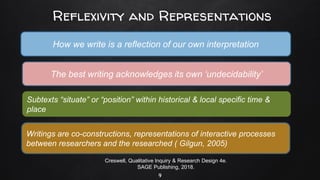
Reflexivity and Representations
9
How we write is a reflection of our own interpretation
The best writing acknowledges its own ‘undecidability’
Subtexts “situate” or “position” within historical & local specific time &
place
Writings are co-constructions, representations of interactive processes
between researchers and the researched ( Gilgun, 2005)
Creswell, Qualitative Inquiry & Research Design 4e.
SAGE Publishing, 2018.
Reflexivity and Representations
10
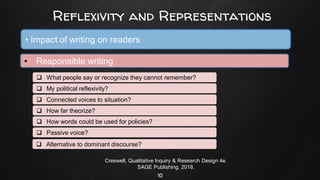
• Impact of writing on readers
• Responsible writing
❑ What people say or recognize they cannot remember?
Creswell, Qualitative Inquiry & Research Design 4e.
SAGE Publishing, 2018.
❑ My political reflexivity?
❑ Connected voices to situation?
❑ How far theorize?
❑ How words could be used for policies?
❑ Alternative to dominant discourse?
❑ Passive voice?
Reflexivity and Representations
11
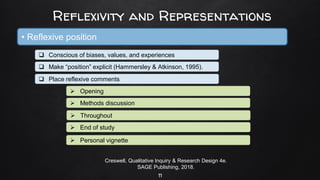
• Reflexive position
❑ Conscious of biases, values, and experiences
Creswell, Qualitative Inquiry & Research Design 4e.
SAGE Publishing, 2018.
❑ Make “position” explicit (Hammersley & Atkinson, 1995).
❑ Place reflexive comments
➢ Opening
➢ Methods discussion
➢ End of study
➢ Throughout
➢ Personal vignette
Audience for Our Writing
12
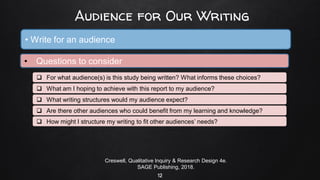
• Write for an audience
• Questions to consider
❑ For what audience(s) is this study being written? What informs these choices?
Creswell, Qualitative Inquiry & Research Design 4e.
SAGE Publishing, 2018.
❑ What am I hoping to achieve with this report to my audience?
❑ What writing structures would my audience expect?
❑ Are there other audiences who could benefit from my learning and knowledge?
❑ How might I structure my writing to fit other audiences’ needs?
Encoding Our Writings
13
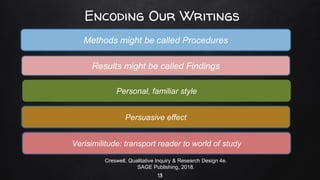
Methods might be called Procedures
Results might be called Findings
Personal, familiar style
Persuasive effect
Creswell, Qualitative Inquiry & Research Design 4e.
SAGE Publishing, 2018.
Verisimilitude: transport reader to world of study
Quotes in Our Writings
14
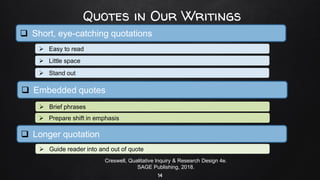
❑ Short, eye-catching quotations
➢ Easy to read
Creswell, Qualitative Inquiry & Research Design 4e.
SAGE Publishing, 2018.
➢ Little space
➢ Stand out
➢ Guide reader into and out of quote
➢ Prepare shift in emphasis
➢ Brief phrases
❑ Embedded quotes
❑ Longer quotation
Overall and Embedded Strategies
15
Overall and Embedded Strategies
16
Overall and Embedded Strategies
17
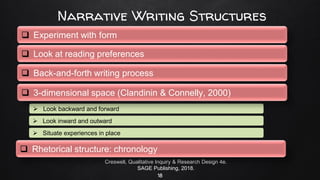
Narrative Writing Structures
18
❑ Experiment with form
Creswell, Qualitative Inquiry & Research Design 4e.
SAGE Publishing, 2018.
➢ Look inward and outward
➢ Look backward and forward
❑ Look at reading preferences
❑ Back-and-forth writing process
❑ 3-dimensional space (Clandinin & Connelly, 2000)
➢ Situate experiences in place
❑ Rhetorical structure: chronology
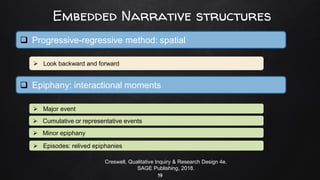
Embedded Narrative structures
19
❑ Progressive-regressive method: spatial
Creswell, Qualitative Inquiry & Research Design 4e.
SAGE Publishing, 2018.
➢ Cumulative or representative events
➢ Major event
❑ Epiphany: interactional moments
➢ Minor epiphany
➢ Look backward and forward
➢ Episodes: relived epiphanies
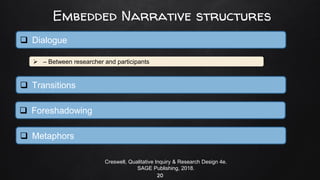
Embedded Narrative structures
20
❑ Dialogue
Creswell, Qualitative Inquiry & Research Design 4e.
SAGE Publishing, 2018.
❑ Transitions
➢ – Between researcher and participants
❑ Foreshadowing
❑ Metaphors
Phenomenological Writing
Structures
• Analysis steps (Moustakas, 1994):
– Identify significant statements
– Create meaning units
– Cluster themes
– Advance textural and structural descriptions
– End with a composite description
• Exhaustive description of essence
21
Creswell, Qualitative Inquiry & Research Design 4e.
SAGE Publishing, 2018.
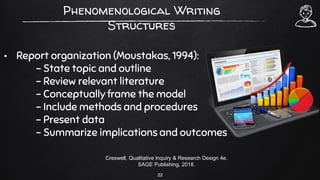
Phenomenological Writing
Structures
• Report organization (Moustakas, 1994):
– State topic and outline
– Review relevant literature
– Conceptually frame the model
– Include methods and procedures
– Present data
– Summarize implications and outcomes
22
Creswell, Qualitative Inquiry & Research Design 4e.
SAGE Publishing, 2018.
Phenomenological Writing
structures
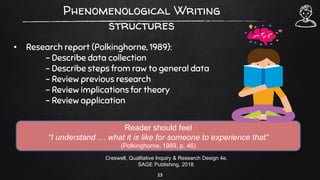
• Research report (Polkinghorne, 1989):
– Describe data collection
– Describe steps from raw to general data
– Review previous research
– Review implications for theory
– Review application
23
Creswell, Qualitative Inquiry & Research Design 4e.
SAGE Publishing, 2018.
Reader should feel
“I understand … what it is like for someone to experience that”
(Polkinghorne, 1989, p. 46)
Phenomenological Writing
strategies
• van Manen, 1990, 2014:
– ‘Working the text’ (p. 167)
– Organization:
• Thematically
• Larger ideas
• Narrow description
• Essence → manifestation
• Dialogic engagement: time, space, lived body, relationships
24
Creswell, Qualitative Inquiry & Research Design 4e.
SAGE Publishing, 2018.
Embedded Phenomenological
structures
• Essence: short paragraph or figure
• Educate reader about phenomenology
• Table of significant statements
• Table of meaning themes
• Create close: essence
• Reflexivity
25
Creswell, Qualitative Inquiry & Research Design 4e.
SAGE Publishing, 2018.
Grounded Theory Writing
Structures
❑ May, 1986
– Broad research questions
– Literature review
– Evolving methodology
– Findings section: theoretical scheme
– Final discussion: relationship to other knowledge
26
Creswell, Qualitative Inquiry & Research Design 4e.
SAGE Publishing, 2018.
Grounded Theory Writing
Structures
❑ Strauss & Corbin, 1990
– Develop clear analytic story
– Write on conceptual level
– Specify relationship among categories
– Specify variations & relevant conditions
27
Creswell, Qualitative Inquiry & Research Design 4e.
SAGE Publishing, 2018.
Grounded Theory Writing
Structures
❑ Less structured approach (Charmaz, 2006)
– Allowing ideas to emerge
– Revising early drafts
– Constructing argument about theory
– Closely examining categories
28
Creswell, Qualitative Inquiry & Research Design 4e.
SAGE Publishing, 2018.
Embedded Grounded Theory
structure
• Report varies w/ extent of analysis
• Chenitz & Swanson, 1986 address
– Description
– Categories generated through open coding
– Linking categories around core category
– Developing substantive, low-level theory
– Linking substantive to formal theory
• Examine propositions or theoretical relationships
29
Creswell, Qualitative Inquiry & Research Design 4e.
SAGE Publishing, 2018.
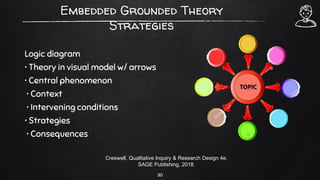
Embedded Grounded Theory
Strategies
Logic diagram
• Theory in visual model w/ arrows
• Central phenomenon
• Context
• Intervening conditions
• Strategies
• Consequences
30
Creswell, Qualitative Inquiry & Research Design 4e.
SAGE Publishing, 2018.
Ethnographic Writing
Structures
• Van Maanen, 1988
– Realist tale: matter-of-fact portrait of studied culture
– Confessional tale: focus on field experiences
– Impressionistic tale: personalized • Wolcott, 1994
– Description: What is going on?
– Analysis: Patterns
– Interpretation: Extend analysis
31
Creswell, Qualitative Inquiry & Research Design 4e.
SAGE Publishing, 2018.
Ethnographic Writing
Structures
Thematic narrative (Emerson, Fretz, & Shaw, 1995)
• Introduction: engage reader’s attention
• Introduce setting and methods
• Present analytic claims
• Reflect and elaborate on thesis
32
Creswell, Qualitative Inquiry & Research Design 4e.
SAGE Publishing, 2018.
Embedded Ethnographic
structure
• Figures of speech
– Metaphors: e.g. visual and spatial characterizations
– Synecdoche: part stands for whole
– Irony: contrasts of frames
• Thick & thin description
• Dialogue: e.g. code switching
• Fictional representation
– Flashback, flash-forward, and alternative points of view
– Deep characterization, tone shifts, and interior monologue
33
Creswell, Qualitative Inquiry & Research Design 4e.
SAGE Publishing, 2018.
Case Study Writing
Structures
• Topics in qualitative case study (Stake, 1995)
– Open w/ vignette
– Identify issue, purpose, and method
– Extensively describe case and context
– Present key issues
– Probe issues further
– Present assertions
– End w/ closing vignette
34
Creswell, Qualitative Inquiry & Research Design 4e.
SAGE Publishing, 2018.
Embedded Case Study
structure
• Funneling approach: broader to narrower
picture
• Amount of description vs. analysis
• Chronological approach
35
Creswell, Qualitative Inquiry & Research Design 4e.
SAGE Publishing, 2018.
Big concept
36
37
In this chapter, I discussed writing the qualitative report. I
began by discussing several rhetorical issues the writer must
address. These issues include writing reflexively and with
representation, the audience for the writing, the encoding for
that audience, and the use of quotes. Then I turned to each
of the five approaches of inquiry and presented overall
rhetorical structures for organizing the entire study as well as
specific embedded structures, writing devices, and
techniques that the researcher incorporates into the study.
Creswell, Qualitative Inquiry & Research Design 4e.
SAGE Publishing, 2018.
38
A table of these structures shows the diversity of perspectives
about structure that reflects different data analysis procedures
and discipline affiliations. I concluded with observations about
the differences in writing structures among the five
approaches, differences reflected in the variability of
approaches, the relationships between data analysis and
report writing, the emphasis in the literature of each approach
on narrative construction, and the amount of structure in the
overall architecture of a study within each approach.
Creswell, Qualitative Inquiry & Research Design 4e.
SAGE Publishing, 2018.
39
https://www.slidescarnival.com/ursula-free-presentation-template/804
Creswell, J. W., & Poth, C. N. (2018). Qualitative Inquiry & Research
Design: Choosing Among Five Approaches (4th ed.). Los Angeles, CA:
SAGE Publication Inc.
References:
40
https://www.pinclipart.com
https://www.123rf.com
https://mind-path.com/
https://englishwithmrspierce.com/
http://carelink-aal.org
https://www.istockphoto.com
https://study.com
https://www.mrvoip.com/custom-reporting/
https://www.shutterstock.com
https://cbps.blog/
https://peachyessay.com/case-studies/
https://www.pinterest.ph//

Writing a Qualitative Study

  • 3.
    Questions for discussion ✘What are several broad writing strategies associated with crafting a qualitative study? ✘ What are the larger writing structures used within each of the five approaches of inquiry? ✘ What are the embedded writing structures within each of the five approaches of inquiry? ✘ How do the narrative structures for the five approaches differ? 3 Creswell, Qualitative Inquiry & Research Design 4e. SAGE Publishing, 2018.
  • 4.
    Ethical Considerations forWriting • Tailor reporting to your audience • Use appropriate, clear language • Create honest and trustworthy reports • Follow APA or other guidelines for permissions to use work of others • Avoid duplicate or piecemeal publication • Disclose funding sources and conflicts of interest 4 Creswell, Qualitative Inquiry & Research Design 4e. SAGE Publishing, 2018.
  • 5.
    1. SEVERAL WRITING STRATEGIES 5 ✘Gleshne and Peshkin, 1992 • Storytelling – blurs the line bet. fiction, journalism & scholarly studies • Chronological approach-unfold events slowly over time • Narrow & expand (camera lens) • Typical day • Self-disclosure Creswell, Qualitative Inquiry & Research Design 4e. SAGE Publishing, 2018. Narrative forms – are extensive in qualitative research.
  • 6.
    “One characteristic ofgood qualitative research is that the inquirer makes his or her “position” explicit. -Hammersley & Atkinson, 1995 6 Creswell, Qualitative Inquiry & Research Design 4e. SAGE Publishing, 2018.
  • 7.
    Reflexivity and Representationsin Writing Reflexivity - the writer is conscious of the biases, values, and experiences that he or she brings to a qualitative research study. 7 Creswell, Qualitative Inquiry & Research Design 4e. SAGE Publishing, 2018.
  • 8.
    The researcher firsttalks about his or her experiences with the phenomenon being explored. - involves relaying past experiences through work, schooling, family dynamics, and so forth reflexivity Then, discuss how these past experiences shape the researcher’s interpretation of the phenomenon. - the heart of being reflexive in a study, because it is important that the researcher not only detail his or her experiences with the phenomenon, but also be self-conscious about how these experiences may potentially have shaped the findings, the conclusions, and the interpretations drawn in a study 8 Creswell, Qualitative Inquiry & Research Design 4e. SAGE Publishing, 2018.
  • 9.
    Reflexivity and Representations 9 Howwe write is a reflection of our own interpretation The best writing acknowledges its own ‘undecidability’ Subtexts “situate” or “position” within historical & local specific time & place Writings are co-constructions, representations of interactive processes between researchers and the researched ( Gilgun, 2005) Creswell, Qualitative Inquiry & Research Design 4e. SAGE Publishing, 2018.
  • 10.
    Reflexivity and Representations 10 •Impact of writing on readers • Responsible writing ❑ What people say or recognize they cannot remember? Creswell, Qualitative Inquiry & Research Design 4e. SAGE Publishing, 2018. ❑ My political reflexivity? ❑ Connected voices to situation? ❑ How far theorize? ❑ How words could be used for policies? ❑ Alternative to dominant discourse? ❑ Passive voice?
  • 11.
    Reflexivity and Representations 11 •Reflexive position ❑ Conscious of biases, values, and experiences Creswell, Qualitative Inquiry & Research Design 4e. SAGE Publishing, 2018. ❑ Make “position” explicit (Hammersley & Atkinson, 1995). ❑ Place reflexive comments ➢ Opening ➢ Methods discussion ➢ End of study ➢ Throughout ➢ Personal vignette
  • 12.
    Audience for OurWriting 12 • Write for an audience • Questions to consider ❑ For what audience(s) is this study being written? What informs these choices? Creswell, Qualitative Inquiry & Research Design 4e. SAGE Publishing, 2018. ❑ What am I hoping to achieve with this report to my audience? ❑ What writing structures would my audience expect? ❑ Are there other audiences who could benefit from my learning and knowledge? ❑ How might I structure my writing to fit other audiences’ needs?
  • 13.
    Encoding Our Writings 13 Methodsmight be called Procedures Results might be called Findings Personal, familiar style Persuasive effect Creswell, Qualitative Inquiry & Research Design 4e. SAGE Publishing, 2018. Verisimilitude: transport reader to world of study
  • 14.
    Quotes in OurWritings 14 ❑ Short, eye-catching quotations ➢ Easy to read Creswell, Qualitative Inquiry & Research Design 4e. SAGE Publishing, 2018. ➢ Little space ➢ Stand out ➢ Guide reader into and out of quote ➢ Prepare shift in emphasis ➢ Brief phrases ❑ Embedded quotes ❑ Longer quotation
  • 15.
    Overall and EmbeddedStrategies 15
  • 16.
    Overall and EmbeddedStrategies 16
  • 17.
    Overall and EmbeddedStrategies 17
  • 18.
    Narrative Writing Structures 18 ❑Experiment with form Creswell, Qualitative Inquiry & Research Design 4e. SAGE Publishing, 2018. ➢ Look inward and outward ➢ Look backward and forward ❑ Look at reading preferences ❑ Back-and-forth writing process ❑ 3-dimensional space (Clandinin & Connelly, 2000) ➢ Situate experiences in place ❑ Rhetorical structure: chronology
  • 19.
    Embedded Narrative structures 19 ❑Progressive-regressive method: spatial Creswell, Qualitative Inquiry & Research Design 4e. SAGE Publishing, 2018. ➢ Cumulative or representative events ➢ Major event ❑ Epiphany: interactional moments ➢ Minor epiphany ➢ Look backward and forward ➢ Episodes: relived epiphanies
  • 20.
    Embedded Narrative structures 20 ❑Dialogue Creswell, Qualitative Inquiry & Research Design 4e. SAGE Publishing, 2018. ❑ Transitions ➢ – Between researcher and participants ❑ Foreshadowing ❑ Metaphors
  • 21.
    Phenomenological Writing Structures • Analysissteps (Moustakas, 1994): – Identify significant statements – Create meaning units – Cluster themes – Advance textural and structural descriptions – End with a composite description • Exhaustive description of essence 21 Creswell, Qualitative Inquiry & Research Design 4e. SAGE Publishing, 2018.
  • 22.
    Phenomenological Writing Structures • Reportorganization (Moustakas, 1994): – State topic and outline – Review relevant literature – Conceptually frame the model – Include methods and procedures – Present data – Summarize implications and outcomes 22 Creswell, Qualitative Inquiry & Research Design 4e. SAGE Publishing, 2018.
  • 23.
    Phenomenological Writing structures • Researchreport (Polkinghorne, 1989): – Describe data collection – Describe steps from raw to general data – Review previous research – Review implications for theory – Review application 23 Creswell, Qualitative Inquiry & Research Design 4e. SAGE Publishing, 2018. Reader should feel “I understand … what it is like for someone to experience that” (Polkinghorne, 1989, p. 46)
  • 24.
    Phenomenological Writing strategies • vanManen, 1990, 2014: – ‘Working the text’ (p. 167) – Organization: • Thematically • Larger ideas • Narrow description • Essence → manifestation • Dialogic engagement: time, space, lived body, relationships 24 Creswell, Qualitative Inquiry & Research Design 4e. SAGE Publishing, 2018.
  • 25.
    Embedded Phenomenological structures • Essence:short paragraph or figure • Educate reader about phenomenology • Table of significant statements • Table of meaning themes • Create close: essence • Reflexivity 25 Creswell, Qualitative Inquiry & Research Design 4e. SAGE Publishing, 2018.
  • 26.
    Grounded Theory Writing Structures ❑May, 1986 – Broad research questions – Literature review – Evolving methodology – Findings section: theoretical scheme – Final discussion: relationship to other knowledge 26 Creswell, Qualitative Inquiry & Research Design 4e. SAGE Publishing, 2018.
  • 27.
    Grounded Theory Writing Structures ❑Strauss & Corbin, 1990 – Develop clear analytic story – Write on conceptual level – Specify relationship among categories – Specify variations & relevant conditions 27 Creswell, Qualitative Inquiry & Research Design 4e. SAGE Publishing, 2018.
  • 28.
    Grounded Theory Writing Structures ❑Less structured approach (Charmaz, 2006) – Allowing ideas to emerge – Revising early drafts – Constructing argument about theory – Closely examining categories 28 Creswell, Qualitative Inquiry & Research Design 4e. SAGE Publishing, 2018.
  • 29.
    Embedded Grounded Theory structure •Report varies w/ extent of analysis • Chenitz & Swanson, 1986 address – Description – Categories generated through open coding – Linking categories around core category – Developing substantive, low-level theory – Linking substantive to formal theory • Examine propositions or theoretical relationships 29 Creswell, Qualitative Inquiry & Research Design 4e. SAGE Publishing, 2018.
  • 30.
    Embedded Grounded Theory Strategies Logicdiagram • Theory in visual model w/ arrows • Central phenomenon • Context • Intervening conditions • Strategies • Consequences 30 Creswell, Qualitative Inquiry & Research Design 4e. SAGE Publishing, 2018.
  • 31.
    Ethnographic Writing Structures • VanMaanen, 1988 – Realist tale: matter-of-fact portrait of studied culture – Confessional tale: focus on field experiences – Impressionistic tale: personalized • Wolcott, 1994 – Description: What is going on? – Analysis: Patterns – Interpretation: Extend analysis 31 Creswell, Qualitative Inquiry & Research Design 4e. SAGE Publishing, 2018.
  • 32.
    Ethnographic Writing Structures Thematic narrative(Emerson, Fretz, & Shaw, 1995) • Introduction: engage reader’s attention • Introduce setting and methods • Present analytic claims • Reflect and elaborate on thesis 32 Creswell, Qualitative Inquiry & Research Design 4e. SAGE Publishing, 2018.
  • 33.
    Embedded Ethnographic structure • Figuresof speech – Metaphors: e.g. visual and spatial characterizations – Synecdoche: part stands for whole – Irony: contrasts of frames • Thick & thin description • Dialogue: e.g. code switching • Fictional representation – Flashback, flash-forward, and alternative points of view – Deep characterization, tone shifts, and interior monologue 33 Creswell, Qualitative Inquiry & Research Design 4e. SAGE Publishing, 2018.
  • 34.
    Case Study Writing Structures •Topics in qualitative case study (Stake, 1995) – Open w/ vignette – Identify issue, purpose, and method – Extensively describe case and context – Present key issues – Probe issues further – Present assertions – End w/ closing vignette 34 Creswell, Qualitative Inquiry & Research Design 4e. SAGE Publishing, 2018.
  • 35.
    Embedded Case Study structure •Funneling approach: broader to narrower picture • Amount of description vs. analysis • Chronological approach 35 Creswell, Qualitative Inquiry & Research Design 4e. SAGE Publishing, 2018.
  • 36.
  • 37.
    37 In this chapter,I discussed writing the qualitative report. I began by discussing several rhetorical issues the writer must address. These issues include writing reflexively and with representation, the audience for the writing, the encoding for that audience, and the use of quotes. Then I turned to each of the five approaches of inquiry and presented overall rhetorical structures for organizing the entire study as well as specific embedded structures, writing devices, and techniques that the researcher incorporates into the study. Creswell, Qualitative Inquiry & Research Design 4e. SAGE Publishing, 2018.
  • 38.
    38 A table ofthese structures shows the diversity of perspectives about structure that reflects different data analysis procedures and discipline affiliations. I concluded with observations about the differences in writing structures among the five approaches, differences reflected in the variability of approaches, the relationships between data analysis and report writing, the emphasis in the literature of each approach on narrative construction, and the amount of structure in the overall architecture of a study within each approach. Creswell, Qualitative Inquiry & Research Design 4e. SAGE Publishing, 2018.
  • 39.
    39 https://www.slidescarnival.com/ursula-free-presentation-template/804 Creswell, J. W.,& Poth, C. N. (2018). Qualitative Inquiry & Research Design: Choosing Among Five Approaches (4th ed.). Los Angeles, CA: SAGE Publication Inc. References:
  • 40.