© 2015 American Nurses Association
PURPOSE AND
EVOLUTION OF THE CODE
AND PROVISIONS 1-3,
NURSES AND PATIENTS
Slide Deck 1
© 2015 American Nurses Association
Provisions 1-3, Nurses and Patients
What do we mean by nurses and patients?
Provisions 1-3 address direct patient care and describe the
most fundamental values and commitments of the nurse.
3
Scope of Nursing Ethics
Unless separately referenced, all content comes from ANA’s Code of
Ethics for Nurses with Interpretive Statements, 2015 (“the Code”) OR
Fowler, M. D.M. (2015). Guide to the code of ethics for nurses:
Development, application, and interpretation (2nd Ed.). Silver Spring,
MD: American Nurses Association.
*All images are public domain under the Creative Commons license
and were retrieved from http://pixabay.com/en/.
The question mark icon throughout indicates a discussion point
or question to engage in dialogue.
4
What Is Ethics?
 A specialized area of philosophy
dating back to ancient Greece and
earlier
 Concepts of Hippocrates still inform today’s
ethical issues.
 A systematic study of what is right and
good measured against principles,
virtues and core values of a
profession.
5
Scope of Nursing Ethics
Deals with:
 Character (what sort of person one ought to be)
 Conduct (how one should act)
Deals with duties and obligations of nurses to:
 Patients
 Other health professionals
 The profession
 The wider public
 Global humanity
6
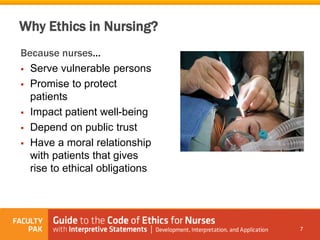
Why Ethics in Nursing?
Because nurses…
 Serve vulnerable persons
 Promise to protect
patients
 Impact patient well-being
 Depend on public trust
 Have a moral relationship
with patients that gives
rise to ethical obligations
7
Personal Values and Nursing
 Morality comprises personal values, character and
conduct.
 Those entering nursing bring moral values stemming
from:
 Religion, culture, family, education, life experience
 Embedded moral values are a starting point for ethical
behavior and personal integrity.
 As nursing core values are learned and practiced, they
are integrated with personal values to create a nursing
moral identity.
8
Branches of Ethics
METAETHICS
 Theoretical thinking about morality
NORMATIVE ETHICS
 What is right/wrong, good/evil individual or collective
choices
APPLIED ETHICS
 Right/wrong, good/evil of actions in a specific profession
or discipline
9
What Is an Ethical Code?
An ethical code is an identifying feature of a profession to:
 Facilitate professional self-regulation and accountability
 Describe obligations of client-professional and colleague-
to-colleague relationships
 Serve as a guide for analysis, decision and action
10
ANA’s Code of Ethics for Nurses with
Interpretive Statements (“the Code”)
 Conveys shared ethical values, obligations, duties and
ideals of nurses individually and collectively
 Provides an implied contract with the public
 Informs society of the moral values and ideals by which it
functions
 Informs new professionals of the expected moral
behaviors
 Guides the profession in self-regulation
 Provides a framework for ethical decision-making
 Is unapologetic, aspirational and nonnegotiable
11
Legacy of the Code
 Commitment to service is the most precious ideal of the
nursing profession.
 The Code supports ideals of nursing’s service.
 The Code guides all nurses in living out the values and
ideals of the profession.
 The Code is a living, ongoing legacy of core values from
Florence Nightingale in 1850 to 2015 and beyond.
12
Evolution of the Code
 1893: “Nightingale Pledge”
 1926: Suggested Code in the American Journal of Nursing
(AJN)
 1940: Tentative Code, AJN
 1950: The Code adopted by ANA
 1956, 1960, 1968, 1976, 1985, 2001: Revisions of the Code
 2015: Major revision of the Code
13
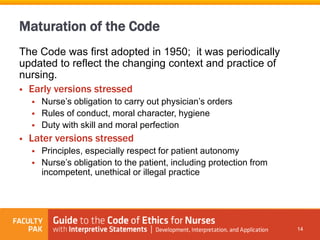
Maturation of the Code
The Code was first adopted in 1950; it was periodically
updated to reflect the changing context and practice of
nursing.
 Early versions stressed
 Nurse’s obligation to carry out physician’s orders
 Rules of conduct, moral character, hygiene
 Duty with skill and moral perfection
 Later versions stressed
 Principles, especially respect for patient autonomy
 Nurse’s obligation to the patient, including protection from
incompetent, unethical or illegal practice
14
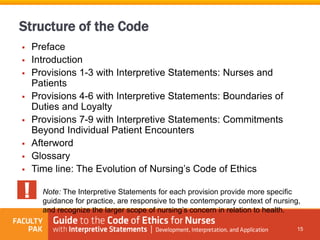
Structure of the Code
 Preface
 Introduction
 Provisions 1-3 with Interpretive Statements: Nurses and
Patients
 Provisions 4-6 with Interpretive Statements: Boundaries of
Duties and Loyalty
 Provisions 7-9 with Interpretive Statements: Commitments
Beyond Individual Patient Encounters
 Afterword
 Glossary
 Time line: The Evolution of Nursing’s Code of Ethics
Note: The Interpretive Statements for each provision provide more specific
guidance for practice, are responsive to the contemporary context of nursing,
and recognize the larger scope of nursing’s concern in relation to health.
15
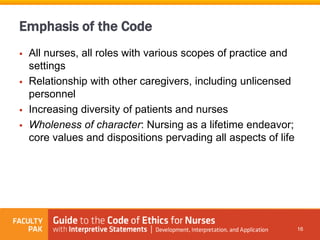
Emphasis of the Code
 All nurses, all roles with various scopes of practice and
settings
 Relationship with other caregivers, including unlicensed
personnel
 Increasing diversity of patients and nurses
 Wholeness of character: Nursing as a lifetime endeavor;
core values and dispositions pervading all aspects of life
16
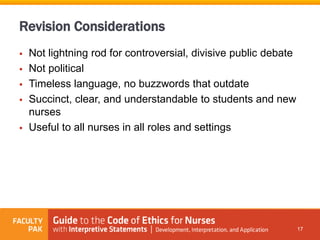
Revision Considerations
 Not lightning rod for controversial, divisive public debate
 Not political
 Timeless language, no buzzwords that outdate
 Succinct, clear, and understandable to students and new
nurses
 Useful to all nurses in all roles and settings
17
Nursing Is Value Laden
Caring for those suffering in the most vulnerable
moments of life:
 Finding meaning
 Bearing witness
 Facilitating healing
 Being present
 Expressing caring
18
Ethical Theories
 Nursing draws from many ethical theories, including:
• Kantian Normalism
• Utilitarianism
• Virtue Ethics
• Ethic of Caring
 The Code functions at mid-range
 Any of these theories can be used “behind” the Code
19
The nurse practices with compassion and respect for the
inherent dignity, worth and unique attributes of every
person.
Interpretive Statements
1.1 Respect for Human Dignity
1.2 Relationships With Patients
1.3 The Nature of Health
1.4 The Right to Self-Determination
1.5 Relationships With Colleagues and Others
20
Provision 1
Patient dignity is the foundation of nursing ethics.
 Dignity is inherent, not “earned.”
 A patient never loses dignity, e.g., when comatose,
delirious, frail, or in an altered state.
 A nurse must approach every patient with respect for
dignity, regardless of personal attributes, health state,
or any other situational or patient variable.
Source: Ferrell, B.R., & Coyle, N. (2008). The nature of suffering and the goals of nursing. New York,
NY: Oxford University Press.
21
1.1 Respect for Human Dignity
22
How would the Code impact your decision?
Nurses provide care to people at some of the best
and worst times of life.
• Is there any action or event that would prevent
you from providing compassionate care to a
specific individual?
• What if you had to care for a patient
suspected of injuring himself when detonating
a bomb deliberately targeting civilians…how
would the Code impact your decision?
 Trust
 Honoring patient choices, even when risky
How would the Code impact your decision?
 If a patient is self-harming by cutting to soothe
anxiety, is this an autonomous choice? Should you
stop the patient?
 How does the Code guide you?
23
1.2 Relationships With Patients
 Care shaped by patient
preferences, needs, values,
choices
 Evidence provides the science
of options; patient particulars
help choose the options
24
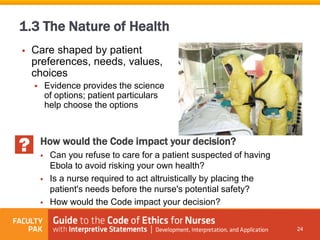
1.3 The Nature of Health
How would the Code impact your decision?
 Can you refuse to care for a patient suspected of having
Ebola to avoid risking your own health?
 Is a nurse required to act altruistically by placing the
patient's needs before the nurse's potential safety?
 How would the Code impact your decision?
Patients have a right to decide for themselves.
 The patient, and decisions made by the patient, are
to be respected regardless of personal attributes of
the patient, conflicting values, or circumstances.
25
1.4 The Right to Self-Determination
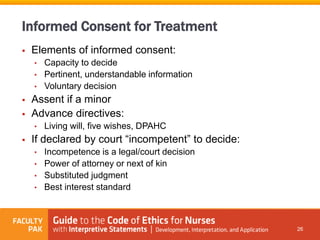
 Elements of informed consent:
• Capacity to decide
• Pertinent, understandable information
• Voluntary decision
 Assent if a minor
 Advance directives:
• Living will, five wishes, DPAHC
 If declared by court “incompetent” to decide:
• Incompetence is a legal/court decision
• Power of attorney or next of kin
• Substituted judgment
• Best interest standard
26
Informed Consent for Treatment
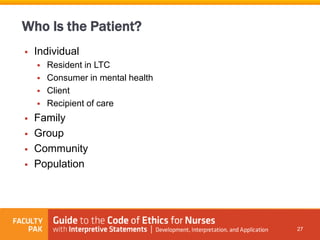
 Individual
 Resident in LTC
 Consumer in mental health
 Client
 Recipient of care
 Family
 Group
 Community
 Population
27
Who Is the Patient?
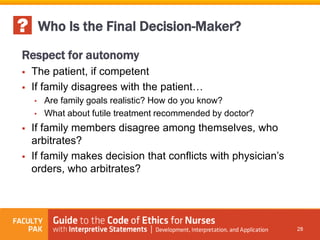
Respect for autonomy
 The patient, if competent
 If family disagrees with the patient…
• Are family goals realistic? How do you know?
• What about futile treatment recommended by doctor?
 If family members disagree among themselves, who
arbitrates?
 If family makes decision that conflicts with physician’s
orders, who arbitrates?
28
Who Is the Final Decision-Maker?
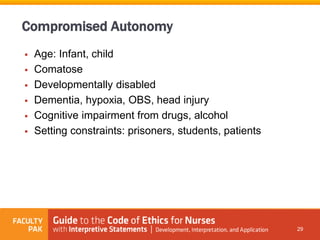
 Age: Infant, child
 Comatose
 Developmentally disabled
 Dementia, hypoxia, OBS, head injury
 Cognitive impairment from drugs, alcohol
 Setting constraints: prisoners, students, patients
29
Compromised Autonomy
 Self-determination depends on awareness of decisions to
be made
 Patient’s ability to comprehend treatment options may be
impaired by:
 Cognitive capacity
 Literacy, language proficiency, or educational level
 Visual or hearing impairment
 Anxiety in presence of health professionals
 Fear
 Important to assess patient’s understanding of treatment
options and implications
30
Health Literacy
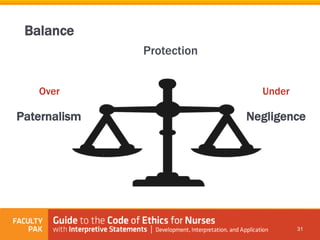
Under
31
Protection
Paternalism Negligence
Balance
Over
Nurses must live with their own conscience
 Adequate ethical justification for decisions and actions to
sleep at night
 Principles can only go so far
 Clinical judgment is in the end situational, contextual and
personal
 Ethical decisions always entail ambiguity and uncertainty
32
At the End of the Day…
“Nurses may not act with the sole intent to end life even
though such actions may be motivated by compassion,
respect for autonomy or quality of life considerations.”
Autonomy to accept, refuse, or terminate care:
 Foregoing nutrition and hydration
 Withholding or withdrawing life-sustaining treatment
 Honoring advance directives
33
Interpretive Statement 1.4
 Nurse may administer medications with the intent of
reducing symptoms of dying, even though the secondary
impact may decrease respirations and perhaps hasten
death
 The nurse’s actions do not cause the death, the terminal
illness causes the death
34
Doctrine of Double Effect
Interdisciplinary
 All colleagues, including unlicensed personnel
Inter-professional
 All licensed colleagues (medicine, pharmacy, social
workers, dieticians, PT, OT, RT, etc.)
Trans-professional
 Licensed colleagues working together on a team
across fields of expertise
35
1.5 Relationships With Colleagues and Others
Cultivate civility, collaboration, and collegiality to ensure:
 Safe, quality patient care and outcomes
 Compassionate, transparent, effective health
services
 A hospitable work environment
36
Create a Culture of Respect
The nurse’s primary commitment is to the patient, whether
an individual, family, group, community or population.
Interpretive Statements
2.1 Primacy of the Patient’s Interests
2.2 Conflict of Interest for Nurses
2.3 Collaboration
2.4 Professional Boundaries
37
Provision 2
 Engagement, trust, intimacy, presence
• Based on covenant relationship, existential encounter,
response to vulnerability
 Respond in the here and now
• Attentiveness
• Responsibility
• Competence
• Responsiveness
38
2.1 Primacy of the Patient’s Interests
 Contextual variables shift
 Decision-making never static or complete
 Approach may be
• Too broad/too narrow
• Too hasty/too delayed
• Too constrained/too flexible
• Too conventional/too visionary
• Too reductionist/too expansionist
• Too technical/not caring enough
39
Anticipate Nuances
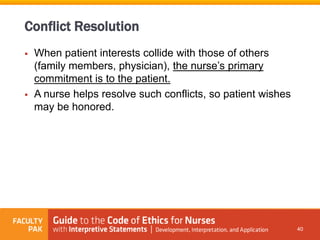
 When patient interests collide with those of others
(family members, physician), the nurse’s primary
commitment is to the patient.
 A nurse helps resolve such conflicts, so patient wishes
may be honored.
40
Conflict Resolution
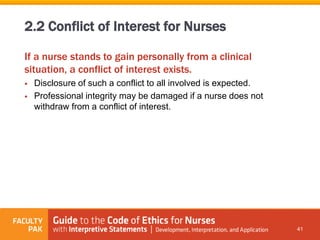
If a nurse stands to gain personally from a clinical
situation, a conflict of interest exists.
 Disclosure of such a conflict to all involved is expected.
 Professional integrity may be damaged if a nurse does not
withdraw from a conflict of interest.
41
2.2 Conflict of Interest for Nurses
42
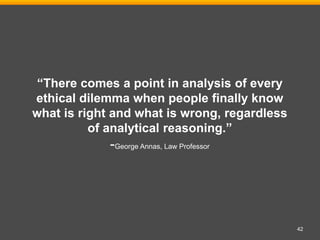
“There comes a point in analysis of every
ethical dilemma when people finally know
what is right and what is wrong, regardless
of analytical reasoning.”
-George Annas, Law Professor
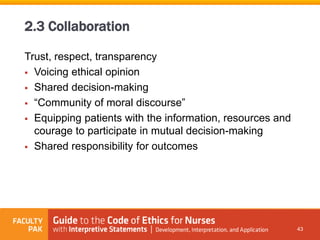
Trust, respect, transparency
 Voicing ethical opinion
 Shared decision-making
 “Community of moral discourse”
 Equipping patients with the information, resources and
courage to participate in mutual decision-making
 Shared responsibility for outcomes
43
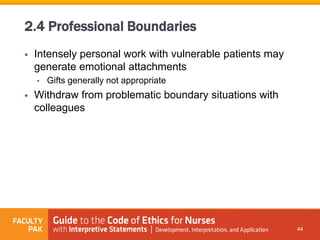
2.3 Collaboration
 Intensely personal work with vulnerable patients may
generate emotional attachments
• Gifts generally not appropriate
 Withdraw from problematic boundary situations with
colleagues
44
2.4 Professional Boundaries
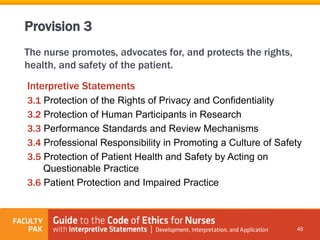
The nurse promotes, advocates for, and protects the rights,
health, and safety of the patient.
Interpretive Statements
3.1 Protection of the Rights of Privacy and Confidentiality
3.2 Protection of Human Participants in Research
3.3 Performance Standards and Review Mechanisms
3.4 Professional Responsibility in Promoting a Culture of Safety
3.5 Protection of Patient Health and Safety by Acting on
Questionable Practice
3.6 Patient Protection and Impaired Practice
45
Provision 3
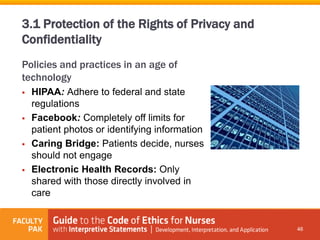
Policies and practices in an age of
technology
 HIPAA: Adhere to federal and state
regulations
 Facebook: Completely off limits for
patient photos or identifying information
 Caring Bridge: Patients decide, nurses
should not engage
 Electronic Health Records: Only
shared with those directly involved in
care
46
3.1 Protection of the Rights of Privacy and
Confidentiality
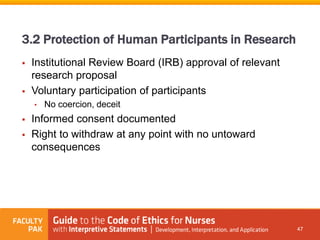
 Institutional Review Board (IRB) approval of relevant
research proposal
 Voluntary participation of participants
• No coercion, deceit
 Informed consent documented
 Right to withdraw at any point with no untoward
consequences
47
3.2 Protection of Human Participants in Research
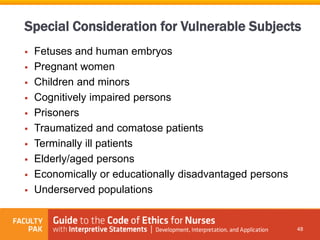
 Fetuses and human embryos
 Pregnant women
 Children and minors
 Cognitively impaired persons
 Prisoners
 Traumatized and comatose patients
 Terminally ill patients
 Elderly/aged persons
 Economically or educationally disadvantaged persons
 Underserved populations
48
Special Consideration for Vulnerable Subjects
 Demonstrate ongoing knowledge, skills, dispositions and
integrity for competence in practice
 Assume accountability for current, quality nursing
practice according to national, state, and institutional
standards
49
3.3 Performance Standards and Review
Mechanisms
 Avoid or reduce errors
 Do not conceal errors
 Correct or treat errors
 Use chain of authority when reporting a problem
 Provide timely responsive communication
 Document
50
3.4 Professional Responsibility in Promoting a
Culture of Safety
If a nurse observes a violation of law, policy, or ethical
standards that could jeopardize patient safety…
51
3.5 Protection of Patient Health and Safety by
Acting on Questionable Practice
 What guidance does the Code provide?
 What ANA position papers provide additional
guidance?
 What other policies or procedures need to be
followed?
When impaired practice is suspected, patient safety may be
jeopardized
 Identify colleagues whose practice may be impaired or
who are placing patients at risk
 Follow chain of authority with compassion and caring so
remediation and recovery may follow
 Access employee assistance program for help
52
3.6 Patient Protection and Impaired Practice
53
What Will Guide Your Moral Compass?

ANA ETHICS 1 to 3.pptx

  • 1.
    © 2015 AmericanNurses Association
  • 2.
    PURPOSE AND EVOLUTION OFTHE CODE AND PROVISIONS 1-3, NURSES AND PATIENTS Slide Deck 1 © 2015 American Nurses Association
  • 3.
    Provisions 1-3, Nursesand Patients What do we mean by nurses and patients? Provisions 1-3 address direct patient care and describe the most fundamental values and commitments of the nurse. 3
  • 4.
    Scope of NursingEthics Unless separately referenced, all content comes from ANA’s Code of Ethics for Nurses with Interpretive Statements, 2015 (“the Code”) OR Fowler, M. D.M. (2015). Guide to the code of ethics for nurses: Development, application, and interpretation (2nd Ed.). Silver Spring, MD: American Nurses Association. *All images are public domain under the Creative Commons license and were retrieved from http://pixabay.com/en/. The question mark icon throughout indicates a discussion point or question to engage in dialogue. 4
  • 5.
    What Is Ethics? A specialized area of philosophy dating back to ancient Greece and earlier  Concepts of Hippocrates still inform today’s ethical issues.  A systematic study of what is right and good measured against principles, virtues and core values of a profession. 5
  • 6.
    Scope of NursingEthics Deals with:  Character (what sort of person one ought to be)  Conduct (how one should act) Deals with duties and obligations of nurses to:  Patients  Other health professionals  The profession  The wider public  Global humanity 6
  • 7.
    Why Ethics inNursing? Because nurses…  Serve vulnerable persons  Promise to protect patients  Impact patient well-being  Depend on public trust  Have a moral relationship with patients that gives rise to ethical obligations 7
  • 8.
    Personal Values andNursing  Morality comprises personal values, character and conduct.  Those entering nursing bring moral values stemming from:  Religion, culture, family, education, life experience  Embedded moral values are a starting point for ethical behavior and personal integrity.  As nursing core values are learned and practiced, they are integrated with personal values to create a nursing moral identity. 8
  • 9.
    Branches of Ethics METAETHICS Theoretical thinking about morality NORMATIVE ETHICS  What is right/wrong, good/evil individual or collective choices APPLIED ETHICS  Right/wrong, good/evil of actions in a specific profession or discipline 9
  • 10.
    What Is anEthical Code? An ethical code is an identifying feature of a profession to:  Facilitate professional self-regulation and accountability  Describe obligations of client-professional and colleague- to-colleague relationships  Serve as a guide for analysis, decision and action 10
  • 11.
    ANA’s Code ofEthics for Nurses with Interpretive Statements (“the Code”)  Conveys shared ethical values, obligations, duties and ideals of nurses individually and collectively  Provides an implied contract with the public  Informs society of the moral values and ideals by which it functions  Informs new professionals of the expected moral behaviors  Guides the profession in self-regulation  Provides a framework for ethical decision-making  Is unapologetic, aspirational and nonnegotiable 11
  • 12.
    Legacy of theCode  Commitment to service is the most precious ideal of the nursing profession.  The Code supports ideals of nursing’s service.  The Code guides all nurses in living out the values and ideals of the profession.  The Code is a living, ongoing legacy of core values from Florence Nightingale in 1850 to 2015 and beyond. 12
  • 13.
    Evolution of theCode  1893: “Nightingale Pledge”  1926: Suggested Code in the American Journal of Nursing (AJN)  1940: Tentative Code, AJN  1950: The Code adopted by ANA  1956, 1960, 1968, 1976, 1985, 2001: Revisions of the Code  2015: Major revision of the Code 13
  • 14.
    Maturation of theCode The Code was first adopted in 1950; it was periodically updated to reflect the changing context and practice of nursing.  Early versions stressed  Nurse’s obligation to carry out physician’s orders  Rules of conduct, moral character, hygiene  Duty with skill and moral perfection  Later versions stressed  Principles, especially respect for patient autonomy  Nurse’s obligation to the patient, including protection from incompetent, unethical or illegal practice 14
  • 15.
    Structure of theCode  Preface  Introduction  Provisions 1-3 with Interpretive Statements: Nurses and Patients  Provisions 4-6 with Interpretive Statements: Boundaries of Duties and Loyalty  Provisions 7-9 with Interpretive Statements: Commitments Beyond Individual Patient Encounters  Afterword  Glossary  Time line: The Evolution of Nursing’s Code of Ethics Note: The Interpretive Statements for each provision provide more specific guidance for practice, are responsive to the contemporary context of nursing, and recognize the larger scope of nursing’s concern in relation to health. 15
  • 16.
    Emphasis of theCode  All nurses, all roles with various scopes of practice and settings  Relationship with other caregivers, including unlicensed personnel  Increasing diversity of patients and nurses  Wholeness of character: Nursing as a lifetime endeavor; core values and dispositions pervading all aspects of life 16
  • 17.
    Revision Considerations  Notlightning rod for controversial, divisive public debate  Not political  Timeless language, no buzzwords that outdate  Succinct, clear, and understandable to students and new nurses  Useful to all nurses in all roles and settings 17
  • 18.
    Nursing Is ValueLaden Caring for those suffering in the most vulnerable moments of life:  Finding meaning  Bearing witness  Facilitating healing  Being present  Expressing caring 18
  • 19.
    Ethical Theories  Nursingdraws from many ethical theories, including: • Kantian Normalism • Utilitarianism • Virtue Ethics • Ethic of Caring  The Code functions at mid-range  Any of these theories can be used “behind” the Code 19
  • 20.
    The nurse practiceswith compassion and respect for the inherent dignity, worth and unique attributes of every person. Interpretive Statements 1.1 Respect for Human Dignity 1.2 Relationships With Patients 1.3 The Nature of Health 1.4 The Right to Self-Determination 1.5 Relationships With Colleagues and Others 20 Provision 1
  • 21.
    Patient dignity isthe foundation of nursing ethics.  Dignity is inherent, not “earned.”  A patient never loses dignity, e.g., when comatose, delirious, frail, or in an altered state.  A nurse must approach every patient with respect for dignity, regardless of personal attributes, health state, or any other situational or patient variable. Source: Ferrell, B.R., & Coyle, N. (2008). The nature of suffering and the goals of nursing. New York, NY: Oxford University Press. 21 1.1 Respect for Human Dignity
  • 22.
    22 How would theCode impact your decision? Nurses provide care to people at some of the best and worst times of life. • Is there any action or event that would prevent you from providing compassionate care to a specific individual? • What if you had to care for a patient suspected of injuring himself when detonating a bomb deliberately targeting civilians…how would the Code impact your decision?
  • 23.
     Trust  Honoringpatient choices, even when risky How would the Code impact your decision?  If a patient is self-harming by cutting to soothe anxiety, is this an autonomous choice? Should you stop the patient?  How does the Code guide you? 23 1.2 Relationships With Patients
  • 24.
     Care shapedby patient preferences, needs, values, choices  Evidence provides the science of options; patient particulars help choose the options 24 1.3 The Nature of Health How would the Code impact your decision?  Can you refuse to care for a patient suspected of having Ebola to avoid risking your own health?  Is a nurse required to act altruistically by placing the patient's needs before the nurse's potential safety?  How would the Code impact your decision?
  • 25.
    Patients have aright to decide for themselves.  The patient, and decisions made by the patient, are to be respected regardless of personal attributes of the patient, conflicting values, or circumstances. 25 1.4 The Right to Self-Determination
  • 26.
     Elements ofinformed consent: • Capacity to decide • Pertinent, understandable information • Voluntary decision  Assent if a minor  Advance directives: • Living will, five wishes, DPAHC  If declared by court “incompetent” to decide: • Incompetence is a legal/court decision • Power of attorney or next of kin • Substituted judgment • Best interest standard 26 Informed Consent for Treatment
  • 27.
     Individual  Residentin LTC  Consumer in mental health  Client  Recipient of care  Family  Group  Community  Population 27 Who Is the Patient?
  • 28.
    Respect for autonomy The patient, if competent  If family disagrees with the patient… • Are family goals realistic? How do you know? • What about futile treatment recommended by doctor?  If family members disagree among themselves, who arbitrates?  If family makes decision that conflicts with physician’s orders, who arbitrates? 28 Who Is the Final Decision-Maker?
  • 29.
     Age: Infant,child  Comatose  Developmentally disabled  Dementia, hypoxia, OBS, head injury  Cognitive impairment from drugs, alcohol  Setting constraints: prisoners, students, patients 29 Compromised Autonomy
  • 30.
     Self-determination dependson awareness of decisions to be made  Patient’s ability to comprehend treatment options may be impaired by:  Cognitive capacity  Literacy, language proficiency, or educational level  Visual or hearing impairment  Anxiety in presence of health professionals  Fear  Important to assess patient’s understanding of treatment options and implications 30 Health Literacy
  • 31.
  • 32.
    Nurses must livewith their own conscience  Adequate ethical justification for decisions and actions to sleep at night  Principles can only go so far  Clinical judgment is in the end situational, contextual and personal  Ethical decisions always entail ambiguity and uncertainty 32 At the End of the Day…
  • 33.
    “Nurses may notact with the sole intent to end life even though such actions may be motivated by compassion, respect for autonomy or quality of life considerations.” Autonomy to accept, refuse, or terminate care:  Foregoing nutrition and hydration  Withholding or withdrawing life-sustaining treatment  Honoring advance directives 33 Interpretive Statement 1.4
  • 34.
     Nurse mayadminister medications with the intent of reducing symptoms of dying, even though the secondary impact may decrease respirations and perhaps hasten death  The nurse’s actions do not cause the death, the terminal illness causes the death 34 Doctrine of Double Effect
  • 35.
    Interdisciplinary  All colleagues,including unlicensed personnel Inter-professional  All licensed colleagues (medicine, pharmacy, social workers, dieticians, PT, OT, RT, etc.) Trans-professional  Licensed colleagues working together on a team across fields of expertise 35 1.5 Relationships With Colleagues and Others
  • 36.
    Cultivate civility, collaboration,and collegiality to ensure:  Safe, quality patient care and outcomes  Compassionate, transparent, effective health services  A hospitable work environment 36 Create a Culture of Respect
  • 37.
    The nurse’s primarycommitment is to the patient, whether an individual, family, group, community or population. Interpretive Statements 2.1 Primacy of the Patient’s Interests 2.2 Conflict of Interest for Nurses 2.3 Collaboration 2.4 Professional Boundaries 37 Provision 2
  • 38.
     Engagement, trust,intimacy, presence • Based on covenant relationship, existential encounter, response to vulnerability  Respond in the here and now • Attentiveness • Responsibility • Competence • Responsiveness 38 2.1 Primacy of the Patient’s Interests
  • 39.
     Contextual variablesshift  Decision-making never static or complete  Approach may be • Too broad/too narrow • Too hasty/too delayed • Too constrained/too flexible • Too conventional/too visionary • Too reductionist/too expansionist • Too technical/not caring enough 39 Anticipate Nuances
  • 40.
     When patientinterests collide with those of others (family members, physician), the nurse’s primary commitment is to the patient.  A nurse helps resolve such conflicts, so patient wishes may be honored. 40 Conflict Resolution
  • 41.
    If a nursestands to gain personally from a clinical situation, a conflict of interest exists.  Disclosure of such a conflict to all involved is expected.  Professional integrity may be damaged if a nurse does not withdraw from a conflict of interest. 41 2.2 Conflict of Interest for Nurses
  • 42.
    42 “There comes apoint in analysis of every ethical dilemma when people finally know what is right and what is wrong, regardless of analytical reasoning.” -George Annas, Law Professor
  • 43.
    Trust, respect, transparency Voicing ethical opinion  Shared decision-making  “Community of moral discourse”  Equipping patients with the information, resources and courage to participate in mutual decision-making  Shared responsibility for outcomes 43 2.3 Collaboration
  • 44.
     Intensely personalwork with vulnerable patients may generate emotional attachments • Gifts generally not appropriate  Withdraw from problematic boundary situations with colleagues 44 2.4 Professional Boundaries
  • 45.
    The nurse promotes,advocates for, and protects the rights, health, and safety of the patient. Interpretive Statements 3.1 Protection of the Rights of Privacy and Confidentiality 3.2 Protection of Human Participants in Research 3.3 Performance Standards and Review Mechanisms 3.4 Professional Responsibility in Promoting a Culture of Safety 3.5 Protection of Patient Health and Safety by Acting on Questionable Practice 3.6 Patient Protection and Impaired Practice 45 Provision 3
  • 46.
    Policies and practicesin an age of technology  HIPAA: Adhere to federal and state regulations  Facebook: Completely off limits for patient photos or identifying information  Caring Bridge: Patients decide, nurses should not engage  Electronic Health Records: Only shared with those directly involved in care 46 3.1 Protection of the Rights of Privacy and Confidentiality
  • 47.
     Institutional ReviewBoard (IRB) approval of relevant research proposal  Voluntary participation of participants • No coercion, deceit  Informed consent documented  Right to withdraw at any point with no untoward consequences 47 3.2 Protection of Human Participants in Research
  • 48.
     Fetuses andhuman embryos  Pregnant women  Children and minors  Cognitively impaired persons  Prisoners  Traumatized and comatose patients  Terminally ill patients  Elderly/aged persons  Economically or educationally disadvantaged persons  Underserved populations 48 Special Consideration for Vulnerable Subjects
  • 49.
     Demonstrate ongoingknowledge, skills, dispositions and integrity for competence in practice  Assume accountability for current, quality nursing practice according to national, state, and institutional standards 49 3.3 Performance Standards and Review Mechanisms
  • 50.
     Avoid orreduce errors  Do not conceal errors  Correct or treat errors  Use chain of authority when reporting a problem  Provide timely responsive communication  Document 50 3.4 Professional Responsibility in Promoting a Culture of Safety
  • 51.
    If a nurseobserves a violation of law, policy, or ethical standards that could jeopardize patient safety… 51 3.5 Protection of Patient Health and Safety by Acting on Questionable Practice  What guidance does the Code provide?  What ANA position papers provide additional guidance?  What other policies or procedures need to be followed?
  • 52.
    When impaired practiceis suspected, patient safety may be jeopardized  Identify colleagues whose practice may be impaired or who are placing patients at risk  Follow chain of authority with compassion and caring so remediation and recovery may follow  Access employee assistance program for help 52 3.6 Patient Protection and Impaired Practice
  • 53.
    53 What Will GuideYour Moral Compass?

Editor's Notes

  • #27 Legal Information Institute. 38 CFR 17.32 - Informed consent and advance care planning. http://www.law.cornell.edu/cfr/text/38/17.32. Battard Menendez, J. (Dec. 2013). Informed consent: Essential legal and ethical principles for nurses. JONA's Healthcare Law, Ethics, and Regulation, 15(4), 140–144. Retrieved from http://www.nursingcenter.com/lnc/CEArticle?an=00128488-201310000-00004&Journal_ID=260876&Issue_ID=1632116#sthash.IsSVFwRT.dpuf. Schrems, B.M. (2014). Informed consent, vulnerability and the risks of group specific attribution. Nursing Ethics, 21(7), 829–843. Incompetence can only be declared by a court (not by physicians)—i.e., is a legal term.
  • #31 Glassman, P. (2014). Health literacy. National Network of Libraries of Medicine. Retrieved from http://nnlm.gov/outreach/consumer/hlthlit.html.
  • #34 ANA Ethics Position Statements: http://www.nursingworld.org/MainMenuCategories/EthicsStandards/Ethics-Position-Statements. Position Papers developed by the Ethics Advisory Board and approved by the American Nurses Association: American Nurses Association. (2011). Forgoing nutrition and hydration. Silver Spring, MD: Author. American Nurses Association. (2012). Nursing care and do not resuscitate (DNR) and allow natural death decisions. Silver Spring, MD: Author. American Nurses Association. (2013). Euthanasia, assisted suicide and aid in dying. Silver Spring, MD: Author. American Nurses Association. (2011). Registered nurse roles and responsibilities in providing expert care and counseling at end of life. Silver Spring, MD: Author.
  • #35 Doctrine of Double Effect. Stanford Encyclopedia of Philosophy. Retrieved from http://plato.stanford.edu/entries/double-effect/.
  • #36 Institute of Medicine. (2013). Establishing transdisciplinary professionalism for improving health outcomes, workshop summary. Retrieved from www.iom.edu/Activities/Global/InnovationHealthProfEducation/2013-May-14.aspx. Interprofessional Education Collaborative Expert Panel. (May 2011). Core competencies for interprofessional collaboration: Report of an expert panel. Washington D.C.: Interprofessional Education Collaborative. Newhouse, R.P., & Spring, B. (Nov.-Dec. 2010). Interdisciplinary evidence-based practice: moving from silos to synergy. Nursing Outlook, 58(6), 309–317. Ruddy, G., & Rhee, K.S. (2005). Transdisciplinary teams in primary care for the underserved: A literature review. Journal of Healthcare for the Poor and Underserved, 16(2), 248–256.
  • #39 Ferrell, B.R., & Coyle, N. (2008). The nature of suffering and the goals of nursing. New York: Oxford University Press. Tronto, Joan. (1993). Moral boundaries: a political argument for an Ethic of care. London: Routledge Publishing Company.
  • #42 Crigger, N.J. (2009). Towards understanding the nature of conflict of interest and its application to the discipline of nursing. Nursing Philosophy, 10(4), 253–262.
  • #43 Annas, G. (2014). Religion and morality. Stanford Encyclopedia of Philosophy. Retrieved from http://plato.stanford.edu/entries/religion-morality/.
  • #44 Interprofessional Education Collaborative Expert Panel. (May 2011). Core competencies for interprofessional collaboration: Report of an expert panel. Washington D.C.: Interprofessional Education Collaborative.
  • #49 Institutional Review Board. IRB Guidebook, chapter VI. Special classes of subjects. Retrieved from www.hhs.gov/ohrp/archive/irb/irb_chapter6.htm.