© 2015 American Nurses Association
PROVISIONS 4-6,
BOUNDARIES OF DUTY
AND LOYALTY
© 2015 American Nurses Association
Slide Deck 2
Provisions 4-6, Boundaries of Duty and Loyalty
What do we mean by “boundaries of duty and loyalty”?
Provisions 4-6 focus on the individual nurse’s responsibility
and accountability in nursing practice, as well as the
promotion of safe, quality health care.
The nurse has authority, accountability and responsibility for
nursing practice; makes decisions; and takes action
consistent with the obligation to promote health and to
provide optimal care.
Interpretive Statements
4.1 Authority, Accountability, and Responsibility
4.2 Accountability for Nursing Judgments, Decisions, and Actions
4.3 Responsibility for Nursing Judgments, Decisions, and Actions
4.4 Assignment and Delegation of Nursing Activities or Tasks
Provision 4
Nurses are always accountable for their own actions,
maintaining their competence to ensure safe practice.
 Technological advancements require ongoing learning.
 Evidence-informed practice mandates continuous
learning.
 Shifting patterns of health care delivery demand
orientation to changing lines of authority, communication
channels and multisystem policies.
 APRNs adhere to scope of practice, as state nurse
practice acts vary and reform roles periodically.
4.1 Authority, Accountability and Responsibility
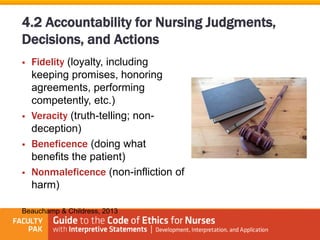
 Fidelity (loyalty, including
keeping promises, honoring
agreements, performing
competently, etc.)
 Veracity (truth-telling; non-
deception)
 Beneficence (doing what
benefits the patient)
 Nonmaleficence (non-infliction of
harm)
Beauchamp & Childress, 2013
4.2 Accountability for Nursing Judgments,
Decisions, and Actions
 Compassion
 Discernment
 Trustworthiness
 Integrity
 Conscientiousness
Ethical Virtues of All Health Professionals
Beauchamp & Childress, 2013
 Wisdom
 Patience
 Compassion
 Honesty
 Altruism
 Courage
Virtues Specific to Nursing
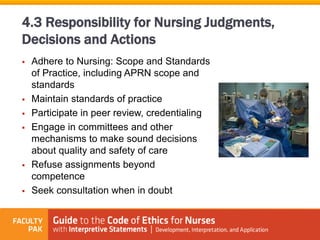
 Adhere to Nursing: Scope and Standards
of Practice, including APRN scope and
standards
 Maintain standards of practice
 Participate in peer review, credentialing
 Engage in committees and other
mechanisms to make sound decisions
about quality and safety of care
 Refuse assignments beyond
competence
 Seek consultation when in doubt
4.3 Responsibility for Nursing Judgments,
Decisions and Actions
 Delegate tasks consistent with your state’s nurse practice
act
 Assess qualifications and competence of those whom
you delegate or assign
 Participate in orientation, skill development, continuing
education, competency verification and staffing policies
to ensure safe care
 Engage in shared responsibility for educating student
nurses
4.4 Assignment Delegation of Nursing
Activities or Tasks
The nurse owes the same duties to self as to others, including
the responsibility to promote health and safety, preserve
wholeness of character and integrity, maintain competence,
and continue personal and professional growth.
Interpretive Statements
5.1 Duties to Self and Others
5.2 Promotion of Personal Health, Safety and Well-Being
5.3 Preservation of Wholeness of Character
5.4 Preservation of Integrity
5.5 Maintenance of Competence and Continuation of
Professional Growth
5.6 Continuation of Personal Growth
Provision 5
Nurses must take care of themselves before taking care of
others.
 Self-regarding duties include health, safety, integrity,
competence and professional growth.
5.1 Duties to Self and Others
Nurses have a duty to model health promotion to patients
and the public.
 Fatigue and compassion fatigue may be occupational
hazards for nurses in intense clinical practice.
 Balance in personal and professional life is essential for
well-being.
 Good diet, exercise, healthy sleep patterns and healthy
relationships are all factors in maintaining this balance.
5.2 Promotion of Personal Health, Safety and
Well-Being
Nurses are moral agents in any setting, as they embrace the
values of the profession and display them in their
communication and actions.
 Nurses should assess risks to integrity ahead of
employment decisions.
 Nurses’ personal values merge with professional values,
creating an identity that is reflected in practice and
permeates private life.
• Thieves, liars and cheats do not make good nurses!
• Felonious record disqualifies a person from becoming a nurse
 Nurses can foster a community of moral discourse where
open dialogue about crucial health issues is facilitated.
5.3 Preservation of Wholeness of Character
Because nurses are respected and have authority, their
influence on patient decision-making may be unduly
influential; nurses should avoid coercion or unintentional
pressure in helping patients articulate their own values and
preferences.
Undue Influence of Patients
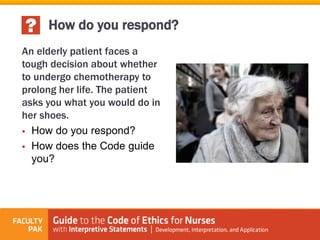
An elderly patient faces a
tough decision about whether
to undergo chemotherapy to
prolong her life. The patient
asks you what you would do in
her shoes.
 How do you respond?
 How does the Code guide
you?
How do you respond?
 When integrity is eroded, nurses may experience moral
distress.
 Threats to integrity may be encountered in practice.
 Nurses may be asked to take action in conflict with personal or
professional values or the Code.
 Nurses have a right and duty to express their opposition and only
compromise if such a decision preserves their moral integrity.
 Integrity-preserving compromise is more likely in a safe
environment of mutual respect where open moral
dialogue is encouraged.

5.4 Preservation of Integrity
Conscientious objection enables an individual to refuse
participation in an activity that violates personal values or
beliefs.
 Select an employer whose values correspond with your
own, whose routine practices do not violate your beliefs.
 Timely appropriate communication to supervisors is
necessary to make alternate arrangements in order to
avoid “neglect of care” or “patient abandonment.”
Conscientious Objection
When is it imperative to refuse to participate
in a practice that conflicts with your values?
Thousand Shades of Grey
“…ethics isn’t about choosing between right and
wrong; it’s about choosing between grey and
grey. It’s about choosing between two equally
desirable, but mutually exclusive courses of
action. Freedom or security? Courage or
comfort? Self-examination or blissful
happiness?”
-Will Ferguson, Happiness
 Moral distress
 Cumulative moral residue
 Crescendo effect
 Burnout/rustout
 Moral courage
Ethical Unloading
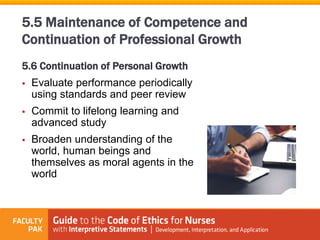
5.6 Continuation of Personal Growth
 Evaluate performance periodically
using standards and peer review
 Commit to lifelong learning and
advanced study
 Broaden understanding of the
world, human beings and
themselves as moral agents in the
world
5.5 Maintenance of Competence and
Continuation of Professional Growth
The nurse, through individual and collective effort,
establishes, maintains, and improves the ethical
environment of the work settings and conditions of
employment that are conducive to safe, quality health care.
Interpretive Statements
6.1 The Environment and Moral Virtue
6.2 The Environment and Ethical Obligation
6.3 Responsibility for the Health care Environment
Provision 6
6.1 The Environment and Moral Virtue
Virtues Expected of All:
 Integrity
 Respect
 Moderation
 Industry
Additional Virtues Expected
of All Nurses:
 Knowledge
 Skill
 Wisdom
 Patience
 Compassion
 Honesty
 Altruism
 Courage
For virtues to flourish, the work climate should foster:
 Respect and trust
 Mutual caring
 Communication
 Generosity
 Kindness
 Equality
 Prudence
 Transparency
Moral Milieu
 Create a culture of excellence
 Formulate clear policies and procedures
 Ensure all nurses have working knowledge of the Code
 Provide functional Ethics Committees
 Treat employees fairly and with dignity
 Facilitate mechanisms for grievances to be aired in a fair
and timely fashion
6.2 The Environment and Ethical Obligation
 Ensure ongoing professional development and evaluation
of all staff
 Participate in interprofessional workplace advocacy to
address unethical practice
 Continue to express concerns over unacceptable ethical
practice, documenting these sequentially
 Resign after repeated unsuccessful attempts to change
unjust or unethical practice in order to preserve integrity,
or risk being complicit in unethical practice
6.3 Responsibility for the Health Care
Environment
Mutual Ethical Integrity
What can we do collaboratively to
shape a future for nursing that fosters ethical
integrity in all dimensions
of practice?
“Ethical living requires coping well with the lives
fate has dealt us. Our lives routinely demand
that we choose well from among myriad options
for shaping our common destinies. We are
enlarged by the magnitude of our
responsibilities for shaping the future. Every
human life takes on a singular majesty when
dedicated to the noble quest for ethical living.”
-Anita Allen, 2004

ANA ETHICS 4 to 6.pptx

  • 1.
    © 2015 AmericanNurses Association
  • 2.
    PROVISIONS 4-6, BOUNDARIES OFDUTY AND LOYALTY © 2015 American Nurses Association Slide Deck 2
  • 3.
    Provisions 4-6, Boundariesof Duty and Loyalty What do we mean by “boundaries of duty and loyalty”? Provisions 4-6 focus on the individual nurse’s responsibility and accountability in nursing practice, as well as the promotion of safe, quality health care.
  • 4.
    The nurse hasauthority, accountability and responsibility for nursing practice; makes decisions; and takes action consistent with the obligation to promote health and to provide optimal care. Interpretive Statements 4.1 Authority, Accountability, and Responsibility 4.2 Accountability for Nursing Judgments, Decisions, and Actions 4.3 Responsibility for Nursing Judgments, Decisions, and Actions 4.4 Assignment and Delegation of Nursing Activities or Tasks Provision 4
  • 5.
    Nurses are alwaysaccountable for their own actions, maintaining their competence to ensure safe practice.  Technological advancements require ongoing learning.  Evidence-informed practice mandates continuous learning.  Shifting patterns of health care delivery demand orientation to changing lines of authority, communication channels and multisystem policies.  APRNs adhere to scope of practice, as state nurse practice acts vary and reform roles periodically. 4.1 Authority, Accountability and Responsibility
  • 6.
     Fidelity (loyalty,including keeping promises, honoring agreements, performing competently, etc.)  Veracity (truth-telling; non- deception)  Beneficence (doing what benefits the patient)  Nonmaleficence (non-infliction of harm) Beauchamp & Childress, 2013 4.2 Accountability for Nursing Judgments, Decisions, and Actions
  • 7.
     Compassion  Discernment Trustworthiness  Integrity  Conscientiousness Ethical Virtues of All Health Professionals Beauchamp & Childress, 2013
  • 8.
     Wisdom  Patience Compassion  Honesty  Altruism  Courage Virtues Specific to Nursing
  • 9.
     Adhere toNursing: Scope and Standards of Practice, including APRN scope and standards  Maintain standards of practice  Participate in peer review, credentialing  Engage in committees and other mechanisms to make sound decisions about quality and safety of care  Refuse assignments beyond competence  Seek consultation when in doubt 4.3 Responsibility for Nursing Judgments, Decisions and Actions
  • 10.
     Delegate tasksconsistent with your state’s nurse practice act  Assess qualifications and competence of those whom you delegate or assign  Participate in orientation, skill development, continuing education, competency verification and staffing policies to ensure safe care  Engage in shared responsibility for educating student nurses 4.4 Assignment Delegation of Nursing Activities or Tasks
  • 11.
    The nurse owesthe same duties to self as to others, including the responsibility to promote health and safety, preserve wholeness of character and integrity, maintain competence, and continue personal and professional growth. Interpretive Statements 5.1 Duties to Self and Others 5.2 Promotion of Personal Health, Safety and Well-Being 5.3 Preservation of Wholeness of Character 5.4 Preservation of Integrity 5.5 Maintenance of Competence and Continuation of Professional Growth 5.6 Continuation of Personal Growth Provision 5
  • 12.
    Nurses must takecare of themselves before taking care of others.  Self-regarding duties include health, safety, integrity, competence and professional growth. 5.1 Duties to Self and Others
  • 13.
    Nurses have aduty to model health promotion to patients and the public.  Fatigue and compassion fatigue may be occupational hazards for nurses in intense clinical practice.  Balance in personal and professional life is essential for well-being.  Good diet, exercise, healthy sleep patterns and healthy relationships are all factors in maintaining this balance. 5.2 Promotion of Personal Health, Safety and Well-Being
  • 14.
    Nurses are moralagents in any setting, as they embrace the values of the profession and display them in their communication and actions.  Nurses should assess risks to integrity ahead of employment decisions.  Nurses’ personal values merge with professional values, creating an identity that is reflected in practice and permeates private life. • Thieves, liars and cheats do not make good nurses! • Felonious record disqualifies a person from becoming a nurse  Nurses can foster a community of moral discourse where open dialogue about crucial health issues is facilitated. 5.3 Preservation of Wholeness of Character
  • 15.
    Because nurses arerespected and have authority, their influence on patient decision-making may be unduly influential; nurses should avoid coercion or unintentional pressure in helping patients articulate their own values and preferences. Undue Influence of Patients
  • 16.
    An elderly patientfaces a tough decision about whether to undergo chemotherapy to prolong her life. The patient asks you what you would do in her shoes.  How do you respond?  How does the Code guide you? How do you respond?
  • 17.
     When integrityis eroded, nurses may experience moral distress.  Threats to integrity may be encountered in practice.  Nurses may be asked to take action in conflict with personal or professional values or the Code.  Nurses have a right and duty to express their opposition and only compromise if such a decision preserves their moral integrity.  Integrity-preserving compromise is more likely in a safe environment of mutual respect where open moral dialogue is encouraged.  5.4 Preservation of Integrity
  • 18.
    Conscientious objection enablesan individual to refuse participation in an activity that violates personal values or beliefs.  Select an employer whose values correspond with your own, whose routine practices do not violate your beliefs.  Timely appropriate communication to supervisors is necessary to make alternate arrangements in order to avoid “neglect of care” or “patient abandonment.” Conscientious Objection
  • 19.
    Conscientious Objection When isit imperative to refuse to participate in a practice that conflicts with your values?
  • 20.
    Thousand Shades ofGrey “…ethics isn’t about choosing between right and wrong; it’s about choosing between grey and grey. It’s about choosing between two equally desirable, but mutually exclusive courses of action. Freedom or security? Courage or comfort? Self-examination or blissful happiness?” -Will Ferguson, Happiness
  • 21.
     Moral distress Cumulative moral residue  Crescendo effect  Burnout/rustout  Moral courage Ethical Unloading
  • 22.
    5.6 Continuation ofPersonal Growth  Evaluate performance periodically using standards and peer review  Commit to lifelong learning and advanced study  Broaden understanding of the world, human beings and themselves as moral agents in the world 5.5 Maintenance of Competence and Continuation of Professional Growth
  • 23.
    The nurse, throughindividual and collective effort, establishes, maintains, and improves the ethical environment of the work settings and conditions of employment that are conducive to safe, quality health care. Interpretive Statements 6.1 The Environment and Moral Virtue 6.2 The Environment and Ethical Obligation 6.3 Responsibility for the Health care Environment Provision 6
  • 24.
    6.1 The Environmentand Moral Virtue Virtues Expected of All:  Integrity  Respect  Moderation  Industry Additional Virtues Expected of All Nurses:  Knowledge  Skill  Wisdom  Patience  Compassion  Honesty  Altruism  Courage
  • 25.
    For virtues toflourish, the work climate should foster:  Respect and trust  Mutual caring  Communication  Generosity  Kindness  Equality  Prudence  Transparency Moral Milieu
  • 26.
     Create aculture of excellence  Formulate clear policies and procedures  Ensure all nurses have working knowledge of the Code  Provide functional Ethics Committees  Treat employees fairly and with dignity  Facilitate mechanisms for grievances to be aired in a fair and timely fashion 6.2 The Environment and Ethical Obligation
  • 27.
     Ensure ongoingprofessional development and evaluation of all staff  Participate in interprofessional workplace advocacy to address unethical practice  Continue to express concerns over unacceptable ethical practice, documenting these sequentially  Resign after repeated unsuccessful attempts to change unjust or unethical practice in order to preserve integrity, or risk being complicit in unethical practice 6.3 Responsibility for the Health Care Environment
  • 28.
    Mutual Ethical Integrity Whatcan we do collaboratively to shape a future for nursing that fosters ethical integrity in all dimensions of practice?
  • 29.
    “Ethical living requirescoping well with the lives fate has dealt us. Our lives routinely demand that we choose well from among myriad options for shaping our common destinies. We are enlarged by the magnitude of our responsibilities for shaping the future. Every human life takes on a singular majesty when dedicated to the noble quest for ethical living.” -Anita Allen, 2004

Editor's Notes

  • #7  Bok, S. (1999). Lying: Moral choice in public and private life. New York: Vintage Books. Ethical principlism is one of several approaches to ethical decision-making. Beauchamp and Childress’s form of principlism is the dominant approach used in bioethics, especially among physicians and on IECs/IRBs. Ethical principlism, like the ANA’s Code of Ethics for Nurses with Interpretive Statements, functions at the level of a mid-range theory. Beauchamp and Childress assert that one can use the principles independent of (and without contradicting) a wide variety of ethical theories including virtue theory, an ethic of care, rule utilitarianism, and so forth. Those who advocate for virtue ethics and an ethic of care, especially, may disagree with Beauchamp and Childress’s assertion. Fidelity means “loyalty” and is a “compound duty” that includes a number of related duties, including keeping promises and honoring agreements. Veracity includes telling the truth without deception. For example, failure to disclose, or withholding selected elements of the truth, involves the intent to deceive and manipulate, but may not be lying directly.
  • #8 Riggio, R.E., Zhu, W., Reina, C., & Maroosis, J.A. (2010). Virtue-based measurement of ethical leadership: The leadership virtues questionnaire. Consulting Psychology Journal: Practice and Research, 62(4), 235–250.
  • #15 Class Discussion Point: It makes sense that a person convicted of a felony for harming another is barred from becoming a nurse or may lose a nursing license. However, some anti-protest laws make participation in social protest a felony. Should a nurse lose her or his license to practice nursing for participating in an anti-racism protest? An anti-nuclear power protest? An environmental contamination protest? Are there conflicts between the law and ethics?
  • #18  Davis, S., Schrader, K., & Belcheir, M. (2012). Influences of ethical beliefs and the impact of moral distress and conscientious objection. Nursing Ethics, 19(6), 738–749. Lachman, V. (2010). Strategies necessary for moral courage. OJIN: The Online Journal of Issues in Nursing, 15(3), Manuscript 3.
  • #19 Davis, S., Schrader, K., & Belcheir, M. (2012). Influences of ethical beliefs and the impact of moral distress and conscientious objection. Nursing Ethics, 19(6), 738–749.
  • #21 Ferguson, W. (2003). Happiness. New York: Perennial Press.
  • #22 Lachman, V. (2009). Ethical challenges in healthcare: Developing your moral compass. New York: Springer Publishing Company.
  • #30 Allen, A. (2004). Personal Communication, ANA Ethics Advisory Board Discussion.