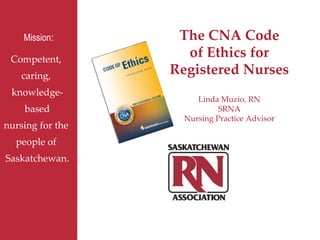
Competent,  caring,  knowledge- based nursing for the  people of  Saskatchewan. Mission : The CNA Code of Ethics for Registered Nurses Linda Muzio, RN SRNA Nursing Practice Advisor
What is the Code of Ethics? 1954 CNA adopted the International Council of Nurses code 1980 CNA developed and adopted its own Code-CNA Code of Ethics: An Ethical Basis for Nursing in Canada Updated every 5-6 years Most recent version launched June 2008 CNA Convention
Nature of Ethics   Ethics is not a black & white subject Ethics is not something you either know or don’t know Ethics involves thinking and feeling, study and practice, knowledge and intuition
Purpose of the Code   Serves as a foundation of ethical practice Sets out expectations for ethical behavior of RNs Provides guidance for decision-making used in conjunction with professional regulations, competencies, standards &  laws Basis from which RNs can advocate Provides a means for self-evaluation and self-reflection Provides a basis for feedback and peer review
Purpose of the Code (cont’d) Delineates what RNs must know about their ethical responsibilities Informs other health care professionals & members of the public about the ethical commitments of RNs Upholds the responsibility of being a self-regulating profession Serves as an ethical basis from which to advocate for quality practice environments
The Code Does  Not… Provide rules of ethical or moral behavior for every circumstance Offer guidance about which values should take priority or how they can be balanced in practice Supersede other and stronger moral or legal obligations (e.g. the law)
Elements of an ethical practice Commitment to do good Sensitivity and receptiveness to ethical matters  Willingness to enter into relationships with clients receiving care
Level of Application Nursing practice involves attention to ethics at various levels: The client (individual, family, groups, populations) Organizational - the health care agency or program The community Society Internationally
Structure of the Code The Code is organized in two parts:  Part 1 – “Nursing Values and Ethical Responsibilities”  Part 2 – “Ethical Endeavours”
Nursing Values Providing safe, compassionate, competent and ethical care Promoting health and well-being Promoting and respecting informed decision-making Preserving dignity Maintaining privacy and confidentiality Promoting justice Being accountable
Further Support Responsibility Statements Each value is followed with a number of responsibility statements Assist in clarifying and elaborating on the application of each value Provide further support in assessing the ethical situation
When Do Values Collide? When one’s personal, professional or institutional values conflict When an individual’s values conflict with the values of another individual
Types of Ethical Situations Ethical Problems Ethical (or Moral) Uncertainty Ethical Dilemmas or Questions Ethical (or Moral) Distress Ethical (or moral) Residue Ethical (or Moral) Disengagement Ethical Violations Ethical (or Moral) Courage
Moral Residue “ Is what nurses experience when they seriously compromise themselves or allow themselves to be compromised. The moral residue that nurses carry forward from these kinds of situations can help them reflect on what they would do differently in similar situations in the future” (CNA, 2008, p. 7).
Ethical Disengagement “ Can occur if nurses begins to see the disregard of their ethical commitments as normal. A nurse may then become apathetic or disengage to the point of being unkind, non-compassionate or even cruel to other health-care workers and persons receiving care” (CNA, 2008, p. 7).
Ethical Courage “ Is exercised when a nurse stands firm on a point of moral principle or a particular decision about something in the face of overwhelming fear or threat to himself or herself” (CNA, 2008, p. 7).
Barriers Barriers to carrying out or completing the action: Fear or circumstances beyond the RNs control Co-worker’s attitudes Institutional obstacles
Sources of Moral Distress Harm to patients (pain, suffering) Health policy constraints Medical prolongation of dying without informed choice Inadequate staffing Effects of cost containment
Signs of ethical & moral distress Anger Frustration Anxiety Feeling ashamed Embarrassed Heartsick Grieving Depression Miserable Physical Pain Sadness Ineffective Fatigue Burnout Cynicism
Symptoms Over Time Crying Loss of sleep Loss of appetite Nightmares Feelings of worthlessness Loss of confidence More intense or prolonged physical symptoms
Strategies to reduce ethical distress Recognition Speak Out Education  Support Consultation Debriefing/case studies Be proactive!
Summary: Ethical Distress Nurse perceives a moral problem Acknowledges moral responsibility Makes a moral judgement about right action Real or perceived constraints block the action Nurse participates in perceived moral wrongdoing - moral distress experienced
Guidance in Making Moral Decisions Recognize the moral dimension Who are the interested parties? What are their relationships? What values are involved? Weigh the benefits and burdens
Guide to Moral Decision-Making Look for similar cases Discuss with relevant others Does this decision accord with legal and organizational rules? Am I comfortable with this decision?
Part 2: Ethical Endeavours RNs should advocate for and work toward eliminating social inequities. Such as: Utilize principles of primary health care Address organizational, social, economic and political factors Advocate for change to unethical policies/laws/regulations
The Code as a Resource While the code cannot enforce responsibilities outside of nursing, it can provide a powerful political instrument for nurses when they are concerned about being able to practice ethically.

Ethics presentation from Saskatchewan RN Association

  • 1.
    Competent, caring, knowledge- based nursing for the people of Saskatchewan. Mission : The CNA Code of Ethics for Registered Nurses Linda Muzio, RN SRNA Nursing Practice Advisor
  • 2.
    What is theCode of Ethics? 1954 CNA adopted the International Council of Nurses code 1980 CNA developed and adopted its own Code-CNA Code of Ethics: An Ethical Basis for Nursing in Canada Updated every 5-6 years Most recent version launched June 2008 CNA Convention
  • 3.
    Nature of Ethics Ethics is not a black & white subject Ethics is not something you either know or don’t know Ethics involves thinking and feeling, study and practice, knowledge and intuition
  • 4.
    Purpose of theCode Serves as a foundation of ethical practice Sets out expectations for ethical behavior of RNs Provides guidance for decision-making used in conjunction with professional regulations, competencies, standards & laws Basis from which RNs can advocate Provides a means for self-evaluation and self-reflection Provides a basis for feedback and peer review
  • 5.
    Purpose of theCode (cont’d) Delineates what RNs must know about their ethical responsibilities Informs other health care professionals & members of the public about the ethical commitments of RNs Upholds the responsibility of being a self-regulating profession Serves as an ethical basis from which to advocate for quality practice environments
  • 6.
    The Code Does Not… Provide rules of ethical or moral behavior for every circumstance Offer guidance about which values should take priority or how they can be balanced in practice Supersede other and stronger moral or legal obligations (e.g. the law)
  • 7.
    Elements of anethical practice Commitment to do good Sensitivity and receptiveness to ethical matters Willingness to enter into relationships with clients receiving care
  • 8.
    Level of ApplicationNursing practice involves attention to ethics at various levels: The client (individual, family, groups, populations) Organizational - the health care agency or program The community Society Internationally
  • 9.
    Structure of theCode The Code is organized in two parts: Part 1 – “Nursing Values and Ethical Responsibilities” Part 2 – “Ethical Endeavours”
  • 10.
    Nursing Values Providingsafe, compassionate, competent and ethical care Promoting health and well-being Promoting and respecting informed decision-making Preserving dignity Maintaining privacy and confidentiality Promoting justice Being accountable
  • 11.
    Further Support ResponsibilityStatements Each value is followed with a number of responsibility statements Assist in clarifying and elaborating on the application of each value Provide further support in assessing the ethical situation
  • 12.
    When Do ValuesCollide? When one’s personal, professional or institutional values conflict When an individual’s values conflict with the values of another individual
  • 13.
    Types of EthicalSituations Ethical Problems Ethical (or Moral) Uncertainty Ethical Dilemmas or Questions Ethical (or Moral) Distress Ethical (or moral) Residue Ethical (or Moral) Disengagement Ethical Violations Ethical (or Moral) Courage
  • 14.
    Moral Residue “Is what nurses experience when they seriously compromise themselves or allow themselves to be compromised. The moral residue that nurses carry forward from these kinds of situations can help them reflect on what they would do differently in similar situations in the future” (CNA, 2008, p. 7).
  • 15.
    Ethical Disengagement “Can occur if nurses begins to see the disregard of their ethical commitments as normal. A nurse may then become apathetic or disengage to the point of being unkind, non-compassionate or even cruel to other health-care workers and persons receiving care” (CNA, 2008, p. 7).
  • 16.
    Ethical Courage “Is exercised when a nurse stands firm on a point of moral principle or a particular decision about something in the face of overwhelming fear or threat to himself or herself” (CNA, 2008, p. 7).
  • 17.
    Barriers Barriers tocarrying out or completing the action: Fear or circumstances beyond the RNs control Co-worker’s attitudes Institutional obstacles
  • 18.
    Sources of MoralDistress Harm to patients (pain, suffering) Health policy constraints Medical prolongation of dying without informed choice Inadequate staffing Effects of cost containment
  • 19.
    Signs of ethical& moral distress Anger Frustration Anxiety Feeling ashamed Embarrassed Heartsick Grieving Depression Miserable Physical Pain Sadness Ineffective Fatigue Burnout Cynicism
  • 20.
    Symptoms Over TimeCrying Loss of sleep Loss of appetite Nightmares Feelings of worthlessness Loss of confidence More intense or prolonged physical symptoms
  • 21.
    Strategies to reduceethical distress Recognition Speak Out Education Support Consultation Debriefing/case studies Be proactive!
  • 22.
    Summary: Ethical DistressNurse perceives a moral problem Acknowledges moral responsibility Makes a moral judgement about right action Real or perceived constraints block the action Nurse participates in perceived moral wrongdoing - moral distress experienced
  • 23.
    Guidance in MakingMoral Decisions Recognize the moral dimension Who are the interested parties? What are their relationships? What values are involved? Weigh the benefits and burdens
  • 24.
    Guide to MoralDecision-Making Look for similar cases Discuss with relevant others Does this decision accord with legal and organizational rules? Am I comfortable with this decision?
  • 25.
    Part 2: EthicalEndeavours RNs should advocate for and work toward eliminating social inequities. Such as: Utilize principles of primary health care Address organizational, social, economic and political factors Advocate for change to unethical policies/laws/regulations
  • 26.
    The Code asa Resource While the code cannot enforce responsibilities outside of nursing, it can provide a powerful political instrument for nurses when they are concerned about being able to practice ethically.