An Introduction to SaaS and Cloud Computing Ross Cooney
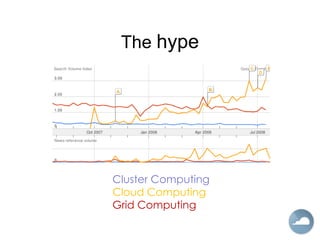
The  hype Cluster Computing Cloud Computing Grid Computing 
What is the cloud ? IT as a service Cloud allows access to services without user technical knowledge or control of supporting infrastructure Best described in terms of what happened to mechanical power over 100 yrs ago Now computers are simple devices connected to the larger cloud Data processing, storage and software applications that used to run locally are now being supplied by big central computing stations. They're becoming, in essence, computing utilities. What is Cloud Computing?
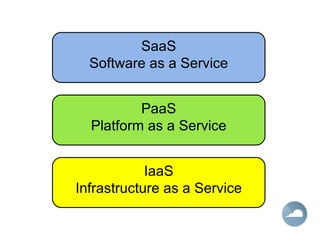
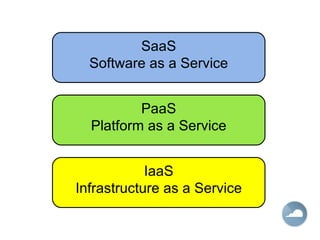
IaaS Infrastructure as a Service PaaS Platform as a Service SaaS Software as a Service
SaaS Software as a Service
Software delivery model Increasingly popular with SMEs No hardware or software to manage Service delivered through a browser SaaS
Advantages Pay per use Instant Scalability Security Reliability APIs SaaS
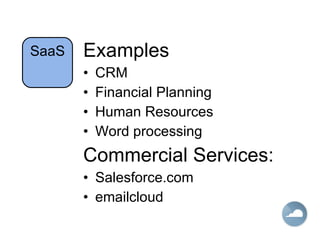
Examples CRM Financial Planning Human Resources Word processing Commercial Services: Salesforce.com emailcloud SaaS
PaaS Platform as a Service
Platform delivery model Platforms are built upon Infrastructure, which is expensive Estimating demand is not a science! Platform management is not fun! PaaS
Popular services Storage Database Scalability PaaS
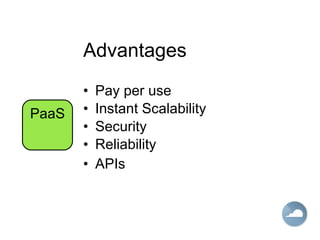
Advantages Pay per use Instant Scalability Security Reliability APIs PaaS
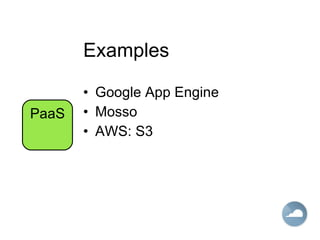
Examples Google App Engine Mosso AWS: S3 PaaS
IaaS Infrastructure as a Service
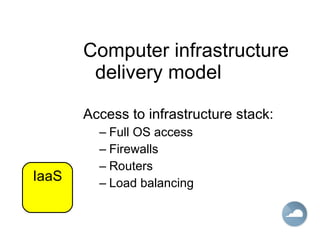
Computer infrastructure delivery model Access to infrastructure stack: Full OS access Firewalls Routers Load balancing IaaS
Advantages Pay per use Instant Scalability Security Reliability APIs IaaS
Examples Flexiscale AWS: EC2 IaaS
IaaS Infrastructure as a Service PaaS Platform as a Service SaaS Software as a Service
Common Factors Pay per use Instant Scalability Security Reliability APIs  IaaS PaaS SaaS
Advantages Lower cost of ownership Reduce infrastructure management responsibility Allow for unexpected resource loads Faster application rollout IaaS PaaS SaaS
Cloud Economics Multi-tenented Virtualisation lowers costs by increasing utilisation Economies of scale afforded by technology Automated update policy IaaS PaaS SaaS
Risks Security Downtime Access Dependency Interoperability IaaS PaaS SaaS

An Introduction to SaaS and Cloud Computing

  • 1.
    An Introduction toSaaS and Cloud Computing Ross Cooney
  • 2.
    The hypeCluster Computing Cloud Computing Grid Computing 
  • 3.
    What is thecloud ? IT as a service Cloud allows access to services without user technical knowledge or control of supporting infrastructure Best described in terms of what happened to mechanical power over 100 yrs ago Now computers are simple devices connected to the larger cloud Data processing, storage and software applications that used to run locally are now being supplied by big central computing stations. They're becoming, in essence, computing utilities. What is Cloud Computing?
  • 4.
    IaaS Infrastructure asa Service PaaS Platform as a Service SaaS Software as a Service
  • 5.
  • 6.
    Software delivery modelIncreasingly popular with SMEs No hardware or software to manage Service delivered through a browser SaaS
  • 7.
    Advantages Pay peruse Instant Scalability Security Reliability APIs SaaS
  • 8.
    Examples CRM FinancialPlanning Human Resources Word processing Commercial Services: Salesforce.com emailcloud SaaS
  • 9.
  • 10.
    Platform delivery modelPlatforms are built upon Infrastructure, which is expensive Estimating demand is not a science! Platform management is not fun! PaaS
  • 11.
    Popular services StorageDatabase Scalability PaaS
  • 12.
    Advantages Pay peruse Instant Scalability Security Reliability APIs PaaS
  • 13.
    Examples Google AppEngine Mosso AWS: S3 PaaS
  • 14.
  • 15.
    Computer infrastructure deliverymodel Access to infrastructure stack: Full OS access Firewalls Routers Load balancing IaaS
  • 16.
    Advantages Pay peruse Instant Scalability Security Reliability APIs IaaS
  • 17.
  • 18.
    IaaS Infrastructure asa Service PaaS Platform as a Service SaaS Software as a Service
  • 19.
    Common Factors Payper use Instant Scalability Security Reliability APIs IaaS PaaS SaaS
  • 20.
    Advantages Lower costof ownership Reduce infrastructure management responsibility Allow for unexpected resource loads Faster application rollout IaaS PaaS SaaS
  • 21.
    Cloud Economics Multi-tenentedVirtualisation lowers costs by increasing utilisation Economies of scale afforded by technology Automated update policy IaaS PaaS SaaS
  • 22.
    Risks Security DowntimeAccess Dependency Interoperability IaaS PaaS SaaS

Editor's Notes

  • #16 Sometimes called Utility computing
  • #17 Sometimes called Utility computing
  • #18 Sometimes called Utility computing