Multivariate Analysis
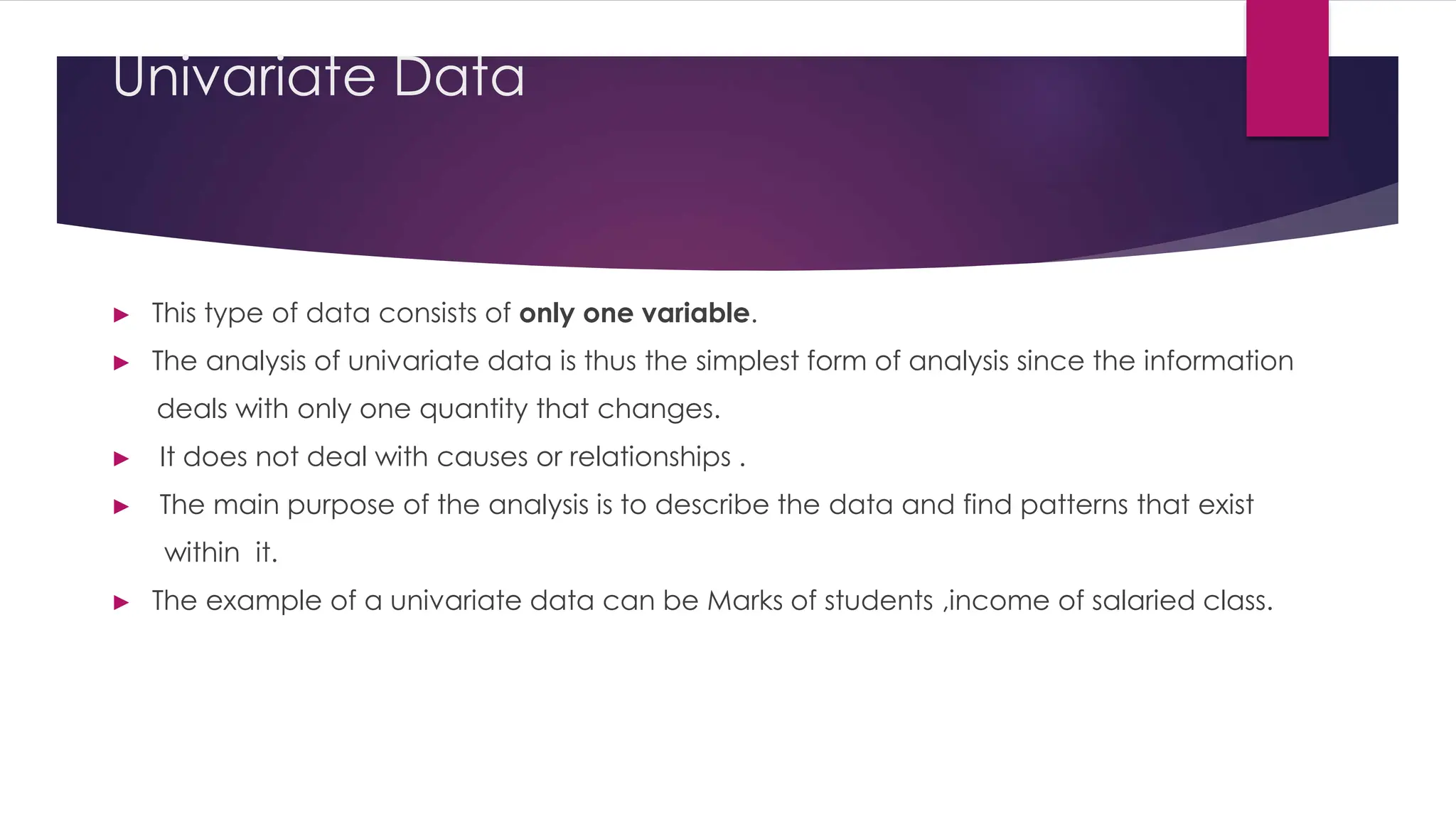
Univariate Data
► This type of data consists of only one variable.
► The analysis of univariate data is thus the simplest form of analysis since the information
deals with only one quantity that changes.
► It does not deal with causes or relationships .
► The main purpose of the analysis is to describe the data and find patterns that exist
within it.
► The example of a univariate data can be Marks of students ,income of salaried class.
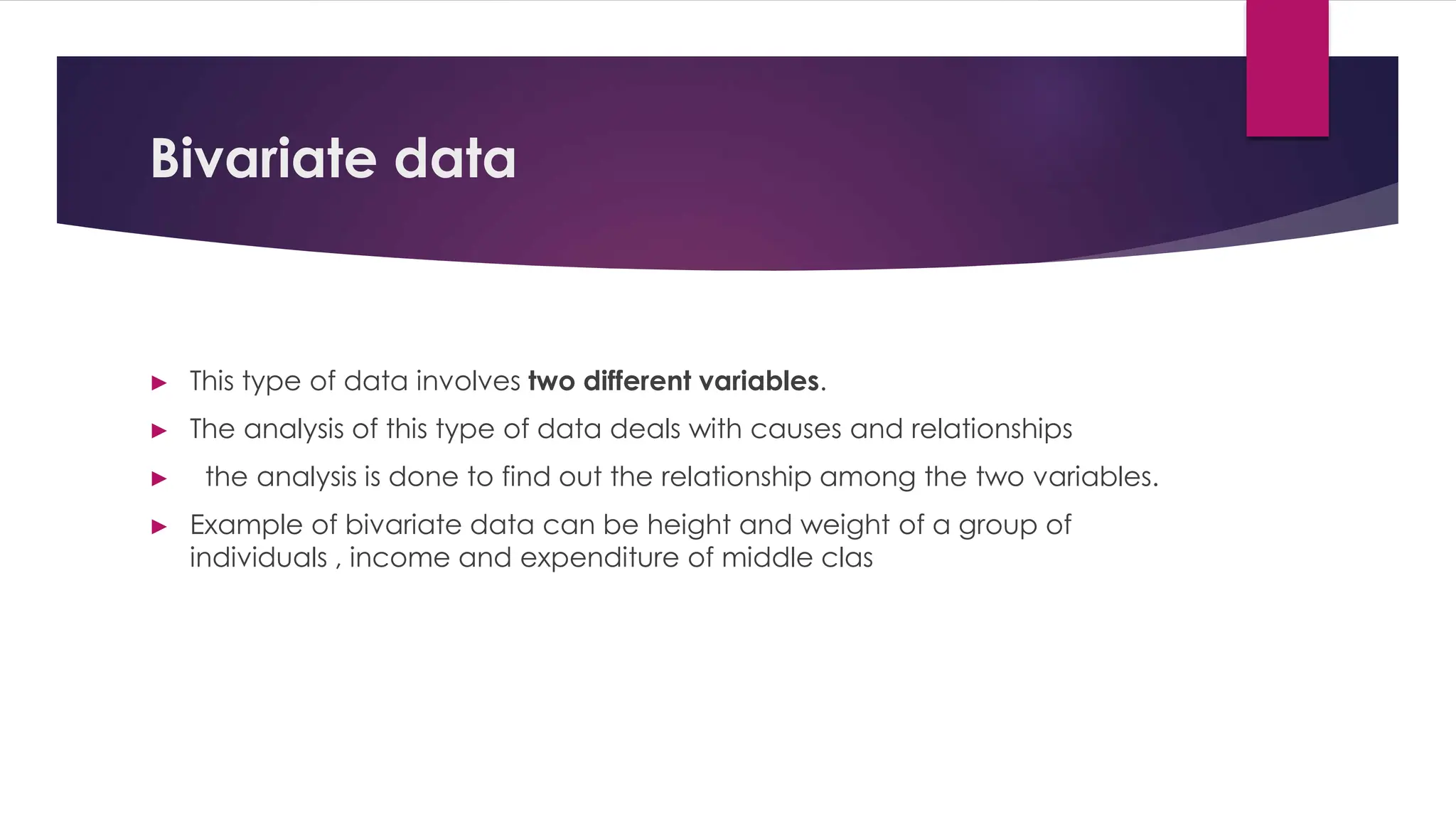
Bivariate data
► This type of data involves two different variables.
► The analysis of this type of data deals with causes and relationships
► the analysis is done to find out the relationship among the two variables.
► Example of bivariate data can be height and weight of a group of
individuals , income and expenditure of middle clas
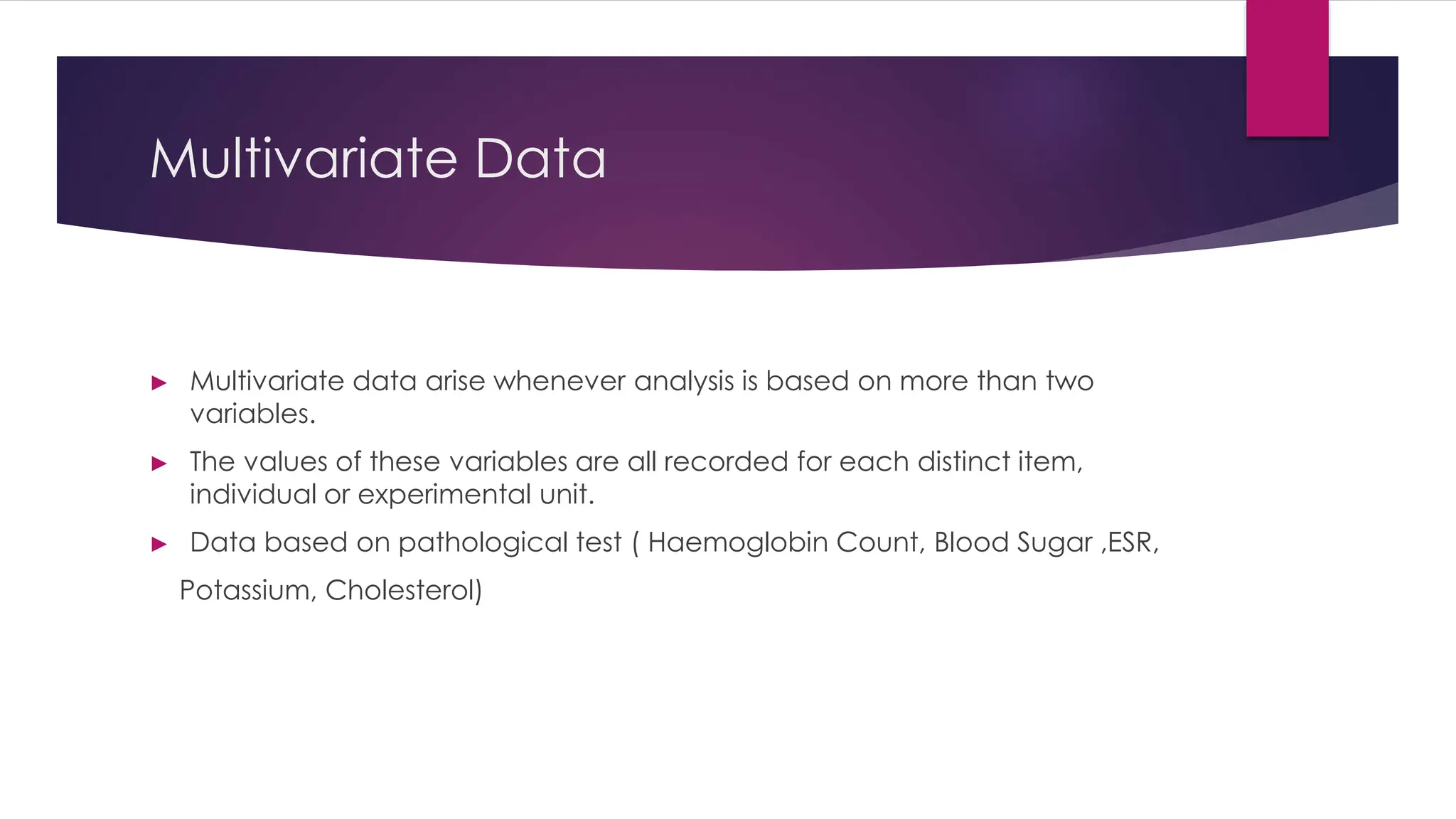
Multivariate Data
► Multivariate data arise whenever analysis is based on more than two
variables.
► The values of these variables are all recorded for each distinct item,
individual or experimental unit.
► Data based on pathological test ( Haemoglobin Count, Blood Sugar ,ESR,
Potassium, Cholesterol)
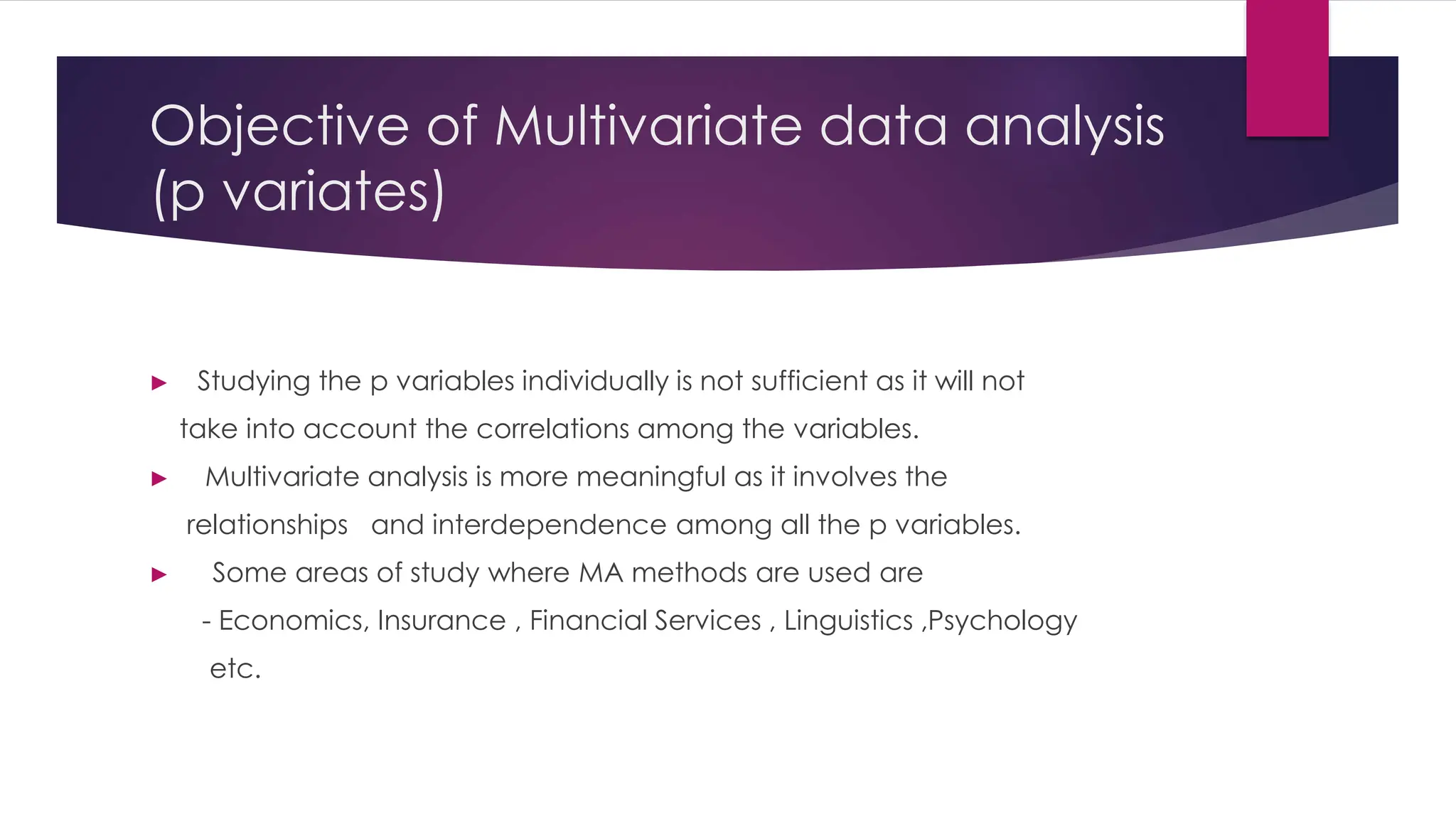
Objective of Multivariate data analysis
(p variates)
► Studying the p variables individually is not sufficient as it will not
take into account the correlations among the variables.
► Multivariate analysis is more meaningful as it involves the
relationships and interdependence among all the p variables.
► Some areas of study where MA methods are used are
- Economics, Insurance , Financial Services , Linguistics ,Psychology
etc.
Some of the Multivariate techniques
► Discriminant Analysis
► Principal Components Analysis (PCA)
► Factor Analysis (FA)
► Canonical analysis
► Cluster Analysis
► Multivariate Analysis of Variance and Covariance
► Multivariate Regression Analysis
Contd.
► In this paper we will be focusing on first three methods.
► We will also be doing Multivariate normal distribution.
► We have already covered Bivariate normal distribution.
► For now a brief introduction of PCA and FA
PCA
► A PCA is concerned with explaining the variance – covariance
structure of a set of variables through a few linear combinations
of these variables.
► Its general objectives are (i) Data Reduction (ii)Interpretation.
► P C’s serve as intermediate steps in much larger investigations eg . Multiple
regression and cluster analysis
Factor Analysis
► F A is a data reduction technique for investigating interdependencies or
correlations or covariances.
► The essential purpose of FA is to describe ,if possible, the covariance
relationships among many variables in terms of a few underlying, but
unobservable variables called factors.
► Details in my next PPT.

an introduction to multivariate analysis.pptx

  • 1.
  • 2.
    Univariate Data ► Thistype of data consists of only one variable. ► The analysis of univariate data is thus the simplest form of analysis since the information deals with only one quantity that changes. ► It does not deal with causes or relationships . ► The main purpose of the analysis is to describe the data and find patterns that exist within it. ► The example of a univariate data can be Marks of students ,income of salaried class.
  • 3.
    Bivariate data ► Thistype of data involves two different variables. ► The analysis of this type of data deals with causes and relationships ► the analysis is done to find out the relationship among the two variables. ► Example of bivariate data can be height and weight of a group of individuals , income and expenditure of middle clas
  • 4.
    Multivariate Data ► Multivariatedata arise whenever analysis is based on more than two variables. ► The values of these variables are all recorded for each distinct item, individual or experimental unit. ► Data based on pathological test ( Haemoglobin Count, Blood Sugar ,ESR, Potassium, Cholesterol)
  • 5.
    Objective of Multivariatedata analysis (p variates) ► Studying the p variables individually is not sufficient as it will not take into account the correlations among the variables. ► Multivariate analysis is more meaningful as it involves the relationships and interdependence among all the p variables. ► Some areas of study where MA methods are used are - Economics, Insurance , Financial Services , Linguistics ,Psychology etc.
  • 6.
    Some of theMultivariate techniques ► Discriminant Analysis ► Principal Components Analysis (PCA) ► Factor Analysis (FA) ► Canonical analysis ► Cluster Analysis ► Multivariate Analysis of Variance and Covariance ► Multivariate Regression Analysis
  • 7.
    Contd. ► In thispaper we will be focusing on first three methods. ► We will also be doing Multivariate normal distribution. ► We have already covered Bivariate normal distribution. ► For now a brief introduction of PCA and FA
  • 8.
    PCA ► A PCAis concerned with explaining the variance – covariance structure of a set of variables through a few linear combinations of these variables. ► Its general objectives are (i) Data Reduction (ii)Interpretation. ► P C’s serve as intermediate steps in much larger investigations eg . Multiple regression and cluster analysis
  • 9.
    Factor Analysis ► FA is a data reduction technique for investigating interdependencies or correlations or covariances. ► The essential purpose of FA is to describe ,if possible, the covariance relationships among many variables in terms of a few underlying, but unobservable variables called factors. ► Details in my next PPT.